# Objective
- Fixes#14974
## Solution
- Replace all* instances of `NonZero*` with `NonZero<*>`
## Testing
- CI passed locally.
---
## Notes
Within the `bevy_reflect` implementations for `std` types,
`impl_reflect_value!()` will continue to use the type aliases instead,
as it inappropriately parses the concrete type parameter as a generic
argument. If the `ZeroablePrimitive` trait was stable, or the macro
could be modified to accept a finite list of types, then we could fully
migrate.
## Introduction
This is the first step in my [Next Generation Scene / UI
Proposal](https://github.com/bevyengine/bevy/discussions/14437).
Fixes https://github.com/bevyengine/bevy/issues/7272#14800.
Bevy's current Bundles as the "unit of construction" hamstring the UI
user experience and have been a pain point in the Bevy ecosystem
generally when composing scenes:
* They are an additional _object defining_ concept, which must be
learned separately from components. Notably, Bundles _are not present at
runtime_, which is confusing and limiting.
* They can completely erase the _defining component_ during Bundle init.
For example, `ButtonBundle { style: Style::default(), ..default() }`
_makes no mention_ of the `Button` component symbol, which is what makes
the Entity a "button"!
* They are not capable of representing "dependency inheritance" without
completely non-viable / ergonomically crushing nested bundles. This
limitation is especially painful in UI scenarios, but it applies to
everything across the board.
* They introduce a bunch of additional nesting when defining scenes,
making them ugly to look at
* They introduce component name "stutter": `SomeBundle { component_name:
ComponentName::new() }`
* They require copious sprinklings of `..default()` when spawning them
in Rust code, due to the additional layer of nesting
**Required Components** solve this by allowing you to define which
components a given component needs, and how to construct those
components when they aren't explicitly provided.
This is what a `ButtonBundle` looks like with Bundles (the current
approach):
```rust
#[derive(Component, Default)]
struct Button;
#[derive(Bundle, Default)]
struct ButtonBundle {
pub button: Button,
pub node: Node,
pub style: Style,
pub interaction: Interaction,
pub focus_policy: FocusPolicy,
pub border_color: BorderColor,
pub border_radius: BorderRadius,
pub image: UiImage,
pub transform: Transform,
pub global_transform: GlobalTransform,
pub visibility: Visibility,
pub inherited_visibility: InheritedVisibility,
pub view_visibility: ViewVisibility,
pub z_index: ZIndex,
}
commands.spawn(ButtonBundle {
style: Style {
width: Val::Px(100.0),
height: Val::Px(50.0),
..default()
},
focus_policy: FocusPolicy::Block,
..default()
})
```
And this is what it looks like with Required Components:
```rust
#[derive(Component)]
#[require(Node, UiImage)]
struct Button;
commands.spawn((
Button,
Style {
width: Val::Px(100.0),
height: Val::Px(50.0),
..default()
},
FocusPolicy::Block,
));
```
With Required Components, we mention only the most relevant components.
Every component required by `Node` (ex: `Style`, `FocusPolicy`, etc) is
automatically brought in!
### Efficiency
1. At insertion/spawn time, Required Components (including recursive
required components) are initialized and inserted _as if they were
manually inserted alongside the given components_. This means that this
is maximally efficient: there are no archetype or table moves.
2. Required components are only initialized and inserted if they were
not manually provided by the developer. For the code example in the
previous section, because `Style` and `FocusPolicy` are inserted
manually, they _will not_ be initialized and inserted as part of the
required components system. Efficient!
3. The "missing required components _and_ constructors needed for an
insertion" are cached in the "archetype graph edge", meaning they aren't
computed per-insertion. When a component is inserted, the "missing
required components" list is iterated (and that graph edge (AddBundle)
is actually already looked up for us during insertion, because we need
that for "normal" insert logic too).
### IDE Integration
The `#[require(SomeComponent)]` macro has been written in such a way
that Rust Analyzer can provide type-inspection-on-hover and `F12` /
go-to-definition for required components.
### Custom Constructors
The `require` syntax expects a `Default` constructor by default, but it
can be overridden with a custom constructor:
```rust
#[derive(Component)]
#[require(
Node,
Style(button_style),
UiImage
)]
struct Button;
fn button_style() -> Style {
Style {
width: Val::Px(100.0),
..default()
}
}
```
### Multiple Inheritance
You may have noticed by now that this behaves a bit like "multiple
inheritance". One of the problems that this presents is that it is
possible to have duplicate requires for a given type at different levels
of the inheritance tree:
```rust
#[derive(Component)
struct X(usize);
#[derive(Component)]
#[require(X(x1))
struct Y;
fn x1() -> X {
X(1)
}
#[derive(Component)]
#[require(
Y,
X(x2),
)]
struct Z;
fn x2() -> X {
X(2)
}
// What version of X is inserted for Z?
commands.spawn(Z);
```
This is allowed (and encouraged), although this doesn't appear to occur
much in practice. First: only one version of `X` is initialized and
inserted for `Z`. In the case above, I think we can all probably agree
that it makes the most sense to use the `x2` constructor for `X`,
because `Y`'s `x1` constructor exists "beneath" `Z` in the inheritance
hierarchy; `Z`'s constructor is "more specific".
The algorithm is simple and predictable:
1. Use all of the constructors (including default constructors) directly
defined in the spawned component's require list
2. In the order the requires are defined in `#[require()]`, recursively
visit the require list of each of the components in the list (this is a
depth Depth First Search). When a constructor is found, it will only be
used if one has not already been found.
From a user perspective, just think about this as the following:
1. Specifying a required component constructor for `Foo` directly on a
spawned component `Bar` will result in that constructor being used (and
overriding existing constructors lower in the inheritance tree). This is
the classic "inheritance override" behavior people expect.
2. For cases where "multiple inheritance" results in constructor
clashes, Components should be listed in "importance order". List a
component earlier in the requirement list to initialize its inheritance
tree earlier.
Required Components _does_ generally result in a model where component
values are decoupled from each other at construction time. Notably, some
existing Bundle patterns use bundle constructors to initialize multiple
components with shared state. I think (in general) moving away from this
is necessary:
1. It allows Required Components (and the Scene system more generally)
to operate according to simple rules
2. The "do arbitrary init value sharing in Bundle constructors" approach
_already_ causes data consistency problems, and those problems would be
exacerbated in the context of a Scene/UI system. For cases where shared
state is truly necessary, I think we are better served by observers /
hooks.
3. If a situation _truly_ needs shared state constructors (which should
be rare / generally discouraged), Bundles are still there if they are
needed.
## Next Steps
* **Require Construct-ed Components**: I have already implemented this
(as defined in the [Next Generation Scene / UI
Proposal](https://github.com/bevyengine/bevy/discussions/14437). However
I've removed `Construct` support from this PR, as that has not landed
yet. Adding this back in requires relatively minimal changes to the
current impl, and can be done as part of a future Construct pr.
* **Port Built-in Bundles to Required Components**: This isn't something
we should do right away. It will require rethinking our public
interfaces, which IMO should be done holistically after the rest of Next
Generation Scene / UI lands. I think we should merge this PR first and
let people experiment _inside their own code with their own Components_
while we wait for the rest of the new scene system to land.
* **_Consider_ Automatic Required Component Removal**: We should
evaluate _if_ automatic Required Component removal should be done. Ex:
if all components that explicitly require a component are removed,
automatically remove that component. This issue has been explicitly
deferred in this PR, as I consider the insertion behavior to be
desirable on its own (and viable on its own). I am also doubtful that we
can find a design that has behavior we actually want. Aka: can we
_really_ distinguish between a component that is "only there because it
was automatically inserted" and "a component that was necessary / should
be kept". See my [discussion response
here](https://github.com/bevyengine/bevy/discussions/14437#discussioncomment-10268668)
for more details.
---------
Co-authored-by: Alice Cecile <alice.i.cecile@gmail.com>
Co-authored-by: BD103 <59022059+BD103@users.noreply.github.com>
Co-authored-by: Pascal Hertleif <killercup@gmail.com>
# Objective
Fixes#14782
## Solution
Enable the lint and fix all upcoming hints (`--fix`). Also tried to
figure out the false-positive (see review comment). Maybe split this PR
up into multiple parts where only the last one enables the lint, so some
can already be merged resulting in less many files touched / less
potential for merge conflicts?
Currently, there are some cases where it might be easier to read the
code with the qualifier, so perhaps remove the import of it and adapt
its cases? In the current stage it's just a plain adoption of the
suggestions in order to have a base to discuss.
## Testing
`cargo clippy` and `cargo run -p ci` are happy.
# Objective
Fixes#12139
## Solution
See this comment on original issue for my proposal:
https://github.com/bevyengine/bevy/issues/12139#issuecomment-2241915791
This PR is an implementation of this proposal.
I modified the implementation of `fmt::Debug` to instead display
`0v0#12345` to ensure entity index, generation, and raw bits are all
present in the output for debug purposes while still keeping log message
concise.
`fmt::Display` remains as is (`0v0`) to offer an even shorter output.
To me, this is the most non-intrusive fix for this issue.
## Testing
Add `fn entity_debug` test
---------
Co-authored-by: Alice Cecile <alice.i.cecile@gmail.com>
Co-authored-by: Gino Valente <49806985+MrGVSV@users.noreply.github.com>
# Objective
#12469 changed the `Debug` impl for `Entity`, making sure it's actually
accurate for debugging. To ensure that its can still be readily logged
in error messages and inspectors, this PR added a more concise and
human-friendly `Display` impl.
However, users found this form too verbose: the `to_bits` information
was unhelpful and too long. Fixes#13980.
## Solution
- Don't include `Entity::to_bits` in the `Display` implementation for
`Entity`. This information can readily be accessed and logged for users
who need it.
- Also clean up the implementation of `Display` for `DebugName`,
introduced in https://github.com/bevyengine/bevy/pull/13760, to simply
use the new `Display` impl (since this was the desired format there).
## Testing
I've updated an existing test to verify the output of `Entity::display`.
---------
Co-authored-by: Kristoffer Søholm <k.soeholm@gmail.com>
# Objective

There were some issues with the `serialize` feature:
- `bevy_app` had a `serialize` feature and a dependency on `serde` even
there is no usage of serde at all inside `bevy_app`
- the `bevy_app/serialize` feature enabled `bevy_ecs/serde`, which is
strange
- `bevy_internal/serialize` did not enable `bevy_app/serialize` so there
was no way of serializing an Entity in bevy 0.14

## Solution

- Remove `serde` and `bevy_app/serialize`
- Add a `serialize` flag on `bevy_ecs` that enables `serde`
- ` bevy_internal/serialize` now enables `bevy_ecs/serialize`
# Objective
- Fixes#12976
## Solution
This one is a doozy.
- Run `cargo +beta clippy --workspace --all-targets --all-features` and
fix all issues
- This includes:
- Moving inner attributes to be outer attributes, when the item in
question has both inner and outer attributes
- Use `ptr::from_ref` in more scenarios
- Extend the valid idents list used by `clippy:doc_markdown` with more
names
- Use `Clone::clone_from` when possible
- Remove redundant `ron` import
- Add backticks to **so many** identifiers and items
- I'm sorry whoever has to review this
---
## Changelog
- Added links to more identifiers in documentation.
# Objective
Minimize the number of dependencies low in the tree.

## Solution

* Remove the dependency on rustc-hash in bevy_ecs (not used) and
bevy_macro_utils (only used in one spot).
* Deduplicate the dependency on `sha1_smol` with the existing blake3
dependency already being used for bevy_asset.
 * Remove the unused `ron` dependency on `bevy_app`
* Make the `serde` dependency for `bevy_ecs` optional. It's only used
for serializing Entity.
* Change the `wgpu` dependency to `wgpu-types`, and make it optional for
`bevy_color`.
 * Remove the unused `thread-local` dependency on `bevy_render`.
* Make multiple dependencies for `bevy_tasks` optional and enabled only
when running with the `multi-threaded` feature. Preferably they'd be
disabled all the time on wasm, but I couldn't find a clean way to do
this.

---

## Changelog
TODO

## Migration Guide
TODO
# Objective
Fixes#12139
## Solution
- Derive `Debug` impl for `Entity`
- Add impl `Display` for `Entity`
- Add `entity_display` test to check the output contains all required
info
I decided to go with `0v0|1234` format as opposed to the `0v0[1234]`
which was initially discussed in the issue.
My rationale for this is that `[1234]` may be confused for index values,
which may be common in logs, and so searching for entities by text would
become harder. I figured `|1234` would help the entity IDs stand out
more.
Additionally, I'm a little concerned that this change is gonna break
existing logging for projects because `Debug` is now going to be a
multi-line output. But maybe this is ok.
We could implement `Debug` to be a single-line output, but then I don't
see why it would be different from `Display` at all.
@alice-i-cecile Let me know if we'd like to make any changes based on
these points.
# Objective
bevy_ecs has been developed with a de facto assumption that `Entity` is
to be treated as an opaque identifier by external users, and that its
internal representation is readable but in no way guaranteed to be
stable between versions of bevy_ecs.

This hasn't been clear to users, and the functions on the type that
expose its guts speak a different story.

## Solution
Explicitly document the lack of stability here and define internal
representation changes as a non-breaking change under SemVer. Give it
the same treatment that the standard lib gives `TypeId`.
# Objective
- Add the new `-Zcheck-cfg` checks to catch more warnings
- Fixes#12091
## Solution
- Create a new `cfg-check` to the CI that runs `cargo check -Zcheck-cfg
--workspace` using cargo nightly (and fails if there are warnings)
- Fix all warnings generated by the new check
---
## Changelog
- Remove all redundant imports
- Fix cfg wasm32 targets
- Add 3 dead code exceptions (should StandardColor be unused?)
- Convert ios_simulator to a feature (I'm not sure if this is the right
way to do it, but the check complained before)
## Migration Guide
No breaking changes
---------
Co-authored-by: Alice Cecile <alice.i.cecile@gmail.com>
# Objective

- Part of #11590
- Fix `unsafe_op_in_unsafe_fn` for trivial cases in bevy_ecs

## Solution

Fix `unsafe_op_in_unsafe_fn` in bevy_ecs for trivial cases, i.e., add an
`unsafe` block when the safety comment already exists or add a comment
like "The invariants are uphold by the caller".

---------

Co-authored-by: James Liu <contact@jamessliu.com>
# Objective

Reduce the size of `bevy_utils`
(https://github.com/bevyengine/bevy/issues/11478)

## Solution

Move `EntityHash` related types into `bevy_ecs`. This also allows us
access to `Entity`, which means we no longer need `EntityHashMap`'s
first generic argument.

---

## Changelog

- Moved `bevy::utils::{EntityHash, EntityHasher, EntityHashMap,
EntityHashSet}` into `bevy::ecs::entity::hash` .
- Removed `EntityHashMap`'s first generic argument. It is now hardcoded
to always be `Entity`.

## Migration Guide

- Uses of `bevy::utils::{EntityHash, EntityHasher, EntityHashMap,
EntityHashSet}` now have to be imported from `bevy::ecs::entity::hash`.
- Uses of `EntityHashMap` no longer have to specify the first generic
parameter. It is now hardcoded to always be `Entity`.
# Objective

The purpose of this PR is to begin putting together a unified identifier
structure that can be used by entities and later components (as
entities) as well as relationship pairs for relations, to enable all of
these to be able to use the same storages. For the moment, to keep
things small and focused, only `Entity` is being changed to make use of
the new `Identifier` type, keeping `Entity`'s API and
serialization/deserialization the same. Further changes are for
follow-up PRs.

## Solution

`Identifier` is a wrapper around `u64` split into two `u32` segments
with the idea of being generalised to not impose restrictions on
variants. That is for `Entity` to do. Instead, it is a general API for
taking bits to then merge and map into a `u64` integer. It exposes
low/high methods to return the two value portions as `u32` integers,
with then the MSB masked for usage as a type flag, enabling entity kind
discrimination and future activation/deactivation semantics.

The layout in this PR for `Identifier` is described as below, going from
MSB -> LSB.

```
|F| High value                    | Low value                      |
|_|_______________________________|________________________________|
|1| 31                            | 32                             |

F = Bit Flags
```

The high component in this implementation has only 31 bits, but that
still leaves 2^31 or 2,147,483,648 values that can be stored still, more
than enough for any generation/relation kinds/etc usage. The low part is
a full 32-bit index. The flags allow for 1 bit to be used for
entity/pair discrimination, as these have different usages for the
low/high portions of the `Identifier`. More bits can be reserved for
more variants or activation/deactivation purposes, but this currently
has no use in bevy.

More bits could be reserved for future features at the cost of bits for
the high component, so how much to reserve is up for discussion. Also,
naming of the struct and methods are also subject to further
bikeshedding and feedback.

Also, because IDs can have different variants, I wonder if
`Entity::from_bits` needs to return a `Result` instead of potentially
panicking on receiving an invalid ID.

PR is provided as an early WIP to obtain feedback and notes on whether
this approach is viable.

---

## Changelog

### Added

New `Identifier` struct for unifying IDs.

### Changed

`Entity` changed to use new `Identifier`/`IdentifierMask` as the
underlying ID logic.

---------

Co-authored-by: Alice Cecile <alice.i.cecile@gmail.com>
Co-authored-by: vero <email@atlasdostal.com>
# Objective

- Implements change described in
https://github.com/bevyengine/bevy/issues/3022
- Goal is to allow Entity to benefit from niche optimization, especially
in the case of Option<Entity> to reduce memory overhead with structures
with empty slots

## Discussion
- First PR attempt: https://github.com/bevyengine/bevy/pull/3029
- Discord:
https://discord.com/channels/691052431525675048/1154573759752183808/1154573764240093224

## Solution

- Change `Entity::generation` from u32 to NonZeroU32 to allow for niche
optimization.
- The reason for changing generation rather than index is so that the
costs are only encountered on Entity free, instead of on Entity alloc
- There was some concern with generations being used, due to there being
some desire to introduce flags. This was more to do with the original
retirement approach, however, in reality even if generations were
reduced to 24-bits, we would still have 16 million generations available
before wrapping and current ideas indicate that we would be using closer
to 4-bits for flags.
- Additionally, another concern was the representation of relationships
where NonZeroU32 prevents us using the full address space, talking with
Joy it seems unlikely to be an issue. The majority of the time these
entity references will be low-index entries (ie. `ChildOf`, `Owes`),
these will be able to be fast lookups, and the remainder of the range
can use slower lookups to map to the address space.
- It has the additional benefit of being less visible to most users,
since generation is only ever really set through `from_bits` type
methods.
- `EntityMeta` was changed to match
- On free, generation now explicitly wraps:
- Originally, generation would panic in debug mode and wrap in release
mode due to using regular ops.
- The first attempt at this PR changed the behavior to "retire" slots
and remove them from use when generations overflowed. This change was
controversial, and likely needs a proper RFC/discussion.
- Wrapping matches current release behaviour, and should therefore be
less controversial.
- Wrapping also more easily migrates to the retirement approach, as
users likely to exhaust the exorbitant supply of generations will code
defensively against aliasing and that defensive code is less likely to
break than code assuming that generations don't wrap.
- We use some unsafe code here when wrapping generations, to avoid
branch on NonZeroU32 construction. It's guaranteed safe due to how we
perform wrapping and it results in significantly smaller ASM code.
    - https://godbolt.org/z/6b6hj8PrM

## Migration

- Previous `bevy_scene` serializations have a high likelihood of being
broken, as they contain 0th generation entities.

## Current Issues

- `Entities::reserve_generations` and `EntityMapper` wrap now, even in
debug - although they technically did in release mode already so this
probably isn't a huge issue. It just depends if we need to change
anything here?

---------

Co-authored-by: Natalie Baker <natalie.baker@advancednavigation.com>
# Objective

Fix ci hang, so we can merge pr's again.

## Solution

- switch ppa action to use mesa stable versions
https://launchpad.net/~kisak/+archive/ubuntu/turtle
- use commit from #11123

---------

Co-authored-by: Stepan Koltsov <stepan.koltsov@gmail.com>
# Objective

- Shorten paths by removing unnecessary prefixes

## Solution

- Remove the prefixes from many paths which do not need them. Finding
the paths was done automatically using built-in refactoring tools in
Jetbrains RustRover.
# Objective
Keep essentially the same structure of `EntityHasher` from #9903, but
rephrase the multiplication slightly to save an instruction.
cc @superdump
Discord thread:
https://discord.com/channels/691052431525675048/1172033156845674507/1174969772522356756
## Solution
Today, the hash is
```rust
self.hash = i | (i.wrapping_mul(FRAC_U64MAX_PI) << 32);
```
with `i` being `(generation << 32) | index`.
Expanding things out, we get
```rust
i | ( (i * CONST) << 32 )
= (generation << 32) | index | ((((generation << 32) | index) * CONST) << 32)
= (generation << 32) | index | ((index * CONST) << 32) // because the generation overflowed
= (index * CONST | generation) << 32 | index
```
What if we do the same thing, but with `+` instead of `|`? That's almost
the same thing, except that it has carries, which are actually often
better in a hash function anyway, since it doesn't saturate. (`|` can be
dangerous, since once something becomes `-1` it'll stay that, and
there's no mixing available.)
```rust
(index * CONST + generation) << 32 + index
= (CONST << 32 + 1) * index + generation << 32
= (CONST << 32 + 1) * index + (WHATEVER << 32 + generation) << 32 // because the extra overflows and thus can be anything
= (CONST << 32 + 1) * index + ((CONST * generation) << 32 + generation) << 32 // pick "whatever" to be something convenient
= (CONST << 32 + 1) * index + ((CONST << 32 + 1) * generation) << 32
= (CONST << 32 + 1) * index +((CONST << 32 + 1) * (generation << 32)
= (CONST << 32 + 1) * (index + generation << 32)
= (CONST << 32 + 1) * (generation << 32 | index)
= (CONST << 32 + 1) * i
```
So we can do essentially the same thing using a single multiplication
instead of doing multiply-shift-or.
LLVM was already smart enough to merge the shifting into a
multiplication, but this saves the extra `or`:

<https://rust.godbolt.org/z/MEvbz4eo4>
It's a very small change, and often will disappear in load latency
anyway, but it's a couple percent faster in lookups:

(There was more of an improvement here before #10558, but with `to_bits`
being a single `qword` load now, keeping things mostly as it is turned
out to be better than the bigger changes I'd tried in #10605.)
---
## Changelog
(Probably skip it)
## Migration Guide
(none needed)
# Objective
- Follow up on https://github.com/bevyengine/bevy/pull/10519, diving
deeper into optimising `Entity` due to the `derive`d `PartialOrd`
`partial_cmp` not being optimal with codegen:
https://github.com/rust-lang/rust/issues/106107
- Fixes#2346.
## Solution
Given the previous PR's solution and the other existing LLVM codegen
bug, there seemed to be a potential further optimisation possible with
`Entity`. In exploring providing manual `PartialOrd` impl, it turned out
initially that the resulting codegen was not immediately better than the
derived version. However, once `Entity` was given `#[repr(align(8)]`,
the codegen improved remarkably, even more once the fields in `Entity`
were rearranged to correspond to a `u64` layout (Rust doesn't
automatically reorder fields correctly it seems). The field order and
`align(8)` additions also improved `to_bits` codegen to be a single
`mov` op. In turn, this led me to replace the previous
"non-shortcircuiting" impl of `PartialEq::eq` to use direct `to_bits`
comparison.
The result was remarkably better codegen across the board, even for
hastable lookups.
The current baseline codegen is as follows:
https://godbolt.org/z/zTW1h8PnY
Assuming the following example struct that mirrors with the existing
`Entity` definition:
```rust
#[derive(Clone, Copy, Eq, PartialEq, PartialOrd, Ord)]
pub struct FakeU64 {
high: u32,
low: u32,
}
```
the output for `to_bits` is as follows:
```
example::FakeU64::to_bits:
shl rdi, 32
mov eax, esi
or rax, rdi
ret
```
Changing the struct to:
```rust
#[derive(Clone, Copy, Eq)]
#[repr(align(8))]
pub struct FakeU64 {
low: u32,
high: u32,
}
```
and providing manual implementations for `PartialEq`/`PartialOrd`/`Ord`,
`to_bits` now optimises to:
```
example::FakeU64::to_bits:
mov rax, rdi
ret
```
The full codegen example for this PR is here for reference:
https://godbolt.org/z/n4Mjx165a
To highlight, `gt` comparison goes from
```
example::greater_than:
cmp edi, edx
jae .LBB3_2
xor eax, eax
ret
.LBB3_2:
setne dl
cmp esi, ecx
seta al
or al, dl
ret
```
to
```
example::greater_than:
cmp rdi, rsi
seta al
ret
```
As explained on Discord by @scottmcm :
>The root issue here, as far as I understand it, is that LLVM's
middle-end is inexplicably unwilling to merge loads if that would make
them under-aligned. It leaves that entirely up to its target-specific
back-end, and thus a bunch of the things that you'd expect it to do that
would fix this just don't happen.
## Benchmarks
Before discussing benchmarks, everything was tested on the following
specs:
AMD Ryzen 7950X 16C/32T CPU
64GB 5200 RAM
AMD RX7900XT 20GB Gfx card
Manjaro KDE on Wayland
I made use of the new entity hashing benchmarks to see how this PR would
improve things there. With the changes in place, I first did an
implementation keeping the existing "non shortcircuit" `PartialEq`
implementation in place, but with the alignment and field ordering
changes, which in the benchmark is the `ord_shortcircuit` column. The
`to_bits` `PartialEq` implementation is the `ord_to_bits` column. The
main_ord column is the current existing baseline from `main` branch.

My machine is not super set-up for benchmarking, so some results are
within noise, but there's not just a clear improvement between the
non-shortcircuiting implementation, but even further optimisation taking
place with the `to_bits` implementation.
On my machine, a fair number of the stress tests were not showing any
difference (indicating other bottlenecks), but I was able to get a clear
difference with `many_foxes` with a fox count of 10,000:
Test with `cargo run --example many_foxes --features
bevy/trace_tracy,wayland --release -- --count 10000`:

On avg, a framerate of about 28-29FPS was improved to 30-32FPS. "This
trace" represents the current PR's perf, while "External trace"
represents the `main` branch baseline.
## Changelog
Changed: micro-optimized Entity align and field ordering as well as
providing manual `PartialOrd`/`Ord` impls to help LLVM optimise further.
## Migration Guide
Any `unsafe` code relying on field ordering of `Entity` or sufficiently
cursed shenanigans should change to reflect the different internal
representation and alignment requirements of `Entity`.
Co-authored-by: james7132 <contact@jamessliu.com>
Co-authored-by: NathanW <nathansward@comcast.net>
(This is my first PR here, so I've probably missed some things. Please
let me know what else I should do to help you as a reviewer!)
# Objective
Due to https://github.com/rust-lang/rust/issues/117800, the `derive`'d
`PartialEq::eq` on `Entity` isn't as good as it could be. Since that's
used in hashtable lookup, let's improve it.
## Solution
The derived `PartialEq::eq` short-circuits if the generation doesn't
match. However, having a branch there is sub-optimal, especially on
64-bit systems like x64 that could just load the whole `Entity` in one
load anyway.
Due to complications around `poison` in LLVM and the exact details of
what unsafe code is allowed to do with reference in Rust
(https://github.com/rust-lang/unsafe-code-guidelines/issues/346), LLVM
isn't allowed to completely remove the short-circuiting. `&Entity` is
marked `dereferencable(8)` so LLVM knows it's allowed to *load* all 8
bytes -- and does so -- but it has to assume that the `index` might be
undef/poison if the `generation` doesn't match, and thus while it finds
a way to do it without needing a branch, it has to do something slightly
more complicated than optimal to combine the results. (LLVM is allowed
to change non-short-circuiting code to use branches, but not the other
way around.)
Here's a link showing the codegen today:
<https://rust.godbolt.org/z/9WzjxrY7c>
```rust
#[no_mangle]
pub fn demo_eq_ref(a: &Entity, b: &Entity) -> bool {
a == b
}
```
ends up generating the following assembly:
```asm
demo_eq_ref:
movq xmm0, qword ptr [rdi]
movq xmm1, qword ptr [rsi]
pcmpeqd xmm1, xmm0
pshufd xmm0, xmm1, 80
movmskpd eax, xmm0
cmp eax, 3
sete al
ret
```
(It's usually not this bad in real uses after inlining and LTO, but it
makes a strong demo.)
This PR manually implements `PartialEq::eq` *without* short-circuiting,
and because that tells LLVM that neither the generations nor the index
can be poison, it doesn't need to be so careful and can generate the
"just compare the two 64-bit values" code you'd have probably already
expected:
```asm
demo_eq_ref:
mov rax, qword ptr [rsi]
cmp qword ptr [rdi], rax
sete al
ret
```
Since this doesn't change the representation of `Entity`, if it's
instead passed by *value*, then each `Entity` is two `u32` registers,
and the old and the new code do exactly the same thing. (Other
approaches, like changing `Entity` to be `[u32; 2]` or `u64`, affect
this case.)
This should hopefully merge easily with changes like
https://github.com/bevyengine/bevy/pull/9907 that also want to change
`Entity`.
## Benchmarks
I'm not super-confident that I got my machine fully consistent for
benchmarking, but whether I run the old or the new one first I get
reasonably consistent results.
Here's a fairly typical example of the benchmarks I added in this PR:

Building the sets seems to be basically the same. It's usually reported
as noise, but sometimes I see a few percent slower or faster.
But lookup hits in particular -- since a hit checks that the key is
equal -- consistently shows around 10% improvement.
`cargo run --example many_cubes --features bevy/trace_tracy --release --
--benchmark` showed as slightly faster with this change, though if I had
to bet I'd probably say it's more noise than meaningful (but at least
it's not worse either):

This is my first PR here -- and my first time running Tracy -- so please
let me know what else I should run, or run things on your own more
reliable machines to double-check.
---
## Changelog
(probably not worth including)
Changed: micro-optimized `Entity::eq` to help LLVM slightly.
## Migration Guide
(I really hope nobody was using this on uninitialized entities where
sufficiently tortured `unsafe` could could technically notice that this
has changed.)
# Objective

- Improve rendering performance, particularly by avoiding the large
system commands costs of using the ECS in the way that the render world
does.

## Solution

- Define `EntityHasher` that calculates a hash from the
`Entity.to_bits()` by `i | (i.wrapping_mul(0x517cc1b727220a95) << 32)`.
`0x517cc1b727220a95` is something like `u64::MAX / N` for N that gives a
value close to π and that works well for hashing. Thanks for @SkiFire13
for the suggestion and to @nicopap for alternative suggestions and
discussion. This approach comes from `rustc-hash` (a.k.a. `FxHasher`)
with some tweaks for the case of hashing an `Entity`. `FxHasher` and
`SeaHasher` were also tested but were significantly slower.
- Define `EntityHashMap` type that uses the `EntityHashser`
- Use `EntityHashMap<Entity, T>` for render world entity storage,
including:
- `RenderMaterialInstances` - contains the `AssetId<M>` of the material
associated with the entity. Also for 2D.
- `RenderMeshInstances` - contains mesh transforms, flags and properties
about mesh entities. Also for 2D.
- `SkinIndices` and `MorphIndices` - contains the skin and morph index
for an entity, respectively
  - `ExtractedSprites`
  - `ExtractedUiNodes`

## Benchmarks

All benchmarks have been conducted on an M1 Max connected to AC power.
The tests are run for 1500 frames. The 1000th frame is captured for
comparison to check for visual regressions. There were none.

### 2D Meshes

`bevymark --benchmark --waves 160 --per-wave 1000 --mode mesh2d`

#### `--ordered-z`

This test spawns the 2D meshes with z incrementing back to front, which
is the ideal arrangement allocation order as it matches the sorted
render order which means lookups have a high cache hit rate.

<img width="1112" alt="Screenshot 2023-09-27 at 07 50 45"
src="https://github.com/bevyengine/bevy/assets/302146/e140bc98-7091-4a3b-8ae1-ab75d16d2ccb">

-39.1% median frame time.

#### Random

This test spawns the 2D meshes with random z. This not only makes the
batching and transparent 2D pass lookups get a lot of cache misses, it
also currently means that the meshes are almost certain to not be
batchable.

<img width="1108" alt="Screenshot 2023-09-27 at 07 51 28"
src="https://github.com/bevyengine/bevy/assets/302146/29c2e813-645a-43ce-982a-55df4bf7d8c4">

-7.2% median frame time.

### 3D Meshes

`many_cubes --benchmark`

<img width="1112" alt="Screenshot 2023-09-27 at 07 51 57"
src="https://github.com/bevyengine/bevy/assets/302146/1a729673-3254-4e2a-9072-55e27c69f0fc">

-7.7% median frame time.

### Sprites

**NOTE: On `main` sprites are using `SparseSet<Entity, T>`!**

`bevymark --benchmark --waves 160 --per-wave 1000 --mode sprite`

#### `--ordered-z`

This test spawns the sprites with z incrementing back to front, which is
the ideal arrangement allocation order as it matches the sorted render
order which means lookups have a high cache hit rate.

<img width="1116" alt="Screenshot 2023-09-27 at 07 52 31"
src="https://github.com/bevyengine/bevy/assets/302146/bc8eab90-e375-4d31-b5cd-f55f6f59ab67">

+13.0% median frame time.

#### Random

This test spawns the sprites with random z. This makes the batching and
transparent 2D pass lookups get a lot of cache misses.

<img width="1109" alt="Screenshot 2023-09-27 at 07 53 01"
src="https://github.com/bevyengine/bevy/assets/302146/22073f5d-99a7-49b0-9584-d3ac3eac3033">

+0.6% median frame time.

### UI

**NOTE: On `main` UI is using `SparseSet<Entity, T>`!**

`many_buttons`

<img width="1111" alt="Screenshot 2023-09-27 at 07 53 26"
src="https://github.com/bevyengine/bevy/assets/302146/66afd56d-cbe4-49e7-8b64-2f28f6043d85">

+15.1% median frame time.

## Alternatives

- Cart originally suggested trying out `SparseSet<Entity, T>` and indeed
that is slightly faster under ideal conditions. However,
`PassHashMap<Entity, T>` has better worst case performance when data is
randomly distributed, rather than in sorted render order, and does not
have the worst case memory usage that `SparseSet`'s dense `Vec<usize>`
that maps from the `Entity` index to sparse index into `Vec<T>`. This
dense `Vec` has to be as large as the largest Entity index used with the
`SparseSet`.
- I also tested `PassHashMap<u32, T>`, intending to use `Entity.index()`
as the key, but this proved to sometimes be slower and mostly no
different.
- The only outstanding approach that has not been implemented and tested
is to _not_ clear the render world of its entities each frame. That has
its own problems, though they could perhaps be solved.
- Performance-wise, if the entities and their component data were not
cleared, then they would incur table moves on spawn, and should not
thereafter, rather just their component data would be overwritten.
Ideally we would have a neat way of either updating data in-place via
`&mut T` queries, or inserting components if not present. This would
likely be quite cumbersome to have to remember to do everywhere, but
perhaps it only needs to be done in the more performance-sensitive
systems.
- The main problem to solve however is that we want to both maintain a
mapping between main world entities and render world entities, be able
to run the render app and world in parallel with the main app and world
for pipelined rendering, and at the same time be able to spawn entities
in the render world in such a way that those Entity ids do not collide
with those spawned in the main world. This is potentially quite
solvable, but could well be a lot of ECS work to do it in a way that
makes sense.

---

## Changelog

- Changed: Component data for entities to be drawn are no longer stored
on entities in the render world. Instead, data is stored in a
`EntityHashMap<Entity, T>` in various resources. This brings significant
performance benefits due to the way the render app clears entities every
frame. Resources of most interest are `RenderMeshInstances` and
`RenderMaterialInstances`, and their 2D counterparts.

## Migration Guide

Previously the render app extracted mesh entities and their component
data from the main world and stored them as entities and components in
the render world. Now they are extracted into essentially
`EntityHashMap<Entity, T>` where `T` are structs containing an
appropriate group of data. This means that while extract set systems
will continue to run extract queries against the main world they will
store their data in hash maps. Also, systems in later sets will either
need to look up entities in the available resources such as
`RenderMeshInstances`, or maintain their own `EntityHashMap<Entity, T>`
for their own data.

Before:
```rust
fn queue_custom(
    material_meshes: Query<(Entity, &MeshTransforms, &Handle<Mesh>), With<InstanceMaterialData>>,
) {
    ...
    for (entity, mesh_transforms, mesh_handle) in &material_meshes {
        ...
    }
}
```

After:
```rust
fn queue_custom(
    render_mesh_instances: Res<RenderMeshInstances>,
    instance_entities: Query<Entity, With<InstanceMaterialData>>,
) {
    ...
    for entity in &instance_entities {
        let Some(mesh_instance) = render_mesh_instances.get(&entity) else { continue; };
        // The mesh handle in `AssetId<Mesh>` form, and the `MeshTransforms` can now
        // be found in `mesh_instance` which is a `RenderMeshInstance`
        ...
    }
}
```

---------

Co-authored-by: robtfm <50659922+robtfm@users.noreply.github.com>
# Objective
Fix#4278Fix#5504Fix#9422
Provide safe ways to borrow an entire entity, while allowing disjoint
mutable access. `EntityRef` and `EntityMut` are not suitable for this,
since they provide access to the entire world -- they are just helper
types for working with `&World`/`&mut World`.
This has potential uses for reflection and serialization
## Solution
Remove `EntityRef::world`, which allows it to soundly be used within
queries.
`EntityMut` no longer supports structural world mutations, which allows
multiple instances of it to exist for different entities at once.
Structural world mutations are performed using the new type
`EntityWorldMut`.
```rust
fn disjoint_system(
q2: Query<&mut A>,
q1: Query<EntityMut, Without<A>>,
) { ... }
let [entity1, entity2] = world.many_entities_mut([id1, id2]);
*entity1.get_mut::<T>().unwrap() = *entity2.get().unwrap();
for entity in world.iter_entities_mut() {
...
}
```
---
## Changelog
- Removed `EntityRef::world`, to fix a soundness issue with queries.
+ Removed the ability to structurally mutate the world using
`EntityMut`, which allows it to be used in queries.
+ Added `EntityWorldMut`, which is used to perform structural mutations
that are no longer allowed using `EntityMut`.
## Migration Guide
**Note for maintainers: ensure that the guide for #9604 is updated
accordingly.**
Removed the method `EntityRef::world`, to fix a soundness issue with
queries. If you need access to `&World` while using an `EntityRef`,
consider passing the world as a separate parameter.
`EntityMut` can no longer perform 'structural' world mutations, such as
adding or removing components, or despawning the entity. Additionally,
`EntityMut::world`, `EntityMut::world_mut` , and
`EntityMut::world_scope` have been removed.
Instead, use the newly-added type `EntityWorldMut`, which is a helper
type for working with `&mut World`.
---------
Co-authored-by: Alice Cecile <alice.i.cecile@gmail.com>
# Objective

Fix typos throughout the project.

## Solution

[`typos`](https://github.com/crate-ci/typos) project was used for
scanning, but no automatic corrections were applied. I checked
everything by hand before fixing.

Most of the changes are documentation/comments corrections. Also, there
are few trivial changes to code (variable name, pub(crate) function name
and a few error/panic messages).

## Unsolved

`bevy_reflect_derive` has
[typo](1b51053f19/crates/bevy_reflect/bevy_reflect_derive/src/type_path.rs (L76))
in enum variant name that I didn't fix. Enum is `pub(crate)`, so there
shouldn't be any trouble if fixed. However, code is tightly coupled with
macro usage, so I decided to leave it for more experienced contributor
just in case.
# Objective

Title.

---------

Co-authored-by: François <mockersf@gmail.com>
Co-authored-by: Alice Cecile <alice.i.cecile@gmail.com>
Co-authored-by: James Liu <contact@jamessliu.com>
# Objective
- Handle dangling entity references inside scenes
- Handle references to entities with generation > 0 inside scenes
- Fix a latent bug in `Parent`'s `MapEntities` implementation, which
would, if the parent was outside the scene, cause the scene to be loaded
into the new world with a parent reference potentially pointing to some
random entity in that new world.
- Fixes#4793 and addresses #7235
## Solution
- DynamicScenes now identify entities with a `Entity` instead of a u32,
therefore including generation
- `World` exposes a new `reserve_generations` function that despawns an
entity and advances its generation by some extra amount.
- `MapEntities` implementations have a new `get_or_reserve` function
available that will always return an `Entity`, establishing a new
mapping to a dead entity when the entity they are called with is not in
the `EntityMap`. Subsequent calls with that same `Entity` will return
the same newly created dead entity reference, preserving equality
semantics.
- As a result, after loading a scene containing references to dead
entities (or entities otherwise outside the scene), those references
will all point to different generations on a single entity id in the new
world.
---
## Changelog
### Changed
- In serialized scenes, entities are now identified by a u64 instead of
a u32.
- In serialized scenes, components with entity references now have those
references serialize as u64s instead of structs.
### Fixed
- Scenes containing components with entity references will now
deserialize and add to a world reliably.
## Migration Guide
- `MapEntities` implementations must change from a `&EntityMap`
parameter to a `&mut EntityMapper` parameter and can no longer return a
`Result`. Finally, they should switch from calling `EntityMap::get` to
calling `EntityMapper::get_or_reserve`.
---------
Co-authored-by: Nicola Papale <nicopap@users.noreply.github.com>
Links in the api docs are nice. I noticed that there were several places
where structs / functions and other things were referenced in the docs,
but weren't linked. I added the links where possible / logical.

---------

Co-authored-by: Alice Cecile <alice.i.cecile@gmail.com>
Co-authored-by: François <mockersf@gmail.com>
# Objective
Upon closer inspection, there are a few functions in the ECS that are
not being inlined, even with the highest optimizations and LTO enabled:

- Almost all
[WorldQuery::init_fetch](9fd5f20e25/results/query_get.s (L57))
calls. Affects `Query::get` calls in hot loops. In particular, the
`WorldQuery` implementation for `()` is used *everywhere* as the default
filter and is effectively a no-op.
-
[Entities::get](9fd5f20e25/results/query_get.s (L39)).
Affects `Query::get`, `World::get`, and any component insertion or
removal.
-
[Entities::set](9fd5f20e25/results/entity_remove.s (L2487)).
Affects any component insertion or removal.
-
[Tick::new](9fd5f20e25/results/entity_insert.s (L1368)).
I've only seen this in component insertion and spawning.
 - ArchetypeRow::new
 - BlobVec::set_len

Almost all of these have trivial or even empty implementations or have
significant opportunity to be optimized into surrounding code when
inlined with LTO enabled.

## Solution
Inline them
# Objective
- We rely on the construction of `EntityRef` to be valid elsewhere in unsafe code. This construction is not checked (for performance reasons), and thus this private method must be unsafe.
- Fixes#7218.
## Solution
- Make the method unsafe.
- Add safety docs.
- Improve safety docs slightly for the sibling `EntityMut::new`.
- Add debug asserts to start to verify these assumptions in debug mode.
## Context for reviewers
I attempted to verify the `EntityLocation` more thoroughly, but this turned out to be more work than expected. I've spun that off into #7221 as a result.
# Objective
`Query::get` and other random access methods require looking up `EntityLocation` for every provided entity, then always looking up the `Archetype` to get the table ID and table row. This requires 4 total random fetches from memory: the `Entities` lookup, the `Archetype` lookup, the table row lookup, and the final fetch from table/sparse sets. If `EntityLocation` contains the table ID and table row, only the `Entities` lookup and the final storage fetch are required.

## Solution
Add `TableId` and table row to `EntityLocation`. Ensure it's updated whenever entities are moved around. To ensure `EntityMeta` does not grow bigger, both `TableId` and `ArchetypeId` have been shrunk to u32, and the archetype index and table row are stored as u32s instead of as usizes. This should shrink `EntityMeta` by 4 bytes, from 24 to 20 bytes, as there is no padding anymore due to the change in alignment.

This idea was partially concocted by @BoxyUwU.

## Performance
This should restore the `Query::get` "gains" lost to #6625 that were introduced in #4800 without being unsound, and also incorporates some of the memory usage reductions seen in #3678.

This also removes the same lookups during add/remove/spawn commands, so there may be a bit of a speedup in commands and `Entity{Ref,Mut}`.

---

## Changelog
Added: `EntityLocation::table_id`
Added: `EntityLocation::table_row`.
Changed: `World`s can now only hold a maximum of 2<sup>32</sup>- 1 archetypes.
Changed: `World`s can now only hold a maximum of 2<sup>32</sup> - 1 tables.

## Migration Guide

A `World` can only hold a maximum of 2<sup>32</sup> - 1 archetypes and tables now. If your use case requires more than this, please file an issue explaining your use case.
# Objective
Prevent future unsoundness that was seen in #6623.

## Solution
Newtype both indexes in `Archetype` and `Table` as `ArchetypeRow` and `TableRow`. This avoids weird numerical manipulation on the indices, and can be stored and treated opaquely. Also enforces the source and destination of where these indices at a type level.

---

## Changelog
Changed: `Archetype` indices and `Table` rows have been newtyped as `ArchetypeRow` and `TableRow`.
# Objective
The soundness of the ECS `World` partially relies on the correctness of the state of `Entities` stored within it. We're currently allowing users to (unsafely) mutate it, as well as readily construct it without using a `World`. While this is not strictly unsound so long as users (including `bevy_render`) safely use the APIs, it's a fairly easy path to unsoundness without much of a guard rail.

Addresses #3362 for `bevy_ecs::entity`. Incorporates the changes from #3985.

## Solution
Remove `Entities`'s  `Default` implementation and force access to the type to only be through a properly constructed `World`.

Additional cleanup for other parts of `bevy_ecs::entity`:

 - `Entity::index` and `Entity::generation` are no longer `pub(crate)`, opting to force the rest of bevy_ecs to use the public interface to access these values.
 - `EntityMeta` is no longer `pub` and also not `pub(crate)` to attempt to cut down on updating `generation` without going through an `Entities` API. It's currently inaccessible except via the `pub(crate)` Vec on `Entities`, there was no way for an outside user to use it.
 - Added `Entities::set`, an unsafe `pub(crate)` API for setting the location of an Entity (parallel to `Entities::get`) that replaces the internal case where we need to set the location of an entity when it's been spawned, moved, or despawned.
 - `Entities::alloc_at_without_replacement` is only used in `World::get_or_spawn` within the first party crates, and I cannot find a public use of this API in any ecosystem crate that I've checked (via GitHub search).
 - Attempted to document the few remaining undocumented public APIs in the module.

---

## Changelog
Removed: `Entities`'s `Default` implementation.
Removed: `EntityMeta`
Removed: `Entities::alloc_at_without_replacement` and `AllocAtWithoutReplacement`.

Co-authored-by: james7132 <contact@jamessliu.com>
Co-authored-by: James Liu <contact@jamessliu.com>
# Objective

- The documentation describing different ways to spawn an Entity is missing reference to "method" for "Spawn an entity with components".

## Solution

- Update the documentation to add the reference to `World::spawn`.
# Objective

One of the use-cases for the function `Entity::from_raw` is creating placeholder entity ids, which are meant to be overwritten later. If we use a constant for this instead of `from_raw`, it is more ergonomic and self-documenting.

## Solution

Add a constant that returns an entity ID with an index of `u32::MAX` and a generation of zero. Users are instructed to overwrite this value before using it.
# Objective
Fix#6548. Most of these methods were already made `const` in #5688. `Entity::to_bits` is the only one that remained.
## Solution
Make it const.
# Objective
Fixes#6059, changing all incorrect occurrences of ``id`` in the ``entity`` module to ``index``:
* struct level documentation,
* ``id`` struct field,
* ``id`` method and its documentation.
## Solution
Renaming and verifying using CI.
Co-authored-by: Edvin Kjell <43633999+Edwox@users.noreply.github.com>
# Objective
Currently for entities we serialize only `id`. But this is not very expected behavior. For example, in networking, when the server sends its state, it contains entities and components. On the client, I create new objects and map them (using `EntityMap`) to those received from the server (to know which one matches which). And if `generation` field is missing, this mapping can be broken. Example:
1. Server sends an entity `Entity{ id: 2, generation: 1}` with components.
2. Client puts the received entity in a map and create a new entity that maps to this received entity. The new entity have different `id` and `generation`. Let's call it `Entity{ id: 12, generation: 4}`.
3. Client sends a command for `Entity{ id: 12, generation: 4}`. To do so, it maps local entity to the one from server. But `generation` field is 0 because it was omitted for serialization on the server. So it maps to `Entity{ id: 2, generation: 0}`.
4. Server receives `Entity{ id: 2, generation: 0}` which is invalid.
In my game I worked around it by [writing custom serialization](https://github.com/dollisgame/dollis/blob/master/src/core/network/entity_serde.rs) and using `serde(with = "...")`. But it feels like a bad default to me.
Using `Entity` over a custom `NetworkId` also have the following advantages:
1. Re-use `MapEntities` trait to map `Entity`s in replicated components.
2. Instead of server `Entity <-> NetworkId ` and `Entity <-> NetworkId`, we map entities only on client.
3. No need to handling uniqueness. It's a rare case, but makes things simpler. For example, I don't need to query for a resource to create an unique ID.
Closes#6143.
## Solution
Use default serde impls. If anyone want to avoid wasting memory on `generation`, they can create a new type that holds `u32`. This is what Bevy do for [DynamicEntity](https://docs.rs/bevy/latest/bevy/scene/struct.DynamicEntity.html) to serialize scenes. And I don't see any use case to serialize an entity id expect this one.
---
## Changelog
### Changed
- Entity now serializes / deserializes `generation` field.
## Migration Guide
- Entity now fully serialized. If you want to serialze only `id`, as it was before, you can create a new type that wraps `u32`.
# Objective

- Improve #3953

## Solution

- The very specific circumstances under which the render world is reset meant that the flush_as_invalid function could be replaced with one that had a noop as its init method.
- This removes a double-writing issue leading to greatly increased performance.

Running the reproduction code in the linked issue, this change nearly doubles the framerate.

Co-authored-by: Carter Anderson <mcanders1@gmail.com>
# Objective

The [Stageless RFC](https://github.com/bevyengine/rfcs/pull/45) involves allowing exclusive systems to be referenced and ordered relative to parallel systems. We've agreed that unifying systems under `System` is the right move.

This is an alternative to #4166 (see rationale in the comments I left there). Note that this builds on the learnings established there (and borrows some patterns).

## Solution

This unifies parallel and exclusive systems under the shared `System` trait, removing the old `ExclusiveSystem` trait / impls. This is accomplished by adding a new `ExclusiveFunctionSystem` impl similar to `FunctionSystem`. It is backed by `ExclusiveSystemParam`, which is similar to `SystemParam`. There is a new flattened out SystemContainer api (which cuts out a lot of trait and type complexity).

This means you can remove all cases of `exclusive_system()`:

```rust
// before
commands.add_system(some_system.exclusive_system());
// after
commands.add_system(some_system);
```

I've also implemented `ExclusiveSystemParam` for `&mut QueryState` and `&mut SystemState`, which makes this possible in exclusive systems:

```rust
fn some_exclusive_system(
    world: &mut World,
    transforms: &mut QueryState<&Transform>,
    state: &mut SystemState<(Res<Time>, Query<&Player>)>,
) {
    for transform in transforms.iter(world) {
        println!("{transform:?}");
    }
    let (time, players) = state.get(world);
    for player in players.iter() {
        println!("{player:?}");
    }
}
```

Note that "exclusive function systems" assume `&mut World` is present (and the first param). I think this is a fair assumption, given that the presence of `&mut World` is what defines the need for an exclusive system.

I added some targeted SystemParam `static` constraints, which removed the need for this:
``` rust
fn some_exclusive_system(state: &mut SystemState<(Res<'static, Time>, Query<&'static Player>)>) {}
```

## Related

- #2923
- #3001
- #3946

## Changelog

- `ExclusiveSystem` trait (and implementations) has been removed in favor of sharing the `System` trait.
- `ExclusiveFunctionSystem` and `ExclusiveSystemParam` were added, enabling flexible exclusive function systems
- `&mut SystemState` and `&mut QueryState` now implement `ExclusiveSystemParam`
- Exclusive and parallel System configuration is now done via a unified `SystemDescriptor`, `IntoSystemDescriptor`, and `SystemContainer` api.

## Migration Guide

Calling `.exclusive_system()` is no longer required (or supported) for converting exclusive system functions to exclusive systems:

```rust
// Old (0.8)
app.add_system(some_exclusive_system.exclusive_system());
// New (0.9)
app.add_system(some_exclusive_system);
```

Converting "normal" parallel systems to exclusive systems is done by calling the exclusive ordering apis:

```rust
// Old (0.8)
app.add_system(some_system.exclusive_system().at_end());
// New (0.9)
app.add_system(some_system.at_end());
```

Query state in exclusive systems can now be cached via ExclusiveSystemParams, which should be preferred for clarity and performance reasons:
```rust
// Old (0.8)
fn some_system(world: &mut World) {
  let mut transforms = world.query::<&Transform>();
  for transform in transforms.iter(world) {
  }
}
// New (0.9)
fn some_system(world: &mut World, transforms: &mut QueryState<&Transform>) {
  for transform in transforms.iter(world) {
  }
}
```
# Objective
Now that we can consolidate Bundles and Components under a single insert (thanks to #2975 and #6039), almost 100% of world spawns now look like `world.spawn().insert((Some, Tuple, Here))`. Spawning an entity without any components is an extremely uncommon pattern, so it makes sense to give spawn the "first class" ergonomic api. This consolidated api should be made consistent across all spawn apis (such as World and Commands).
## Solution
All `spawn` apis (`World::spawn`, `Commands:;spawn`, `ChildBuilder::spawn`, and `WorldChildBuilder::spawn`) now accept a bundle as input:
```rust
// before:
commands
.spawn()
.insert((A, B, C));
world
.spawn()
.insert((A, B, C);
// after
commands.spawn((A, B, C));
world.spawn((A, B, C));
```
All existing instances of `spawn_bundle` have been deprecated in favor of the new `spawn` api. A new `spawn_empty` has been added, replacing the old `spawn` api.
By allowing `world.spawn(some_bundle)` to replace `world.spawn().insert(some_bundle)`, this opened the door to removing the initial entity allocation in the "empty" archetype / table done in `spawn()` (and subsequent move to the actual archetype in `.insert(some_bundle)`).
This improves spawn performance by over 10%:
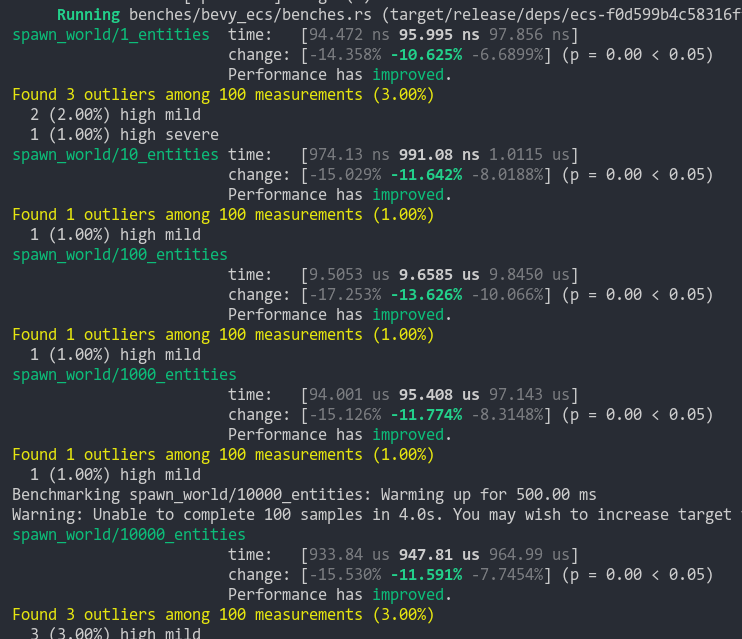
To take this measurement, I added a new `world_spawn` benchmark.
Unfortunately, optimizing `Commands::spawn` is slightly less trivial, as Commands expose the Entity id of spawned entities prior to actually spawning. Doing the optimization would (naively) require assurances that the `spawn(some_bundle)` command is applied before all other commands involving the entity (which would not necessarily be true, if memory serves). Optimizing `Commands::spawn` this way does feel possible, but it will require careful thought (and maybe some additional checks), which deserves its own PR. For now, it has the same performance characteristics of the current `Commands::spawn_bundle` on main.
**Note that 99% of this PR is simple renames and refactors. The only code that needs careful scrutiny is the new `World::spawn()` impl, which is relatively straightforward, but it has some new unsafe code (which re-uses battle tested BundlerSpawner code path).**
---
## Changelog
- All `spawn` apis (`World::spawn`, `Commands:;spawn`, `ChildBuilder::spawn`, and `WorldChildBuilder::spawn`) now accept a bundle as input
- All instances of `spawn_bundle` have been deprecated in favor of the new `spawn` api
- World and Commands now have `spawn_empty()`, which is equivalent to the old `spawn()` behavior.
## Migration Guide
```rust
// Old (0.8):
commands
.spawn()
.insert_bundle((A, B, C));
// New (0.9)
commands.spawn((A, B, C));
// Old (0.8):
commands.spawn_bundle((A, B, C));
// New (0.9)
commands.spawn((A, B, C));
// Old (0.8):
let entity = commands.spawn().id();
// New (0.9)
let entity = commands.spawn_empty().id();
// Old (0.8)
let entity = world.spawn().id();
// New (0.9)
let entity = world.spawn_empty();
```
## Objective

Fixes https://github.com/bevyengine/bevy/issues/6063

## Solution

- Use `then_some(x)` instead of `then( || x)`.
- Updated error logs from `bevy_ecs_compile_fail_tests`.

## Migration Guide

From Rust 1.63 to 1.64, a new Clippy error was added; now one should use `then_some(x)` instead of `then( || x)`.
# Objective

Take advantage of the "impl Bundle for Component" changes in #2975 / add the follow up changes discussed there.

## Solution

- Change `insert` and `remove` to accept a Bundle instead of a Component (for both Commands and World)
- Deprecate `insert_bundle`, `remove_bundle`, and `remove_bundle_intersection`
- Add `remove_intersection`

---

## Changelog

- Change `insert` and `remove` now accept a Bundle instead of a Component (for both Commands and World)
- `insert_bundle` and `remove_bundle` are deprecated


## Migration Guide

Replace `insert_bundle` with `insert`:
```rust
// Old (0.8)
commands.spawn().insert_bundle(SomeBundle::default());
// New (0.9)
commands.spawn().insert(SomeBundle::default());
```

Replace `remove_bundle` with `remove`:
```rust
// Old (0.8)
commands.entity(some_entity).remove_bundle::<SomeBundle>();
// New (0.9)
commands.entity(some_entity).remove::<SomeBundle>();
```

Replace `remove_bundle_intersection` with `remove_intersection`:
```rust
// Old (0.8)
world.entity_mut(some_entity).remove_bundle_intersection::<SomeBundle>();
// New (0.9)
world.entity_mut(some_entity).remove_intersection::<SomeBundle>();
```

Consider consolidating as many operations as possible to improve ergonomics and cut down on archetype moves:
```rust
// Old (0.8)
commands.spawn()
  .insert_bundle(SomeBundle::default())
  .insert(SomeComponent);

// New (0.9) - Option 1
commands.spawn().insert((
  SomeBundle::default(),
  SomeComponent,
))

// New (0.9) - Option 2
commands.spawn_bundle((
  SomeBundle::default(),
  SomeComponent,
))
```

## Next Steps

Consider changing `spawn` to accept a bundle and deprecate `spawn_bundle`.
# Objective
Fixes#5687
## Solution
Update the methods on the `Entity` struct to be `const`, so we can
define compile-time constants and more generally use them in a const
context.
---
## Changelog
### Added
- Most `Entity` methods are now `const fn`.
# Objective
- Fixes#4451
## Solution
- Conditionally compile entity ID cursor as `AtomicI32` when compiling on a platform that does not support 64-bit atomics.
- This effectively raises the MSRV to 1.60 as it uses a `#[cfg]` that was only just stabilized there. (should this be noted in changelog?)
---
## Changelog
- Added `bevy_ecs` support for platforms without 64-bit atomic ints
## Migration Guide
N/A
Remove unnecessary calls to `iter()`/`iter_mut()`.
Mainly updates the use of queries in our code, docs, and examples.

```rust
// From
for _ in list.iter() {
for _ in list.iter_mut() {

// To
for _ in &list {
for _ in &mut list {
```

We already enable the pedantic lint [clippy::explicit_iter_loop](https://rust-lang.github.io/rust-clippy/stable/) inside of Bevy. However, this only warns for a few known types from the standard library.

## Note for reviewers
As you can see the additions and deletions are exactly equal.
Maybe give it a quick skim to check I didn't sneak in a crypto miner, but you don't have to torture yourself by reading every line.
I already experienced enough pain making this PR :)


Co-authored-by: devil-ira <justthecooldude@gmail.com>
# Objective
`SAFETY` comments are meant to be placed before `unsafe` blocks and should contain the reasoning of why in this case the usage of unsafe is okay. This is useful when reading the code because it makes it clear which assumptions are required for safety, and makes it easier to spot possible unsoundness holes. It also forces the code writer to think of something to write and maybe look at the safety contracts of any called unsafe methods again to double-check their correct usage.
There's a clippy lint called `undocumented_unsafe_blocks` which warns when using a block without such a comment.
## Solution
- since clippy expects `SAFETY` instead of `SAFE`, rename those
- add `SAFETY` comments in more places
- for the last remaining 3 places, add an `#[allow()]` and `// TODO` since I wasn't comfortable enough with the code to justify their safety
- add ` #![warn(clippy::undocumented_unsafe_blocks)]` to `bevy_ecs`
### Note for reviewers
The first commit only renames `SAFETY` to `SAFE` so it doesn't need a thorough review.
cb042a416e..55cef2d6fa is the diff for all other changes.
### Safety comments where I'm not too familiar with the code
774012ece5/crates/bevy_ecs/src/entity/mod.rs (L540-L546)774012ece5/crates/bevy_ecs/src/world/entity_ref.rs (L249-L252)
### Locations left undocumented with a `TODO` comment
5dde944a30/crates/bevy_ecs/src/schedule/executor_parallel.rs (L196-L199)5dde944a30/crates/bevy_ecs/src/world/entity_ref.rs (L287-L289)5dde944a30/crates/bevy_ecs/src/world/entity_ref.rs (L413-L415)
Co-authored-by: Jakob Hellermann <hellermann@sipgate.de>
# Objective

The descriptions included in the API docs of `entity` module, `Entity` struct, and `Component` trait have some issues:
1. the concept of entity is not clearly defined,
2. descriptions are a little bit out of place,
3. in a case the description leak too many details about the implementation,
4. some descriptions are not exhaustive,
5. there are not enough examples,
6. the content can be formatted in a much better way.

## Solution

1. ~~Stress the fact that entity is an abstract and elementary concept. Abstract because the concept of entity is not hardcoded into the library but emerges from the interaction of `Entity` with every other part of `bevy_ecs`, like components and world methods. Elementary because it is a fundamental concept that cannot be defined with other terms (like point in euclidean geometry, or time in classical physics).~~ We decided to omit the definition of entity in the API docs ([see why]). It is only described in its relationship with components.
2. Information has been moved to relevant places and links are used instead in the other places.
3. Implementation details about `Entity` have been reduced.
4. Descriptions have been made more exhaustive by stating how to obtain and use items. Entity operations are enriched with `World` methods.
5. Examples have been added or enriched.
6. Sections have been added to organize content. Entity operations are now laid out in a table.

### Todo list

- [x] Break lines at sentence-level.

## For reviewers

- ~~I added a TODO over `Component` docs, make sure to check it out and discuss it if necessary.~~ ([Resolved])
- You can easily check the rendered documentation by doing `cargo doc -p bevy_ecs --no-deps --open`.

[see why]: https://github.com/bevyengine/bevy/pull/4767#discussion_r875106329
[Resolved]: https://github.com/bevyengine/bevy/pull/4767#discussion_r874127825