3690ad5b0b
150 Commits
| Author | SHA1 | Message | Date | |
|---|---|---|---|---|
 Eero Lehtinen
|
2db103708a
|
Make sure prepass notices changes in alpha mode (#19170)
# Objective
Fixes #19150
## Solution
Normally the `validate_cached_entity` in
|
||
|
Joona Aalto
|
7b1c9f192e
|
Adopt consistent FooSystems naming convention for system sets (#18900)
# Objective Fixes a part of #14274. Bevy has an incredibly inconsistent naming convention for its system sets, both internally and across the ecosystem. <img alt="System sets in Bevy" src="https://github.com/user-attachments/assets/d16e2027-793f-4ba4-9cc9-e780b14a5a1b" width="450" /> *Names of public system set types in Bevy* Most Bevy types use a naming of `FooSystem` or just `Foo`, but there are also a few `FooSystems` and `FooSet` types. In ecosystem crates on the other hand, `FooSet` is perhaps the most commonly used name in general. Conventions being so wildly inconsistent can make it harder for users to pick names for their own types, to search for system sets on docs.rs, or to even discern which types *are* system sets. To reign in the inconsistency a bit and help unify the ecosystem, it would be good to establish a common recommended naming convention for system sets in Bevy itself, similar to how plugins are commonly suffixed with `Plugin` (ex: `TimePlugin`). By adopting a consistent naming convention in first-party Bevy, we can softly nudge ecosystem crates to follow suit (for types where it makes sense to do so). Choosing a naming convention is also relevant now, as the [`bevy_cli` recently adopted lints](https://github.com/TheBevyFlock/bevy_cli/pull/345) to enforce naming for plugins and system sets, and the recommended naming used for system sets is still a bit open. ## Which Name To Use? Now the contentious part: what naming convention should we actually adopt? This was discussed on the Bevy Discord at the end of last year, starting [here](<https://discord.com/channels/691052431525675048/692572690833473578/1310659954683936789>). `FooSet` and `FooSystems` were the clear favorites, with `FooSet` very narrowly winning an unofficial poll. However, it seems to me like the consensus was broadly moving towards `FooSystems` at the end and after the poll, with Cart ([source](https://discord.com/channels/691052431525675048/692572690833473578/1311140204974706708)) and later Alice ([source](https://discord.com/channels/691052431525675048/692572690833473578/1311092530732859533)) and also me being in favor of it. Let's do a quick pros and cons list! Of course these are just what I thought of, so take it with a grain of salt. `FooSet`: - Pro: Nice and short! - Pro: Used by many ecosystem crates. - Pro: The `Set` suffix comes directly from the trait name `SystemSet`. - Pro: Pairs nicely with existing APIs like `in_set` and `configure_sets`. - Con: `Set` by itself doesn't actually indicate that it's related to systems *at all*, apart from the implemented trait. A set of what? - Con: Is `FooSet` a set of `Foo`s or a system set related to `Foo`? Ex: `ContactSet`, `MeshSet`, `EnemySet`... `FooSystems`: - Pro: Very clearly indicates that the type represents a collection of systems. The actual core concept, system(s), is in the name. - Pro: Parallels nicely with `FooPlugins` for plugin groups. - Pro: Low risk of conflicts with other names or misunderstandings about what the type is. - Pro: In most cases, reads *very* nicely and clearly. Ex: `PhysicsSystems` and `AnimationSystems` as opposed to `PhysicsSet` and `AnimationSet`. - Pro: Easy to search for on docs.rs. - Con: Usually results in longer names. - Con: Not yet as widely used. Really the big problem with `FooSet` is that it doesn't actually describe what it is. It describes what *kind of thing* it is (a set of something), but not *what it is a set of*, unless you know the type or check its docs or implemented traits. `FooSystems` on the other hand is much more self-descriptive in this regard, at the cost of being a bit longer to type. Ultimately, in some ways it comes down to preference and how you think of system sets. Personally, I was originally in favor of `FooSet`, but have been increasingly on the side of `FooSystems`, especially after seeing what the new names would actually look like in Avian and now Bevy. I prefer it because it usually reads better, is much more clearly related to groups of systems than `FooSet`, and overall *feels* more correct and natural to me in the long term. For these reasons, and because Alice and Cart also seemed to share a preference for it when it was previously being discussed, I propose that we adopt a `FooSystems` naming convention where applicable. ## Solution Rename Bevy's system set types to use a consistent `FooSet` naming where applicable. - `AccessibilitySystem` → `AccessibilitySystems` - `GizmoRenderSystem` → `GizmoRenderSystems` - `PickSet` → `PickingSystems` - `RunFixedMainLoopSystem` → `RunFixedMainLoopSystems` - `TransformSystem` → `TransformSystems` - `RemoteSet` → `RemoteSystems` - `RenderSet` → `RenderSystems` - `SpriteSystem` → `SpriteSystems` - `StateTransitionSteps` → `StateTransitionSystems` - `RenderUiSystem` → `RenderUiSystems` - `UiSystem` → `UiSystems` - `Animation` → `AnimationSystems` - `AssetEvents` → `AssetEventSystems` - `TrackAssets` → `AssetTrackingSystems` - `UpdateGizmoMeshes` → `GizmoMeshSystems` - `InputSystem` → `InputSystems` - `InputFocusSet` → `InputFocusSystems` - `ExtractMaterialsSet` → `MaterialExtractionSystems` - `ExtractMeshesSet` → `MeshExtractionSystems` - `RumbleSystem` → `RumbleSystems` - `CameraUpdateSystem` → `CameraUpdateSystems` - `ExtractAssetsSet` → `AssetExtractionSystems` - `Update2dText` → `Text2dUpdateSystems` - `TimeSystem` → `TimeSystems` - `AudioPlaySet` → `AudioPlaybackSystems` - `SendEvents` → `EventSenderSystems` - `EventUpdates` → `EventUpdateSystems` A lot of the names got slightly longer, but they are also a lot more consistent, and in my opinion the majority of them read much better. For a few of the names I took the liberty of rewording things a bit; definitely open to any further naming improvements. There are still also cases where the `FooSystems` naming doesn't really make sense, and those I left alone. This primarily includes system sets like `Interned<dyn SystemSet>`, `EnterSchedules<S>`, `ExitSchedules<S>`, or `TransitionSchedules<S>`, where the type has some special purpose and semantics. ## Todo - [x] Should I keep all the old names as deprecated type aliases? I can do this, but to avoid wasting work I'd prefer to first reach consensus on whether these renames are even desired. - [x] Migration guide - [x] Release notes |
||
|
charlotte
|
6f3ea06060
|
Make sure the mesh actually exists before we try to specialize. (#18836)
Fixes #18809 Fixes #18823 Meshes despawned in `Last` can still be in visisible entities if they were visible as of `PostUpdate`. Sanity check that the mesh actually exists before we specialize. We still want to unconditionally assume that the entity is in `EntitySpecializationTicks` as its absence from that cache would likely suggest another bug. |
||
|
Carter Anderson
|
e9a0ef49f9
|
Rename bevy_platform_support to bevy_platform (#18813)
# Objective The goal of `bevy_platform_support` is to provide a set of platform agnostic APIs, alongside platform-specific functionality. This is a high traffic crate (providing things like HashMap and Instant). Especially in light of https://github.com/bevyengine/bevy/discussions/18799, it deserves a friendlier / shorter name. Given that it hasn't had a full release yet, getting this change in before Bevy 0.16 makes sense. ## Solution - Rename `bevy_platform_support` to `bevy_platform`. |
||
|
Patrick Walton
|
6c619397d5
|
Unify RenderMaterialInstances and RenderMeshMaterialIds, and fix an associated race condition. (#18734)
Currently, `RenderMaterialInstances` and `RenderMeshMaterialIds` are very similar render-world resources: the former maps main world meshes to typed material asset IDs, and the latter maps main world meshes to untyped material asset IDs. This is needlessly-complex and wasteful, so this patch unifies the two in favor of a single untyped `RenderMaterialInstances` resource. This patch also fixes a subtle issue that could cause mesh materials to be incorrect if a `MeshMaterial3d<A>` was removed and replaced with a `MeshMaterial3d<B>` material in the same frame. The problematic pattern looks like: 1. `extract_mesh_materials<B>` runs and, seeing the `Changed<MeshMaterial3d<B>>` condition, adds an entry mapping the mesh to the new material to the untyped `RenderMeshMaterialIds`. 2. `extract_mesh_materials<A>` runs and, seeing that the entity is present in `RemovedComponents<MeshMaterial3d<A>>`, removes the entry from `RenderMeshMaterialIds`. 3. The material slot is now empty, and the mesh will show up as whatever material happens to be in slot 0 in the material data slab. This commit fixes the issue by splitting out `extract_mesh_materials` into *three* phases: *extraction*, *early sweeping*, and *late sweeping*, which run in that order: 1. The *extraction* system, which runs for each material, updates `RenderMaterialInstances` records whenever `MeshMaterial3d` components change, and updates a change tick so that the following system will know not to remove it. 2. The *early sweeping* system, which runs for each material, processes entities present in `RemovedComponents<MeshMaterial3d>` and removes each such entity's record from `RenderMeshInstances` only if the extraction system didn't update it this frame. This system runs after *all* extraction systems have completed, fixing the race condition. 3. The *late sweeping* system, which runs only once regardless of the number of materials in the scene, processes entities present in `RemovedComponents<ViewVisibility>` and, as in the early sweeping phase, removes each such entity's record from `RenderMeshInstances` only if the extraction system didn't update it this frame. At the end, the late sweeping system updates the change tick. Because this pattern happens relatively frequently, I think this PR should land for 0.16. |
||
|
Greeble
|
5da64ddbee
|
Fix motion blur on skinned meshes (#18712)
## Objective Fix motion blur not working on skinned meshes. ## Solution `set_mesh_motion_vector_flags` can set `RenderMeshInstanceFlags::HAS_PREVIOUS_SKIN` after specialization has already cached the material. This can lead to `MeshPipelineKey::HAS_PREVIOUS_SKIN` never getting set, disabling motion blur. The fix is to make sure `set_mesh_motion_vector_flags` happens before specialization. Note that the bug is fixed in a different way by #18074, which includes other fixes but is a much larger change. ## Testing Open the `animated_mesh` example and add these components to the `Camera3d` entity: ```rust MotionBlur { shutter_angle: 5.0, samples: 2, #[cfg(all(feature = "webgl2", target_arch = "wasm32", not(feature = "webgpu")))] _webgl2_padding: Default::default(), }, #[cfg(all(feature = "webgl2", target_arch = "wasm32", not(feature = "webgpu")))] Msaa::Off, ``` Tested on `animated_mesh`, `many_foxes`, `custom_skinned_mesh`, Win10/Nvidia with Vulkan, WebGL/Chrome, WebGPU/Chrome. Note that testing `many_foxes` WebGL requires #18715. |
||
|
Aevyrie
|
d09f958056
|
Parallelize bevy 0.16-rc bottlenecks (#18632)
# Objective - Found stuttering and performance degradation while updating big_space stress tests. ## Solution - Identify and fix slow spots using tracy. Patch to verify fixes. ## Testing - Tracy - Before:  - prev_gt parallelization and mutating instead of component insertion:  - parallelize visibility ranges and mesh specialization  --------- Co-authored-by: Zachary Harrold <zac@harrold.com.au> |
||
|
IceSentry
|
65d9a7535a
|
Move non-generic parts of the PrepassPipeline to internal field (#18322)
# Objective - The prepass pipeline has a generic bound on the specialize function but 95% of it doesn't need it ## Solution - Move most of the fields to an internal struct and use a separate specialize function for those fields ## Testing - Ran the 3d_scene and it worked like before --- ## Migration Guide If you were using a field of the `PrepassPipeline`, most of them have now been move to `PrepassPipeline::internal`. ## Notes Here's the cargo bloat size comparison (from this tool https://github.com/bevyengine/bevy/discussions/14864): ``` before: ( "<bevy_pbr::prepass::PrepassPipeline<M> as bevy_render::render_resource::pipeline_specializer::SpecializedMeshPipeline>::specialize", 25416, 0.05582993, ), after: ( "<bevy_pbr::prepass::PrepassPipeline<M> as bevy_render::render_resource::pipeline_specializer::SpecializedMeshPipeline>::specialize", 2496, 0.005490916, ), ( "bevy_pbr::prepass::PrepassPipelineInternal::specialize", 11444, 0.025175499, ), ``` The size for the specialize function that is generic is now much smaller, so users won't need to recompile it for every material. |
||
|
charlotte
|
8d5474a2f2
|
Fix unecessary specialization checks for apps with many materials (#18410)
# Objective For materials that aren't being used or a visible entity doesn't have an instance of, we were unnecessarily constantly checking whether they needed specialization, saying yes (because the material had never been specialized for that entity), and failing to look up the material instance. ## Solution If an entity doesn't have an instance of the material, it can't possibly need specialization, so exit early before spending time doing the check. Fixes #18388. |
||
|
Florian Poncabaré
|
910e405ea9
|
Allow prepass to run without ATTRIBUTE_NORMAL (#17881)
# Objective Allow prepass to run without ATTRIBUTE_NORMAL. This is needed for custom materials with non-standard vertex attributes. For example a voxel material with manually packed vertex data. Fixes #13054. This PR covers the first part of the **stale** PR #13569 to only focus on fixing #13054. ## Solution - Only push normals `vertex_attributes` when the layout contains `Mesh::ATTRIBUTE_NORMAL` ## Testing - Did you test these changes? If so, how? **Tested the fix on my own project with a mesh without normal attribute.** - Are there any parts that need more testing? **I don't think so.** - How can other people (reviewers) test your changes? Is there anything specific they need to know? **Prepass should not be blocked on a mesh without normal attributes (with or without custom material).** - If relevant, what platforms did you test these changes on, and are there any important ones you can't test? **Probably irrelevant, but Windows/Vulkan.** |
||
|
Patrick Walton
|
28441337bb
|
Use global binding arrays for bindless resources. (#17898)
Currently, Bevy's implementation of bindless resources is rather unusual: every binding in an object that implements `AsBindGroup` (most commonly, a material) becomes its own separate binding array in the shader. This is inefficient for two reasons: 1. If multiple materials reference the same texture or other resource, the reference to that resource will be duplicated many times. This increases `wgpu` validation overhead. 2. It creates many unused binding array slots. This increases `wgpu` and driver overhead and makes it easier to hit limits on APIs that `wgpu` currently imposes tight resource limits on, like Metal. This PR fixes these issues by switching Bevy to use the standard approach in GPU-driven renderers, in which resources are de-duplicated and passed as global arrays, one for each type of resource. Along the way, this patch introduces per-platform resource limits and bumps them from 16 resources per binding array to 64 resources per bind group on Metal and 2048 resources per bind group on other platforms. (Note that the number of resources per *binding array* isn't the same as the number of resources per *bind group*; as it currently stands, if all the PBR features are turned on, Bevy could pack as many as 496 resources into a single slab.) The limits have been increased because `wgpu` now has universal support for partially-bound binding arrays, which mean that we no longer need to fill the binding arrays with fallback resources on Direct3D 12. The `#[bindless(LIMIT)]` declaration when deriving `AsBindGroup` can now simply be written `#[bindless]` in order to have Bevy choose a default limit size for the current platform. Custom limits are still available with the new `#[bindless(limit(LIMIT))]` syntax: e.g. `#[bindless(limit(8))]`. The material bind group allocator has been completely rewritten. Now there are two allocators: one for bindless materials and one for non-bindless materials. The new non-bindless material allocator simply maintains a 1:1 mapping from material to bind group. The new bindless material allocator maintains a list of slabs and allocates materials into slabs on a first-fit basis. This unfortunately makes its performance O(number of resources per object * number of slabs), but the number of slabs is likely to be low, and it's planned to become even lower in the future with `wgpu` improvements. Resources are de-duplicated with in a slab and reference counted. So, for instance, if multiple materials refer to the same texture, that texture will exist only once in the appropriate binding array. To support these new features, this patch adds the concept of a *bindless descriptor* to the `AsBindGroup` trait. The bindless descriptor allows the material bind group allocator to probe the layout of the material, now that an array of `BindGroupLayoutEntry` records is insufficient to describe the group. The `#[derive(AsBindGroup)]` has been heavily modified to support the new features. The most important user-facing change to that macro is that the struct-level `uniform` attribute, `#[uniform(BINDING_NUMBER, StandardMaterial)]`, now reads `#[uniform(BINDLESS_INDEX, MATERIAL_UNIFORM_TYPE, binding_array(BINDING_NUMBER)]`, allowing the material to specify the binding number for the binding array that holds the uniform data. To make this patch simpler, I removed support for bindless `ExtendedMaterial`s, as well as field-level bindless uniform and storage buffers. I intend to add back support for these as a follow-up. Because they aren't in any released Bevy version yet, I figured this was OK. Finally, this patch updates `StandardMaterial` for the new bindless changes. Generally, code throughout the PBR shaders that looked like `base_color_texture[slot]` now looks like `bindless_2d_textures[material_indices[slot].base_color_texture]`. This patch fixes a system hang that I experienced on the [Caldera test] when running with `caldera --random-materials --texture-count 100`. The time per frame is around 19.75 ms, down from 154.2 ms in Bevy 0.14: a 7.8× speedup. [Caldera test]: https://github.com/DGriffin91/bevy_caldera_scene |
||
|
Patrick Walton
|
5e569af2d0
|
Make the specialized pipeline cache two-level. (#17915)
Currently, the specialized pipeline cache maps a (view entity, mesh entity) tuple to the retained pipeline for that entity. This causes two problems: 1. Using the view entity is incorrect, because the view entity isn't stable from frame to frame. 2. Switching the view entity to a `RetainedViewEntity`, which is necessary for correctness, significantly regresses performance of `specialize_material_meshes` and `specialize_shadows` because of the loss of the fast `EntityHash`. This patch fixes both problems by switching to a *two-level* hash table. The outer level of the table maps each `RetainedViewEntity` to an inner table, which maps each `MainEntity` to its pipeline ID and change tick. Because we loop over views first and, within that loop, loop over entities visible from that view, we hoist the slow lookup of the view entity out of the inner entity loop. Additionally, this patch fixes a bug whereby pipeline IDs were leaked when removing the view. We still have a problem with leaking pipeline IDs for deleted entities, but that won't be fixed until the specialized pipeline cache is retained. This patch improves performance of the [Caldera benchmark] from 7.8× faster than 0.14 to 9.0× faster than 0.14, when applied on top of the global binding arrays PR, #17898. [Caldera benchmark]: https://github.com/DGriffin91/bevy_caldera_scene |
||
|
Patrick Walton
|
0ede857103
|
Build batches across phases in parallel. (#17764)
Currently, invocations of `batch_and_prepare_binned_render_phase` and `batch_and_prepare_sorted_render_phase` can't run in parallel because they write to scene-global GPU buffers. After PR #17698, `batch_and_prepare_binned_render_phase` started accounting for the lion's share of the CPU time, causing us to be strongly CPU bound on scenes like Caldera when occlusion culling was on (because of the overhead of batching for the Z-prepass). Although I eventually plan to optimize `batch_and_prepare_binned_render_phase`, we can obtain significant wins now by parallelizing that system across phases. This commit splits all GPU buffers that `batch_and_prepare_binned_render_phase` and `batch_and_prepare_sorted_render_phase` touches into separate buffers for each phase so that the scheduler will run those phases in parallel. At the end of batch preparation, we gather the render phases up into a single resource with a new *collection* phase. Because we already run mesh preprocessing separately for each phase in order to make occlusion culling work, this is actually a cleaner separation. For example, mesh output indices (the unique ID that identifies each mesh instance on GPU) are now guaranteed to be sequential starting from 0, which will simplify the forthcoming work to remove them in favor of the compute dispatch ID. On Caldera, this brings the frame time down to approximately 9.1 ms with occlusion culling on.  |
||
|
Patrick Walton
|
85b366a8a2
|
Cache MeshInputUniform indices in each RenderBin. (#17772)
Currently, we look up each `MeshInputUniform` index in a hash table that maps the main entity ID to the index every frame. This is inefficient, cache unfriendly, and unnecessary, as the `MeshInputUniform` index for an entity remains the same from frame to frame (even if the input uniform changes). This commit changes the `IndexSet` in the `RenderBin` to an `IndexMap` that maps the `MainEntity` to `MeshInputUniformIndex` (a new type that this patch adds for more type safety). On Caldera with parallel `batch_and_prepare_binned_render_phase`, this patch improves that function from 3.18 ms to 2.42 ms, a 31% speedup. |
||
|
Patrick Walton
|
69db29efb9
|
Sweep bins after queuing so as to only sweep them once. (#17787)
Currently, we *sweep*, or remove entities from bins when those entities became invisible or changed phases, during `queue_material_meshes` and similar phases. This, however, is wrong, because `queue_material_meshes` executes once per material type, not once per phase. This could result in sweeping bins multiple times per phase, which can corrupt the bins. This commit fixes the issue by moving sweeping to a separate system that runs after queuing. This manifested itself as entities appearing and disappearing seemingly at random. Closes #17759. --------- Co-authored-by: Robert Swain <robert.swain@gmail.com> |
||
|
charlotte
|
af6629cbe9
|
Move specialize_* to QueueMeshes. (#17719)
# Objective Things were breaking post-cs. ## Solution `specialize_mesh_materials` must run after `collect_meshes_for_gpu_building`. Therefore, its placement in the `PrepareAssets` set didn't make sense (also more generally). To fix, we put this class of system in ~`PrepareResources`~ `QueueMeshes`, although it potentially could use a more descriptive location. We may want to review the placement of `check_views_need_specialization` which is also currently in `PrepareAssets`. |
||
|
Patrick Walton
|
7fc122ad16
|
Retain bins from frame to frame. (#17698)
This PR makes Bevy keep entities in bins from frame to frame if they haven't changed. This reduces the time spent in `queue_material_meshes` and related functions to near zero for static geometry. This patch uses the same change tick technique that #17567 uses to detect when meshes have changed in such a way as to require re-binning. In order to quickly find the relevant bin for an entity when that entity has changed, we introduce a new type of cache, the *bin key cache*. This cache stores a mapping from main world entity ID to cached bin key, as well as the tick of the most recent change to the entity. As we iterate through the visible entities in `queue_material_meshes`, we check the cache to see whether the entity needs to be re-binned. If it doesn't, then we mark it as clean in the `valid_cached_entity_bin_keys` bit set. If it does, then we insert it into the correct bin, and then mark the entity as clean. At the end, all entities not marked as clean are removed from the bins. This patch has a dramatic effect on the rendering performance of most benchmarks, as it effectively eliminates `queue_material_meshes` from the profile. Note, however, that it generally simultaneously regresses `batch_and_prepare_binned_render_phase` by a bit (not by enough to outweigh the win, however). I believe that's because, before this patch, `queue_material_meshes` put the bins in the CPU cache for `batch_and_prepare_binned_render_phase` to use, while with this patch, `batch_and_prepare_binned_render_phase` must load the bins into the CPU cache itself. On Caldera, this reduces the time spent in `queue_material_meshes` from 5+ ms to 0.2ms-0.3ms. Note that benchmarking on that scene is very noisy right now because of https://github.com/bevyengine/bevy/issues/17535. 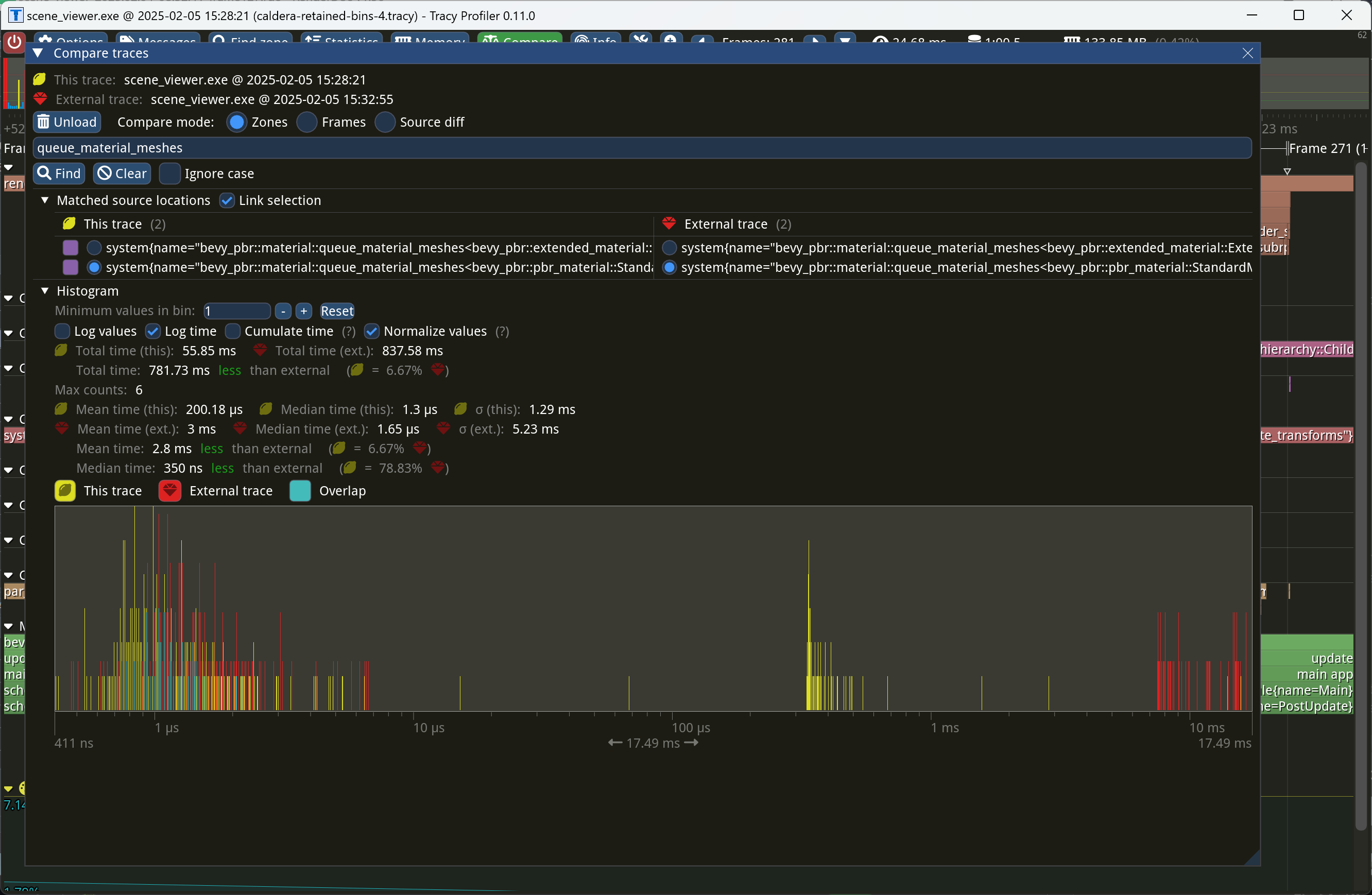 |
||
|
Sludge
|
989f547080
|
Weak handle migration (#17695)
# Objective - Make use of the new `weak_handle!` macro added in https://github.com/bevyengine/bevy/pull/17384 ## Solution - Migrate bevy from `Handle::weak_from_u128` to the new `weak_handle!` macro that takes a random UUID - Deprecate `Handle::weak_from_u128`, since there are no remaining use cases that can't also be addressed by constructing the type manually ## Testing - `cargo run -p ci -- test` --- ## Migration Guide Replace `Handle::weak_from_u128` with `weak_handle!` and a random UUID. |
||
|
charlotte
|
2ea5e9b846
|
Cold Specialization (#17567)
# Cold Specialization ## Objective An ongoing part of our quest to retain everything in the render world, cold-specialization aims to cache pipeline specialization so that pipeline IDs can be recomputed only when necessary, rather than every frame. This approach reduces redundant work in stable scenes, while still accommodating scenarios in which materials, views, or visibility might change, as well as unlocking future optimization work like retaining render bins. ## Solution Queue systems are split into a specialization system and queue system, the former of which only runs when necessary to compute a new pipeline id. Pipelines are invalidated using a combination of change detection and ECS ticks. ### The difficulty with change detection Detecting “what changed” can be tricky because pipeline specialization depends not only on the entity’s components (e.g., mesh, material, etc.) but also on which view (camera) it is rendering in. In other words, the cache key for a given pipeline id is a view entity/render entity pair. As such, it's not sufficient simply to react to change detection in order to specialize -- an entity could currently be out of view or could be rendered in the future in camera that is currently disabled or hasn't spawned yet. ### Why ticks? Ticks allow us to ensure correctness by allowing us to compare the last time a view or entity was updated compared to the cached pipeline id. This ensures that even if an entity was out of view or has never been seen in a given camera before we can still correctly determine whether it needs to be re-specialized or not. ## Testing TODO: Tested a bunch of different examples, need to test more. ## Migration Guide TODO - `AssetEvents` has been moved into the `PostUpdate` schedule. --------- Co-authored-by: Patrick Walton <pcwalton@mimiga.net> |
||
|
Patrick Walton
|
48049f7256
|
Don't mark a previous mesh transform as changed if it didn't actually change. (#17688)
This patch fixes a bug whereby we're re-extracting every mesh every frame. It's a regression from PR #17413. The code in question has actually been in the tree with this bug for quite a while; it's that just the code didn't actually run unless the renderer considered the previous view transforms necessary. Occlusion culling expanded the set of circumstances under which Bevy computes the previous view transforms, causing this bug to appear more often. This patch fixes the issue by checking to see if the previous transform of a mesh actually differs from the current transform before copying the current transform to the previous transform. |
||
|
Patrick Walton
|
dda97880c4
|
Implement experimental GPU two-phase occlusion culling for the standard 3D mesh pipeline. (#17413)
*Occlusion culling* allows the GPU to skip the vertex and fragment shading overhead for objects that can be quickly proved to be invisible because they're behind other geometry. A depth prepass already eliminates most fragment shading overhead for occluded objects, but the vertex shading overhead, as well as the cost of testing and rejecting fragments against the Z-buffer, is presently unavoidable for standard meshes. We currently perform occlusion culling only for meshlets. But other meshes, such as skinned meshes, can benefit from occlusion culling too in order to avoid the transform and skinning overhead for unseen meshes. This commit adapts the same [*two-phase occlusion culling*] technique that meshlets use to Bevy's standard 3D mesh pipeline when the new `OcclusionCulling` component, as well as the `DepthPrepass` component, are present on the camera. It has these steps: 1. *Early depth prepass*: We use the hierarchical Z-buffer from the previous frame to cull meshes for the initial depth prepass, effectively rendering only the meshes that were visible in the last frame. 2. *Early depth downsample*: We downsample the depth buffer to create another hierarchical Z-buffer, this time with the current view transform. 3. *Late depth prepass*: We use the new hierarchical Z-buffer to test all meshes that weren't rendered in the early depth prepass. Any meshes that pass this check are rendered. 4. *Late depth downsample*: Again, we downsample the depth buffer to create a hierarchical Z-buffer in preparation for the early depth prepass of the next frame. This step is done after all the rendering, in order to account for custom phase items that might write to the depth buffer. Note that this patch has no effect on the per-mesh CPU overhead for occluded objects, which remains high for a GPU-driven renderer due to the lack of `cold-specialization` and retained bins. If `cold-specialization` and retained bins weren't on the horizon, then a more traditional approach like potentially visible sets (PVS) or low-res CPU rendering would probably be more efficient than the GPU-driven approach that this patch implements for most scenes. However, at this point the amount of effort required to implement a PVS baking tool or a low-res CPU renderer would probably be greater than landing `cold-specialization` and retained bins, and the GPU driven approach is the more modern one anyway. It does mean that the performance improvements from occlusion culling as implemented in this patch *today* are likely to be limited, because of the high CPU overhead for occluded meshes. Note also that this patch currently doesn't implement occlusion culling for 2D objects or shadow maps. Those can be addressed in a follow-up. Additionally, note that the techniques in this patch require compute shaders, which excludes support for WebGL 2. This PR is marked experimental because of known precision issues with the downsampling approach when applied to non-power-of-two framebuffer sizes (i.e. most of them). These precision issues can, in rare cases, cause objects to be judged occluded that in fact are not. (I've never seen this in practice, but I know it's possible; it tends to be likelier to happen with small meshes.) As a follow-up to this patch, we desire to switch to the [SPD-based hi-Z buffer shader from the Granite engine], which doesn't suffer from these problems, at which point we should be able to graduate this feature from experimental status. I opted not to include that rewrite in this patch for two reasons: (1) @JMS55 is planning on doing the rewrite to coincide with the new availability of image atomic operations in Naga; (2) to reduce the scope of this patch. A new example, `occlusion_culling`, has been added. It demonstrates objects becoming quickly occluded and disoccluded by dynamic geometry and shows the number of objects that are actually being rendered. Also, a new `--occlusion-culling` switch has been added to `scene_viewer`, in order to make it easy to test this patch with large scenes like Bistro. [*two-phase occlusion culling*]: https://medium.com/@mil_kru/two-pass-occlusion-culling-4100edcad501 [Aaltonen SIGGRAPH 2015]: https://www.advances.realtimerendering.com/s2015/aaltonenhaar_siggraph2015_combined_final_footer_220dpi.pdf [Some literature]: https://gist.github.com/reduz/c5769d0e705d8ab7ac187d63be0099b5?permalink_comment_id=5040452#gistcomment-5040452 [SPD-based hi-Z buffer shader from the Granite engine]: https://github.com/Themaister/Granite/blob/master/assets/shaders/post/hiz.comp ## Migration guide * When enqueuing a custom mesh pipeline, work item buffers are now created with `bevy::render::batching::gpu_preprocessing::get_or_create_work_item_buffer`, not `PreprocessWorkItemBuffers::new`. See the `specialized_mesh_pipeline` example. ## Showcase Occlusion culling example:  Bistro zoomed out, before occlusion culling:  Bistro zoomed out, after occlusion culling:  In this scene, occlusion culling reduces the number of meshes Bevy has to render from 1591 to 585. |
||
|
Patrick Walton
|
fc831c390d
|
Implement basic clustered decal projectors. (#17315)
This commit adds support for *decal projectors* to Bevy, allowing for textures to be projected on top of geometry. Decal projectors are clusterable objects, just as punctual lights and light probes are. This means that decals are only evaluated for objects within the conservative bounds of the projector, and they don't require a second pass. These clustered decals require support for bindless textures and as such currently don't work on WebGL 2, WebGPU, macOS, or iOS. For an alternative that doesn't require bindless, see PR #16600. I believe that both contact projective decals in #16600 and clustered decals are desirable to have in Bevy. Contact projective decals offer broader hardware and driver support, while clustered decals don't require the creation of bounding geometry. A new example, `decal_projectors`, has been added, which demonstrates multiple decals on a rotating object. The decal projectors can be scaled and rotated with the mouse. There are several limitations of this initial patch that can be addressed in follow-ups: 1. There's no way to specify the Z-index of decals. That is, the order in which multiple decals are blended on top of one another is arbitrary. A follow-up could introduce some sort of Z-index field so that artists can specify that some decals should be blended on top of others. 2. Decals don't take the normal of the surface they're projected onto into account. Most decal implementations in other engines have a feature whereby the angle between the decal projector and the normal of the surface must be within some threshold for the decal to appear. Often, artists can specify a fade-off range for a smooth transition between oblique surfaces and aligned surfaces. 3. There's no distance-based fadeoff toward the end of the projector range. Many decal implementations have this. This addresses #2401. ## Showcase  |
||
|
Patrick Walton
|
35101f3ed5
|
Use multi_draw_indirect_count where available, in preparation for two-phase occlusion culling. (#17211)
This commit allows Bevy to use `multi_draw_indirect_count` for drawing meshes. The `multi_draw_indirect_count` feature works just like `multi_draw_indirect`, but it takes the number of indirect parameters from a GPU buffer rather than specifying it on the CPU. Currently, the CPU constructs the list of indirect draw parameters with the instance count for each batch set to zero, uploads the resulting buffer to the GPU, and dispatches a compute shader that bumps the instance count for each mesh that survives culling. Unfortunately, this is inefficient when we support `multi_draw_indirect_count`. Draw commands corresponding to meshes for which all instances were culled will remain present in the list when calling `multi_draw_indirect_count`, causing overhead. Proper use of `multi_draw_indirect_count` requires eliminating these empty draw commands. To address this inefficiency, this PR makes Bevy fully construct the indirect draw commands on the GPU instead of on the CPU. Instead of writing instance counts to the draw command buffer, the mesh preprocessing shader now writes them to a separate *indirect metadata buffer*. A second compute dispatch known as the *build indirect parameters* shader runs after mesh preprocessing and converts the indirect draw metadata into actual indirect draw commands for the GPU. The build indirect parameters shader operates on a batch at a time, rather than an instance at a time, and as such each thread writes only 0 or 1 indirect draw parameters, simplifying the current logic in `mesh_preprocessing`, which currently has to have special cases for the first mesh in each batch. The build indirect parameters shader emits draw commands in a tightly packed manner, enabling maximally efficient use of `multi_draw_indirect_count`. Along the way, this patch switches mesh preprocessing to dispatch one compute invocation per render phase per view, instead of dispatching one compute invocation per view. This is preparation for two-phase occlusion culling, in which we will have two mesh preprocessing stages. In that scenario, the first mesh preprocessing stage must only process opaque and alpha tested objects, so the work items must be separated into those that are opaque or alpha tested and those that aren't. Thus this PR splits out the work items into a separate buffer for each phase. As this patch rewrites so much of the mesh preprocessing infrastructure, it was simpler to just fold the change into this patch instead of deferring it to the forthcoming occlusion culling PR. Finally, this patch changes mesh preprocessing so that it runs separately for indexed and non-indexed meshes. This is because draw commands for indexed and non-indexed meshes have different sizes and layouts. *The existing code is actually broken for non-indexed meshes*, as it attempts to overlay the indirect parameters for non-indexed meshes on top of those for indexed meshes. Consequently, right now the parameters will be read incorrectly when multiple non-indexed meshes are multi-drawn together. *This is a bug fix* and, as with the change to dispatch phases separately noted above, was easiest to include in this patch as opposed to separately. ## Migration Guide * Systems that add custom phase items now need to populate the indirect drawing-related buffers. See the `specialized_mesh_pipeline` example for an example of how this is done. |
||
|
Patrick Walton
|
141b7673ab
|
Key render phases off the main world view entity, not the render world view entity. (#16942)
We won't be able to retain render phases from frame to frame if the keys are unstable. It's not as simple as simply keying off the main world entity, however, because some main world entities extract to multiple render world entities. For example, directional lights extract to multiple shadow cascades, and point lights extract to one view per cubemap face. Therefore, we key off a new type, `RetainedViewEntity`, which contains the main entity plus a *subview ID*. This is part of the preparation for retained bins. --------- Co-authored-by: ickshonpe <david.curthoys@googlemail.com> |
||
|
JMS55
|
bb0a82b9a7
|
Higher quality bicubic lightmap sampling (#16740)
# Objective - Closes https://github.com/bevyengine/bevy/issues/14322. ## Solution - Implement fast 4-sample bicubic filtering based on this shader toy https://www.shadertoy.com/view/4df3Dn, with a small speedup from a ghost of tushima presentation. ## Testing - Did you test these changes? If so, how? - Ran on lightmapped example. Practically no difference in that scene. - Are there any parts that need more testing? - Lightmapping a better scene. ## Changelog - Lightmaps now have a higher quality bicubic sampling method (off by default). --------- Co-authored-by: Patrick Walton <pcwalton@mimiga.net> |
||
|
MichiRecRoom
|
3742e621ef
|
Allow clippy::too_many_arguments to lint without warnings (#17249)
# Objective Many instances of `clippy::too_many_arguments` linting happen to be on systems - functions which we don't call manually, and thus there's not much reason to worry about the argument count. ## Solution Allow `clippy::too_many_arguments` globally, and remove all lint attributes related to it. |
||
|
Patrick Walton
|
a8f15bd95e
|
Introduce two-level bins for multidrawable meshes. (#16898)
Currently, our batchable binned items are stored in a hash table that maps bin key, which includes the batch set key, to a list of entities. Multidraw is handled by sorting the bin keys and accumulating adjacent bins that can be multidrawn together (i.e. have the same batch set key) into multidraw commands during `batch_and_prepare_binned_render_phase`. This is reasonably efficient right now, but it will complicate future work to retain indirect draw parameters from frame to frame. Consider what must happen when we have retained indirect draw parameters and the application adds a bin (i.e. a new mesh) that shares a batch set key with some pre-existing meshes. (That is, the new mesh can be multidrawn with the pre-existing meshes.) To be maximally efficient, our goal in that scenario will be to update *only* the indirect draw parameters for the batch set (i.e. multidraw command) containing the mesh that was added, while leaving the others alone. That means that we have to quickly locate all the bins that belong to the batch set being modified. In the existing code, we would have to sort the list of bin keys so that bins that can be multidrawn together become adjacent to one another in the list. Then we would have to do a binary search through the sorted list to find the location of the bin that was just added. Next, we would have to widen our search to adjacent indexes that contain the same batch set, doing expensive comparisons against the batch set key every time. Finally, we would reallocate the indirect draw parameters and update the stored pointers to the indirect draw parameters that the bins store. By contrast, it'd be dramatically simpler if we simply changed the way bins are stored to first map from batch set key (i.e. multidraw command) to the bins (i.e. meshes) within that batch set key, and then from each individual bin to the mesh instances. That way, the scenario above in which we add a new mesh will be simpler to handle. First, we will look up the batch set key corresponding to that mesh in the outer map to find an inner map corresponding to the single multidraw command that will draw that batch set. We will know how many meshes the multidraw command is going to draw by the size of that inner map. Then we simply need to reallocate the indirect draw parameters and update the pointers to those parameters within the bins as necessary. There will be no need to do any binary search or expensive batch set key comparison: only a single hash lookup and an iteration over the inner map to update the pointers. This patch implements the above technique. Because we don't have retained bins yet, this PR provides no performance benefits. However, it opens the door to maximally efficient updates when only a small number of meshes change from frame to frame. The main churn that this patch causes is that the *batch set key* (which uniquely specifies a multidraw command) and *bin key* (which uniquely specifies a mesh *within* that multidraw command) are now separate, instead of the batch set key being embedded *within* the bin key. In order to isolate potential regressions, I think that at least #16890, #16836, and #16825 should land before this PR does. ## Migration Guide * The *batch set key* is now separate from the *bin key* in `BinnedPhaseItem`. The batch set key is used to collect multidrawable meshes together. If you aren't using the multidraw feature, you can safely set the batch set key to `()`. |
||
|
Zachary Harrold
|
a371ee3019
|
Remove tracing re-export from bevy_utils (#17161)
# Objective - Contributes to #11478 ## Solution - Made `bevy_utils::tracing` `doc(hidden)` - Re-exported `tracing` from `bevy_log` for end-users - Added `tracing` directly to crates that need it. ## Testing - CI --- ## Migration Guide If you were importing `tracing` via `bevy::utils::tracing`, instead use `bevy::log::tracing`. Note that many items within `tracing` are also directly re-exported from `bevy::log` as well, so you may only need `bevy::log` for the most common items (e.g., `warn!`, `trace!`, etc.). This also applies to the `log_once!` family of macros. ## Notes - While this doesn't reduce the line-count in `bevy_utils`, it further decouples the internal crates from `bevy_utils`, making its eventual removal more feasible in the future. - I have just imported `tracing` as we do for all dependencies. However, a workspace dependency may be more appropriate for version management. |
||
|
Patrick Walton
|
11c4339f45
|
Get lightmaps working in deferred rendering. (#16836)
A previous PR, #14599, attempted to enable lightmaps in deferred mode, but it still used the `OpaqueNoLightmap3dBinKey`, which meant that it would be broken if multiple lightmaps were used. This commit fixes that issue, and allows bindless lightmaps to work with deferred rendering as well. |
||
|
Patrick Walton
|
40df1ea4b6
|
Remove the type parameter from check_visibility, and only invoke it once. (#16812)
Currently, `check_visibility` is parameterized over a query filter that specifies the type of potentially-visible object. This has the unfortunate side effect that we need a separate system, `mark_view_visibility_as_changed_if_necessary`, to trigger view visibility change detection. That system is quite slow because it must iterate sequentially over all entities in the scene. This PR moves the query filter from `check_visibility` to a new component, `VisibilityClass`. `VisibilityClass` stores a list of type IDs, each corresponding to one of the query filters we used to use. Because `check_visibility` is no longer specialized to the query filter at the type level, Bevy now only needs to invoke it once, leading to better performance as `check_visibility` can do change detection on the fly rather than delegating it to a separate system. This commit also has ergonomic improvements, as there's no need for applications that want to add their own custom renderable components to add specializations of the `check_visibility` system to the schedule. Instead, they only need to ensure that the `ViewVisibility` component is properly kept up to date. The recommended way to do this, and the way that's demonstrated in the `custom_phase_item` and `specialized_mesh_pipeline` examples, is to make `ViewVisibility` a required component and to add the type ID to it in a component add hook. This patch does this for `Mesh3d`, `Mesh2d`, `Sprite`, `Light`, and `Node`, which means that most app code doesn't need to change at all. Note that, although this patch has a large impact on the performance of visibility determination, it doesn't actually improve the end-to-end frame time of `many_cubes`. That's because the render world was already effectively hiding the latency from `mark_view_visibility_as_changed_if_necessary`. This patch is, however, necessary for *further* improvements to `many_cubes` performance. `many_cubes` trace before:  `many_cubes` trace after:  ## Migration Guide * `check_visibility` no longer takes a `QueryFilter`, and there's no need to add it manually to your app schedule anymore for custom rendering items. Instead, entities with custom renderable components should add the appropriate type IDs to `VisibilityClass`. See `custom_phase_item` for an example. |
||
|
Patrick Walton
|
a900f68d1b
|
Update the prepass shaders and fix the batching logic for bindless and multidraw. (#16755)
This commit resolves most of the failures seen in #16670. It contains two major fixes: 1. The prepass shaders weren't updated for bindless mode, so they were accessing `material` as a single element instead of as an array. I added the needed `BINDLESS` check. 2. If the mesh didn't support batch set keys (i.e. `get_batch_set_key()` returns `None`), and multidraw was enabled, the batching logic would try to multidraw all the meshes in a bin together instead of disabling multidraw. This is because we checked whether the `Option<BatchSetKey>` for the previous batch was equal to the `Option<BatchSetKey>` for the next batch to determine whether objects could be multidrawn together, which would return true if batch set keys were absent, causing an entire bin to be multidrawn together. This patch fixes the logic so that multidraw is only enabled if the batch set keys match *and are `Some`*. Additionally, this commit adds batch key support for bins that use `Opaque3dNoLightmapBinKey`, which in practice means prepasses. Consequently, this patch enables multidraw for the prepass when GPU culling is enabled. When testing this patch, try adding `GpuCulling` to the camera in the `deferred_rendering` and `ssr` examples. You can see that these examples break without this patch and work properly with it. --------- Co-authored-by: Alice Cecile <alice.i.cecile@gmail.com> |
||
|
Patrick Walton
|
3188e5af61
|
Batch skinned meshes on platforms where storage buffers are available. (#16599)
This commit makes skinned meshes batchable on platforms other than WebGL 2. On supported platforms, it replaces the two uniform buffers used for joint matrices with a pair of storage buffers containing all matrices for all skinned meshes packed together. The indices into the buffer are stored in the mesh uniform and mesh input uniform. The GPU mesh preprocessing step copies the indices in if that step is enabled. On the `many_foxes` demo, I observed a frame time decrease from 15.470ms to 11.935ms. This is the result of reducing the `submit_graph_commands` time from an average of 5.45ms to 0.489ms, an 11x speedup in that portion of rendering.  This is what the profile looks like for `many_foxes` after these changes.  --------- Co-authored-by: François Mockers <mockersf@gmail.com> |
||
|
Patrick Walton
|
7ed1f327d9
|
Make StandardMaterial bindless. (#16644)
This commit makes `StandardMaterial` use bindless textures, as implemented in PR #16368. Non-bindless mode, as used for example in Metal and WebGL 2, remains fully supported via a plethora of `#ifdef BINDLESS` preprocessor definitions. Unfortunately, this PR introduces quite a bit of unsightliness into the PBR shaders. This is a result of the fact that WGSL supports neither passing binding arrays to functions nor passing individual *elements* of binding arrays to functions, except directly to texture sample functions. Thus we're unable to use the `sample_texture` abstraction that helped abstract over the meshlet and non-meshlet paths. I don't think there's anything we can do to help this other than to suggest improvements to upstream Naga. |
||
|
Patrick Walton
|
56c70f8463
|
Make visibility range (HLOD) dithering work when prepasses are enabled. (#16286)
Currently, the prepass has no support for visibility ranges, so artifacts appear when using dithering visibility ranges in conjunction with a prepass. This patch fixes that problem. Note that this patch changes the prepass to use sparse bind group indices instead of sequential ones. I figured this is cleaner, because it allows for greater sharing of WGSL code between the forward pipeline and the prepass pipeline. The `visibility_range` example has been updated to allow the prepass to be toggled on and off. |
||
|
Patrick Walton
|
5adf831b42
|
Add a bindless mode to AsBindGroup. (#16368)
This patch adds the infrastructure necessary for Bevy to support
*bindless resources*, by adding a new `#[bindless]` attribute to
`AsBindGroup`.
Classically, only a single texture (or sampler, or buffer) can be
attached to each shader binding. This means that switching materials
requires breaking a batch and issuing a new drawcall, even if the mesh
is otherwise identical. This adds significant overhead not only in the
driver but also in `wgpu`, as switching bind groups increases the amount
of validation work that `wgpu` must do.
*Bindless resources* are the typical solution to this problem. Instead
of switching bindings between each texture, the renderer instead
supplies a large *array* of all textures in the scene up front, and the
material contains an index into that array. This pattern is repeated for
buffers and samplers as well. The renderer now no longer needs to switch
binding descriptor sets while drawing the scene.
Unfortunately, as things currently stand, this approach won't quite work
for Bevy. Two aspects of `wgpu` conspire to make this ideal approach
unacceptably slow:
1. In the DX12 backend, all binding arrays (bindless resources) must
have a constant size declared in the shader, and all textures in an
array must be bound to actual textures. Changing the size requires a
recompile.
2. Changing even one texture incurs revalidation of all textures, a
process that takes time that's linear in the total size of the binding
array.
This means that declaring a large array of textures big enough to
encompass the entire scene is presently unacceptably slow. For example,
if you declare 4096 textures, then `wgpu` will have to revalidate all
4096 textures if even a single one changes. This process can take
multiple frames.
To work around this problem, this PR groups bindless resources into
small *slabs* and maintains a free list for each. The size of each slab
for the bindless arrays associated with a material is specified via the
`#[bindless(N)]` attribute. For instance, consider the following
declaration:
```rust
#[derive(AsBindGroup)]
#[bindless(16)]
struct MyMaterial {
#[buffer(0)]
color: Vec4,
#[texture(1)]
#[sampler(2)]
diffuse: Handle<Image>,
}
```
The `#[bindless(N)]` attribute specifies that, if bindless arrays are
supported on the current platform, each resource becomes a binding array
of N instances of that resource. So, for `MyMaterial` above, the `color`
attribute is exposed to the shader as `binding_array<vec4<f32>, 16>`,
the `diffuse` texture is exposed to the shader as
`binding_array<texture_2d<f32>, 16>`, and the `diffuse` sampler is
exposed to the shader as `binding_array<sampler, 16>`. Inside the
material's vertex and fragment shaders, the applicable index is
available via the `material_bind_group_slot` field of the `Mesh`
structure. So, for instance, you can access the current color like so:
```wgsl
// `uniform` binding arrays are a non-sequitur, so `uniform` is automatically promoted
// to `storage` in bindless mode.
@group(2) @binding(0) var<storage> material_color: binding_array<Color, 4>;
...
@fragment
fn fragment(in: VertexOutput) -> @location(0) vec4<f32> {
let color = material_color[mesh[in.instance_index].material_bind_group_slot];
...
}
```
Note that portable shader code can't guarantee that the current platform
supports bindless textures. Indeed, bindless mode is only available in
Vulkan and DX12. The `BINDLESS` shader definition is available for your
use to determine whether you're on a bindless platform or not. Thus a
portable version of the shader above would look like:
```wgsl
#ifdef BINDLESS
@group(2) @binding(0) var<storage> material_color: binding_array<Color, 4>;
#else // BINDLESS
@group(2) @binding(0) var<uniform> material_color: Color;
#endif // BINDLESS
...
@fragment
fn fragment(in: VertexOutput) -> @location(0) vec4<f32> {
#ifdef BINDLESS
let color = material_color[mesh[in.instance_index].material_bind_group_slot];
#else // BINDLESS
let color = material_color;
#endif // BINDLESS
...
}
```
Importantly, this PR *doesn't* update `StandardMaterial` to be bindless.
So, for example, `scene_viewer` will currently not run any faster. I
intend to update `StandardMaterial` to use bindless mode in a follow-up
patch.
A new example, `shaders/shader_material_bindless`, has been added to
demonstrate how to use this new feature.
Here's a Tracy profile of `submit_graph_commands` of this patch and an
additional patch (not submitted yet) that makes `StandardMaterial` use
bindless. Red is those patches; yellow is `main`. The scene was Bistro
Exterior with a hack that forces all textures to opaque. You can see a
1.47x mean speedup.

## Migration Guide
* `RenderAssets::prepare_asset` now takes an `AssetId` parameter.
* Bin keys now have Bevy-specific material bind group indices instead of
`wgpu` material bind group IDs, as part of the bindless change. Use the
new `MaterialBindGroupAllocator` to map from bind group index to bind
group ID.
|
||
|
JMS55
|
d221665386
|
Native unclipped depth on supported platforms (#16095)
# Objective - Fixes #16078 ## Solution - Rename things to clarify that we _want_ unclipped depth for directional light shadow views, and need some way of disabling the GPU's builtin depth clipping - Use DEPTH_CLIP_CONTROL instead of the fragment shader emulation on supported platforms - Pass only the clip position depth instead of the whole clip position between vertex->fragment shader (no idea if this helps performance or not, compiler might optimize it anyways) - Meshlets - HW raster always uses DEPTH_CLIP_CONTROL since it targets a more limited set of platforms - SW raster was not handling DEPTH_CLAMP_ORTHO correctly, it ended up pretty much doing nothing. - This PR made me realize that SW raster technically should have depth clipping for all views that are not directional light shadows, but I decided not to bother writing it. I'm not sure that it ever matters in practice. If proven otherwise, I can add it. ## Testing - Did you test these changes? If so, how? - Lighting example. Both opaque (no fragment shader) and alpha masked geometry (fragment shader emulation) are working with depth_clip_control, and both work when it's turned off. Also tested meshlet example. - Are there any parts that need more testing? - Performance. I can't figure out a good test scene. - How can other people (reviewers) test your changes? Is there anything specific they need to know? - Toggle depth_clip_control_supported in prepass/mod.rs line 323 to turn this PR on or off. - If relevant, what platforms did you test these changes on, and are there any important ones you can't test? - Native --- ## Migration Guide - `MeshPipelineKey::DEPTH_CLAMP_ORTHO` is now `MeshPipelineKey::UNCLIPPED_DEPTH_ORTHO` - The `DEPTH_CLAMP_ORTHO` shaderdef has been renamed to `UNCLIPPED_DEPTH_ORTHO_EMULATION` - `clip_position_unclamped: vec4<f32>` is now `unclipped_depth: f32` |
||
|
atlv
|
c29e67153b
|
Expose Pipeline Compilation Zero Initialize Workgroup Memory Option (#16301)
# Objective - wgpu 0.20 made workgroup vars stop being zero-init by default. this broke some applications (cough foresight cough) and now we workaround it. wgpu exposes a compilation option that zero initializes workgroup memory by default, but bevy does not expose it. ## Solution - expose the compilation option wgpu gives us ## Testing - ran examples: 3d_scene, compute_shader_game_of_life, gpu_readback, lines, specialized_mesh_pipeline. they all work - confirmed fix for our own problems --- </details> ## Migration Guide - add `zero_initialize_workgroup_memory: false,` to `ComputePipelineDescriptor` or `RenderPipelineDescriptor` structs to preserve 0.14 functionality, add `zero_initialize_workgroup_memory: true,` to restore bevy 0.13 functionality. |
||
|
JMS55
|
3fb6cefb2f
|
Meshlet fill cluster buffers rewritten (#15955)
# Objective - Make the meshlet fill cluster buffers pass slightly faster - Address https://github.com/bevyengine/bevy/issues/15920 for meshlets - Added PreviousGlobalTransform as a required meshlet component to avoid extra archetype moves, slightly alleviating https://github.com/bevyengine/bevy/issues/14681 for meshlets - Enforce that MeshletPlugin::cluster_buffer_slots is not greater than 2^25 (glitches will occur otherwise). Technically this field controls post-lod/culling cluster count, and the issue is on pre-lod/culling cluster count, but it's still valid now, and in the future this will be more true. Needs to be merged after https://github.com/bevyengine/bevy/pull/15846 and https://github.com/bevyengine/bevy/pull/15886 ## Solution - Old pass dispatched a thread per cluster, and did a binary search over the instances to find which instance the cluster belongs to, and what meshlet index within the instance it is. - New pass dispatches a workgroup per instance, and has the workgroup loop over all meshlets in the instance in order to write out the cluster data. - Use a push constant instead of arrayLength to fix the linked bug - Remap 1d->2d dispatch for software raster only if actually needed to save on spawning excess workgroups ## Testing - Did you test these changes? If so, how? - Ran the meshlet example, and an example with 1041 instances of 32217 meshlets per instance. Profiled the second scene with nsight, went from 0.55ms -> 0.40ms. Small savings. We're pretty much VRAM bandwidth bound at this point. - How can other people (reviewers) test your changes? Is there anything specific they need to know? - Run the meshlet example ## Changelog (non-meshlets) - PreviousGlobalTransform now implements the Default trait |
||
|
akimakinai
|
61350cd36f
|
Remove components if not extracted (#15948)
# Objective - Fixes https://github.com/bevyengine/bevy/issues/15871 (Camera is done in #15946) ## Solution - Do the same as #15904 for other extraction systems - Added missing `SyncComponentPlugin` for DOF, TAA, and SSAO (According to the [documentation](https://dev-docs.bevyengine.org/bevy/render/sync_component/struct.SyncComponentPlugin.html), this plugin "needs to be added for manual extraction implementations." We may need to check this is done.) ## Testing Modified example locally to add toggles if not exist. - [x] DOF - toggling DOF component and perspective in `depth_of_field` example - [x] TAA - toggling `Camera.is_active` and TAA component - [x] clusters - not entirely sure, toggling `Camera.is_active` in `many_lights` example (no crash/glitch even without this PR) - [x] previous_view - toggling `Camera.is_active` in `skybox` (no crash/glitch even without this PR) - [x] lights - toggling `Visibility` of `DirectionalLight` in `lighting` example - [x] SSAO - toggling `Camera.is_active` and SSAO component in `ssao` example - [x] default UI camera view - toggling `Camera.is_active` (nop without #15946 because UI defaults to some camera even if `DefaultCameraView` is not there) - [x] volumetric fog - toggling existence of volumetric light. Looks like optimization, no change in behavior/visuals |
||
|
Sou1gh0st
|
3a478ad5c1
|
Fix lightmaps break when deferred rendering is enabled (#14599)
# Objective - Fixes https://github.com/bevyengine/bevy/issues/13552 ## Solution - Thanks for the guidance from @DGriffin91, the current solution is to transmit the light_map through the emissive channel to avoid increasing the bandwidth of deferred shading. - <del>Store lightmap sample result into G-Buffer and pass them into the `Deferred Lighting Pipeline`, therefore we can get the correct indirect lighting via the `apply_pbr_lighting` function.</del> - <del>The original G-Buffer lacks storage for lightmap data, therefore a new buffer is added. We can only use Rgba16Uint here due to the 32-byte limit on the render targets.</del> ## Testing - Need to test all the examples that contains a prepass, with both the forward and deferred rendering mode. - I have tested the ones below. - `lightmaps` (adjust the code based on the issue and check the rendering result) - `transmission` (it contains a prepass) - `ssr` (it also uses the G-Bufffer) - `meshlet` (forward and deferred) - `pbr` ## Showcase By updating the `lightmaps` example to use deferred rendering, this pull request enables correct rendering result of the Cornell Box. ``` diff --git a/examples/3d/lightmaps.rs b/examples/3d/lightmaps.rs index 564a3162b..11a748fba 100644 --- a/examples/3d/lightmaps.rs +++ b/examples/3d/lightmaps.rs @@ -1,12 +1,14 @@ //! Rendering a scene with baked lightmaps. -use bevy::pbr::Lightmap; +use bevy::core_pipeline::prepass::DeferredPrepass; +use bevy::pbr::{DefaultOpaqueRendererMethod, Lightmap}; use bevy::prelude::*; fn main() { App::new() .add_plugins(DefaultPlugins) .insert_resource(AmbientLight::NONE) + .insert_resource(DefaultOpaqueRendererMethod::deferred()) .add_systems(Startup, setup) .add_systems(Update, add_lightmaps_to_meshes) .run(); @@ -19,10 +21,12 @@ fn setup(mut commands: Commands, asset_server: Res<AssetServer>) { ..default() }); - commands.spawn(Camera3dBundle { - transform: Transform::from_xyz(-278.0, 273.0, 800.0), - ..default() - }); + commands + .spawn(Camera3dBundle { + transform: Transform::from_xyz(-278.0, 273.0, 800.0), + ..default() + }) + .insert(DeferredPrepass); } fn add_lightmaps_to_meshes( ``` <img width="1280" alt="image" src="https://github.com/user-attachments/assets/17fd3367-61cc-4c23-b956-e7cfc751af3c"> ## Emissive Issue **The emissive light object appears incorrectly rendered because the alpha channel of emission is set to 1 in deferred rendering and 0 in forward rendering, leading to different emissive light result. Could this be a bug?** ```wgsl // pbr_deferred_functions.wgsl - pbr_input_from_deferred_gbuffer let emissive = rgb9e5::rgb9e5_to_vec3_(gbuffer.g); if ((pbr.material.flags & STANDARD_MATERIAL_FLAGS_UNLIT_BIT) != 0u) { pbr.material.base_color = vec4(emissive, 1.0); pbr.material.emissive = vec4(vec3(0.0), 1.0); } else { pbr.material.base_color = vec4(pow(base_rough.rgb, vec3(2.2)), 1.0); pbr.material.emissive = vec4(emissive, 1.0); } // pbr_functions.wgsl - apply_pbr_lighting emissive_light = emissive_light * mix(1.0, view_bindings::view.exposure, emissive.a); ``` --------- Co-authored-by: JMS55 <47158642+JMS55@users.noreply.github.com> |
||
|
Alice Cecile
|
a7e9330af9
|
Implement WorldQuery for MainWorld and RenderWorld components (#15745)
# Objective #15320 is a particularly painful breaking change, and the new `RenderEntity` in particular is very noisy, with a lot of `let entity = entity.id()` spam. ## Solution Implement `WorldQuery`, `QueryData` and `ReadOnlyQueryData` for `RenderEntity` and `WorldEntity`. These work the same as the `Entity` impls from a user-facing perspective: they simply return an owned (copied) `Entity` identifier. This dramatically reduces noise and eases migration. Under the hood, these impls defer to the implementations for `&T` for everything other than the "call .id() for the user" bit, as they involve read-only access to component data. Doing it this way (as opposed to implementing a custom fetch, as tried in the first commit) dramatically reduces the maintenance risk of complex unsafe code outside of `bevy_ecs`. To make this easier (and encourage users to do this themselves!), I've made `ReadFetch` and `WriteFetch` slightly more public: they're no longer `doc(hidden)`. This is a good change, since trying to vendor the logic is much worse than just deferring to the existing tested impls. ## Testing I've run a handful of rendering examples (breakout, alien_cake_addict, auto_exposure, fog_volumes, box_shadow) and nothing broke. ## Follow-up We should lint for the uses of `&RenderEntity` and `&MainEntity` in queries: this is just less nice for no reason. --------- Co-authored-by: Trashtalk217 <trashtalk217@gmail.com> |
||
|
charlotte
|
dd812b3e49
|
Type safe retained render world (#15756)
# Objective In the Render World, there are a number of collections that are derived from Main World entities and are used to drive rendering. The most notable are: - `VisibleEntities`, which is generated in the `check_visibility` system and contains visible entities for a view. - `ExtractedInstances`, which maps entity ids to asset ids. In the old model, these collections were trivially kept in sync -- any extracted phase item could look itself up because the render entity id was guaranteed to always match the corresponding main world id. After #15320, this became much more complicated, and was leading to a number of subtle bugs in the Render World. The main rendering systems, i.e. `queue_material_meshes` and `queue_material2d_meshes`, follow a similar pattern: ```rust for visible_entity in visible_entities.iter::<With<Mesh2d>>() { let Some(mesh_instance) = render_mesh_instances.get_mut(visible_entity) else { continue; }; // Look some more stuff up and specialize the pipeline... let bin_key = Opaque2dBinKey { pipeline: pipeline_id, draw_function: draw_opaque_2d, asset_id: mesh_instance.mesh_asset_id.into(), material_bind_group_id: material_2d.get_bind_group_id().0, }; opaque_phase.add( bin_key, *visible_entity, BinnedRenderPhaseType::mesh(mesh_instance.automatic_batching), ); } ``` In this case, `visible_entities` and `render_mesh_instances` are both collections that are created and keyed by Main World entity ids, and so this lookup happens to work by coincidence. However, there is a major unintentional bug here: namely, because `visible_entities` is a collection of Main World ids, the phase item being queued is created with a Main World id rather than its correct Render World id. This happens to not break mesh rendering because the render commands used for drawing meshes do not access the `ItemQuery` parameter, but demonstrates the confusion that is now possible: our UI phase items are correctly being queued with Render World ids while our meshes aren't. Additionally, this makes it very easy and error prone to use the wrong entity id to look up things like assets. For example, if instead we ignored visibility checks and queued our meshes via a query, we'd have to be extra careful to use `&MainEntity` instead of the natural `Entity`. ## Solution Make all collections that are derived from Main World data use `MainEntity` as their key, to ensure type safety and avoid accidentally looking up data with the wrong entity id: ```rust pub type MainEntityHashMap<V> = hashbrown::HashMap<MainEntity, V, EntityHash>; ``` Additionally, we make all `PhaseItem` be able to provide both their Main and Render World ids, to allow render phase implementors maximum flexibility as to what id should be used to look up data. You can think of this like tracking at the type level whether something in the Render World should use it's "primary key", i.e. entity id, or needs to use a foreign key, i.e. `MainEntity`. ## Testing ##### TODO: This will require extensive testing to make sure things didn't break! Additionally, some extraction logic has become more complicated and needs to be checked for regressions. ## Migration Guide With the advent of the retained render world, collections that contain references to `Entity` that are extracted into the render world have been changed to contain `MainEntity` in order to prevent errors where a render world entity id is used to look up an item by accident. Custom rendering code may need to be changed to query for `&MainEntity` in order to look up the correct item from such a collection. Additionally, users who implement their own extraction logic for collections of main world entity should strongly consider extracting into a different collection that uses `MainEntity` as a key. Additionally, render phases now require specifying both the `Entity` and `MainEntity` for a given `PhaseItem`. Custom render phases should ensure `MainEntity` is available when queuing a phase item. |
||
|
Tim
|
3da0ef048e
|
Remove the Component trait implementation from Handle (#15796)
# Objective - Closes #15716 - Closes #15718 ## Solution - Replace `Handle<MeshletMesh>` with a new `MeshletMesh3d` component - As expected there were some random things that needed fixing: - A couple tests were storing handles just to prevent them from being dropped I believe, which seems to have been unnecessary in some. - The `SpriteBundle` still had a `Handle<Image>` field. I've removed this. - Tests in `bevy_sprite` incorrectly added a `Handle<Image>` field outside of the `Sprite` component. - A few examples were still inserting `Handle`s, switched those to their corresponding wrappers. - 2 examples that were still querying for `Handle<Image>` were changed to query `Sprite` ## Testing - I've verified that the changed example work now ## Migration Guide `Handle` can no longer be used as a `Component`. All existing Bevy types using this pattern have been wrapped in their own semantically meaningful type. You should do the same for any custom `Handle` components your project needs. The `Handle<MeshletMesh>` component is now `MeshletMesh3d`. The `WithMeshletMesh` type alias has been removed. Use `With<MeshletMesh3d>` instead. |
||
|
Kristoffer Søholm
|
2d1b4939d2
|
Synchronize removed components with the render world (#15582)
# Objective Fixes #15560 Fixes (most of) #15570 Currently a lot of examples (and presumably some user code) depend on toggling certain render features by adding/removing a single component to an entity, e.g. `SpotLight` to toggle a light. Because of the retained render world this no longer works: Extract will add any new components, but when it is removed the entity persists unchanged in the render world. ## Solution Add `SyncComponentPlugin<C: Component>` that registers `SyncToRenderWorld` as a required component for `C`, and adds a component hook that will clear all components from the render world entity when `C` is removed. We add this plugin to `ExtractComponentPlugin` which fixes most instances of the problem. For custom extraction logic we can manually add `SyncComponentPlugin` for that component. We also rename `WorldSyncPlugin` to `SyncWorldPlugin` so we start a naming convention like all the `Extract` plugins. In this PR I also fixed a bunch of breakage related to the retained render world, stemming from old code that assumed that `Entity` would be the same in both worlds. I found that using the `RenderEntity` wrapper instead of `Entity` in data structures when referring to render world entities makes intent much clearer, so I propose we make this an official pattern. ## Testing Run examples like ``` cargo run --features pbr_multi_layer_material_textures --example clearcoat cargo run --example volumetric_fog ``` and see that they work, and that toggles work correctly. But really we should test every single example, as we might not even have caught all the breakage yet. --- ## Migration Guide The retained render world notes should be updated to explain this edge case and `SyncComponentPlugin` --------- Co-authored-by: Alice Cecile <alice.i.cecile@gmail.com> Co-authored-by: Trashtalk217 <trashtalk217@gmail.com> |
||
|
Trashtalk217
|
d1bd46d45e
|
Deprecate get_or_spawn (#15652)
# Objective After merging retained rendering world #15320, we now have a good way of creating a link between worlds (*HIYAA intensifies*). This means that `get_or_spawn` is no longer necessary for that function. Entity should be opaque as the warning above `get_or_spawn` says. This is also part of #15459. I'm deprecating `get_or_spawn_batch` in a different PR in order to keep the PR small in size. ## Solution Deprecate `get_or_spawn` and replace it with `get_entity` in most contexts. If it's possible to query `&RenderEntity`, then the entity is synced and `render_entity.id()` is initialized in the render world. ## Migration Guide If you are given an `Entity` and you want to do something with it, use `Commands.entity(...)` or `World.entity(...)`. If instead you want to spawn something use `Commands.spawn(...)` or `World.spawn(...)`. If you are not sure if an entity exists, you can always use `get_entity` and match on the `Option<...>` that is returned. --------- Co-authored-by: Alice Cecile <alice.i.cecile@gmail.com> |
||
|
Tim
|
461305b3d7
|
Revert "Have EntityCommands methods consume self for easier chaining" (#15523)
As discussed in #15521 - Partial revert of #14897, reverting the change to the methods to consume `self` - The `insert_if` method is kept The migration guide of #14897 should be removed Closes #15521 --------- Co-authored-by: Alice Cecile <alice.i.cecile@gmail.com> |
||
|
Joona Aalto
|
54006b107b
|
Migrate meshes and materials to required components (#15524)
# Objective A big step in the migration to required components: meshes and materials! ## Solution As per the [selected proposal](https://hackmd.io/@bevy/required_components/%2Fj9-PnF-2QKK0on1KQ29UWQ): - Deprecate `MaterialMesh2dBundle`, `MaterialMeshBundle`, and `PbrBundle`. - Add `Mesh2d` and `Mesh3d` components, which wrap a `Handle<Mesh>`. - Add `MeshMaterial2d<M: Material2d>` and `MeshMaterial3d<M: Material>`, which wrap a `Handle<M>`. - Meshes *without* a mesh material should be rendered with a default material. The existence of a material is determined by `HasMaterial2d`/`HasMaterial3d`, which is required by `MeshMaterial2d`/`MeshMaterial3d`. This gets around problems with the generics. Previously: ```rust commands.spawn(MaterialMesh2dBundle { mesh: meshes.add(Circle::new(100.0)).into(), material: materials.add(Color::srgb(7.5, 0.0, 7.5)), transform: Transform::from_translation(Vec3::new(-200., 0., 0.)), ..default() }); ``` Now: ```rust commands.spawn(( Mesh2d(meshes.add(Circle::new(100.0))), MeshMaterial2d(materials.add(Color::srgb(7.5, 0.0, 7.5))), Transform::from_translation(Vec3::new(-200., 0., 0.)), )); ``` If the mesh material is missing, previously nothing was rendered. Now, it renders a white default `ColorMaterial` in 2D and a `StandardMaterial` in 3D (this can be overridden). Below, only every other entity has a material:   Why white? This is still open for discussion, but I think white makes sense for a *default* material, while *invalid* asset handles pointing to nothing should have something like a pink material to indicate that something is broken (I don't handle that in this PR yet). This is kind of a mix of Godot and Unity: Godot just renders a white material for non-existent materials, while Unity renders nothing when no materials exist, but renders pink for invalid materials. I can also change the default material to pink if that is preferable though. ## Testing I ran some 2D and 3D examples to test if anything changed visually. I have not tested all examples or features yet however. If anyone wants to test more extensively, it would be appreciated! ## Implementation Notes - The relationship between `bevy_render` and `bevy_pbr` is weird here. `bevy_render` needs `Mesh3d` for its own systems, but `bevy_pbr` has all of the material logic, and `bevy_render` doesn't depend on it. I feel like the two crates should be refactored in some way, but I think that's out of scope for this PR. - I didn't migrate meshlets to required components yet. That can probably be done in a follow-up, as this is already a huge PR. - It is becoming increasingly clear to me that we really, *really* want to disallow raw asset handles as components. They caused me a *ton* of headache here already, and it took me a long time to find every place that queried for them or inserted them directly on entities, since there were no compiler errors for it. If we don't remove the `Component` derive, I expect raw asset handles to be a *huge* footgun for users as we transition to wrapper components, especially as handles as components have been the norm so far. I personally consider this to be a blocker for 0.15: we need to migrate to wrapper components for asset handles everywhere, and remove the `Component` derive. Also see https://github.com/bevyengine/bevy/issues/14124. --- ## Migration Guide Asset handles for meshes and mesh materials must now be wrapped in the `Mesh2d` and `MeshMaterial2d` or `Mesh3d` and `MeshMaterial3d` components for 2D and 3D respectively. Raw handles as components no longer render meshes. Additionally, `MaterialMesh2dBundle`, `MaterialMeshBundle`, and `PbrBundle` have been deprecated. Instead, use the mesh and material components directly. Previously: ```rust commands.spawn(MaterialMesh2dBundle { mesh: meshes.add(Circle::new(100.0)).into(), material: materials.add(Color::srgb(7.5, 0.0, 7.5)), transform: Transform::from_translation(Vec3::new(-200., 0., 0.)), ..default() }); ``` Now: ```rust commands.spawn(( Mesh2d(meshes.add(Circle::new(100.0))), MeshMaterial2d(materials.add(Color::srgb(7.5, 0.0, 7.5))), Transform::from_translation(Vec3::new(-200., 0., 0.)), )); ``` If the mesh material is missing, a white default material is now used. Previously, nothing was rendered if the material was missing. The `WithMesh2d` and `WithMesh3d` query filter type aliases have also been removed. Simply use `With<Mesh2d>` or `With<Mesh3d>`. --------- Co-authored-by: Tim Blackbird <justthecooldude@gmail.com> Co-authored-by: Carter Anderson <mcanders1@gmail.com> |
||
|
Trashtalk217
|
56f8e526dd
|
The Cooler 'Retain Rendering World' (#15320)
- Adopted from #14449 - Still fixes #12144. ## Migration Guide The retained render world is a complex change: migrating might take one of a few different forms depending on the patterns you're using. For every example, we specify in which world the code is run. Most of the changes affect render world code, so for the average Bevy user who's using Bevy's high-level rendering APIs, these changes are unlikely to affect your code. ### Spawning entities in the render world Previously, if you spawned an entity with `world.spawn(...)`, `commands.spawn(...)` or some other method in the rendering world, it would be despawned at the end of each frame. In 0.15, this is no longer the case and so your old code could leak entities. This can be mitigated by either re-architecting your code to no longer continuously spawn entities (like you're used to in the main world), or by adding the `bevy_render::world_sync::TemporaryRenderEntity` component to the entity you're spawning. Entities tagged with `TemporaryRenderEntity` will be removed at the end of each frame (like before). ### Extract components with `ExtractComponentPlugin` ``` // main world app.add_plugins(ExtractComponentPlugin::<ComponentToExtract>::default()); ``` `ExtractComponentPlugin` has been changed to only work with synced entities. Entities are automatically synced if `ComponentToExtract` is added to them. However, entities are not "unsynced" if any given `ComponentToExtract` is removed, because an entity may have multiple components to extract. This would cause the other components to no longer get extracted because the entity is not synced. So be careful when only removing extracted components from entities in the render world, because it might leave an entity behind in the render world. The solution here is to avoid only removing extracted components and instead despawn the entire entity. ### Manual extraction using `Extract<Query<(Entity, ...)>>` ```rust // in render world, inspired by bevy_pbr/src/cluster/mod.rs pub fn extract_clusters( mut commands: Commands, views: Extract<Query<(Entity, &Clusters, &Camera)>>, ) { for (entity, clusters, camera) in &views { // some code commands.get_or_spawn(entity).insert(...); } } ``` One of the primary consequences of the retained rendering world is that there's no longer a one-to-one mapping from entity IDs in the main world to entity IDs in the render world. Unlike in Bevy 0.14, Entity 42 in the main world doesn't necessarily map to entity 42 in the render world. Previous code which called `get_or_spawn(main_world_entity)` in the render world (`Extract<Query<(Entity, ...)>>` returns main world entities). Instead, you should use `&RenderEntity` and `render_entity.id()` to get the correct entity in the render world. Note that this entity does need to be synced first in order to have a `RenderEntity`. When performing manual abstraction, this won't happen automatically (like with `ExtractComponentPlugin`) so add a `SyncToRenderWorld` marker component to the entities you want to extract. This results in the following code: ```rust // in render world, inspired by bevy_pbr/src/cluster/mod.rs pub fn extract_clusters( mut commands: Commands, views: Extract<Query<(&RenderEntity, &Clusters, &Camera)>>, ) { for (render_entity, clusters, camera) in &views { // some code commands.get_or_spawn(render_entity.id()).insert(...); } } // in main world, when spawning world.spawn(Clusters::default(), Camera::default(), SyncToRenderWorld) ``` ### Looking up `Entity` ids in the render world As previously stated, there's now no correspondence between main world and render world `Entity` identifiers. Querying for `Entity` in the render world will return the `Entity` id in the render world: query for `MainEntity` (and use its `id()` method) to get the corresponding entity in the main world. This is also a good way to tell the difference between synced and unsynced entities in the render world, because unsynced entities won't have a `MainEntity` component. --------- Co-authored-by: re0312 <re0312@outlook.com> Co-authored-by: re0312 <45868716+re0312@users.noreply.github.com> Co-authored-by: Periwink <charlesbour@gmail.com> Co-authored-by: Anselmo Sampietro <ans.samp@gmail.com> Co-authored-by: Emerson Coskey <56370779+ecoskey@users.noreply.github.com> Co-authored-by: Alice Cecile <alice.i.cecile@gmail.com> Co-authored-by: Christian Hughes <9044780+ItsDoot@users.noreply.github.com> |
||
|
Zachary Harrold
|
d70595b667
|
Add core and alloc over std Lints (#15281)
# Objective - Fixes #6370 - Closes #6581 ## Solution - Added the following lints to the workspace: - `std_instead_of_core` - `std_instead_of_alloc` - `alloc_instead_of_core` - Used `cargo +nightly fmt` with [item level use formatting](https://rust-lang.github.io/rustfmt/?version=v1.6.0&search=#Item%5C%3A) to split all `use` statements into single items. - Used `cargo clippy --workspace --all-targets --all-features --fix --allow-dirty` to _attempt_ to resolve the new linting issues, and intervened where the lint was unable to resolve the issue automatically (usually due to needing an `extern crate alloc;` statement in a crate root). - Manually removed certain uses of `std` where negative feature gating prevented `--all-features` from finding the offending uses. - Used `cargo +nightly fmt` with [crate level use formatting](https://rust-lang.github.io/rustfmt/?version=v1.6.0&search=#Crate%5C%3A) to re-merge all `use` statements matching Bevy's previous styling. - Manually fixed cases where the `fmt` tool could not re-merge `use` statements due to conditional compilation attributes. ## Testing - Ran CI locally ## Migration Guide The MSRV is now 1.81. Please update to this version or higher. ## Notes - This is a _massive_ change to try and push through, which is why I've outlined the semi-automatic steps I used to create this PR, in case this fails and someone else tries again in the future. - Making this change has no impact on user code, but does mean Bevy contributors will be warned to use `core` and `alloc` instead of `std` where possible. - This lint is a critical first step towards investigating `no_std` options for Bevy. --------- Co-authored-by: François Mockers <francois.mockers@vleue.com> |
||
|
Clar Fon
|
efda7f3f9c
|
Simpler lint fixes: makes ci lints work but disables a lint for now (#15376)
Takes the first two commits from #15375 and adds suggestions from this comment: https://github.com/bevyengine/bevy/pull/15375#issuecomment-2366968300 See #15375 for more reasoning/motivation. ## Rebasing (rerunning) ```rust git switch simpler-lint-fixes git reset --hard main cargo fmt --all -- --unstable-features --config normalize_comments=true,imports_granularity=Crate cargo fmt --all git add --update git commit --message "rustfmt" cargo clippy --workspace --all-targets --all-features --fix cargo fmt --all -- --unstable-features --config normalize_comments=true,imports_granularity=Crate cargo fmt --all git add --update git commit --message "clippy" git cherry-pick e6c0b94f6795222310fb812fa5c4512661fc7887 ``` |