# Objective
Closes#18075
In order to enable a number of patterns for dynamic materials in the
engine, it's necessary to decouple the renderer from the `Material`
trait.
This opens the possibility for:
- Materials that aren't coupled to `AsBindGroup`.
- 2d using the underlying 3d bindless infrastructure.
- Dynamic materials that can change their layout at runtime.
- Materials that aren't even backed by a Rust struct at all.
## Solution
In short, remove all trait bounds from render world material systems and
resources. This means moving a bunch of stuff onto `MaterialProperties`
and engaging in some hacks to make specialization work. Rather than
storing the bind group data in `MaterialBindGroupAllocator`, right now
we're storing it in a closure on `MaterialProperties`. TBD if this has
bad performance characteristics.
## Benchmarks
- `many_cubes`:
`cargo run --example many_cubes --release --features=bevy/trace_tracy --
--vary-material-data-per-instance`:

- @DGriffin91's Caldera
`cargo run --release --features=bevy/trace_tracy -- --random-materials`

- @DGriffin91's Caldera with 20 unique material types (i.e.
`MaterialPlugin<M>`) and random materials per mesh
`cargo run --release --features=bevy/trace_tracy -- --random-materials`

### TODO
- We almost certainly lost some parallelization from removing the type
params that could be gained back from smarter iteration.
- Test all the things that could have broken.
- ~Fix meshlets~
## Showcase
See [the
example](https://github.com/bevyengine/bevy/pull/19667/files#diff-9d768cfe1c3aa81eff365d250d3cbe5a63e8df63e81dd85f64c3c3cd993f6d94)
for a custom material implemented without the use of the `Material`
trait and thus `AsBindGroup`.

---------
Co-authored-by: IceSentry <IceSentry@users.noreply.github.com>
Co-authored-by: IceSentry <c.giguere42@gmail.com>
# Objective

- Get in-engine shader hot reloading working

## Solution

- Adopt #12009
- Cut back on everything possible to land an MVP: we only hot-reload PBR
in deferred shading mode. This is to minimize the diff and avoid merge
hell. The rest shall come in followups.

## Testing

- `cargo run --example pbr --features="embedded_watcher"` and edit some
pbr shader code
Due to the preprocessor usage in the shader, different combinations of
features could cause the fields of `StandardMaterialBindings` to shift
around. In certain cases, this could cause them to not line up with the
bindings specified in `StandardMaterial`. This resulted in #18104.
This commit fixes the issue by making `StandardMaterialBindings` have a
fixed size. On the CPU side, it uses the
`#[bindless(index_table(range(M..N)))]` feature I added to `AsBindGroup`
in #18025 to do so. Thus this patch has a dependency on #18025.
Closes#18104.
---------
Co-authored-by: Robert Swain <robert.swain@gmail.com>
# Objective

Make all feature gated bindings consistent with each other

## Solution

Make the bindings of fields gated by `pbr_specular_textures` feature
consistent with the other gated bindings
# Objective

Now that #13432 has been merged, it's important we update our reflected
types to properly opt into this feature. If we do not, then this could
cause issues for users downstream who want to make use of
reflection-based cloning.

## Solution

This PR is broken into 4 commits:

1. Add `#[reflect(Clone)]` on all types marked `#[reflect(opaque)]` that
are also `Clone`. This is mandatory as these types would otherwise cause
the cloning operation to fail for any type that contains it at any
depth.
2. Update the reflection example to suggest adding `#[reflect(Clone)]`
on opaque types.
3. Add `#[reflect(clone)]` attributes on all fields marked
`#[reflect(ignore)]` that are also `Clone`. This prevents the ignored
field from causing the cloning operation to fail.

Note that some of the types that contain these fields are also `Clone`,
and thus can be marked `#[reflect(Clone)]`. This makes the
`#[reflect(clone)]` attribute redundant. However, I think it's safer to
keep it marked in the case that the `Clone` impl/derive is ever removed.
I'm open to removing them, though, if people disagree.
4. Finally, I added `#[reflect(Clone)]` on all types that are also
`Clone`. While not strictly necessary, it enables us to reduce the
generated output since we can just call `Clone::clone` directly instead
of calling `PartialReflect::reflect_clone` on each variant/field. It
also means we benefit from any optimizations or customizations made in
the `Clone` impl, including directly dereferencing `Copy` values and
increasing reference counters.

Along with that change I also took the liberty of adding any missing
registrations that I saw could be applied to the type as well, such as
`Default`, `PartialEq`, and `Hash`. There were hundreds of these to
edit, though, so it's possible I missed quite a few.

That last commit is **_massive_**. There were nearly 700 types to
update. So it's recommended to review the first three before moving onto
that last one.

Additionally, I can break the last commit off into its own PR or into
smaller PRs, but I figured this would be the easiest way of doing it
(and in a timely manner since I unfortunately don't have as much time as
I used to for code contributions).

## Testing

You can test locally with a `cargo check`:

```
cargo check --workspace --all-features
```
Currently, the structure-level `#[uniform]` attribute of `AsBindGroup`
creates a binding array of individual buffers, each of which contains
data for a single material. A more efficient approach would be to
provide a single buffer with an array containing all of the data for all
materials in the bind group. Because `StandardMaterial` uses
`#[uniform]`, this can be notably inefficient with large numbers of
materials.

This patch introduces a new attribute on `AsBindGroup`, `#[data]`, which
works identically to `#[uniform]` except that it concatenates all the
data into a single buffer that the material bind group allocator itself
manages. It also converts `StandardMaterial` to use this new
functionality. This effectively provides the "material data in arrays"
feature.
# Objective
- Fixes#17960
## Solution
- Followed the [edition upgrade
guide](https://doc.rust-lang.org/edition-guide/editions/transitioning-an-existing-project-to-a-new-edition.html)
## Testing
- CI
---
## Summary of Changes
### Documentation Indentation
When using lists in documentation, proper indentation is now linted for.
This means subsequent lines within the same list item must start at the
same indentation level as the item.
```rust
/* Valid */
/// - Item 1
/// Run-on sentence.
/// - Item 2
struct Foo;
/* Invalid */
/// - Item 1
/// Run-on sentence.
/// - Item 2
struct Foo;
```
### Implicit `!` to `()` Conversion
`!` (the never return type, returned by `panic!`, etc.) no longer
implicitly converts to `()`. This is particularly painful for systems
with `todo!` or `panic!` statements, as they will no longer be functions
returning `()` (or `Result<()>`), making them invalid systems for
functions like `add_systems`. The ideal fix would be to accept functions
returning `!` (or rather, _not_ returning), but this is blocked on the
[stabilisation of the `!` type
itself](https://doc.rust-lang.org/std/primitive.never.html), which is
not done.
The "simple" fix would be to add an explicit `-> ()` to system
signatures (e.g., `|| { todo!() }` becomes `|| -> () { todo!() }`).
However, this is _also_ banned, as there is an existing lint which (IMO,
incorrectly) marks this as an unnecessary annotation.
So, the "fix" (read: workaround) is to put these kinds of `|| -> ! { ...
}` closuers into variables and give the variable an explicit type (e.g.,
`fn()`).
```rust
// Valid
let system: fn() = || todo!("Not implemented yet!");
app.add_systems(..., system);
// Invalid
app.add_systems(..., || todo!("Not implemented yet!"));
```
### Temporary Variable Lifetimes
The order in which temporary variables are dropped has changed. The
simple fix here is _usually_ to just assign temporaries to a named
variable before use.
### `gen` is a keyword
We can no longer use the name `gen` as it is reserved for a future
generator syntax. This involved replacing uses of the name `gen` with
`r#gen` (the raw-identifier syntax).
### Formatting has changed
Use statements have had the order of imports changed, causing a
substantial +/-3,000 diff when applied. For now, I have opted-out of
this change by amending `rustfmt.toml`
```toml
style_edition = "2021"
```
This preserves the original formatting for now, reducing the size of
this PR. It would be a simple followup to update this to 2024 and run
`cargo fmt`.
### New `use<>` Opt-Out Syntax
Lifetimes are now implicitly included in RPIT types. There was a handful
of instances where it needed to be added to satisfy the borrow checker,
but there may be more cases where it _should_ be added to avoid
breakages in user code.
### `MyUnitStruct { .. }` is an invalid pattern
Previously, you could match against unit structs (and unit enum
variants) with a `{ .. }` destructuring. This is no longer valid.
### Pretty much every use of `ref` and `mut` are gone
Pattern binding has changed to the point where these terms are largely
unused now. They still serve a purpose, but it is far more niche now.
### `iter::repeat(...).take(...)` is bad
New lint recommends using the more explicit `iter::repeat_n(..., ...)`
instead.
## Migration Guide
The lifetimes of functions using return-position impl-trait (RPIT) are
likely _more_ conservative than they had been previously. If you
encounter lifetime issues with such a function, please create an issue
to investigate the addition of `+ use<...>`.
## Notes
- Check the individual commits for a clearer breakdown for what
_actually_ changed.
---------
Co-authored-by: François Mockers <francois.mockers@vleue.com>
Currently, Bevy's implementation of bindless resources is rather
unusual: every binding in an object that implements `AsBindGroup` (most
commonly, a material) becomes its own separate binding array in the
shader. This is inefficient for two reasons:

1. If multiple materials reference the same texture or other resource,
the reference to that resource will be duplicated many times. This
increases `wgpu` validation overhead.

2. It creates many unused binding array slots. This increases `wgpu` and
driver overhead and makes it easier to hit limits on APIs that `wgpu`
currently imposes tight resource limits on, like Metal.

This PR fixes these issues by switching Bevy to use the standard
approach in GPU-driven renderers, in which resources are de-duplicated
and passed as global arrays, one for each type of resource.

Along the way, this patch introduces per-platform resource limits and
bumps them from 16 resources per binding array to 64 resources per bind
group on Metal and 2048 resources per bind group on other platforms.
(Note that the number of resources per *binding array* isn't the same as
the number of resources per *bind group*; as it currently stands, if all
the PBR features are turned on, Bevy could pack as many as 496 resources
into a single slab.) The limits have been increased because `wgpu` now
has universal support for partially-bound binding arrays, which mean
that we no longer need to fill the binding arrays with fallback
resources on Direct3D 12. The `#[bindless(LIMIT)]` declaration when
deriving `AsBindGroup` can now simply be written `#[bindless]` in order
to have Bevy choose a default limit size for the current platform.
Custom limits are still available with the new
`#[bindless(limit(LIMIT))]` syntax: e.g. `#[bindless(limit(8))]`.

The material bind group allocator has been completely rewritten. Now
there are two allocators: one for bindless materials and one for
non-bindless materials. The new non-bindless material allocator simply
maintains a 1:1 mapping from material to bind group. The new bindless
material allocator maintains a list of slabs and allocates materials
into slabs on a first-fit basis. This unfortunately makes its
performance O(number of resources per object * number of slabs), but the
number of slabs is likely to be low, and it's planned to become even
lower in the future with `wgpu` improvements. Resources are
de-duplicated with in a slab and reference counted. So, for instance, if
multiple materials refer to the same texture, that texture will exist
only once in the appropriate binding array.

To support these new features, this patch adds the concept of a
*bindless descriptor* to the `AsBindGroup` trait. The bindless
descriptor allows the material bind group allocator to probe the layout
of the material, now that an array of `BindGroupLayoutEntry` records is
insufficient to describe the group. The `#[derive(AsBindGroup)]` has
been heavily modified to support the new features. The most important
user-facing change to that macro is that the struct-level `uniform`
attribute, `#[uniform(BINDING_NUMBER, StandardMaterial)]`, now reads
`#[uniform(BINDLESS_INDEX, MATERIAL_UNIFORM_TYPE,
binding_array(BINDING_NUMBER)]`, allowing the material to specify the
binding number for the binding array that holds the uniform data.

To make this patch simpler, I removed support for bindless
`ExtendedMaterial`s, as well as field-level bindless uniform and storage
buffers. I intend to add back support for these as a follow-up. Because
they aren't in any released Bevy version yet, I figured this was OK.

Finally, this patch updates `StandardMaterial` for the new bindless
changes. Generally, code throughout the PBR shaders that looked like
`base_color_texture[slot]` now looks like
`bindless_2d_textures[material_indices[slot].base_color_texture]`.

This patch fixes a system hang that I experienced on the [Caldera test]
when running with `caldera --random-materials --texture-count 100`. The
time per frame is around 19.75 ms, down from 154.2 ms in Bevy 0.14: a
7.8× speedup.

[Caldera test]: https://github.com/DGriffin91/bevy_caldera_scene
This commit allows specular highlights to be tinted with a color and for
the reflectance and color tint values to vary across a model via a pair
of maps. The implementation follows the [`KHR_materials_specular`] glTF
extension. In order to reduce the number of samplers and textures in the
default `StandardMaterial` configuration, the maps are gated behind the
`pbr_specular_textures` Cargo feature.

Specular tinting is currently unsupported in the deferred renderer,
because I didn't want to bloat the deferred G-buffers. A possible fix
for this in the future would be to make the G-buffer layout more
configurable, so that specular tints could be supported on an opt-in
basis. As an alternative, Bevy could force meshes with specular tints to
render in forward mode. Both of these solutions require some more
design, so I consider them out of scope for now.

Note that the map is a *specular* map, not a *reflectance* map. In Bevy
and Filament terms, the reflectance values in the specular map range
from [0.0, 0.5], rather than [0.0, 1.0]. This is an unfortunate
[`KHR_materials_specular`] specification requirement that stems from the
fact that glTF is specified in terms of a specular strength model, not
the reflectance model that Filament and Bevy use. A workaround, which is
noted in the `StandardMaterial` documentation, is to set the
`reflectance` value to 2.0, which spreads the specular map range from
[0.0, 1.0] as normal.

The glTF loader has been updated to parse the [`KHR_materials_specular`]
extension. Note that, unless the non-default `pbr_specular_textures` is
supplied, the maps are ignored. The `specularFactor` value is applied as
usual. Note that, as with the specular map, the glTF `specularFactor` is
twice Bevy's `reflectance` value.

This PR adds a new example, `specular_tint`, which demonstrates the
specular tint and map features. Note that this example requires the
[`KHR_materials_specular`] Cargo feature.

[`KHR_materials_specular`]:
https://github.com/KhronosGroup/glTF/tree/main/extensions/2.0/Khronos/KHR_materials_specular

## Changelog

### Added

* Specular highlights can now be tinted with the `specular_tint` field
in `StandardMaterial`.
* Specular maps are now available in `StandardMaterial`, gated behind
the `pbr_specular_textures` Cargo feature.
* The `KHR_materials_specular` glTF extension is now supported, allowing
for customization of specular reflectance and specular maps. Note that
the latter are gated behind the `pbr_specular_textures` Cargo feature.
# Objective
- I'm compiling (parts of) bevy for an embedded platform with no 64bit
atomic and ctrlc handler support. Some compilation errors came up. This
PR contains the fixes for those.
- Fix depth_bias casting in PBR material (Fixes#14169)
- Negative depth_bias values were casted to 0 before this PR
- f32::INFINITY depth_bias value was casted to -1 before this PR
## Solutions
- Restrict 64bit atomic reflection to supported platforms
- Restrict ctrlc handler to supported platforms (linux, windows or macos
instead of "not wasm")
- The depth bias value (f32) is first casted to i32 then u64 in order to
preserve negative values
## Testing
- This version compiles on a platform with no 64bit atomic support, and
no ctrlc support
- CtrlC handler still works on Linux and Windows (I can't test on Macos)
- depth_bias:
```rust
println!("{}",f32::INFINITY as u64 as i32); // Prints: -1 (old implementation)
println!("{}",f32::INFINITY as i32 as u64 as i32); // Prints: 2147483647 (expected, new implementation)
```
Also ran a modified version of 3d_scene example with the following
results:
RED cube depth_bias: -1000.0
BLUE cube depth_bias: 0.0

RED cube depth_bias: -INF
BLUE cube depth_bias: 0.0

RED cube depth_bias: INF (case reported in #14169)
BLUE cube depth_bias: 0.0
(Im not completely sure whats going on with the shadows here, it seems
like depth_bias has some affect to those aswell, if this is
unintentional this issue was not introduced by this PR)

# Objective
Fixes#16104
## Solution
I removed all instances of `:?` and put them back one by one where it
caused an error.
I removed some bevy_utils helper functions that were only used in 2
places and don't add value. See: #11478
## Testing
CI should catch the mistakes
## Migration Guide
`bevy::utils::{dbg,info,warn,error}` were removed. Use
`bevy::utils::tracing::{debug,info,warn,error}` instead.
---------
Co-authored-by: SpecificProtagonist <vincentjunge@posteo.net>
This commit makes `StandardMaterial` use bindless textures, as
implemented in PR #16368. Non-bindless mode, as used for example in
Metal and WebGL 2, remains fully supported via a plethora of `#ifdef
BINDLESS` preprocessor definitions.

Unfortunately, this PR introduces quite a bit of unsightliness into the
PBR shaders. This is a result of the fact that WGSL supports neither
passing binding arrays to functions nor passing individual *elements* of
binding arrays to functions, except directly to texture sample
functions. Thus we're unable to use the `sample_texture` abstraction
that helped abstract over the meshlet and non-meshlet paths. I don't
think there's anything we can do to help this other than to suggest
improvements to upstream Naga.
# Objective

Fixes typos in bevy project, following suggestion in
https://github.com/bevyengine/bevy-website/pull/1912#pullrequestreview-2483499337

## Solution

I used https://github.com/crate-ci/typos to find them.

I included only the ones that feel undebatable too me, but I am not in
game engine so maybe some terms are expected.

I left out the following typos:
- `reparametrize` => `reparameterize`: There are a lot of occurences, I
believe this was expected
- `semicircles` => `hemicircles`: 2 occurences, may mean something
specific in geometry
- `invertation` => `inversion`: may mean something specific
- `unparented` => `parentless`: may mean something specific
- `metalness` => `metallicity`: may mean something specific

## Testing

- Did you test these changes? If so, how? I did not test the changes,
most changes are related to raw text. I expect the others to be tested
by the CI.
- Are there any parts that need more testing? I do not think
- How can other people (reviewers) test your changes? Is there anything
specific they need to know? To me there is nothing to test
- If relevant, what platforms did you test these changes on, and are
there any important ones you can't test?

---

## Migration Guide

> This section is optional. If there are no breaking changes, you can
delete this section.

(kept in case I include the `reparameterize` change here)

- If this PR is a breaking change (relative to the last release of
Bevy), describe how a user might need to migrate their code to support
these changes
- Simply adding new functionality is not a breaking change.
- Fixing behavior that was definitely a bug, rather than a questionable
design choice is not a breaking change.

## Questions

- [x] Should I include the above typos? No
(https://github.com/bevyengine/bevy/pull/16702#issuecomment-2525271152)
- [ ] Should I add `typos` to the CI? (I will check how to configure it
properly)

This project looks awesome, I really enjoy reading the progress made,
thanks to everyone involved.
# Objective

Bevy seems to want to standardize on "American English" spellings. Not
sure if this is laid out anywhere in writing, but see also #15947.

While perusing the docs for `typos`, I noticed that it has a `locale`
config option and tried it out.

## Solution

Switch to `en-us` locale in the `typos` config and run `typos -w`

## Migration Guide

The following methods or fields have been renamed from `*dependants*` to
`*dependents*`.

- `ProcessorAssetInfo::dependants`
- `ProcessorAssetInfos::add_dependant`
- `ProcessorAssetInfos::non_existent_dependants`
- `AssetInfo::dependants_waiting_on_load`
- `AssetInfo::dependants_waiting_on_recursive_dep_load`
- `AssetInfos::loader_dependants`
- `AssetInfos::remove_dependants_and_labels`
# Objective
- Fixes#15236
## Solution
- Use bevy_math::ops instead of std floating point operations.
## Testing
- Did you test these changes? If so, how?
Unit tests and `cargo run -p ci -- test`
- How can other people (reviewers) test your changes? Is there anything
specific they need to know?
Execute `cargo run -p ci -- test` on Windows.
- If relevant, what platforms did you test these changes on, and are
there any important ones you can't test?
Windows
## Migration Guide
- Not a breaking change
- Projects should use bevy math where applicable
---------
Co-authored-by: Alice Cecile <alice.i.cecile@gmail.com>
Co-authored-by: IQuick 143 <IQuick143cz@gmail.com>
Co-authored-by: Joona Aalto <jondolf.dev@gmail.com>
# Objective

- Bevy currently has lot of invalid intra-doc links, let's fix them!
- Also make CI test them, to avoid future regressions.
- Helps with #1983 (but doesn't fix it, as there could still be explicit
links to docs.rs that are broken)

## Solution

- Make `cargo r -p ci -- doc-check` check fail on warnings (could also
be changed to just some specific lints)
- Manually fix all the warnings (note that in some cases it was unclear
to me what the fix should have been, I'll try to highlight them in a
self-review)
# Objective

- Standard Material is starting to run out of samplers (currently uses
13 with no additional features off, I think in 0.13 it was 12).
- This change adds a new feature switch, modelled on the other ones
which add features to Standard Material, to turn off the new anisotropy
feature by default.

## Solution

- feature + texture define

## Testing

- Anisotropy example still works fine
- Other samples work fine
- Standard Material now takes 12 samplers by default on my Mac instead
of 13

## Migration Guide

- Add feature pbr_anisotropy_texture if you are using that texture in
any standard materials.

---------

Co-authored-by: John Payne <20407779+johngpayne@users.noreply.github.com>
# Objective
Closes#13738
## Solution
Added `from_color` to materials that would support it. Didn't add
`from_color` to `WireframeMaterial` as it doesn't seem we expect users
to be constructing them themselves.
## Testing
None
---
## Changelog
### Added
- `from_color` to `StandardMaterial` so you can construct this material
from any color type.
- `from_color` to `ColorMaterial` so you can construct this material
from any color type.
# Objective

- If the fog is disabled it still generates a useless branch which can
hurt performance

## Solution

- Make the flag a shader_def instead

## Testing

- I tested enabling/disabling fog works as expected per-material in the
fog example
- I also tested that scenes that don't add the FogSettings resource
still work correctly

## Review notes

I'm not sure how to handle the removed material flag. Right now I just
commented it out and added a not to reuse it instead of creating a new
one.
This commit implements support for physically-based anisotropy in Bevy's
`StandardMaterial`, following the specification for the
[`KHR_materials_anisotropy`] glTF extension.
[*Anisotropy*] (not to be confused with [anisotropic filtering]) is a
PBR feature that allows roughness to vary along the tangent and
bitangent directions of a mesh. In effect, this causes the specular
light to stretch out into lines instead of a round lobe. This is useful
for modeling brushed metal, hair, and similar surfaces. Support for
anisotropy is a common feature in major game and graphics engines;
Unity, Unreal, Godot, three.js, and Blender all support it to varying
degrees.
Two new parameters have been added to `StandardMaterial`:
`anisotropy_strength` and `anisotropy_rotation`. Anisotropy strength,
which ranges from 0 to 1, represents how much the roughness differs
between the tangent and the bitangent of the mesh. In effect, it
controls how stretched the specular highlight is. Anisotropy rotation
allows the roughness direction to differ from the tangent of the model.
In addition to these two fixed parameters, an *anisotropy texture* can
be supplied. Such a texture should be a 3-channel RGB texture, where the
red and green values specify a direction vector using the same
conventions as a normal map ([0, 1] color values map to [-1, 1] vector
values), and the the blue value represents the strength. This matches
the format that the [`KHR_materials_anisotropy`] specification requires.
Such textures should be loaded as linear and not sRGB. Note that this
texture does consume one additional texture binding in the standard
material shader.
The glTF loader has been updated to properly parse the
`KHR_materials_anisotropy` extension.
A new example, `anisotropy`, has been added. This example loads and
displays the barn lamp example from the [`glTF-Sample-Assets`]
repository. Note that the textures were rather large, so I shrunk them
down and converted them to a mixture of JPEG and KTX2 format, in the
interests of saving space in the Bevy repository.
[*Anisotropy*]:
https://google.github.io/filament/Filament.md.html#materialsystem/anisotropicmodel
[anisotropic filtering]:
https://en.wikipedia.org/wiki/Anisotropic_filtering
[`KHR_materials_anisotropy`]:
https://github.com/KhronosGroup/glTF/blob/main/extensions/2.0/Khronos/KHR_materials_anisotropy/README.md
[`glTF-Sample-Assets`]:
https://github.com/KhronosGroup/glTF-Sample-Assets/
## Changelog
### Added
* Physically-based anisotropy is now available for materials, which
enhances the look of surfaces such as brushed metal or hair. glTF scenes
can use the new feature with the `KHR_materials_anisotropy` extension.
## Screenshots
With anisotropy:

Without anisotropy:

Clearcoat is a separate material layer that represents a thin
translucent layer of a material. Examples include (from the [Filament
spec]) car paint, soda cans, and lacquered wood. This commit implements
support for clearcoat following the Filament and Khronos specifications,
marking the beginnings of support for multiple PBR layers in Bevy.
The [`KHR_materials_clearcoat`] specification describes the clearcoat
support in glTF. In Blender, applying a clearcoat to the Principled BSDF
node causes the clearcoat settings to be exported via this extension. As
of this commit, Bevy parses and reads the extension data when present in
glTF. Note that the `gltf` crate has no support for
`KHR_materials_clearcoat`; this patch therefore implements the JSON
semantics manually.
Clearcoat is integrated with `StandardMaterial`, but the code is behind
a series of `#ifdef`s that only activate when clearcoat is present.
Additionally, the `pbr_feature_layer_material_textures` Cargo feature
must be active in order to enable support for clearcoat factor maps,
clearcoat roughness maps, and clearcoat normal maps. This approach
mirrors the same pattern used by the existing transmission feature and
exists to avoid running out of texture bindings on platforms like WebGL
and WebGPU. Note that constant clearcoat factors and roughness values
*are* supported in the browser; only the relatively-less-common maps are
disabled on those platforms.
This patch refactors the lighting code in `StandardMaterial`
significantly in order to better support multiple layers in a natural
way. That code was due for a refactor in any case, so this is a nice
improvement.
A new demo, `clearcoat`, has been added. It's based on [the
corresponding three.js demo], but all the assets (aside from the skybox
and environment map) are my original work.
[Filament spec]:
https://google.github.io/filament/Filament.html#materialsystem/clearcoatmodel
[`KHR_materials_clearcoat`]:
https://github.com/KhronosGroup/glTF/blob/main/extensions/2.0/Khronos/KHR_materials_clearcoat/README.md
[the corresponding three.js demo]:
https://threejs.org/examples/webgl_materials_physical_clearcoat.html


## Changelog
### Added
* `StandardMaterial` now supports a clearcoat layer, which represents a
thin translucent layer over an underlying material.
* The glTF loader now supports the `KHR_materials_clearcoat` extension,
representing materials with clearcoat layers.
## Migration Guide
* The lighting functions in the `pbr_lighting` WGSL module now have
clearcoat parameters, if `STANDARD_MATERIAL_CLEARCOAT` is defined.
* The `R` reflection vector parameter has been removed from some
lighting functions, as it was unused.
# Objective
- Fixes#12976
## Solution
This one is a doozy.
- Run `cargo +beta clippy --workspace --all-targets --all-features` and
fix all issues
- This includes:
- Moving inner attributes to be outer attributes, when the item in
question has both inner and outer attributes
- Use `ptr::from_ref` in more scenarios
- Extend the valid idents list used by `clippy:doc_markdown` with more
names
- Use `Clone::clone_from` when possible
- Remove redundant `ron` import
- Add backticks to **so many** identifiers and items
- I'm sorry whoever has to review this
---
## Changelog
- Added links to more identifiers in documentation.
[Alpha to coverage] (A2C) replaces alpha blending with a
hardware-specific multisample coverage mask when multisample
antialiasing is in use. It's a simple form of [order-independent
transparency] that relies on MSAA. ["Anti-aliased Alpha Test: The
Esoteric Alpha To Coverage"] is a good summary of the motivation for and
best practices relating to A2C.

This commit implements alpha to coverage support as a new variant for
`AlphaMode`. You can supply `AlphaMode::AlphaToCoverage` as the
`alpha_mode` field in `StandardMaterial` to use it. When in use, the
standard material shader automatically applies the texture filtering
method from ["Anti-aliased Alpha Test: The Esoteric Alpha To Coverage"].
Objects with alpha-to-coverage materials are binned in the opaque pass,
as they're fully order-independent.

The `transparency_3d` example has been updated to feature an object with
alpha to coverage. Happily, the example was already using MSAA.

This is part of #2223, as far as I can tell.

[Alpha to coverage]: https://en.wikipedia.org/wiki/Alpha_to_coverage

[order-independent transparency]:
https://en.wikipedia.org/wiki/Order-independent_transparency

["Anti-aliased Alpha Test: The Esoteric Alpha To Coverage"]:
https://bgolus.medium.com/anti-aliased-alpha-test-the-esoteric-alpha-to-coverage-8b177335ae4f

---

## Changelog

### Added

* The `AlphaMode` enum now supports `AlphaToCoverage`, to provide
limited order-independent transparency when multisample antialiasing is
in use.
# Objective
Fixes#11996
The deprecated shape Quad's flip field role migrated to
StandardMaterial's flip/flipped methods
## Solution
flip/flipping methods of StandardMaterial is applicable to any mesh
---
## Changelog
- Added flip and flipped methods to the StandardMaterial implementation
- Added FLIP_HORIZONTAL, FLIP_VERTICAL, FLIP_X, FLIP_Y, FLIP_Z constants
## Migration Guide
Instead of using `Quad::flip` field, call `flipped(true, false)` method
on the StandardMaterial instance when adding the mesh.
---------
Co-authored-by: BD103 <59022059+BD103@users.noreply.github.com>
# Objective

- Replace `RenderMaterials` / `RenderMaterials2d` / `RenderUiMaterials`
with `RenderAssets` to enable implementing changes to one thing,
`RenderAssets`, that applies to all use cases rather than duplicating
changes everywhere for multiple things that should be one thing.
- Adopts #8149

## Solution

- Make RenderAsset generic over the destination type rather than the
source type as in #8149
- Use `RenderAssets<PreparedMaterial<M>>` etc for render materials

---

## Changelog

- Changed:
- The `RenderAsset` trait is now implemented on the destination type.
Its `SourceAsset` associated type refers to the type of the source
asset.
- `RenderMaterials`, `RenderMaterials2d`, and `RenderUiMaterials` have
been replaced by `RenderAssets<PreparedMaterial<M>>` and similar.

## Migration Guide

- `RenderAsset` is now implemented for the destination type rather that
the source asset type. The source asset type is now the `RenderAsset`
trait's `SourceAsset` associated type.
This commit changes the `StandardMaterialKey` to be based on a set of
bitflags instead of a structure. We hash it every frame for every mesh,
and `#[derive(Hash)]` doesn't generate particularly efficient code for
large structures full of small types. Packing it into a single `u64`
therefore results in a roughly 10% speedup in `queue_material_meshes` on
`many_cubes --no-frustum-culling`.

# Objective

- Describe the objective or issue this PR addresses.

Improve docs around emissive colors --

I couldn't figure out how to increase the emissive strength of
materials, asking on discord @alice-i-cecile told me that color channel
values can go above `1.0` in the case of the `emissive` field. I would
have never figured this out on my own, because [the docs for
emissive](https://docs.rs/bevy/latest/bevy/prelude/struct.StandardMaterial.html#structfield.emissive)
don't mention this possibility, and indeed if you follow the link in the
`emissive` doc [to the `Color`
type](https://docs.rs/bevy/latest/bevy/render/color/enum.Color.html#variants),
you are told that values should be in `[0.0, 1.0]`.


## Solution

- Describe the solution used to achieve the objective above.

Just added a note on the possibility of large color channel values with
example.
Although we cached hashes of `MeshVertexBufferLayout`, we were paying
the cost of `PartialEq` on `InnerMeshVertexBufferLayout` for every
entity, every frame. This patch changes that logic to place
`MeshVertexBufferLayout`s in `Arc`s so that they can be compared and
hashed by pointer. This results in a 28% speedup in the
`queue_material_meshes` phase of `many_cubes`, with frustum culling
disabled.

Additionally, this patch contains two minor changes:

1. This commit flattens the specialized mesh pipeline cache to one level
of hash tables instead of two. This saves a hash lookup.

2. The example `many_cubes` has been given a `--no-frustum-culling`
flag, to aid in benchmarking.

See the Tracy profile:

<img width="1064" alt="Screenshot 2024-02-29 144406"
src="https://github.com/bevyengine/bevy/assets/157897/18632f1d-1fdd-4ac7-90ed-2d10306b2a1e">

## Migration guide

* Duplicate `MeshVertexBufferLayout`s are now combined into a single
object, `MeshVertexBufferLayoutRef`, which contains an
atomically-reference-counted pointer to the layout. Code that was using
`MeshVertexBufferLayout` may need to be updated to use
`MeshVertexBufferLayoutRef` instead.
# Objective
- As part of the migration process we need to a) see the end effect of
the migration on user ergonomics b) check for serious perf regressions
c) actually migrate the code
- To accomplish this, I'm going to attempt to migrate all of the
remaining user-facing usages of `LegacyColor` in one PR, being careful
to keep a clean commit history.
- Fixes#12056.
## Solution
I've chosen to use the polymorphic `Color` type as our standard
user-facing API.
- [x] Migrate `bevy_gizmos`.
- [x] Take `impl Into<Color>` in all `bevy_gizmos` APIs
- [x] Migrate sprites
- [x] Migrate UI
- [x] Migrate `ColorMaterial`
- [x] Migrate `MaterialMesh2D`
- [x] Migrate fog
- [x] Migrate lights
- [x] Migrate StandardMaterial
- [x] Migrate wireframes
- [x] Migrate clear color
- [x] Migrate text
- [x] Migrate gltf loader
- [x] Register color types for reflection
- [x] Remove `LegacyColor`
- [x] Make sure CI passes
Incidental improvements to ease migration:
- added `Color::srgba_u8`, `Color::srgba_from_array` and friends
- added `set_alpha`, `is_fully_transparent` and `is_fully_opaque` to the
`Alpha` trait
- add and immediately deprecate (lol) `Color::rgb` and friends in favor
of more explicit and consistent `Color::srgb`
- standardized on white and black for most example text colors
- added vector field traits to `LinearRgba`: ~~`Add`, `Sub`,
`AddAssign`, `SubAssign`,~~ `Mul<f32>` and `Div<f32>`. Multiplications
and divisions do not scale alpha. `Add` and `Sub` have been cut from
this PR.
- added `LinearRgba` and `Srgba` `RED/GREEN/BLUE`
- added `LinearRgba_to_f32_array` and `LinearRgba::to_u32`
## Migration Guide
Bevy's color types have changed! Wherever you used a
`bevy::render::Color`, a `bevy::color::Color` is used instead.
These are quite similar! Both are enums storing a color in a specific
color space (or to be more precise, using a specific color model).
However, each of the different color models now has its own type.
TODO...
- `Color::rgba`, `Color::rgb`, `Color::rbga_u8`, `Color::rgb_u8`,
`Color::rgb_from_array` are now `Color::srgba`, `Color::srgb`,
`Color::srgba_u8`, `Color::srgb_u8` and `Color::srgb_from_array`.
- `Color::set_a` and `Color::a` is now `Color::set_alpha` and
`Color::alpha`. These are part of the `Alpha` trait in `bevy_color`.
- `Color::is_fully_transparent` is now part of the `Alpha` trait in
`bevy_color`
- `Color::r`, `Color::set_r`, `Color::with_r` and the equivalents for
`g`, `b` `h`, `s` and `l` have been removed due to causing silent
relatively expensive conversions. Convert your `Color` into the desired
color space, perform your operations there, and then convert it back
into a polymorphic `Color` enum.
- `Color::hex` is now `Srgba::hex`. Call `.into` or construct a
`Color::Srgba` variant manually to convert it.
- `WireframeMaterial`, `ExtractedUiNode`, `ExtractedDirectionalLight`,
`ExtractedPointLight`, `ExtractedSpotLight` and `ExtractedSprite` now
store a `LinearRgba`, rather than a polymorphic `Color`
- `Color::rgb_linear` and `Color::rgba_linear` are now
`Color::linear_rgb` and `Color::linear_rgba`
- The various CSS color constants are no longer stored directly on
`Color`. Instead, they're defined in the `Srgba` color space, and
accessed via `bevy::color::palettes::css`. Call `.into()` on them to
convert them into a `Color` for quick debugging use, and consider using
the much prettier `tailwind` palette for prototyping.
- The `LIME_GREEN` color has been renamed to `LIMEGREEN` to comply with
the standard naming.
- Vector field arithmetic operations on `Color` (add, subtract, multiply
and divide by a f32) have been removed. Instead, convert your colors
into `LinearRgba` space, and perform your operations explicitly there.
This is particularly relevant when working with emissive or HDR colors,
whose color channel values are routinely outside of the ordinary 0 to 1
range.
- `Color::as_linear_rgba_f32` has been removed. Call
`LinearRgba::to_f32_array` instead, converting if needed.
- `Color::as_linear_rgba_u32` has been removed. Call
`LinearRgba::to_u32` instead, converting if needed.
- Several other color conversion methods to transform LCH or HSL colors
into float arrays or `Vec` types have been removed. Please reimplement
these externally or open a PR to re-add them if you found them
particularly useful.
- Various methods on `Color` such as `rgb` or `hsl` to convert the color
into a specific color space have been removed. Convert into
`LinearRgba`, then to the color space of your choice.
- Various implicitly-converting color value methods on `Color` such as
`r`, `g`, `b` or `h` have been removed. Please convert it into the color
space of your choice, then check these properties.
- `Color` no longer implements `AsBindGroup`. Store a `LinearRgba`
internally instead to avoid conversion costs.
---------
Co-authored-by: Alice Cecile <alice.i.cecil@gmail.com>
Co-authored-by: Afonso Lage <lage.afonso@gmail.com>
Co-authored-by: Rob Parrett <robparrett@gmail.com>
Co-authored-by: Zachary Harrold <zac@harrold.com.au>
# Objective
- Fixes#12081
## Solution
Passing the `Affine2` as a neatly packed `mat3x2` breaks WebGL with
`drawElementsInstanced: Buffer for uniform block is smaller than
UNIFORM_BLOCK_DATA_SIZE.`
I fixed this by using a `mat3x3` instead.
Alternative solutions that come to mind:
- Pass in a `mat3x2` on non-webgl targets and a `mat3x3` otherwise. I
guess I could use `#ifdef SIXTEEN_BYTE_ALIGNMENT` for this, but it
doesn't seem quite right? This would be more efficient, but decrease
code quality.
- Do something about `UNIFORM_BLOCK_DATA_SIZE`. I don't know how, so I'd
need some guidance here.
@superdump let me know if you'd like me to implement other variants.
Otherwise, I vote for merging this as a quick fix for `main` and then
improving the packing in subsequent PRs :)
## Additional notes
Ideally we should merge this before @JMS55 rebases #10164 so that they
don't have to rebase everything a second time.
# Objective
- Add the new `-Zcheck-cfg` checks to catch more warnings
- Fixes#12091
## Solution
- Create a new `cfg-check` to the CI that runs `cargo check -Zcheck-cfg
--workspace` using cargo nightly (and fails if there are warnings)
- Fix all warnings generated by the new check
---
## Changelog
- Remove all redundant imports
- Fix cfg wasm32 targets
- Add 3 dead code exceptions (should StandardColor be unused?)
- Convert ios_simulator to a feature (I'm not sure if this is the right
way to do it, but the check complained before)
## Migration Guide
No breaking changes
---------
Co-authored-by: Alice Cecile <alice.i.cecile@gmail.com>
# Objective

The migration process for `bevy_color` (#12013) will be fairly involved:
there will be hundreds of affected files, and a large number of APIs.

## Solution

To allow us to proceed granularly, we're going to keep both
`bevy_color::Color` (new) and `bevy_render::Color` (old) around until
the migration is complete.

However, simply doing this directly is confusing! They're both called
`Color`, making it very hard to tell when a portion of the code has been
ported.

As discussed in #12056, by renaming the old `Color` type, we can make it
easier to gradually migrate over, one API at a time.

## Migration Guide

THIS MIGRATION GUIDE INTENTIONALLY LEFT BLANK.

This change should not be shipped to end users: delete this section in
the final migration guide!

---------

Co-authored-by: Alice Cecile <alice.i.cecil@gmail.com>
Adopted #8266, so copy-pasting the description from there:
# Objective
Support the KHR_texture_transform extension for the glTF loader.
- Fixes#6335
- Fixes#11869
- Implements part of #11350
- Implements the GLTF part of #399
## Solution
As is, this only supports a single transform. Looking at Godot's source,
they support one transform with an optional second one for detail, AO,
and emission. glTF specifies one per texture. The public domain
materials I looked at seem to share the same transform. So maybe having
just one is acceptable for now. I tried to include a warning if multiple
different transforms exist for the same material.
Note the gltf crate doesn't expose the texture transform for the normal
and occlusion textures, which it should, so I just ignored those for
now. (note by @janhohenheim: this is still the case)
Via `cargo run --release --example scene_viewer
~/src/clone/glTF-Sample-Models/2.0/TextureTransformTest/glTF/TextureTransformTest.gltf`:
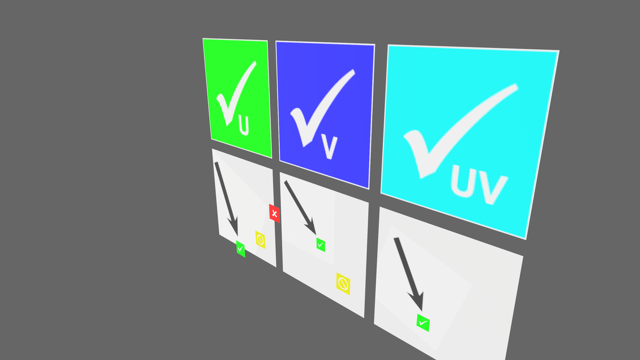
## Changelog
Support for the
[KHR_texture_transform](https://github.com/KhronosGroup/glTF/tree/main/extensions/2.0/Khronos/KHR_texture_transform)
extension added. Texture UVs that were scaled, rotated, or offset in a
GLTF are now properly handled.
---------
Co-authored-by: Al McElrath <hello@yrns.org>
Co-authored-by: Kanabenki <lucien.menassol@gmail.com>
# Objective

- Address #10338

## Solution

- When implementing specular and diffuse transmission, I inadvertently
introduced a performance regression. On high-end hardware it is barely
noticeable, but **for lower-end hardware it can be pretty brutal**. If I
understand it correctly, this is likely due to use of masking by the GPU
to implement control flow, which means that you still pay the price for
the branches you don't take;
- To avoid that, this PR introduces new shader defs (controlled via
`StandardMaterialKey`) that conditionally include the transmission
logic, that way the shader code for both types of transmission isn't
even sent to the GPU if you're not using them;
- This PR also renames ~~`STANDARDMATERIAL_NORMAL_MAP`~~ to
`STANDARD_MATERIAL_NORMAL_MAP` for consistency with the naming
convention used elsewhere in the codebase. (Drive-by fix)

---

## Changelog

- Added new shader defs, set when using transmission in the
`StandardMaterial`:
  - `STANDARD_MATERIAL_SPECULAR_TRANSMISSION`;
  - `STANDARD_MATERIAL_DIFFUSE_TRANSMISSION`;
  - `STANDARD_MATERIAL_SPECULAR_OR_DIFFUSE_TRANSMISSION`.
- Fixed performance regression caused by the introduction of
transmission, by gating transmission shader logic behind the newly
introduced shader defs;
- Renamed ~~`STANDARDMATERIAL_NORMAL_MAP`~~ to
`STANDARD_MATERIAL_NORMAL_MAP` for consistency;

## Migration Guide

- If you were using `#ifdef STANDARDMATERIAL_NORMAL_MAP` on your shader
code, make sure to update the name to `STANDARD_MATERIAL_NORMAL_MAP`;
(with an underscore between `STANDARD` and `MATERIAL`)

# Objective
Lightmaps, textures that store baked global illumination, have been a
mainstay of real-time graphics for decades. Bevy currently has no
support for them, so this pull request implements them.
## Solution
The new `Lightmap` component can be attached to any entity that contains
a `Handle<Mesh>` and a `StandardMaterial`. When present, it will be
applied in the PBR shader. Because multiple lightmaps are frequently
packed into atlases, each lightmap may have its own UV boundaries within
its texture. An `exposure` field is also provided, to control the
brightness of the lightmap.
Note that this PR doesn't provide any way to bake the lightmaps. That
can be done with [The Lightmapper] or another solution, such as Unity's
Bakery.
---
## Changelog
### Added
* A new component, `Lightmap`, is available, for baked global
illumination. If your mesh has a second UV channel (UV1), and you attach
this component to the entity with that mesh, Bevy will apply the texture
referenced in the lightmap.
[The Lightmapper]: https://github.com/Naxela/The_Lightmapper
---------
Co-authored-by: Carter Anderson <mcanders1@gmail.com>