# Objective

- Showcase the use of `or_else()` as requested. Fixes
https://github.com/bevyengine/bevy/issues/8702

## Solution

- Add an uninitialized resource `Unused`
- Use `or_else()` to evaluate a second run condition
- Add documentation explaining how `or_else()` works
# Objective


Since #8446, example `shader_prepass` logs the following error on my mac
m1:
```
ERROR bevy_render::render_resource::pipeline_cache: failed to process shader:
error: Entry point fragment at Fragment is invalid
 = Argument 1 varying error
 = Capability MULTISAMPLED_SHADING is not supported
```
The example display the 3d scene but doesn't change with the preps
selected

Maybe related to this update in naga:
cc3a8ac737

## Solution

- Disable MSAA in the example, and check if it's enabled in the shader
# Objective

- fix clippy lints early to make sure CI doesn't break when they get
promoted to stable
- have a noise-free `clippy` experience for nightly users

## Solution

- `cargo clippy --fix`
- replace `filter_map(|x| x.ok())` with `map_while(|x| x.ok())` to fix
potential infinite loop in case of IO error
# Objective

Fix the examples many_buttons and many_glyphs not working on the WebGPU
examples page. Currently they both fail with the follow error:

```
panicked at 'Only FIFO/Auto* is supported on web', ..../wgpu-0.16.0/src/backend/web.rs:1162:13
```

## Solution

Change `present_mode` from `PresentMode::Immediate` to
`PresentMode::AutoNoVsync`. AutoNoVsync seems to be common mode used by
other examples of this kind.
# Objective

- Simplify API and make authoring styles easier

See:
https://github.com/bevyengine/bevy/issues/8540#issuecomment-1536177102

## Solution

- The `size`, `min_size`, `max_size`, and `gap` properties have been
replaced by `width`, `height`, `min_width`, `min_height`, `max_width`,
`max_height`, `row_gap`, and `column_gap` properties

---

## Changelog

- Flattened `Style` properties that have a `Size` value directly into
`Style`

## Migration Guide

- The `size`, `min_size`, `max_size`, and `gap` properties have been
replaced by the `width`, `height`, `min_width`, `min_height`,
`max_width`, `max_height`, `row_gap`, and `column_gap` properties. Use
the new properties instead.

---------

Co-authored-by: ickshonpe <david.curthoys@googlemail.com>
# Objective
- Fix#5631
## Solution
- Wait 50ms (configurable) after the last modification event before
reloading an asset.
---
## Changelog
- `AssetPlugin::watch_for_changes` is now a `ChangeWatcher` instead of a
`bool`
- Fixed https://github.com/bevyengine/bevy/issues/5631
## Migration Guide
- Replace `AssetPlugin::watch_for_changes: true` with e.g.
`ChangeWatcher::with_delay(Duration::from_millis(200))`
---------
Co-authored-by: François <mockersf@gmail.com>
# Objective

- Cleanup file tree

## Solution

A mysterious mod.rs lies in the scene_viewer directory. It seems
completely useless, everything ignores it and it doesn't affect
anything.

We cruelly remove it, making the world a less whimsical place. A
dystopian drive for pure and complete order compels us to eliminate all
that is useless, for clarity and to prevent the wonder and beauty of
confusion.
# Objective

`ScheduleRunnerPlugin` was still configured via a resource, meaning
users would be able to change the settings while the app is running, but
the changes wouldn't have an effect.

## Solution

Configure plugin directly

---

## Changelog

- Changed: merged `ScheduleRunnerSettings` into `ScheduleRunnerPlugin`

## Migration Guide

- instead of inserting the `ScheduleRunnerSettings` resource, configure
the `ScheduleRunnerPlugin`
# Objective
Frustum culling for 2D components has been enabled since #7885,
Fixes#8490
## Solution
Re-introduced the comments about frustum culling in the
many_animated_sprites.rs and many_sprites.rs examples.
---------
Co-authored-by: Nicola Papale <nicopap@users.noreply.github.com>
Co-authored-by: François <mockersf@gmail.com>
# Objective
- Support WebGPU
- alternative to #5027 that doesn't need any async / await
- fixes#8315
- Surprise fix#7318
## Solution
### For async renderer initialisation
- Update the plugin lifecycle:
- app builds the plugin
- calls `plugin.build`
- registers the plugin
- app starts the event loop
- event loop waits for `ready` of all registered plugins in the same
order
- returns `true` by default
- then call all `finish` then all `cleanup` in the same order as
registered
- then execute the schedule
In the case of the renderer, to avoid anything async:
- building the renderer plugin creates a detached task that will send
back the initialised renderer through a mutex in a resource
- `ready` will wait for the renderer to be present in the resource
- `finish` will take that renderer and place it in the expected
resources by other plugins
- other plugins (that expect the renderer to be available) `finish` are
called and they are able to set up their pipelines
- `cleanup` is called, only custom one is still for pipeline rendering
### For WebGPU support
- update the `build-wasm-example` script to support passing `--api
webgpu` that will build the example with WebGPU support
- feature for webgl2 was always enabled when building for wasm. it's now
in the default feature list and enabled on all platforms, so check for
this feature must also check that the target_arch is `wasm32`
---
## Migration Guide
- `Plugin::setup` has been renamed `Plugin::cleanup`
- `Plugin::finish` has been added, and plugins adding pipelines should
do it in this function instead of `Plugin::build`
```rust
// Before
impl Plugin for MyPlugin {
fn build(&self, app: &mut App) {
app.insert_resource::<MyResource>
.add_systems(Update, my_system);
let render_app = match app.get_sub_app_mut(RenderApp) {
Ok(render_app) => render_app,
Err(_) => return,
};
render_app
.init_resource::<RenderResourceNeedingDevice>()
.init_resource::<OtherRenderResource>();
}
}
// After
impl Plugin for MyPlugin {
fn build(&self, app: &mut App) {
app.insert_resource::<MyResource>
.add_systems(Update, my_system);
let render_app = match app.get_sub_app_mut(RenderApp) {
Ok(render_app) => render_app,
Err(_) => return,
};
render_app
.init_resource::<OtherRenderResource>();
}
fn finish(&self, app: &mut App) {
let render_app = match app.get_sub_app_mut(RenderApp) {
Ok(render_app) => render_app,
Err(_) => return,
};
render_app
.init_resource::<RenderResourceNeedingDevice>();
}
}
```
# Objective

- Enable taking a screenshot in wasm
- Followup on #7163

## Solution

- Create a blob from the image data, generate a url to that blob, add an
`a` element to the document linking to that url, click on that element,
then revoke the url
- This will automatically trigger a download of the screenshot file in
the browser
# Objective

- Standardize on screen instructions in examples:
  - top left, bottom left when better
  - white, black when better
  - same margin (12px) and font size (20)

## Solution

- Started with a few examples, let's reach consensus then document and
open issues for the rest
# Objective

Provide the ability to trigger controller rumbling (force-feedback) with
a cross-platform API.

## Solution

This adds the `GamepadRumbleRequest` event to `bevy_input` and adds a
system in `bevy_gilrs` to read them and rumble controllers accordingly.

It's a relatively primitive API with a `duration` in seconds and
`GamepadRumbleIntensity` with values for the weak and strong gamepad
motors. It's is an almost 1-to-1 mapping to platform APIs. Some
platforms refer to these motors as left and right, and low frequency and
high frequency, but by convention, they're usually the same.

I used #3868 as a starting point, updated to main, removed the low-level
gilrs effect API, and moved the requests to `bevy_input` and exposed the
strong and weak intensities.

I intend this to hopefully be a non-controversial cross-platform
starting point we can build upon to eventually support more fine-grained
control (closer to the gilrs effect API)

---

## Changelog

### Added

- Gamepads can now be rumbled by sending the `GamepadRumbleRequest`
event.

---------

Co-authored-by: Nicola Papale <nico@nicopap.ch>
Co-authored-by: Alice Cecile <alice.i.cecile@gmail.com>
Co-authored-by: Nicola Papale <nicopap@users.noreply.github.com>
Co-authored-by: Bruce Reif (Buswolley) <bruce.reif@dynata.com>
# Objective
Add a bounding box gizmo
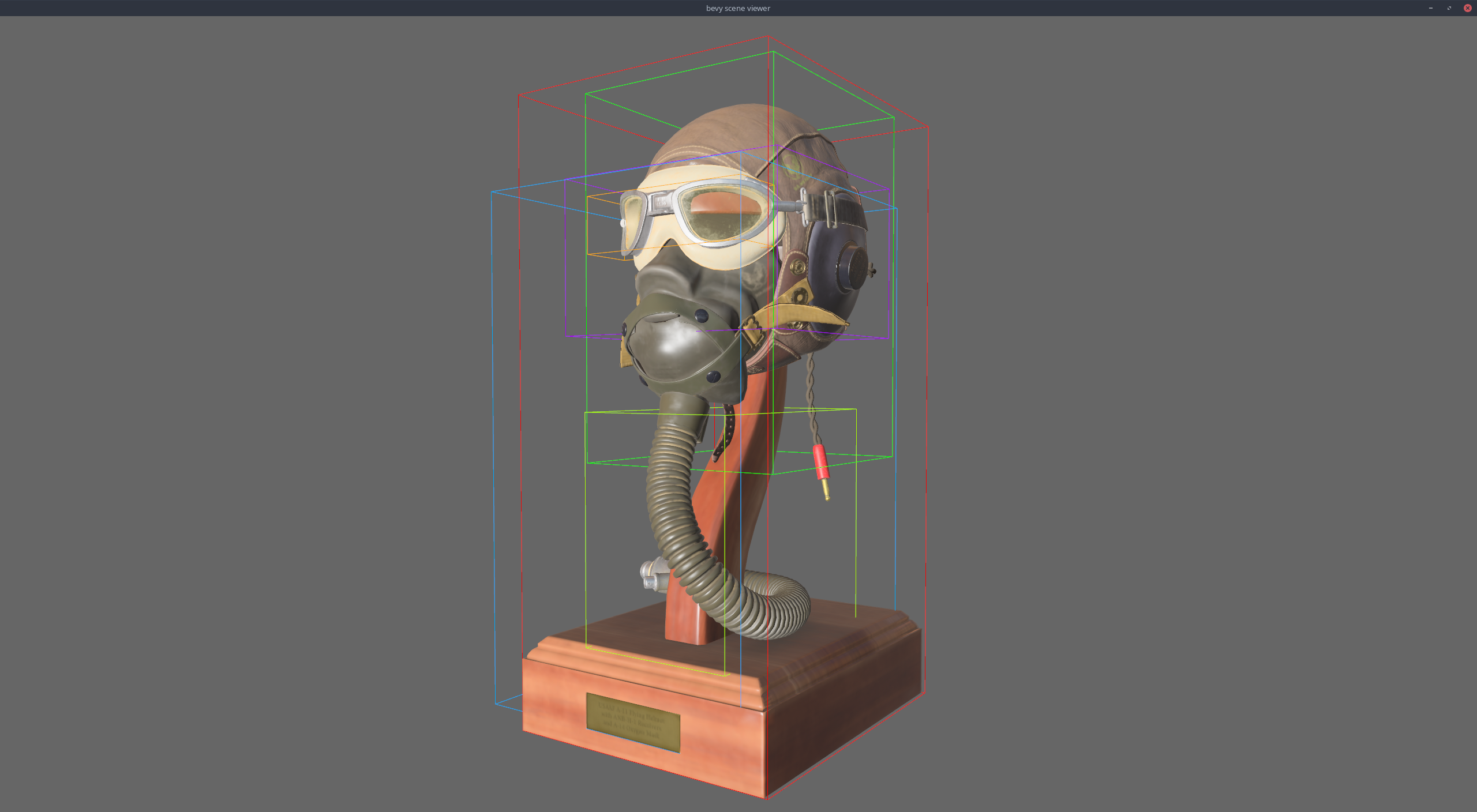
## Changes
- Added the `AabbGizmo` component that will draw the `Aabb` component on
that entity.
- Added an option to draw all bounding boxes in a scene on the
`GizmoConfig` resource.
- Added `TransformPoint` trait to generalize over the point
transformation methods on various transform types (e.g `Transform` and
`GlobalTransform`).
- Changed the `Gizmos::cuboid` method to accept an `impl TransformPoint`
instead of separate translation, rotation, and scale.
# Objective

The objective is to be able to load data from "application-specific"
(see glTF spec 3.7.2.1.) vertex attribute semantics from glTF files into
Bevy meshes.

## Solution

Rather than probe the glTF for the specific attributes supported by
Bevy, this PR changes the loader to iterate through all the attributes
and map them onto `MeshVertexAttribute`s. This mapping includes all the
previously supported attributes, plus it is now possible to add mappings
using the `add_custom_vertex_attribute()` method on `GltfPlugin`.

## Changelog

- Add support for loading custom vertex attributes from glTF files.
- Add the `custom_gltf_vertex_attribute.rs` example to illustrate
loading custom vertex attributes.

## Migration Guide

- If you were instantiating `GltfPlugin` using the unit-like struct
syntax, you must instead use `GltfPlugin::default()` as the type is no
longer unit-like.
Links in the api docs are nice. I noticed that there were several places
where structs / functions and other things were referenced in the docs,
but weren't linked. I added the links where possible / logical.

---------

Co-authored-by: Alice Cecile <alice.i.cecile@gmail.com>
Co-authored-by: François <mockersf@gmail.com>
# Objective

- Enabling AlphaMode::Opaque in the shader_prepass example crashes. The
issue seems to be that enabling opaque also generates vertex_uvs

Fixes https://github.com/bevyengine/bevy/issues/8273

## Solution

- Use the vertex_uvs in the shader if they are present
# Objective

- Have a default font

## Solution

- Add a font based on FiraMono containing only ASCII characters and use
it as the default font
- It is behind a feature `default_font` enabled by default
- I also updated examples to use it, but not UI examples to still show
how to use a custom font

---

## Changelog

* If you display text without using the default handle provided by
`TextStyle`, the text will be displayed
# Objective

Added the possibility to draw arcs in 2d via gizmos

## Solution

- Added `arc_2d` function to `Gizmos`
- Added `arc_inner` function
- Added `Arc2dBuilder<'a, 's>`
- Updated `2d_gizmos.rs` example to draw an arc

---------

Co-authored-by: kjolnyr <kjolnyr@protonmail.ch>
Co-authored-by: Alice Cecile <alice.i.cecile@gmail.com>
Co-authored-by: ira <JustTheCoolDude@gmail.com>
Fixes https://github.com/bevyengine/bevy/issues/1207

# Objective

Right now, it's impossible to capture a screenshot of the entire window
without forking bevy. This is because
- The swapchain texture never has the COPY_SRC usage
- It can't be accessed without taking ownership of it
- Taking ownership of it breaks *a lot* of stuff

## Solution

- Introduce a dedicated api for taking a screenshot of a given bevy
window, and guarantee this screenshot will always match up with what
gets put on the screen.

---

## Changelog

- Added the `ScreenshotManager` resource with two functions,
`take_screenshot` and `save_screenshot_to_disk`
# Objective

Split the UI overflow enum so that overflow can be set for each axis
separately.

## Solution

Change `Overflow` from an enum to a struct with `x` and `y`
`OverflowAxis` fields, where `OverflowAxis` is an enum with `Clip` and
`Visible` variants. Modify `update_clipping` to calculate clipping for
each axis separately. If only one axis is clipped, the other axis is
given infinite bounds.

<img width="642" alt="overflow"
src="https://user-images.githubusercontent.com/27962798/227592983-568cf76f-7e40-48c4-a511-43c886f5e431.PNG">

---

## Changelog
* Split the UI overflow implementation so overflow can be set for each
axis separately.
* Added the enum `OverflowAxis` with `Clip` and `Visible` variants.
* Changed `Overflow` to a struct with `x` and `y` fields of type
`OverflowAxis`.
* `Overflow` has new methods `visible()` and `hidden()` that replace its
previous `Clip` and `Visible` variants.
* Added `Overflow` helper methods `clip_x()` and `clip_y()` that return
a new `Overflow` value with the given axis clipped.
* Modified `update_clipping` so it calculates clipping for each axis
separately. If a node is only clipped on a single axis, the other axis
is given `-f32::INFINITY` to `f32::INFINITY` clipping bounds.


## Migration Guide

The `Style` property `Overflow` is now a struct with `x` and `y` fields,
that allow for per-axis overflow control.

Use these helper functions to replace the variants of `Overflow`:
* Replace `Overflow::Visible` with  `Overflow::visible()`
* Replace `Overflow::Hidden` with `Overflow::clip()`
# Objective

Followup to #7779 which tweaks the actual text measurement algorithm to
be more robust.

Before:

<img width="822" alt="Screenshot 2023-04-17 at 18 12 05"
src="https://user-images.githubusercontent.com/1007307/232566858-3d3f0fd5-f3d4-400a-8371-3c2a3f541e56.png">

After:

<img width="810" alt="Screenshot 2023-04-17 at 18 41 40"
src="https://user-images.githubusercontent.com/1007307/232566919-4254cbfa-1cc3-4ea7-91ed-8ca1b759bacf.png">

(note extra space taken up in header in before example)

## Solution

- Text layout of horizontal text (currently the only kind of text we
support) is now based solely on the layout constraints in the horizontal
axis. It ignores constraints in the vertical axis and computes vertical
size based on wrapping subject to the horizontal axis constraints.
- I've also added a paragraph to the `grid` example for testing / demo
purposes.
# Objective

An easy way to create 2D grid layouts

## Solution

Enable the `grid` feature in Taffy and add new style types for defining
grids.

## Notes

- ~I'm having a bit of trouble getting `#[derive(Reflect)]` to work
properly. Help with that would be appreciated (EDIT: got it to compile
by ignoring the problematic fields, but this presumably can't be
merged).~ This is now fixed
- ~The alignment types now have a `Normal` variant because I couldn't
get reflect to work with `Option`.~ I've decided to stick with the
flattened variant, as it saves a level of wrapping when authoring
styles. But I've renamed the variants from `Normal` to `Default`.
- ~This currently exposes a simplified API on top of grid. In particular
the following is not currently supported:~
   - ~Negative grid indices~ Now supported.
- ~Custom `end` values for grid placement (you can only use `start` and
`span`)~ Now supported
- ~`minmax()` track sizing functions~ minmax is now support through a
`GridTrack::minmax()` constructor
   - ~`repeat()`~ repeat is now implemented as `RepeatedGridTrack`

- ~Documentation still needs to be improved.~ An initial pass over the
documentation has been completed.

## Screenshot

<img width="846" alt="Screenshot 2023-03-10 at 17 56 21"
src="https://user-images.githubusercontent.com/1007307/224435332-69aa9eac-123d-4856-b75d-5449d3f1d426.png">

---

## Changelog

- Support for CSS Grid layout added to `bevy_ui`

---------

Co-authored-by: Rob Parrett <robparrett@gmail.com>
Co-authored-by: Andreas Weibye <13300393+Weibye@users.noreply.github.com>
# Objective

Examples on how to use the freshly merged `Bezier` struct ( #7653 ) are
missing.

## Solution

- Added a `bezier_curve.rs` example in the `animation/` folder.

---------

Co-authored-by: ira <JustTheCoolDude@gmail.com>
Co-authored-by: Aevyrie <aevyrie@gmail.com>
# Objective

Bevy provides an easy way to build the `examples/README.md` page, but
it's difficult to discover.
By adding instructions in `CONTRIBUTING.md`, it's easier to find that
it's possible to avoid this error-prone manual process.

Precisely: #8405 took me about 1 additional hour searching what command
to use to generate automatically the file. (I could have manually edited
the README, but that's beyond the point…)