9e4c07238b
70 Commits
| Author | SHA1 | Message | Date | |
|---|---|---|---|---|
 Zachary Harrold
|
21786632c3
|
Remove bevy_core (#16897)
# Objective - Fixes #16892 ## Solution - Removed `TypeRegistryPlugin` (`Name` is now automatically registered with a default `App`) - Moved `TaskPoolPlugin` to `bevy_app` - Moved `FrameCountPlugin` to `bevy_diagnostic` - Deleted now-empty `bevy_core` ## Testing - CI ## Migration Guide - `TypeRegistryPlugin` no longer exists. If you can't use a default `App` but still need `Name` registered, do so manually with `app.register_type::<Name>()`. - References to `TaskPoolPlugin` and associated types will need to import it from `bevy_app` instead of `bevy_core` - References to `FrameCountPlugin` and associated types will need to import it from `bevy_diagnostic` instead of `bevy_core` ## Notes This strategy was agreed upon by Cart and several other members in [Discord](https://discord.com/channels/691052431525675048/692572690833473578/1319137218312278077). |
||
|
Zachary Harrold
|
f45e78e658
|
Add no_std support to bevy_app (#16874)
# Objective - Contributes to #15460 ## Solution - Added the following features: - `std` (default) - `bevy_tasks` (default) - `downcast ` (default) - `portable-atomic` - `critical-section` - `downcast` and `bevy_tasks` are now optional dependencies for `bevy_app`. ## Testing - CI - Personal UEFI and Raspberry Pi Pico demo applications compile and run against this branch ## Draft Release Notes Bevy's application framework now supports `no_std` platforms. Following up on `bevy_ecs` gaining `no_std` support, `bevy_app` extends the functionality available on these targets to include the powerful `App` and `Plugin` abstractions. With this, library authors now have the option of making their plugins `no_std` compatible, or even offering plugins specifically to improve Bevy on certain embedded platforms! To start making a `no_std` compatible plugin, simply disable default features when including `bevy_app`: ```toml [dependencies] bevy_app = { version = "0.16", default-features = false } ``` We encourage library authors to do this anyway, as it can also help with compile times and binary size on all platforms. Keep an eye out for future `no_std` updates as we continue to improve the parity between `std` and `no_std`. We look forward to seeing what kinds of applications are now possible with Bevy! ## Notes - `downcast-rs` is optional as it isn't compatible with `portable-atomic`. I will investigate making a PR upstream to add support for this functionality, as it should be very straightforward. - In line with the `bevy_ecs` no-std-ification, I've added documentation to all features, and grouped them as well. - ~~Creating this PR in draft while CI runs and so I can polish before review.~~ --------- Co-authored-by: Alice Cecile <alice.i.cecile@gmail.com> |
||
|
Rich Churcher
|
f2719f5470
|
Rust 1.83, allow -> expect (missing_docs) (#16561)
# Objective We were waiting for 1.83 to address most of these, due to a bug with `missing_docs` and `expect`. Relates to, but does not entirely complete, #15059. ## Solution - Upgrade to 1.83 - Switch `allow(missing_docs)` to `expect(missing_docs)` - Remove a few now-unused `allow`s along the way, or convert to `expect` |
||
|
Benjamin Brienen
|
c841dd92a1
|
Documentation for variadics (#15387)
# Objective Relevant: #15208 ## Solution I went ahead and added the variadics documentation in all applicable locations. ## Testing - I built the documentation and inspected it to see whether the feature is there. |
||
|
Zachary Harrold
|
d70595b667
|
Add core and alloc over std Lints (#15281)
# Objective - Fixes #6370 - Closes #6581 ## Solution - Added the following lints to the workspace: - `std_instead_of_core` - `std_instead_of_alloc` - `alloc_instead_of_core` - Used `cargo +nightly fmt` with [item level use formatting](https://rust-lang.github.io/rustfmt/?version=v1.6.0&search=#Item%5C%3A) to split all `use` statements into single items. - Used `cargo clippy --workspace --all-targets --all-features --fix --allow-dirty` to _attempt_ to resolve the new linting issues, and intervened where the lint was unable to resolve the issue automatically (usually due to needing an `extern crate alloc;` statement in a crate root). - Manually removed certain uses of `std` where negative feature gating prevented `--all-features` from finding the offending uses. - Used `cargo +nightly fmt` with [crate level use formatting](https://rust-lang.github.io/rustfmt/?version=v1.6.0&search=#Crate%5C%3A) to re-merge all `use` statements matching Bevy's previous styling. - Manually fixed cases where the `fmt` tool could not re-merge `use` statements due to conditional compilation attributes. ## Testing - Ran CI locally ## Migration Guide The MSRV is now 1.81. Please update to this version or higher. ## Notes - This is a _massive_ change to try and push through, which is why I've outlined the semi-automatic steps I used to create this PR, in case this fails and someone else tries again in the future. - Making this change has no impact on user code, but does mean Bevy contributors will be warned to use `core` and `alloc` instead of `std` where possible. - This lint is a critical first step towards investigating `no_std` options for Bevy. --------- Co-authored-by: François Mockers <francois.mockers@vleue.com> |
||
|
BD103
|
6ec6a55645
|
Unify crate-level preludes (#15080)
# Objective

- Crate-level prelude modules, such as `bevy_ecs::prelude`, are plagued
with inconsistency! Let's fix it!

## Solution

Format all preludes based on the following rules:

1. All preludes should have brief documentation in the format of:
   > The _name_ prelude.
   >
> This includes the most common types in this crate, re-exported for
your convenience.
2. All documentation should be outer, not inner. (`///` instead of
`//!`.)
3. No prelude modules should be annotated with `#[doc(hidden)]`. (Items
within them may, though I'm not sure why this was done.)

## Testing

- I manually searched for the term `mod prelude` and updated all
occurrences by hand. 🫠

---------

Co-authored-by: Gino Valente <49806985+MrGVSV@users.noreply.github.com>
|
||
|
Jan Hohenheim
|
c92ee31779
|
Allow ordering variable timesteps around fixed timesteps (#14881)
# Objective - Fixes #14873, see that issue for a whole lot of context ## Solution - Add a blessed system set for this stuff. See [this Discord discussion](https://discord.com/channels/691052431525675048/749335865876021248/1276262931327094908). Note that the gizmo systems, [LWIM](https://github.com/Leafwing-Studios/leafwing-input-manager/pull/522/files#diff-9b59ee4899ad0a5d008889ea89a124a7291316532e42f9f3d6ae842b906fb095R154) and now a new plugin I'm working on are all already ordering against `run_fixed_main_schedule`, so having a dedicated system set should be more robust and hopefully also more discoverable. --- ## ~~Showcase~~ ~~I can add a little video of a smooth camera later if this gets merged :)~~ Apparently a release note is not needed, so I'll leave it out. See the changes in the fixed timestep example for usage showcase and the video in #14873 for a more or less accurate video of the effect (it does not use the same solution though, so it is not quite the same) ## Migration Guide [run_fixed_main_schedule](https://docs.rs/bevy/latest/bevy/time/fn.run_fixed_main_schedule.html) is no longer public. If you used to order against it, use the new dedicated `RunFixedMainLoopSystem` system set instead. You can replace your usage of `run_fixed_main_schedule` one for one by `RunFixedMainLoopSystem::FixedMainLoop`, but it is now more idiomatic to place your systems in either `RunFixedMainLoopSystem::BeforeFixedMainLoop` or `RunFixedMainLoopSystem::AfterFixedMainLoop` Old: ```rust app.add_systems( RunFixedMainLoop, some_system.before(run_fixed_main_schedule) ); ``` New: ```rust app.add_systems( RunFixedMainLoop, some_system.in_set(RunFixedMainLoopSystem::BeforeFixedMainLoop) ); ``` --------- Co-authored-by: Tau Gärtli <git@tau.garden> |
||
|
BD103
|
d722fef23d
|
Remove deprecated bevy_dynamic_plugin (#14534)
# Objective - Dynamic plugins were deprecated in #13080 due to being unsound. The plan was to deprecate them in 0.14 and remove them in 0.15. ## Solution - Remove all dynamic plugin functionality. - Update documentation to reflect this change. --- ## Migration Guide Dynamic plugins were deprecated in 0.14 for being unsound, and they have now been fully removed. Please consider using the alternatives listed in the `bevy_dynamic_plugin` crate documentation, or worst-case scenario you may copy the code from 0.14. |
||
|
Sarthak Singh
|
f607be8777
|
Handle Ctrl+C in the terminal properly (#14001)
# Objective Fixes #13995. ## Solution Override the default `Ctrl+C` handler with one that sends `AppExit` event to every app with `TerminalCtrlCHandlerPlugin`. ## Testing Tested by running the `3d_scene` example and hitting `Ctrl+C` in the terminal. --- ## Changelog Handles `Ctrl+C` in the terminal gracefully. ## Migration Guide If you are overriding the `Ctrl+C` handler then you should call `TerminalCtrlCHandlerPlugin::gracefully_exit` from your handler. It will tell the app to exit. |
||
|
Lee-Orr
|
b8832dc862
|
Computed State & Sub States (#11426)
## Summary/Description This PR extends states to allow support for a wider variety of state types and patterns, by providing 3 distinct types of state: - Standard [`States`] can only be changed by manually setting the [`NextState<S>`] resource. These states are the baseline on which the other state types are built, and can be used on their own for many simple patterns. See the [state example](https://github.com/bevyengine/bevy/blob/latest/examples/ecs/state.rs) for a simple use case - these are the states that existed so far in Bevy. - [`SubStates`] are children of other states - they can be changed manually using [`NextState<S>`], but are removed from the [`World`] if the source states aren't in the right state. See the [sub_states example](https://github.com/lee-orr/bevy/blob/derived_state/examples/ecs/sub_states.rs) for a simple use case based on the derive macro, or read the trait docs for more complex scenarios. - [`ComputedStates`] are fully derived from other states - they provide a [`compute`](ComputedStates::compute) method that takes in the source states and returns their derived value. They are particularly useful for situations where a simplified view of the source states is necessary - such as having an `InAMenu` computed state derived from a source state that defines multiple distinct menus. See the [computed state example](https://github.com/lee-orr/bevy/blob/derived_state/examples/ecs/computed_states.rscomputed_states.rs) to see a sampling of uses for these states. # Objective This PR is another attempt at allowing Bevy to better handle complex state objects in a manner that doesn't rely on strict equality. While my previous attempts (https://github.com/bevyengine/bevy/pull/10088 and https://github.com/bevyengine/bevy/pull/9957) relied on complex matching capacities at the point of adding a system to application, this one instead relies on deterministically deriving simple states from more complex ones. As a result, it does not require any special macros, nor does it change any other interactions with the state system once you define and add your derived state. It also maintains a degree of distinction between `State` and just normal application state - your derivations have to end up being discreet pre-determined values, meaning there is less of a risk/temptation to place a significant amount of logic and data within a given state. ### Addition - Sub States closes #9942 After some conversation with Maintainers & SMEs, a significant concern was that people might attempt to use this feature as if it were sub-states, and find themselves unable to use it appropriately. Since `ComputedState` is mainly a state matching feature, while `SubStates` are more of a state mutation related feature - but one that is easy to add with the help of the machinery introduced by `ComputedState`, it was added here as well. The relevant discussion is here: https://discord.com/channels/691052431525675048/1200556329803186316 ## Solution closes #11358 The solution is to create a new type of state - one implementing `ComputedStates` - which is deterministically tied to one or more other states. Implementors write a function to transform the source states into the computed state, and it gets triggered whenever one of the source states changes. In addition, we added the `FreelyMutableState` trait , which is implemented as part of the derive macro for `States`. This allows us to limit use of `NextState<S>` to states that are actually mutable, preventing mis-use of `ComputedStates`. --- ## Changelog - Added `ComputedStates` trait - Added `FreelyMutableState` trait - Converted `NextState` resource to an Enum, with `Unchanged` and `Pending` - Added `App::add_computed_state::<S: ComputedStates>()`, to allow for easily adding derived states to an App. - Moved the `StateTransition` schedule label from `bevy_app` to `bevy_ecs` - but maintained the export in `bevy_app` for continuity. - Modified the process for updating states. Instead of just having an `apply_state_transition` system that can be added anywhere, we now have a multi-stage process that has to run within the `StateTransition` label. First, all the state changes are calculated - manual transitions rely on `apply_state_transition`, while computed transitions run their computation process before both call `internal_apply_state_transition` to apply the transition, send out the transition event, trigger dependent states, and record which exit/transition/enter schedules need to occur. Once all the states have been updated, the transition schedules are called - first the exit schedules, then transition schedules and finally enter schedules. - Added `SubStates` trait - Adjusted `apply_state_transition` to be a no-op if the `State<S>` resource doesn't exist ## Migration Guide If the user accessed the NextState resource's value directly or created them from scratch they will need to adjust to use the new enum variants: - if they created a `NextState(Some(S))` - they should now use `NextState::Pending(S)` - if they created a `NextState(None)` -they should now use `NextState::Unchanged` - if they matched on the `NextState` value, they would need to make the adjustments above If the user manually utilized `apply_state_transition`, they should instead use systems that trigger the `StateTransition` schedule. --- ## Future Work There is still some future potential work in the area, but I wanted to keep these potential features and changes separate to keep the scope here contained, and keep the core of it easy to understand and use. However, I do want to note some of these things, both as inspiration to others and an illustration of what this PR could unlock. - `NextState::Remove` - Now that the `State` related mechanisms all utilize options (#11417), it's fairly easy to add support for explicit state removal. And while `ComputedStates` can add and remove themselves, right now `FreelyMutableState`s can't be removed from within the state system. While it existed originally in this PR, it is a different question with a separate scope and usability concerns - so having it as it's own future PR seems like the best approach. This feature currently lives in a separate branch in my fork, and the differences between it and this PR can be seen here: https://github.com/lee-orr/bevy/pull/5 - `NextState::ReEnter` - this would allow you to trigger exit & entry systems for the current state type. We can potentially also add a `NextState::ReEnterRecirsive` to also re-trigger any states that depend on the current one. - More mechanisms for `State` updates - This PR would finally make states that aren't a set of exclusive Enums useful, and with that comes the question of setting state more effectively. Right now, to update a state you either need to fully create the new state, or include the `Res<Option<State<S>>>` resource in your system, clone the state, mutate it, and then use `NextState.set(my_mutated_state)` to make it the pending next state. There are a few other potential methods that could be implemented in future PRs: - Inverse Compute States - these would essentially be compute states that have an additional (manually defined) function that can be used to nudge the source states so that they result in the computed states having a given value. For example, you could use set the `IsPaused` state, and it would attempt to pause or unpause the game by modifying the `AppState` as needed. - Closure-based state modification - this would involve adding a `NextState.modify(f: impl Fn(Option<S> -> Option<S>)` method, and then you can pass in closures or function pointers to adjust the state as needed. - Message-based state modification - this would involve either creating states that can respond to specific messages, similar to Elm or Redux. These could either use the `NextState` mechanism or the Event mechanism. - ~`SubStates` - which are essentially a hybrid of computed and manual states. In the simplest (and most likely) version, they would work by having a computed element that determines whether the state should exist, and if it should has the capacity to add a new version in, but then any changes to it's content would be freely mutated.~ this feature is now part of this PR. See above. - Lastly, since states are getting more complex there might be value in moving them out of `bevy_ecs` and into their own crate, or at least out of the `schedule` module into a `states` module. #11087 As mentioned, all these future work elements are TBD and are explicitly not part of this PR - I just wanted to provide them as potential explorations for the future. --------- Co-authored-by: Alice Cecile <alice.i.cecile@gmail.com> Co-authored-by: Marcel Champagne <voiceofmarcel@gmail.com> Co-authored-by: MiniaczQ <xnetroidpl@gmail.com> |
||
|
Brezak
|
de875fdc4c
|
Make AppExit more specific about exit reason. (#13022)
# Objective Closes #13017. ## Solution - Make `AppExit` a enum with a `Success` and `Error` variant. - Make `App::run()` return a `AppExit` if it ever returns. - Make app runners return a `AppExit` to signal if they encountered a error. --- ## Changelog ### Added - [`App::should_exit`](https://example.org/) - [`AppExit`](https://docs.rs/bevy/latest/bevy/app/struct.AppExit.html) to the `bevy` and `bevy_app` preludes, ### Changed - [`AppExit`](https://docs.rs/bevy/latest/bevy/app/struct.AppExit.html) is now a enum with 2 variants (`Success` and `Error`). - The app's [runner function](https://docs.rs/bevy/latest/bevy/app/struct.App.html#method.set_runner) now has to return a `AppExit`. - [`App::run()`](https://docs.rs/bevy/latest/bevy/app/struct.App.html#method.run) now also returns the `AppExit` produced by the runner function. ## Migration Guide - Replace all usages of [`AppExit`](https://docs.rs/bevy/latest/bevy/app/struct.AppExit.html) with `AppExit::Success` or `AppExit::Failure`. - Any custom app runners now need to return a `AppExit`. We suggest you return a `AppExit::Error` if any `AppExit` raised was a Error. You can use the new [`App::should_exit`](https://example.org/) method. - If not exiting from `main` any other way. You should return the `AppExit` from `App::run()` so the app correctly returns a error code if anything fails e.g. ```rust fn main() -> AppExit { App::new() //Your setup here... .run() } ``` --------- Co-authored-by: Alice Cecile <alice.i.cecile@gmail.com> |
||
|
Cameron
|
01649f13e2
|
Refactor App and SubApp internals for better separation (#9202)
# Objective This is a necessary precursor to #9122 (this was split from that PR to reduce the amount of code to review all at once). Moving `!Send` resource ownership to `App` will make it unambiguously `!Send`. `SubApp` must be `Send`, so it can't wrap `App`. ## Solution Refactor `App` and `SubApp` to not have a recursive relationship. Since `SubApp` no longer wraps `App`, once `!Send` resources are moved out of `World` and into `App`, `SubApp` will become unambiguously `Send`. There could be less code duplication between `App` and `SubApp`, but that would break `App` method chaining. ## Changelog - `SubApp` no longer wraps `App`. - `App` fields are no longer publicly accessible. - `App` can no longer be converted into a `SubApp`. - Various methods now return references to a `SubApp` instead of an `App`. ## Migration Guide - To construct a sub-app, use `SubApp::new()`. `App` can no longer convert into `SubApp`. - If you implemented a trait for `App`, you may want to implement it for `SubApp` as well. - If you're accessing `app.world` directly, you now have to use `app.world()` and `app.world_mut()`. - `App::sub_app` now returns `&SubApp`. - `App::sub_app_mut` now returns `&mut SubApp`. - `App::get_sub_app` now returns `Option<&SubApp>.` - `App::get_sub_app_mut` now returns `Option<&mut SubApp>.` |
||
|
Gabriel Kwong
|
d8383fb535
|
Move PanicHandlerPlugin into bevy_app (#12640)
# Objective - Move `PanicHandlerPlugin` into `bevy_app` - Fixes #12603 . ## Solution - I moved the `bevy_panic_handler` into `bevy_app` - Copy pasted `bevy_panic_handler`'s lib.rs into a separate module in `bevy_app` as a `panic_handler.rs` module file and added the `PanicHandlerPlugin` in lib.rs of `bevy_app` - added the dependency into `cargo.toml` ## Review notes - I probably want some feedback if I imported App and Plugin correctly in `panic_handler.rs` line 10 and 11. - As of yet I have not deleted `bevy_panic_handler` crate, wanted to get a check if I added it correctly. - Once validated that my move was correct, I'll probably have to remove the panic handler find default plugins which I probably need some help to find. - And then remove bevy panic_handler and making sure ci passes. - This is my first issue for contributing to bevy so let me know if I am doing anything wrong. ## tools context - rust is 1.76 version - Windows 11 --------- Co-authored-by: Alice Cecile <alice.i.cecile@gmail.com> |
||
|
James Liu
|
56bcbb0975
|
Forbid unsafe in most crates in the engine (#12684)
# Objective Resolves #3824. `unsafe` code should be the exception, not the norm in Rust. It's obviously needed for various use cases as it's interfacing with platforms and essentially running the borrow checker at runtime in the ECS, but the touted benefits of Bevy is that we are able to heavily leverage Rust's safety, and we should be holding ourselves accountable to that by minimizing our unsafe footprint. ## Solution Deny `unsafe_code` workspace wide. Add explicit exceptions for the following crates, and forbid it in almost all of the others. * bevy_ecs - Obvious given how much unsafe is needed to achieve performant results * bevy_ptr - Works with raw pointers, even more low level than bevy_ecs. * bevy_render - due to needing to integrate with wgpu * bevy_window - due to needing to integrate with raw_window_handle * bevy_utils - Several unsafe utilities used by bevy_ecs. Ideally moved into bevy_ecs instead of made publicly usable. * bevy_reflect - Required for the unsafe type casting it's doing. * bevy_transform - for the parallel transform propagation * bevy_gizmos - For the SystemParam impls it has. * bevy_assets - To support reflection. Might not be required, not 100% sure yet. * bevy_mikktspace - due to being a conversion from a C library. Pending safe rewrite. * bevy_dynamic_plugin - Inherently unsafe due to the dynamic loading nature. Several uses of unsafe were rewritten, as they did not need to be using them: * bevy_text - a case of `Option::unchecked` could be rewritten as a normal for loop and match instead of an iterator. * bevy_color - the Pod/Zeroable implementations were replaceable with bytemuck's derive macros. |
||
|
James Liu
|
f096ad4155
|
Set the logo and favicon for all of Bevy's published crates (#12696)
# Objective Currently the built docs only shows the logo and favicon for the top level `bevy` crate. This makes views like https://docs.rs/bevy_ecs/latest/bevy_ecs/ look potentially unrelated to the project at first glance. ## Solution Reproduce the docs attributes for every crate that Bevy publishes. Ideally this would be done with some workspace level Cargo.toml control, but AFAICT, such support does not exist. |
||
|
Ame
|
72c51cdab9
|
Make feature(doc_auto_cfg) work (#12642)
# Objective - In #12366 `![cfg_attr(docsrs, feature(doc_auto_cfg))] `was added. But to apply it it needs `--cfg=docsrs` in rustdoc-args. ## Solution - Apply `--cfg=docsrs` to all crates and CI. I also added `[package.metadata.docs.rs]` to all crates to avoid adding code behind a feature and forget adding the metadata. Before:  After:  |
||
|
Al M
|
52e3f2007b
|
Add "all-features = true" to docs.rs metadata for most crates (#12366)
# Objective Fix missing `TextBundle` (and many others) which are present in the main crate as default features but optional in the sub-crate. See: - https://docs.rs/bevy/0.13.0/bevy/ui/node_bundles/index.html - https://docs.rs/bevy_ui/0.13.0/bevy_ui/node_bundles/index.html ~~There are probably other instances in other crates that I could track down, but maybe "all-features = true" should be used by default in all sub-crates? Not sure.~~ (There were many.) I only noticed this because rust-analyzer's "open docs" features takes me to the sub-crate, not the main one. ## Solution Add "all-features = true" to docs.rs metadata for crates that use features. ## Changelog ### Changed - Unified features documented on docs.rs between main crate and sub-crates |
||
|
Mateusz Wachowiak
|
6533170e94
|
Add bevy_dev_tools crate (#11341)
# Objective - Resolves #11309 ## Solution - Add `bevy_dev_tools` crate as a default feature. - Add `DevToolsPlugin` and add it to an app if the `bevy_dev_tools` feature is enabled. `bevy_dev_tools` is reserved by @alice-i-cecile, should we wait until it gets transferred to cart before merging? --------- Co-authored-by: Alice Cecile <alice.i.cecile@gmail.com> Co-authored-by: BD103 <59022059+BD103@users.noreply.github.com> |
||
|
Tristan Guichaoua
|
694c06f3d0
|
Inverse missing_docs logic (#11676)
# Objective Currently the `missing_docs` lint is allowed-by-default and enabled at crate level when their documentations is complete (see #3492). This PR proposes to inverse this logic by making `missing_docs` warn-by-default and mark crates with imcomplete docs allowed. ## Solution Makes `missing_docs` warn at workspace level and allowed at crate level when the docs is imcomplete. |
||
|
Aceeri
|
fe28e0ec32
|
Add First/Pre/Post/Last schedules to the Fixed timestep (#10977)
Fixes https://github.com/bevyengine/bevy/issues/10974 # Objective Duplicate the ordering logic of the `Main` schedule into the `FixedMain` schedule. --- ## Changelog - `FixedUpdate` is no longer the main schedule ran in `RunFixedUpdateLoop`, `FixedMain` has replaced this and has a similar structure to `Main`. ## Migration Guide - Usage of `RunFixedUpdateLoop` should be renamed to `RunFixedMainLoop`. |
||
|
Ame
|
951c9bb1a2
|
Add [lints] table, fix adding #![allow(clippy::type_complexity)] everywhere (#10011)
# Objective - Fix adding `#![allow(clippy::type_complexity)]` everywhere. like #9796 ## Solution - Use the new [lints] table that will land in 1.74 (https://doc.rust-lang.org/nightly/cargo/reference/unstable.html#lints) - inherit lint to the workspace, crates and examples. ``` [lints] workspace = true ``` ## Changelog - Bump rust version to 1.74 - Enable lints table for the workspace ```toml [workspace.lints.clippy] type_complexity = "allow" ``` - Allow type complexity for all crates and examples ```toml [lints] workspace = true ``` --------- Co-authored-by: Martín Maita <47983254+mnmaita@users.noreply.github.com> |
||
|
Hennadii Chernyshchyk
|
756b044f39
|
Add SpawnScene to prelude (#9451)
# Objective #9260 added this schedule, but it's not in prelude like other schedules. ## Solution Add to prelude. |
||
|
Nicola Papale
|
0294bb191d
|
Move AppTypeRegistry to bevy_ecs (#8901)
# Objective - Use `AppTypeRegistry` on API defined in `bevy_ecs` (https://github.com/bevyengine/bevy/pull/8895#discussion_r1234748418) A lot of the API on `Reflect` depends on a registry. When it comes to the ECS. We should use `AppTypeRegistry` in the general case. This is however impossible in `bevy_ecs`, since `AppTypeRegistry` is defined in `bevy_app`. ## Solution - Move `AppTypeRegistry` resource definition from `bevy_app` to `bevy_ecs` - Still add the resource in the `App` plugin, since bevy_ecs itself doesn't know of plugins Note that `bevy_ecs` is a dependency of `bevy_app`, so nothing revolutionary happens. ## Alternative - Define the API as a trait in `bevy_app` over `bevy_ecs`. (though this prevents us from using bevy_ecs internals) - Do not rely on `AppTypeRegistry` for the API in question, requring users to extract themselves the resource and pass it to the API methods. --- ## Changelog - Moved `AppTypeRegistry` resource definition from `bevy_app` to `bevy_ecs` ## Migration Guide - If you were **not** using a `prelude::*` to import `AppTypeRegistry`, you should update your imports: ```diff - use bevy::app::AppTypeRegistry; + use bevy::ecs::reflect::AppTypeRegistry ``` |
||
|
François
|
8070c29c21
|
Take example screenshots in CI (#8488)
# Objective - I want to take screenshots of examples in CI to help with validation of changes ## Solution - Can override how much time is updated per frame - Can specify on which frame to take a screenshots - Save screenshots in CI I reused the `TimeUpdateStrategy::ManualDuration` to be able to set the time update strategy to a fixed duration every frame. Its previous meaning didn't make much sense to me. This change makes it possible to have screenshots that are exactly the same across runs. If this gets merged, I'll add visual comparison of screenshots between runs to ensure nothing gets broken ## Migration Guide * `TimeUpdateStrategy::ManualDuration` meaning has changed. Instead of setting time to `Instant::now()` plus the given duration, it sets time to last update plus the given duration. |
||
|
JoJoJet
|
3ead10a3e0
|
Suppress the clippy::type_complexity lint (#8313)
# Objective The clippy lint `type_complexity` is known not to play well with bevy. It frequently triggers when writing complex queries, and taking the lint's advice of using a type alias almost always just obfuscates the code with no benefit. Because of this, this lint is currently ignored in CI, but unfortunately it still shows up when viewing bevy code in an IDE. As someone who's made a fair amount of pull requests to this repo, I will say that this issue has been a consistent thorn in my side. Since bevy code is filled with spurious, ignorable warnings, it can be very difficult to spot the *real* warnings that must be fixed -- most of the time I just ignore all warnings, only to later find out that one of them was real after I'm done when CI runs. ## Solution Suppress this lint in all bevy crates. This was previously attempted in #7050, but the review process ended up making it more complicated than it needs to be and landed on a subpar solution. The discussion in https://github.com/rust-lang/rust-clippy/pull/10571 explores some better long-term solutions to this problem. Since there is no timeline on when these solutions may land, we should resolve this issue in the meantime by locally suppressing these lints. ### Unresolved issues Currently, these lints are not suppressed in our examples, since that would require suppressing the lint in every single source file. They are still ignored in CI. |
||
|
Carter Anderson
|
aefe1f0739
|
Schedule-First: the new and improved add_systems (#8079)
Co-authored-by: Mike <mike.hsu@gmail.com> |
||
|
JoJoJet
|
fd1af7c8b8
|
Replace multiple calls to add_system with add_systems (#8001)
|
||
|
JoJoJet
|
b8263b55fb |
Support system.in_schedule() and system.on_startup() (#7790)
# Objective

Support the following syntax for adding systems:

```rust
App::new()
    .add_system(setup.on_startup())
    .add_systems((
        show_menu.in_schedule(OnEnter(GameState::Paused)),
        menu_ssytem.in_set(OnUpdate(GameState::Paused)),
        hide_menu.in_schedule(OnExit(GameState::Paused)),
    ))
```

## Solution

Add the traits `IntoSystemAppConfig{s}`, which provide the extension methods necessary for configuring which schedule a system belongs to. These extension methods return `IntoSystemAppConfig{s}`, which `App::add_system{s}` uses to choose which schedule to add systems to.

---

## Changelog

+ Added the extension methods `in_schedule(label)` and  `on_startup()` for configuring the schedule a system belongs to.

## Future Work

* Replace all uses of `add_startup_system` in the engine.
* Deprecate this method
|
||
|
TimJentzsch
|
9b7060c4d2 |
Make StartupSet a base set (#7574)
# Objective Closes #7573 - Make `StartupSet` a base set ## Solution - Add `#[system_set(base)]` to the enum declaration - Replace `.in_set(StartupSet::...)` with `.in_base_set(StartupSet::...)` **Note**: I don't really know what I'm doing and what exactly the difference between base and non-base sets are. I mostly opened this PR based on discussion in Discord. I also don't really know how to test that I didn't break everything. Your reviews are appreciated! --- ## Changelog - `StartupSet` is now a base set ## Migration Guide `StartupSet` is now a base set. This means that you have to use `.in_base_set` instead of `.in_set`: ### Before ```rs app.add_system(foo.in_set(StartupSet::PreStartup)) ``` ### After ```rs app.add_system(foo.in_base_set(StartupSet::PreStartup)) ``` |
||
|
Niklas Eicker
|
0bce78439b |
Cleanup system sets called labels (#7678)
# Objective We have a few old system labels that are now system sets but are still named or documented as labels. Documentation also generally mentioned system labels in some places. ## Solution - Clean up naming and documentation regarding system sets ## Migration Guide `PrepareAssetLabel` is now called `PrepareAssetSet` |
||
|
Ashy
|
26e00f9069 |
Fixed minor link error in docs (#7572)
# Objective Fix #7571 ## Solution * Removed the offending line. *** ## Changelog * Removed * * The line: ``\\ [`apply_system_buffers`]: bevy_ecs::prelude::apply_system_buffers`` from `bevy_app` crate, which overrides the link in that specific comment block. Co-authored-by: lupan <kallll5@hotmail.com> |
||
|
张林伟
|
aa4170d9a4 |
Rename schedule v3 to schedule (#7519)
# Objective - Follow up of https://github.com/bevyengine/bevy/pull/7267 ## Solution - Rename schedule_v3 to schedule - Suppress "module inception" lint |
||
|
Carter Anderson
|
dcc03724a5 |
Base Sets (#7466)
# Objective NOTE: This depends on #7267 and should not be merged until #7267 is merged. If you are reviewing this before that is merged, I highly recommend viewing the Base Sets commit instead of trying to find my changes amongst those from #7267. "Default sets" as described by the [Stageless RFC](https://github.com/bevyengine/rfcs/pull/45) have some [unfortunate consequences](https://github.com/bevyengine/bevy/discussions/7365). ## Solution This adds "base sets" as a variant of `SystemSet`: A set is a "base set" if `SystemSet::is_base` returns `true`. Typically this will be opted-in to using the `SystemSet` derive: ```rust #[derive(SystemSet, Clone, Hash, Debug, PartialEq, Eq)] #[system_set(base)] enum MyBaseSet { A, B, } ``` **Base sets are exclusive**: a system can belong to at most one "base set". Adding a system to more than one will result in an error. When possible we fail immediately during system-config-time with a nice file + line number. For the more nested graph-ey cases, this will fail at the final schedule build. **Base sets cannot belong to other sets**: this is where the word "base" comes from Systems and Sets can only be added to base sets using `in_base_set`. Calling `in_set` with a base set will fail. As will calling `in_base_set` with a normal set. ```rust app.add_system(foo.in_base_set(MyBaseSet::A)) // X must be a normal set ... base sets cannot be added to base sets .configure_set(X.in_base_set(MyBaseSet::A)) ``` Base sets can still be configured like normal sets: ```rust app.add_system(MyBaseSet::B.after(MyBaseSet::Ap)) ``` The primary use case for base sets is enabling a "default base set": ```rust schedule.set_default_base_set(CoreSet::Update) // this will belong to CoreSet::Update by default .add_system(foo) // this will override the default base set with PostUpdate .add_system(bar.in_base_set(CoreSet::PostUpdate)) ``` This allows us to build apis that work by default in the standard Bevy style. This is a rough analog to the "default stage" model, but it use the new "stageless sets" model instead, with all of the ordering flexibility (including exclusive systems) that it provides. --- ## Changelog - Added "base sets" and ported CoreSet to use them. ## Migration Guide TODO |
||
|
Alice Cecile
|
206c7ce219 |
Migrate engine to Schedule v3 (#7267)
Huge thanks to @maniwani, @devil-ira, @hymm, @cart, @superdump and @jakobhellermann for the help with this PR. # Objective - Followup #6587. - Minimal integration for the Stageless Scheduling RFC: https://github.com/bevyengine/rfcs/pull/45 ## Solution - [x] Remove old scheduling module - [x] Migrate new methods to no longer use extension methods - [x] Fix compiler errors - [x] Fix benchmarks - [x] Fix examples - [x] Fix docs - [x] Fix tests ## Changelog ### Added - a large number of methods on `App` to work with schedules ergonomically - the `CoreSchedule` enum - `App::add_extract_system` via the `RenderingAppExtension` trait extension method - the private `prepare_view_uniforms` system now has a public system set for scheduling purposes, called `ViewSet::PrepareUniforms` ### Removed - stages, and all code that mentions stages - states have been dramatically simplified, and no longer use a stack - `RunCriteriaLabel` - `AsSystemLabel` trait - `on_hierarchy_reports_enabled` run criteria (now just uses an ad hoc resource checking run condition) - systems in `RenderSet/Stage::Extract` no longer warn when they do not read data from the main world - `RunCriteriaLabel` - `transform_propagate_system_set`: this was a nonstandard pattern that didn't actually provide enough control. The systems are already `pub`: the docs have been updated to ensure that the third-party usage is clear. ### Changed - `System::default_labels` is now `System::default_system_sets`. - `App::add_default_labels` is now `App::add_default_sets` - `CoreStage` and `StartupStage` enums are now `CoreSet` and `StartupSet` - `App::add_system_set` was renamed to `App::add_systems` - The `StartupSchedule` label is now defined as part of the `CoreSchedules` enum - `.label(SystemLabel)` is now referred to as `.in_set(SystemSet)` - `SystemLabel` trait was replaced by `SystemSet` - `SystemTypeIdLabel<T>` was replaced by `SystemSetType<T>` - The `ReportHierarchyIssue` resource now has a public constructor (`new`), and implements `PartialEq` - Fixed time steps now use a schedule (`CoreSchedule::FixedTimeStep`) rather than a run criteria. - Adding rendering extraction systems now panics rather than silently failing if no subapp with the `RenderApp` label is found. - the `calculate_bounds` system, with the `CalculateBounds` label, is now in `CoreSet::Update`, rather than in `CoreSet::PostUpdate` before commands are applied. - `SceneSpawnerSystem` now runs under `CoreSet::Update`, rather than `CoreStage::PreUpdate.at_end()`. - `bevy_pbr::add_clusters` is no longer an exclusive system - the top level `bevy_ecs::schedule` module was replaced with `bevy_ecs::scheduling` - `tick_global_task_pools_on_main_thread` is no longer run as an exclusive system. Instead, it has been replaced by `tick_global_task_pools`, which uses a `NonSend` resource to force running on the main thread. ## Migration Guide - Calls to `.label(MyLabel)` should be replaced with `.in_set(MySet)` - Stages have been removed. Replace these with system sets, and then add command flushes using the `apply_system_buffers` exclusive system where needed. - The `CoreStage`, `StartupStage, `RenderStage` and `AssetStage` enums have been replaced with `CoreSet`, `StartupSet, `RenderSet` and `AssetSet`. The same scheduling guarantees have been preserved. - Systems are no longer added to `CoreSet::Update` by default. Add systems manually if this behavior is needed, although you should consider adding your game logic systems to `CoreSchedule::FixedTimestep` instead for more reliable framerate-independent behavior. - Similarly, startup systems are no longer part of `StartupSet::Startup` by default. In most cases, this won't matter to you. - For example, `add_system_to_stage(CoreStage::PostUpdate, my_system)` should be replaced with - `add_system(my_system.in_set(CoreSet::PostUpdate)` - When testing systems or otherwise running them in a headless fashion, simply construct and run a schedule using `Schedule::new()` and `World::run_schedule` rather than constructing stages - Run criteria have been renamed to run conditions. These can now be combined with each other and with states. - Looping run criteria and state stacks have been removed. Use an exclusive system that runs a schedule if you need this level of control over system control flow. - For app-level control flow over which schedules get run when (such as for rollback networking), create your own schedule and insert it under the `CoreSchedule::Outer` label. - Fixed timesteps are now evaluated in a schedule, rather than controlled via run criteria. The `run_fixed_timestep` system runs this schedule between `CoreSet::First` and `CoreSet::PreUpdate` by default. - Command flush points introduced by `AssetStage` have been removed. If you were relying on these, add them back manually. - Adding extract systems is now typically done directly on the main app. Make sure the `RenderingAppExtension` trait is in scope, then call `app.add_extract_system(my_system)`. - the `calculate_bounds` system, with the `CalculateBounds` label, is now in `CoreSet::Update`, rather than in `CoreSet::PostUpdate` before commands are applied. You may need to order your movement systems to occur before this system in order to avoid system order ambiguities in culling behavior. - the `RenderLabel` `AppLabel` was renamed to `RenderApp` for clarity - `App::add_state` now takes 0 arguments: the starting state is set based on the `Default` impl. - Instead of creating `SystemSet` containers for systems that run in stages, simply use `.on_enter::<State::Variant>()` or its `on_exit` or `on_update` siblings. - `SystemLabel` derives should be replaced with `SystemSet`. You will also need to add the `Debug`, `PartialEq`, `Eq`, and `Hash` traits to satisfy the new trait bounds. - `with_run_criteria` has been renamed to `run_if`. Run criteria have been renamed to run conditions for clarity, and should now simply return a bool. - States have been dramatically simplified: there is no longer a "state stack". To queue a transition to the next state, call `NextState::set` ## TODO - [x] remove dead methods on App and World - [x] add `App::add_system_to_schedule` and `App::add_systems_to_schedule` - [x] avoid adding the default system set at inappropriate times - [x] remove any accidental cycles in the default plugins schedule - [x] migrate benchmarks - [x] expose explicit labels for the built-in command flush points - [x] migrate engine code - [x] remove all mentions of stages from the docs - [x] verify docs for States - [x] fix uses of exclusive systems that use .end / .at_start / .before_commands - [x] migrate RenderStage and AssetStage - [x] migrate examples - [x] ensure that transform propagation is exported in a sufficiently public way (the systems are already pub) - [x] ensure that on_enter schedules are run at least once before the main app - [x] re-enable opt-in to execution order ambiguities - [x] revert change to `update_bounds` to ensure it runs in `PostUpdate` - [x] test all examples - [x] unbreak directional lights - [x] unbreak shadows (see 3d_scene, 3d_shape, lighting, transparaency_3d examples) - [x] game menu example shows loading screen and menu simultaneously - [x] display settings menu is a blank screen - [x] `without_winit` example panics - [x] ensure all tests pass - [x] SubApp doc test fails - [x] runs_spawn_local tasks fails - [x] [Fix panic_when_hierachy_cycle test hanging](https://github.com/alice-i-cecile/bevy/pull/120) ## Points of Difficulty and Controversy **Reviewers, please give feedback on these and look closely** 1. Default sets, from the RFC, have been removed. These added a tremendous amount of implicit complexity and result in hard to debug scheduling errors. They're going to be tackled in the form of "base sets" by @cart in a followup. 2. The outer schedule controls which schedule is run when `App::update` is called. 3. I implemented `Label for `Box<dyn Label>` for our label types. This enables us to store schedule labels in concrete form, and then later run them. I ran into the same set of problems when working with one-shot systems. We've previously investigated this pattern in depth, and it does not appear to lead to extra indirection with nested boxes. 4. `SubApp::update` simply runs the default schedule once. This sucks, but this whole API is incomplete and this was the minimal changeset. 5. `time_system` and `tick_global_task_pools_on_main_thread` no longer use exclusive systems to attempt to force scheduling order 6. Implemetnation strategy for fixed timesteps 7. `AssetStage` was migrated to `AssetSet` without reintroducing command flush points. These did not appear to be used, and it's nice to remove these bottlenecks. 8. Migration of `bevy_render/lib.rs` and pipelined rendering. The logic here is unusually tricky, as we have complex scheduling requirements. ## Future Work (ideally before 0.10) - Rename schedule_v3 module to schedule or scheduling - Add a derive macro to states, and likely a `EnumIter` trait of some form - Figure out what exactly to do with the "systems added should basically work by default" problem - Improve ergonomics for working with fixed timesteps and states - Polish FixedTime API to match Time - Rebase and merge #7415 - Resolve all internal ambiguities (blocked on better tools, especially #7442) - Add "base sets" to replace the removed default sets. |
||
|
Alice Cecile
|
334e09892b |
Revert "Show prelude re-exports in docs (#6448)" (#6449)
This reverts commit
|
||
|
Alejandro Pascual
|
53d387f340 |
Show prelude re-exports in docs (#6448)
# Objective - Right now re-exports are completely hidden in prelude docs. - Fixes #6433 ## Solution - We could show the re-exports without inlining their documentation. |
||
|
ira
|
992681b59b |
Make Resource trait opt-in, requiring #[derive(Resource)] V2 (#5577)
*This PR description is an edited copy of #5007, written by @alice-i-cecile.* # Objective Follow-up to https://github.com/bevyengine/bevy/pull/2254. The `Resource` trait currently has a blanket implementation for all types that meet its bounds. While ergonomic, this results in several drawbacks: * it is possible to make confusing, silent mistakes such as inserting a function pointer (Foo) rather than a value (Foo::Bar) as a resource * it is challenging to discover if a type is intended to be used as a resource * we cannot later add customization options (see the [RFC](https://github.com/bevyengine/rfcs/blob/main/rfcs/27-derive-component.md) for the equivalent choice for Component). * dependencies can use the same Rust type as a resource in invisibly conflicting ways * raw Rust types used as resources cannot preserve privacy appropriately, as anyone able to access that type can read and write to internal values * we cannot capture a definitive list of possible resources to display to users in an editor ## Notes to reviewers * Review this commit-by-commit; there's effectively no back-tracking and there's a lot of churn in some of these commits. *ira: My commits are not as well organized :')* * I've relaxed the bound on Local to Send + Sync + 'static: I don't think these concerns apply there, so this can keep things simple. Storing e.g. a u32 in a Local is fine, because there's a variable name attached explaining what it does. * I think this is a bad place for the Resource trait to live, but I've left it in place to make reviewing easier. IMO that's best tackled with https://github.com/bevyengine/bevy/issues/4981. ## Changelog `Resource` is no longer automatically implemented for all matching types. Instead, use the new `#[derive(Resource)]` macro. ## Migration Guide Add `#[derive(Resource)]` to all types you are using as a resource. If you are using a third party type as a resource, wrap it in a tuple struct to bypass orphan rules. Consider deriving `Deref` and `DerefMut` to improve ergonomics. `ClearColor` no longer implements `Component`. Using `ClearColor` as a component in 0.8 did nothing. Use the `ClearColorConfig` in the `Camera3d` and `Camera2d` components instead. Co-authored-by: Alice <alice.i.cecile@gmail.com> Co-authored-by: Alice Cecile <alice.i.cecile@gmail.com> Co-authored-by: devil-ira <justthecooldude@gmail.com> Co-authored-by: Carter Anderson <mcanders1@gmail.com> |
||
|
KDecay
|
f907d67d7e |
Fix formatting, spelling, phrasing and consistency (#4275)
# Objective The `bevy_app` crate has a lot of inconsistencies in the documentation (formatting, spelling, phrasing, consistency). ## Solution Make it more consistent. |
||
|
pubrrr
|
caf6611c62 |
remove Events from bevy_app, they now live in bevy_ecs (#4066)
# Objective Fixes #4064. ## Solution - remove Events from bevy_app |
||
|
MinerSebas
|
b3462428c9 |
Move the CoreStage::Startup to a seperate StartupSchedule label (#2434)
# Objective

- `CoreStage::Startup` is unique in the `CoreStage` enum, in that it represents a `Schedule` and not a `SystemStage`.
- This can lead to confusion about how `CoreStage::Startup` and the `StartupStage` enum are related.
- Beginners sometimes try `.add_system_to_stage(CoreStage::Startup, setup.system())` instead of `.add_startup_system(setup.system())`, which causes a Panic:
```
thread 'main' panicked at 'Stage 'Startup' does not exist or is not a SystemStage', crates\bevy_ecs\src\schedule\mod.rs:153:13
stack backtrace:
   0: std::panicking::begin_panic_handler
             at /rustc/53cb7b09b00cbea8754ffb78e7e3cb521cb8af4b\/library\std\src\panicking.rs:493
   1: std::panicking::begin_panic_fmt
             at /rustc/53cb7b09b00cbea8754ffb78e7e3cb521cb8af4b\/library\std\src\panicking.rs:435
   2: bevy_ecs::schedule::{{impl}}::add_system_to_stage::stage_not_found
             at .\crates\bevy_ecs\src\schedule\mod.rs:153
   3: bevy_ecs::schedule::{{impl}}::add_system_to_stage::{{closure}}<tuple<bevy_ecs::system::function_system::IsFunctionSystem, tuple<bevy_ecs::system::commands::Commands, bevy_ecs::change_detection::ResMut<bevy_asset::assets::Assets<bevy_render::mesh::mesh::Me
             at .\crates\bevy_ecs\src\schedule\mod.rs:161
   4: core::option::Option<mut bevy_ecs::schedule::stage::SystemStage*>::unwrap_or_else<mut bevy_ecs::schedule::stage::SystemStage*,closure-0>
             at C:\Users\scher\.rustup\toolchains\stable-x86_64-pc-windows-msvc\lib\rustlib\src\rust\library\core\src\option.rs:427
   5: bevy_ecs::schedule::Schedule::add_system_to_stage<tuple<bevy_ecs::system::function_system::IsFunctionSystem, tuple<bevy_ecs::system::commands::Commands, bevy_ecs::change_detection::ResMut<bevy_asset::assets::Assets<bevy_render::mesh::mesh::Mesh>>, bevy_ec
             at .\crates\bevy_ecs\src\schedule\mod.rs:159
   6: bevy_app::app_builder::AppBuilder::add_system_to_stage<tuple<bevy_ecs::system::function_system::IsFunctionSystem, tuple<bevy_ecs::system::commands::Commands, bevy_ecs::change_detection::ResMut<bevy_asset::assets::Assets<bevy_render::mesh::mesh::Mesh>>, be
             at .\crates\bevy_app\src\app_builder.rs:196
   7: 3d_scene::main
             at .\examples\3d\3d_scene.rs:4
   8: core::ops::function::FnOnce::call_once<fn(),tuple<>>
             at C:\Users\scher\.rustup\toolchains\stable-x86_64-pc-windows-msvc\lib\rustlib\src\rust\library\core\src\ops\function.rs:227
```

## Solution

- Replace the `CoreStage::Startup` Label with the new `StartupSchedule` unit type.


Resolves #2229
|
||
|
Daniel Bearden
|
b673c51e20 |
Bevy app docs (#3539)
# Objective Achieve 100% documentation coverage for bevy_app crate. See #3492 ## Solution - Add #![warn(missing_docs)] to crate root - Add doc comments to public items - Add doc comment to bevy_utils::define_label macro trait |
||
|
Federico Rinaldi
|
615d43b998 |
Improve bevy_ecs and bevy_app API docs where referenced by the new Bevy Book (#2365)
## Objective

The upcoming Bevy Book makes many references to the API documentation of bevy.

Most references belong to the first two chapters of the Bevy Book:

- bevyengine/bevy-website#176
- bevyengine/bevy-website#182

This PR attempts to improve the documentation of `bevy_ecs` and `bevy_app` in order to help readers of the Book who want to delve deeper into technical details.

## Solution

- Add crate and level module documentation
- Document the most important items (basically those included in the preludes), with the following style, where applicable:
    - **Summary.** Short description of the item.
    - **Second paragraph.** Detailed description of the item, without going too much in the implementation.
    - **Code example(s).**
    - **Safety or panic notes.**

## Collaboration

Any kind of collaboration is welcome, especially corrections, wording, new ideas and guidelines on where the focus should be put in.

---

### Related issues

- Fixes #2246
|
||
|
bjorn3
|
6d6bc2a8b4 |
Merge AppBuilder into App (#2531)
This is extracted out of eb8f973646476b4a4926ba644a77e2b3a5772159 and includes some additional changes to remove all references to AppBuilder and fix examples that still used App::build() instead of App::new(). In addition I didn't extract the sub app feature as it isn't ready yet. You can use `git diff --diff-filter=M eb8f973646476b4a4926ba644a77e2b3a5772159` to find all differences in this PR. The `--diff-filtered=M` filters all files added in the original commit but not in this commit away. Co-Authored-By: Carter Anderson <mcanders1@gmail.com> |
||
|
Lucas Rocha
|
b1ed28e17e |
Hide re-exported docs (#1985)
Solves #1957 Co-authored-by: caelumLaron <caelum.laron@gmail.com> |
||
|
François
|
d868d07d0b |
run some examples on CI using swiftshader (#1826)
From suggestion from Godot workflows: https://github.com/bevyengine/bevy/issues/1730#issuecomment-810321110 * Add a feature `bevy_debug` that will make Bevy read a debug config file to setup some debug systems * Currently, only one that will exit after x frames * Could add option to dump screen to image file once that's possible * Add a job in CI workflow that will run a few examples using [`swiftshader`](https://github.com/google/swiftshader) * This job takes around 13 minutes, so doesn't add to global CI duration |example|number of frames|duration| |-|-|-| |`alien_cake_addict`|300|1:50| |`breakout`|1800|0:44| |`contributors`|1800|0:43| |`load_gltf`|300|2:37| |`scene`|1800|0:44| |
||
|
Yoh Deadfall
|
04a37f722a |
Moved events to ECS (#1823)
Fixes #1809. It makes it also possible to use `derive` for `SystemParam` inside ECS and avoid manual implementation. An alternative solution to macro changes is to use `use crate as bevy_ecs;` in `event.rs`. |
||
|
Carter Anderson
|
b17f8a4bce |
format comments (#1612)
Uses the new unstable comment formatting features added to rustfmt.toml. |
||
|
Carter Anderson
|
be1c317d4e |
Resolve (most) internal system ambiguities (#1606)
* Adds labels and orderings to systems that need them (uses the new many-to-many labels for InputSystem) * Removes the Event, PreEvent, Scene, and Ui stages in favor of First, PreUpdate, and PostUpdate (there is more collapsing potential, such as the Asset stages and _maybe_ removing First, but those have more nuance so they should be handled separately) * Ambiguity detection now prints component conflicts * Removed broken change filters from flex calculation (which implicitly relied on the z-update system always modifying translation.z). This will require more work to make it behave as expected so i just removed it (and it was already doing this work every frame). |
||
|
TheRawMeatball
|
d9b8b3e618 |
Add EventWriter (#1575)
This adds a `EventWriter<T>` `SystemParam` that is just a thin wrapper around `ResMut<Events<T>>`. This is primarily to have API symmetry between the reader and writer, and has the added benefit of easily improving the API later with no breaking changes. |
||
|
Carter Anderson
|
3a2a68852c |
Bevy ECS V2 (#1525)
# Bevy ECS V2
This is a rewrite of Bevy ECS (basically everything but the new executor/schedule, which are already awesome). The overall goal was to improve the performance and versatility of Bevy ECS. Here is a quick bulleted list of changes before we dive into the details:
* Complete World rewrite
* Multiple component storage types:
* Tables: fast cache friendly iteration, slower add/removes (previously called Archetypes)
* Sparse Sets: fast add/remove, slower iteration
* Stateful Queries (caches query results for faster iteration. fragmented iteration is _fast_ now)
* Stateful System Params (caches expensive operations. inspired by @DJMcNab's work in #1364)
* Configurable System Params (users can set configuration when they construct their systems. once again inspired by @DJMcNab's work)
* Archetypes are now "just metadata", component storage is separate
* Archetype Graph (for faster archetype changes)
* Component Metadata
* Configure component storage type
* Retrieve information about component size/type/name/layout/send-ness/etc
* Components are uniquely identified by a densely packed ComponentId
* TypeIds are now totally optional (which should make implementing scripting easier)
* Super fast "for_each" query iterators
* Merged Resources into World. Resources are now just a special type of component
* EntityRef/EntityMut builder apis (more efficient and more ergonomic)
* Fast bitset-backed `Access<T>` replaces old hashmap-based approach everywhere
* Query conflicts are determined by component access instead of archetype component access (to avoid random failures at runtime)
* With/Without are still taken into account for conflicts, so this should still be comfy to use
* Much simpler `IntoSystem` impl
* Significantly reduced the amount of hashing throughout the ecs in favor of Sparse Sets (indexed by densely packed ArchetypeId, ComponentId, BundleId, and TableId)
* Safety Improvements
* Entity reservation uses a normal world reference instead of unsafe transmute
* QuerySets no longer transmute lifetimes
* Made traits "unsafe" where relevant
* More thorough safety docs
* WorldCell
* Exposes safe mutable access to multiple resources at a time in a World
* Replaced "catch all" `System::update_archetypes(world: &World)` with `System::new_archetype(archetype: &Archetype)`
* Simpler Bundle implementation
* Replaced slow "remove_bundle_one_by_one" used as fallback for Commands::remove_bundle with fast "remove_bundle_intersection"
* Removed `Mut<T>` query impl. it is better to only support one way: `&mut T`
* Removed with() from `Flags<T>` in favor of `Option<Flags<T>>`, which allows querying for flags to be "filtered" by default
* Components now have is_send property (currently only resources support non-send)
* More granular module organization
* New `RemovedComponents<T>` SystemParam that replaces `query.removed::<T>()`
* `world.resource_scope()` for mutable access to resources and world at the same time
* WorldQuery and QueryFilter traits unified. FilterFetch trait added to enable "short circuit" filtering. Auto impled for cases that don't need it
* Significantly slimmed down SystemState in favor of individual SystemParam state
* System Commands changed from `commands: &mut Commands` back to `mut commands: Commands` (to allow Commands to have a World reference)
Fixes #1320
## `World` Rewrite
This is a from-scratch rewrite of `World` that fills the niche that `hecs` used to. Yes, this means Bevy ECS is no longer a "fork" of hecs. We're going out our own!
(the only shared code between the projects is the entity id allocator, which is already basically ideal)
A huge shout out to @SanderMertens (author of [flecs](https://github.com/SanderMertens/flecs)) for sharing some great ideas with me (specifically hybrid ecs storage and archetype graphs). He also helped advise on a number of implementation details.
## Component Storage (The Problem)
Two ECS storage paradigms have gained a lot of traction over the years:
* **Archetypal ECS**:
* Stores components in "tables" with static schemas. Each "column" stores components of a given type. Each "row" is an entity.
* Each "archetype" has its own table. Adding/removing an entity's component changes the archetype.
* Enables super-fast Query iteration due to its cache-friendly data layout
* Comes at the cost of more expensive add/remove operations for an Entity's components, because all components need to be copied to the new archetype's "table"
* **Sparse Set ECS**:
* Stores components of the same type in densely packed arrays, which are sparsely indexed by densely packed unsigned integers (Entity ids)
* Query iteration is slower than Archetypal ECS because each entity's component could be at any position in the sparse set. This "random access" pattern isn't cache friendly. Additionally, there is an extra layer of indirection because you must first map the entity id to an index in the component array.
* Adding/removing components is a cheap, constant time operation
Bevy ECS V1, hecs, legion, flec, and Unity DOTS are all "archetypal ecs-es". I personally think "archetypal" storage is a good default for game engines. An entity's archetype doesn't need to change frequently in general, and it creates "fast by default" query iteration (which is a much more common operation). It is also "self optimizing". Users don't need to think about optimizing component layouts for iteration performance. It "just works" without any extra boilerplate.
Shipyard and EnTT are "sparse set ecs-es". They employ "packing" as a way to work around the "suboptimal by default" iteration performance for specific sets of components. This helps, but I didn't think this was a good choice for a general purpose engine like Bevy because:
1. "packs" conflict with each other. If bevy decides to internally pack the Transform and GlobalTransform components, users are then blocked if they want to pack some custom component with Transform.
2. users need to take manual action to optimize
Developers selecting an ECS framework are stuck with a hard choice. Select an "archetypal" framework with "fast iteration everywhere" but without the ability to cheaply add/remove components, or select a "sparse set" framework to cheaply add/remove components but with slower iteration performance.
## Hybrid Component Storage (The Solution)
In Bevy ECS V2, we get to have our cake and eat it too. It now has _both_ of the component storage types above (and more can be added later if needed):
* **Tables** (aka "archetypal" storage)
* The default storage. If you don't configure anything, this is what you get
* Fast iteration by default
* Slower add/remove operations
* **Sparse Sets**
* Opt-in
* Slower iteration
* Faster add/remove operations
These storage types complement each other perfectly. By default Query iteration is fast. If developers know that they want to add/remove a component at high frequencies, they can set the storage to "sparse set":
```rust
world.register_component(
ComponentDescriptor:🆕:<MyComponent>(StorageType::SparseSet)
).unwrap();
```
## Archetypes
Archetypes are now "just metadata" ... they no longer store components directly. They do store:
* The `ComponentId`s of each of the Archetype's components (and that component's storage type)
* Archetypes are uniquely defined by their component layouts
* For example: entities with "table" components `[A, B, C]` _and_ "sparse set" components `[D, E]` will always be in the same archetype.
* The `TableId` associated with the archetype
* For now each archetype has exactly one table (which can have no components),
* There is a 1->Many relationship from Tables->Archetypes. A given table could have any number of archetype components stored in it:
* Ex: an entity with "table storage" components `[A, B, C]` and "sparse set" components `[D, E]` will share the same `[A, B, C]` table as an entity with `[A, B, C]` table component and `[F]` sparse set components.
* This 1->Many relationship is how we preserve fast "cache friendly" iteration performance when possible (more on this later)
* A list of entities that are in the archetype and the row id of the table they are in
* ArchetypeComponentIds
* unique densely packed identifiers for (ArchetypeId, ComponentId) pairs
* used by the schedule executor for cheap system access control
* "Archetype Graph Edges" (see the next section)
## The "Archetype Graph"
Archetype changes in Bevy (and a number of other archetypal ecs-es) have historically been expensive to compute. First, you need to allocate a new vector of the entity's current component ids, add or remove components based on the operation performed, sort it (to ensure it is order-independent), then hash it to find the archetype (if it exists). And thats all before we get to the _already_ expensive full copy of all components to the new table storage.
The solution is to build a "graph" of archetypes to cache these results. @SanderMertens first exposed me to the idea (and he got it from @gjroelofs, who came up with it). They propose adding directed edges between archetypes for add/remove component operations. If `ComponentId`s are densely packed, you can use sparse sets to cheaply jump between archetypes.
Bevy takes this one step further by using add/remove `Bundle` edges instead of `Component` edges. Bevy encourages the use of `Bundles` to group add/remove operations. This is largely for "clearer game logic" reasons, but it also helps cut down on the number of archetype changes required. `Bundles` now also have densely-packed `BundleId`s. This allows us to use a _single_ edge for each bundle operation (rather than needing to traverse N edges ... one for each component). Single component operations are also bundles, so this is strictly an improvement over a "component only" graph.
As a result, an operation that used to be _heavy_ (both for allocations and compute) is now two dirt-cheap array lookups and zero allocations.
## Stateful Queries
World queries are now stateful. This allows us to:
1. Cache archetype (and table) matches
* This resolves another issue with (naive) archetypal ECS: query performance getting worse as the number of archetypes goes up (and fragmentation occurs).
2. Cache Fetch and Filter state
* The expensive parts of fetch/filter operations (such as hashing the TypeId to find the ComponentId) now only happen once when the Query is first constructed
3. Incrementally build up state
* When new archetypes are added, we only process the new archetypes (no need to rebuild state for old archetypes)
As a result, the direct `World` query api now looks like this:
```rust
let mut query = world.query::<(&A, &mut B)>();
for (a, mut b) in query.iter_mut(&mut world) {
}
```
Requiring `World` to generate stateful queries (rather than letting the `QueryState` type be constructed separately) allows us to ensure that _all_ queries are properly initialized (and the relevant world state, such as ComponentIds). This enables QueryState to remove branches from its operations that check for initialization status (and also enables query.iter() to take an immutable world reference because it doesn't need to initialize anything in world).
However in systems, this is a non-breaking change. State management is done internally by the relevant SystemParam.
## Stateful SystemParams
Like Queries, `SystemParams` now also cache state. For example, `Query` system params store the "stateful query" state mentioned above. Commands store their internal `CommandQueue`. This means you can now safely use as many separate `Commands` parameters in your system as you want. `Local<T>` system params store their `T` value in their state (instead of in Resources).
SystemParam state also enabled a significant slim-down of SystemState. It is much nicer to look at now.
Per-SystemParam state naturally insulates us from an "aliased mut" class of errors we have hit in the past (ex: using multiple `Commands` system params).
(credit goes to @DJMcNab for the initial idea and draft pr here #1364)
## Configurable SystemParams
@DJMcNab also had the great idea to make SystemParams configurable. This allows users to provide some initial configuration / values for system parameters (when possible). Most SystemParams have no config (the config type is `()`), but the `Local<T>` param now supports user-provided parameters:
```rust
fn foo(value: Local<usize>) {
}
app.add_system(foo.system().config(|c| c.0 = Some(10)));
```
## Uber Fast "for_each" Query Iterators
Developers now have the choice to use a fast "for_each" iterator, which yields ~1.5-3x iteration speed improvements for "fragmented iteration", and minor ~1.2x iteration speed improvements for unfragmented iteration.
```rust
fn system(query: Query<(&A, &mut B)>) {
// you now have the option to do this for a speed boost
query.for_each_mut(|(a, mut b)| {
});
// however normal iterators are still available
for (a, mut b) in query.iter_mut() {
}
}
```
I think in most cases we should continue to encourage "normal" iterators as they are more flexible and more "rust idiomatic". But when that extra "oomf" is needed, it makes sense to use `for_each`.
We should also consider using `for_each` for internal bevy systems to give our users a nice speed boost (but that should be a separate pr).
## Component Metadata
`World` now has a `Components` collection, which is accessible via `world.components()`. This stores mappings from `ComponentId` to `ComponentInfo`, as well as `TypeId` to `ComponentId` mappings (where relevant). `ComponentInfo` stores information about the component, such as ComponentId, TypeId, memory layout, send-ness (currently limited to resources), and storage type.
## Significantly Cheaper `Access<T>`
We used to use `TypeAccess<TypeId>` to manage read/write component/archetype-component access. This was expensive because TypeIds must be hashed and compared individually. The parallel executor got around this by "condensing" type ids into bitset-backed access types. This worked, but it had to be re-generated from the `TypeAccess<TypeId>`sources every time archetypes changed.
This pr removes TypeAccess in favor of faster bitset access everywhere. We can do this thanks to the move to densely packed `ComponentId`s and `ArchetypeComponentId`s.
## Merged Resources into World
Resources had a lot of redundant functionality with Components. They stored typed data, they had access control, they had unique ids, they were queryable via SystemParams, etc. In fact the _only_ major difference between them was that they were unique (and didn't correlate to an entity).
Separate resources also had the downside of requiring a separate set of access controls, which meant the parallel executor needed to compare more bitsets per system and manage more state.
I initially got the "separate resources" idea from `legion`. I think that design was motivated by the fact that it made the direct world query/resource lifetime interactions more manageable. It certainly made our lives easier when using Resources alongside hecs/bevy_ecs. However we already have a construct for safely and ergonomically managing in-world lifetimes: systems (which use `Access<T>` internally).
This pr merges Resources into World:
```rust
world.insert_resource(1);
world.insert_resource(2.0);
let a = world.get_resource::<i32>().unwrap();
let mut b = world.get_resource_mut::<f64>().unwrap();
*b = 3.0;
```
Resources are now just a special kind of component. They have their own ComponentIds (and their own resource TypeId->ComponentId scope, so they don't conflict wit components of the same type). They are stored in a special "resource archetype", which stores components inside the archetype using a new `unique_components` sparse set (note that this sparse set could later be used to implement Tags). This allows us to keep the code size small by reusing existing datastructures (namely Column, Archetype, ComponentFlags, and ComponentInfo). This allows us the executor to use a single `Access<ArchetypeComponentId>` per system. It should also make scripting language integration easier.
_But_ this merge did create problems for people directly interacting with `World`. What if you need mutable access to multiple resources at the same time? `world.get_resource_mut()` borrows World mutably!
## WorldCell
WorldCell applies the `Access<ArchetypeComponentId>` concept to direct world access:
```rust
let world_cell = world.cell();
let a = world_cell.get_resource_mut::<i32>().unwrap();
let b = world_cell.get_resource_mut::<f64>().unwrap();
```
This adds cheap runtime checks (a sparse set lookup of `ArchetypeComponentId` and a counter) to ensure that world accesses do not conflict with each other. Each operation returns a `WorldBorrow<'w, T>` or `WorldBorrowMut<'w, T>` wrapper type, which will release the relevant ArchetypeComponentId resources when dropped.
World caches the access sparse set (and only one cell can exist at a time), so `world.cell()` is a cheap operation.
WorldCell does _not_ use atomic operations. It is non-send, does a mutable borrow of world to prevent other accesses, and uses a simple `Rc<RefCell<ArchetypeComponentAccess>>` wrapper in each WorldBorrow pointer.
The api is currently limited to resource access, but it can and should be extended to queries / entity component access.
## Resource Scopes
WorldCell does not yet support component queries, and even when it does there are sometimes legitimate reasons to want a mutable world ref _and_ a mutable resource ref (ex: bevy_render and bevy_scene both need this). In these cases we could always drop down to the unsafe `world.get_resource_unchecked_mut()`, but that is not ideal!
Instead developers can use a "resource scope"
```rust
world.resource_scope(|world: &mut World, a: &mut A| {
})
```
This temporarily removes the `A` resource from `World`, provides mutable pointers to both, and re-adds A to World when finished. Thanks to the move to ComponentIds/sparse sets, this is a cheap operation.
If multiple resources are required, scopes can be nested. We could also consider adding a "resource tuple" to the api if this pattern becomes common and the boilerplate gets nasty.
## Query Conflicts Use ComponentId Instead of ArchetypeComponentId
For safety reasons, systems cannot contain queries that conflict with each other without wrapping them in a QuerySet. On bevy `main`, we use ArchetypeComponentIds to determine conflicts. This is nice because it can take into account filters:
```rust
// these queries will never conflict due to their filters
fn filter_system(a: Query<&mut A, With<B>>, b: Query<&mut B, Without<B>>) {
}
```
But it also has a significant downside:
```rust
// these queries will not conflict _until_ an entity with A, B, and C is spawned
fn maybe_conflicts_system(a: Query<(&mut A, &C)>, b: Query<(&mut A, &B)>) {
}
```
The system above will panic at runtime if an entity with A, B, and C is spawned. This makes it hard to trust that your game logic will run without crashing.
In this pr, I switched to using `ComponentId` instead. This _is_ more constraining. `maybe_conflicts_system` will now always fail, but it will do it consistently at startup. Naively, it would also _disallow_ `filter_system`, which would be a significant downgrade in usability. Bevy has a number of internal systems that rely on disjoint queries and I expect it to be a common pattern in userspace.
To resolve this, I added a new `FilteredAccess<T>` type, which wraps `Access<T>` and adds with/without filters. If two `FilteredAccess` have with/without values that prove they are disjoint, they will no longer conflict.
## EntityRef / EntityMut
World entity operations on `main` require that the user passes in an `entity` id to each operation:
```rust
let entity = world.spawn((A, )); // create a new entity with A
world.get::<A>(entity);
world.insert(entity, (B, C));
world.insert_one(entity, D);
```
This means that each operation needs to look up the entity location / verify its validity. The initial spawn operation also requires a Bundle as input. This can be awkward when no components are required (or one component is required).
These operations have been replaced by `EntityRef` and `EntityMut`, which are "builder-style" wrappers around world that provide read and read/write operations on a single, pre-validated entity:
```rust
// spawn now takes no inputs and returns an EntityMut
let entity = world.spawn()
.insert(A) // insert a single component into the entity
.insert_bundle((B, C)) // insert a bundle of components into the entity
.id() // id returns the Entity id
// Returns EntityMut (or panics if the entity does not exist)
world.entity_mut(entity)
.insert(D)
.insert_bundle(SomeBundle::default());
{
// returns EntityRef (or panics if the entity does not exist)
let d = world.entity(entity)
.get::<D>() // gets the D component
.unwrap();
// world.get still exists for ergonomics
let d = world.get::<D>(entity).unwrap();
}
// These variants return Options if you want to check existence instead of panicing
world.get_entity_mut(entity)
.unwrap()
.insert(E);
if let Some(entity_ref) = world.get_entity(entity) {
let d = entity_ref.get::<D>().unwrap();
}
```
This _does not_ affect the current Commands api or terminology. I think that should be a separate conversation as that is a much larger breaking change.
## Safety Improvements
* Entity reservation in Commands uses a normal world borrow instead of an unsafe transmute
* QuerySets no longer transmutes lifetimes
* Made traits "unsafe" when implementing a trait incorrectly could cause unsafety
* More thorough safety docs
## RemovedComponents SystemParam
The old approach to querying removed components: `query.removed:<T>()` was confusing because it had no connection to the query itself. I replaced it with the following, which is both clearer and allows us to cache the ComponentId mapping in the SystemParamState:
```rust
fn system(removed: RemovedComponents<T>) {
for entity in removed.iter() {
}
}
```
## Simpler Bundle implementation
Bundles are no longer responsible for sorting (or deduping) TypeInfo. They are just a simple ordered list of component types / data. This makes the implementation smaller and opens the door to an easy "nested bundle" implementation in the future (which i might even add in this pr). Duplicate detection is now done once per bundle type by World the first time a bundle is used.
## Unified WorldQuery and QueryFilter types
(don't worry they are still separate type _parameters_ in Queries .. this is a non-breaking change)
WorldQuery and QueryFilter were already basically identical apis. With the addition of `FetchState` and more storage-specific fetch methods, the overlap was even clearer (and the redundancy more painful).
QueryFilters are now just `F: WorldQuery where F::Fetch: FilterFetch`. FilterFetch requires `Fetch<Item = bool>` and adds new "short circuit" variants of fetch methods. This enables a filter tuple like `(With<A>, Without<B>, Changed<C>)` to stop evaluating the filter after the first mismatch is encountered. FilterFetch is automatically implemented for `Fetch` implementations that return bool.
This forces fetch implementations that return things like `(bool, bool, bool)` (such as the filter above) to manually implement FilterFetch and decide whether or not to short-circuit.
## More Granular Modules
World no longer globs all of the internal modules together. It now exports `core`, `system`, and `schedule` separately. I'm also considering exporting `core` submodules directly as that is still pretty "glob-ey" and unorganized (feedback welcome here).
## Remaining Draft Work (to be done in this pr)
* ~~panic on conflicting WorldQuery fetches (&A, &mut A)~~
* ~~bevy `main` and hecs both currently allow this, but we should protect against it if possible~~
* ~~batch_iter / par_iter (currently stubbed out)~~
* ~~ChangedRes~~
* ~~I skipped this while we sort out #1313. This pr should be adapted to account for whatever we land on there~~.
* ~~The `Archetypes` and `Tables` collections use hashes of sorted lists of component ids to uniquely identify each archetype/table. This hash is then used as the key in a HashMap to look up the relevant ArchetypeId or TableId. (which doesn't handle hash collisions properly)~~
* ~~It is currently unsafe to generate a Query from "World A", then use it on "World B" (despite the api claiming it is safe). We should probably close this gap. This could be done by adding a randomly generated WorldId to each world, then storing that id in each Query. They could then be compared to each other on each `query.do_thing(&world)` operation. This _does_ add an extra branch to each query operation, so I'm open to other suggestions if people have them.~~
* ~~Nested Bundles (if i find time)~~
## Potential Future Work
* Expand WorldCell to support queries.
* Consider not allocating in the empty archetype on `world.spawn()`
* ex: return something like EntityMutUninit, which turns into EntityMut after an `insert` or `insert_bundle` op
* this actually regressed performance last time i tried it, but in theory it should be faster
* Optimize SparseSet::insert (see `PERF` comment on insert)
* Replace SparseArray `Option<T>` with T::MAX to cut down on branching
* would enable cheaper get_unchecked() operations
* upstream fixedbitset optimizations
* fixedbitset could be allocation free for small block counts (store blocks in a SmallVec)
* fixedbitset could have a const constructor
* Consider implementing Tags (archetype-specific by-value data that affects archetype identity)
* ex: ArchetypeA could have `[A, B, C]` table components and `[D(1)]` "tag" component. ArchetypeB could have `[A, B, C]` table components and a `[D(2)]` tag component. The archetypes are different, despite both having D tags because the value inside D is different.
* this could potentially build on top of the `archetype.unique_components` added in this pr for resource storage.
* Consider reverting `all_tuples` proc macro in favor of the old `macro_rules` implementation
* all_tuples is more flexible and produces cleaner documentation (the macro_rules version produces weird type parameter orders due to parser constraints)
* but unfortunately all_tuples also appears to make Rust Analyzer sad/slow when working inside of `bevy_ecs` (does not affect user code)
* Consider "resource queries" and/or "mixed resource and entity component queries" as an alternative to WorldCell
* this is basically just "systems" so maybe it's not worth it
* Add more world ops
* `world.clear()`
* `world.reserve<T: Bundle>(count: usize)`
* Try using the old archetype allocation strategy (allocate new memory on resize and copy everything over). I expect this to improve batch insertion performance at the cost of unbatched performance. But thats just a guess. I'm not an allocation perf pro :)
* Adapt Commands apis for consistency with new World apis
## Benchmarks
key:
* `bevy_old`: bevy `main` branch
* `bevy`: this branch
* `_foreach`: uses an optimized for_each iterator
* ` _sparse`: uses sparse set storage (if unspecified assume table storage)
* `_system`: runs inside a system (if unspecified assume test happens via direct world ops)
### Simple Insert (from ecs_bench_suite)
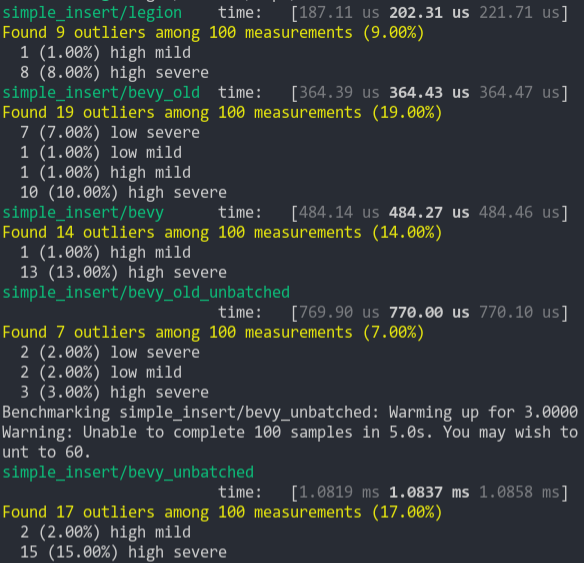
### Simpler Iter (from ecs_bench_suite)
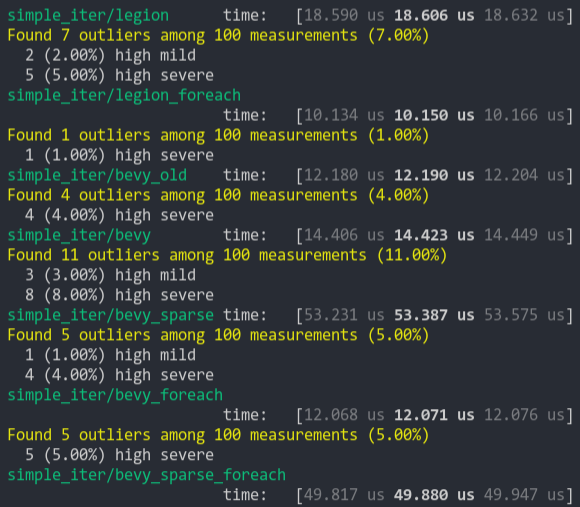
### Fragment Iter (from ecs_bench_suite)
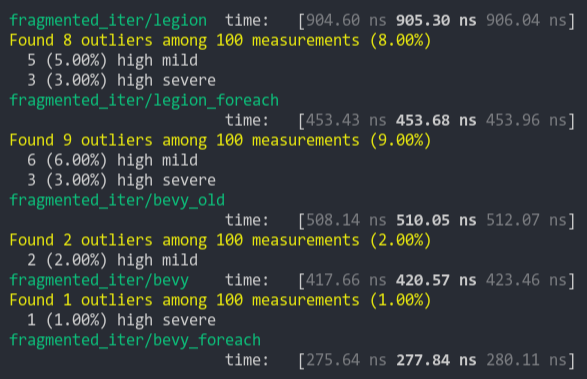
### Sparse Fragmented Iter
Iterate a query that matches 5 entities from a single matching archetype, but there are 100 unmatching archetypes
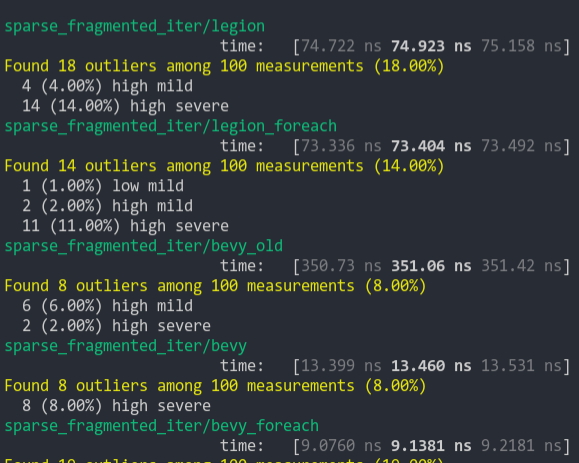
### Schedule (from ecs_bench_suite)
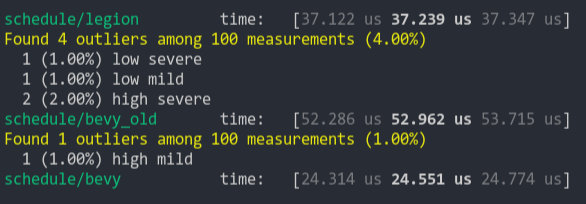
### Add Remove Component (from ecs_bench_suite)
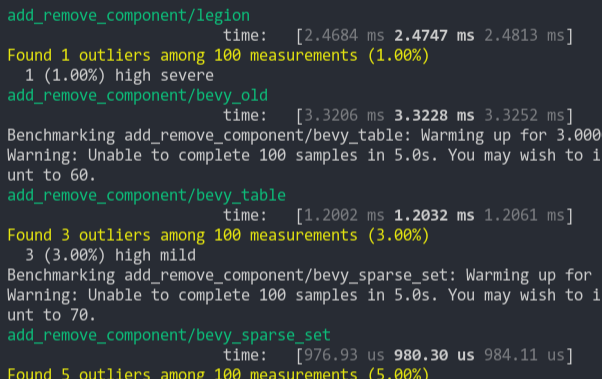
### Add Remove Component Big
Same as the test above, but each entity has 5 "large" matrix components and 1 "large" matrix component is added and removed
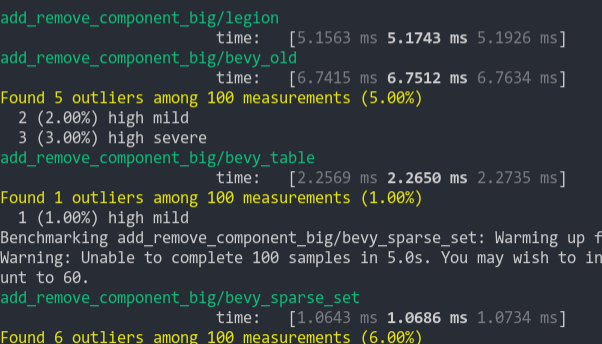
### Get Component
Looks up a single component value a large number of times
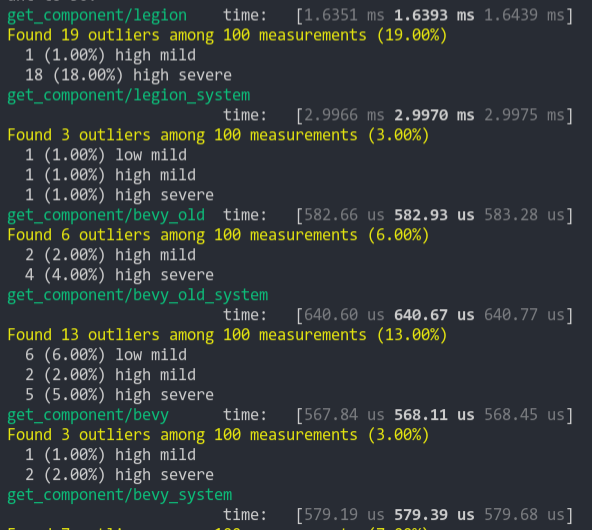
|







