This commit adds support for *decal projectors* to Bevy, allowing for
textures to be projected on top of geometry. Decal projectors are
clusterable objects, just as punctual lights and light probes are. This
means that decals are only evaluated for objects within the conservative
bounds of the projector, and they don't require a second pass.
These clustered decals require support for bindless textures and as such
currently don't work on WebGL 2, WebGPU, macOS, or iOS. For an
alternative that doesn't require bindless, see PR #16600. I believe that
both contact projective decals in #16600 and clustered decals are
desirable to have in Bevy. Contact projective decals offer broader
hardware and driver support, while clustered decals don't require the
creation of bounding geometry.
A new example, `decal_projectors`, has been added, which demonstrates
multiple decals on a rotating object. The decal projectors can be scaled
and rotated with the mouse.
There are several limitations of this initial patch that can be
addressed in follow-ups:
1. There's no way to specify the Z-index of decals. That is, the order
in which multiple decals are blended on top of one another is arbitrary.
A follow-up could introduce some sort of Z-index field so that artists
can specify that some decals should be blended on top of others.
2. Decals don't take the normal of the surface they're projected onto
into account. Most decal implementations in other engines have a feature
whereby the angle between the decal projector and the normal of the
surface must be within some threshold for the decal to appear. Often,
artists can specify a fade-off range for a smooth transition between
oblique surfaces and aligned surfaces.
3. There's no distance-based fadeoff toward the end of the projector
range. Many decal implementations have this.
This addresses #2401.
## Showcase

# Objective
- Alpha blending can easily fail in many situations and requires sorting
on the cpu
## Solution
- Implement order independent transparency (OIT) as an alternative to
alpha blending
- The implementation uses 2 passes
- The first pass records all the fragments colors and position to a
buffer that is the size of N layers * the render target resolution.
- The second pass sorts the fragments, blends them and draws them to the
screen. It also currently does manual depth testing because early-z
fails in too many cases in the first pass.
## Testing
- We've been using this implementation at foresight in production for
many months now and we haven't had any issues related to OIT.
---
## Showcase


## Future work
- Add an example showing how to use OIT for a custom material
- Next step would be to implement a per-pixel linked list to reduce
memory use
- I'd also like to investigate using a BinnedRenderPhase instead of a
SortedRenderPhase. If it works, it would make the transparent pass
significantly faster.
---------
Co-authored-by: Kristoffer Søholm <k.soeholm@gmail.com>
Co-authored-by: JMS55 <47158642+JMS55@users.noreply.github.com>
Co-authored-by: Charlotte McElwain <charlotte.c.mcelwain@gmail.com>
Implement visibility ranges, also known as hierarchical levels of detail
(HLODs).
This commit introduces a new component, `VisibilityRange`, which allows
developers to specify camera distances in which meshes are to be shown
and hidden. Hiding meshes happens early in the rendering pipeline, so
this feature can be used for level of detail optimization. Additionally,
this feature is properly evaluated per-view, so different views can show
different levels of detail.
This feature differs from proper mesh LODs, which can be implemented
later. Engines generally implement true mesh LODs later in the pipeline;
they're typically more efficient than HLODs with GPU-driven rendering.
However, mesh LODs are more limited than HLODs, because they require the
lower levels of detail to be meshes with the same vertex layout and
shader (and perhaps the same material) as the original mesh. Games often
want to use objects other than meshes to replace distant models, such as
*octahedral imposters* or *billboard imposters*.
The reason why the feature is called *hierarchical level of detail* is
that HLODs can replace multiple meshes with a single mesh when the
camera is far away. This can be useful for reducing drawcall count. Note
that `VisibilityRange` doesn't automatically propagate down to children;
it must be placed on every mesh.
Crossfading between different levels of detail is supported, using the
standard 4x4 ordered dithering pattern from [1]. The shader code to
compute the dithering patterns should be well-optimized. The dithering
code is only active when visibility ranges are in use for the mesh in
question, so that we don't lose early Z.
Cascaded shadow maps show the HLOD level of the view they're associated
with. Point light and spot light shadow maps, which have no CSMs,
display all HLOD levels that are visible in any view. To support this
efficiently and avoid doing visibility checks multiple times, we
precalculate all visible HLOD levels for each entity with a
`VisibilityRange` during the `check_visibility_range` system.
A new example, `visibility_range`, has been added to the tree, as well
as a new low-poly version of the flight helmet model to go with it. It
demonstrates use of the visibility range feature to provide levels of
detail.
[1]: https://en.wikipedia.org/wiki/Ordered_dithering#Threshold_map
[^1]: Unreal doesn't have a feature that exactly corresponds to
visibility ranges, but Unreal's HLOD system serves roughly the same
purpose.
## Changelog
### Added
* A new `VisibilityRange` component is available to conditionally enable
entity visibility at camera distances, with optional crossfade support.
This can be used to implement different levels of detail (LODs).
## Screenshots
High-poly model:

Low-poly model up close:

Crossfading between the two:

---------
Co-authored-by: Carter Anderson <mcanders1@gmail.com>
# Objective

- bump naga_oil to 0.10
- update shader imports to use rusty syntax

## Migration Guide

naga_oil 0.10 reworks the import mechanism to support more syntax to
make it more rusty, and test for item use before importing to determine
which imports are modules and which are items, which allows:

- use rust-style imports
```
#import bevy_pbr::{
    pbr_functions::{alpha_discard as discard, apply_pbr_lighting},
    mesh_bindings,
}
```

- import partial paths:
```
#import part::of::path
...
path::remainder::function();
```
which will call to `part::of::path::remainder::function`

- use fully qualified paths without importing:
```
// #import bevy_pbr::pbr_functions
bevy_pbr::pbr_functions::pbr()
```
- use imported items without qualifying
```
#import bevy_pbr::pbr_functions::pbr
// for backwards compatibility the old style is still supported:
// #import bevy_pbr::pbr_functions pbr
...
pbr()
```

- allows most imported items to end with `_` and numbers (naga_oil#30).
still doesn't allow struct members to end with `_` or numbers but it's
progress.

- the vast majority of existing shader code will work without changes,
but will emit "deprecated" warnings for old-style imports. these can be
suppressed with the `allow-deprecated` feature.

- partly breaks overrides (as far as i'm aware nobody uses these yet) -
now overrides will only be applied if the overriding module is added as
an additional import in the arguments to `Composer::make_naga_module` or
`Composer::add_composable_module`. this is necessary to support
determining whether imports are modules or items.
# Objective

allow extending `Material`s (including the built in `StandardMaterial`)
with custom vertex/fragment shaders and additional data, to easily get
pbr lighting with custom modifications, or otherwise extend a base
material.

# Solution

- added `ExtendedMaterial<B: Material, E: MaterialExtension>` which
contains a base material and a user-defined extension.
- added example `extended_material` showing how to use it
- modified AsBindGroup to have "unprepared" functions that return raw
resources / layout entries so that the extended material can combine
them

note: doesn't currently work with array resources, as i can't figure out
how to make the OwnedBindingResource::get_binding() work, as wgpu
requires a `&'a[&'a TextureView]` and i have a `Vec<TextureView>`.

# Migration Guide

manual implementations of `AsBindGroup` will need to be adjusted, the
changes are pretty straightforward and can be seen in the diff for e.g.
the `texture_binding_array` example.

---------

Co-authored-by: Robert Swain <robert.swain@gmail.com>
# Objective

- This PR aims to make the various `*_PREPASS` shader defs we have
(`NORMAL_PREPASS`, `DEPTH_PREPASS`, `MOTION_VECTORS_PREPASS` AND
`DEFERRED_PREPASS`) easier to use and understand:
- So that their meaning is now consistent across all contexts; (“prepass
X is enabled for the current view”)
  - So that they're also consistently set across all contexts.
- It also aims to enable us to (with a follow up PR) to conditionally
gate the `BindGroupEntry` and `BindGroupLayoutEntry` items associated
with these prepasses, saving us up to 4 texture slots in WebGL
(currently globally limited to 16 per shader, regardless of bind groups)

## Solution

- We now consistently set these from `PrepassPipeline`, the
`MeshPipeline` and the `DeferredLightingPipeline`, we also set their
`MeshPipelineKey`s;
- We introduce `PREPASS_PIPELINE`, `MESH_PIPELINE` and
`DEFERRED_LIGHTING_PIPELINE` that can be used to detect where the code
is running, without overloading the meanings of the prepass shader defs;
- We also gate the WGSL functions in `bevy_pbr::prepass_utils` with
`#ifdef`s for their respective shader defs, so that shader code can
provide a fallback whenever they're not available.
- This allows us to conditionally include the bindings for these prepass
textures (My next PR, which will hopefully unblock #8015)
- @robtfm mentioned [these were being used to prevent accessing the same
binding as read/write in the
prepass](https://discord.com/channels/691052431525675048/743663924229963868/1163270458393759814),
however even after reversing the `#ifndef`s I had no issues running the
code, so perhaps the compiler is already smart enough even without tree
shaking to know they're not being used, thanks to `#ifdef
PREPASS_PIPELINE`?

## Comparison

### Before

| Shader Def | `PrepassPipeline` | `MeshPipeline` |
`DeferredLightingPipeline` |
| ------------------------ | ----------------- | -------------- |
-------------------------- |
| `NORMAL_PREPASS` | Yes | No | No |
| `DEPTH_PREPASS` | Yes | No | No |
| `MOTION_VECTORS_PREPASS` | Yes | No | No |
| `DEFERRED_PREPASS` | Yes | No | No |

| View Key | `PrepassPipeline` | `MeshPipeline` |
`DeferredLightingPipeline` |
| ------------------------ | ----------------- | -------------- |
-------------------------- |
| `NORMAL_PREPASS` | Yes | Yes | No |
| `DEPTH_PREPASS` | Yes | No | No |
| `MOTION_VECTORS_PREPASS` | Yes | No | No |
| `DEFERRED_PREPASS` | Yes | Yes\* | No |

\* Accidentally was being set twice, once with only
`deferred_prepass.is_some()` as a condition,
and once with `deferred_p repass.is_some() && !forward` as a condition.

### After

| Shader Def | `PrepassPipeline` | `MeshPipeline` |
`DeferredLightingPipeline` |
| ---------------------------- | ----------------- | --------------- |
-------------------------- |
| `NORMAL_PREPASS` | Yes | Yes | Yes |
| `DEPTH_PREPASS` | Yes | Yes | Yes |
| `MOTION_VECTORS_PREPASS` | Yes | Yes | Yes |
| `DEFERRED_PREPASS` | Yes | Yes | Unconditionally |
| `PREPASS_PIPELINE` | Unconditionally | No | No |
| `MESH_PIPELINE` | No | Unconditionally | No |
| `DEFERRED_LIGHTING_PIPELINE` | No | No | Unconditionally |

| View Key | `PrepassPipeline` | `MeshPipeline` |
`DeferredLightingPipeline` |
| ------------------------ | ----------------- | -------------- |
-------------------------- |
| `NORMAL_PREPASS` | Yes | Yes | Yes |
| `DEPTH_PREPASS` | Yes | Yes | Yes |
| `MOTION_VECTORS_PREPASS` | Yes | Yes | Yes |
| `DEFERRED_PREPASS` | Yes | Yes | Unconditionally |

---

## Changelog

- Cleaned up WGSL `*_PREPASS` shader defs so they're now consistently
used everywhere;
- Introduced `PREPASS_PIPELINE`, `MESH_PIPELINE` and
`DEFERRED_LIGHTING_PIPELINE` WGSL shader defs for conditionally
compiling logic based the current pipeline;
- WGSL functions from `bevy_pbr::prepass_utils` are now guarded with
`#ifdef` based on the currently enabled prepasses;

## Migration Guide

- When using functions from `bevy_pbr::prepass_utils`
(`prepass_depth()`, `prepass_normal()`, `prepass_motion_vector()`) in
contexts where these prepasses might be disabled, you should now wrap
your calls with the appropriate `#ifdef` guards, (`#ifdef
DEPTH_PREPASS`, `#ifdef NORMAL_PREPASS`, `#ifdef MOTION_VECTOR_PREPASS`)
providing fallback logic where applicable.

---------

Co-authored-by: Carter Anderson <mcanders1@gmail.com>
Co-authored-by: IceSentry <IceSentry@users.noreply.github.com>
# Objective

#10105 changed the ssao input color from the material base color to
white. i can't actually see a difference in the example but there should
be one in some cases.

## Solution

change it back.
# Objective

cleanup some pbr shader code. improve shader stage io consistency and
make pbr.wgsl (probably many people's first foray into bevy shader code)
a little more human-readable. also fix a couple of small issues with
deferred rendering.

## Solution

mesh_vertex_output:
- rename to forward_io (to align with prepass_io)
- rename `MeshVertexOutput` to `VertexOutput` (to align with prepass_io)
- move `Vertex` from mesh.wgsl into here (to align with prepass_io)

prepass_io:
- remove `FragmentInput`, use `VertexOutput` directly (to align with
forward_io)
- rename `VertexOutput::clip_position` to `position` (to align with
forward_io)

pbr.wgsl:
- restructure so we don't need `#ifdefs` on the actual entrypoint, use
VertexOutput and FragmentOutput in all cases and use #ifdefs to import
the right struct definitions.
- rearrange to make the flow clearer
- move alpha_discard up from `pbr_functions::pbr` to avoid needing to
call it on some branches and not others
- add a bunch of comments

deferred_lighting:
- move ssao into the `!unlit` block to reflect forward behaviour
correctly
- fix compile error with deferred + premultiply_alpha

## Migration Guide

in custom material shaders:
- `pbr_functions::pbr` no longer calls to
`pbr_functions::alpha_discard`. if you were using the `pbr` function in
a custom shader with alpha mask mode you now also need to call
alpha_discard manually
- rename imports of `bevy_pbr::mesh_vertex_output` to
`bevy_pbr::forward_io`
- rename instances of `MeshVertexOutput` to `VertexOutput`

in custom material prepass shaders:
- rename instances of `VertexOutput::clip_position` to
`VertexOutput::position`
# Objective

- Add a [Deferred
Renderer](https://en.wikipedia.org/wiki/Deferred_shading) to Bevy.
- This allows subsequent passes to access per pixel material information
before/during shading.
- Accessing this per pixel material information is needed for some
features, like GI. It also makes other features (ex. Decals) simpler to
implement and/or improves their capability. There are multiple
approaches to accomplishing this. The deferred shading approach works
well given the limitations of WebGPU and WebGL2.

Motivation: [I'm working on a GI solution for
Bevy](https://youtu.be/eH1AkL-mwhI)

# Solution
- The deferred renderer is implemented with a prepass and a deferred
lighting pass.
- The prepass renders opaque objects into the Gbuffer attachment
(`Rgba32Uint`). The PBR shader generates a `PbrInput` in mostly the same
way as the forward implementation and then [packs it into the
Gbuffer](ec1465559f/crates/bevy_pbr/src/render/pbr.wgsl (L168)).
- The deferred lighting pass unpacks the `PbrInput` and [feeds it into
the pbr()
function](ec1465559f/crates/bevy_pbr/src/deferred/deferred_lighting.wgsl (L65)),
then outputs the shaded color data.

- There is now a resource
[DefaultOpaqueRendererMethod](ec1465559f/crates/bevy_pbr/src/material.rs (L599))
that can be used to set the default render method for opaque materials.
If materials return `None` from
[opaque_render_method()](ec1465559f/crates/bevy_pbr/src/material.rs (L131))
the `DefaultOpaqueRendererMethod` will be used. Otherwise, custom
materials can also explicitly choose to only support Deferred or Forward
by returning the respective
[OpaqueRendererMethod](ec1465559f/crates/bevy_pbr/src/material.rs (L603))

- Deferred materials can be used seamlessly along with both opaque and
transparent forward rendered materials in the same scene. The [deferred
rendering
example](https://github.com/DGriffin91/bevy/blob/deferred/examples/3d/deferred_rendering.rs)
does this.

- The deferred renderer does not support MSAA. If any deferred materials
are used, MSAA must be disabled. Both TAA and FXAA are supported.

- Deferred rendering supports WebGL2/WebGPU.

## Custom deferred materials
- Custom materials can support both deferred and forward at the same
time. The
[StandardMaterial](ec1465559f/crates/bevy_pbr/src/render/pbr.wgsl (L166))
does this. So does [this
example](https://github.com/DGriffin91/bevy_glowy_orb_tutorial/blob/deferred/assets/shaders/glowy.wgsl#L56).
- Custom deferred materials that require PBR lighting can create a
`PbrInput`, write it to the deferred GBuffer and let it be rendered by
the `PBRDeferredLightingPlugin`.
- Custom deferred materials that require custom lighting have two
options:
1. Use the base_color channel of the `PbrInput` combined with the
`STANDARD_MATERIAL_FLAGS_UNLIT_BIT` flag.
[Example.](https://github.com/DGriffin91/bevy_glowy_orb_tutorial/blob/deferred/assets/shaders/glowy.wgsl#L56)
(If the unlit bit is set, the base_color is stored as RGB9E5 for extra
precision)
2. A Custom Deferred Lighting pass can be created, either overriding the
default, or running in addition. The a depth buffer is used to limit
rendering to only the required fragments for each deferred lighting
pass. Materials can set their respective depth id via the
[deferred_lighting_pass_id](b79182d2a3/crates/bevy_pbr/src/prepass/prepass_io.wgsl (L95))
attachment. The custom deferred lighting pass plugin can then set [its
corresponding
depth](ec1465559f/crates/bevy_pbr/src/deferred/deferred_lighting.wgsl (L37)).
Then with the lighting pass using
[CompareFunction::Equal](ec1465559f/crates/bevy_pbr/src/deferred/mod.rs (L335)),
only the fragments with a depth that equal the corresponding depth
written in the material will be rendered.

Custom deferred lighting plugins can also be created to render the
StandardMaterial. The default deferred lighting plugin can be bypassed
with `DefaultPlugins.set(PBRDeferredLightingPlugin { bypass: true })`

---------

Co-authored-by: nickrart <nickolas.g.russell@gmail.com>
# Objective

- Reduce the number of rebindings to enable batching of draw commands

## Solution

- Use the new `GpuArrayBuffer` for `MeshUniform` data to store all
`MeshUniform` data in arrays within fewer bindings
- Sort opaque/alpha mask prepass, opaque/alpha mask main, and shadow
phases also by the batch per-object data binding dynamic offset to
improve performance on WebGL2.

---

## Changelog

- Changed: Per-object `MeshUniform` data is now managed by
`GpuArrayBuffer` as arrays in buffers that need to be indexed into.

## Migration Guide

Accessing the `model` member of an individual mesh object's shader
`Mesh` struct the old way where each `MeshUniform` was stored at its own
dynamic offset:
```rust
struct Vertex {
    @location(0) position: vec3<f32>,
};

fn vertex(vertex: Vertex) -> VertexOutput {
    var out: VertexOutput;
    out.clip_position = mesh_position_local_to_clip(
        mesh.model,
        vec4<f32>(vertex.position, 1.0)
    );
    return out;
}
```

The new way where one needs to index into the array of `Mesh`es for the
batch:
```rust
struct Vertex {
    @builtin(instance_index) instance_index: u32,
    @location(0) position: vec3<f32>,
};

fn vertex(vertex: Vertex) -> VertexOutput {
    var out: VertexOutput;
    out.clip_position = mesh_position_local_to_clip(
        mesh[vertex.instance_index].model,
        vec4<f32>(vertex.position, 1.0)
    );
    return out;
}
```
Note that using the instance_index is the default way to pass the
per-object index into the shader, but if you wish to do custom rendering
approaches you can pass it in however you like.

---------

Co-authored-by: robtfm <50659922+robtfm@users.noreply.github.com>
Co-authored-by: Elabajaba <Elabajaba@users.noreply.github.com>
# Objective

Since 10f5c92, parallax mapping was broken.

When #5703 was merged, the change from `in.uv` to `uv` in the pbr shader
was reverted. So the shader would use the wrong coordinate to sample the
various textures.

## Solution

We revert to using the correct uv.
# Objective

#5703 caused the normal prepass to fail as the prepass uses
`pbr_functions::apply_normal_mapping`, which uses
`mesh_view_bindings::view` to determine mip bias, which conflicts with
`prepass_bindings::view`.

## Solution

pass the mip bias to the `apply_normal_mapping` function explicitly.
# Objective

operate on naga IR directly to improve handling of shader modules.
- give codespan reporting into imported modules
- allow glsl to be used from wgsl and vice-versa

the ultimate objective is to make it possible to
- provide user hooks for core shader functions (to modify light
behaviour within the standard pbr pipeline, for example)
- make automatic binding slot allocation possible

but ... since this is already big, adds some value and (i think) is at
feature parity with the existing code, i wanted to push this now.

## Solution

i made a crate called naga_oil (https://github.com/robtfm/naga_oil -
unpublished for now, could be part of bevy) which manages modules by
- building each module independantly to naga IR
- creating "header" files for each supported language, which are used to
build dependent modules/shaders
- make final shaders by combining the shader IR with the IR for imported
modules

then integrated this into bevy, replacing some of the existing shader
processing stuff. also reworked examples to reflect this.

## Migration Guide

shaders that don't use `#import` directives should work without changes.

the most notable user-facing difference is that imported
functions/variables/etc need to be qualified at point of use, and
there's no "leakage" of visible stuff into your shader scope from the
imports of your imports, so if you used things imported by your imports,
you now need to import them directly and qualify them.

the current strategy of including/'spreading' `mesh_vertex_output`
directly into a struct doesn't work any more, so these need to be
modified as per the examples (e.g. color_material.wgsl, or many others).
mesh data is assumed to be in bindgroup 2 by default, if mesh data is
bound into bindgroup 1 instead then the shader def `MESH_BINDGROUP_1`
needs to be added to the pipeline shader_defs.
# Objective
- Closes#7323
- Reduce texture blurriness for TAA
## Solution
- Add a `MipBias` component and view uniform.
- Switch material `textureSample()` calls to `textureSampleBias()`.
- Add a `-1.0` bias to TAA.
---
## Changelog
- Added `MipBias` camera component, mostly for internal use.
---------
Co-authored-by: François <mockersf@gmail.com>
Co-authored-by: Carter Anderson <mcanders1@gmail.com>
# Objective

- Fix broken normals when the NormalPrepass is enabled

## Solution

- Don't use the normal prepass for the world_normal
- Only loadthe normal prepass
    - when msaa is disabled
- for opaque or alpha mask meshes and only for use it for N not
world_normal
# Objective

- Make #8015 easier to review;

## Solution

- This commit contains changes not directly related to transmission
required by #8015, in easier-to-review, one-change-per-commit form.

---

## Changelog

### Fixed

- Clear motion vector prepass using `0.0` instead of `1.0`, to avoid TAA
artifacts on transparent objects against the background;

### Added

- The `E` mathematical constant is now available for use in shaders,
exposed under `bevy_pbr::utils`;
- A new `TAA` shader def is now available, for conditionally enabling
shader logic via `#ifdef` when TAA is enabled; (e.g. for jittering
texture samples)
- A new `FallbackImageZero` resource is introduced, for when a fallback
image filled with zeroes is required;
- A new `RenderPhase<I>::render_range()` method is introduced, for
render phases that need to render their items in multiple parceled out
“steps”;

### Changed

- The `MainTargetTextures` struct now holds both `Texture` and
`TextureViews` for the main textures;
- The fog shader functions under `bevy_pbr::fog` now take the a `Fog`
structure as their first argument, instead of relying on the global
`fog` uniform;
- The main textures can now be used as copy sources;

## Migration Guide

- `ViewTarget::main_texture()` and `ViewTarget::main_texture_other()`
now return `&Texture` instead of `&TextureView`. If you were relying on
these methods, replace your usage with
`ViewTarget::main_texture_view()`and
`ViewTarget::main_texture_other_view()`, respectively;
- `ViewTarget::sampled_main_texture()` now returns `Option<&Texture>`
instead of a `Option<&TextureView>`. If you were relying on this method,
replace your usage with `ViewTarget::sampled_main_texture_view()`;
- The `apply_fog()`, `linear_fog()`, `exponential_fog()`,
`exponential_squared_fog()` and `atmospheric_fog()` functions now take a
configurable `Fog` struct. If you were relying on them, update your
usage by adding the global `fog` uniform as their first argument;
# Objective

- We support enabling a normal prepass, but the main pass never actually
uses it and recomputes the normals in the main pass. This isn't ideal
since it's doing redundant work.

## Solution

- Use the normal texture from the prepass in the main pass

## Notes

~~I used `NORMAL_PREPASS_ENABLED` as a shader_def because
`NORMAL_PREPASS` is currently used to signify that it is running in the
prepass while this shader_def need to indicate the prepass is done and
the normal prepass was ran before. I'm not sure if there's a better way
to name this.~~
- Fixes#7965
- Code quality improvements.
- Removes the unreferenced function `dither` in pbr_functions.wgsl
introduced in 72fbcc7, but made obsolete in c069c54.
- Makes the reference to `screen_space_dither` in pbr.wgsl conditional
on `#ifdef TONEMAP_IN_SHADER`, as the required import is conditional on
the same, as deband dithering can only occur if tonemapping is also
occurring.
---------
Co-authored-by: Carter Anderson <mcanders1@gmail.com>
# Objective

Currently, it is quite awkward to use the `pbr` function in a custom shader without binding a mesh bind group.
This is because the `pbr` function depends on the `MESH_FLAGS_SHADOW_RECEIVER_BIT` flag.

## Solution

I have removed this dependency by adding the flag as a parameter to the `PbrInput` struct.

I am not sure if this is the ideal solution since the mesh flag indicates both `MESH_FLAGS_SIGN_DETERMINANT_MODEL_3X3_BIT` and `MESH_FLAGS_SHADOW_RECEIVER_BIT`.
The former seems to be unrelated to PBR. Maybe the flag should be split.
# Objective

Splits tone mapping from https://github.com/bevyengine/bevy/pull/6677 into a separate PR.
Address https://github.com/bevyengine/bevy/issues/2264.
Adds tone mapping options:
- None: Bypasses tonemapping for instances where users want colors output to match those set.
- Reinhard
- Reinhard Luminance: Bevy's exiting tonemapping
- [ACES](https://github.com/TheRealMJP/BakingLab/blob/master/BakingLab/ACES.hlsl) (Fitted version, based on the same implementation that Godot 4 uses) see https://github.com/bevyengine/bevy/issues/2264
- [AgX](https://github.com/sobotka/AgX)
- SomewhatBoringDisplayTransform
- TonyMcMapface
- Blender Filmic

This PR also adds support for EXR images so they can be used to compare tonemapping options with reference images.

## Migration Guide
- Tonemapping is now an enum with NONE and the various tonemappers.
- The DebandDither is now a separate component.


Co-authored-by: JMS55 <47158642+JMS55@users.noreply.github.com>
# Objective

add a hook for ambient occlusion to the pbr shader

## Solution

add a hook for ambient occlusion to the pbr shader


Co-authored-by: atlas dostal <rodol@rivalrebels.com>
<img width="1392" alt="image" src="https://user-images.githubusercontent.com/418473/203873533-44c029af-13b7-4740-8ea3-af96bd5867c9.png">
<img width="1392" alt="image" src="https://user-images.githubusercontent.com/418473/203873549-36be7a23-b341-42a2-8a9f-ceea8ac7a2b8.png">


# Objective

- Add support for the “classic” distance fog effect, as well as a more advanced atmospheric fog effect.

## Solution

This PR:

- Introduces a new `FogSettings` component that controls distance fog per-camera.
- Adds support for three widely used “traditional” fog falloff modes: `Linear`, `Exponential` and `ExponentialSquared`, as well as a more advanced `Atmospheric` fog;
- Adds support for directional light influence over fog color;
- Extracts fog via `ExtractComponent`, then uses a prepare system that sets up a new dynamic uniform struct (`Fog`), similar to other mesh view types;
- Renders fog in PBR material shader, as a final adjustment to the `output_color`, after PBR is computed (but before tone mapping);
- Adds a new `StandardMaterial` flag to enable fog; (`fog_enabled`)
- Adds convenience methods for easier artistic control when creating non-linear fog types;
- Adds documentation around fog.

---

## Changelog

### Added

- Added support for distance-based fog effects for PBR materials, controllable per-camera via the new `FogSettings` component;
- Added `FogFalloff` enum for selecting between three widely used “traditional” fog falloff modes: `Linear`, `Exponential` and `ExponentialSquared`, as well as a more advanced `Atmospheric` fog;
# Objective

- This PR adds support for blend modes to the PBR `StandardMaterial`.

<img width="1392" alt="Screenshot 2022-11-18 at 20 00 56" src="https://user-images.githubusercontent.com/418473/202820627-0636219a-a1e5-437a-b08b-b08c6856bf9c.png">

<img width="1392" alt="Screenshot 2022-11-18 at 20 01 01" src="https://user-images.githubusercontent.com/418473/202820615-c8d43301-9a57-49c4-bd21-4ae343c3e9ec.png">

## Solution

- The existing `AlphaMode` enum is extended, adding three more modes: `AlphaMode::Premultiplied`, `AlphaMode::Add` and `AlphaMode::Multiply`;
- All new modes are rendered in the existing `Transparent3d` phase;
- The existing mesh flags for alpha mode are reorganized for a more compact/efficient representation, and new values are added;
- `MeshPipelineKey::TRANSPARENT_MAIN_PASS` is refactored into `MeshPipelineKey::BLEND_BITS`.
  -  `AlphaMode::Opaque` and `AlphaMode::Mask(f32)` share a single opaque pipeline key: `MeshPipelineKey::BLEND_OPAQUE`;
  - `Blend`, `Premultiplied` and `Add` share a single premultiplied alpha pipeline key, `MeshPipelineKey::BLEND_PREMULTIPLIED_ALPHA`. In the shader, color values are premultiplied accordingly (or not) depending on the blend mode to produce the three different results after PBR/tone mapping/dithering;
  - `Multiply` uses its own independent pipeline key, `MeshPipelineKey::BLEND_MULTIPLY`;
- Example and documentation are provided.
---

## Changelog

### Added

- Added support for additive and multiplicative blend modes in the PBR `StandardMaterial`, via `AlphaMode::Add` and `AlphaMode::Multiply`;
- Added support for premultiplied alpha in the PBR `StandardMaterial`, via `AlphaMode::Premultiplied`;
# Objective
- Closes#5262
- Fix color banding caused by quantization.
## Solution
- Adds dithering to the tonemapping node from #3425.
- This is inspired by Godot's default "debanding" shader: https://gist.github.com/belzecue/
- Unlike Godot:
- debanding happens after tonemapping. My understanding is that this is preferred, because we are running the debanding at the last moment before quantization (`[f32, f32, f32, f32]` -> `f32`). This ensures we aren't biasing the dithering strength by applying it in a different (linear) color space.
- This code instead uses and reference the origin source, Valve at GDC 2015
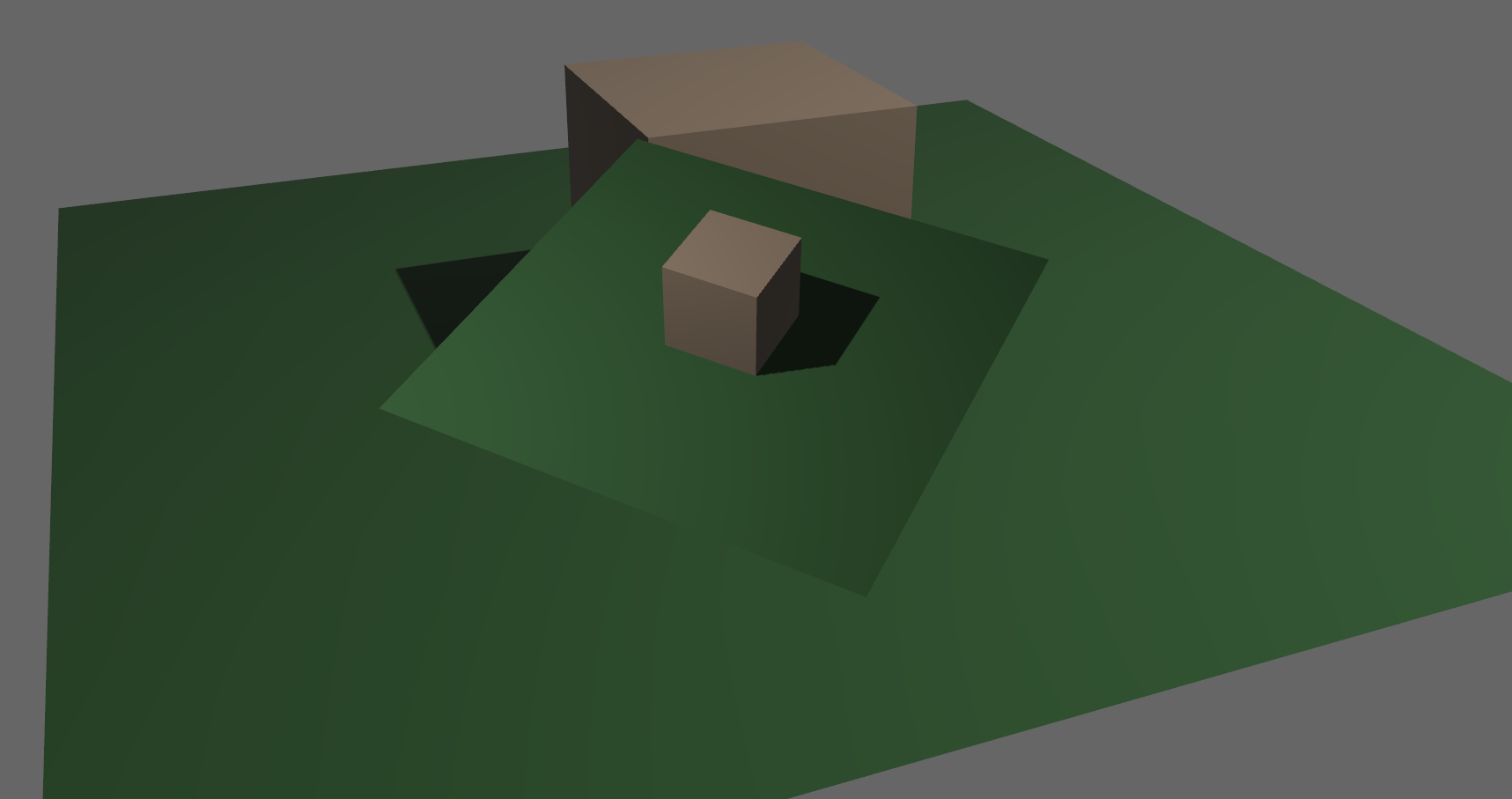
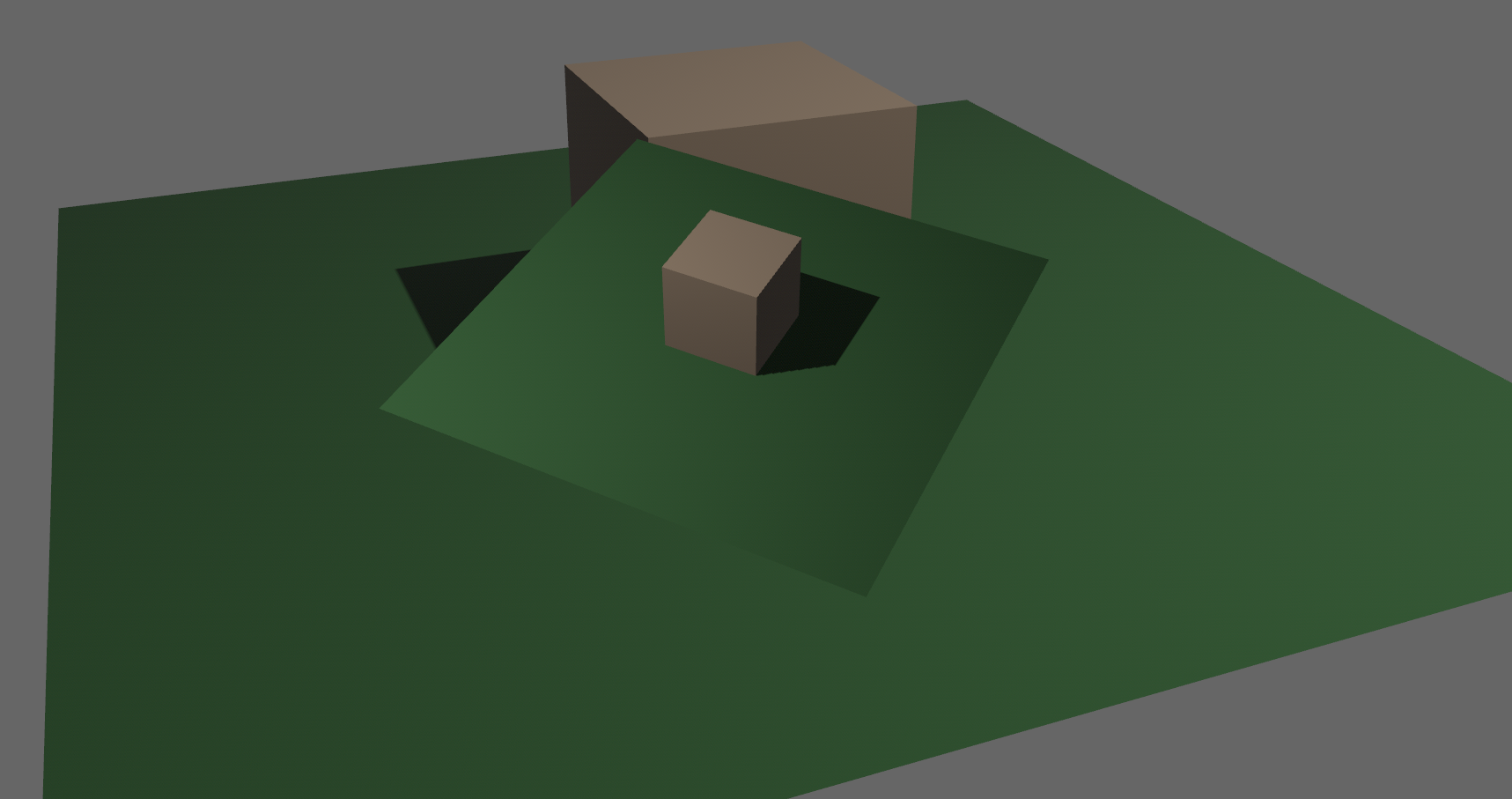
## Additional Notes
Real time rendering to standard dynamic range outputs is limited to 8 bits of depth per color channel. Internally we keep everything in full 32-bit precision (`vec4<f32>`) inside passes and 16-bit between passes until the image is ready to be displayed, at which point the GPU implicitly converts our `vec4<f32>` into a single 32bit value per pixel, with each channel (rgba) getting 8 of those 32 bits.
### The Problem
8 bits of color depth is simply not enough precision to make each step invisible - we only have 256 values per channel! Human vision can perceive steps in luma to about 14 bits of precision. When drawing a very slight gradient, the transition between steps become visible because with a gradient, neighboring pixels will all jump to the next "step" of precision at the same time.
### The Solution
One solution is to simply output in HDR - more bits of color data means the transition between bands will become smaller. However, not everyone has hardware that supports 10+ bit color depth. Additionally, 10 bit color doesn't even fully solve the issue, banding will result in coherent bands on shallow gradients, but the steps will be harder to perceive.
The solution in this PR adds noise to the signal before it is "quantized" or resampled from 32 to 8 bits. Done naively, it's easy to add unneeded noise to the image. To ensure dithering is correct and absolutely minimal, noise is adding *within* one step of the output color depth. When converting from the 32bit to 8bit signal, the value is rounded to the nearest 8 bit value (0 - 255). Banding occurs around the transition from one value to the next, let's say from 50-51. Dithering will never add more than +/-0.5 bits of noise, so the pixels near this transition might round to 50 instead of 51 but will never round more than one step. This means that the output image won't have excess variance:
- in a gradient from 49 to 51, there will be a step between each band at 49, 50, and 51.
- Done correctly, the modified image of this gradient will never have a adjacent pixels more than one step (0-255) from each other.
- I.e. when scanning across the gradient you should expect to see:
```
|-band-| |-band-| |-band-|
Baseline: 49 49 49 50 50 50 51 51 51
Dithered: 49 50 49 50 50 51 50 51 51
Dithered (wrong): 49 50 51 49 50 51 49 51 50
```


You can see from above how correct dithering "fuzzes" the transition between bands to reduce distinct steps in color, without adding excess noise.
### HDR
The previous section (and this PR) assumes the final output is to an 8-bit texture, however this is not always the case. When Bevy adds HDR support, the dithering code will need to take the per-channel depth into account instead of assuming it to be 0-255. Edit: I talked with Rob about this and it seems like the current solution is okay. We may need to revisit once we have actual HDR final image output.
---
## Changelog
### Added
- All pipelines now support deband dithering. This is enabled by default in 3D, and can be toggled in the `Tonemapping` component in camera bundles. Banding is a graphical artifact created when the rendered image is crunched from high precision (f32 per color channel) down to the final output (u8 per channel in SDR). This results in subtle gradients becoming blocky due to the reduced color precision. Deband dithering applies a small amount of noise to the signal before it is "crunched", which breaks up the hard edges of blocks (bands) of color. Note that this does not add excess noise to the image, as the amount of noise is less than a single step of a color channel - just enough to break up the transition between color blocks in a gradient.
Co-authored-by: Carter Anderson <mcanders1@gmail.com>
# Objective
- Fixes#4019
- Fix lighting of double-sided materials when using a negative scale
- The FlightHelmet.gltf model's hose uses a double-sided material. Loading the model with a uniform scale of -1.0, and comparing against Blender, it was identified that negating the world-space tangent, bitangent, and interpolated normal produces incorrect lighting. Discussion with Morten Mikkelsen clarified that this is both incorrect and unnecessary.
## Solution
- Remove the code that negates the T, B, and N vectors (the interpolated world-space tangent, calculated world-space bitangent, and interpolated world-space normal) when seeing the back face of a double-sided material with negative scale.
- Negate the world normal for a double-sided back face only when not using normal mapping
### Before, on `main`, flipping T, B, and N
<img width="932" alt="Screenshot 2022-08-22 at 15 11 53" src="https://user-images.githubusercontent.com/302146/185965366-f776ff2c-cfa1-46d1-9c84-fdcb399c273c.png">
### After, on this PR
<img width="932" alt="Screenshot 2022-08-22 at 15 12 11" src="https://user-images.githubusercontent.com/302146/185965420-8be493e2-3b1a-4188-bd13-fd6b17a76fe7.png">
### Double-sided material without normal maps
https://user-images.githubusercontent.com/302146/185988113-44a384e7-0b55-4946-9b99-20f8c803ab7e.mp4
---
## Changelog
- Fixed: Lighting of normal-mapped, double-sided materials applied to models with negative scale
- Fixed: Lighting and shadowing of back faces with no normal-mapping and a double-sided material
## Migration Guide
`prepare_normal` from the `bevy_pbr::pbr_functions` shader import has been reworked.
Before:
```rust
pbr_input.world_normal = in.world_normal;
pbr_input.N = prepare_normal(
pbr_input.material.flags,
in.world_normal,
#ifdef VERTEX_TANGENTS
#ifdef STANDARDMATERIAL_NORMAL_MAP
in.world_tangent,
#endif
#endif
in.uv,
in.is_front,
);
```
After:
```rust
pbr_input.world_normal = prepare_world_normal(
in.world_normal,
(material.flags & STANDARD_MATERIAL_FLAGS_DOUBLE_SIDED_BIT) != 0u,
in.is_front,
);
pbr_input.N = apply_normal_mapping(
pbr_input.material.flags,
pbr_input.world_normal,
#ifdef VERTEX_TANGENTS
#ifdef STANDARDMATERIAL_NORMAL_MAP
in.world_tangent,
#endif
#endif
in.uv,
);
```
# Objective

- Add post processing passes for FXAA (Fast Approximate Anti-Aliasing)
- Add example comparing MSAA and FXAA

## Solution

When the FXAA plugin is added, passes for FXAA are inserted between the main pass and the tonemapping pass. Supports using either HDR or LDR output from the main pass.

---

## Changelog

- Add a new FXAANode that runs after the main pass when the FXAA plugin is added.

Co-authored-by: Carter Anderson <mcanders1@gmail.com>
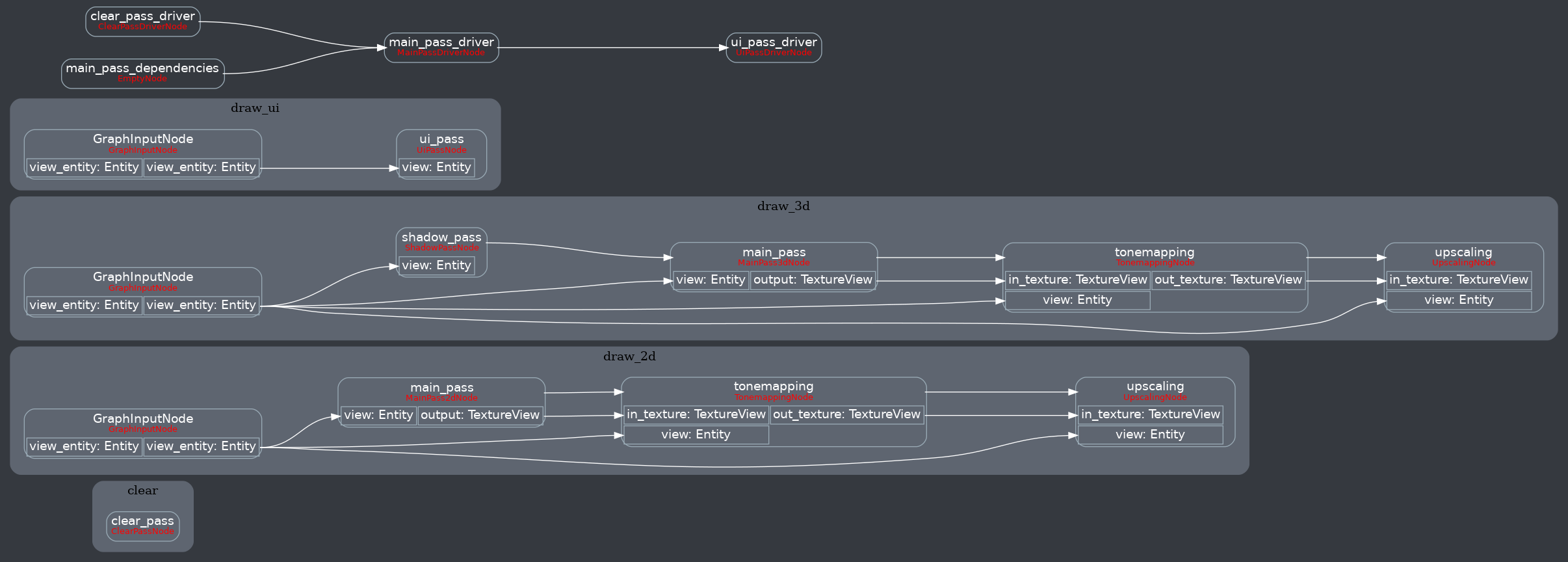
Attempt to make features like bloom https://github.com/bevyengine/bevy/pull/2876 easier to implement.
**This PR:**
- Moves the tonemapping from `pbr.wgsl` into a separate pass
- also add a separate upscaling pass after the tonemapping which writes to the swap chain (enables resolution-independant rendering and post-processing after tonemapping)
- adds a `hdr` bool to the camera which controls whether the pbr and sprite shaders render into a `Rgba16Float` texture
**Open questions:**
- ~should the 2d graph work the same as the 3d one?~ it is the same now
- ~The current solution is a bit inflexible because while you can add a post processing pass that writes to e.g. the `hdr_texture`, you can't write to a separate `user_postprocess_texture` while reading the `hdr_texture` and tell the tone mapping pass to read from the `user_postprocess_texture` instead. If the tonemapping and upscaling render graph nodes were to take in a `TextureView` instead of the view entity this would almost work, but the bind groups for their respective input textures are already created in the `Queue` render stage in the hardcoded order.~ solved by creating bind groups in render node
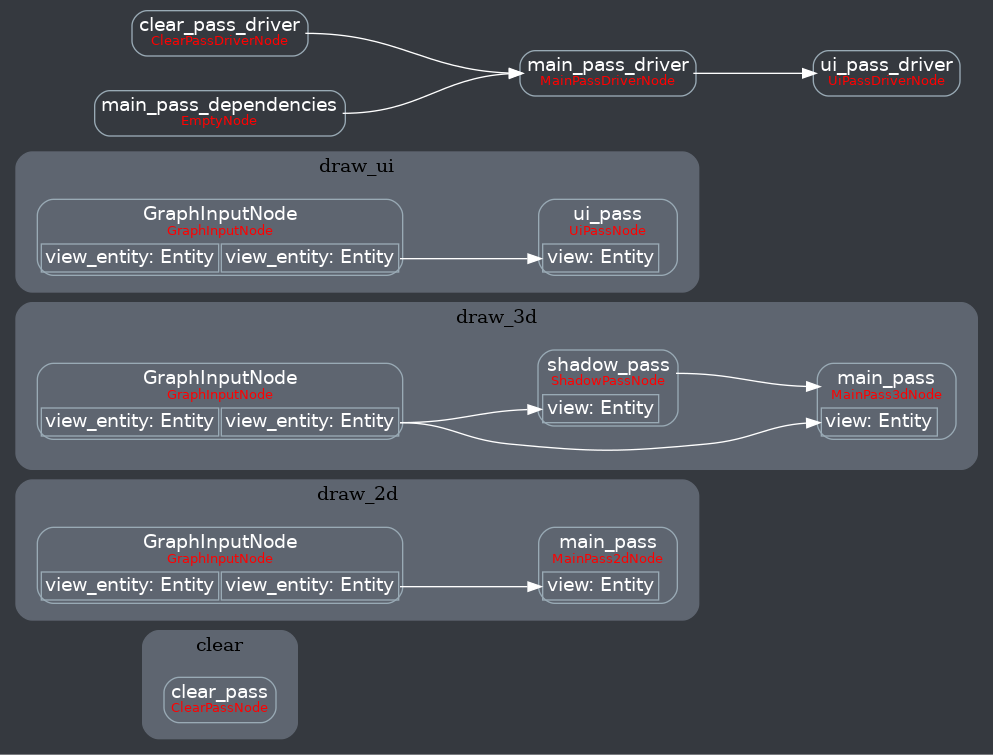
**New render graph:**
<details>
<summary>Before</summary>
</details>
Co-authored-by: Carter Anderson <mcanders1@gmail.com>
# Objective

- Alpha mask was previously ignored when using an unlit material.
- Fixes https://github.com/bevyengine/bevy/issues/4479

## Solution

- Extract the alpha discard to a separate function and use it when unlit is true

## Notes
I tried calling `alpha_discard()` before the `if` in pbr.wgsl, but I had errors related to having a `discard` at the beginning before doing the texture sampling. I'm not sure if there's a way to fix that instead of having the function being called in 2 places.
# Objective

Bevy requires meshes to include UV coordinates, even if the material does not use any textures, and will fail with an error `ERROR bevy_pbr::material: Mesh is missing requested attribute: Vertex_Uv (MeshVertexAttributeId(2), pipeline type: Some("bevy_pbr::material::MaterialPipeline<bevy_pbr::pbr_material::StandardMaterial>"))` otherwise. The objective of this PR is to permit this.

## Solution

This PR follows the design of #4528, which added support for per-vertex colours. It adds a shader define called VERTEX_UVS which indicates the presence of UV coordinates to the shader.
# Objective

- Make the reusable PBR shading functionality a little more reusable
  - Add constructor functions for `StandardMaterial` and `PbrInput` structs to populate them with default values
  - Document unclear `PbrInput` members
- Demonstrate how to reuse the bevy PBR shading functionality
- The final important piece from #3969 as the initial shot at making the PBR shader code reusable in custom materials

## Solution

- Add back and rework the 'old' `array_texture` example from pre-0.6.
- Create a custom shader material
  - Use a single array texture binding and sampler for the material bind group
  - Use a shader that calls `pbr()` from the `bevy_pbr::pbr_functions` import
- Spawn a row of cubes using the custom material
- In the shader, select the array texture layer to sample by using the world position x coordinate modulo the number of array texture layers

<img width="1392" alt="Screenshot 2022-06-23 at 12 28 05" src="https://user-images.githubusercontent.com/302146/175278593-2296f519-f577-4ece-81c0-d842283784a1.png">

Co-authored-by: Carter Anderson <mcanders1@gmail.com>
# Objective

- Allow custom shaders to reuse the HDR results of PBR.

## Solution

- Separate `pbr()` and `tone_mapping()` into 2 functions in `pbr_functions.wgsl`.
# Objective

- Builds on top of #4938
- Make clustered-forward PBR lighting/shadows functionality callable
- See #3969 for details

## Solution

- Add `PbrInput` struct type containing a `StandardMaterial`, occlusion, world_position, world_normal, and frag_coord
- Split functionality to calculate the unit view vector, and normal-mapped normal into `bevy_pbr::pbr_functions`
- Split high-level shading flow into `pbr(in: PbrInput, N: vec3<f32>, V: vec3<f32>, is_orthographic: bool)` function in `bevy_pbr::pbr_functions`
- Rework `pbr.wgsl` fragment stage entry point to make use of the new functions
- This has been benchmarked on an M1 Max using `many_cubes -- sphere`. `main` had a median frame time of 15.88ms, this PR 15.99ms, which is a 0.69% frame time increase, which is within noise in my opinion.

---

## Changelog

- Added: PBR shading code is now callable. Import `bevy_pbr::pbr_functions` and its dependencies, create a `PbrInput`, calculate the unit view and normal-mapped normal vectors and whether the projection is orthographic, and call `pbr()`!
# Objective

- Builds on top of #4901
- Separate out PBR lighting, shadows, clustered forward, and utils from `pbr.wgsl` as part of making the PBR code more reusable and extensible.
- See #3969 for details.

## Solution

- Add `bevy_pbr::utils`, `bevy_pbr::clustered_forward`, `bevy_pbr::lighting`, `bevy_pbr::shadows` shader imports exposing many shader functions for external use
- Split `PI`, `saturate()`, `hsv2rgb()`, and `random1D()` into `bevy_pbr::utils`
- Split clustered-forward-specific functions into `bevy_pbr::clustered_forward`, including moving the debug visualization code into a `cluster_debug_visualization()` function in that import
- Split PBR lighting functions into `bevy_pbr::lighting`
- Split shadow functions into `bevy_pbr::shadows`

---

## Changelog

- Added: `bevy_pbr::utils`, `bevy_pbr::clustered_forward`, `bevy_pbr::lighting`, `bevy_pbr::shadows` shader imports exposing many shader functions for external use
  - Split `PI`, `saturate()`, `hsv2rgb()`, and `random1D()` into `bevy_pbr::utils`
  - Split clustered-forward-specific functions into `bevy_pbr::clustered_forward`, including moving the debug visualization code into a `cluster_debug_visualization()` function in that import
  - Split PBR lighting functions into `bevy_pbr::lighting`
  - Split shadow functions into `bevy_pbr::shadows`
# Objective

- Split PBR and 2D mesh shaders into types and bindings to prepare the shaders to be more reusable.
- See #3969 for details. I'm doing this in multiple steps to make review easier.

---

## Changelog

- Changed: 2D and PBR mesh shaders are now split into types and bindings, the following shader imports are available: `bevy_pbr::mesh_view_types`, `bevy_pbr::mesh_view_bindings`, `bevy_pbr::mesh_types`, `bevy_pbr::mesh_bindings`, `bevy_sprite::mesh2d_view_types`, `bevy_sprite::mesh2d_view_bindings`, `bevy_sprite::mesh2d_types`, `bevy_sprite::mesh2d_bindings`

## Migration Guide

- In shaders for 3D meshes:
  - `#import bevy_pbr::mesh_view_bind_group` -> `#import bevy_pbr::mesh_view_bindings`
  - `#import bevy_pbr::mesh_struct` -> `#import bevy_pbr::mesh_types`
    - NOTE: If you are using the mesh bind group at bind group index 2, you can remove those binding statements in your shader and just use `#import bevy_pbr::mesh_bindings` which itself imports the mesh types needed for the bindings.
- In shaders for 2D meshes:
  - `#import bevy_sprite::mesh2d_view_bind_group` -> `#import bevy_sprite::mesh2d_view_bindings`
  - `#import bevy_sprite::mesh2d_struct` -> `#import bevy_sprite::mesh2d_types`
    - NOTE: If you are using the mesh2d bind group at bind group index 2, you can remove those binding statements in your shader and just use `#import bevy_sprite::mesh2d_bindings` which itself imports the mesh2d types needed for the bindings.
# Objective

Models can be produced that do not have vertex tangents but do have normal map textures. The tangents can be generated. There is a way that the vertex tangents can be generated to be exactly invertible to avoid introducing error when recreating the normals in the fragment shader.

## Solution

- After attempts to get https://github.com/gltf-rs/mikktspace to integrate simple glam changes and version bumps, and releases of that crate taking weeks / not being made (no offense intended to the authors/maintainers, bevy just has its own timelines and needs to take care of) it was decided to fork that repository. The following steps were taken:
  - mikktspace was forked to https://github.com/bevyengine/mikktspace in order to preserve the repository's history in case the original is ever taken down
  - The README in that repo was edited to add a note stating from where the repository was forked and explaining why
  - The repo was locked for changes as its only purpose is historical
  - The repo was integrated into the bevy repo using `git subtree add --prefix crates/bevy_mikktspace git@github.com:bevyengine/mikktspace.git master`
  - In `bevy_mikktspace`:
    - The travis configuration was removed
    - `cargo fmt` was run
    - The `Cargo.toml` was conformed to bevy's (just adding bevy to the keywords, changing the homepage and repository, changing the version to 0.7.0-dev - importantly the license is exactly the same)
    - Remove the features, remove `nalgebra` entirely, only use `glam`, suppress clippy.
      - This was necessary because our CI runs clippy with `--all-features` and the `nalgebra` and `glam` features are mutually exclusive, plus I don't want to modify this highly numerically-sensitive code just to appease clippy and diverge even more from upstream.
- Rebase https://github.com/bevyengine/bevy/pull/1795
  - @jakobhellermann said it was fine to copy and paste but it ended up being almost exactly the same with just a couple of adjustments when validating correctness so I decided to actually rebase it and then build on top of it.
- Use the exact same fragment shader code to ensure correct normal mapping.
- Tested with both https://github.com/KhronosGroup/glTF-Sample-Models/tree/master/2.0/NormalTangentMirrorTest which has vertex tangents and https://github.com/KhronosGroup/glTF-Sample-Models/tree/master/2.0/NormalTangentTest which requires vertex tangent generation

Co-authored-by: alteous <alteous@outlook.com>
# Objective

Add support for vertex colors

## Solution

This change is modeled after how vertex tangents are handled, so the shader is conditionally compiled with vertex color support if the mesh has the corresponding attribute set.

Vertex colors are multiplied by the base color. I'm not sure if this is the best for all cases, but may be useful for modifying vertex colors without creating a new mesh.

I chose `VertexFormat::Float32x4`, but I'd prefer 16-bit floats if/when support is added.

## Changelog

### Added
- Vertex colors can be specified using the `Mesh::ATTRIBUTE_COLOR` mesh attribute.
# Objective
- Fixes#4234
- Fixes#4473
- Built on top of #3989
- Improve performance of `assign_lights_to_clusters`
## Solution
- Remove the OBB-based cluster light assignment algorithm and calculation of view space AABBs
- Implement the 'iterative sphere refinement' algorithm used in Just Cause 3 by Emil Persson as documented in the Siggraph 2015 Practical Clustered Shading talk by Persson, on pages 42-44 http://newq.net/dl/pub/s2015_practical.pdf
- Adapt to also support orthographic projections
- Add `many_lights -- orthographic` for testing many lights using an orthographic projection
## Results
- `assign_lights_to_clusters` in `many_lights` before this PR on an M1 Max over 1500 frames had a median execution time of 1.71ms. With this PR it is 1.51ms, a reduction of 0.2ms or 11.7% for this system.
---
## Changelog
- Changed: Improved cluster light assignment performance
Co-authored-by: robtfm <50659922+robtfm@users.noreply.github.com>
Co-authored-by: Carter Anderson <mcanders1@gmail.com>
# Objective
- Make use of storage buffers, where they are available, for clustered forward bindings to support far more point lights in a scene
- Fixes#3605
- Based on top of #4079
This branch on an M1 Max can keep 60fps with about 2150 point lights of radius 1m in the Sponza scene where I've been testing. The bottleneck is mostly assigning lights to clusters which grows faster than linearly (I think 1000 lights was about 1.5ms and 5000 was 7.5ms). I have seen papers and presentations leveraging compute shaders that can get this up to over 1 million. That said, I think any further optimisations should probably be done in a separate PR.
## Solution
- Add `RenderDevice` to the `Material` and `SpecializedMaterial` trait `::key()` functions to allow setting flags on the keys depending on feature/limit availability
- Make `GpuPointLights` and `ViewClusterBuffers` into enums containing `UniformVec` and `StorageBuffer` variants. Implement the necessary API on them to make usage the same for both cases, and the only difference is at initialisation time.
- Appropriate shader defs in the shader code to handle the two cases
## Context on some decisions / open questions
- I'm using `max_storage_buffers_per_shader_stage >= 3` as a check to see if storage buffers are supported. I was thinking about diving into 'binding resource management' but it feels like we don't have enough use cases to understand the problem yet, and it is mostly a separate concern to this PR, so I think it should be handled separately.
- Should `ViewClusterBuffers` and `ViewClusterBindings` be merged, duplicating the count variables into the enum variants?
Co-authored-by: Carter Anderson <mcanders1@gmail.com>
# Objective

- Support compressed textures including 'universal' formats (ETC1S, UASTC) and transcoding of them to
- Support `.dds`, `.ktx2`, and `.basis` files

## Solution

- Fixes https://github.com/bevyengine/bevy/issues/3608 Look there for more details.
- Note that the functionality is all enabled through non-default features. If it is desirable to enable some by default, I can do that.
- The `basis-universal` crate, used for `.basis` file support and for transcoding, is built on bindings against a C++ library. It's not feasible to rewrite in Rust in a short amount of time. There are no Rust alternatives of which I am aware and it's specialised code. In its current state it doesn't support the wasm target, but I don't know for sure. However, it is possible to build the upstream C++ library with emscripten, so there is perhaps a way to add support for web too with some shenanigans.
- There's no support for transcoding from BasisLZ/ETC1S in KTX2 files as it was quite non-trivial to implement and didn't feel important given people could use `.basis` files for ETC1S.
# Objective
fix#3915
## Solution
the issues are caused by
- lights are assigned to clusters before being filtered down to MAX_POINT_LIGHTS, leading to cluster counts potentially being too high
- after fixing the above, packing the count into 8 bits still causes overflow with exactly 256 lights affecting a cluster
to fix:
```assign_lights_to_clusters```
- limit extracted lights to MAX_POINT_LIGHTS, selecting based on shadow-caster & intensity (if required)
- warn if MAX_POINT_LIGHT count is exceeded
```prepare_lights```
- limit the lights assigned to a cluster to CLUSTER_COUNT_MASK (which is 1 less than MAX_POINT_LIGHTS) to avoid overflowing into the offset bits
notes:
- a better solution to the overflow may be to use more than 8 bits for cluster_count (the comment states only 14 of the remaining 24 bits are used for the offset). this would touch more of the code base but i'm happy to try if it has some benefit.
- intensity is only one way to select lights. it may be worth allowing user configuration of the light filtering, but i can't see a clean way to do that