This reverts commit 0b5302d96a.
# Objective
- Fixes#18158
- #17482 introduced rendering changes and was merged a bit too fast
## Solution
- Revert #17482 so that it can be redone and rendering changes discussed
before being merged. This will make it easier to compare changes with
main in the known "valid" state
This is not an issue with the work done in #17482 that is still
interesting
# Objective

Transparently uses simple `EnvironmentMapLight`s to mimic
`AmbientLight`s. Implements the first part of #17468, but I can
implement hemispherical lights in this PR too if needed.

## Solution

- A function `EnvironmentMapLight::solid_color(&mut Assets<Image>,
Color)` is provided to make an environment light with a solid color.
- A new system is added to `SimulationLightSystems` that maps
`AmbientLight`s on views or the world to a corresponding
`EnvironmentMapLight`.

I have never worked with (or on) Bevy before, so nitpicky comments on
how I did things are appreciated :).

## Testing

Testing was done on a modified version of the `3d/lighting` example,
where I removed all lights except the ambient light. I have not included
the example, but can if required.

## Migration
`bevy_pbr::AmbientLight` has been deprecated, so all usages of it should
be replaced by a `bevy_pbr::EnvironmentMapLight` created with
`EnvironmentMapLight::solid_color` placed on the camera. There is no
alternative to ambient lights as resources.
# Objective

Even at `reflectance == 0.0`, our ambient and environment map light
implementations still produce fresnel/specular highlights.

Such a low `reflectance` value lies outside of the physically possible
range and is already used by our directional, point and spot light
implementations (via the `fresnel()` function) to enable artistic
control, effectively disabling the fresnel "look" for non-physically
realistic materials. Since ambient and environment lights use a
different formulation, they were not honoring this same principle.

This PR aims to bring consistency to all light types, offering the same
fresnel extinguishing control to ambient and environment lights.

Thanks to `@nathanf` for [pointing
out](https://discord.com/channels/691052431525675048/743663924229963868/1164083373514440744)
the [Filament docs section about
this](https://google.github.io/filament/Filament.md.html#lighting/occlusion/specularocclusion).

## Solution

- We use [the same
formulation](ffc572728f/crates/bevy_pbr/src/render/pbr_lighting.wgsl (L99))
already used by the `fresnel()` function in `bevy_pbr::lighting` to
modulate the F90, to modulate the specular component of Ambient and
Environment Map lights.

## Comparison

⚠️ **Modified version of the PBR example for demo purposes, that shows
reflectance (_NOT_ part of this PR)** ⚠️

Also, keep in mind this is a very subtle difference (look for the
fresnel highlights on the lower left spheres, you might need to zoom in.

### Before
<img width="1392" alt="Screenshot 2023-10-18 at 23 02 25"
src="https://github.com/bevyengine/bevy/assets/418473/ec0efb58-9a98-4377-87bc-726a1b0a3ff3">

### After
<img width="1392" alt="Screenshot 2023-10-18 at 23 01 43"
src="https://github.com/bevyengine/bevy/assets/418473/a2809325-5728-405e-af02-9b5779767843">

---

## Changelog

- Ambient and Environment Map lights will now honor values of
`reflectance` that are below the physically possible range (⪅ 0.35) by
extinguishing their fresnel highlights. (Just like point, directional
and spot lights already did.) This allows for more consistent artistic
control and for non-physically realistic looks with all light types.

## Migration Guide

- If Fresnel highlights from Ambient and Environment Map lights are no
longer visible in your materials, make sure you're using a higher,
physically plausible value of `reflectance` (⪆ 0.35).
# Objective

- bump naga_oil to 0.10
- update shader imports to use rusty syntax

## Migration Guide

naga_oil 0.10 reworks the import mechanism to support more syntax to
make it more rusty, and test for item use before importing to determine
which imports are modules and which are items, which allows:

- use rust-style imports
```
#import bevy_pbr::{
    pbr_functions::{alpha_discard as discard, apply_pbr_lighting},
    mesh_bindings,
}
```

- import partial paths:
```
#import part::of::path
...
path::remainder::function();
```
which will call to `part::of::path::remainder::function`

- use fully qualified paths without importing:
```
// #import bevy_pbr::pbr_functions
bevy_pbr::pbr_functions::pbr()
```
- use imported items without qualifying
```
#import bevy_pbr::pbr_functions::pbr
// for backwards compatibility the old style is still supported:
// #import bevy_pbr::pbr_functions pbr
...
pbr()
```

- allows most imported items to end with `_` and numbers (naga_oil#30).
still doesn't allow struct members to end with `_` or numbers but it's
progress.

- the vast majority of existing shader code will work without changes,
but will emit "deprecated" warnings for old-style imports. these can be
suppressed with the `allow-deprecated` feature.

- partly breaks overrides (as far as i'm aware nobody uses these yet) -
now overrides will only be applied if the overriding module is added as
an additional import in the arguments to `Composer::make_naga_module` or
`Composer::add_composable_module`. this is necessary to support
determining whether imports are modules or items.
# Objective

operate on naga IR directly to improve handling of shader modules.
- give codespan reporting into imported modules
- allow glsl to be used from wgsl and vice-versa

the ultimate objective is to make it possible to
- provide user hooks for core shader functions (to modify light
behaviour within the standard pbr pipeline, for example)
- make automatic binding slot allocation possible

but ... since this is already big, adds some value and (i think) is at
feature parity with the existing code, i wanted to push this now.

## Solution

i made a crate called naga_oil (https://github.com/robtfm/naga_oil -
unpublished for now, could be part of bevy) which manages modules by
- building each module independantly to naga IR
- creating "header" files for each supported language, which are used to
build dependent modules/shaders
- make final shaders by combining the shader IR with the IR for imported
modules

then integrated this into bevy, replacing some of the existing shader
processing stuff. also reworked examples to reflect this.

## Migration Guide

shaders that don't use `#import` directives should work without changes.

the most notable user-facing difference is that imported
functions/variables/etc need to be qualified at point of use, and
there's no "leakage" of visible stuff into your shader scope from the
imports of your imports, so if you used things imported by your imports,
you now need to import them directly and qualify them.

the current strategy of including/'spreading' `mesh_vertex_output`
directly into a struct doesn't work any more, so these need to be
modified as per the examples (e.g. color_material.wgsl, or many others).
mesh data is assumed to be in bindgroup 2 by default, if mesh data is
bound into bindgroup 1 instead then the shader def `MESH_BINDGROUP_1`
needs to be added to the pipeline shader_defs.
(Before)
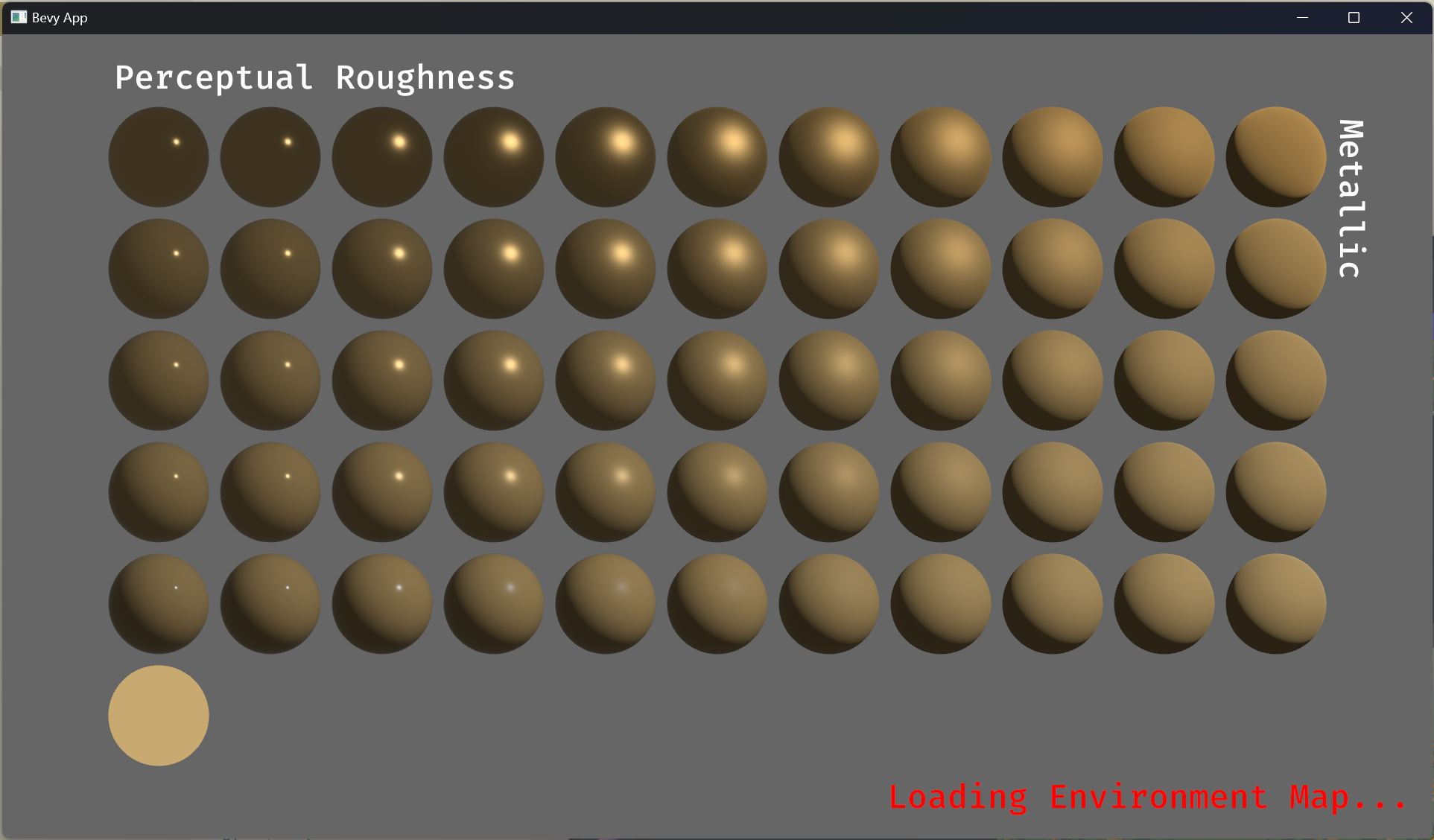
(After)
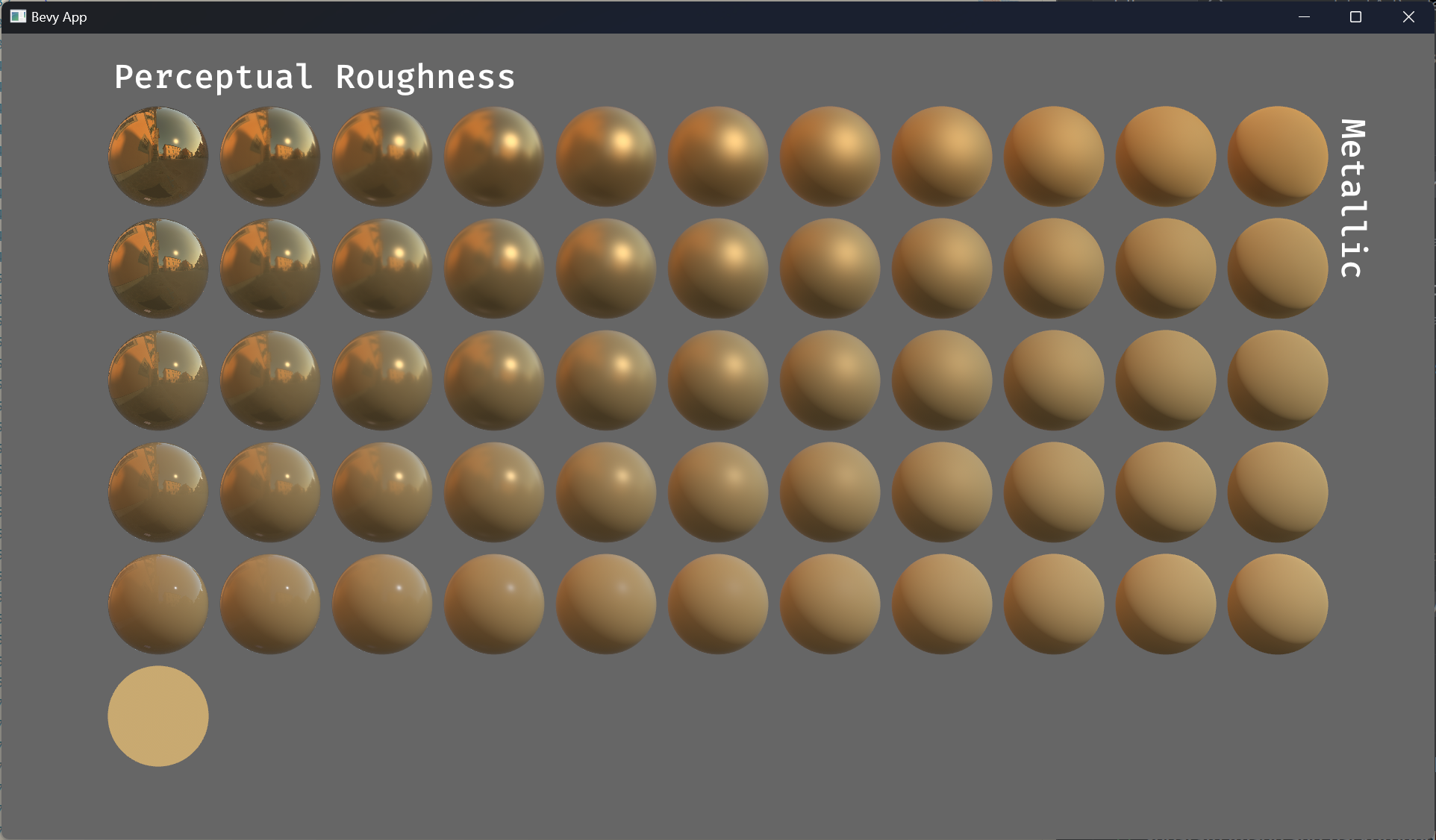
# Objective
- Improve lighting; especially reflections.
- Closes https://github.com/bevyengine/bevy/issues/4581.
## Solution
- Implement environment maps, providing better ambient light.
- Add microfacet multibounce approximation for specular highlights from Filament.
- Occlusion is no longer incorrectly applied to direct lighting. It now only applies to diffuse indirect light. Unsure if it's also supposed to apply to specular indirect light - the glTF specification just says "indirect light". In the case of ambient occlusion, for instance, that's usually only calculated as diffuse though. For now, I'm choosing to apply this just to indirect diffuse light, and not specular.
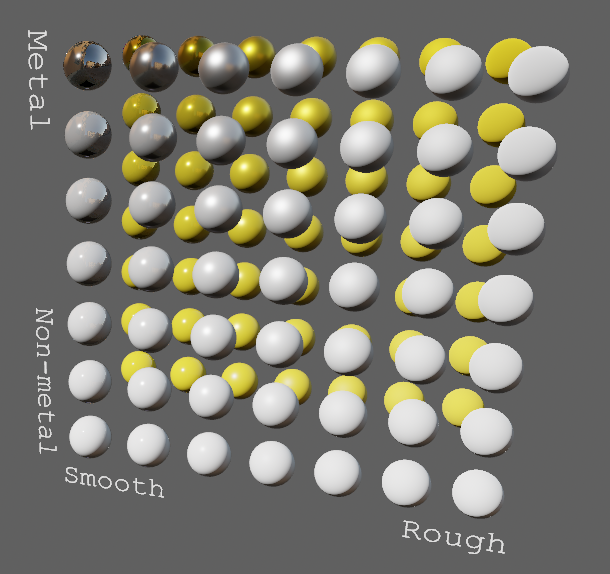
- Modified the PBR example to use an environment map, and have labels.
- Added `FallbackImageCubemap`.
## Implementation
- IBL technique references can be found in environment_map.wgsl.
- It's more accurate to use a LUT for the scale/bias. Filament has a good reference on generating this LUT. For now, I just used an analytic approximation.
- For now, environment maps must first be prefiltered outside of bevy using a 3rd party tool. See the `EnvironmentMap` documentation.
- Eventually, we should have our own prefiltering code, so that we can have dynamically changing environment maps, as well as let users drop in an HDR image and use asset preprocessing to create the needed textures using only bevy.
---
## Changelog
- Added an `EnvironmentMapLight` camera component that adds additional ambient light to a scene.
- StandardMaterials will now appear brighter and more saturated at high roughness, due to internal material changes. This is more physically correct.
- Fixed StandardMaterial occlusion being incorrectly applied to direct lighting.
- Added `FallbackImageCubemap`.
Co-authored-by: IceSentry <c.giguere42@gmail.com>
Co-authored-by: James Liu <contact@jamessliu.com>
Co-authored-by: Rob Parrett <robparrett@gmail.com>
# Objective

add a hook for ambient occlusion to the pbr shader

## Solution

add a hook for ambient occlusion to the pbr shader


Co-authored-by: atlas dostal <rodol@rivalrebels.com>