e1f593fae0
17 Commits
| Author | SHA1 | Message | Date | |
|---|---|---|---|---|
 Zachary Harrold
|
5241e09671
|
Upgrade to Rust Edition 2024 (#17967)
# Objective - Fixes #17960 ## Solution - Followed the [edition upgrade guide](https://doc.rust-lang.org/edition-guide/editions/transitioning-an-existing-project-to-a-new-edition.html) ## Testing - CI --- ## Summary of Changes ### Documentation Indentation When using lists in documentation, proper indentation is now linted for. This means subsequent lines within the same list item must start at the same indentation level as the item. ```rust /* Valid */ /// - Item 1 /// Run-on sentence. /// - Item 2 struct Foo; /* Invalid */ /// - Item 1 /// Run-on sentence. /// - Item 2 struct Foo; ``` ### Implicit `!` to `()` Conversion `!` (the never return type, returned by `panic!`, etc.) no longer implicitly converts to `()`. This is particularly painful for systems with `todo!` or `panic!` statements, as they will no longer be functions returning `()` (or `Result<()>`), making them invalid systems for functions like `add_systems`. The ideal fix would be to accept functions returning `!` (or rather, _not_ returning), but this is blocked on the [stabilisation of the `!` type itself](https://doc.rust-lang.org/std/primitive.never.html), which is not done. The "simple" fix would be to add an explicit `-> ()` to system signatures (e.g., `|| { todo!() }` becomes `|| -> () { todo!() }`). However, this is _also_ banned, as there is an existing lint which (IMO, incorrectly) marks this as an unnecessary annotation. So, the "fix" (read: workaround) is to put these kinds of `|| -> ! { ... }` closuers into variables and give the variable an explicit type (e.g., `fn()`). ```rust // Valid let system: fn() = || todo!("Not implemented yet!"); app.add_systems(..., system); // Invalid app.add_systems(..., || todo!("Not implemented yet!")); ``` ### Temporary Variable Lifetimes The order in which temporary variables are dropped has changed. The simple fix here is _usually_ to just assign temporaries to a named variable before use. ### `gen` is a keyword We can no longer use the name `gen` as it is reserved for a future generator syntax. This involved replacing uses of the name `gen` with `r#gen` (the raw-identifier syntax). ### Formatting has changed Use statements have had the order of imports changed, causing a substantial +/-3,000 diff when applied. For now, I have opted-out of this change by amending `rustfmt.toml` ```toml style_edition = "2021" ``` This preserves the original formatting for now, reducing the size of this PR. It would be a simple followup to update this to 2024 and run `cargo fmt`. ### New `use<>` Opt-Out Syntax Lifetimes are now implicitly included in RPIT types. There was a handful of instances where it needed to be added to satisfy the borrow checker, but there may be more cases where it _should_ be added to avoid breakages in user code. ### `MyUnitStruct { .. }` is an invalid pattern Previously, you could match against unit structs (and unit enum variants) with a `{ .. }` destructuring. This is no longer valid. ### Pretty much every use of `ref` and `mut` are gone Pattern binding has changed to the point where these terms are largely unused now. They still serve a purpose, but it is far more niche now. ### `iter::repeat(...).take(...)` is bad New lint recommends using the more explicit `iter::repeat_n(..., ...)` instead. ## Migration Guide The lifetimes of functions using return-position impl-trait (RPIT) are likely _more_ conservative than they had been previously. If you encounter lifetime issues with such a function, please create an issue to investigate the addition of `+ use<...>`. ## Notes - Check the individual commits for a clearer breakdown for what _actually_ changed. --------- Co-authored-by: François Mockers <francois.mockers@vleue.com> |
||
|
raldone01
|
1b7db895b7
|
Harden proc macro path resolution and add integration tests. (#17330)
This pr uses the `extern crate self as` trick to make proc macros behave the same way inside and outside bevy. # Objective - Removes noise introduced by `crate as` in the whole bevy repo. - Fixes #17004. - Hardens proc macro path resolution. ## TODO - [x] `BevyManifest` needs cleanup. - [x] Cleanup remaining `crate as`. - [x] Add proper integration tests to the ci. ## Notes - `cargo-manifest-proc-macros` is written by me and based/inspired by the old `BevyManifest` implementation and [`bkchr/proc-macro-crate`](https://github.com/bkchr/proc-macro-crate). - What do you think about the new integration test machinery I added to the `ci`? More and better integration tests can be added at a later stage. The goal of these integration tests is to simulate an actual separate crate that uses bevy. Ideally they would lightly touch all bevy crates. ## Testing - Needs RA test - Needs testing from other users - Others need to run at least `cargo run -p ci integration-test` and verify that they work. --------- Co-authored-by: Alice Cecile <alice.i.cecile@gmail.com> |
||
|
MichiRecRoom
|
26bb0b40d2
|
Move #![warn(clippy::allow_attributes, clippy::allow_attributes_without_reason)] to the workspace Cargo.toml (#17374)
# Objective Fixes https://github.com/bevyengine/bevy/issues/17111 ## Solution Move `#![warn(clippy::allow_attributes, clippy::allow_attributes_without_reason)]` to the workspace `Cargo.toml` ## Testing Lots of CI testing, and local testing too. --------- Co-authored-by: Benjamin Brienen <benjamin.brienen@outlook.com> |
||
|
BD103
|
c4a24d5b51
|
Make benchmark setup consistent (#16733)
# Objective - Benchmarks are inconsistently setup, there are several that do not compile, and several others that need to be reformatted. - Related / precursor to #16647, this is part of my attempt migrating [`bevy-bencher`](https://github.com/TheBevyFlock/bevy-bencher) to the official benchmarks. ## Solution > [!TIP] > > I recommend reviewing this PR commit-by-commit, instead of all at once! In |
||
|
Benjamin Brienen
|
4df8b1998e
|
Allow or fix dead code in benches (#16282)
# Objective Fixes #15806 ## Solution Fix an undeclared module and expect `dead_code`. ## Testing Run this command and see no `dead_code` warnings. `cargo +nightly check --benches --target-dir ../target --manifest-path ./benches/Cargo.toml` |
||
|
Zachary Harrold
|
d70595b667
|
Add core and alloc over std Lints (#15281)
# Objective - Fixes #6370 - Closes #6581 ## Solution - Added the following lints to the workspace: - `std_instead_of_core` - `std_instead_of_alloc` - `alloc_instead_of_core` - Used `cargo +nightly fmt` with [item level use formatting](https://rust-lang.github.io/rustfmt/?version=v1.6.0&search=#Item%5C%3A) to split all `use` statements into single items. - Used `cargo clippy --workspace --all-targets --all-features --fix --allow-dirty` to _attempt_ to resolve the new linting issues, and intervened where the lint was unable to resolve the issue automatically (usually due to needing an `extern crate alloc;` statement in a crate root). - Manually removed certain uses of `std` where negative feature gating prevented `--all-features` from finding the offending uses. - Used `cargo +nightly fmt` with [crate level use formatting](https://rust-lang.github.io/rustfmt/?version=v1.6.0&search=#Crate%5C%3A) to re-merge all `use` statements matching Bevy's previous styling. - Manually fixed cases where the `fmt` tool could not re-merge `use` statements due to conditional compilation attributes. ## Testing - Ran CI locally ## Migration Guide The MSRV is now 1.81. Please update to this version or higher. ## Notes - This is a _massive_ change to try and push through, which is why I've outlined the semi-automatic steps I used to create this PR, in case this fails and someone else tries again in the future. - Making this change has no impact on user code, but does mean Bevy contributors will be warned to use `core` and `alloc` instead of `std` where possible. - This lint is a critical first step towards investigating `no_std` options for Bevy. --------- Co-authored-by: François Mockers <francois.mockers@vleue.com> |
||
|
Adam
|
9bda913e36
|
Remove redundent information and optimize dynamic allocations in Table (#12929)
# Objective - fix #12853 - Make `Table::allocate` faster ## Solution The PR consists of multiple steps: 1) For the component data: create a new data-structure that's similar to `BlobVec` but doesn't store `len` & `capacity` inside of it: "BlobArray" (name suggestions welcome) 2) For the `Tick` data: create a new data-structure that's similar to `ThinSlicePtr` but supports dynamic reallocation: "ThinArrayPtr" (name suggestions welcome) 3) Create a new data-structure that's very similar to `Column` that doesn't store `len` & `capacity` inside of it: "ThinColumn" 4) Adjust the `Table` implementation to use `ThinColumn` instead of `Column` The result is that only one set of `len` & `capacity` is stored in `Table`, in `Table::entities` ### Notes Regarding Performance Apart from shaving off some excess memory in `Table`, the changes have also brought noteworthy performance improvements: The previous implementation relied on `Vec::reserve` & `BlobVec::reserve`, but that redundantly repeated the same if statement (`capacity` == `len`). Now that check could be made at the `Table` level because the capacity and length of all the columns are synchronized; saving N branches per allocation. The result is a respectable performance improvement per every `Table::reserve` (and subsequently `Table::allocate`) call. I'm hesitant to give exact numbers because I don't have a lot of experience in profiling and benchmarking, but these are the results I got so far: *`add_remove_big/table` benchmark after the implementation:*  *`add_remove_big/table` benchmark in main branch (measured in comparison to the implementation):*  *`add_remove_very_big/table` benchmark after the implementation:*  *`add_remove_very_big/table` benchmark in main branch (measured in comparison to the implementation):*  cc @james7132 to verify --- ## Changelog - New data-structure that's similar to `BlobVec` but doesn't store `len` & `capacity` inside of it: `BlobArray` - New data-structure that's similar to `ThinSlicePtr` but supports dynamic allocation:`ThinArrayPtr` - New data-structure that's very similar to `Column` that doesn't store `len` & `capacity` inside of it: `ThinColumn` - Adjust the `Table` implementation to use `ThinColumn` instead of `Column` - New benchmark: `add_remove_very_big` to benchmark the performance of spawning a lot of entities with a lot of components (15) each ## Migration Guide `Table` now uses `ThinColumn` instead of `Column`. That means that methods that previously returned `Column`, will now return `ThinColumn` instead. `ThinColumn` has a much more limited and low-level API, but you can still achieve the same things in `ThinColumn` as you did in `Column`. For example, instead of calling `Column::get_added_tick`, you'd call `ThinColumn::get_added_ticks_slice` and index it to get the specific added tick. --------- Co-authored-by: James Liu <contact@jamessliu.com> |
||
|
Nicola Papale
|
359e6c718d
|
Use single threaded executor for archetype benches (#9835)
# Objective `no_archetype` benchmark group results were very noisy ## Solution Use the `SingeThreaded` executor. On my machine, this makes the `no_archetype` bench group 20 to 30 times faster. Meaning that most of the runtime was accounted by the multithreaded scheduler. ie: the benchmark was not testing system archetype update, but the overhead of multithreaded scheduling. With this change, the benchmark results are more meaningful. The add_archetypes function is also simplified. |
||
|
Mike
|
33fdc5f5db
|
Move schedule name into Schedule (#9600)
# Objective - Move schedule name into `Schedule` to allow the schedule name to be used for errors and tracing in Schedule methods - Fixes #9510 ## Solution - Move label onto `Schedule` and adjust api's on `World` and `Schedule` to not pass explicit label where it makes sense to. - add name to errors and tracing. - `Schedule::new` now takes a label so either add the label or use `Schedule::default` which uses a default label. `default` is mostly used in doc examples and tests. --- ## Changelog - move label onto `Schedule` to improve error message and logging for schedules. ## Migration Guide `Schedule::new` and `App::add_schedule` ```rust // old let schedule = Schedule::new(); app.add_schedule(MyLabel, schedule); // new let schedule = Schedule::new(MyLabel); app.add_schedule(schedule); ``` if you aren't using a label and are using the schedule struct directly you can use the default constructor. ```rust // old let schedule = Schedule::new(); schedule.run(world); // new let schedule = Schedule::default(); schedule.run(world); ``` `Schedules:insert` ```rust // old let schedule = Schedule::new(); schedules.insert(MyLabel, schedule); // new let schedule = Schedule::new(MyLabel); schedules.insert(schedule); ``` `World::add_schedule` ```rust // old let schedule = Schedule::new(); world.add_schedule(MyLabel, schedule); // new let schedule = Schedule::new(MyLabel); world.add_schedule(schedule); ``` |
||
|
Carter Anderson
|
aefe1f0739
|
Schedule-First: the new and improved add_systems (#8079)
Co-authored-by: Mike <mike.hsu@gmail.com> |
||
|
张林伟
|
aa4170d9a4 |
Rename schedule v3 to schedule (#7519)
# Objective - Follow up of https://github.com/bevyengine/bevy/pull/7267 ## Solution - Rename schedule_v3 to schedule - Suppress "module inception" lint |
||
|
Alice Cecile
|
206c7ce219 |
Migrate engine to Schedule v3 (#7267)
Huge thanks to @maniwani, @devil-ira, @hymm, @cart, @superdump and @jakobhellermann for the help with this PR. # Objective - Followup #6587. - Minimal integration for the Stageless Scheduling RFC: https://github.com/bevyengine/rfcs/pull/45 ## Solution - [x] Remove old scheduling module - [x] Migrate new methods to no longer use extension methods - [x] Fix compiler errors - [x] Fix benchmarks - [x] Fix examples - [x] Fix docs - [x] Fix tests ## Changelog ### Added - a large number of methods on `App` to work with schedules ergonomically - the `CoreSchedule` enum - `App::add_extract_system` via the `RenderingAppExtension` trait extension method - the private `prepare_view_uniforms` system now has a public system set for scheduling purposes, called `ViewSet::PrepareUniforms` ### Removed - stages, and all code that mentions stages - states have been dramatically simplified, and no longer use a stack - `RunCriteriaLabel` - `AsSystemLabel` trait - `on_hierarchy_reports_enabled` run criteria (now just uses an ad hoc resource checking run condition) - systems in `RenderSet/Stage::Extract` no longer warn when they do not read data from the main world - `RunCriteriaLabel` - `transform_propagate_system_set`: this was a nonstandard pattern that didn't actually provide enough control. The systems are already `pub`: the docs have been updated to ensure that the third-party usage is clear. ### Changed - `System::default_labels` is now `System::default_system_sets`. - `App::add_default_labels` is now `App::add_default_sets` - `CoreStage` and `StartupStage` enums are now `CoreSet` and `StartupSet` - `App::add_system_set` was renamed to `App::add_systems` - The `StartupSchedule` label is now defined as part of the `CoreSchedules` enum - `.label(SystemLabel)` is now referred to as `.in_set(SystemSet)` - `SystemLabel` trait was replaced by `SystemSet` - `SystemTypeIdLabel<T>` was replaced by `SystemSetType<T>` - The `ReportHierarchyIssue` resource now has a public constructor (`new`), and implements `PartialEq` - Fixed time steps now use a schedule (`CoreSchedule::FixedTimeStep`) rather than a run criteria. - Adding rendering extraction systems now panics rather than silently failing if no subapp with the `RenderApp` label is found. - the `calculate_bounds` system, with the `CalculateBounds` label, is now in `CoreSet::Update`, rather than in `CoreSet::PostUpdate` before commands are applied. - `SceneSpawnerSystem` now runs under `CoreSet::Update`, rather than `CoreStage::PreUpdate.at_end()`. - `bevy_pbr::add_clusters` is no longer an exclusive system - the top level `bevy_ecs::schedule` module was replaced with `bevy_ecs::scheduling` - `tick_global_task_pools_on_main_thread` is no longer run as an exclusive system. Instead, it has been replaced by `tick_global_task_pools`, which uses a `NonSend` resource to force running on the main thread. ## Migration Guide - Calls to `.label(MyLabel)` should be replaced with `.in_set(MySet)` - Stages have been removed. Replace these with system sets, and then add command flushes using the `apply_system_buffers` exclusive system where needed. - The `CoreStage`, `StartupStage, `RenderStage` and `AssetStage` enums have been replaced with `CoreSet`, `StartupSet, `RenderSet` and `AssetSet`. The same scheduling guarantees have been preserved. - Systems are no longer added to `CoreSet::Update` by default. Add systems manually if this behavior is needed, although you should consider adding your game logic systems to `CoreSchedule::FixedTimestep` instead for more reliable framerate-independent behavior. - Similarly, startup systems are no longer part of `StartupSet::Startup` by default. In most cases, this won't matter to you. - For example, `add_system_to_stage(CoreStage::PostUpdate, my_system)` should be replaced with - `add_system(my_system.in_set(CoreSet::PostUpdate)` - When testing systems or otherwise running them in a headless fashion, simply construct and run a schedule using `Schedule::new()` and `World::run_schedule` rather than constructing stages - Run criteria have been renamed to run conditions. These can now be combined with each other and with states. - Looping run criteria and state stacks have been removed. Use an exclusive system that runs a schedule if you need this level of control over system control flow. - For app-level control flow over which schedules get run when (such as for rollback networking), create your own schedule and insert it under the `CoreSchedule::Outer` label. - Fixed timesteps are now evaluated in a schedule, rather than controlled via run criteria. The `run_fixed_timestep` system runs this schedule between `CoreSet::First` and `CoreSet::PreUpdate` by default. - Command flush points introduced by `AssetStage` have been removed. If you were relying on these, add them back manually. - Adding extract systems is now typically done directly on the main app. Make sure the `RenderingAppExtension` trait is in scope, then call `app.add_extract_system(my_system)`. - the `calculate_bounds` system, with the `CalculateBounds` label, is now in `CoreSet::Update`, rather than in `CoreSet::PostUpdate` before commands are applied. You may need to order your movement systems to occur before this system in order to avoid system order ambiguities in culling behavior. - the `RenderLabel` `AppLabel` was renamed to `RenderApp` for clarity - `App::add_state` now takes 0 arguments: the starting state is set based on the `Default` impl. - Instead of creating `SystemSet` containers for systems that run in stages, simply use `.on_enter::<State::Variant>()` or its `on_exit` or `on_update` siblings. - `SystemLabel` derives should be replaced with `SystemSet`. You will also need to add the `Debug`, `PartialEq`, `Eq`, and `Hash` traits to satisfy the new trait bounds. - `with_run_criteria` has been renamed to `run_if`. Run criteria have been renamed to run conditions for clarity, and should now simply return a bool. - States have been dramatically simplified: there is no longer a "state stack". To queue a transition to the next state, call `NextState::set` ## TODO - [x] remove dead methods on App and World - [x] add `App::add_system_to_schedule` and `App::add_systems_to_schedule` - [x] avoid adding the default system set at inappropriate times - [x] remove any accidental cycles in the default plugins schedule - [x] migrate benchmarks - [x] expose explicit labels for the built-in command flush points - [x] migrate engine code - [x] remove all mentions of stages from the docs - [x] verify docs for States - [x] fix uses of exclusive systems that use .end / .at_start / .before_commands - [x] migrate RenderStage and AssetStage - [x] migrate examples - [x] ensure that transform propagation is exported in a sufficiently public way (the systems are already pub) - [x] ensure that on_enter schedules are run at least once before the main app - [x] re-enable opt-in to execution order ambiguities - [x] revert change to `update_bounds` to ensure it runs in `PostUpdate` - [x] test all examples - [x] unbreak directional lights - [x] unbreak shadows (see 3d_scene, 3d_shape, lighting, transparaency_3d examples) - [x] game menu example shows loading screen and menu simultaneously - [x] display settings menu is a blank screen - [x] `without_winit` example panics - [x] ensure all tests pass - [x] SubApp doc test fails - [x] runs_spawn_local tasks fails - [x] [Fix panic_when_hierachy_cycle test hanging](https://github.com/alice-i-cecile/bevy/pull/120) ## Points of Difficulty and Controversy **Reviewers, please give feedback on these and look closely** 1. Default sets, from the RFC, have been removed. These added a tremendous amount of implicit complexity and result in hard to debug scheduling errors. They're going to be tackled in the form of "base sets" by @cart in a followup. 2. The outer schedule controls which schedule is run when `App::update` is called. 3. I implemented `Label for `Box<dyn Label>` for our label types. This enables us to store schedule labels in concrete form, and then later run them. I ran into the same set of problems when working with one-shot systems. We've previously investigated this pattern in depth, and it does not appear to lead to extra indirection with nested boxes. 4. `SubApp::update` simply runs the default schedule once. This sucks, but this whole API is incomplete and this was the minimal changeset. 5. `time_system` and `tick_global_task_pools_on_main_thread` no longer use exclusive systems to attempt to force scheduling order 6. Implemetnation strategy for fixed timesteps 7. `AssetStage` was migrated to `AssetSet` without reintroducing command flush points. These did not appear to be used, and it's nice to remove these bottlenecks. 8. Migration of `bevy_render/lib.rs` and pipelined rendering. The logic here is unusually tricky, as we have complex scheduling requirements. ## Future Work (ideally before 0.10) - Rename schedule_v3 module to schedule or scheduling - Add a derive macro to states, and likely a `EnumIter` trait of some form - Figure out what exactly to do with the "systems added should basically work by default" problem - Improve ergonomics for working with fixed timesteps and states - Polish FixedTime API to match Time - Rebase and merge #7415 - Resolve all internal ambiguities (blocked on better tools, especially #7442) - Add "base sets" to replace the removed default sets. |
||
|
张林伟
|
bb79903938 |
Fix clippy issue for benches crate (#6806)
# Objective - https://github.com/bevyengine/bevy/pull/3505 marked `S-Adopt-Me` , this pr is to continue his work. ## Solution - run `cargo clippy --workspace --all-targets --all-features -- -Aclippy::type_complexity -Wclippy::doc_markdown -Wclippy::redundant_else -Wclippy::match_same_arms -Wclippy::semicolon_if_nothing_returned -Wclippy::explicit_iter_loop -Wclippy::map_flatten -Dwarnings` under benches dir. - fix issue according to suggestion. |
||
|
JoJoJet
|
336049da68 |
Remove outdated uses of single-tuple bundles (#6406)
# Objective Bevy still has many instances of using single-tuples `(T,)` to create a bundle. Due to #2975, this is no longer necessary. ## Solution Search for regex `\(.+\s*,\)`. This should have found every instance. |
||
|
Carter Anderson
|
01aedc8431 |
Spawn now takes a Bundle (#6054)
# Objective Now that we can consolidate Bundles and Components under a single insert (thanks to #2975 and #6039), almost 100% of world spawns now look like `world.spawn().insert((Some, Tuple, Here))`. Spawning an entity without any components is an extremely uncommon pattern, so it makes sense to give spawn the "first class" ergonomic api. This consolidated api should be made consistent across all spawn apis (such as World and Commands). ## Solution All `spawn` apis (`World::spawn`, `Commands:;spawn`, `ChildBuilder::spawn`, and `WorldChildBuilder::spawn`) now accept a bundle as input: ```rust // before: commands .spawn() .insert((A, B, C)); world .spawn() .insert((A, B, C); // after commands.spawn((A, B, C)); world.spawn((A, B, C)); ``` All existing instances of `spawn_bundle` have been deprecated in favor of the new `spawn` api. A new `spawn_empty` has been added, replacing the old `spawn` api. By allowing `world.spawn(some_bundle)` to replace `world.spawn().insert(some_bundle)`, this opened the door to removing the initial entity allocation in the "empty" archetype / table done in `spawn()` (and subsequent move to the actual archetype in `.insert(some_bundle)`). This improves spawn performance by over 10%: 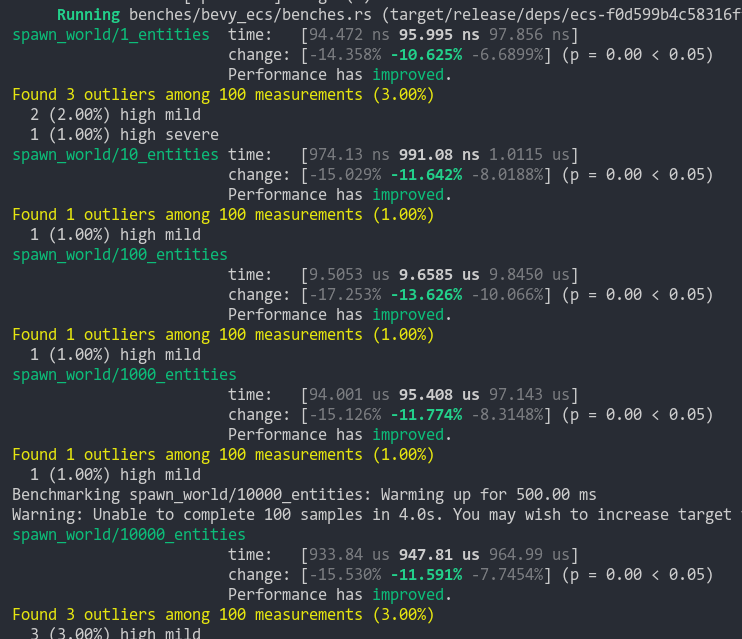 To take this measurement, I added a new `world_spawn` benchmark. Unfortunately, optimizing `Commands::spawn` is slightly less trivial, as Commands expose the Entity id of spawned entities prior to actually spawning. Doing the optimization would (naively) require assurances that the `spawn(some_bundle)` command is applied before all other commands involving the entity (which would not necessarily be true, if memory serves). Optimizing `Commands::spawn` this way does feel possible, but it will require careful thought (and maybe some additional checks), which deserves its own PR. For now, it has the same performance characteristics of the current `Commands::spawn_bundle` on main. **Note that 99% of this PR is simple renames and refactors. The only code that needs careful scrutiny is the new `World::spawn()` impl, which is relatively straightforward, but it has some new unsafe code (which re-uses battle tested BundlerSpawner code path).** --- ## Changelog - All `spawn` apis (`World::spawn`, `Commands:;spawn`, `ChildBuilder::spawn`, and `WorldChildBuilder::spawn`) now accept a bundle as input - All instances of `spawn_bundle` have been deprecated in favor of the new `spawn` api - World and Commands now have `spawn_empty()`, which is equivalent to the old `spawn()` behavior. ## Migration Guide ```rust // Old (0.8): commands .spawn() .insert_bundle((A, B, C)); // New (0.9) commands.spawn((A, B, C)); // Old (0.8): commands.spawn_bundle((A, B, C)); // New (0.9) commands.spawn((A, B, C)); // Old (0.8): let entity = commands.spawn().id(); // New (0.9) let entity = commands.spawn_empty().id(); // Old (0.8) let entity = world.spawn().id(); // New (0.9) let entity = world.spawn_empty(); ``` |
||
|
Carter Anderson
|
cd15f0f5be |
Accept Bundles for insert and remove. Deprecate insert/remove_bundle (#6039)
# Objective Take advantage of the "impl Bundle for Component" changes in #2975 / add the follow up changes discussed there. ## Solution - Change `insert` and `remove` to accept a Bundle instead of a Component (for both Commands and World) - Deprecate `insert_bundle`, `remove_bundle`, and `remove_bundle_intersection` - Add `remove_intersection` --- ## Changelog - Change `insert` and `remove` now accept a Bundle instead of a Component (for both Commands and World) - `insert_bundle` and `remove_bundle` are deprecated ## Migration Guide Replace `insert_bundle` with `insert`: ```rust // Old (0.8) commands.spawn().insert_bundle(SomeBundle::default()); // New (0.9) commands.spawn().insert(SomeBundle::default()); ``` Replace `remove_bundle` with `remove`: ```rust // Old (0.8) commands.entity(some_entity).remove_bundle::<SomeBundle>(); // New (0.9) commands.entity(some_entity).remove::<SomeBundle>(); ``` Replace `remove_bundle_intersection` with `remove_intersection`: ```rust // Old (0.8) world.entity_mut(some_entity).remove_bundle_intersection::<SomeBundle>(); // New (0.9) world.entity_mut(some_entity).remove_intersection::<SomeBundle>(); ``` Consider consolidating as many operations as possible to improve ergonomics and cut down on archetype moves: ```rust // Old (0.8) commands.spawn() .insert_bundle(SomeBundle::default()) .insert(SomeComponent); // New (0.9) - Option 1 commands.spawn().insert(( SomeBundle::default(), SomeComponent, )) // New (0.9) - Option 2 commands.spawn_bundle(( SomeBundle::default(), SomeComponent, )) ``` ## Next Steps Consider changing `spawn` to accept a bundle and deprecate `spawn_bundle`. |
||
|
ShadowCurse
|
179f719553 |
ECS benchmarks organization (#5189)
## Objective Fixes: #5110 ## Solution - Moved benches into separate modules according to the part of ECS they are testing. - Made so all ECS benches are included in one `benches.rs` so they don’t need to be added separately in `Cargo.toml`. - Renamed a bunch of files to have more coherent names. - Merged `schedule.rs` and `system_schedule.rs` into one file. |
