## Objective

- `bevy_text/src/pipeline.rs` had some crufty code.

## Solution

Remove the cruft.

- `&mut self` argument was unused by
`TextPipeline::create_text_measure`, so we replace it with a constructor
`TextMeasureInfo::from_text`.
- We also pass a `&Text` to `from_text` since there is no reason to
split the struct before passing it as argument.
- from_text also checks beforehand that every Font exist in the
Assets<Font>. This allows rust to skip the drop code on the Vecs we
create in the method, since there is no early exit.
- We also remove the scaled_fonts field on `TextMeasureInfo`. This
avoids an additional allocation. We can re-use the font on `fonts`
instead in `compute_size`. Building a `ScaledFont` seems fairly cheap,
when looking at the ab_glyph internals.
- We also implement ToSectionText on TextMeasureSection, this let us
skip creating a whole new Vec each time we call compute_size.
- This let us remove compute_size_from_section_text, since its only
purpose was to not have to allocate the Vec we just made redundant.
- Make some immutabe `Vec<T>` into `Box<[T]>` and `String` into
`Box<str>`
- `{min,max}_width_content_size` fields of `TextMeasureInfo` have name
`width` in them, yet the contain information on both width and height.
- `TextMeasureInfo::linebreak_behaviour`  -> `linebreak_behavior`

## Migration Guide

- The `ResMut<TextPipeline>` argument to `measure_text_system` doesn't
exist anymore. If you were calling this system manually, you should
remove the argument.
- The `{min,max}_width_content_size` fields of `TextMeasureInfo` are
renamed to `min` and `max` respectively
- Other changes to `TextMeasureInfo` may also break your code if you
were manually building it. Please consider using the new
`TextMeasureInfo::from_text` to build one instead.
- `TextPipeline::create_text_measure` has been removed in favor of
`TextMeasureInfo::from_text`
# Objective

Inconvenient initialization of `UiScale`

## Solution

Change `UiScale` to a tuple struct

## Migration Guide

Replace initialization of `UiScale` like ```UiScale { scale: 1.0 }```
with ```UiScale(1.0)```
# Objective

The doc comment for `text_system` is not quite correct. It implies that
a new `TextLayoutInfo` is generated on changes to `Text` and `Style`.
While changes to those components might indirectly trigger a
regeneration of the text layout, `text_system` itself only queries for
changes to `Node`

Also added details to `measure_text_system`'s doc comments explaining
how it reacts to changes.

---------

Co-authored-by: François <mockersf@gmail.com>
# Objective

Fix typos throughout the project.

## Solution

[`typos`](https://github.com/crate-ci/typos) project was used for
scanning, but no automatic corrections were applied. I checked
everything by hand before fixing.

Most of the changes are documentation/comments corrections. Also, there
are few trivial changes to code (variable name, pub(crate) function name
and a few error/panic messages).

## Unsolved

`bevy_reflect_derive` has
[typo](1b51053f19/crates/bevy_reflect/bevy_reflect_derive/src/type_path.rs (L76))
in enum variant name that I didn't fix. Enum is `pub(crate)`, so there
shouldn't be any trouble if fixed. However, code is tightly coupled with
macro usage, so I decided to leave it for more experienced contributor
just in case.
# Objective
After the UI layout is computed when the coordinates are converted back
from physical coordinates to logical coordinates the `UiScale` is
ignored. This results in a confusing situation where we have two
different systems of logical coordinates.
Example:
```rust
use bevy::prelude::*;
fn main() {
App::new()
.add_plugins(DefaultPlugins)
.add_systems(Startup, setup)
.add_systems(Update, update)
.run();
}
fn setup(mut commands: Commands, mut ui_scale: ResMut<UiScale>) {
ui_scale.scale = 4.;
commands.spawn(Camera2dBundle::default());
commands.spawn(NodeBundle {
style: Style {
align_items: AlignItems::Center,
justify_content: JustifyContent::Center,
width: Val::Percent(100.),
..Default::default()
},
..Default::default()
})
.with_children(|builder| {
builder.spawn(NodeBundle {
style: Style {
width: Val::Px(100.),
height: Val::Px(100.),
..Default::default()
},
background_color: Color::MAROON.into(),
..Default::default()
}).with_children(|builder| {
builder.spawn(TextBundle::from_section("", TextStyle::default());
});
});
}
fn update(
mut text_query: Query<(&mut Text, &Parent)>,
node_query: Query<Ref<Node>>,
) {
for (mut text, parent) in text_query.iter_mut() {
let node = node_query.get(parent.get()).unwrap();
if node.is_changed() {
text.sections[0].value = format!("size: {}", node.size());
}
}
}
```
result:

We asked for a 100x100 UI node but the Node's size is multiplied by the
value of `UiScale` to give a logical size of 400x400.
## Solution
Divide the output physical coordinates by `UiScale` in
`ui_layout_system` and multiply the logical viewport size by `UiScale`
when creating the projection matrix for the UI's `ExtractedView` in
`extract_default_ui_camera_view`.
---
## Changelog
* The UI layout's physical coordinates are divided by both the window
scale factor and `UiScale` when converting them back to logical
coordinates. The logical size of Ui nodes now matches the values given
to their size constraints.
* Multiply the logical viewport size by `UiScale` before creating the
projection matrix for the UI's `ExtractedView` in
`extract_default_ui_camera_view`.
* In `ui_focus_system` the cursor position returned from `Window` is
divided by `UiScale`.
* Added a scale factor parameter to `Node::physical_size` and
`Node::physical_rect`.
* The example `viewport_debug` now uses a `UiScale` of 2. to ensure that
viewport coordinates are working correctly with a non-unit `UiScale`.
## Migration Guide
Physical UI coordinates are now divided by both the `UiScale` and the
window's scale factor to compute the logical sizes and positions of UI
nodes.
This ensures that UI Node size and position values, held by the `Node`
and `GlobalTransform` components, conform to the same logical coordinate
system as the style constraints from which they are derived,
irrespective of the current `scale_factor` and `UiScale`.
---------
Co-authored-by: Carter Anderson <mcanders1@gmail.com>
# Objective
- Fix#8984
### Solution
- Address compilation errors
I admit: I did sneak it an unrelated mini-refactor. of the
`measurment.rs` module. it seemed to me that directly importing `taffy`
types helped reduce a lot of boilerplate, so I did it.
# Objective
**This implementation is based on
https://github.com/bevyengine/rfcs/pull/59.**
---
Resolves#4597
Full details and motivation can be found in the RFC, but here's a brief
summary.
`FromReflect` is a very powerful and important trait within the
reflection API. It allows Dynamic types (e.g., `DynamicList`, etc.) to
be formed into Real ones (e.g., `Vec<i32>`, etc.).
This mainly comes into play concerning deserialization, where the
reflection deserializers both return a `Box<dyn Reflect>` that almost
always contain one of these Dynamic representations of a Real type. To
convert this to our Real type, we need to use `FromReflect`.
It also sneaks up in other ways. For example, it's a required bound for
`T` in `Vec<T>` so that `Vec<T>` as a whole can be made `FromReflect`.
It's also required by all fields of an enum as it's used as part of the
`Reflect::apply` implementation.
So in other words, much like `GetTypeRegistration` and `Typed`, it is
very much a core reflection trait.
The problem is that it is not currently treated like a core trait and is
not automatically derived alongside `Reflect`. This makes using it a bit
cumbersome and easy to forget.
## Solution
Automatically derive `FromReflect` when deriving `Reflect`.
Users can then choose to opt-out if needed using the
`#[reflect(from_reflect = false)]` attribute.
```rust
#[derive(Reflect)]
struct Foo;
#[derive(Reflect)]
#[reflect(from_reflect = false)]
struct Bar;
fn test<T: FromReflect>(value: T) {}
test(Foo); // <-- OK
test(Bar); // <-- Panic! Bar does not implement trait `FromReflect`
```
#### `ReflectFromReflect`
This PR also automatically adds the `ReflectFromReflect` (introduced in
#6245) registration to the derived `GetTypeRegistration` impl— if the
type hasn't opted out of `FromReflect` of course.
<details>
<summary><h4>Improved Deserialization</h4></summary>
> **Warning**
> This section includes changes that have since been descoped from this
PR. They will likely be implemented again in a followup PR. I am mainly
leaving these details in for archival purposes, as well as for reference
when implementing this logic again.
And since we can do all the above, we might as well improve
deserialization. We can now choose to deserialize into a Dynamic type or
automatically convert it using `FromReflect` under the hood.
`[Un]TypedReflectDeserializer::new` will now perform the conversion and
return the `Box`'d Real type.
`[Un]TypedReflectDeserializer::new_dynamic` will work like what we have
now and simply return the `Box`'d Dynamic type.
```rust
// Returns the Real type
let reflect_deserializer = UntypedReflectDeserializer::new(®istry);
let mut deserializer = ron:🇩🇪:Deserializer::from_str(input)?;
let output: SomeStruct = reflect_deserializer.deserialize(&mut deserializer)?.take()?;
// Returns the Dynamic type
let reflect_deserializer = UntypedReflectDeserializer::new_dynamic(®istry);
let mut deserializer = ron:🇩🇪:Deserializer::from_str(input)?;
let output: DynamicStruct = reflect_deserializer.deserialize(&mut deserializer)?.take()?;
```
</details>
---
## Changelog
* `FromReflect` is now automatically derived within the `Reflect` derive
macro
* This includes auto-registering `ReflectFromReflect` in the derived
`GetTypeRegistration` impl
* ~~Renamed `TypedReflectDeserializer::new` and
`UntypedReflectDeserializer::new` to
`TypedReflectDeserializer::new_dynamic` and
`UntypedReflectDeserializer::new_dynamic`, respectively~~ **Descoped**
* ~~Changed `TypedReflectDeserializer::new` and
`UntypedReflectDeserializer::new` to automatically convert the
deserialized output using `FromReflect`~~ **Descoped**
## Migration Guide
* `FromReflect` is now automatically derived within the `Reflect` derive
macro. Items with both derives will need to remove the `FromReflect`
one.
```rust
// OLD
#[derive(Reflect, FromReflect)]
struct Foo;
// NEW
#[derive(Reflect)]
struct Foo;
```
If using a manual implementation of `FromReflect` and the `Reflect`
derive, users will need to opt-out of the automatic implementation.
```rust
// OLD
#[derive(Reflect)]
struct Foo;
impl FromReflect for Foo {/* ... */}
// NEW
#[derive(Reflect)]
#[reflect(from_reflect = false)]
struct Foo;
impl FromReflect for Foo {/* ... */}
```
<details>
<summary><h4>Removed Migrations</h4></summary>
> **Warning**
> This section includes changes that have since been descoped from this
PR. They will likely be implemented again in a followup PR. I am mainly
leaving these details in for archival purposes, as well as for reference
when implementing this logic again.
* The reflect deserializers now perform a `FromReflect` conversion
internally. The expected output of `TypedReflectDeserializer::new` and
`UntypedReflectDeserializer::new` is no longer a Dynamic (e.g.,
`DynamicList`), but its Real counterpart (e.g., `Vec<i32>`).
```rust
let reflect_deserializer =
UntypedReflectDeserializer::new_dynamic(®istry);
let mut deserializer = ron:🇩🇪:Deserializer::from_str(input)?;
// OLD
let output: DynamicStruct = reflect_deserializer.deserialize(&mut
deserializer)?.take()?;
// NEW
let output: SomeStruct = reflect_deserializer.deserialize(&mut
deserializer)?.take()?;
```
Alternatively, if this behavior isn't desired, use the
`TypedReflectDeserializer::new_dynamic` and
`UntypedReflectDeserializer::new_dynamic` methods instead:
```rust
// OLD
let reflect_deserializer = UntypedReflectDeserializer::new(®istry);
// NEW
let reflect_deserializer =
UntypedReflectDeserializer::new_dynamic(®istry);
```
</details>
---------
Co-authored-by: Carter Anderson <mcanders1@gmail.com>
# Objective

In Bevy 10.1 and before, the only way to enable text wrapping was to set
a local `Val::Px` width constraint on the text node itself.
`Val::Percent` constraints and constraints on the text node's ancestors
did nothing.

#7779 fixed those problems. But perversely displaying unwrapped text is
really difficult now, and requires users to nest each `TextBundle` in a
`NodeBundle` and apply `min_width` and `max_width` constraints. Some
constructions may even need more than one layer of nesting. I've seen
several people already who have really struggled with this when porting
their projects to main in advance of 0.11.

## Solution

Add a `NoWrap` variant to the `BreakLineOn` enum.
If `NoWrap` is set, ignore any constraints on the width for the text and
call `TextPipeline::queue_text` with a width bound of `f32::INFINITY`.


---

## Changelog
* Added a `NoWrap` variant to the `BreakLineOn` enum.
* If `NoWrap` is set, any constraints on the width for the text are
ignored and `TextPipeline::queue_text` is called with a width bound of
`f32::INFINITY`.
* Changed the `size` field of `FixedMeasure` to `pub`. This shouldn't
have been private, it was always intended to have `pub` visibility.
* Added a `with_no_wrap` method to `TextBundle`.

## Migration Guide

`bevy_text::text::BreakLineOn` has a new variant `NoWrap` that disables
text wrapping for the `Text`.
Text wrapping can also be disabled using the `with_no_wrap` method of
`TextBundle`.
# Objective

In Bevy main, the unconstrained size of an `ImageBundle` or
`AtlasImageBundle` UI node is based solely on the size of its texture
and doesn't change with window scale factor or `UiScale`.

## Solution

* The size field of each `ImageMeasure` should be multiplied by the
current combined scale factor.
* Each `ImageMeasure` should be updated when the combined scale factor
is changed.

## Example:
```rust
use bevy::prelude::*;

fn main() {
    App::new()
        .add_plugins(DefaultPlugins)
        .insert_resource(UiScale { scale: 1.5 })
        .add_systems(Startup, setup)
        .run();
}

fn setup(mut commands: Commands, asset_server: Res<AssetServer>) {
    commands.spawn(Camera2dBundle::default());
    commands.spawn(NodeBundle {
        style: Style {
            // The size of the "bevy_logo_dark.png" texture is 520x130 pixels
            width: Val::Px(520.),
            height: Val::Px(130.),
            ..Default::default()
        },
        background_color: Color::RED.into(),
        ..Default::default()
    });
    commands
        .spawn(ImageBundle {
            style: Style {
                position_type: PositionType::Absolute,
                ..Default::default()
            },
            image: UiImage::new(asset_server.load("bevy_logo_dark.png")),
            ..Default::default()
        });
}
```

The red node is given a size with the same dimensions as the texture. So
we would expect the texture to fill the node exactly.

* Result with Bevy main branch  bb59509d44:
<img width="400" alt="image-size-broke"
src="https://github.com/bevyengine/bevy/assets/27962798/19fd927d-ecc5-49a7-be05-c121a8df163f">

* Result with this PR (and Bevy 0.10.1):
<img width="400" alt="image-size-fixed"
src="https://github.com/bevyengine/bevy/assets/27962798/40b47820-5f2d-408f-88ef-9e2beb9c92a0">

---

## Changelog

`bevy_ui::widget::image`
* Update all `ImageMeasure`s on changes to the window scale factor or
`UiScale`.
* Multiply `ImageMeasure::size` by the window scale factor and
`UiScale`.

## Migration Guide
# Objective

This adds support for using texture atlas sprites in UI. From
discussions today in the ui-dev discord it seems this is a much wanted
feature.

This was previously attempted in #5070 by @ManevilleF however that was
blocked #5103. This work can be easily modified to support #5103 changes
after that merges.

## Solution

I created a new UI bundle that reuses the existing texture atlas
infrastructure. I create a new atlas image component to prevent it from
being drawn by the existing non-UI systems and to remove unused
parameters.

In extract I added new system to calculate the required values for the
texture atlas image, this extracts into the same resource as the
existing UI Image and Text components.

This should have minimal performance impact because if texture atlas is
not present then the exact same code path is followed. Also there should
be no unintended behavior changes because without the new components the
existing systems write the extract same resulting data.

I also added an example showing the sprite working and a system to
advance the animation on space bar presses.

Naming is hard and I would accept any feedback on the bundle name!

---

## Changelog

>  Added TextureAtlasImageBundle

---------

Co-authored-by: ickshonpe <david.curthoys@googlemail.com>
# Objective

Discovered that PointLight did not implement FromReflect. Adding
FromReflect where Reflect is used. I overreached and applied this rule
everywhere there was a Reflect without a FromReflect, except from where
the compiler wouldn't allow me.

Based from question: https://github.com/bevyengine/bevy/discussions/8774

## Solution

- Adding FromReflect where Reflect was already derived

## Notes

First PR I do in this ecosystem, so not sure if this is the usual
approach, that is, to touch many files at once.

---------

Co-authored-by: Alice Cecile <alice.i.cecile@gmail.com>
# Objective

* `Node::physical_rect` divides the logical size of the node by the
scale factor, when it should multiply.
* Add a `physical_size` method to `Node` that calculates the physical
size of a node.

---

## Changelog

* Added a method `physical_size` to `Node` that calculates the physical
size of the `Node` based on the given scale factor.
* Fixed the `Node::physical_rect` method, the logical size should be
multiplied by the scale factor to get the physical size.
* Removed the `scale_value` function from the `text` widget module and
replaced its usage with `Node::physical_size`.
* Derived `Copy` for `Node` (since it's only a wrapped `Vec2`).
* Made `Node::size` const.
# Objective

`text_system` and `measure_text_system` both keep local queues to keep
track of text node entities that need recomputations/remeasurement,
which scales very badly with large numbers of text entities (O(n^2)) and
makes the code quite difficult to understand.

Also `text_system` filters for `Changed<Text>`, this isn't something
that it should do. When a text node entity fails to be processed by
`measure_text_system` because a font can't be found, the text node will
still be added to `text_system`'s local queue for recomputation. `Text`
should only ever be queued by `text_system` when a text node's geometry
is modified or a new measure is added.

## Solution

Remove the local text queues and use a component `TextFlags` to schedule
remeasurements and recomputations.

## Changelog
* Created a component `TextFlags` with fields `remeasure` and
`recompute`, which can be used to schedule a text `remeasure` or
`recomputation` respectively and added it to `TextBundle`.
* Removed the local text queues from `measure_text_system` and
`text_system` and instead use the `TextFlags` component to schedule
remeasurements and recomputations.

## Migration Guide

The component `TextFlags` has been added to `TextBundle`.
# Objective
fixes#8516
* Give `CalculatedSize` a more specific and intuitive name.
* `MeasureFunc`s should only be updated when their `CalculatedSize` is
modified by the systems managing their content.
For example, suppose that you have a UI displaying an image using an
`ImageNode`. When the window is resized, the node's `MeasureFunc` will
be updated even though the dimensions of the texture contained by the
node are unchanged.
* Fix the `CalculatedSize` API so that it no longer requires the extra
boxing and the `dyn_clone` method.
## Solution
* Rename `CalculatedSize` to `ContentSize`
* Only update `MeasureFunc`s on `CalculatedSize` changes.
* Remove the `dyn_clone` method from `Measure` and move the `Measure`
from the `ContentSize` component rather than cloning it.
* Change the measure_func field of `ContentSize` to type
`Option<taffy::node::MeasureFunc>`. Add a `set` method that wraps the
given measure appropriately.
---
## Changelog
* Renamed `CalculatedSize` to `ContentSize`.
* Replaced `upsert_leaf` with a function `update_measure` that only
updates the node's `MeasureFunc`.
* `MeasureFunc`s are only updated when the `ContentSize` changes and not
when the layout changes.
* Scale factor is no longer applied to the size values passed to the
`MeasureFunc`.
* Remove the `ContentSize` scaling in `text_system`.
* The `dyn_clone` method has been removed from the `Measure` trait.
* `Measure`s are moved from the `ContentSize` component instead of
cloning them.
* Added `set` method to `ContentSize` that replaces the `new` function.
## Migration Guide
* `CalculatedSize` has been renamed to `ContentSize`.
* The `upsert_leaf` function has been removed from `UiSurface` and
replaced with `update_measure` which updates the `MeasureFunc` without
node insertion.
* The `dyn_clone` method has been removed from the `Measure` trait.
* The new function of `CalculatedSize` has been replaced with the method
`set`.
# Objective

A lot of items in `bevy_ui` could be `FromReflect` but aren't. This
prevents users and library authors from being able to convert from a
`dyn Reflect` to one of these items.

## Solution

Derive `FromReflect` where possible. Also register the
`ReflectFromReflect` type data.
# Objective

The first query of `measure_text_system`'s `text_queries` `ParamSet`
queries for all changed `Text` meaning that non-UI `Text` entities could
be added to its queue.

## Solution

Add a `With<Node>` query filter.

---

## Changelog
changes:
* Added a `With<Node>` query filter to first query of
`measure_text_system`'s `text_queries` `ParamSet` to ensure that only UI
node entities are added to its local queue.
* Fixed comment (text is not computed on changes to style).
# Objective

Followup to #7779 which tweaks the actual text measurement algorithm to
be more robust.

Before:

<img width="822" alt="Screenshot 2023-04-17 at 18 12 05"
src="https://user-images.githubusercontent.com/1007307/232566858-3d3f0fd5-f3d4-400a-8371-3c2a3f541e56.png">

After:

<img width="810" alt="Screenshot 2023-04-17 at 18 41 40"
src="https://user-images.githubusercontent.com/1007307/232566919-4254cbfa-1cc3-4ea7-91ed-8ca1b759bacf.png">

(note extra space taken up in header in before example)

## Solution

- Text layout of horizontal text (currently the only kind of text we
support) is now based solely on the layout constraints in the horizontal
axis. It ignores constraints in the vertical axis and computes vertical
size based on wrapping subject to the horizontal axis constraints.
- I've also added a paragraph to the `grid` example for testing / demo
purposes.
# Objective
`text_system` runs before the UI layout is calculated and the size of
the text node is determined, so it cannot correctly shape the text to
fit the layout, and has no way of determining if the text needs to be
wrapped.
The function `text_constraint` attempts to determine the size of the
node from the local size constraints in the `Style` component. It can't
be made to work, you have to compute the whole layout to get the correct
size. A simple example of where this fails completely is a text node set
to stretch to fill the empty space adjacent to a node with size
constraints set to `Val::Percent(50.)`. The text node will take up half
the space, even though its size constraints are `Val::Auto`
Also because the `text_system` queries for changes to the `Style`
component, when a style value is changed that doesn't affect the node's
geometry the text is recomputed unnecessarily.
Querying on changes to `Node` is not much better. The UI layout is
changed to fit the `CalculatedSize` of the text, so the size of the node
is changed and so the text and UI layout get recalculated multiple times
from a single change to a `Text`.
Also, the `MeasureFunc` doesn't work at all, it doesn't have enough
information to fit the text correctly and makes no attempt.
Fixes#7663, #6717, #5834, #1490,
## Solution
Split the `text_system` into two functions:
* `measure_text_system` which calculates the size constraints for the
text node and runs before `UiSystem::Flex`
* `text_system` which runs after `UiSystem::Flex` and generates the
actual text.
* Fix the `MeasureFunc` calculations.
---
Text wrapping in main:
<img width="961" alt="Capturemain"
src="https://user-images.githubusercontent.com/27962798/220425740-4fe4bf46-24fb-4685-a1cf-bc01e139e72d.PNG">
With this PR:
<img width="961" alt="captured_wrap"
src="https://user-images.githubusercontent.com/27962798/220425807-949996b0-f127-4637-9f33-56a6da944fb0.PNG">
## Changelog
* Removed the previous fields from `CalculatedSize`. `CalculatedSize`
now contains a boxed `Measure`.
* Added `measurement` module to `bevy_ui`.
* Added the method `create_text_measure` to `TextPipeline`.
* Added a new system `measure_text_system` that runs before
`UiSystem::Flex` that creates a `MeasureFunc` for the text.
* Rescheduled `text_system` to run after `UiSystem::Flex`.
* Added a trait `Measure`. A `Measure` is used to compute the size of a
UI node when the size of that node is based on its content.
* Added `ImageMeasure` and `TextMeasure` which implement `Measure`.
* Added a new component `UiImageSize` which is used by
`update_image_calculated_size_system` to track image size changes.
* Added a `UiImageSize` component to `ImageBundle`.
## Migration Guide
`ImageBundle` has a new component `UiImageSize` which contains the size
of the image bundle's texture and is updated automatically by
`update_image_calculated_size_system`
---------
Co-authored-by: François <mockersf@gmail.com>
# Objective

In the
[`Text`](3442a13d2c/crates/bevy_text/src/text.rs (L18))
struct the field is named: `linebreak_behaviour`, the British spelling
of _behavior_.
**Update**, also found:
- `FileDragAndDrop::HoveredFileCancelled`
- `TouchPhase::Cancelled`
- `Touches.just_cancelled`

The majority of all spelling is in the US but when you have a lot of
contributors across the world, sometimes
spelling differences can pop up in APIs such as in this case.

For consistency, I think it would be worth a while to ensure that the
API is persistent.

Some examples:
`from_reflect.rs` has `DefaultBehavior`
TextStyle has `color` and uses the `Color` struct.
In `bevy_input/src/Touch.rs` `TouchPhase::Cancelled` and _canceled_ are
used interchangeably in the documentation

I've found that there is also the same type of discrepancies in the
documentation, though this is a low priority but is worth checking.
**Update**: I've now checked the documentation (See #8291)

## Solution

I've only renamed the inconsistencies that have breaking changes and
documentation pertaining to them. The rest of the documentation will be
changed via #8291.

Do note that the winit API is written with UK spelling, thus this may be
a cause for confusion:
`winit::event::TouchPhase::Cancelled => TouchPhase::Canceled`
`winit::event::WindowEvent::HoveredFileCancelled` -> Related to
`FileDragAndDrop::HoveredFileCanceled`

But I'm hoping to maybe outline other spelling inconsistencies in the
API, and maybe an addition to the contribution guide.

---

## Changelog

- `Text` field `linebreak_behaviour` has been renamed to
`linebreak_behavior`.
- Event `FileDragAndDrop::HoveredFileCancelled` has been renamed to
`HoveredFileCanceled`
- Function `Touches.just_cancelled` has been renamed to
`Touches.just_canceled`
- Event `TouchPhase::Cancelled` has been renamed to
`TouchPhase::Canceled`

## Migration Guide

Update where `linebreak_behaviour` is used to `linebreak_behavior`
Updated the event `FileDragAndDrop::HoveredFileCancelled` where used to
`HoveredFileCanceled`
Update `Touches.just_cancelled` where used as `Touches.just_canceled`
The event `TouchPhase::Cancelled` is now called `TouchPhase::Canceled`
# Objective

UIs created for Bevy cannot currently be made accessible. This PR aims to address that.

## Solution

Integrate AccessKit as a dependency, adding accessibility support to existing bevy_ui widgets.

## Changelog

### Added

* Integrate with and expose [AccessKit](https://accesskit.dev) for platform accessibility.
* Add `Label` for marking text specifically as a label for UI controls.
# Objective

- `bevy_text` used to be "optional". the feature could be disabled, which meant that the systems were not added but `bevy_text` was still compiled because of a hard dependency in `bevy_ui`
- Running something without `bevy_text` enabled and with `bevy_ui` enabled now crashes:
```
thread 'main' panicked at 'called `Option::unwrap()` on a `None` value', /bevy/crates/bevy_ecs/src/schedule/schedule.rs:1147:34
```
- This is because `bevy_ui` declares some of its systems in ambiguity sets with systems from `bevy_text`, which were not added if `bevy_text` is disabled

## Solution

- Make `bevy_text` completely optional

## Migration Guide

- feature `bevy_text` now completely removes `bevy_text` from the dependencies when not enabled. Enable feature `bevy_text` if you use Bevy to render text
# Objective

The text contained by a text node is only recomputed when its `Style` or `Text` components change, or when the scale factor changes. Not when the geometry of the text node is modified.

Make it so that any change in text node size triggers a text recomputation.

## Solution

Change `text_system` so that it queries for text nodes with changed `Node` components and recomputes their text.

---

Most users won't notice any difference but it should fix some confusing edge cases in more complicated and interactive layouts.

## Changelog

* Added `Changed<Node>` to the change detection query of `text_system`. This ensures that any change in the size of a text node will cause any text it contains to be recomputed.
# Objective

The `size` field of `CalculatedSize` shouldn't be a `Size` as it only ever stores (unscaled) pixel values. By default its fields are `Val::Auto` but these are converted to `0`s before being sent to Taffy.

## Solution

Change the `size` field of `CalculatedSize` to a Vec2.

## Changelog

* Changed the `size` field of `CalculatedSize` to a Vec2.
* Removed the `Val` <-> `f32`  conversion code for  `CalculatedSize`.

## Migration Guide

* The size field of `CalculatedSize` has been changed to a `Vec2`.
# Objective
Fixes#7476. UI scale was being incorrectly ignored when a primary window exists.
## Solution
Always take into account UI scale, regardless of whether a primary window exists.
Tested locally on @forbjok 's minimal repro project https://github.com/forbjok/bevy_ui_repro with this patch, and the issue is fixed on my machine.
## Objective

Remove `QueuedText`.

`QueuedText` isn't useful. It's exposed in the `bevy_ui` public interface but can't be used for anything because its `entities` field is private.

## Solution

Remove the `QueuedText` struct and use a `Local<Vec<Entity>` in its place.

## Changelog

* Removed `QueuedText`
# Objective
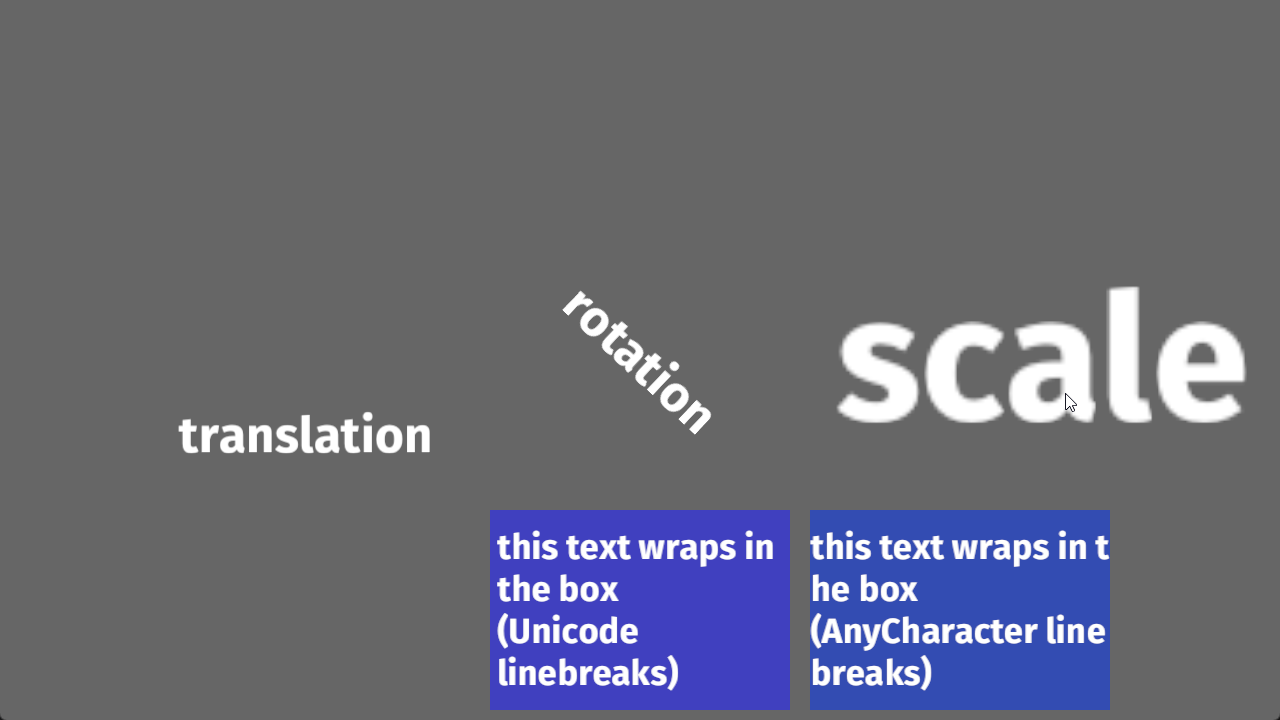
Currently, Text always uses the default linebreaking behaviour in glyph_brush_layout `BuiltInLineBreaker::Unicode` which breaks lines at word boundaries. However, glyph_brush_layout also supports breaking lines at any character by setting the linebreaker to `BuiltInLineBreaker::AnyChar`. Having text wrap character-by-character instead of at word boundaries is desirable in some cases - consider that consoles/terminals usually wrap this way.
As a side note, the default Unicode linebreaker does not seem to handle emergency cases, where there is no word boundary on a line to break at. In that case, the text runs out of bounds. Issue #1867 shows an example of this.
## Solution
Basically just copies how TextAlignment is exposed, but for a new enum TextLineBreakBehaviour.
This PR exposes glyph_brush_layout's two simple linebreaking options (Unicode, AnyChar) to users of Text via the enum TextLineBreakBehaviour (which just translates those 2 aforementioned options), plus a method 'with_linebreak_behaviour' on Text and TextBundle.
## Changelog
Added `Text::with_linebreak_behaviour`
Added `TextBundle::with_linebreak_behaviour`
`TextPipeline::queue_text` and `GlyphBrush::compute_glyphs` now need a TextLineBreakBehaviour argument, in order to pass through the new field.
Modified the `text2d` example to show both linebreaking behaviours.
## Example
Here's what the modified example looks like
# Objective

Fix https://github.com/bevyengine/bevy/issues/4530

- Make it easier to open/close/modify windows by setting them up as `Entity`s with a `Window` component.
- Make multiple windows very simple to set up. (just add a `Window` component to an entity and it should open)

## Solution

- Move all properties of window descriptor to ~components~ a component.
- Replace `WindowId` with `Entity`.
- ~Use change detection for components to update backend rather than events/commands. (The `CursorMoved`/`WindowResized`/... events are kept for user convenience.~
  Check each field individually to see what we need to update, events are still kept for user convenience.

---

## Changelog

- `WindowDescriptor` renamed to `Window`.
    - Width/height consolidated into a `WindowResolution` component.
    - Requesting maximization/minimization is done on the [`Window::state`] field.
- `WindowId` is now `Entity`.

## Migration Guide

- Replace `WindowDescriptor` with `Window`.
    - Change `width` and `height` fields in a `WindowResolution`, either by doing
      ```rust
      WindowResolution::new(width, height) // Explicitly
      // or using From<_> for tuples for convenience
      (1920., 1080.).into()
      ```
- Replace any `WindowCommand` code to just modify the `Window`'s fields directly  and creating/closing windows is now by spawning/despawning an entity with a `Window` component like so:
  ```rust
  let window = commands.spawn(Window { ... }).id(); // open window
  commands.entity(window).despawn(); // close window
  ```

## Unresolved
- ~How do we tell when a window is minimized by a user?~
  ~Currently using the `Resize(0, 0)` as an indicator of minimization.~
  No longer attempting to tell given how finnicky this was across platforms, now the user can only request that a window be maximized/minimized.

 ## Future work
 - Move `exit_on_close` functionality out from windowing and into app(?)
 - https://github.com/bevyengine/bevy/issues/5621
 - https://github.com/bevyengine/bevy/issues/7099
 - https://github.com/bevyengine/bevy/issues/7098


Co-authored-by: Carter Anderson <mcanders1@gmail.com>
## Objective
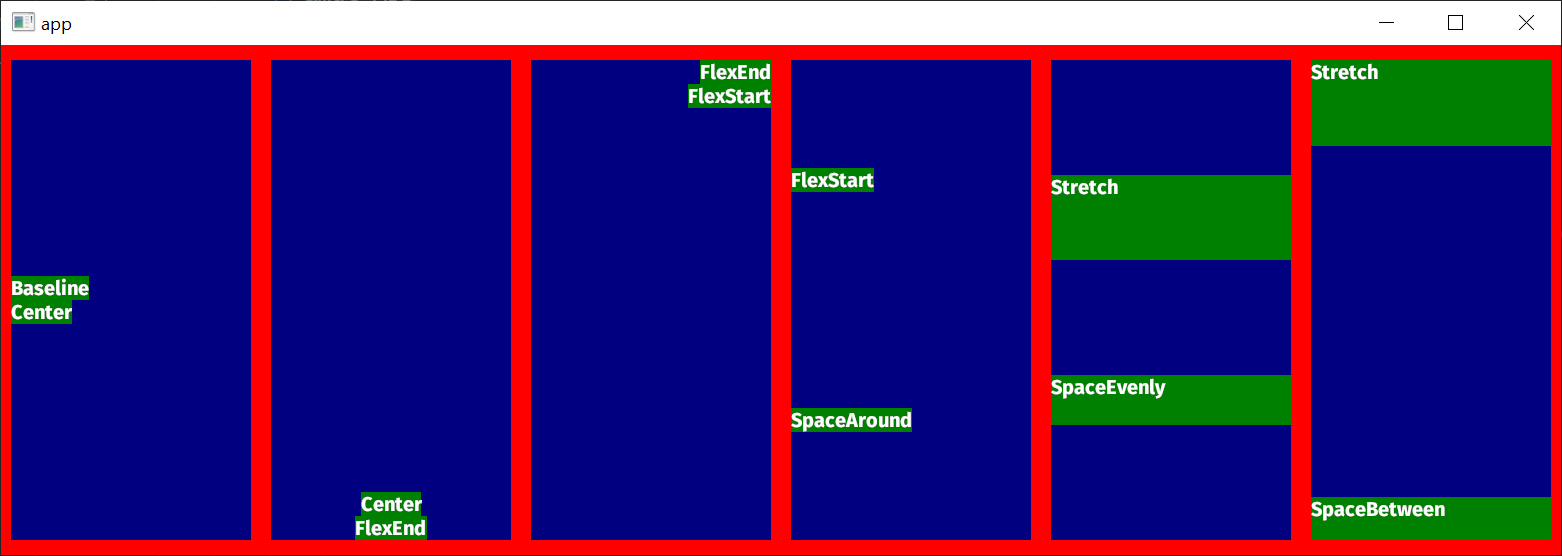
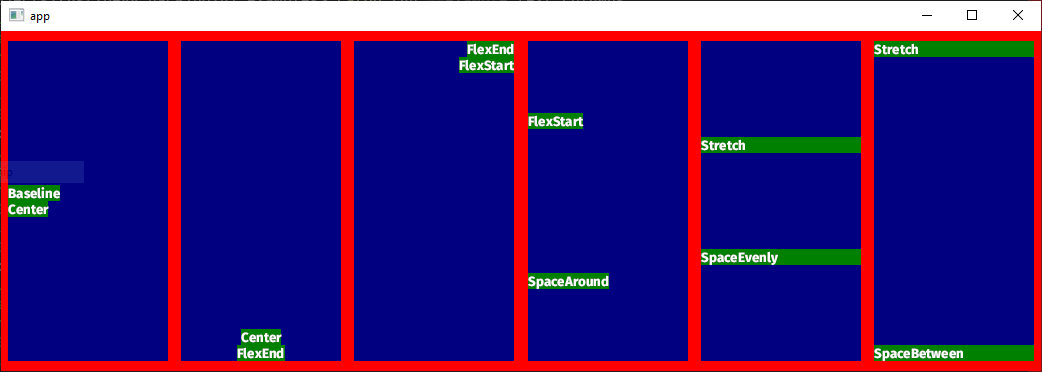
Bevy UI uses a `MeasureFunc` that preserves the aspect ratio of text, not just images. This means that the extent of flex-items containing text may be calculated incorrectly depending on the ratio of the text size compared to the size of its containing node.
Fixes#6748
Related to #6724
with Bevy 0.9:
with this PR (accurately matching the behavior of Flexbox):
## Solution
Only perform the aspect ratio calculations if the uinode contains an image.
## Changelog
* Added a field `preserve_aspect_ratio` to `CalculatedSize`
* The `MeasureFunc` only preserves the aspect ratio when `preserve_aspect_ratio` is true.
* `update_image_calculated_size_system` sets `preserve_aspect_ratio` to true for nodes with images.
# Objective
Fixes#6642
In a way that doesn't create any breaking changes, as a possible way to fix the above in a patch release.
## Solution
Don't actually remove font atlases when `max_font_atlases` is exceeded. Add a warning instead.
Keep `TextError::ExceedMaxTextAtlases` and `TextSettings` as-is so we don't break anything.
This is a bit of a cop-out, but the problems revealed by #6642 seem very challenging to fix properly.
Maybe follow up later with something more like https://github.com/rparrett/bevy/commits/remove-max-font-atlases later, if this is the direction we want to go.
## Note
See previous attempt at a "simple fix" that only solved some of the issues: #6666
# Objective
Delete `ImageMode`. It doesn't do anything except mislead people into thinking it controls the aspect ratio of images somehow.
Fixes#3933 and #6637
## Solution
Delete `ImageMode`
## Changelog
Removes the `ImageMode` enum.
Removes the `image_mode` field from `ImageBundle`
Removes the `With<ImageMode>` query filter from `image_node_system`
Renames `image_node_system` to` update_image_calculated_size_system`
# Objective
Fixes  #3225, Allow for flippable UI Images

## Solution
Add flip_x and flip_y fields to UiImage, and swap the UV coordinates accordingly in ui_prepare_nodes.

## Changelog
* Changes UiImage to a struct with texture, flip_x, and flip_y fields.
* Adds flip_x and flip_y fields to ExtractedUiNode.
* Changes extract_uinodes to extract the flip_x and flip_y values from UiImage.
* Changes prepare_uinodes to swap the UV coordinates as required.
* Changes UiImage derefs to texture field accesses.
# Objective

- fix new clippy lints before they get stable and break CI

## Solution

- run `clippy --fix` to auto-fix machine-applicable lints
- silence `clippy::should_implement_trait` for `fn HandleId::default<T: Asset>`

## Changes
- always prefer `format!("{inline}")` over `format!("{}", not_inline)`
- prefer `Box::default` (or `Box::<T>::default` if necessary) over `Box::new(T::default())`
# Objective

Bevy's internal plugins have lots of execution-order ambiguities, which makes the ambiguity detection tool very noisy for our users.

## Solution

Silence every last ambiguity that can currently be resolved.
Each time an ambiguity is silenced, it is accompanied by a comment describing why it is correct. This description should be based on the public API of the respective systems. Thus, I have added documentation to some systems describing how they use some resources.

# Future work

Some ambiguities remain, due to issues out of scope for this PR.

* The ambiguity checker does not respect `Without<>` filters, leading to false positives.
* Ambiguities between `bevy_ui` and `bevy_animation` cannot be resolved, since neither crate knows that the other exists. We will need a general solution to this problem.
# Objective

- Proactive changing of code to comply with warnings generated by beta of rustlang version of cargo clippy.

## Solution

- Code changed as recommended by `rustup update`, `rustup default beta`, `cargo run -p ci -- clippy`.
- Tested using `beta` and `stable`.  No clippy warnings in either after changes made.

---

## Changelog

- Warnings fixed were: `clippy::explicit-auto-deref` (present in 11 files), `clippy::needless-borrow` (present in 2 files), and `clippy::only-used-in-recursion` (only 1 file).
# Objective
Fixes#6272
## Solution
Revert to old way of positioning text for Text2D rendered text.
Co-authored-by: Michel van der Hulst <hulstmichel@gmail.com>
# Objective
Fixes#5636
Summary: The FontAtlasSet caches generated font textures per font size. Since font size can be any arbitrary floating point number it is possible for the user to generate thousands of font texture inadvertently by changing the font size over time. This results in a memory leak as these generated font textures fill the available memory.
## Solution
We limit the number of possible font sizes that we will cache and throw an error if the user attempts to generate more. This error encourages the user to use alternative, less performance intensive methods to accomplish the same goal. If the user requires more font sizes and the alternative solutions wont work there is now a TextSettings Resource that the user can set to configure this limit.
---
## Changelog
The number of cached font sizes per font is now limited with a default limit of 100 font sizes per font. This limit is configurable via the new TextSettings struct.
# Objective

Make `TextLayoutInfo` more accessible as a component, rather than internal to `TextPipeline`. I am working on a plugin that manipulates these and there is no (mutable) access to them right now.

## Solution

This changes `TextPipeline::queue_text` to return `TextLayoutInfo`'s rather than storing them in a map internally. `text2d_system` and `text_system` now take the returned `TextLayoutInfo` and store it as a component of the entity. I considered adding an accessor to `TextPipeline` (e.g. `get_glyphs_mut`) but this seems like it might be a little faster, and also has the added benefit of cleaning itself up when entities are removed. Right now nothing is ever removed from the glyphs map.

## Changelog

Removed `DefaultTextPipeline`. `TextPipeline` no longer has a generic key type. `TextPipeline::queue_text` returns `TextLayoutInfo` directly.

## Migration Guide

This might break a third-party crate? I could restore the orginal TextPipeline API as a wrapper around what's in this PR.
# Objective

- Allow users to change the scaling of the UI
- Adopted from #2808

## Solution

- This is an accessibility feature for fixed-size UI elements, allowing the developer to expose a range of UI scales for the player to set a scale that works for their needs.

> - The user can modify the UiScale struct to change the scaling at runtime. This multiplies the Px values by the scale given, while not touching any others.
> - The example showcases how this even allows for fluid transitions

> Here's how the example looks like:

https://user-images.githubusercontent.com/1631166/132979069-044161a9-8e85-45ab-9e93-fcf8e3852c2b.mp4

---

## Changelog

- Added a `UiScale` which can be used to scale all of UI


Co-authored-by: Andreas Weibye <13300393+Weibye@users.noreply.github.com>
Co-authored-by: Carter Anderson <mcanders1@gmail.com>
> In draft until #4761 is merged. See the relevant commits [here](a85fe94a18).

---

# Objective

Update enums across Bevy to use the new enum reflection and get rid of `#[reflect_value(...)]` usages.

## Solution

Find and replace all[^1] instances of `#[reflect_value(...)]` on enum types.

---

## Changelog

- Updated all[^1] reflected enums to implement `Enum` (i.e. they are no longer `ReflectRef::Value`)

## Migration Guide
Bevy-defined enums have been updated to implement `Enum` and are not considered value types (`ReflectRef::Value`) anymore. This means that their serialized representations will need to be updated. For example, given the Bevy enum:

```rust
pub enum ScalingMode {
  None,
  WindowSize,
  Auto { min_width: f32, min_height: f32 },
  FixedVertical(f32),
  FixedHorizontal(f32),
}
```

You will need to update the serialized versions accordingly.

```js
// OLD FORMAT
{
  "type": "bevy_render:📷:projection::ScalingMode",
  "value": FixedHorizontal(720),
},

// NEW FORMAT
{
  "type": "bevy_render:📷:projection::ScalingMode",
  "enum": {
    "variant": "FixedHorizontal",
    "tuple": [
      {
        "type": "f32",
        "value": 720,
      },
    ],
  },
},
```

This may also have other smaller implications (such as `Debug` representation), but serialization is probably the most prominent.

[^1]: All enums except `HandleId` as neither `Uuid` nor `AssetPathId` implement the reflection traits
# Objective

- Migrate changes from #3503.

## Solution

- Change `Size<T>` and `UiRect<T>` to `Size` and `UiRect` using `Val`.
- Implement `Sub`, `SubAssign`, `Mul`, `MulAssign`, `Div` and `DivAssign` for `Val`.
- Update tests for `Size`.

---

## Changelog

### Changed

- The generic `T` of `Size` and `UiRect` got removed and instead they both now always use `Val`.

## Migration Guide

- The generic `T` of `Size` and `UiRect` got removed and instead they both now always use `Val`. If you used a `Size<f32>` consider replacing it with a `Vec2` which is way more powerful.


Co-authored-by: KDecay <KDecayMusic@protonmail.com>
Remove unnecessary calls to `iter()`/`iter_mut()`.
Mainly updates the use of queries in our code, docs, and examples.

```rust
// From
for _ in list.iter() {
for _ in list.iter_mut() {

// To
for _ in &list {
for _ in &mut list {
```

We already enable the pedantic lint [clippy::explicit_iter_loop](https://rust-lang.github.io/rust-clippy/stable/) inside of Bevy. However, this only warns for a few known types from the standard library.

## Note for reviewers
As you can see the additions and deletions are exactly equal.
Maybe give it a quick skim to check I didn't sneak in a crypto miner, but you don't have to torture yourself by reading every line.
I already experienced enough pain making this PR :)


Co-authored-by: devil-ira <justthecooldude@gmail.com>
# Objective
Fixes#5153
## Solution
Search for all enums and manually check if they have default impls that can use this new derive.
By my reckoning:
| enum | num |
|-|-|
| total | 159 |
| has default impl | 29 |
| default is unit variant | 23 |
builds on top of #4780

# Objective

`Reflect` and `Serialize` are currently very tied together because `Reflect` has a `fn serialize(&self) -> Option<Serializable<'_>>` method. Because of that, we can either implement `Reflect` for types like `Option<T>` with `T: Serialize` and have `fn serialize` be implemented, or without the bound but having `fn serialize` return `None`.

By separating `ReflectSerialize` into a separate type (like how it already is for `ReflectDeserialize`, `ReflectDefault`), we could separately `.register::<Option<T>>()` and `.register_data::<Option<T>, ReflectSerialize>()` only if the type `T: Serialize`.

This PR does not change the registration but allows it to be changed in a future PR.

## Solution

- add the type
```rust
struct ReflectSerialize { .. }
impl<T: Reflect + Serialize> FromType<T> for ReflectSerialize { .. }
```

- remove `#[reflect(Serialize)]` special casing.

- when serializing reflect value types, look for `ReflectSerialize` in the `TypeRegistry` instead of calling `value.serialize()`
# Objective

- Sometimes, people might load an asset as one type, then use it with an `Asset`s for a different type.
- See e.g. #4784.
- This is especially likely with the Gltf types, since users may not have a clear conceptual model of what types the assets will be.
- We had an instance of this ourselves, in the `scene_viewer` example

## Solution

- Make `Assets::get` require a type safe handle.

---

## Changelog

### Changed

- `Assets::<T>::get` and `Assets::<T>::get_mut` now require that the passed handles are `Handle<T>`, improving the type safety of handles.

### Added
- `HandleUntyped::typed_weak`, a helper function for creating a weak typed version of an exisitng `HandleUntyped`.

## Migration Guide

`Assets::<T>::get` and `Assets::<T>::get_mut` now require that the passed handles are `Handle<T>`, improving the type safety of handles. If you were previously passing in:
   - a `HandleId`, use `&Handle::weak(id)` instead, to create a weak handle. You may have been able to store a type safe `Handle` instead.
   - a `HandleUntyped`, use `&handle_untyped.typed_weak()` to create a weak handle of the specified type. This is most likely to be the useful when using [load_folder](https://docs.rs/bevy_asset/latest/bevy_asset/struct.AssetServer.html#method.load_folder)
   - a `Handle<U>` of  of a different type, consider whether this is the correct handle type to store. If it is (i.e. the same handle id is used for multiple different Asset types) use `Handle::weak(handle.id)` to cast to a different type.
### Problem
It currently isn't possible to construct the default value of a reflected type. Because of that, it isn't possible to use `add_component` of `ReflectComponent` to add a new component to an entity because you can't know what the initial value should be.

### Solution

1. add `ReflectDefault` type
```rust
#[derive(Clone)]
pub struct ReflectDefault {
    default: fn() -> Box<dyn Reflect>,
}

impl ReflectDefault {
    pub fn default(&self) -> Box<dyn Reflect> {
        (self.default)()
    }
}

impl<T: Reflect + Default> FromType<T> for ReflectDefault {
    fn from_type() -> Self {
        ReflectDefault {
            default: || Box::new(T::default()),
        }
    }
}
```

2. add `#[reflect(Default)]` to all component types that implement `Default` and are user facing (so not `ComputedSize`, `CubemapVisibleEntities` etc.)


This makes it possible to add the default value of a component to an entity without any compile-time information:

```rust
fn main() {
    let mut app = App::new();
    app.register_type::<Camera>();

    let type_registry = app.world.get_resource::<TypeRegistry>().unwrap();
    let type_registry = type_registry.read();

    let camera_registration = type_registry.get(std::any::TypeId::of::<Camera>()).unwrap();
    let reflect_default = camera_registration.data::<ReflectDefault>().unwrap();
    let reflect_component = camera_registration
        .data::<ReflectComponent>()
        .unwrap()
        .clone();

    let default = reflect_default.default();

    drop(type_registry);

    let entity = app.world.spawn().id();
    reflect_component.add_component(&mut app.world, entity, &*default);

    let camera = app.world.entity(entity).get::<Camera>().unwrap();
    dbg!(&camera);
}
```

### Open questions
- should we have `ReflectDefault` or `ReflectFromWorld` or both?
# Objective

- Related #4276.
- Part of the splitting process of #3503.

## Solution

- Move `Size` to `bevy_ui`.

## Reasons

- `Size` is only needed in `bevy_ui` (because it needs to use `Val` instead of `f32`), but it's also used as a worse `Vec2`  replacement in other areas.
- `Vec2` is more powerful than `Size` so it should be used whenever possible.
- Discussion in #3503.

## Changelog

### Changed

- The `Size` type got moved from `bevy_math` to `bevy_ui`.

## Migration Guide

- The `Size` type got moved from `bevy::math` to `bevy::ui`. To migrate you just have to import `bevy::ui::Size` instead of `bevy::math::Math` or use the `bevy::prelude` instead.

Co-authored-by: KDecay <KDecayMusic@protonmail.com>