7beca6fd0e
65 Commits
| Author | SHA1 | Message | Date | |
|---|---|---|---|---|
 ickshonpe
|
4836c7868c
|
Specialized UI transform (#16615)
# Objective Add specialized UI transform `Component`s and fix some related problems: * Animating UI elements by modifying the `Transform` component of UI nodes doesn't work very well because `ui_layout_system` overwrites the translations each frame. The `overflow_debug` example uses a horrible hack where it copies the transform into the position that'll likely cause a panic if any users naively copy it. * Picking ignores rotation and scaling and assumes UI nodes are always axis aligned. * The clipping geometry stored in `CalculatedClip` is wrong for rotated and scaled elements. * Transform propagation is unnecessary for the UI, the transforms can be updated during layout updates. * The UI internals use both object-centered and top-left-corner-based coordinates systems for UI nodes. Depending on the context you have to add or subtract the half-size sometimes before transforming between coordinate spaces. We should just use one system consistantly so that the transform can always be directly applied. * `Transform` doesn't support responsive coordinates. ## Solution * Unrequire `Transform` from `Node`. * New components `UiTransform`, `UiGlobalTransform`: - `Node` requires `UiTransform`, `UiTransform` requires `UiGlobalTransform` - `UiTransform` is a 2d-only equivalent of `Transform` with a translation in `Val`s. - `UiGlobalTransform` newtypes `Affine2` and is updated in `ui_layout_system`. * New helper functions on `ComputedNode` for mapping between viewport and local node space. * The cursor position is transformed to local node space during picking so that it respects rotations and scalings. * To check if the cursor hovers a node recursively walk up the tree to the root checking if any of the ancestor nodes clip the point at the cursor. If the point is clipped the interaction is ignored. * Use object-centered coordinates for UI nodes. * `RelativeCursorPosition`'s coordinates are now object-centered with (0,0) at the the center of the node and the corners at (±0.5, ±0.5). * Replaced the `normalized_visible_node_rect: Rect` field of `RelativeCursorPosition` with `cursor_over: bool`, which is set to true when the cursor is over an unclipped point on the node. The visible area of the node is not necessarily a rectangle, so the previous implementation didn't work. This should fix all the logical bugs with non-axis aligned interactions and clipping. Rendering still needs changes but they are far outside the scope of this PR. Tried and abandoned two other approaches: * New `transform` field on `Node`, require `GlobalTransform` on `Node`, and unrequire `Transform` on `Node`. Unrequiring `Transform` opts out of transform propagation so there is then no conflict with updating the `GlobalTransform` in `ui_layout_system`. This was a nice change in its simplicity but potentially confusing for users I think, all the `GlobalTransform` docs mention `Transform` and having special rules for how it's updated just for the UI is unpleasently surprising. * New `transform` field on `Node`. Unrequire `Transform` on `Node`. New `transform: Affine2` field on `ComputedNode`. This was okay but I think most users want a separate specialized UI transform components. The fat `ComputedNode` doesn't work well with change detection. Fixes #18929, #18930 ## Testing There is an example you can look at: ``` cargo run --example ui_transform ``` Sometimes in the example if you press the rotate button couple of times the first glyph from the top label disappears , I'm not sure what's causing it yet but I don't think it's related to this PR. ## Migration Guide New specialized 2D UI transform components `UiTransform` and `UiGlobalTransform`. `UiTransform` is a 2d-only equivalent of `Transform` with a translation in `Val`s. `UiGlobalTransform` newtypes `Affine2` and is updated in `ui_layout_system`. `Node` now requires `UiTransform` instead of `Transform`. `UiTransform` requires `UiGlobalTransform`. In previous versions of Bevy `ui_layout_system` would overwrite UI node's `Transform::translation` each frame. `UiTransform`s aren't overwritten and there is no longer any need for systems that cache and rewrite the transform for translated UI elements. `RelativeCursorPosition`'s coordinates are now object-centered with (0,0) at the the center of the node and the corners at (±0.5, ±0.5). Its `normalized_visible_node_rect` field has been removed and replaced with a new `cursor_over: bool` field which is set to true when the cursor is hovering an unclipped area of the UI node. --------- Co-authored-by: Alice Cecile <alice.i.cecile@gmail.com> |
||
|
Carter Anderson
|
d8fa57bd7b
|
Switch ChildOf back to tuple struct (#18672)
# Objective In #17905 we swapped to a named field on `ChildOf` to help resolve variable naming ambiguity of child vs parent (ex: `child_of.parent` clearly reads as "I am accessing the parent of the child_of relationship", whereas `child_of.0` is less clear). Unfortunately this has the side effect of making initialization less ideal. `ChildOf { parent }` reads just as well as `ChildOf(parent)`, but `ChildOf { parent: root }` doesn't read nearly as well as `ChildOf(root)`. ## Solution Move back to `ChildOf(pub Entity)` but add a `child_of.parent()` function and use it for all accesses. The downside here is that users are no longer "forced" to access the parent field with `parent` nomenclature, but I think this strikes the right balance. Take a look at the diff. I think the results provide strong evidence for this change. Initialization has the benefit of reading much better _and_ of taking up significantly less space, as many lines go from 3 to 1, and we're cutting out a bunch of syntax in some cases. Sadly I do think this should land in 0.16 as the cost of doing this _after_ the relationships migration is high. |
||
|
ickshonpe
|
17435c7118
|
Remove the visited local system param from update_ui_context_system. (#18664)
# Objective The `visited: Local<HashSet<Entity>>` system param is meant to track which entities `update_contexts_recursively` has visited and updated but when the reparent_nodes_query isn't ordered descending from parent to child nodes can get marked as visited even though their camera target is unset and if the camera target is unset then the node won't be rendered. Fixes #18616 ## Solution Remove the `visited` system param from `update_ui_context_system` and the associated visited check from `update_contexts_recursively`. It was redundant anyway since the set_if_neq check is sufficient to track already updated nodes. ## Testing The example from #18616 can be used for testing. |
||
|
Vic
|
f57c7a43c4
|
reexport entity set collections in entity module (#18413)
# Objective Unlike for their helper typers, the import paths for `unique_array::UniqueEntityArray`, `unique_slice::UniqueEntitySlice`, `unique_vec::UniqueEntityVec`, `hash_set::EntityHashSet`, `hash_map::EntityHashMap`, `index_set::EntityIndexSet`, `index_map::EntityIndexMap` are quite redundant. When looking at the structure of `hashbrown`, we can also see that while both `HashSet` and `HashMap` have their own modules, the main types themselves are re-exported to the crate level. ## Solution Re-export the types in their shared `entity` parent module, and simplify the imports where they're used. |
||
|
newclarityex
|
ecccd57417
|
Generic system config (#17962)
# Objective Prevents duplicate implementation between IntoSystemConfigs and IntoSystemSetConfigs using a generic, adds a NodeType trait for more config flexibility (opening the door to implement https://github.com/bevyengine/bevy/issues/14195?). ## Solution Followed writeup by @ItsDoot: https://hackmd.io/@doot/rJeefFHc1x Removes IntoSystemConfigs and IntoSystemSetConfigs, instead using IntoNodeConfigs with generics. ## Testing Pending --- ## Showcase N/A ## Migration Guide SystemSetConfigs -> NodeConfigs<InternedSystemSet> SystemConfigs -> NodeConfigs<ScheduleSystem> IntoSystemSetConfigs -> IntoNodeConfigs<InternedSystemSet, M> IntoSystemConfigs -> IntoNodeConfigs<ScheduleSystem, M> --------- Co-authored-by: Christian Hughes <9044780+ItsDoot@users.noreply.github.com> Co-authored-by: Alice Cecile <alice.i.cecile@gmail.com> |
||
|
Tim Overbeek
|
ccb7069e7f
|
Change ChildOf to Childof { parent: Entity} and support deriving Relationship and RelationshipTarget with named structs (#17905)
# Objective fixes #17896 ## Solution Change ChildOf ( Entity ) to ChildOf { parent: Entity } by doing this we also allow users to use named structs for relationship derives, When you have more than 1 field in a struct with named fields the macro will look for a field with the attribute #[relationship] and all of the other fields should implement the Default trait. Unnamed fields are still supported. When u have a unnamed struct with more than one field the macro will fail. Do we want to support something like this ? ```rust #[derive(Component)] #[relationship_target(relationship = ChildOf)] pub struct Children (#[relationship] Entity, u8); ``` I could add this, it but doesn't seem nice. ## Testing crates/bevy_ecs - cargo test ## Showcase ```rust use bevy_ecs::component::Component; use bevy_ecs::entity::Entity; #[derive(Component)] #[relationship(relationship_target = Children)] pub struct ChildOf { #[relationship] pub parent: Entity, internal: u8, }; #[derive(Component)] #[relationship_target(relationship = ChildOf)] pub struct Children { children: Vec<Entity> }; ``` --------- Co-authored-by: Tim Overbeek <oorbecktim@Tims-MacBook-Pro.local> Co-authored-by: Tim Overbeek <oorbecktim@c-001-001-042.client.nl.eduvpn.org> Co-authored-by: Tim Overbeek <oorbecktim@c-001-001-059.client.nl.eduvpn.org> Co-authored-by: Tim Overbeek <oorbecktim@c-001-001-054.client.nl.eduvpn.org> Co-authored-by: Tim Overbeek <oorbecktim@c-001-001-027.client.nl.eduvpn.org> |
||
|
ickshonpe
|
359cd432c0
|
UI clipping update function comments fix (#17785)
# Objective Fix for the comments for the clipping rects update function which references `Overflow` variants that no longer exist. |
||
|
ickshonpe
|
300fe4db4d
|
Store UI render target info locally per node (#17579)
# Objective It's difficult to understand or make changes to the UI systems because of how each system needs to individually track changes to scale factor, windows and camera targets in local hashmaps, particularly for new contributors. Any major change inevitably introduces new scale factor bugs. Instead of per-system resolution we can resolve the camera target info for all UI nodes in a system at the start of `PostUpdate` and then store it per-node in components that can be queried with change detection. Fixes #17578 Fixes #15143 ## Solution Store the UI render target's data locally per node in a component that is updated in `PostUpdate` before any other UI systems run. This component can be then be queried with change detection so that UI systems no longer need to have knowledge of cameras and windows and don't require fragile custom change detection solutions using local hashmaps. ## Showcase Compare `measure_text_system` from main (which has a bug the causes it to use the wrong scale factor when a node's camera target changes): ``` pub fn measure_text_system( mut scale_factors_buffer: Local<EntityHashMap<f32>>, mut last_scale_factors: Local<EntityHashMap<f32>>, fonts: Res<Assets<Font>>, camera_query: Query<(Entity, &Camera)>, default_ui_camera: DefaultUiCamera, ui_scale: Res<UiScale>, mut text_query: Query< ( Entity, Ref<TextLayout>, &mut ContentSize, &mut TextNodeFlags, &mut ComputedTextBlock, Option<&UiTargetCamera>, ), With<Node>, >, mut text_reader: TextUiReader, mut text_pipeline: ResMut<TextPipeline>, mut font_system: ResMut<CosmicFontSystem>, ) { scale_factors_buffer.clear(); let default_camera_entity = default_ui_camera.get(); for (entity, block, content_size, text_flags, computed, maybe_camera) in &mut text_query { let Some(camera_entity) = maybe_camera .map(UiTargetCamera::entity) .or(default_camera_entity) else { continue; }; let scale_factor = match scale_factors_buffer.entry(camera_entity) { Entry::Occupied(entry) => *entry.get(), Entry::Vacant(entry) => *entry.insert( camera_query .get(camera_entity) .ok() .and_then(|(_, c)| c.target_scaling_factor()) .unwrap_or(1.0) * ui_scale.0, ), }; if last_scale_factors.get(&camera_entity) != Some(&scale_factor) || computed.needs_rerender() || text_flags.needs_measure_fn || content_size.is_added() { create_text_measure( entity, &fonts, scale_factor.into(), text_reader.iter(entity), block, &mut text_pipeline, content_size, text_flags, computed, &mut font_system, ); } } core::mem::swap(&mut *last_scale_factors, &mut *scale_factors_buffer); } ``` with `measure_text_system` from this PR (which always uses the correct scale factor): ``` pub fn measure_text_system( fonts: Res<Assets<Font>>, mut text_query: Query< ( Entity, Ref<TextLayout>, &mut ContentSize, &mut TextNodeFlags, &mut ComputedTextBlock, Ref<ComputedNodeTarget>, ), With<Node>, >, mut text_reader: TextUiReader, mut text_pipeline: ResMut<TextPipeline>, mut font_system: ResMut<CosmicFontSystem>, ) { for (entity, block, content_size, text_flags, computed, computed_target) in &mut text_query { // Note: the ComputedTextBlock::needs_rerender bool is cleared in create_text_measure(). if computed_target.is_changed() || computed.needs_rerender() || text_flags.needs_measure_fn || content_size.is_added() { create_text_measure( entity, &fonts, computed_target.scale_factor.into(), text_reader.iter(entity), block, &mut text_pipeline, content_size, text_flags, computed, &mut font_system, ); } } } ``` ## Testing I removed an alarming number of tests from the `layout` module but they were mostly to do with the deleted camera synchronisation logic. The remaining tests should all pass now. The most relevant examples are `multiple_windows` and `split_screen`, the behaviour of both should be unchanged from main. --------- Co-authored-by: UkoeHB <37489173+UkoeHB@users.noreply.github.com> Co-authored-by: Alice Cecile <alice.i.cecile@gmail.com> |
||
|
Zachary Harrold
|
9bc0ae33c3
|
Move hashbrown and foldhash out of bevy_utils (#17460)
# Objective - Contributes to #16877 ## Solution - Moved `hashbrown`, `foldhash`, and related types out of `bevy_utils` and into `bevy_platform_support` - Refactored the above to match the layout of these types in `std`. - Updated crates as required. ## Testing - CI --- ## Migration Guide - The following items were moved out of `bevy_utils` and into `bevy_platform_support::hash`: - `FixedState` - `DefaultHasher` - `RandomState` - `FixedHasher` - `Hashed` - `PassHash` - `PassHasher` - `NoOpHash` - The following items were moved out of `bevy_utils` and into `bevy_platform_support::collections`: - `HashMap` - `HashSet` - `bevy_utils::hashbrown` has been removed. Instead, import from `bevy_platform_support::collections` _or_ take a dependency on `hashbrown` directly. - `bevy_utils::Entry` has been removed. Instead, import from `bevy_platform_support::collections::hash_map` or `bevy_platform_support::collections::hash_set` as appropriate. - All of the above equally apply to `bevy::utils` and `bevy::platform_support`. ## Notes - I left `PreHashMap`, `PreHashMapExt`, and `TypeIdMap` in `bevy_utils` as they might be candidates for micro-crating. They can always be moved into `bevy_platform_support` at a later date if desired. |
||
|
ickshonpe
|
adc33b5108
|
Rename TargetCamera to UiTargetCamera (#17403)
# Objective It's not immediately obvious that `TargetCamera` only works with UI node entities. It's natural to assume from looking at something like the `multiple_windows` example that it will work with everything. ## Solution Rename `TargetCamera` to `UiTargetCamera`. ## Migration Guide `TargetCamera` has been renamed to `UiTargetCamera`. |
||
|
Clar Fon
|
711246aa34
|
Update hashbrown to 0.15 (#15801)
Updating dependencies; adopted version of #15696. (Supercedes #15696.) Long answer: hashbrown is no longer using ahash by default, meaning that we can't use the default-hasher methods with ahasher. So, we have to use the longer-winded versions instead. This takes the opportunity to also switch our default hasher as well, but without actually enabling the default-hasher feature for hashbrown, meaning that we'll be able to change our hasher more easily at the cost of all of these method calls being obnoxious forever. One large change from 0.15 is that `insert_unique_unchecked` is now `unsafe`, and for cases where unsafe code was denied at the crate level, I replaced it with `insert`. ## Migration Guide `bevy_utils` has updated its version of `hashbrown` to 0.15 and now defaults to `foldhash` instead of `ahash`. This means that if you've hard-coded your hasher to `bevy_utils::AHasher` or separately used the `ahash` crate in your code, you may need to switch to `foldhash` to ensure that everything works like it does in Bevy. |
||
|
ickshonpe
|
8a3a8b5cfb
|
Only use physical coords internally in bevy_ui (#16375)
# Objective We switch back and forwards between logical and physical coordinates all over the place. Systems have to query for cameras and the UiScale when they shouldn't need to. It's confusing and fragile and new scale factor bugs get found constantly. ## Solution * Use physical coordinates whereever possible in `bevy_ui`. * Store physical coords in `ComputedNode` and tear out all the unneeded scale factor calculations and queries. * Add an `inverse_scale_factor` field to `ComputedNode` and set nodes changed when their scale factor changes. ## Migration Guide `ComputedNode`'s fields and methods now use physical coordinates. `ComputedNode` has a new field `inverse_scale_factor`. Multiplying the physical coordinates by the `inverse_scale_factor` will give the logical values. --------- Co-authored-by: atlv <email@atlasdostal.com> |
||
|
Carter Anderson
|
015f2c69ca
|
Merge Style properties into Node. Use ComputedNode for computed properties. (#15975)
# Objective Continue improving the user experience of our UI Node API in the direction specified by [Bevy's Next Generation Scene / UI System](https://github.com/bevyengine/bevy/discussions/14437) ## Solution As specified in the document above, merge `Style` fields into `Node`, and move "computed Node fields" into `ComputedNode` (I chose this name over something like `ComputedNodeLayout` because it currently contains more than just layout info. If we want to break this up / rename these concepts, lets do that in a separate PR). `Style` has been removed. This accomplishes a number of goals: ## Ergonomics wins Specifying both `Node` and `Style` is now no longer required for non-default styles Before: ```rust commands.spawn(( Node::default(), Style { width: Val::Px(100.), ..default() }, )); ``` After: ```rust commands.spawn(Node { width: Val::Px(100.), ..default() }); ``` ## Conceptual clarity `Style` was never a comprehensive "style sheet". It only defined "core" style properties that all `Nodes` shared. Any "styled property" that couldn't fit that mold had to be in a separate component. A "real" style system would style properties _across_ components (`Node`, `Button`, etc). We have plans to build a true style system (see the doc linked above). By moving the `Style` fields to `Node`, we fully embrace `Node` as the driving concept and remove the "style system" confusion. ## Next Steps * Consider identifying and splitting out "style properties that aren't core to Node". This should not happen for Bevy 0.15. --- ## Migration Guide Move any fields set on `Style` into `Node` and replace all `Style` component usage with `Node`. Before: ```rust commands.spawn(( Node::default(), Style { width: Val::Px(100.), ..default() }, )); ``` After: ```rust commands.spawn(Node { width: Val::Px(100.), ..default() }); ``` For any usage of the "computed node properties" that used to live on `Node`, use `ComputedNode` instead: Before: ```rust fn system(nodes: Query<&Node>) { for node in &nodes { let computed_size = node.size(); } } ``` After: ```rust fn system(computed_nodes: Query<&ComputedNode>) { for computed_node in &computed_nodes { let computed_size = computed_node.size(); } } ``` |
||
|
Alice Cecile
|
76744bf58c
|
Mark ghost nodes as experimental and partially feature flag them (#15961)
# Objective As discussed in #15341, ghost nodes are a contentious and experimental feature. In the interest of enabling ecosystem experimentation, we've decided to keep them in Bevy 0.15. That said, we don't use them internally, and don't expect third-party crates to support them. If the experimentation returns a negative result (they aren't very useful, an alternative design is preferred etc) they will be removed. We should clearly communicate this status to users, and make sure that users don't use ghost nodes in their projects without a very clear understanding of what they're getting themselves into. ## Solution To make life easy for users (and Bevy), `GhostNode` and all associated helpers remain public and are always available. However, actually constructing these requires enabling a feature flag that's clearly marked as experimental. To do so, I've added a meaningless private field. When the feature flag is enabled, our constructs (`new` and `default`) can be used. I've added a `new` constructor, which should be preferred over `Default::default` as that can be readily deprecated, allowing us to prompt users to swap over to the much nicer `GhostNode` syntax once this is a unit struct again. Full credit: this was mostly @cart's design: I'm just implementing it! ## Testing I've run the ghost_nodes example and it fails to compile without the feature flag. With the feature flag, it works fine :) --------- Co-authored-by: Zachary Harrold <zac@harrold.com.au> |
||
|
ickshonpe
|
6d3965f520
|
Overflow clip margin (#15561)
# Objective Limited implementation of the CSS property `overflow-clip-margin` https://developer.mozilla.org/en-US/docs/Web/CSS/overflow-clip-margin Allows you to control the visible area for clipped content when using overfllow-clip, -hidden, or -scroll and expand it with a margin. Based on #15442 Fixes #15468 ## Solution Adds a new field to Style: `overflow_clip_margin: OverflowClipMargin`. The field is ignored unless overflow-clip, -hidden or -scroll is set on at least one axis. `OverflowClipMargin` has these associated constructor functions: ``` pub const fn content_box() -> Self; pub const fn padding_box() -> Self; pub const fn border_box() -> Self; ``` You can also use the method `with_margin` to increases the size of the visible area: ``` commands .spawn(NodeBundle { style: Style { width: Val::Px(100.), height: Val::Px(100.), padding: UiRect::all(Val::Px(20.)), border: UiRect::all(Val::Px(5.)), overflow: Overflow::clip(), overflow_clip_margin: OverflowClipMargin::border_box().with_margin(25.), ..Default::default() }, border_color: Color::BLACK.into(), background_color: GRAY.into(), ..Default::default() }) ``` `with_margin` expects a length in logical pixels, negative values are clamped to zero. ## Notes * To keep this PR as simple as possible I omitted responsive margin values support. This could be added in a follow up if we want it. * CSS also supports a `margin-box` option but we don't have access to the margin values in `Node` so it's probably not feasible to implement atm. ## Testing ```cargo run --example overflow_clip_margin``` <img width="396" alt="overflow-clip-margin" src="https://github.com/user-attachments/assets/07b51cd6-a565-4451-87a0-fa079429b04b"> ## Migration Guide Style has a new field `OverflowClipMargin`. It allows users to set the visible area for clipped content when using overflow-clip, -hidden, or -scroll and expand it with a margin. There are three associated constructor functions `content_box`, `padding_box` and `border_box`: * `content_box`: elements painted outside of the content box area (the innermost part of the node excluding the padding and border) of the node are clipped. This is the new default behaviour. * `padding_box`: elements painted outside outside of the padding area of the node are clipped. * `border_box`: elements painted outside of the bounds of the node are clipped. This matches the behaviour from Bevy 0.14. There is also a `with_margin` method that increases the size of the visible area by the given number in logical pixels, negative margin values are clamped to zero. `OverflowClipMargin` is ignored unless overflow-clip, -hidden or -scroll is also set on at least one axis of the UI node. --------- Co-authored-by: UkoeHB <37489173+UkoeHB@users.noreply.github.com> |
||
|
ickshonpe
|
b78a060af2
|
Clip to the UI node's content box (#15442)
# Objective Change UI clipping to respect borders and padding. Fixes #15335 ## Solution Based on #15163 1. Add a `padding` field to `Node`. 2. In `ui_layout_size` copy the padding values from taffy to `Node::padding`. 4. Determine the node's content box (The innermost part of the node excluding the padding and border). 5. In `update_clipping` perform the clipping intersection with the node's content box. ## Notes * `Rect` probably needs some helper methods for working with insets but because `Rect` and `BorderRect` are in different crates it's awkward to add them. Left for a follow up. * We could have another `Overflow` variant (probably called `Overflow::Hidden`) to that clips inside of the border box instead of the content box. Left it out here as I'm not certain about the naming or behaviour though. If this PR is adopted, it would be trivial to add a `Hidden` variant in a follow up. * Depending on UI scaling there are sometimes gaps in the layout: <img width="532" alt="rounding-bug" src="https://github.com/user-attachments/assets/cc29aa0d-44fe-403f-8f0e-cd28a8b1d1b3"> This is caused by existing bugs in `ui_layout_system`'s coordinates rounding and not anything to do with the changes in this PR. ## Testing This PR also changes the `overflow` example to display borders on the overflow nodes so you can see how this works: #### main (The image is clipped at the edges of the node, overwriting the border). <img width="722" alt="main_overflow" src="https://github.com/user-attachments/assets/eb316cd0-fff8-46ee-b481-e0cd6bab3f5c"> #### this PR (The image is clipped at the edges of the node's border). <img width="711" alt="content-box-clip" src="https://github.com/user-attachments/assets/fb302e56-9302-47b9-9a29-ec3e15fe9a9f"> ## Migration Guide Migration guide is on #15561 --------- Co-authored-by: UkoeHB <37489173+UkoeHB@users.noreply.github.com> |
||
|
Viktor Gustavsson
|
f86ee32576
|
Add UI GhostNode (#15341)
# Objective - Fixes #14826 - For context, see #15238 ## Solution Add a `GhostNode` component to `bevy_ui` and update all the relevant systems to use it to traverse for UI children. - [x] `ghost_hierarchy` module - [x] Add `GhostNode` - [x] Add `UiRootNodes` system param for iterating (ghost-aware) UI root nodes - [x] Add `UiChildren` system param for iterating (ghost-aware) UI children - [x] Update `layout::ui_layout_system` - [x] Use ghost-aware root nodes for camera updates - [x] Update and remove children in taffy - [x] Initial spawn - [x] Detect changes on nested UI children - [x] Use ghost-aware children traversal in `update_uinode_geometry_recursive` - [x] Update the rest of the UI systems to use the ghost hierarchy - [x] `stack::ui_stack_system` - [x] `update::` - [x] `update_clipping_system` - [x] `update_target_camera_system` - [x] `accessibility::calc_name` ## Testing - [x] Added a new example `ghost_nodes` that can be used as a testbed. - [x] Added unit tests for _some_ of the traversal utilities in `ghost_hierarchy` - [x] Ensure this fulfills the needs for currently known use cases - [x] Reactivity libraries (test with `bevy_reactor`) - [ ] Text spans (mentioned by koe [on discord](https://discord.com/channels/691052431525675048/1285371432460881991/1285377442998915246)) --- ## Performance [See comment below](https://github.com/bevyengine/bevy/pull/15341#issuecomment-2385456820) ## Migration guide Any code that previously relied on `Parent`/`Children` to iterate UI children may now want to use `bevy_ui::UiChildren` to ensure ghost nodes are skipped, and their first descendant Nodes included. UI root nodes may now be children of ghost nodes, which means `Without<Parent>` might not query all root nodes. Use `bevy_ui::UiRootNodes` where needed to iterate root nodes instead. ## Potential future work - Benchmarking/optimizations of hierarchies containing lots of ghost nodes - Further exploration of UI hierarchies and markers for root nodes/leaf nodes to create better ergonomics for things like `UiLayer` (world-space ui) --------- Co-authored-by: Alice Cecile <alice.i.cecile@gmail.com> Co-authored-by: UkoeHB <37489173+UkoeHB@users.noreply.github.com> |
||
|
ickshonpe
|
0fe33c3bba
|
use precomputed border values (#15163)
# Objective Fixes #15142 ## Solution * Moved all the UI border geometry calculations that were scattered through the UI extraction functions into `ui_layout_system`. * Added a `border: BorderRect` field to `Node` to store the border size computed by `ui_layout_system`. * Use the border values returned from Taffy rather than calculate them ourselves during extraction. * Removed the `logical_rect` and `physical_rect` methods from `Node` the descriptions and namings are deceptive, it's better to create the rects manually instead. * Added a method `outline_radius` to `Node` that calculates the border radius of outlines. * For border values `ExtractedUiNode` takes `BorderRect` and `ResolvedBorderRadius` now instead of raw `[f32; 4]` values and converts them in `prepare_uinodes`. * Removed some unnecessary scaling and clamping of border values (#15142). * Added a `BorderRect::ZERO` constant. * Added an `outlined_node_size` method to `Node`. ## Testing Added some non-uniform borders to the border example. Everything seems to be in order: <img width="626" alt="nub" src="https://github.com/user-attachments/assets/258ed8b5-1a9e-4ac5-99c2-6bf25c0ef31c"> ## Migration Guide The `logical_rect` and `physical_rect` methods have been removed from `Node`. Use `Rect::from_center_size` with the translation and node size instead. The types of the fields border and border_radius of `ExtractedUiNode` have been changed to `BorderRect` and `ResolvedBorderRadius` respectively. --------- Co-authored-by: UkoeHB <37489173+UkoeHB@users.noreply.github.com> Co-authored-by: akimakinai <105044389+akimakinai@users.noreply.github.com> |
||
|
Marco Meijer
|
2ad27ee4ee
|
fix: use try_insert instead of insert in bevy_ui to prevent panics when despawning ui nodes (#13000)
# Objective

Sometimes when despawning a ui node in the PostUpdate schedule it
panics. This is because both a despawn command and insert command are
being run on the same entity.

See this example code:

```rs
use bevy::{prelude::*, ui::UiSystem};

#[derive(Resource)]
struct SliceSquare(Handle<Image>);

fn main() {
    App::new()
        .add_plugins(DefaultPlugins)
        .add_systems(Startup, setup)
        .add_systems(Update, create_ui)
        .add_systems(PostUpdate, despawn_nine_slice.after(UiSystem::Layout))
        .run();
}

fn setup(mut commands: Commands, asset_server: Res<AssetServer>) {
    commands.spawn(Camera2dBundle::default());
    commands.insert_resource(SliceSquare(asset_server.load("textures/slice_square.png")));
}

fn create_ui(mut commands: Commands, slice_square: Res<SliceSquare>) {
    commands.spawn((
        NodeBundle {
            style: Style {
                width: Val::Px(200.),
                height: Val::Px(200.),
                ..default()
            },
            background_color: Color::WHITE.into(),
            ..default()
        },
        UiImage::new(slice_square.0.clone()),
        ImageScaleMode::Sliced(TextureSlicer {
            border: BorderRect::square(220.),
            center_scale_mode: SliceScaleMode::Stretch,
            sides_scale_mode: SliceScaleMode::Stretch,
            max_corner_scale: 1.,
        }),
    ));
}

fn despawn_nine_slice(mut commands: Commands, mut slices: Query<Entity, With<ImageScaleMode>>) {
    for entity in slices.iter_mut() {
        commands.entity(entity).despawn_recursive();
    }
}
```

This code spawns a UiNode with a sliced image scale mode, and despawns
it in the same frame. The
bevy_ui::texture_slice::compute_slices_on_image_change system tries to
insert the ComputedTextureSlices component on that node, but that entity
is already despawned causing this error:

```md
error[B0003]: Could not insert a bundle (of type `bevy_ui::texture_slice::ComputedTextureSlices`) for entity Entity { index: 2, generation: 3 } because it doesn't
exist in this World. See: https://bevyengine.org/learn/errors/#b0003
note: run with `RUST_BACKTRACE=1` environment variable to display a backtrace
Encountered a panic when applying buffers for system `bevy_ui::texture_slice::compute_slices_on_image_change`!
Encountered a panic in system `bevy_ecs::schedule::executor::apply_deferred`!
Encountered a panic in system `bevy_app::main_schedule::Main::run_main`!
```

Note that you might have to run the code a few times before this error
appears.

## Solution

Use try_insert instead of insert for non critical inserts in the bevy_ui
crate.

## Some notes

In a lot of cases it does not makes much sense to despawn ui nodes after
the layout system has finished. Except maybe if you delete the root ui
node of a tree. I personally encountered this issue in bevy `0.13.2`
with a system that was running before the layout system. And in `0.13.2`
the `compute_slices_on_image_change` system was also running before the
layout system. But now it runs after the layout system. So the only way
that this bug appears now is if you despawn ui nodes after the layout
system. So I am not 100% sure if using try_insert in this system is the
best option. But personally I still think it is better then the program
panicking.

However the `update_children_target_camera` system does still run before
the layout system. So I do think it might still be able to panic when ui
nodes are despawned before the layout system. Though I haven't been able
to verify that.
|
||
|
Sludge
|
080f280b59
|
Avoid panicking with non-UI nodes (#12213)
# Objective - Fixes https://github.com/bevyengine/bevy/issues/10826 - Fixes https://github.com/bevyengine/bevy/issues/9615 ## Solution - Early-out when components are missing. |
||
|
Roman Salnikov
|
eb9db21113
|
Camera-driven UI (#10559)
# Objective Add support for presenting each UI tree on a specific window and viewport, while making as few breaking changes as possible. This PR is meant to resolve the following issues at once, since they're all related. - Fixes #5622 - Fixes #5570 - Fixes #5621 Adopted #5892 , but started over since the current codebase diverged significantly from the original PR branch. Also, I made a decision to propagate component to children instead of recursively iterating over nodes in search for the root. ## Solution Add a new optional component that can be inserted to UI root nodes and propagate to children to specify which camera it should render onto. This is then used to get the render target and the viewport for that UI tree. Since this component is optional, the default behavior should be to render onto the single camera (if only one exist) and warn of ambiguity if multiple cameras exist. This reduces the complexity for users with just one camera, while giving control in contexts where it matters. ## Changelog - Adds `TargetCamera(Entity)` component to specify which camera should a node tree be rendered into. If only one camera exists, this component is optional. - Adds an example of rendering UI to a texture and using it as a material in a 3D world. - Fixes recalculation of physical viewport size when target scale factor changes. This can happen when the window is moved between displays with different DPI. - Changes examples to demonstrate assigning UI to different viewports and windows and make interactions in an offset viewport testable. - Removes `UiCameraConfig`. UI visibility now can be controlled via combination of explicit `TargetCamera` and `Visibility` on the root nodes. --------- Co-authored-by: davier <bricedavier@gmail.com> Co-authored-by: Alice Cecile <alice.i.cecile@gmail.com> Co-authored-by: Alice Cecile <alice.i.cecil@gmail.com> |
||
|
ickshonpe
|
efb4fa5d61
|
Give UI nodes with Display::None an empty clipping rect (#10942)
# Objective Outlines are drawn for UI nodes with `Display::None` set and their descendants. They should not be visible. ## Solution Make all Nodes with `Display::None` inherit an empty clipping rect, ensuring that the outlines are not visible. Fixes #10940 --- ## Changelog * In `update_clipping_system` if a node has `Display::None` set, clip the entire node and all its descendants by replacing the inherited clip with a default rect (which is empty) |
||
|
Nicola Papale
|
9073d446dc
|
Do not panic on non-UI child of UI entity (#9621)
Legitimately, bevy emits a WARN when encountering entities in UI trees without NodeBunlde components. Bevy pretty much always panics when such a thing happens, due to the update_clipping system. However, sometimes, it's perfectly legitimate to have a child without UI nodes in a UI tree. For example, as a "seed" entity that is consumed by a 3rd party plugin, which will later spawn a valid UI tree. In loading scenarios, you are pretty much guaranteed to have incomplete children. The presence of the WARN hints that bevy does not intend to panic on such occasion (otherwise the warn! would be a panic!) so I assume panic is an unintended behavior, aka a bug. ## Solution Early-return instead of panicking. I did only test that it indeed fixed the panic, not checked for UI inconsistencies. Though on a logical level, it can only have changed code that would otherwise panic. ## Alternatives Instead of early-returning on invalid entity in `update_clipping`, do not call it with invalid entity in its recursive call. --- ## Changelog - Do not panic on non-UI child of UI entity |
||
|
ickshonpe
|
09df19bcad
|
Split UI Overflow by axis (#8095)
# Objective Split the UI overflow enum so that overflow can be set for each axis separately. ## Solution Change `Overflow` from an enum to a struct with `x` and `y` `OverflowAxis` fields, where `OverflowAxis` is an enum with `Clip` and `Visible` variants. Modify `update_clipping` to calculate clipping for each axis separately. If only one axis is clipped, the other axis is given infinite bounds. <img width="642" alt="overflow" src="https://user-images.githubusercontent.com/27962798/227592983-568cf76f-7e40-48c4-a511-43c886f5e431.PNG"> --- ## Changelog * Split the UI overflow implementation so overflow can be set for each axis separately. * Added the enum `OverflowAxis` with `Clip` and `Visible` variants. * Changed `Overflow` to a struct with `x` and `y` fields of type `OverflowAxis`. * `Overflow` has new methods `visible()` and `hidden()` that replace its previous `Clip` and `Visible` variants. * Added `Overflow` helper methods `clip_x()` and `clip_y()` that return a new `Overflow` value with the given axis clipped. * Modified `update_clipping` so it calculates clipping for each axis separately. If a node is only clipped on a single axis, the other axis is given `-f32::INFINITY` to `f32::INFINITY` clipping bounds. ## Migration Guide The `Style` property `Overflow` is now a struct with `x` and `y` fields, that allow for per-axis overflow control. Use these helper functions to replace the variants of `Overflow`: * Replace `Overflow::Visible` with `Overflow::visible()` * Replace `Overflow::Hidden` with `Overflow::clip()` |
||
|
Asier Illarramendi
|
e2b8cc836b
|
Improve UI update_clipping_system comments (#8147)
# Objective - Improve `update_clipping_system` comments ## Solution - Add extra comments - Reorder `CalculatedClip` updating `match` so it's reads `(old, new)` vs previous `(new, old)` - Remove `clone` on children iteration --------- Co-authored-by: ickshonpe <27962798+ickshonpe@users.noreply.github.com> |
||
|
Gabriel Bourgeois
|
4b5a33d970 |
Add z-index support with a predictable UI stack (#5877)
# Objective Add consistent UI rendering and interaction where deep nodes inside two different hierarchies will never render on top of one-another by default and offer an escape hatch (z-index) for nodes to change their depth. ## The problem with current implementation The current implementation of UI rendering is broken in that regard, mainly because [it sets the Z value of the `Transform` component based on a "global Z" space](https://github.com/bevyengine/bevy/blob/main/crates/bevy_ui/src/update.rs#L43) shared by all nodes in the UI. This doesn't account for the fact that each node's final `GlobalTransform` value will be relative to its parent. This effectively makes the depth unpredictable when two deep trees are rendered on top of one-another. At the moment, it's also up to each part of the UI code to sort all of the UI nodes. The solution that's offered here does the full sorting of UI node entities once and offers the result through a resource so that all systems can use it. ## Solution ### New ZIndex component This adds a new optional `ZIndex` enum component for nodes which offers two mechanism: - `ZIndex::Local(i32)`: Overrides the depth of the node relative to its siblings. - `ZIndex::Global(i32)`: Overrides the depth of the node relative to the UI root. This basically allows any node in the tree to "escape" the parent and be ordered relative to the entire UI. Note that in the current implementation, omitting `ZIndex` on a node has the same result as adding `ZIndex::Local(0)`. Additionally, the "global" stacking context is essentially a way to add your node to the root stacking context, so using `ZIndex::Local(n)` on a root node (one without parent) will share that space with all nodes using `Index::Global(n)`. ### New UiStack resource This adds a new `UiStack` resource which is calculated from both hierarchy and `ZIndex` during UI update and contains a vector of all node entities in the UI, ordered by depth (from farthest from camera to closest). This is exposed publicly by the bevy_ui crate with the hope that it can be used for consistent ordering and to reduce the amount of sorting that needs to be done by UI systems (i.e. instead of sorting everything by `global_transform.z` in every system, this array can be iterated over). ### New z_index example This also adds a new z_index example that showcases the new `ZIndex` component. It's also a good general demo of the new UI stack system, because making this kind of UI was very broken with the old system (e.g. nodes would render on top of each other, not respecting hierarchy or insert order at all). 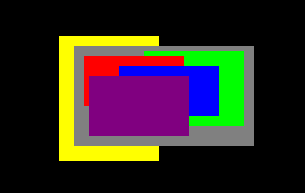 --- ## Changelog - Added the `ZIndex` component to bevy_ui. - Added the `UiStack` resource to bevy_ui, and added implementation in a new `stack.rs` module. - Removed the previous Z updating system from bevy_ui, because it was replaced with the above. - Changed bevy_ui rendering to use UiStack instead of z ordering. - Changed bevy_ui focus/interaction system to use UiStack instead of z ordering. - Added a new z_index example. ## ZIndex demo Here's a demo I wrote to test these features https://user-images.githubusercontent.com/1060971/188329295-d7beebd6-9aee-43ab-821e-d437df5dbe8a.mp4 Co-authored-by: Carter Anderson <mcanders1@gmail.com> |
||
|
François
|
a3ca184128 |
Fix clipping in UI (#6351)
# Objective - Clipping (visible in the UI example with text scrolling) is funky - Fixes #6287 ## Solution - Fix UV calculation: - correct order for values (issue introduced in #6000) - add the `y` values instead of subtracting them now that vertical order is reversed - take scale factor into account (bug already present before reversing the order) - While around clipping, I changed clip to only mutate when changed No more funkiness! 😞 <img width="696" alt="Screenshot 2022-10-23 at 22 44 18" src="https://user-images.githubusercontent.com/8672791/197417721-30ad4150-5264-427f-ac82-e5265c1fb3a9.png"> |
||
|
Sergi-Ferrez
|
05c7babba2 |
Clarify bevy::ui::Node field and documentation (#5995)
# Objective Fixes #5820 ## Solution Change field name and documentation from `bevy::ui::Node` struct --- ## Changelog `bevy::ui::Node` `size` field has renamed to `calculated_size` ## Migration Guide All references to the old `size` name has been changed, to access `bevy::ui::Node` `size` field use `calculated_size` |
||
|
Carter Anderson
|
01aedc8431 |
Spawn now takes a Bundle (#6054)
# Objective Now that we can consolidate Bundles and Components under a single insert (thanks to #2975 and #6039), almost 100% of world spawns now look like `world.spawn().insert((Some, Tuple, Here))`. Spawning an entity without any components is an extremely uncommon pattern, so it makes sense to give spawn the "first class" ergonomic api. This consolidated api should be made consistent across all spawn apis (such as World and Commands). ## Solution All `spawn` apis (`World::spawn`, `Commands:;spawn`, `ChildBuilder::spawn`, and `WorldChildBuilder::spawn`) now accept a bundle as input: ```rust // before: commands .spawn() .insert((A, B, C)); world .spawn() .insert((A, B, C); // after commands.spawn((A, B, C)); world.spawn((A, B, C)); ``` All existing instances of `spawn_bundle` have been deprecated in favor of the new `spawn` api. A new `spawn_empty` has been added, replacing the old `spawn` api. By allowing `world.spawn(some_bundle)` to replace `world.spawn().insert(some_bundle)`, this opened the door to removing the initial entity allocation in the "empty" archetype / table done in `spawn()` (and subsequent move to the actual archetype in `.insert(some_bundle)`). This improves spawn performance by over 10%: 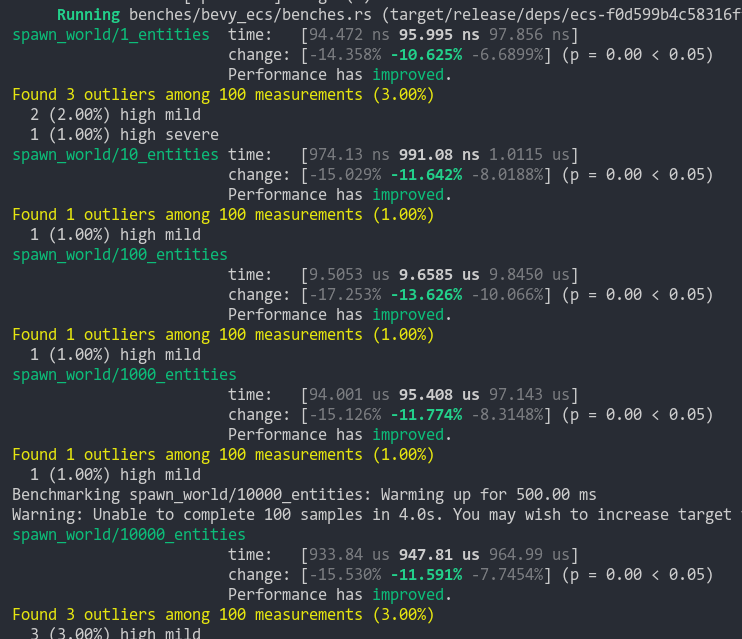 To take this measurement, I added a new `world_spawn` benchmark. Unfortunately, optimizing `Commands::spawn` is slightly less trivial, as Commands expose the Entity id of spawned entities prior to actually spawning. Doing the optimization would (naively) require assurances that the `spawn(some_bundle)` command is applied before all other commands involving the entity (which would not necessarily be true, if memory serves). Optimizing `Commands::spawn` this way does feel possible, but it will require careful thought (and maybe some additional checks), which deserves its own PR. For now, it has the same performance characteristics of the current `Commands::spawn_bundle` on main. **Note that 99% of this PR is simple renames and refactors. The only code that needs careful scrutiny is the new `World::spawn()` impl, which is relatively straightforward, but it has some new unsafe code (which re-uses battle tested BundlerSpawner code path).** --- ## Changelog - All `spawn` apis (`World::spawn`, `Commands:;spawn`, `ChildBuilder::spawn`, and `WorldChildBuilder::spawn`) now accept a bundle as input - All instances of `spawn_bundle` have been deprecated in favor of the new `spawn` api - World and Commands now have `spawn_empty()`, which is equivalent to the old `spawn()` behavior. ## Migration Guide ```rust // Old (0.8): commands .spawn() .insert_bundle((A, B, C)); // New (0.9) commands.spawn((A, B, C)); // Old (0.8): commands.spawn_bundle((A, B, C)); // New (0.9) commands.spawn((A, B, C)); // Old (0.8): let entity = commands.spawn().id(); // New (0.9) let entity = commands.spawn_empty().id(); // Old (0.8) let entity = world.spawn().id(); // New (0.9) let entity = world.spawn_empty(); ``` |
||
|
JoJoJet
|
697d297b55 |
Remove last uses of string-labels (#5420)
# Objective * Related: #4341 * Remove all remaining uses of stringly-typed labels in the repo. Right now, it's just a bunch of tests and examples. |
||
|
Jerome Humbert
|
8b7b44d839 |
Move sprite::Rect into bevy_math (#5686)
# Objective Promote the `Rect` utility of `sprite::Rect`, which defines a rectangle by its minimum and maximum corners, to the `bevy_math` crate to make it available as a general math type to all crates without the need to depend on the `bevy_sprite` crate. Fixes #5575 ## Solution Move `sprite::Rect` into `bevy_math` and fix all uses. Implement `Reflect` for `Rect` directly into the `bevy_reflect` crate by having `bevy_reflect` depend on `bevy_math`. This looks like a new dependency, but the `bevy_reflect` was "cheating" for other math types by directly depending on `glam` to reflect other math types, thereby giving the illusion that there was no dependency on `bevy_math`. In practice conceptually Bevy's math types are reflected into the `bevy_reflect` crate to avoid a dependency of that crate to a "lower level" utility crate like `bevy_math` (which in turn would make `bevy_reflect` be a dependency of most other crates, and increase the risk of circular dependencies). So this change simply formalizes that dependency in `Cargo.toml`. The `Rect` struct is also augmented in this change with a collection of utility methods to improve its usability. A few uses cases are updated to use those new methods, resulting is more clear and concise syntax. --- ## Changelog ### Changed - Moved the `sprite::Rect` type into `bevy_math`. ### Added - Added several utility methods to the `math::Rect` type. ## Migration Guide The `bevy::sprite::Rect` type moved to the math utility crate as `bevy::math::Rect`. You should change your imports from `use bevy::sprite::Rect` to `use bevy::math::Rect`. |
||
|
ira
|
b42f426fc3 |
Add associated constant IDENTITY to Transform and friends. (#5340)
# Objective Since `identity` is a const fn that takes no arguments it seems logical to make it an associated constant. This is also more in line with types from glam (eg. `Quat::IDENTITY`). ## Migration Guide The method `identity()` on `Transform`, `GlobalTransform` and `TransformBundle` has been deprecated. Use the associated constant `IDENTITY` instead. Co-authored-by: devil-ira <justthecooldude@gmail.com> |
||
|
Dusty DeWeese
|
9f8bdeeeb9 |
Use Affine3A for GlobalTransform to allow any affine transformation (#4379)
# Objective - Add capability to use `Affine3A`s for some `GlobalTransform`s. This allows affine transformations that are not possible using a single `Transform` such as shear and non-uniform scaling along an arbitrary axis. - Related to #1755 and #2026 ## Solution - `GlobalTransform` becomes an enum wrapping either a `Transform` or an `Affine3A`. - The API of `GlobalTransform` is minimized to avoid inefficiency, and to make it clear that operations should be performed using the underlying data types. - using `GlobalTransform::Affine3A` disables transform propagation, because the main use is for cases that `Transform`s cannot support. --- ## Changelog - `GlobalTransform`s can optionally support any affine transformation using an `Affine3A`. Co-authored-by: Carter Anderson <mcanders1@gmail.com> |
||
|
CGMossa
|
93a131661d |
Very minor doc formatting changes (#5287)
# Objective - Added a bunch of backticks to things that should have them, like equations, abstract variable names, - Changed all small x, y, and z to capitals X, Y, Z. This might be more annoying than helpful; Feel free to refuse this PR. |
||
|
ira
|
4847f7e3ad |
Update codebase to use IntoIterator where possible. (#5269)
Remove unnecessary calls to `iter()`/`iter_mut()`.
Mainly updates the use of queries in our code, docs, and examples.

```rust
// From
for _ in list.iter() {
for _ in list.iter_mut() {

// To
for _ in &list {
for _ in &mut list {
```

We already enable the pedantic lint [clippy::explicit_iter_loop](https://rust-lang.github.io/rust-clippy/stable/) inside of Bevy. However, this only warns for a few known types from the standard library.

## Note for reviewers
As you can see the additions and deletions are exactly equal.
Maybe give it a quick skim to check I didn't sneak in a crypto miner, but you don't have to torture yourself by reading every line.
I already experienced enough pain making this PR :)


Co-authored-by: devil-ira <justthecooldude@gmail.com>
|
||
|
Alice Cecile
|
a304fd9a99 |
Split bevy_hierarchy out from bevy_transform (#4168)
# Objective - Hierarchy tools are not just used for `Transform`: they are also used for scenes. - In the future there's interest in using them for other features, such as visiibility inheritance. - The fact that these tools are found in `bevy_transform` causes a great deal of user and developer confusion - Fixes #2758. ## Solution - Split `bevy_transform` into two! - Make everything work again. Note that this is a very tightly scoped PR: I *know* there are code quality and docs issues that existed in bevy_transform that I've just moved around. We should fix those in a seperate PR and try to merge this ASAP to reduce the bitrot involved in splitting an entire crate. ## Frustrations The API around `GlobalTransform` is a mess: we have massive code and docs duplication, no link between the two types and no clear way to extend this to other forms of inheritance. In the medium-term, I feel pretty strongly that `GlobalTransform` should be replaced by something like `Inherited<Transform>`, which lives in `bevy_hierarchy`: - avoids code duplication - makes the inheritance pattern extensible - links the types at the type-level - allows us to remove all references to inheritance from `bevy_transform`, making it more useful as a standalone crate and cleaning up its docs ## Additional context - double-blessed by @cart in https://github.com/bevyengine/bevy/issues/4141#issuecomment-1063592414 and https://github.com/bevyengine/bevy/issues/2758#issuecomment-913810963 - preparation for more advanced / cleaner hierarchy tools: go read https://github.com/bevyengine/rfcs/pull/53 ! - originally attempted by @finegeometer in #2789. It was a great idea, just needed more discussion! Co-authored-by: Carter Anderson <mcanders1@gmail.com> |
||
|
Gabriel Bourgeois
|
e41c5c212c |
Fix UI node Transform change detection (#4138)
# Objective Fixes #4133 ## Solution Add comparisons to make sure we don't dereference `Mut<>` in the two places where `Transform` is being mutated. `GlobalTransform` implementation already works properly so fixing Transform automatically fixed that as well. |
||
|
danieleades
|
d8974e7c3d |
small and mostly pointless refactoring (#2934)
What is says on the tin. This has got more to do with making `clippy` slightly more *quiet* than it does with changing anything that might greatly impact readability or performance. that said, deriving `Default` for a couple of structs is a nice easy win |
||
|
Troels Jessen
|
32f7997c56 |
Partially document bevy_ui (#3526)
# Objective Updated the docs for bevy_ui as requested by #3492 ## Solution I have documented the parts I understand. anchors.rs is not in use and should be removed, thus I haven't documented that, and some of the more renderer-heavy code is beyond me and needs input from either cart or someone familiar with bevy rendering Co-authored-by: Troels Jessen <kairyuka@gmail.com> |
||
|
davier
|
340957994d |
Implement the Overflow::Hidden style property for UI (#3296)
# Objective This PR implements the `overflow` style property in `bevy_ui`. When set to `Overflow::Hidden`, the children of that node are clipped so that overflowing parts are not rendered. This is an important building block for UI widgets. ## Solution Clipping is done on the CPU so that it does not break batching. The clip regions update was implemented as a separate system for clarity, but it could be merged with the other UI systems to avoid doing an additional tree traversal. (I don't think it's important until we fix the layout performance issues though). A scrolling list was added to the `ui_pipelined` example to showcase `Overflow::Hidden`. For the sake of simplicity, it can only be scrolled with a mouse. |
||
|
Paweł Grabarz
|
07ed1d053e |
Implement and require #[derive(Component)] on all component structs (#2254)
This implements the most minimal variant of #1843 - a derive for marker trait. This is a prerequisite to more complicated features like statically defined storage type or opt-out component reflection. In order to make component struct's purpose explicit and avoid misuse, it must be annotated with `#[derive(Component)]` (manual impl is discouraged for compatibility). Right now this is just a marker trait, but in the future it might be expanded. Making this change early allows us to make further changes later without breaking backward compatibility for derive macro users. This already prevents a lot of issues, like using bundles in `insert` calls. Primitive types are no longer valid components as well. This can be easily worked around by adding newtype wrappers and deriving `Component` for them. One funny example of prevented bad code (from our own tests) is when an newtype struct or enum variant is used. Previously, it was possible to write `insert(Newtype)` instead of `insert(Newtype(value))`. That code compiled, because function pointers (in this case newtype struct constructor) implement `Send + Sync + 'static`, so we allowed them to be used as components. This is no longer the case and such invalid code will trigger a compile error. Co-authored-by: = <=> Co-authored-by: TheRawMeatball <therawmeatball@gmail.com> Co-authored-by: Carter Anderson <mcanders1@gmail.com> |
||
|
François
|
b724a0f586 |
Down with the system! (#2496)
# Objective - Remove all the `.system()` possible. - Check for remaining missing cases. ## Solution - Remove all `.system()`, fix compile errors - 32 calls to `.system()` remains, mostly internals, the few others should be removed after #2446 |
||
|
Carter Anderson
|
81b53d15d4 |
Make Commands and World apis consistent (#1703)
Resolves #1253 #1562 This makes the Commands apis consistent with World apis. This moves to a "type state" pattern (like World) where the "current entity" is stored in an `EntityCommands` builder. In general this tends to cuts down on indentation and line count. It comes at the cost of needing to type `commands` more and adding more semicolons to terminate expressions. I also added `spawn_bundle` to Commands because this is a common enough operation that I think its worth providing a shorthand. |
||
|
François
|
bbb9849506 |
Replace default method calls from Glam types with explicit const (#1645)
it's a followup of #1550 I think calling explicit methods/values instead of default makes the code easier to read: "what is `Quat::default()`" vs "Oh, it's `Quat::IDENTITY`" `Transform::identity()` and `GlobalTransform::identity()` can also be consts and I replaced the calls to their `default()` impl with `identity()` |
||
|
Carter Anderson
|
3a2a68852c |
Bevy ECS V2 (#1525)
# Bevy ECS V2
This is a rewrite of Bevy ECS (basically everything but the new executor/schedule, which are already awesome). The overall goal was to improve the performance and versatility of Bevy ECS. Here is a quick bulleted list of changes before we dive into the details:
* Complete World rewrite
* Multiple component storage types:
* Tables: fast cache friendly iteration, slower add/removes (previously called Archetypes)
* Sparse Sets: fast add/remove, slower iteration
* Stateful Queries (caches query results for faster iteration. fragmented iteration is _fast_ now)
* Stateful System Params (caches expensive operations. inspired by @DJMcNab's work in #1364)
* Configurable System Params (users can set configuration when they construct their systems. once again inspired by @DJMcNab's work)
* Archetypes are now "just metadata", component storage is separate
* Archetype Graph (for faster archetype changes)
* Component Metadata
* Configure component storage type
* Retrieve information about component size/type/name/layout/send-ness/etc
* Components are uniquely identified by a densely packed ComponentId
* TypeIds are now totally optional (which should make implementing scripting easier)
* Super fast "for_each" query iterators
* Merged Resources into World. Resources are now just a special type of component
* EntityRef/EntityMut builder apis (more efficient and more ergonomic)
* Fast bitset-backed `Access<T>` replaces old hashmap-based approach everywhere
* Query conflicts are determined by component access instead of archetype component access (to avoid random failures at runtime)
* With/Without are still taken into account for conflicts, so this should still be comfy to use
* Much simpler `IntoSystem` impl
* Significantly reduced the amount of hashing throughout the ecs in favor of Sparse Sets (indexed by densely packed ArchetypeId, ComponentId, BundleId, and TableId)
* Safety Improvements
* Entity reservation uses a normal world reference instead of unsafe transmute
* QuerySets no longer transmute lifetimes
* Made traits "unsafe" where relevant
* More thorough safety docs
* WorldCell
* Exposes safe mutable access to multiple resources at a time in a World
* Replaced "catch all" `System::update_archetypes(world: &World)` with `System::new_archetype(archetype: &Archetype)`
* Simpler Bundle implementation
* Replaced slow "remove_bundle_one_by_one" used as fallback for Commands::remove_bundle with fast "remove_bundle_intersection"
* Removed `Mut<T>` query impl. it is better to only support one way: `&mut T`
* Removed with() from `Flags<T>` in favor of `Option<Flags<T>>`, which allows querying for flags to be "filtered" by default
* Components now have is_send property (currently only resources support non-send)
* More granular module organization
* New `RemovedComponents<T>` SystemParam that replaces `query.removed::<T>()`
* `world.resource_scope()` for mutable access to resources and world at the same time
* WorldQuery and QueryFilter traits unified. FilterFetch trait added to enable "short circuit" filtering. Auto impled for cases that don't need it
* Significantly slimmed down SystemState in favor of individual SystemParam state
* System Commands changed from `commands: &mut Commands` back to `mut commands: Commands` (to allow Commands to have a World reference)
Fixes #1320
## `World` Rewrite
This is a from-scratch rewrite of `World` that fills the niche that `hecs` used to. Yes, this means Bevy ECS is no longer a "fork" of hecs. We're going out our own!
(the only shared code between the projects is the entity id allocator, which is already basically ideal)
A huge shout out to @SanderMertens (author of [flecs](https://github.com/SanderMertens/flecs)) for sharing some great ideas with me (specifically hybrid ecs storage and archetype graphs). He also helped advise on a number of implementation details.
## Component Storage (The Problem)
Two ECS storage paradigms have gained a lot of traction over the years:
* **Archetypal ECS**:
* Stores components in "tables" with static schemas. Each "column" stores components of a given type. Each "row" is an entity.
* Each "archetype" has its own table. Adding/removing an entity's component changes the archetype.
* Enables super-fast Query iteration due to its cache-friendly data layout
* Comes at the cost of more expensive add/remove operations for an Entity's components, because all components need to be copied to the new archetype's "table"
* **Sparse Set ECS**:
* Stores components of the same type in densely packed arrays, which are sparsely indexed by densely packed unsigned integers (Entity ids)
* Query iteration is slower than Archetypal ECS because each entity's component could be at any position in the sparse set. This "random access" pattern isn't cache friendly. Additionally, there is an extra layer of indirection because you must first map the entity id to an index in the component array.
* Adding/removing components is a cheap, constant time operation
Bevy ECS V1, hecs, legion, flec, and Unity DOTS are all "archetypal ecs-es". I personally think "archetypal" storage is a good default for game engines. An entity's archetype doesn't need to change frequently in general, and it creates "fast by default" query iteration (which is a much more common operation). It is also "self optimizing". Users don't need to think about optimizing component layouts for iteration performance. It "just works" without any extra boilerplate.
Shipyard and EnTT are "sparse set ecs-es". They employ "packing" as a way to work around the "suboptimal by default" iteration performance for specific sets of components. This helps, but I didn't think this was a good choice for a general purpose engine like Bevy because:
1. "packs" conflict with each other. If bevy decides to internally pack the Transform and GlobalTransform components, users are then blocked if they want to pack some custom component with Transform.
2. users need to take manual action to optimize
Developers selecting an ECS framework are stuck with a hard choice. Select an "archetypal" framework with "fast iteration everywhere" but without the ability to cheaply add/remove components, or select a "sparse set" framework to cheaply add/remove components but with slower iteration performance.
## Hybrid Component Storage (The Solution)
In Bevy ECS V2, we get to have our cake and eat it too. It now has _both_ of the component storage types above (and more can be added later if needed):
* **Tables** (aka "archetypal" storage)
* The default storage. If you don't configure anything, this is what you get
* Fast iteration by default
* Slower add/remove operations
* **Sparse Sets**
* Opt-in
* Slower iteration
* Faster add/remove operations
These storage types complement each other perfectly. By default Query iteration is fast. If developers know that they want to add/remove a component at high frequencies, they can set the storage to "sparse set":
```rust
world.register_component(
ComponentDescriptor:🆕:<MyComponent>(StorageType::SparseSet)
).unwrap();
```
## Archetypes
Archetypes are now "just metadata" ... they no longer store components directly. They do store:
* The `ComponentId`s of each of the Archetype's components (and that component's storage type)
* Archetypes are uniquely defined by their component layouts
* For example: entities with "table" components `[A, B, C]` _and_ "sparse set" components `[D, E]` will always be in the same archetype.
* The `TableId` associated with the archetype
* For now each archetype has exactly one table (which can have no components),
* There is a 1->Many relationship from Tables->Archetypes. A given table could have any number of archetype components stored in it:
* Ex: an entity with "table storage" components `[A, B, C]` and "sparse set" components `[D, E]` will share the same `[A, B, C]` table as an entity with `[A, B, C]` table component and `[F]` sparse set components.
* This 1->Many relationship is how we preserve fast "cache friendly" iteration performance when possible (more on this later)
* A list of entities that are in the archetype and the row id of the table they are in
* ArchetypeComponentIds
* unique densely packed identifiers for (ArchetypeId, ComponentId) pairs
* used by the schedule executor for cheap system access control
* "Archetype Graph Edges" (see the next section)
## The "Archetype Graph"
Archetype changes in Bevy (and a number of other archetypal ecs-es) have historically been expensive to compute. First, you need to allocate a new vector of the entity's current component ids, add or remove components based on the operation performed, sort it (to ensure it is order-independent), then hash it to find the archetype (if it exists). And thats all before we get to the _already_ expensive full copy of all components to the new table storage.
The solution is to build a "graph" of archetypes to cache these results. @SanderMertens first exposed me to the idea (and he got it from @gjroelofs, who came up with it). They propose adding directed edges between archetypes for add/remove component operations. If `ComponentId`s are densely packed, you can use sparse sets to cheaply jump between archetypes.
Bevy takes this one step further by using add/remove `Bundle` edges instead of `Component` edges. Bevy encourages the use of `Bundles` to group add/remove operations. This is largely for "clearer game logic" reasons, but it also helps cut down on the number of archetype changes required. `Bundles` now also have densely-packed `BundleId`s. This allows us to use a _single_ edge for each bundle operation (rather than needing to traverse N edges ... one for each component). Single component operations are also bundles, so this is strictly an improvement over a "component only" graph.
As a result, an operation that used to be _heavy_ (both for allocations and compute) is now two dirt-cheap array lookups and zero allocations.
## Stateful Queries
World queries are now stateful. This allows us to:
1. Cache archetype (and table) matches
* This resolves another issue with (naive) archetypal ECS: query performance getting worse as the number of archetypes goes up (and fragmentation occurs).
2. Cache Fetch and Filter state
* The expensive parts of fetch/filter operations (such as hashing the TypeId to find the ComponentId) now only happen once when the Query is first constructed
3. Incrementally build up state
* When new archetypes are added, we only process the new archetypes (no need to rebuild state for old archetypes)
As a result, the direct `World` query api now looks like this:
```rust
let mut query = world.query::<(&A, &mut B)>();
for (a, mut b) in query.iter_mut(&mut world) {
}
```
Requiring `World` to generate stateful queries (rather than letting the `QueryState` type be constructed separately) allows us to ensure that _all_ queries are properly initialized (and the relevant world state, such as ComponentIds). This enables QueryState to remove branches from its operations that check for initialization status (and also enables query.iter() to take an immutable world reference because it doesn't need to initialize anything in world).
However in systems, this is a non-breaking change. State management is done internally by the relevant SystemParam.
## Stateful SystemParams
Like Queries, `SystemParams` now also cache state. For example, `Query` system params store the "stateful query" state mentioned above. Commands store their internal `CommandQueue`. This means you can now safely use as many separate `Commands` parameters in your system as you want. `Local<T>` system params store their `T` value in their state (instead of in Resources).
SystemParam state also enabled a significant slim-down of SystemState. It is much nicer to look at now.
Per-SystemParam state naturally insulates us from an "aliased mut" class of errors we have hit in the past (ex: using multiple `Commands` system params).
(credit goes to @DJMcNab for the initial idea and draft pr here #1364)
## Configurable SystemParams
@DJMcNab also had the great idea to make SystemParams configurable. This allows users to provide some initial configuration / values for system parameters (when possible). Most SystemParams have no config (the config type is `()`), but the `Local<T>` param now supports user-provided parameters:
```rust
fn foo(value: Local<usize>) {
}
app.add_system(foo.system().config(|c| c.0 = Some(10)));
```
## Uber Fast "for_each" Query Iterators
Developers now have the choice to use a fast "for_each" iterator, which yields ~1.5-3x iteration speed improvements for "fragmented iteration", and minor ~1.2x iteration speed improvements for unfragmented iteration.
```rust
fn system(query: Query<(&A, &mut B)>) {
// you now have the option to do this for a speed boost
query.for_each_mut(|(a, mut b)| {
});
// however normal iterators are still available
for (a, mut b) in query.iter_mut() {
}
}
```
I think in most cases we should continue to encourage "normal" iterators as they are more flexible and more "rust idiomatic". But when that extra "oomf" is needed, it makes sense to use `for_each`.
We should also consider using `for_each` for internal bevy systems to give our users a nice speed boost (but that should be a separate pr).
## Component Metadata
`World` now has a `Components` collection, which is accessible via `world.components()`. This stores mappings from `ComponentId` to `ComponentInfo`, as well as `TypeId` to `ComponentId` mappings (where relevant). `ComponentInfo` stores information about the component, such as ComponentId, TypeId, memory layout, send-ness (currently limited to resources), and storage type.
## Significantly Cheaper `Access<T>`
We used to use `TypeAccess<TypeId>` to manage read/write component/archetype-component access. This was expensive because TypeIds must be hashed and compared individually. The parallel executor got around this by "condensing" type ids into bitset-backed access types. This worked, but it had to be re-generated from the `TypeAccess<TypeId>`sources every time archetypes changed.
This pr removes TypeAccess in favor of faster bitset access everywhere. We can do this thanks to the move to densely packed `ComponentId`s and `ArchetypeComponentId`s.
## Merged Resources into World
Resources had a lot of redundant functionality with Components. They stored typed data, they had access control, they had unique ids, they were queryable via SystemParams, etc. In fact the _only_ major difference between them was that they were unique (and didn't correlate to an entity).
Separate resources also had the downside of requiring a separate set of access controls, which meant the parallel executor needed to compare more bitsets per system and manage more state.
I initially got the "separate resources" idea from `legion`. I think that design was motivated by the fact that it made the direct world query/resource lifetime interactions more manageable. It certainly made our lives easier when using Resources alongside hecs/bevy_ecs. However we already have a construct for safely and ergonomically managing in-world lifetimes: systems (which use `Access<T>` internally).
This pr merges Resources into World:
```rust
world.insert_resource(1);
world.insert_resource(2.0);
let a = world.get_resource::<i32>().unwrap();
let mut b = world.get_resource_mut::<f64>().unwrap();
*b = 3.0;
```
Resources are now just a special kind of component. They have their own ComponentIds (and their own resource TypeId->ComponentId scope, so they don't conflict wit components of the same type). They are stored in a special "resource archetype", which stores components inside the archetype using a new `unique_components` sparse set (note that this sparse set could later be used to implement Tags). This allows us to keep the code size small by reusing existing datastructures (namely Column, Archetype, ComponentFlags, and ComponentInfo). This allows us the executor to use a single `Access<ArchetypeComponentId>` per system. It should also make scripting language integration easier.
_But_ this merge did create problems for people directly interacting with `World`. What if you need mutable access to multiple resources at the same time? `world.get_resource_mut()` borrows World mutably!
## WorldCell
WorldCell applies the `Access<ArchetypeComponentId>` concept to direct world access:
```rust
let world_cell = world.cell();
let a = world_cell.get_resource_mut::<i32>().unwrap();
let b = world_cell.get_resource_mut::<f64>().unwrap();
```
This adds cheap runtime checks (a sparse set lookup of `ArchetypeComponentId` and a counter) to ensure that world accesses do not conflict with each other. Each operation returns a `WorldBorrow<'w, T>` or `WorldBorrowMut<'w, T>` wrapper type, which will release the relevant ArchetypeComponentId resources when dropped.
World caches the access sparse set (and only one cell can exist at a time), so `world.cell()` is a cheap operation.
WorldCell does _not_ use atomic operations. It is non-send, does a mutable borrow of world to prevent other accesses, and uses a simple `Rc<RefCell<ArchetypeComponentAccess>>` wrapper in each WorldBorrow pointer.
The api is currently limited to resource access, but it can and should be extended to queries / entity component access.
## Resource Scopes
WorldCell does not yet support component queries, and even when it does there are sometimes legitimate reasons to want a mutable world ref _and_ a mutable resource ref (ex: bevy_render and bevy_scene both need this). In these cases we could always drop down to the unsafe `world.get_resource_unchecked_mut()`, but that is not ideal!
Instead developers can use a "resource scope"
```rust
world.resource_scope(|world: &mut World, a: &mut A| {
})
```
This temporarily removes the `A` resource from `World`, provides mutable pointers to both, and re-adds A to World when finished. Thanks to the move to ComponentIds/sparse sets, this is a cheap operation.
If multiple resources are required, scopes can be nested. We could also consider adding a "resource tuple" to the api if this pattern becomes common and the boilerplate gets nasty.
## Query Conflicts Use ComponentId Instead of ArchetypeComponentId
For safety reasons, systems cannot contain queries that conflict with each other without wrapping them in a QuerySet. On bevy `main`, we use ArchetypeComponentIds to determine conflicts. This is nice because it can take into account filters:
```rust
// these queries will never conflict due to their filters
fn filter_system(a: Query<&mut A, With<B>>, b: Query<&mut B, Without<B>>) {
}
```
But it also has a significant downside:
```rust
// these queries will not conflict _until_ an entity with A, B, and C is spawned
fn maybe_conflicts_system(a: Query<(&mut A, &C)>, b: Query<(&mut A, &B)>) {
}
```
The system above will panic at runtime if an entity with A, B, and C is spawned. This makes it hard to trust that your game logic will run without crashing.
In this pr, I switched to using `ComponentId` instead. This _is_ more constraining. `maybe_conflicts_system` will now always fail, but it will do it consistently at startup. Naively, it would also _disallow_ `filter_system`, which would be a significant downgrade in usability. Bevy has a number of internal systems that rely on disjoint queries and I expect it to be a common pattern in userspace.
To resolve this, I added a new `FilteredAccess<T>` type, which wraps `Access<T>` and adds with/without filters. If two `FilteredAccess` have with/without values that prove they are disjoint, they will no longer conflict.
## EntityRef / EntityMut
World entity operations on `main` require that the user passes in an `entity` id to each operation:
```rust
let entity = world.spawn((A, )); // create a new entity with A
world.get::<A>(entity);
world.insert(entity, (B, C));
world.insert_one(entity, D);
```
This means that each operation needs to look up the entity location / verify its validity. The initial spawn operation also requires a Bundle as input. This can be awkward when no components are required (or one component is required).
These operations have been replaced by `EntityRef` and `EntityMut`, which are "builder-style" wrappers around world that provide read and read/write operations on a single, pre-validated entity:
```rust
// spawn now takes no inputs and returns an EntityMut
let entity = world.spawn()
.insert(A) // insert a single component into the entity
.insert_bundle((B, C)) // insert a bundle of components into the entity
.id() // id returns the Entity id
// Returns EntityMut (or panics if the entity does not exist)
world.entity_mut(entity)
.insert(D)
.insert_bundle(SomeBundle::default());
{
// returns EntityRef (or panics if the entity does not exist)
let d = world.entity(entity)
.get::<D>() // gets the D component
.unwrap();
// world.get still exists for ergonomics
let d = world.get::<D>(entity).unwrap();
}
// These variants return Options if you want to check existence instead of panicing
world.get_entity_mut(entity)
.unwrap()
.insert(E);
if let Some(entity_ref) = world.get_entity(entity) {
let d = entity_ref.get::<D>().unwrap();
}
```
This _does not_ affect the current Commands api or terminology. I think that should be a separate conversation as that is a much larger breaking change.
## Safety Improvements
* Entity reservation in Commands uses a normal world borrow instead of an unsafe transmute
* QuerySets no longer transmutes lifetimes
* Made traits "unsafe" when implementing a trait incorrectly could cause unsafety
* More thorough safety docs
## RemovedComponents SystemParam
The old approach to querying removed components: `query.removed:<T>()` was confusing because it had no connection to the query itself. I replaced it with the following, which is both clearer and allows us to cache the ComponentId mapping in the SystemParamState:
```rust
fn system(removed: RemovedComponents<T>) {
for entity in removed.iter() {
}
}
```
## Simpler Bundle implementation
Bundles are no longer responsible for sorting (or deduping) TypeInfo. They are just a simple ordered list of component types / data. This makes the implementation smaller and opens the door to an easy "nested bundle" implementation in the future (which i might even add in this pr). Duplicate detection is now done once per bundle type by World the first time a bundle is used.
## Unified WorldQuery and QueryFilter types
(don't worry they are still separate type _parameters_ in Queries .. this is a non-breaking change)
WorldQuery and QueryFilter were already basically identical apis. With the addition of `FetchState` and more storage-specific fetch methods, the overlap was even clearer (and the redundancy more painful).
QueryFilters are now just `F: WorldQuery where F::Fetch: FilterFetch`. FilterFetch requires `Fetch<Item = bool>` and adds new "short circuit" variants of fetch methods. This enables a filter tuple like `(With<A>, Without<B>, Changed<C>)` to stop evaluating the filter after the first mismatch is encountered. FilterFetch is automatically implemented for `Fetch` implementations that return bool.
This forces fetch implementations that return things like `(bool, bool, bool)` (such as the filter above) to manually implement FilterFetch and decide whether or not to short-circuit.
## More Granular Modules
World no longer globs all of the internal modules together. It now exports `core`, `system`, and `schedule` separately. I'm also considering exporting `core` submodules directly as that is still pretty "glob-ey" and unorganized (feedback welcome here).
## Remaining Draft Work (to be done in this pr)
* ~~panic on conflicting WorldQuery fetches (&A, &mut A)~~
* ~~bevy `main` and hecs both currently allow this, but we should protect against it if possible~~
* ~~batch_iter / par_iter (currently stubbed out)~~
* ~~ChangedRes~~
* ~~I skipped this while we sort out #1313. This pr should be adapted to account for whatever we land on there~~.
* ~~The `Archetypes` and `Tables` collections use hashes of sorted lists of component ids to uniquely identify each archetype/table. This hash is then used as the key in a HashMap to look up the relevant ArchetypeId or TableId. (which doesn't handle hash collisions properly)~~
* ~~It is currently unsafe to generate a Query from "World A", then use it on "World B" (despite the api claiming it is safe). We should probably close this gap. This could be done by adding a randomly generated WorldId to each world, then storing that id in each Query. They could then be compared to each other on each `query.do_thing(&world)` operation. This _does_ add an extra branch to each query operation, so I'm open to other suggestions if people have them.~~
* ~~Nested Bundles (if i find time)~~
## Potential Future Work
* Expand WorldCell to support queries.
* Consider not allocating in the empty archetype on `world.spawn()`
* ex: return something like EntityMutUninit, which turns into EntityMut after an `insert` or `insert_bundle` op
* this actually regressed performance last time i tried it, but in theory it should be faster
* Optimize SparseSet::insert (see `PERF` comment on insert)
* Replace SparseArray `Option<T>` with T::MAX to cut down on branching
* would enable cheaper get_unchecked() operations
* upstream fixedbitset optimizations
* fixedbitset could be allocation free for small block counts (store blocks in a SmallVec)
* fixedbitset could have a const constructor
* Consider implementing Tags (archetype-specific by-value data that affects archetype identity)
* ex: ArchetypeA could have `[A, B, C]` table components and `[D(1)]` "tag" component. ArchetypeB could have `[A, B, C]` table components and a `[D(2)]` tag component. The archetypes are different, despite both having D tags because the value inside D is different.
* this could potentially build on top of the `archetype.unique_components` added in this pr for resource storage.
* Consider reverting `all_tuples` proc macro in favor of the old `macro_rules` implementation
* all_tuples is more flexible and produces cleaner documentation (the macro_rules version produces weird type parameter orders due to parser constraints)
* but unfortunately all_tuples also appears to make Rust Analyzer sad/slow when working inside of `bevy_ecs` (does not affect user code)
* Consider "resource queries" and/or "mixed resource and entity component queries" as an alternative to WorldCell
* this is basically just "systems" so maybe it's not worth it
* Add more world ops
* `world.clear()`
* `world.reserve<T: Bundle>(count: usize)`
* Try using the old archetype allocation strategy (allocate new memory on resize and copy everything over). I expect this to improve batch insertion performance at the cost of unbatched performance. But thats just a guess. I'm not an allocation perf pro :)
* Adapt Commands apis for consistency with new World apis
## Benchmarks
key:
* `bevy_old`: bevy `main` branch
* `bevy`: this branch
* `_foreach`: uses an optimized for_each iterator
* ` _sparse`: uses sparse set storage (if unspecified assume table storage)
* `_system`: runs inside a system (if unspecified assume test happens via direct world ops)
### Simple Insert (from ecs_bench_suite)
### Simpler Iter (from ecs_bench_suite)
### Fragment Iter (from ecs_bench_suite)
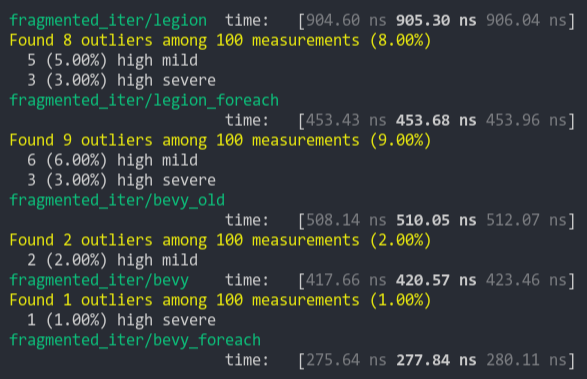
### Sparse Fragmented Iter
Iterate a query that matches 5 entities from a single matching archetype, but there are 100 unmatching archetypes
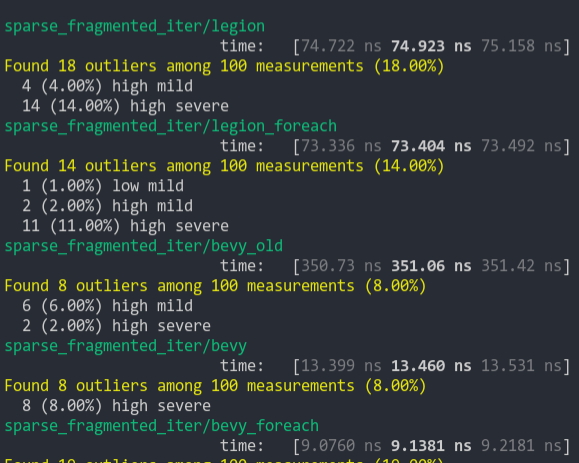
### Schedule (from ecs_bench_suite)
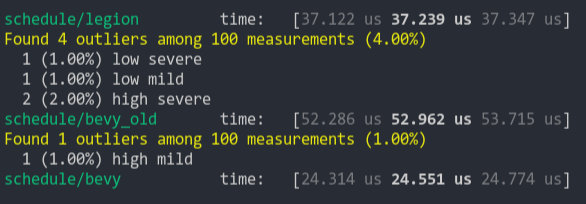
### Add Remove Component (from ecs_bench_suite)
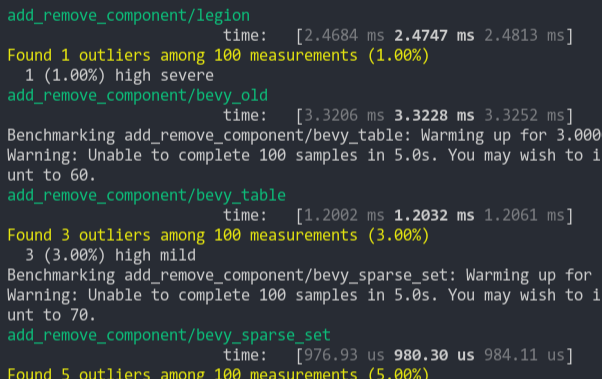
### Add Remove Component Big
Same as the test above, but each entity has 5 "large" matrix components and 1 "large" matrix component is added and removed
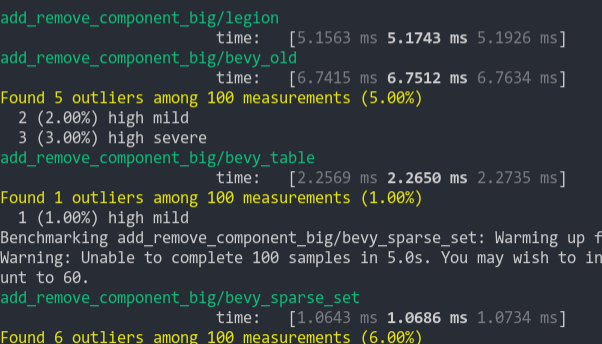
### Get Component
Looks up a single component value a large number of times
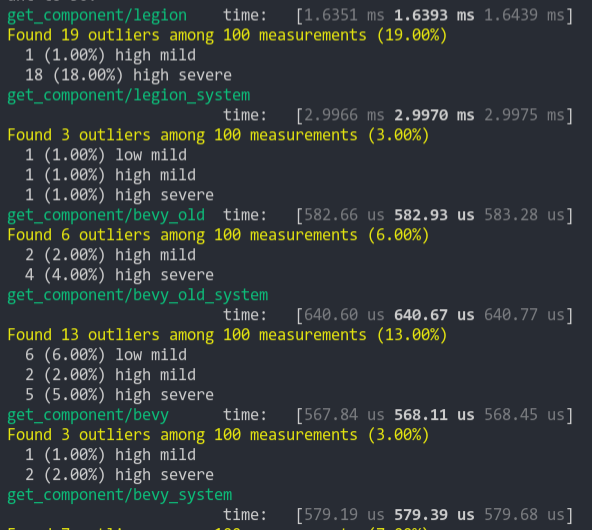
|
||
|
Alexander Sepity
|
d5a7330431
|
System sets and parallel executor v2 (#1144)
System sets and parallel executor v2 |
||
|
Carter Anderson
|
841755aaf2
|
Adopt a Fetch pattern for SystemParams (#1074) | ||
|
Carter Anderson
|
509b138e8f
|
Schedule v2 (#1021)
Schedule V2 |
||
|
SvenTS
|
dd1b08ef8b
|
Improve ui depth system (#905)
* Add test for ui-z system * Remove generic hierarchy runner and refactor ui z-system * Remove different handling for childless nodes Having an empty children list should be the same as having no child component. * Further simplify system after change |
||
|
bjorn3
|
d6eb647451
|
Misc cleanups (#879)
* Remove cfg!(feature = "metal-auto-capture") This cfg! has existed since the initial commit, but the corresponding feature has never been part of Cargo.toml * Remove unnecessary handle_create_window_events call * Remove EventLoopProxyPtr wrapper * Remove unnecessary statics * Fix unrelated deprecation warning to fix CI |











