# Objective

Fixes: #16578

## Solution

This is a patch fix, proper fix requires a breaking change.

Added `Panic` enum variant and using is as the system meta default.
Warn once behavior can be enabled same way disabling panic (originally
disabling wans) is.

To fix an issue with the current architecture, where **all** combinator
system params get checked together,
combinator systems only check params of the first system.
This will result in old, panicking behavior on subsequent systems and
will be fixed in 0.16.

## Testing

Ran unit tests and `fallible_params` example.

---------

Co-authored-by: François Mockers <mockersf@gmail.com>
Co-authored-by: François Mockers <francois.mockers@vleue.com>
This commit fixes the following regressions:

1. Transmission-specific calls to shader lighting functions didn't pass
the `enable_diffuse` parameter, breaking the `transmission` example.

2. The combination of bindless `StandardMaterial` and bindless lightmaps
caused us to blow past the 128 texture limit on M1/M2 chips in some
cases, in particular the `depth_of_field` example.
https://github.com/gfx-rs/wgpu/issues/3334 should fix this, but in the
meantime this patch reduces the number of bindless lightmaps from 16 to
4 in order to stay under the limit.

3. The renderer was crashing on startup on Adreno 610 chips. This PR
simply disables bindless on Adreno 610 and lower.
# Objective
When preparing `GpuImage`s, we currently discard the
`depth_or_array_layers` of the `Image`'s size by converting it into a
`UVec2`.
Fixes#16715.
## Solution
Change `GpuImage::size` to `Extent3d`, and just pass that through when
creating `GpuImage`s.
Also copy the `aspect_ratio`, and `size` (now `size_2d` for
disambiguation from the field) functions from `Image` to `GpuImage` for
ease of use with 2D textures.
I originally copied all size-related functions (like `width`, and
`height`), but i think they are unnecessary considering how visible the
`size` field on `GpuImage` is compared to `Image`.
## Testing
Tested via `cargo r -p ci` for everything except docs, when generating
docs it keeps spitting out a ton of
```
error[E0554]: `#![feature]` may not be used on the stable release channel
--> crates/bevy_dylib/src/lib.rs:1:21
|
1 | #![cfg_attr(docsrs, feature(doc_auto_cfg))]
|
```
Not sure why this is happening, but it also happens without my changes,
so it's almost certainly some strange issue specific to my machine.
## Migration Guide
- `GpuImage::size` is now an `Extent3d`. To easily get 2D size, use
`size_2d()`.
The only thing that was preventing `extract_meshes_for_gpu_building` and
`extract_mesh_materials` from running in parallel was the
`ResMut<RenderMeshMaterialIds>`. This lookup can be safely moved to the
`collect_meshes_for_gpu_building` phase, which runs after the extraction
phase.
This results in a small win on `many_cubes`. `extract_mesh_materials` is
currently nonretained, so it's still slow, but running it in parallel is
an easy win.
Before:

After:

This commit allows Bevy to bind 16 lightmaps at a time, if the current
platform supports bindless textures. Naturally, if bindless textures
aren't supported, Bevy falls back to binding only a single lightmap at a
time. As lightmaps are usually heavily atlased, I doubt many scenes will
use more than 16 lightmap textures.

This has little performance impact now, but it's desirable for us to
reap the benefits of multidraw and bindless textures on scenes that use
lightmaps. Otherwise, we might have to break batches in order to switch
those lightmaps.

Additionally, this PR slightly reduces the cost of binning because it
makes the lightmap index in `Opaque3dBinKey` 32 bits instead of an
`AssetId`.

## Migration Guide

* The `Opaque3dBinKey::lightmap_image` field is now
`Opaque3dBinKey::lightmap_slab`, which is a lightweight identifier for
an entire binding array of lightmaps.
This patch replaces the undocumented `NoGpuCulling` component with a new
component, `NoIndirectDrawing`, effectively turning indirect drawing on
by default. Indirect mode is needed for the recently-landed multidraw
feature (#16427). Since multidraw is such a win for performance, when
that feature is supported the small performance tax that indirect mode
incurs is virtually always worth paying.

To ensure that custom drawing code such as that in the
`custom_shader_instancing` example continues to function, this commit
additionally makes GPU culling take the `NoFrustumCulling` component
into account.

This PR is an alternative to #16670 that doesn't break the
`custom_shader_instancing` example. **PR #16755 should land first in
order to avoid breaking deferred rendering, as multidraw currently
breaks it**.

## Migration Guide

* Indirect drawing (GPU culling) is now enabled by default, so the
`GpuCulling` component is no longer available. To disable indirect mode,
which may be useful with custom render nodes, add the new
`NoIndirectDrawing` component to your camera.
Updating dependencies; adopted version of #15696. (Supercedes #15696.)

Long answer: hashbrown is no longer using ahash by default, meaning that
we can't use the default-hasher methods with ahasher. So, we have to use
the longer-winded versions instead. This takes the opportunity to also
switch our default hasher as well, but without actually enabling the
default-hasher feature for hashbrown, meaning that we'll be able to
change our hasher more easily at the cost of all of these method calls
being obnoxious forever.

One large change from 0.15 is that `insert_unique_unchecked` is now
`unsafe`, and for cases where unsafe code was denied at the crate level,
I replaced it with `insert`.

## Migration Guide

`bevy_utils` has updated its version of `hashbrown` to 0.15 and now
defaults to `foldhash` instead of `ahash`. This means that if you've
hard-coded your hasher to `bevy_utils::AHasher` or separately used the
`ahash` crate in your code, you may need to switch to `foldhash` to
ensure that everything works like it does in Bevy.
This commit makes skinned meshes batchable on platforms other than WebGL
2. On supported platforms, it replaces the two uniform buffers used for
joint matrices with a pair of storage buffers containing all matrices
for all skinned meshes packed together. The indices into the buffer are
stored in the mesh uniform and mesh input uniform. The GPU mesh
preprocessing step copies the indices in if that step is enabled.
On the `many_foxes` demo, I observed a frame time decrease from 15.470ms
to 11.935ms. This is the result of reducing the `submit_graph_commands`
time from an average of 5.45ms to 0.489ms, an 11x speedup in that
portion of rendering.

This is what the profile looks like for `many_foxes` after these
changes.

---------
Co-authored-by: François Mockers <mockersf@gmail.com>
This commit removes the logic that attempted to keep the
`MeshInputUniform` buffer contiguous. Not only was it slow and complex,
but it was also incorrect, which caused #16686 and #16690. I changed the
logic to simply maintain a free list of unused slots in the buffer and
preferentially fill them when pushing new mesh input uniforms.
Closes#16686.
Closes#16690.
This commit adds support for *multidraw*, which is a feature that allows
multiple meshes to be drawn in a single drawcall. `wgpu` currently
implements multidraw on Vulkan, so this feature is only enabled there.
Multiple meshes can be drawn at once if they're in the same vertex and
index buffers and are otherwise placed in the same bin. (Thus, for
example, at present the materials and textures must be identical, but
see #16368.) Multidraw is a significant performance improvement during
the draw phase because it reduces the number of rebindings, as well as
the number of drawcalls.

This feature is currently only enabled when GPU culling is used: i.e.
when `GpuCulling` is present on a camera. Therefore, if you run for
example `scene_viewer`, you will not see any performance improvements,
because `scene_viewer` doesn't add the `GpuCulling` component to its
camera.

Additionally, the multidraw feature is only implemented for opaque 3D
meshes and not for shadows or 2D meshes. I plan to make GPU culling the
default and to extend the feature to shadows in the future. Also, in the
future I suspect that polyfilling multidraw on APIs that don't support
it will be fruitful, as even without driver-level support use of
multidraw allows us to avoid expensive `wgpu` rebindings.
The bindless PR (#16368) broke some examples:

* `specialized_mesh_pipeline` and `custom_shader_instancing` failed
because they expect to be able to render a mesh with no material, by
overriding enough of the render pipeline to be able to do so. This PR
fixes the issue by restoring the old behavior in which we extract meshes
even if they have no material.

* `texture_binding_array` broke because it doesn't implement
`AsBindGroup::unprepared_bind_group`. This was tricky to fix because
there's a very good reason why `texture_binding_array` doesn't implement
that method: there's no sensible way to do so with `wgpu`'s current
bindless API, due to its multiple levels of borrowed references. To fix
the example, I split `MaterialBindGroup` into
`MaterialBindlessBindGroup` and `MaterialNonBindlessBindGroup`, and
allow direct custom implementations of `AsBindGroup::as_bind_group` for
the latter type of bind groups. To opt in to the new behavior, return
the `AsBindGroupError::CreateBindGroupDirectly` error from your
`AsBindGroup::unprepared_bind_group` implementation, and Bevy will call
your custom `AsBindGroup::as_bind_group` method as before.

## Migration Guide

* Bevy will now unconditionally call
`AsBindGroup::unprepared_bind_group` for your materials, so you must no
longer panic in that function. Instead, return the new
`AsBindGroupError::CreateBindGroupDirectly` error, and Bevy will fall
back to calling `AsBindGroup::as_bind_group` as before.
This commit moves the front end of the rendering pipeline to a retained
model when GPU preprocessing is in use (i.e. by default, except in
constrained environments). `RenderMeshInstance` and `MeshUniformData`
are stored from frame to frame and are updated only for the entities
that changed state. This was rather tricky and requires some careful
surgery to keep the data valid in the case of removals.
This patch is built on top of Bevy's change detection. Generally, this
worked, except that `ViewVisibility` isn't currently properly tracked.
Therefore, this commit adds proper change tracking for `ViewVisibility`.
Doing this required adding a new system that runs after all
`check_visibility` invocations, as no single `check_visibility`
invocation has enough global information to detect changes.
On the Bistro exterior scene, with all textures forced to opaque, this
patch improves steady-state `extract_meshes_for_gpu_building` from
93.8us to 34.5us and steady-state `collect_meshes_for_gpu_building` from
195.7us to 4.28us. Altogether this constitutes an improvement from 290us
to 38us, which is a 7.46x speedup.


This patch is only lightly tested and shouldn't land before 0.15 is
released anyway, so I'm releasing it as a draft.
This patch adds the infrastructure necessary for Bevy to support
*bindless resources*, by adding a new `#[bindless]` attribute to
`AsBindGroup`.
Classically, only a single texture (or sampler, or buffer) can be
attached to each shader binding. This means that switching materials
requires breaking a batch and issuing a new drawcall, even if the mesh
is otherwise identical. This adds significant overhead not only in the
driver but also in `wgpu`, as switching bind groups increases the amount
of validation work that `wgpu` must do.
*Bindless resources* are the typical solution to this problem. Instead
of switching bindings between each texture, the renderer instead
supplies a large *array* of all textures in the scene up front, and the
material contains an index into that array. This pattern is repeated for
buffers and samplers as well. The renderer now no longer needs to switch
binding descriptor sets while drawing the scene.
Unfortunately, as things currently stand, this approach won't quite work
for Bevy. Two aspects of `wgpu` conspire to make this ideal approach
unacceptably slow:
1. In the DX12 backend, all binding arrays (bindless resources) must
have a constant size declared in the shader, and all textures in an
array must be bound to actual textures. Changing the size requires a
recompile.
2. Changing even one texture incurs revalidation of all textures, a
process that takes time that's linear in the total size of the binding
array.
This means that declaring a large array of textures big enough to
encompass the entire scene is presently unacceptably slow. For example,
if you declare 4096 textures, then `wgpu` will have to revalidate all
4096 textures if even a single one changes. This process can take
multiple frames.
To work around this problem, this PR groups bindless resources into
small *slabs* and maintains a free list for each. The size of each slab
for the bindless arrays associated with a material is specified via the
`#[bindless(N)]` attribute. For instance, consider the following
declaration:
```rust
#[derive(AsBindGroup)]
#[bindless(16)]
struct MyMaterial {
#[buffer(0)]
color: Vec4,
#[texture(1)]
#[sampler(2)]
diffuse: Handle<Image>,
}
```
The `#[bindless(N)]` attribute specifies that, if bindless arrays are
supported on the current platform, each resource becomes a binding array
of N instances of that resource. So, for `MyMaterial` above, the `color`
attribute is exposed to the shader as `binding_array<vec4<f32>, 16>`,
the `diffuse` texture is exposed to the shader as
`binding_array<texture_2d<f32>, 16>`, and the `diffuse` sampler is
exposed to the shader as `binding_array<sampler, 16>`. Inside the
material's vertex and fragment shaders, the applicable index is
available via the `material_bind_group_slot` field of the `Mesh`
structure. So, for instance, you can access the current color like so:
```wgsl
// `uniform` binding arrays are a non-sequitur, so `uniform` is automatically promoted
// to `storage` in bindless mode.
@group(2) @binding(0) var<storage> material_color: binding_array<Color, 4>;
...
@fragment
fn fragment(in: VertexOutput) -> @location(0) vec4<f32> {
let color = material_color[mesh[in.instance_index].material_bind_group_slot];
...
}
```
Note that portable shader code can't guarantee that the current platform
supports bindless textures. Indeed, bindless mode is only available in
Vulkan and DX12. The `BINDLESS` shader definition is available for your
use to determine whether you're on a bindless platform or not. Thus a
portable version of the shader above would look like:
```wgsl
#ifdef BINDLESS
@group(2) @binding(0) var<storage> material_color: binding_array<Color, 4>;
#else // BINDLESS
@group(2) @binding(0) var<uniform> material_color: Color;
#endif // BINDLESS
...
@fragment
fn fragment(in: VertexOutput) -> @location(0) vec4<f32> {
#ifdef BINDLESS
let color = material_color[mesh[in.instance_index].material_bind_group_slot];
#else // BINDLESS
let color = material_color;
#endif // BINDLESS
...
}
```
Importantly, this PR *doesn't* update `StandardMaterial` to be bindless.
So, for example, `scene_viewer` will currently not run any faster. I
intend to update `StandardMaterial` to use bindless mode in a follow-up
patch.
A new example, `shaders/shader_material_bindless`, has been added to
demonstrate how to use this new feature.
Here's a Tracy profile of `submit_graph_commands` of this patch and an
additional patch (not submitted yet) that makes `StandardMaterial` use
bindless. Red is those patches; yellow is `main`. The scene was Bistro
Exterior with a hack that forces all textures to opaque. You can see a
1.47x mean speedup.

## Migration Guide
* `RenderAssets::prepare_asset` now takes an `AssetId` parameter.
* Bin keys now have Bevy-specific material bind group indices instead of
`wgpu` material bind group IDs, as part of the bindless change. Use the
new `MaterialBindGroupAllocator` to map from bind group index to bind
group ID.
# Objective
- Fixes#16078
## Solution
- Rename things to clarify that we _want_ unclipped depth for
directional light shadow views, and need some way of disabling the GPU's
builtin depth clipping
- Use DEPTH_CLIP_CONTROL instead of the fragment shader emulation on
supported platforms
- Pass only the clip position depth instead of the whole clip position
between vertex->fragment shader (no idea if this helps performance or
not, compiler might optimize it anyways)
- Meshlets
- HW raster always uses DEPTH_CLIP_CONTROL since it targets a more
limited set of platforms
- SW raster was not handling DEPTH_CLAMP_ORTHO correctly, it ended up
pretty much doing nothing.
- This PR made me realize that SW raster technically should have depth
clipping for all views that are not directional light shadows, but I
decided not to bother writing it. I'm not sure that it ever matters in
practice. If proven otherwise, I can add it.
## Testing
- Did you test these changes? If so, how?
- Lighting example. Both opaque (no fragment shader) and alpha masked
geometry (fragment shader emulation) are working with
depth_clip_control, and both work when it's turned off. Also tested
meshlet example.
- Are there any parts that need more testing?
- Performance. I can't figure out a good test scene.
- How can other people (reviewers) test your changes? Is there anything
specific they need to know?
- Toggle depth_clip_control_supported in prepass/mod.rs line 323 to turn
this PR on or off.
- If relevant, what platforms did you test these changes on, and are
there any important ones you can't test?
- Native
---
## Migration Guide
- `MeshPipelineKey::DEPTH_CLAMP_ORTHO` is now
`MeshPipelineKey::UNCLIPPED_DEPTH_ORTHO`
- The `DEPTH_CLAMP_ORTHO` shaderdef has been renamed to
`UNCLIPPED_DEPTH_ORTHO_EMULATION`
- `clip_position_unclamped: vec4<f32>` is now `unclipped_depth: f32`
# Objective

PCSS still has some fundamental issues (#16155). We should resolve them
before "releasing" the feature.

## Solution

1. Rename the already-optional `pbr_pcss` cargo feature to
`experimental_pbr_pcss` to better communicate its state to developers.
2. Adjust the description of the `experimental_pbr_pcss` cargo feature
to better communicate its state to developers.
3. Gate PCSS-related light component fields behind that cargo feature,
to prevent surfacing them to developers by default.
# Objective
Fixes#15940
## Solution
Remove the `pub use` and fix the compile errors.
Make `bevy_image` available as `bevy::image`.
## Testing
Feature Frenzy would be good here! Maybe I'll learn how to use it if I
have some time this weekend, or maybe a reviewer can use it.
## Migration Guide
Use `bevy_image` instead of `bevy_render::texture` items.
---------
Co-authored-by: chompaa <antony.m.3012@gmail.com>
Co-authored-by: Carter Anderson <mcanders1@gmail.com>
# Objective

- wgpu 0.20 made workgroup vars stop being zero-init by default. this
broke some applications (cough foresight cough) and now we workaround
it. wgpu exposes a compilation option that zero initializes workgroup
memory by default, but bevy does not expose it.

## Solution

- expose the compilation option wgpu gives us

## Testing

- ran examples: 3d_scene, compute_shader_game_of_life, gpu_readback,
lines, specialized_mesh_pipeline. they all work
- confirmed fix for our own problems

---

</details>

## Migration Guide

- add `zero_initialize_workgroup_memory: false,` to
`ComputePipelineDescriptor` or `RenderPipelineDescriptor` structs to
preserve 0.14 functionality, add `zero_initialize_workgroup_memory:
true,` to restore bevy 0.13 functionality.
# Objective

Order independent transparency can filter fragment writes based on the
alpha value and it is currently hard-coded to anything higher than 0.0.
By making that value configurable, users can optimize fragment writes,
potentially reducing the number of layers needed and improving
performance in favor of some transparency quality.

## Solution

This PR adds `alpha_threshold` to the
OrderIndependentTransparencySettings component and uses the struct to
configure a corresponding shader uniform. This uniform is then used
instead of the hard-coded value.

To configure OIT with a custom alpha threshold, use:

```rust
fn setup(mut commands: Commands) {
    commands.spawn((
        Camera3d::default(),
        OrderIndependentTransparencySettings {
            layer_count: 8,
            alpha_threshold: 0.2,
        },
    ));
}
```

## Testing

I tested this change using the included OIT example, as well as with two
additional projects.

## Migration Guide

If you previously explicitly initialized
OrderIndependentTransparencySettings with your own `layer_count`, you
will now have to add either a `..default()` statement or an explicit
`alpha_threshold` value:

```rust
fn setup(mut commands: Commands) {
    commands.spawn((
        Camera3d::default(),
        OrderIndependentTransparencySettings {
            layer_count: 16,
            ..default()
        },
    ));
}
```

---------

Co-authored-by: JMS55 <47158642+JMS55@users.noreply.github.com>
The two additional linear texture samplers that PCSS added caused us to
blow past the limit on Apple Silicon macOS and WebGL. To fix the issue,
this commit adds a `--feature pbr_pcss` feature gate that disables PCSS
if not present.
Closes#15345.
Closes#15525.
Closes#15821.
---------
Co-authored-by: Carter Anderson <mcanders1@gmail.com>
Co-authored-by: IceSentry <IceSentry@users.noreply.github.com>
# Objective

In the Render World, there are a number of collections that are derived
from Main World entities and are used to drive rendering. The most
notable are:
- `VisibleEntities`, which is generated in the `check_visibility` system
and contains visible entities for a view.
- `ExtractedInstances`, which maps entity ids to asset ids.

In the old model, these collections were trivially kept in sync -- any
extracted phase item could look itself up because the render entity id
was guaranteed to always match the corresponding main world id.

After #15320, this became much more complicated, and was leading to a
number of subtle bugs in the Render World. The main rendering systems,
i.e. `queue_material_meshes` and `queue_material2d_meshes`, follow a
similar pattern:

```rust
for visible_entity in visible_entities.iter::<With<Mesh2d>>() {
    let Some(mesh_instance) = render_mesh_instances.get_mut(visible_entity) else {
        continue;
    };

    // Look some more stuff up and specialize the pipeline...

    let bin_key = Opaque2dBinKey {
        pipeline: pipeline_id,
        draw_function: draw_opaque_2d,
        asset_id: mesh_instance.mesh_asset_id.into(),
        material_bind_group_id: material_2d.get_bind_group_id().0,
    };
    opaque_phase.add(
        bin_key,
        *visible_entity,
        BinnedRenderPhaseType::mesh(mesh_instance.automatic_batching),
    );
}
```

In this case, `visible_entities` and `render_mesh_instances` are both
collections that are created and keyed by Main World entity ids, and so
this lookup happens to work by coincidence. However, there is a major
unintentional bug here: namely, because `visible_entities` is a
collection of Main World ids, the phase item being queued is created
with a Main World id rather than its correct Render World id.

This happens to not break mesh rendering because the render commands
used for drawing meshes do not access the `ItemQuery` parameter, but
demonstrates the confusion that is now possible: our UI phase items are
correctly being queued with Render World ids while our meshes aren't.

Additionally, this makes it very easy and error prone to use the wrong
entity id to look up things like assets. For example, if instead we
ignored visibility checks and queued our meshes via a query, we'd have
to be extra careful to use `&MainEntity` instead of the natural
`Entity`.

## Solution

Make all collections that are derived from Main World data use
`MainEntity` as their key, to ensure type safety and avoid accidentally
looking up data with the wrong entity id:

```rust
pub type MainEntityHashMap<V> = hashbrown::HashMap<MainEntity, V, EntityHash>;
```

Additionally, we make all `PhaseItem` be able to provide both their Main
and Render World ids, to allow render phase implementors maximum
flexibility as to what id should be used to look up data.

You can think of this like tracking at the type level whether something
in the Render World should use it's "primary key", i.e. entity id, or
needs to use a foreign key, i.e. `MainEntity`.

## Testing

##### TODO:

This will require extensive testing to make sure things didn't break!
Additionally, some extraction logic has become more complicated and
needs to be checked for regressions.

## Migration Guide

With the advent of the retained render world, collections that contain
references to `Entity` that are extracted into the render world have
been changed to contain `MainEntity` in order to prevent errors where a
render world entity id is used to look up an item by accident. Custom
rendering code may need to be changed to query for `&MainEntity` in
order to look up the correct item from such a collection. Additionally,
users who implement their own extraction logic for collections of main
world entity should strongly consider extracting into a different
collection that uses `MainEntity` as a key.

Additionally, render phases now require specifying both the `Entity` and
`MainEntity` for a given `PhaseItem`. Custom render phases should ensure
`MainEntity` is available when queuing a phase item.
# Objective
- Alpha blending can easily fail in many situations and requires sorting
on the cpu
## Solution
- Implement order independent transparency (OIT) as an alternative to
alpha blending
- The implementation uses 2 passes
- The first pass records all the fragments colors and position to a
buffer that is the size of N layers * the render target resolution.
- The second pass sorts the fragments, blends them and draws them to the
screen. It also currently does manual depth testing because early-z
fails in too many cases in the first pass.
## Testing
- We've been using this implementation at foresight in production for
many months now and we haven't had any issues related to OIT.
---
## Showcase


## Future work
- Add an example showing how to use OIT for a custom material
- Next step would be to implement a per-pixel linked list to reduce
memory use
- I'd also like to investigate using a BinnedRenderPhase instead of a
SortedRenderPhase. If it works, it would make the transparent pass
significantly faster.
---------
Co-authored-by: Kristoffer Søholm <k.soeholm@gmail.com>
Co-authored-by: JMS55 <47158642+JMS55@users.noreply.github.com>
Co-authored-by: Charlotte McElwain <charlotte.c.mcelwain@gmail.com>
Currently, it's possible for the `collect_meshes_for_gpu_building`
system to run after `set_mesh_motion_vector_flags`. This will cause
those motion vector flags to be overwritten, which will cause the shader
to ignore the motion vectors for skinned meshes, which will cause
graphical artifacts.

This patch corrects the issue by forcing `set_mesh_motion_vector_flags`
to run after `collect_meshes_for_gpu_building`.
# Objective
Fixes#15525
The deferred and mesh pipelines tonemapping LUT bindings were
accidentally out of sync, breaking deferred rendering.
As noted in the issue it's still broken on wasm due to hitting a texture
limit.
## Solution
Add constants for these instead of hardcoding them.
## Testing
Test with `cargo run --example deferred_rendering` and see it works, run
the same on main and see it crash.
# Objective
A big step in the migration to required components: meshes and
materials!
## Solution
As per the [selected
proposal](https://hackmd.io/@bevy/required_components/%2Fj9-PnF-2QKK0on1KQ29UWQ):
- Deprecate `MaterialMesh2dBundle`, `MaterialMeshBundle`, and
`PbrBundle`.
- Add `Mesh2d` and `Mesh3d` components, which wrap a `Handle<Mesh>`.
- Add `MeshMaterial2d<M: Material2d>` and `MeshMaterial3d<M: Material>`,
which wrap a `Handle<M>`.
- Meshes *without* a mesh material should be rendered with a default
material. The existence of a material is determined by
`HasMaterial2d`/`HasMaterial3d`, which is required by
`MeshMaterial2d`/`MeshMaterial3d`. This gets around problems with the
generics.
Previously:
```rust
commands.spawn(MaterialMesh2dBundle {
mesh: meshes.add(Circle::new(100.0)).into(),
material: materials.add(Color::srgb(7.5, 0.0, 7.5)),
transform: Transform::from_translation(Vec3::new(-200., 0., 0.)),
..default()
});
```
Now:
```rust
commands.spawn((
Mesh2d(meshes.add(Circle::new(100.0))),
MeshMaterial2d(materials.add(Color::srgb(7.5, 0.0, 7.5))),
Transform::from_translation(Vec3::new(-200., 0., 0.)),
));
```
If the mesh material is missing, previously nothing was rendered. Now,
it renders a white default `ColorMaterial` in 2D and a
`StandardMaterial` in 3D (this can be overridden). Below, only every
other entity has a material:


Why white? This is still open for discussion, but I think white makes
sense for a *default* material, while *invalid* asset handles pointing
to nothing should have something like a pink material to indicate that
something is broken (I don't handle that in this PR yet). This is kind
of a mix of Godot and Unity: Godot just renders a white material for
non-existent materials, while Unity renders nothing when no materials
exist, but renders pink for invalid materials. I can also change the
default material to pink if that is preferable though.
## Testing
I ran some 2D and 3D examples to test if anything changed visually. I
have not tested all examples or features yet however. If anyone wants to
test more extensively, it would be appreciated!
## Implementation Notes
- The relationship between `bevy_render` and `bevy_pbr` is weird here.
`bevy_render` needs `Mesh3d` for its own systems, but `bevy_pbr` has all
of the material logic, and `bevy_render` doesn't depend on it. I feel
like the two crates should be refactored in some way, but I think that's
out of scope for this PR.
- I didn't migrate meshlets to required components yet. That can
probably be done in a follow-up, as this is already a huge PR.
- It is becoming increasingly clear to me that we really, *really* want
to disallow raw asset handles as components. They caused me a *ton* of
headache here already, and it took me a long time to find every place
that queried for them or inserted them directly on entities, since there
were no compiler errors for it. If we don't remove the `Component`
derive, I expect raw asset handles to be a *huge* footgun for users as
we transition to wrapper components, especially as handles as components
have been the norm so far. I personally consider this to be a blocker
for 0.15: we need to migrate to wrapper components for asset handles
everywhere, and remove the `Component` derive. Also see
https://github.com/bevyengine/bevy/issues/14124.
---
## Migration Guide
Asset handles for meshes and mesh materials must now be wrapped in the
`Mesh2d` and `MeshMaterial2d` or `Mesh3d` and `MeshMaterial3d`
components for 2D and 3D respectively. Raw handles as components no
longer render meshes.
Additionally, `MaterialMesh2dBundle`, `MaterialMeshBundle`, and
`PbrBundle` have been deprecated. Instead, use the mesh and material
components directly.
Previously:
```rust
commands.spawn(MaterialMesh2dBundle {
mesh: meshes.add(Circle::new(100.0)).into(),
material: materials.add(Color::srgb(7.5, 0.0, 7.5)),
transform: Transform::from_translation(Vec3::new(-200., 0., 0.)),
..default()
});
```
Now:
```rust
commands.spawn((
Mesh2d(meshes.add(Circle::new(100.0))),
MeshMaterial2d(materials.add(Color::srgb(7.5, 0.0, 7.5))),
Transform::from_translation(Vec3::new(-200., 0., 0.)),
));
```
If the mesh material is missing, a white default material is now used.
Previously, nothing was rendered if the material was missing.
The `WithMesh2d` and `WithMesh3d` query filter type aliases have also
been removed. Simply use `With<Mesh2d>` or `With<Mesh3d>`.
---------
Co-authored-by: Tim Blackbird <justthecooldude@gmail.com>
Co-authored-by: Carter Anderson <mcanders1@gmail.com>
# Objective
- Fixes#6370
- Closes#6581
## Solution
- Added the following lints to the workspace:
- `std_instead_of_core`
- `std_instead_of_alloc`
- `alloc_instead_of_core`
- Used `cargo +nightly fmt` with [item level use
formatting](https://rust-lang.github.io/rustfmt/?version=v1.6.0&search=#Item%5C%3A)
to split all `use` statements into single items.
- Used `cargo clippy --workspace --all-targets --all-features --fix
--allow-dirty` to _attempt_ to resolve the new linting issues, and
intervened where the lint was unable to resolve the issue automatically
(usually due to needing an `extern crate alloc;` statement in a crate
root).
- Manually removed certain uses of `std` where negative feature gating
prevented `--all-features` from finding the offending uses.
- Used `cargo +nightly fmt` with [crate level use
formatting](https://rust-lang.github.io/rustfmt/?version=v1.6.0&search=#Crate%5C%3A)
to re-merge all `use` statements matching Bevy's previous styling.
- Manually fixed cases where the `fmt` tool could not re-merge `use`
statements due to conditional compilation attributes.
## Testing
- Ran CI locally
## Migration Guide
The MSRV is now 1.81. Please update to this version or higher.
## Notes
- This is a _massive_ change to try and push through, which is why I've
outlined the semi-automatic steps I used to create this PR, in case this
fails and someone else tries again in the future.
- Making this change has no impact on user code, but does mean Bevy
contributors will be warned to use `core` and `alloc` instead of `std`
where possible.
- This lint is a critical first step towards investigating `no_std`
options for Bevy.
---------
Co-authored-by: François Mockers <francois.mockers@vleue.com>
[*Percentage-closer soft shadows*] are a technique from 2004 that allow
shadows to become blurrier farther from the objects that cast them. It
works by introducing a *blocker search* step that runs before the normal
shadow map sampling. The blocker search step detects the difference
between the depth of the fragment being rasterized and the depth of the
nearby samples in the depth buffer. Larger depth differences result in a
larger penumbra and therefore a blurrier shadow.
To enable PCSS, fill in the `soft_shadow_size` value in
`DirectionalLight`, `PointLight`, or `SpotLight`, as appropriate. This
shadow size value represents the size of the light and should be tuned
as appropriate for your scene. Higher values result in a wider penumbra
(i.e. blurrier shadows).
When using PCSS, temporal shadow maps
(`ShadowFilteringMethod::Temporal`) are recommended. If you don't use
`ShadowFilteringMethod::Temporal` and instead use
`ShadowFilteringMethod::Gaussian`, Bevy will use the same technique as
`Temporal`, but the result won't vary over time. This produces a rather
noisy result. Doing better would likely require downsampling the shadow
map, which would be complex and slower (and would require PR #13003 to
land first).
In addition to PCSS, this commit makes the near Z plane for the shadow
map configurable on a per-light basis. Previously, it had been hardcoded
to 0.1 meters. This change was necessary to make the point light shadow
map in the example look reasonable, as otherwise the shadows appeared
far too aliased.
A new example, `pcss`, has been added. It demonstrates the
percentage-closer soft shadow technique with directional lights, point
lights, spot lights, non-temporal operation, and temporal operation. The
assets are my original work.
Both temporal and non-temporal shadows are rather noisy in the example,
and, as mentioned before, this is unavoidable without downsampling the
depth buffer, which we can't do yet. Note also that the shadows don't
look particularly great for point lights; the example simply isn't an
ideal scene for them. Nevertheless, I felt that the benefits of the
ability to do a side-by-side comparison of directional and point lights
outweighed the unsightliness of the point light shadows in that example,
so I kept the point light feature in.
Fixes#3631.
[*Percentage-closer soft shadows*]:
https://developer.download.nvidia.com/shaderlibrary/docs/shadow_PCSS.pdf
## Changelog
### Added
* Percentage-closer soft shadows (PCSS) are now supported, allowing
shadows to become blurrier as they stretch away from objects. To use
them, set the `soft_shadow_size` field in `DirectionalLight`,
`PointLight`, or `SpotLight`, as applicable.
* The near Z value for shadow maps is now customizable via the
`shadow_map_near_z` field in `DirectionalLight`, `PointLight`, and
`SpotLight`.
## Screenshots
PCSS off:

PCSS on:

---------
Co-authored-by: Alice Cecile <alice.i.cecile@gmail.com>
Co-authored-by: Torstein Grindvik <52322338+torsteingrindvik@users.noreply.github.com>
# Objective
Fixes#14782
## Solution
Enable the lint and fix all upcoming hints (`--fix`). Also tried to
figure out the false-positive (see review comment). Maybe split this PR
up into multiple parts where only the last one enables the lint, so some
can already be merged resulting in less many files touched / less
potential for merge conflicts?
Currently, there are some cases where it might be easier to read the
code with the qualifier, so perhaps remove the import of it and adapt
its cases? In the current stage it's just a plain adoption of the
suggestions in order to have a base to discuss.
## Testing
`cargo clippy` and `cargo run -p ci` are happy.
# Objective

- It's possible to have errors in a draw command, but these errors are
ignored

## Solution

- Return a result with the error

## Changelog

Renamed `RenderCommandResult::Failure` to `RenderCommandResult::Skip`
Added a `reason` string parameter to `RenderCommandResult::Failure`

## Migration Guide
If you were using `RenderCommandResult::Failure` to just ignore an error
and retry later, use `RenderCommandResult::Skip` instead.

This wasn't intentional, but this PR should also help with
https://github.com/bevyengine/bevy/issues/12660 since we can turn a few
unwraps into error messages now.

---------

Co-authored-by: Charlotte McElwain <charlotte.c.mcelwain@gmail.com>
The "uberbuffers" PR #14257 caused some examples to fail intermittently
for different reasons:
1. `morph_targets` could fail because vertex displacements for morph
targets are keyed off the vertex index. With buffer packing, the vertex
index can vary based on the position in the buffer, which caused the
morph targets to be potentially incorrect. The solution is to include
the first vertex index with the `MeshUniform` (and `MeshInputUniform` if
GPU preprocessing is in use), so that the shader can calculate the true
vertex index before performing the morph operation. This results in
wasted space in `MeshUniform`, which is unfortunate, but we'll soon be
filling in the padding with the ID of the material when bindless
textures land, so this had to happen sooner or later anyhow.
Including the vertex index in the `MeshInputUniform` caused an ordering
problem. The `MeshInputUniform` was created during the extraction phase,
before the allocations occurred, so the extraction logic didn't know
where the mesh vertex data was going to end up. The solution is to move
the `MeshInputUniform` creation (the `collect_meshes_for_gpu_building`
system) to after the allocations phase. This should be better for
parallelism anyhow, because it allows the extraction phase to finish
quicker. It's also something we'll have to do for bindless in any event.
2. The `lines` and `fog_volumes` examples could fail because their
custom drawing nodes weren't updated to supply the vertex and index
offsets in their `draw_indexed` and `draw` calls. This commit fixes this
oversight.
Fixes#14366.
# Objective

- Fixes: https://github.com/bevyengine/bevy/issues/14036

## Solution

- Add a world space transformation for the environment sample direction.

## Testing

- I have tested the newly added `transform` field using the newly added
`rotate_environment_map` example.


https://github.com/user-attachments/assets/2de77c65-14bc-48ee-b76a-fb4e9782dbdb


## Migration Guide

- Since we have added a new filed to the `EnvironmentMapLight` struct,
users will need to include `..default()` or some rotation value in their
initialization code.
This commit uses the [`offset-allocator`] crate to combine vertex and
index arrays from different meshes into single buffers. Since the
primary source of `wgpu` overhead is from validation and synchronization
when switching buffers, this significantly improves Bevy's rendering
performance on many scenes.
This patch is a more flexible version of #13218, which also used slabs.
Unlike #13218, which used slabs of a fixed size, this commit implements
slabs that start small and can grow. In addition to reducing memory
usage, supporting slab growth reduces the number of vertex and index
buffer switches that need to happen during rendering, leading to
improved performance. To prevent pathological fragmentation behavior,
slabs are capped to a maximum size, and mesh arrays that are too large
get their own dedicated slabs.
As an additional improvement over #13218, this commit allows the
application to customize all allocator heuristics. The
`MeshAllocatorSettings` resource contains values that adjust the minimum
and maximum slab sizes, the cutoff point at which meshes get their own
dedicated slabs, and the rate at which slabs grow. Hopefully-sensible
defaults have been chosen for each value.
Unfortunately, WebGL 2 doesn't support the *base vertex* feature, which
is necessary to pack vertex arrays from different meshes into the same
buffer. `wgpu` represents this restriction as the downlevel flag
`BASE_VERTEX`. This patch detects that bit and ensures that all vertex
buffers get dedicated slabs on that platform. Even on WebGL 2, though,
we can combine all *index* arrays into single buffers to reduce buffer
changes, and we do so.
The following measurements are on Bistro:
Overall frame time improves from 8.74 ms to 5.53 ms (1.58x speedup):

Render system time improves from 6.57 ms to 3.54 ms (1.86x speedup):

Opaque pass time improves from 4.64 ms to 2.33 ms (1.99x speedup):

## Migration Guide
### Changed
* Vertex and index buffers for meshes may now be packed alongside other
buffers, for performance.
* `GpuMesh` has been renamed to `RenderMesh`, to reflect the fact that
it no longer directly stores handles to GPU objects.
* Because meshes no longer have their own vertex and index buffers, the
responsibility for the buffers has moved from `GpuMesh` (now called
`RenderMesh`) to the `MeshAllocator` resource. To access the vertex data
for a mesh, use `MeshAllocator::mesh_vertex_slice`. To access the index
data for a mesh, use `MeshAllocator::mesh_index_slice`.
[`offset-allocator`]: https://github.com/pcwalton/offset-allocator
# Objective

- Bevy currently has lot of invalid intra-doc links, let's fix them!
- Also make CI test them, to avoid future regressions.
- Helps with #1983 (but doesn't fix it, as there could still be explicit
links to docs.rs that are broken)

## Solution

- Make `cargo r -p ci -- doc-check` check fail on warnings (could also
be changed to just some specific lints)
- Manually fix all the warnings (note that in some cases it was unclear
to me what the fix should have been, I'll try to highlight them in a
self-review)
# Objective

- Standard Material is starting to run out of samplers (currently uses
13 with no additional features off, I think in 0.13 it was 12).
- This change adds a new feature switch, modelled on the other ones
which add features to Standard Material, to turn off the new anisotropy
feature by default.

## Solution

- feature + texture define

## Testing

- Anisotropy example still works fine
- Other samples work fine
- Standard Material now takes 12 samplers by default on my Mac instead
of 13

## Migration Guide

- Add feature pbr_anisotropy_texture if you are using that texture in
any standard materials.

---------

Co-authored-by: John Payne <20407779+johngpayne@users.noreply.github.com>
# Objective
- Fixes#13728
## Solution
- add a new feature `smaa_luts`. if enables, it also enables `ktx2` and
`zstd`. if not, it doesn't load the files but use placeholders instead
- adds all the resources needed in the same places that system that uses
them are added.
# Objective
- Fixes#10909
- Fixes#8492
## Solution
- Name all matrices `x_from_y`, for example `world_from_view`.
## Testing
- I've tested most of the 3D examples. The `lighting` example
particularly should hit a lot of the changes and appears to run fine.
---
## Changelog
- Renamed matrices across the engine to follow a `y_from_x` naming,
making the space conversion more obvious.
## Migration Guide
- `Frustum`'s `from_view_projection`, `from_view_projection_custom_far`
and `from_view_projection_no_far` were renamed to
`from_clip_from_world`, `from_clip_from_world_custom_far` and
`from_clip_from_world_no_far`.
- `ComputedCameraValues::projection_matrix` was renamed to
`clip_from_view`.
- `CameraProjection::get_projection_matrix` was renamed to
`get_clip_from_view` (this affects implementations on `Projection`,
`PerspectiveProjection` and `OrthographicProjection`).
- `ViewRangefinder3d::from_view_matrix` was renamed to
`from_world_from_view`.
- `PreviousViewData`'s members were renamed to `view_from_world` and
`clip_from_world`.
- `ExtractedView`'s `projection`, `transform` and `view_projection` were
renamed to `clip_from_view`, `world_from_view` and `clip_from_world`.
- `ViewUniform`'s `view_proj`, `unjittered_view_proj`,
`inverse_view_proj`, `view`, `inverse_view`, `projection` and
`inverse_projection` were renamed to `clip_from_world`,
`unjittered_clip_from_world`, `world_from_clip`, `world_from_view`,
`view_from_world`, `clip_from_view` and `view_from_clip`.
- `GpuDirectionalCascade::view_projection` was renamed to
`clip_from_world`.
- `MeshTransforms`' `transform` and `previous_transform` were renamed to
`world_from_local` and `previous_world_from_local`.
- `MeshUniform`'s `transform`, `previous_transform`,
`inverse_transpose_model_a` and `inverse_transpose_model_b` were renamed
to `world_from_local`, `previous_world_from_local`,
`local_from_world_transpose_a` and `local_from_world_transpose_b` (the
`Mesh` type in WGSL mirrors this, however `transform` and
`previous_transform` were named `model` and `previous_model`).
- `Mesh2dTransforms::transform` was renamed to `world_from_local`.
- `Mesh2dUniform`'s `transform`, `inverse_transpose_model_a` and
`inverse_transpose_model_b` were renamed to `world_from_local`,
`local_from_world_transpose_a` and `local_from_world_transpose_b` (the
`Mesh2d` type in WGSL mirrors this).
- In WGSL, in `bevy_pbr::mesh_functions`, `get_model_matrix` and
`get_previous_model_matrix` were renamed to `get_world_from_local` and
`get_previous_world_from_local`.
- In WGSL, `bevy_sprite::mesh2d_functions::get_model_matrix` was renamed
to `get_world_from_local`.
This is a revamped equivalent to #9902, though it shares none of the
code. It handles all special cases that I've tested correctly.

The overall technique consists of double-buffering the joint matrix and
morph weights buffers, as most of the previous attempts to solve this
problem did. The process is generally straightforward. Note that, to
avoid regressing the ability of mesh extraction, skin extraction, and
morph target extraction to run in parallel, I had to add a new system to
rendering, `set_mesh_motion_vector_flags`. The comment there explains
the details; it generally runs very quickly.

I've tested this with modified versions of the `animated_fox`,
`morph_targets`, and `many_foxes` examples that add TAA, and the patch
works. To avoid bloating those examples, I didn't add switches for TAA
to them.

Addresses points (1) and (2) of #8423.

## Changelog

### Fixed

* Motion vectors, and therefore TAA, are now supported for meshes with
skins and/or morph targets.
Fixes#13118
If you use `Sprite` or `Mesh2d` and create `Camera` with
* hdr=false
* any tonemapper
You would get
```
wgpu error: Validation Error
Caused by:
In Device::create_render_pipeline
note: label = `sprite_pipeline`
Error matching ShaderStages(FRAGMENT) shader requirements against the pipeline
Shader global ResourceBinding { group: 0, binding: 19 } is not available in the pipeline layout
Binding is missing from the pipeline layout
```
Because of missing tonemapping LUT bindings
## Solution
Add missing bindings for tonemapping LUT's to `SpritePipeline` &
`Mesh2dPipeline`
## Testing
I checked that
* `tonemapping`
* `color_grading`
* `sprite_animations`
* `2d_shapes`
* `meshlet`
* `deferred_rendering`
examples are still working
2d cases I checked with this code:
```
use bevy::{
color::palettes::css::PURPLE, core_pipeline::tonemapping::Tonemapping, prelude::*,
sprite::MaterialMesh2dBundle,
};
fn main() {
App::new()
.add_plugins(DefaultPlugins)
.add_systems(Startup, setup)
.add_systems(Update, toggle_tonemapping_method)
.run();
}
fn setup(
mut commands: Commands,
mut meshes: ResMut<Assets<Mesh>>,
mut materials: ResMut<Assets<ColorMaterial>>,
asset_server: Res<AssetServer>,
) {
commands.spawn(Camera2dBundle {
camera: Camera {
hdr: false,
..default()
},
tonemapping: Tonemapping::BlenderFilmic,
..default()
});
commands.spawn(MaterialMesh2dBundle {
mesh: meshes.add(Rectangle::default()).into(),
transform: Transform::default().with_scale(Vec3::splat(128.)),
material: materials.add(Color::from(PURPLE)),
..default()
});
commands.spawn(SpriteBundle {
texture: asset_server.load("asd.png"),
..default()
});
}
fn toggle_tonemapping_method(
keys: Res<ButtonInput<KeyCode>>,
mut tonemapping: Query<&mut Tonemapping>,
) {
let mut method = tonemapping.single_mut();
if keys.just_pressed(KeyCode::Digit1) {
*method = Tonemapping::None;
} else if keys.just_pressed(KeyCode::Digit2) {
*method = Tonemapping::Reinhard;
} else if keys.just_pressed(KeyCode::Digit3) {
*method = Tonemapping::ReinhardLuminance;
} else if keys.just_pressed(KeyCode::Digit4) {
*method = Tonemapping::AcesFitted;
} else if keys.just_pressed(KeyCode::Digit5) {
*method = Tonemapping::AgX;
} else if keys.just_pressed(KeyCode::Digit6) {
*method = Tonemapping::SomewhatBoringDisplayTransform;
} else if keys.just_pressed(KeyCode::Digit7) {
*method = Tonemapping::TonyMcMapface;
} else if keys.just_pressed(KeyCode::Digit8) {
*method = Tonemapping::BlenderFilmic;
}
}
```
---
## Changelog
Fix the bug which led to the crash when user uses any tonemapper without
hdr for rendering sprites and 2d meshes.
This commit, a revamp of #12959, implements screen-space reflections
(SSR), which approximate real-time reflections based on raymarching
through the depth buffer and copying samples from the final rendered
frame. This patch is a relatively minimal implementation of SSR, so as
to provide a flexible base on which to customize and build in the
future. However, it's based on the production-quality [raymarching code
by Tomasz
Stachowiak](https://gist.github.com/h3r2tic/9c8356bdaefbe80b1a22ae0aaee192db).
For a general basic overview of screen-space reflections, see
[1](https://lettier.github.io/3d-game-shaders-for-beginners/screen-space-reflection.html).
The raymarching shader uses the basic algorithm of tracing forward in
large steps, refining that trace in smaller increments via binary
search, and then using the secant method. No temporal filtering or
roughness blurring, is performed at all; for this reason, SSR currently
only operates on very shiny surfaces. No acceleration via the
hierarchical Z-buffer is implemented (though note that
https://github.com/bevyengine/bevy/pull/12899 will add the
infrastructure for this). Reflections are traced at full resolution,
which is often considered slow. All of these improvements and more can
be follow-ups.
SSR is built on top of the deferred renderer and is currently only
supported in that mode. Forward screen-space reflections are possible
albeit uncommon (though e.g. *Doom Eternal* uses them); however, they
require tracing from the previous frame, which would add complexity.
This patch leaves the door open to implementing SSR in the forward
rendering path but doesn't itself have such an implementation.
Screen-space reflections aren't supported in WebGL 2, because they
require sampling from the depth buffer, which Naga can't do because of a
bug (`sampler2DShadow` is incorrectly generated instead of `sampler2D`;
this is the same reason why depth of field is disabled on that
platform).
To add screen-space reflections to a camera, use the
`ScreenSpaceReflectionsBundle` bundle or the
`ScreenSpaceReflectionsSettings` component. In addition to
`ScreenSpaceReflectionsSettings`, `DepthPrepass` and `DeferredPrepass`
must also be present for the reflections to show up. The
`ScreenSpaceReflectionsSettings` component contains several settings
that artists can tweak, and also comes with sensible defaults.
A new example, `ssr`, has been added. It's loosely based on the
[three.js ocean
sample](https://threejs.org/examples/webgl_shaders_ocean.html), but all
the assets are original. Note that the three.js demo has no screen-space
reflections and instead renders a mirror world. In contrast to #12959,
this demo tests not only a cube but also a more complex model (the
flight helmet).
## Changelog
### Added
* Screen-space reflections can be enabled for very smooth surfaces by
adding the `ScreenSpaceReflections` component to a camera. Deferred
rendering must be enabled for the reflections to appear.


# Objective

- The volumetric fog PR originally needed to be modified to use
`.view_layouts` but that was changed in another PR. The merge with main
still kept those around.

## Solution

- Remove them because they aren't necessary
This commit implements a more physically-accurate, but slower, form of
fog than the `bevy_pbr::fog` module does. Notably, this *volumetric fog*
allows for light beams from directional lights to shine through,
creating what is known as *light shafts* or *god rays*.
To add volumetric fog to a scene, add `VolumetricFogSettings` to the
camera, and add `VolumetricLight` to directional lights that you wish to
be volumetric. `VolumetricFogSettings` has numerous settings that allow
you to define the accuracy of the simulation, as well as the look of the
fog. Currently, only interaction with directional lights that have
shadow maps is supported. Note that the overhead of the effect scales
directly with the number of directional lights in use, so apply
`VolumetricLight` sparingly for the best results.
The overall algorithm, which is implemented as a postprocessing effect,
is a combination of the techniques described in [Scratchapixel] and
[this blog post]. It uses raymarching in screen space, transformed into
shadow map space for sampling and combined with physically-based
modeling of absorption and scattering. Bevy employs the widely-used
[Henyey-Greenstein phase function] to model asymmetry; this essentially
allows light shafts to fade into and out of existence as the user views
them.
Volumetric rendering is a huge subject, and I deliberately kept the
scope of this commit small. Possible follow-ups include:
1. Raymarching at a lower resolution.
2. A post-processing blur (especially useful when combined with (1)).
3. Supporting point lights and spot lights.
4. Supporting lights with no shadow maps.
5. Supporting irradiance volumes and reflection probes.
6. Voxel components that reuse the volumetric fog code to create voxel
shapes.
7. *Horizon: Zero Dawn*-style clouds.
These are all useful, but out of scope of this patch for now, to keep
things tidy and easy to review.
A new example, `volumetric_fog`, has been added to demonstrate the
effect.
## Changelog
### Added
* A new component, `VolumetricFog`, is available, to allow for a more
physically-accurate, but more resource-intensive, form of fog.
* A new component, `VolumetricLight`, can be placed on directional
lights to make them interact with `VolumetricFog`. Notably, this allows
such lights to emit light shafts/god rays.


[Scratchapixel]:
https://www.scratchapixel.com/lessons/3d-basic-rendering/volume-rendering-for-developers/intro-volume-rendering.html
[this blog post]: https://www.alexandre-pestana.com/volumetric-lights/
[Henyey-Greenstein phase function]:
https://www.pbr-book.org/4ed/Volume_Scattering/Phase_Functions#TheHenyeyndashGreensteinPhaseFunction
Copied almost verbatim from the volumetric fog PR

# Objective

- Managing mesh view layouts is complicated

## Solution

- Extract it to it's own struct
- This was done as part of #13057 and is copied almost verbatim. I
wanted to keep this part of the PR it's own atomic commit in case we
ever have to revert fog or run a bisect. This change is good whether or
not we have volumetric fog.

Co-Authored-By: @pcwalton
Clearcoat is a separate material layer that represents a thin
translucent layer of a material. Examples include (from the [Filament
spec]) car paint, soda cans, and lacquered wood. This commit implements
support for clearcoat following the Filament and Khronos specifications,
marking the beginnings of support for multiple PBR layers in Bevy.
The [`KHR_materials_clearcoat`] specification describes the clearcoat
support in glTF. In Blender, applying a clearcoat to the Principled BSDF
node causes the clearcoat settings to be exported via this extension. As
of this commit, Bevy parses and reads the extension data when present in
glTF. Note that the `gltf` crate has no support for
`KHR_materials_clearcoat`; this patch therefore implements the JSON
semantics manually.
Clearcoat is integrated with `StandardMaterial`, but the code is behind
a series of `#ifdef`s that only activate when clearcoat is present.
Additionally, the `pbr_feature_layer_material_textures` Cargo feature
must be active in order to enable support for clearcoat factor maps,
clearcoat roughness maps, and clearcoat normal maps. This approach
mirrors the same pattern used by the existing transmission feature and
exists to avoid running out of texture bindings on platforms like WebGL
and WebGPU. Note that constant clearcoat factors and roughness values
*are* supported in the browser; only the relatively-less-common maps are
disabled on those platforms.
This patch refactors the lighting code in `StandardMaterial`
significantly in order to better support multiple layers in a natural
way. That code was due for a refactor in any case, so this is a nice
improvement.
A new demo, `clearcoat`, has been added. It's based on [the
corresponding three.js demo], but all the assets (aside from the skybox
and environment map) are my original work.
[Filament spec]:
https://google.github.io/filament/Filament.html#materialsystem/clearcoatmodel
[`KHR_materials_clearcoat`]:
https://github.com/KhronosGroup/glTF/blob/main/extensions/2.0/Khronos/KHR_materials_clearcoat/README.md
[the corresponding three.js demo]:
https://threejs.org/examples/webgl_materials_physical_clearcoat.html


## Changelog
### Added
* `StandardMaterial` now supports a clearcoat layer, which represents a
thin translucent layer over an underlying material.
* The glTF loader now supports the `KHR_materials_clearcoat` extension,
representing materials with clearcoat layers.
## Migration Guide
* The lighting functions in the `pbr_lighting` WGSL module now have
clearcoat parameters, if `STANDARD_MATERIAL_CLEARCOAT` is defined.
* The `R` reflection vector parameter has been removed from some
lighting functions, as it was unused.
This is an adoption of #12670 plus some documentation fixes. See that PR
for more details.

---

## Changelog

* Renamed `BufferVec` to `RawBufferVec` and added a new `BufferVec`
type.

## Migration Guide
`BufferVec` has been renamed to `RawBufferVec` and a new similar type
has taken the `BufferVec` name.

---------

Co-authored-by: Patrick Walton <pcwalton@mimiga.net>
Co-authored-by: Alice Cecile <alice.i.cecile@gmail.com>
Co-authored-by: IceSentry <IceSentry@users.noreply.github.com>
Implement visibility ranges, also known as hierarchical levels of detail
(HLODs).
This commit introduces a new component, `VisibilityRange`, which allows
developers to specify camera distances in which meshes are to be shown
and hidden. Hiding meshes happens early in the rendering pipeline, so
this feature can be used for level of detail optimization. Additionally,
this feature is properly evaluated per-view, so different views can show
different levels of detail.
This feature differs from proper mesh LODs, which can be implemented
later. Engines generally implement true mesh LODs later in the pipeline;
they're typically more efficient than HLODs with GPU-driven rendering.
However, mesh LODs are more limited than HLODs, because they require the
lower levels of detail to be meshes with the same vertex layout and
shader (and perhaps the same material) as the original mesh. Games often
want to use objects other than meshes to replace distant models, such as
*octahedral imposters* or *billboard imposters*.
The reason why the feature is called *hierarchical level of detail* is
that HLODs can replace multiple meshes with a single mesh when the
camera is far away. This can be useful for reducing drawcall count. Note
that `VisibilityRange` doesn't automatically propagate down to children;
it must be placed on every mesh.
Crossfading between different levels of detail is supported, using the
standard 4x4 ordered dithering pattern from [1]. The shader code to
compute the dithering patterns should be well-optimized. The dithering
code is only active when visibility ranges are in use for the mesh in
question, so that we don't lose early Z.
Cascaded shadow maps show the HLOD level of the view they're associated
with. Point light and spot light shadow maps, which have no CSMs,
display all HLOD levels that are visible in any view. To support this
efficiently and avoid doing visibility checks multiple times, we
precalculate all visible HLOD levels for each entity with a
`VisibilityRange` during the `check_visibility_range` system.
A new example, `visibility_range`, has been added to the tree, as well
as a new low-poly version of the flight helmet model to go with it. It
demonstrates use of the visibility range feature to provide levels of
detail.
[1]: https://en.wikipedia.org/wiki/Ordered_dithering#Threshold_map
[^1]: Unreal doesn't have a feature that exactly corresponds to
visibility ranges, but Unreal's HLOD system serves roughly the same
purpose.
## Changelog
### Added
* A new `VisibilityRange` component is available to conditionally enable
entity visibility at camera distances, with optional crossfade support.
This can be used to implement different levels of detail (LODs).
## Screenshots
High-poly model:

Low-poly model up close:

Crossfading between the two:

---------
Co-authored-by: Carter Anderson <mcanders1@gmail.com>
This commit implements opt-in GPU frustum culling, built on top of the
infrastructure in https://github.com/bevyengine/bevy/pull/12773. To
enable it on a camera, add the `GpuCulling` component to it. To
additionally disable CPU frustum culling, add the `NoCpuCulling`
component. Note that adding `GpuCulling` without `NoCpuCulling`
*currently* does nothing useful. The reason why `GpuCulling` doesn't
automatically imply `NoCpuCulling` is that I intend to follow this patch
up with GPU two-phase occlusion culling, and CPU frustum culling plus
GPU occlusion culling seems like a very commonly-desired mode.

Adding the `GpuCulling` component to a view puts that view into
*indirect mode*. This mode makes all drawcalls indirect, relying on the
mesh preprocessing shader to allocate instances dynamically. In indirect
mode, the `PreprocessWorkItem` `output_index` points not to a
`MeshUniform` instance slot but instead to a set of `wgpu`
`IndirectParameters`, from which it allocates an instance slot
dynamically if frustum culling succeeds. Batch building has been updated
to allocate and track indirect parameter slots, and the AABBs are now
supplied to the GPU as `MeshCullingData`.

A small amount of code relating to the frustum culling has been borrowed
from meshlets and moved into `maths.wgsl`. Note that standard Bevy
frustum culling uses AABBs, while meshlets use bounding spheres; this
means that not as much code can be shared as one might think.

This patch doesn't provide any way to perform GPU culling on shadow
maps, to avoid making this patch bigger than it already is. That can be
a followup.

## Changelog

### Added

* Frustum culling can now optionally be done on the GPU. To enable it,
add the `GpuCulling` component to a camera.
* To disable CPU frustum culling, add `NoCpuCulling` to a camera. Note
that `GpuCulling` doesn't automatically imply `NoCpuCulling`.
# Objective
- clean up extract_mesh_(gpu/cpu)_building
## Solution
- gpu_building no need to hold `prev_render_mesh_instances`
- using `insert_unique_unchecked` instead of simple insert as we know
all entities are unique
- direcly get `previous_input_index ` in par_loop
## Performance
this should also bring a slight performance win.
cargo run --release --example many_cubes --features bevy/trace_tracy --
--no-frustum-culling
`extract_meshes_for_gpu_building`

---------
Co-authored-by: Patrick Walton <pcwalton@mimiga.net>
# Objective
- bevy usually use `Parallel::scope` to collect items from `par_iter`,
but `scope` will be called with every satifified items. it will cause a
lot of unnecessary lookup.
## Solution
- similar to Rayon ,we introduce `for_each_init` for `par_iter` which
only be invoked when spawn a task for a group of items.
---
## Changelog
- added `for_each_init`
## Performance
`check_visibility ` in `many_foxes `

~40% performance gain in `check_visibility`.
---------
Co-authored-by: James Liu <contact@jamessliu.com>
# Objective

- `MeshPipelineKey` use some bits for two things
- First commit in this PR adds an assertion that doesn't work currently
on main
- This leads to some mesh topology not working anymore, for example
`LineStrip`
- With examples `lines`, there should be two groups of lines, the blue
one doesn't display currently

## Solution

- Change the `MeshPipelineKey` to be backed by a `u64` instead, to have
enough bits
[Alpha to coverage] (A2C) replaces alpha blending with a
hardware-specific multisample coverage mask when multisample
antialiasing is in use. It's a simple form of [order-independent
transparency] that relies on MSAA. ["Anti-aliased Alpha Test: The
Esoteric Alpha To Coverage"] is a good summary of the motivation for and
best practices relating to A2C.

This commit implements alpha to coverage support as a new variant for
`AlphaMode`. You can supply `AlphaMode::AlphaToCoverage` as the
`alpha_mode` field in `StandardMaterial` to use it. When in use, the
standard material shader automatically applies the texture filtering
method from ["Anti-aliased Alpha Test: The Esoteric Alpha To Coverage"].
Objects with alpha-to-coverage materials are binned in the opaque pass,
as they're fully order-independent.

The `transparency_3d` example has been updated to feature an object with
alpha to coverage. Happily, the example was already using MSAA.

This is part of #2223, as far as I can tell.

[Alpha to coverage]: https://en.wikipedia.org/wiki/Alpha_to_coverage

[order-independent transparency]:
https://en.wikipedia.org/wiki/Order-independent_transparency

["Anti-aliased Alpha Test: The Esoteric Alpha To Coverage"]:
https://bgolus.medium.com/anti-aliased-alpha-test-the-esoteric-alpha-to-coverage-8b177335ae4f

---

## Changelog

### Added

* The `AlphaMode` enum now supports `AlphaToCoverage`, to provide
limited order-independent transparency when multisample antialiasing is
in use.
# Objective

- `cargo run --release --example bevymark -- --benchmark --waves 160
--per-wave 1000 --mode mesh2d` runs slower and slower over time due to
`no_gpu_preprocessing::write_batched_instance_buffer<bevy_sprite::mesh2d::mesh::Mesh2dPipeline>`
taking longer and longer because the `BatchedInstanceBuffer` is not
cleared

## Solution

- Split the `clear_batched_instance_buffers` system into CPU and GPU
versions
- Use the CPU version for 2D meshes
I ported the two existing PCF techniques to the cubemap domain as best I
could. Generally, the technique is to create a 2D orthonormal basis
using Gram-Schmidt normalization, then apply the technique over that
basis. The results look fine, though the shadow bias often needs
adjusting.
For comparison, Unity uses a 4-tap pattern for PCF on point lights of
(1, 1, 1), (-1, -1, 1), (-1, 1, -1), (1, -1, -1). I tried this but
didn't like the look, so I went with the design above, which ports the
2D techniques to the 3D domain. There's surprisingly little material on
point light PCF.
I've gone through every example using point lights and verified that the
shadow maps look fine, adjusting biases as necessary.
Fixes#3628.
---
## Changelog
### Added
* Shadows from point lights now support percentage-closer filtering
(PCF), and as a result look less aliased.
### Changed
* `ShadowFilteringMethod::Castano13` and
`ShadowFilteringMethod::Jimenez14` have been renamed to
`ShadowFilteringMethod::Gaussian` and `ShadowFilteringMethod::Temporal`
respectively.
## Migration Guide
* `ShadowFilteringMethod::Castano13` and
`ShadowFilteringMethod::Jimenez14` have been renamed to
`ShadowFilteringMethod::Gaussian` and `ShadowFilteringMethod::Temporal`
respectively.
Currently, `MeshUniform`s are rather large: 160 bytes. They're also
somewhat expensive to compute, because they involve taking the inverse
of a 3x4 matrix. Finally, if a mesh is present in multiple views, that
mesh will have a separate `MeshUniform` for each and every view, which
is wasteful.
This commit fixes these issues by introducing the concept of a *mesh
input uniform* and adding a *mesh uniform building* compute shader pass.
The `MeshInputUniform` is simply the minimum amount of data needed for
the GPU to compute the full `MeshUniform`. Most of this data is just the
transform and is therefore only 64 bytes. `MeshInputUniform`s are
computed during the *extraction* phase, much like skins are today, in
order to avoid needlessly copying transforms around on CPU. (In fact,
the render app has been changed to only store the translation of each
mesh; it no longer cares about any other part of the transform, which is
stored only on the GPU and the main world.) Before rendering, the
`build_mesh_uniforms` pass runs to expand the `MeshInputUniform`s to the
full `MeshUniform`.
The mesh uniform building pass does the following, all on GPU:
1. Copy the appropriate fields of the `MeshInputUniform` to the
`MeshUniform` slot. If a single mesh is present in multiple views, this
effectively duplicates it into each view.
2. Compute the inverse transpose of the model transform, used for
transforming normals.
3. If applicable, copy the mesh's transform from the previous frame for
TAA. To support this, we double-buffer the `MeshInputUniform`s over two
frames and swap the buffers each frame. The `MeshInputUniform`s for the
current frame contain the index of that mesh's `MeshInputUniform` for
the previous frame.
This commit produces wins in virtually every CPU part of the pipeline:
`extract_meshes`, `queue_material_meshes`,
`batch_and_prepare_render_phase`, and especially
`write_batched_instance_buffer` are all faster. Shrinking the amount of
CPU data that has to be shuffled around speeds up the entire rendering
process.
| Benchmark | This branch | `main` | Speedup |
|------------------------|-------------|---------|---------|
| `many_cubes -nfc` | 17.259 | 24.529 | 42.12% |
| `many_cubes -nfc -vpi` | 302.116 | 312.123 | 3.31% |
| `many_foxes` | 3.227 | 3.515 | 8.92% |
Because mesh uniform building requires compute shader, and WebGL 2 has
no compute shader, the existing CPU mesh uniform building code has been
left as-is. Many types now have both CPU mesh uniform building and GPU
mesh uniform building modes. Developers can opt into the old CPU mesh
uniform building by setting the `use_gpu_uniform_builder` option on
`PbrPlugin` to `false`.
Below are graphs of the CPU portions of `many-cubes
--no-frustum-culling`. Yellow is this branch, red is `main`.
`extract_meshes`:

It's notable that we get a small win even though we're now writing to a
GPU buffer.
`queue_material_meshes`:

There's a bit of a regression here; not sure what's causing it. In any
case it's very outweighed by the other gains.
`batch_and_prepare_render_phase`:

There's a huge win here, enough to make batching basically drop off the
profile.
`write_batched_instance_buffer`:

There's a massive improvement here, as expected. Note that a lot of it
simply comes from the fact that `MeshInputUniform` is `Pod`. (This isn't
a maintainability problem in my view because `MeshInputUniform` is so
simple: just 16 tightly-packed words.)
## Changelog
### Added
* Per-mesh instance data is now generated on GPU with a compute shader
instead of CPU, resulting in rendering performance improvements on
platforms where compute shaders are supported.
## Migration guide
* Custom render phases now need multiple systems beyond just
`batch_and_prepare_render_phase`. Code that was previously creating
custom render phases should now add a `BinnedRenderPhasePlugin` or
`SortedRenderPhasePlugin` as appropriate instead of directly adding
`batch_and_prepare_render_phase`.
# Objective

- Replace `RenderMaterials` / `RenderMaterials2d` / `RenderUiMaterials`
with `RenderAssets` to enable implementing changes to one thing,
`RenderAssets`, that applies to all use cases rather than duplicating
changes everywhere for multiple things that should be one thing.
- Adopts #8149

## Solution

- Make RenderAsset generic over the destination type rather than the
source type as in #8149
- Use `RenderAssets<PreparedMaterial<M>>` etc for render materials

---

## Changelog

- Changed:
- The `RenderAsset` trait is now implemented on the destination type.
Its `SourceAsset` associated type refers to the type of the source
asset.
- `RenderMaterials`, `RenderMaterials2d`, and `RenderUiMaterials` have
been replaced by `RenderAssets<PreparedMaterial<M>>` and similar.

## Migration Guide

- `RenderAsset` is now implemented for the destination type rather that
the source asset type. The source asset type is now the `RenderAsset`
trait's `SourceAsset` associated type.
# Objective
- #12791 broke example `irradiance_volumes`
- Fixes#12876
```
wgpu error: Validation Error
Caused by:
In Device::create_render_pipeline
note: label = `pbr_opaque_mesh_pipeline`
Color state [0] is invalid
Sample count 8 is not supported by format Rgba8UnormSrgb on this device. The WebGPU spec guarentees [1, 4] samples are supported by this format. With the TEXTURE_ADAPTER_SPECIFIC_FORMAT_FEATURES feature your device supports [1, 2, 4].
```
## Solution
- Shift bits a bit more
This commit makes the following optimizations:
## `MeshPipelineKey`/`BaseMeshPipelineKey` split
`MeshPipelineKey` has been split into `BaseMeshPipelineKey`, which lives
in `bevy_render` and `MeshPipelineKey`, which lives in `bevy_pbr`.
Conceptually, `BaseMeshPipelineKey` is a superclass of
`MeshPipelineKey`. For `BaseMeshPipelineKey`, the bits start at the
highest (most significant) bit and grow downward toward the lowest bit;
for `MeshPipelineKey`, the bits start at the lowest bit and grow upward
toward the highest bit. This prevents them from colliding.
The goal of this is to avoid having to reassemble bits of the pipeline
key for every mesh every frame. Instead, we can just use a bitwise or
operation to combine the pieces that make up a `MeshPipelineKey`.
## `specialize_slow`
Previously, all of `specialize()` was marked as `#[inline]`. This
bloated `queue_material_meshes` unnecessarily, as a large chunk of it
ended up being a slow path that was rarely hit. This commit refactors
the function to move the slow path to `specialize_slow()`.
Together, these two changes shave about 5% off `queue_material_meshes`:

## Migration Guide
- The `primitive_topology` field on `GpuMesh` is now an accessor method:
`GpuMesh::primitive_topology()`.
- For performance reasons, `MeshPipelineKey` has been split into
`BaseMeshPipelineKey`, which lives in `bevy_render`, and
`MeshPipelineKey`, which lives in `bevy_pbr`. These two should be
combined with bitwise-or to produce the final `MeshPipelineKey`.
# Objective

This is a necessary precursor to #9122 (this was split from that PR to
reduce the amount of code to review all at once).

Moving `!Send` resource ownership to `App` will make it unambiguously
`!Send`. `SubApp` must be `Send`, so it can't wrap `App`.

## Solution

Refactor `App` and `SubApp` to not have a recursive relationship. Since
`SubApp` no longer wraps `App`, once `!Send` resources are moved out of
`World` and into `App`, `SubApp` will become unambiguously `Send`.

There could be less code duplication between `App` and `SubApp`, but
that would break `App` method chaining.

## Changelog

- `SubApp` no longer wraps `App`.
- `App` fields are no longer publicly accessible.
- `App` can no longer be converted into a `SubApp`.
- Various methods now return references to a `SubApp` instead of an
`App`.
## Migration Guide

- To construct a sub-app, use `SubApp::new()`. `App` can no longer
convert into `SubApp`.
- If you implemented a trait for `App`, you may want to implement it for
`SubApp` as well.
- If you're accessing `app.world` directly, you now have to use
`app.world()` and `app.world_mut()`.
- `App::sub_app` now returns `&SubApp`.
- `App::sub_app_mut`  now returns `&mut SubApp`.
- `App::get_sub_app` now returns `Option<&SubApp>.`
- `App::get_sub_app_mut` now returns `Option<&mut SubApp>.`
Today, we sort all entities added to all phases, even the phases that
don't strictly need sorting, such as the opaque and shadow phases. This
results in a performance loss because our `PhaseItem`s are rather large
in memory, so sorting is slow. Additionally, determining the boundaries
of batches is an O(n) process.

This commit makes Bevy instead applicable place phase items into *bins*
keyed by *bin keys*, which have the invariant that everything in the
same bin is potentially batchable. This makes determining batch
boundaries O(1), because everything in the same bin can be batched.
Instead of sorting each entity, we now sort only the bin keys. This
drops the sorting time to near-zero on workloads with few bins like
`many_cubes --no-frustum-culling`. Memory usage is improved too, with
batch boundaries and dynamic indices now implicit instead of explicit.
The improved memory usage results in a significant win even on
unbatchable workloads like `many_cubes --no-frustum-culling
--vary-material-data-per-instance`, presumably due to cache effects.

Not all phases can be binned; some, such as transparent and transmissive
phases, must still be sorted. To handle this, this commit splits
`PhaseItem` into `BinnedPhaseItem` and `SortedPhaseItem`. Most of the
logic that today deals with `PhaseItem`s has been moved to
`SortedPhaseItem`. `BinnedPhaseItem` has the new logic.

Frame time results (in ms/frame) are as follows:

| Benchmark                | `binning` | `main`  | Speedup |
| ------------------------ | --------- | ------- | ------- |
| `many_cubes -nfc -vpi` | 232.179     | 312.123   | 34.43%  |
| `many_cubes -nfc`        | 25.874 | 30.117 | 16.40%  |
| `many_foxes`             | 3.276 | 3.515 | 7.30%   |

(`-nfc` is short for `--no-frustum-culling`; `-vpi` is short for
`--vary-per-instance`.)

---

## Changelog

### Changed

* Render phases have been split into binned and sorted phases. Binned
phases, such as the common opaque phase, achieve improved CPU
performance by avoiding the sorting step.

## Migration Guide

- `PhaseItem` has been split into `BinnedPhaseItem` and
`SortedPhaseItem`. If your code has custom `PhaseItem`s, you will need
to migrate them to one of these two types. `SortedPhaseItem` requires
the fewest code changes, but you may want to pick `BinnedPhaseItem` if
your phase doesn't require sorting, as that enables higher performance.

## Tracy graphs

`many-cubes --no-frustum-culling`, `main` branch:
<img width="1064" alt="Screenshot 2024-03-12 180037"
src="https://github.com/bevyengine/bevy/assets/157897/e1180ce8-8e89-46d2-85e3-f59f72109a55">

`many-cubes --no-frustum-culling`, this branch:
<img width="1064" alt="Screenshot 2024-03-12 180011"
src="https://github.com/bevyengine/bevy/assets/157897/0899f036-6075-44c5-a972-44d95895f46c">

You can see that `batch_and_prepare_binned_render_phase` is a much
smaller fraction of the time. Zooming in on that function, with yellow
being this branch and red being `main`, we see:

<img width="1064" alt="Screenshot 2024-03-12 175832"
src="https://github.com/bevyengine/bevy/assets/157897/0dfc8d3f-49f4-496e-8825-a66e64d356d0">

The binning happens in `queue_material_meshes`. Again with yellow being
this branch and red being `main`:
<img width="1064" alt="Screenshot 2024-03-12 175755"
src="https://github.com/bevyengine/bevy/assets/157897/b9b20dc1-11c8-400c-a6cc-1c2e09c1bb96">

We can see that there is a small regression in `queue_material_meshes`
performance, but it's not nearly enough to outweigh the large gains in
`batch_and_prepare_binned_render_phase`.

---------

Co-authored-by: James Liu <contact@jamessliu.com>
Although we cached hashes of `MeshVertexBufferLayout`, we were paying
the cost of `PartialEq` on `InnerMeshVertexBufferLayout` for every
entity, every frame. This patch changes that logic to place
`MeshVertexBufferLayout`s in `Arc`s so that they can be compared and
hashed by pointer. This results in a 28% speedup in the
`queue_material_meshes` phase of `many_cubes`, with frustum culling
disabled.

Additionally, this patch contains two minor changes:

1. This commit flattens the specialized mesh pipeline cache to one level
of hash tables instead of two. This saves a hash lookup.

2. The example `many_cubes` has been given a `--no-frustum-culling`
flag, to aid in benchmarking.

See the Tracy profile:

<img width="1064" alt="Screenshot 2024-02-29 144406"
src="https://github.com/bevyengine/bevy/assets/157897/18632f1d-1fdd-4ac7-90ed-2d10306b2a1e">

## Migration guide

* Duplicate `MeshVertexBufferLayout`s are now combined into a single
object, `MeshVertexBufferLayoutRef`, which contains an
atomically-reference-counted pointer to the layout. Code that was using
`MeshVertexBufferLayout` may need to be updated to use
`MeshVertexBufferLayoutRef` instead.
# Objective
#7348 added `bevy_utils::Parallel` and replaced the usage of the
`ThreadLocal<Cell<Vec<...>>>` in `check_visibility`, but we were also
using it in `extract_meshes`.

## Solution
Refactor the system to use `Parallel` instead.
# Objective

The physical width and height (pixels) of an image is always integers,
but for `GpuImage` bevy currently stores them as `Vec2` (`f32`).
Switching to `UVec2` makes this more consistent with the [underlying
texture data](https://docs.rs/wgpu/latest/wgpu/struct.Extent3d.html).

I'm not sure if this is worth the change in the surface level API. If
not, feel free to close this PR.

## Solution

- Replace uses of `Vec2` with `UVec2` when referring to texture
dimensions.
- Use integer types for the texture atlas dimensions and sections.


[`Sprite::rect`](a81a2d1da3/crates/bevy_sprite/src/sprite.rs (L29))
remains unchanged, so manually specifying a sub-pixel region of an image
is still possible.

---

## Changelog

- `GpuImage` now stores its size as `UVec2` instead of `Vec2`.
- Texture atlases store their size and sections as `UVec2` and `URect`
respectively.
- `UiImageSize` stores its size as `UVec2`.

## Migration Guide

- Change floating point types (`Vec2`, `Rect`) to their respective
unsigned integer versions (`UVec2`, `URect`) when using `GpuImage`,
`TextureAtlasLayout`, `TextureAtlasBuilder`,
`DynamicAtlasTextureBuilder` or `FontAtlas`.
# Objective
- Add the new `-Zcheck-cfg` checks to catch more warnings
- Fixes#12091
## Solution
- Create a new `cfg-check` to the CI that runs `cargo check -Zcheck-cfg
--workspace` using cargo nightly (and fails if there are warnings)
- Fix all warnings generated by the new check
---
## Changelog
- Remove all redundant imports
- Fix cfg wasm32 targets
- Add 3 dead code exceptions (should StandardColor be unused?)
- Convert ios_simulator to a feature (I'm not sure if this is the right
way to do it, but the check complained before)
## Migration Guide
No breaking changes
---------
Co-authored-by: Alice Cecile <alice.i.cecile@gmail.com>
# Objective

- Save 16 bytes per MeshUniform in uniform/storage buffers.

## Solution

- Reorder members of MeshUniform to capitalise on alignment and size
rules for tighter data packing. Before the size of a MeshUniform was 160
bytes, and after it is 144 bytes, saving 16 bytes of unused padding for
alignment.

---

## Changelog

- Reduced the size of MeshUniform by 16 bytes.
They cause the number of texture bindings to overflow on those
platforms. Ultimately, we shouldn't unconditionally disable them, but
this fixes a crash blocking 0.13.
Closes#11885.
# Objective

Provide a public replacement for `Into<MeshUniform>` trait impl which
was removed by #10231.

I made use of this in the `bevy_mod_outline` crate and will have to
duplicate this function if it's not accessible.

## Solution

Change the MeshUniform::new() method to be public.
# Objective

`RenderMeshInstance::material_bind_group_id` is only set from
`queue_material_meshes::<M>`. this field is used (only) for determining
batch groups, so some items may be batched incorrectly if they have
never been in the camera's view or if they don't use the Material
abstraction.

in particular, shadow views render more meshes than the main camera, and
currently batch some meshes where the object has never entered the
camera view together. this is quite hard to trigger, but should occur in
a scene with out-of-view alpha-mask materials (so that the material
instance actually affects the shadow) in the path of a light.

this is also a footgun for custom pipelines: failing to set the
material_bind_group_id will result in all meshes being batched together
and all using the closest/furthest material to the camera (depending on
sort order).

## Solution

- queue_shadows now sets the material_bind_group_id correctly
- `MeshPipeline` doesn't attempt to batch meshes if the
material_bind_group_id has not been set. custom pipelines still need to
set this field to take advantage of batching, but will at least render
correctly if it is not set
# Objective

Reduce the size of `bevy_utils`
(https://github.com/bevyengine/bevy/issues/11478)

## Solution

Move `EntityHash` related types into `bevy_ecs`. This also allows us
access to `Entity`, which means we no longer need `EntityHashMap`'s
first generic argument.

---

## Changelog

- Moved `bevy::utils::{EntityHash, EntityHasher, EntityHashMap,
EntityHashSet}` into `bevy::ecs::entity::hash` .
- Removed `EntityHashMap`'s first generic argument. It is now hardcoded
to always be `Entity`.

## Migration Guide

- Uses of `bevy::utils::{EntityHash, EntityHasher, EntityHashMap,
EntityHashSet}` now have to be imported from `bevy::ecs::entity::hash`.
- Uses of `EntityHashMap` no longer have to specify the first generic
parameter. It is now hardcoded to always be `Entity`.
This fixes a `FIXME` in `extract_meshes` and results in a performance
improvement.

As a result of this change, meshes in the render world might not be
attached to entities anymore. Therefore, the `entity` parameter to
`RenderCommand::render()` is now wrapped in an `Option`. Most
applications that use the render app's ECS can simply unwrap the
`Option`.

Note that for now sprites, gizmos, and UI elements still use the render
world as usual.

## Migration guide

* For efficiency reasons, some meshes in the render world may not have
corresponding `Entity` IDs anymore. As a result, the `entity` parameter
to `RenderCommand::render()` is now wrapped in an `Option`. Custom
rendering code may need to be updated to handle the case in which no
`Entity` exists for an object that is to be rendered.
# Objective

Bevy could benefit from *irradiance volumes*, also known as *voxel
global illumination* or simply as light probes (though this term is not
preferred, as multiple techniques can be called light probes).
Irradiance volumes are a form of baked global illumination; they work by
sampling the light at the centers of each voxel within a cuboid. At
runtime, the voxels surrounding the fragment center are sampled and
interpolated to produce indirect diffuse illumination.

## Solution

This is divided into two sections. The first is copied and pasted from
the irradiance volume module documentation and describes the technique.
The second part consists of notes on the implementation.

### Overview

An *irradiance volume* is a cuboid voxel region consisting of
regularly-spaced precomputed samples of diffuse indirect light. They're
ideal if you have a dynamic object such as a character that can move
about
static non-moving geometry such as a level in a game, and you want that
dynamic object to be affected by the light bouncing off that static
geometry.

To use irradiance volumes, you need to precompute, or *bake*, the
indirect
light in your scene. Bevy doesn't currently come with a way to do this.
Fortunately, [Blender] provides a [baking tool] as part of the Eevee
renderer, and its irradiance volumes are compatible with those used by
Bevy.
The [`bevy-baked-gi`] project provides a tool, `export-blender-gi`, that
can
extract the baked irradiance volumes from the Blender `.blend` file and
package them up into a `.ktx2` texture for use by the engine. See the
documentation in the `bevy-baked-gi` project for more details as to this
workflow.

Like all light probes in Bevy, irradiance volumes are 1×1×1 cubes that
can
be arbitrarily scaled, rotated, and positioned in a scene with the
[`bevy_transform::components::Transform`] component. The 3D voxel grid
will
be stretched to fill the interior of the cube, and the illumination from
the
irradiance volume will apply to all fragments within that bounding
region.

Bevy's irradiance volumes are based on Valve's [*ambient cubes*] as used
in
*Half-Life 2* ([Mitchell 2006], slide 27). These encode a single color
of
light from the six 3D cardinal directions and blend the sides together
according to the surface normal.

The primary reason for choosing ambient cubes is to match Blender, so
that
its Eevee renderer can be used for baking. However, they also have some
advantages over the common second-order spherical harmonics approach:
ambient cubes don't suffer from ringing artifacts, they are smaller (6
colors for ambient cubes as opposed to 9 for spherical harmonics), and
evaluation is faster. A smaller basis allows for a denser grid of voxels
with the same storage requirements.

If you wish to use a tool other than `export-blender-gi` to produce the
irradiance volumes, you'll need to pack the irradiance volumes in the
following format. The irradiance volume of resolution *(Rx, Ry, Rz)* is
expected to be a 3D texture of dimensions *(Rx, 2Ry, 3Rz)*. The
unnormalized
texture coordinate *(s, t, p)* of the voxel at coordinate *(x, y, z)*
with
side *S* ∈ *{-X, +X, -Y, +Y, -Z, +Z}* is as follows:

```text
s = x

t = y + ⎰  0 if S ∈ {-X, -Y, -Z}
        ⎱ Ry if S ∈ {+X, +Y, +Z}

        ⎧   0 if S ∈ {-X, +X}
p = z + ⎨  Rz if S ∈ {-Y, +Y}
        ⎩ 2Rz if S ∈ {-Z, +Z}
```

Visually, in a left-handed coordinate system with Y up, viewed from the
right, the 3D texture looks like a stacked series of voxel grids, one
for
each cube side, in this order:

| **+X** | **+Y** | **+Z** |
| ------ | ------ | ------ |
| **-X** | **-Y** | **-Z** |

A terminology note: Other engines may refer to irradiance volumes as
*voxel
global illumination*, *VXGI*, or simply as *light probes*. Sometimes
*light
probe* refers to what Bevy calls a reflection probe. In Bevy, *light
probe*
is a generic term that encompasses all cuboid bounding regions that
capture
indirect illumination, whether based on voxels or not.

Note that, if binding arrays aren't supported (e.g. on WebGPU or WebGL
2),
then only the closest irradiance volume to the view will be taken into
account during rendering.

[*ambient cubes*]:
https://advances.realtimerendering.com/s2006/Mitchell-ShadingInValvesSourceEngine.pdf

[Mitchell 2006]:
https://advances.realtimerendering.com/s2006/Mitchell-ShadingInValvesSourceEngine.pdf

[Blender]: http://blender.org/

[baking tool]:
https://docs.blender.org/manual/en/latest/render/eevee/render_settings/indirect_lighting.html

[`bevy-baked-gi`]: https://github.com/pcwalton/bevy-baked-gi

### Implementation notes

This patch generalizes light probes so as to reuse as much code as
possible between irradiance volumes and the existing reflection probes.
This approach was chosen because both techniques share numerous
similarities:

1. Both irradiance volumes and reflection probes are cuboid bounding
regions.
2. Both are responsible for providing baked indirect light.
3. Both techniques involve presenting a variable number of textures to
the shader from which indirect light is sampled. (In the current
implementation, this uses binding arrays.)
4. Both irradiance volumes and reflection probes require gathering and
sorting probes by distance on CPU.
5. Both techniques require the GPU to search through a list of bounding
regions.
6. Both will eventually want to have falloff so that we can smoothly
blend as objects enter and exit the probes' influence ranges. (This is
not implemented yet to keep this patch relatively small and reviewable.)

To do this, we generalize most of the methods in the reflection probes
patch #11366 to be generic over a trait, `LightProbeComponent`. This
trait is implemented by both `EnvironmentMapLight` (for reflection
probes) and `IrradianceVolume` (for irradiance volumes). Using a trait
will allow us to add more types of light probes in the future. In
particular, I highly suspect we will want real-time reflection planes
for mirrors in the future, which can be easily slotted into this
framework.

## Changelog

> This section is optional. If this was a trivial fix, or has no
externally-visible impact, you can delete this section.

### Added
* A new `IrradianceVolume` asset type is available for baked voxelized
light probes. You can bake the global illumination using Blender or
another tool of your choice and use it in Bevy to apply indirect
illumination to dynamic objects.
# Objective

- Some places manually use a `bool` /`AtomicBool` to warn once.

## Solution

- Use the `warn_once` macro which internally creates an `AtomicBool`.

Downside: in some case the warning state would have been reset after
recreating the struct carrying the warn state, whereas now it will
always warn only once per program run (For example, if all
`MeshPipeline`s are dropped or the `World` is recreated for
`Local<bool>`/ a `bool` resource, which shouldn't happen over the course
of a standard `App` run).


---

## Changelog

### Removed

- `FontAtlasWarning` has been removed, but the corresponding warning is
still emitted.
# Objective

Keep core dependencies up to date.

## Solution

Update the dependencies.

wgpu 0.19 only supports raw-window-handle (rwh) 0.6, so bumping that was
included in this.

The rwh 0.6 version bump is just the simplest way of doing it. There
might be a way we can take advantage of wgpu's new safe surface creation
api, but I'm not familiar enough with bevy's window management to
untangle it and my attempt ended up being a mess of lifetimes and rustc
complaining about missing trait impls (that were implemented). Thanks to
@MiniaczQ for the (much simpler) rwh 0.6 version bump code.

Unblocks https://github.com/bevyengine/bevy/pull/9172 and
https://github.com/bevyengine/bevy/pull/10812

~~This might be blocked on cpal and oboe updating their ndk versions to
0.8, as they both currently target ndk 0.7 which uses rwh 0.5.2~~ Tested
on android, and everything seems to work correctly (audio properly stops
when minimized, and plays when re-focusing the app).

---

## Changelog

- `wgpu` has been updated to 0.19! The long awaited arcanization has
been merged (for more info, see
https://gfx-rs.github.io/2023/11/24/arcanization.html), and Vulkan
should now be working again on Intel GPUs.
- Targeting WebGPU now requires that you add the new `webgpu` feature
(setting the `RUSTFLAGS` environment variable to
`--cfg=web_sys_unstable_apis` is still required). This feature currently
overrides the `webgl2` feature if you have both enabled (the `webgl2`
feature is enabled by default), so it is not recommended to add it as a
default feature to libraries without putting it behind a flag that
allows library users to opt out of it! In the future we plan on
supporting wasm binaries that can target both webgl2 and webgpu now that
wgpu added support for doing so (see
https://github.com/bevyengine/bevy/issues/11505).
- `raw-window-handle` has been updated to version 0.6.

## Migration Guide

- `bevy_render::instance_index::get_instance_index()` has been removed
as the webgl2 workaround is no longer required as it was fixed upstream
in wgpu. The `BASE_INSTANCE_WORKAROUND` shaderdef has also been removed.
- WebGPU now requires the new `webgpu` feature to be enabled. The
`webgpu` feature currently overrides the `webgl2` feature so you no
longer need to disable all default features and re-add them all when
targeting `webgpu`, but binaries built with both the `webgpu` and
`webgl2` features will only target the webgpu backend, and will only
work on browsers that support WebGPU.
- Places where you conditionally compiled things for webgl2 need to be
updated because of this change, eg:
- `#[cfg(any(not(feature = "webgl"), not(target_arch = "wasm32")))]`
becomes `#[cfg(any(not(feature = "webgl") ,not(target_arch = "wasm32"),
feature = "webgpu"))]`
- `#[cfg(all(feature = "webgl", target_arch = "wasm32"))]` becomes
`#[cfg(all(feature = "webgl", target_arch = "wasm32", not(feature =
"webgpu")))]`
- `if cfg!(all(feature = "webgl", target_arch = "wasm32"))` becomes `if
cfg!(all(feature = "webgl", target_arch = "wasm32", not(feature =
"webgpu")))`
- `create_texture_with_data` now also takes a `TextureDataOrder`. You
can probably just set this to `TextureDataOrder::default()`
- `TextureFormat`'s `block_size` has been renamed to `block_copy_size`
- See the `wgpu` changelog for anything I might've missed:
https://github.com/gfx-rs/wgpu/blob/trunk/CHANGELOG.md

---------

Co-authored-by: François <mockersf@gmail.com>
# Objective

> Can anyone explain to me the reasoning of renaming all the types named
Query to Data. I'm talking about this PR
https://github.com/bevyengine/bevy/pull/10779 It doesn't make sense to
me that a bunch of types that are used to run queries aren't named Query
anymore. Like ViewQuery on the ViewNode is the type of the Query. I
don't really understand the point of the rename, it just seems like it
hides the fact that a query will run based on those types.


[@IceSentry](https://discord.com/channels/691052431525675048/692572690833473578/1184946251431694387)

## Solution

Revert several renames in #10779.

## Changelog

- `ViewNode::ViewData` is now `ViewNode::ViewQuery` again.

## Migration Guide

- This PR amends the migration guide in
https://github.com/bevyengine/bevy/pull/10779

---------

Co-authored-by: atlas dostal <rodol@rivalrebels.com>
# Objective
- since #9685 ,bevy introduce automatic batching of draw commands,
- `batch_and_prepare_render_phase` take the responsibility for batching
`phaseItem`,
- `GetBatchData` trait is used for indentify each phaseitem how to
batch. it defines a associated type `Data `used for Query to fetch data
from world.
- however,the impl of `GetBatchData ` in bevy always set ` type
Data=Entity` then we acually get following code
`let entity:Entity =query.get(item.entity())` that cause unnecessary
overhead .
## Solution
- remove associated type `Data ` and `Filter` from `GetBatchData `,
- change the type of the `query_item ` parameter in get_batch_data from`
Self::Data` to `Entity`.
- `batch_and_prepare_render_phase ` no longer takes a query using
`F::Data, F::Filter`
- `get_batch_data `now returns `Option<(Self::BufferData,
Option<Self::CompareData>)>`
---
## Performance
based in main merged with #11290
Window 11 ,Intel 13400kf, NV 4070Ti

frame time from 3.34ms to 3 ms, ~ 10%
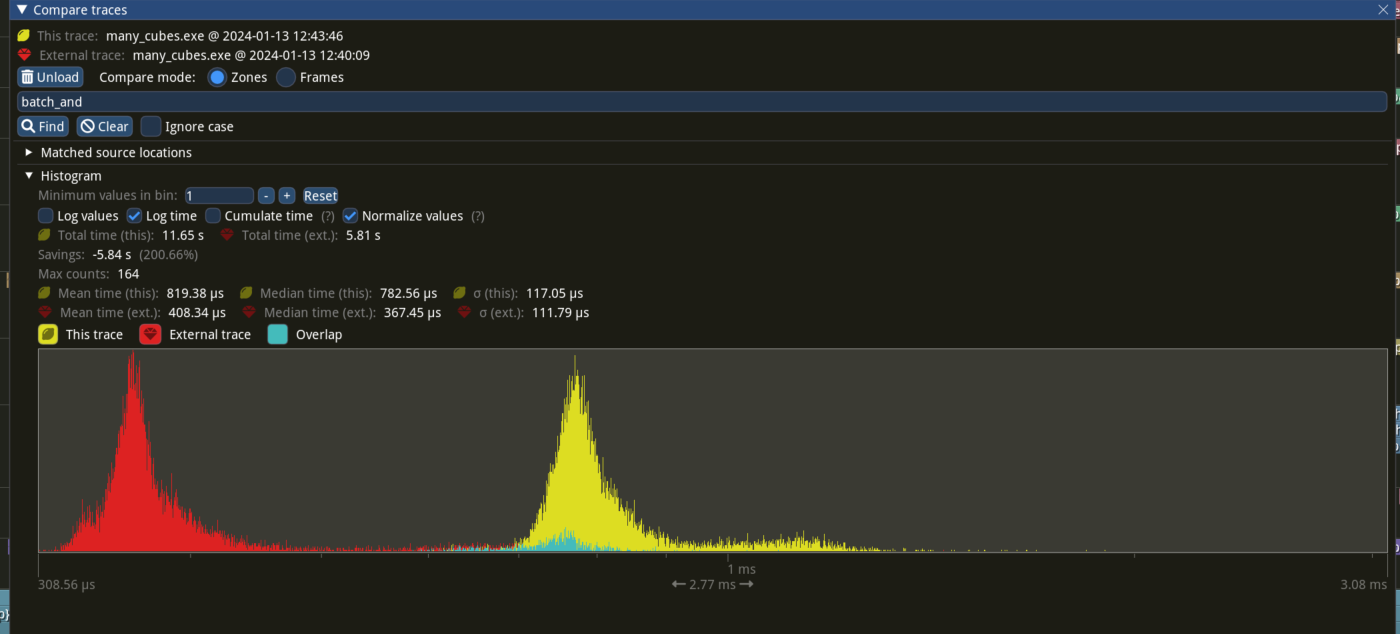
`batch_and_prepare_render_phase` from 800us ~ 400 us
## Migration Guide
trait `GetBatchData` no longer hold associated type `Data `and `Filter`
`get_batch_data` `query_item `type from `Self::Data` to `Entity` and
return `Option<(Self::BufferData, Option<Self::CompareData>)>`
`batch_and_prepare_render_phase` should not have a query
This pull request re-submits #10057, which was backed out for breaking
macOS, iOS, and Android. I've tested this version on macOS and Android
and on the iOS simulator.

# Objective

This pull request implements *reflection probes*, which generalize
environment maps to allow for multiple environment maps in the same
scene, each of which has an axis-aligned bounding box. This is a
standard feature of physically-based renderers and was inspired by [the
corresponding feature in Blender's Eevee renderer].

## Solution

This is a minimal implementation of reflection probes that allows
artists to define cuboid bounding regions associated with environment
maps. For every view, on every frame, a system builds up a list of the
nearest 4 reflection probes that are within the view's frustum and
supplies that list to the shader. The PBR fragment shader searches
through the list, finds the first containing reflection probe, and uses
it for indirect lighting, falling back to the view's environment map if
none is found. Both forward and deferred renderers are fully supported.

A reflection probe is an entity with a pair of components, *LightProbe*
and *EnvironmentMapLight* (as well as the standard *SpatialBundle*, to
position it in the world). The *LightProbe* component (along with the
*Transform*) defines the bounding region, while the
*EnvironmentMapLight* component specifies the associated diffuse and
specular cubemaps.

A frequent question is "why two components instead of just one?" The
advantages of this setup are:

1. It's readily extensible to other types of light probes, in particular
*irradiance volumes* (also known as ambient cubes or voxel global
illumination), which use the same approach of bounding cuboids. With a
single component that applies to both reflection probes and irradiance
volumes, we can share the logic that implements falloff and blending
between multiple light probes between both of those features.

2. It reduces duplication between the existing *EnvironmentMapLight* and
these new reflection probes. Systems can treat environment maps attached
to cameras the same way they treat environment maps applied to
reflection probes if they wish.

Internally, we gather up all environment maps in the scene and place
them in a cubemap array. At present, this means that all environment
maps must have the same size, mipmap count, and texture format. A
warning is emitted if this restriction is violated. We could potentially
relax this in the future as part of the automatic mipmap generation
work, which could easily do texture format conversion as part of its
preprocessing.

An easy way to generate reflection probe cubemaps is to bake them in
Blender and use the `export-blender-gi` tool that's part of the
[`bevy-baked-gi`] project. This tool takes a `.blend` file containing
baked cubemaps as input and exports cubemap images, pre-filtered with an
embedded fork of the [glTF IBL Sampler], alongside a corresponding
`.scn.ron` file that the scene spawner can use to recreate the
reflection probes.

Note that this is intentionally a minimal implementation, to aid
reviewability. Known issues are:

* Reflection probes are basically unsupported on WebGL 2, because WebGL
2 has no cubemap arrays. (Strictly speaking, you can have precisely one
reflection probe in the scene if you have no other cubemaps anywhere,
but this isn't very useful.)

* Reflection probes have no falloff, so reflections will abruptly change
when objects move from one bounding region to another.

* As mentioned before, all cubemaps in the world of a given type
(diffuse or specular) must have the same size, format, and mipmap count.

Future work includes:

* Blending between multiple reflection probes.

* A falloff/fade-out region so that reflected objects disappear
gradually instead of vanishing all at once.

* Irradiance volumes for voxel-based global illumination. This should
reuse much of the reflection probe logic, as they're both GI techniques
based on cuboid bounding regions.

* Support for WebGL 2, by breaking batches when reflection probes are
used.

These issues notwithstanding, I think it's best to land this with
roughly the current set of functionality, because this patch is useful
as is and adding everything above would make the pull request
significantly larger and harder to review.

---

## Changelog

### Added

* A new *LightProbe* component is available that specifies a bounding
region that an *EnvironmentMapLight* applies to. The combination of a
*LightProbe* and an *EnvironmentMapLight* offers *reflection probe*
functionality similar to that available in other engines.

[the corresponding feature in Blender's Eevee renderer]:
https://docs.blender.org/manual/en/latest/render/eevee/light_probes/reflection_cubemaps.html

[`bevy-baked-gi`]: https://github.com/pcwalton/bevy-baked-gi

[glTF IBL Sampler]: https://github.com/KhronosGroup/glTF-IBL-Sampler
# Objective

This pull request implements *reflection probes*, which generalize
environment maps to allow for multiple environment maps in the same
scene, each of which has an axis-aligned bounding box. This is a
standard feature of physically-based renderers and was inspired by [the
corresponding feature in Blender's Eevee renderer].

## Solution

This is a minimal implementation of reflection probes that allows
artists to define cuboid bounding regions associated with environment
maps. For every view, on every frame, a system builds up a list of the
nearest 4 reflection probes that are within the view's frustum and
supplies that list to the shader. The PBR fragment shader searches
through the list, finds the first containing reflection probe, and uses
it for indirect lighting, falling back to the view's environment map if
none is found. Both forward and deferred renderers are fully supported.

A reflection probe is an entity with a pair of components, *LightProbe*
and *EnvironmentMapLight* (as well as the standard *SpatialBundle*, to
position it in the world). The *LightProbe* component (along with the
*Transform*) defines the bounding region, while the
*EnvironmentMapLight* component specifies the associated diffuse and
specular cubemaps.

A frequent question is "why two components instead of just one?" The
advantages of this setup are:

1. It's readily extensible to other types of light probes, in particular
*irradiance volumes* (also known as ambient cubes or voxel global
illumination), which use the same approach of bounding cuboids. With a
single component that applies to both reflection probes and irradiance
volumes, we can share the logic that implements falloff and blending
between multiple light probes between both of those features.

2. It reduces duplication between the existing *EnvironmentMapLight* and
these new reflection probes. Systems can treat environment maps attached
to cameras the same way they treat environment maps applied to
reflection probes if they wish.

Internally, we gather up all environment maps in the scene and place
them in a cubemap array. At present, this means that all environment
maps must have the same size, mipmap count, and texture format. A
warning is emitted if this restriction is violated. We could potentially
relax this in the future as part of the automatic mipmap generation
work, which could easily do texture format conversion as part of its
preprocessing.

An easy way to generate reflection probe cubemaps is to bake them in
Blender and use the `export-blender-gi` tool that's part of the
[`bevy-baked-gi`] project. This tool takes a `.blend` file containing
baked cubemaps as input and exports cubemap images, pre-filtered with an
embedded fork of the [glTF IBL Sampler], alongside a corresponding
`.scn.ron` file that the scene spawner can use to recreate the
reflection probes.

Note that this is intentionally a minimal implementation, to aid
reviewability. Known issues are:

* Reflection probes are basically unsupported on WebGL 2, because WebGL
2 has no cubemap arrays. (Strictly speaking, you can have precisely one
reflection probe in the scene if you have no other cubemaps anywhere,
but this isn't very useful.)

* Reflection probes have no falloff, so reflections will abruptly change
when objects move from one bounding region to another.

* As mentioned before, all cubemaps in the world of a given type
(diffuse or specular) must have the same size, format, and mipmap count.

Future work includes:

* Blending between multiple reflection probes.

* A falloff/fade-out region so that reflected objects disappear
gradually instead of vanishing all at once.

* Irradiance volumes for voxel-based global illumination. This should
reuse much of the reflection probe logic, as they're both GI techniques
based on cuboid bounding regions.

* Support for WebGL 2, by breaking batches when reflection probes are
used.

These issues notwithstanding, I think it's best to land this with
roughly the current set of functionality, because this patch is useful
as is and adding everything above would make the pull request
significantly larger and harder to review.

---

## Changelog

### Added

* A new *LightProbe* component is available that specifies a bounding
region that an *EnvironmentMapLight* applies to. The combination of a
*LightProbe* and an *EnvironmentMapLight* offers *reflection probe*
functionality similar to that available in other engines.

[the corresponding feature in Blender's Eevee renderer]:
https://docs.blender.org/manual/en/latest/render/eevee/light_probes/reflection_cubemaps.html

[`bevy-baked-gi`]: https://github.com/pcwalton/bevy-baked-gi

[glTF IBL Sampler]: https://github.com/KhronosGroup/glTF-IBL-Sampler

# Objective
Lightmaps, textures that store baked global illumination, have been a
mainstay of real-time graphics for decades. Bevy currently has no
support for them, so this pull request implements them.
## Solution
The new `Lightmap` component can be attached to any entity that contains
a `Handle<Mesh>` and a `StandardMaterial`. When present, it will be
applied in the PBR shader. Because multiple lightmaps are frequently
packed into atlases, each lightmap may have its own UV boundaries within
its texture. An `exposure` field is also provided, to control the
brightness of the lightmap.
Note that this PR doesn't provide any way to bake the lightmaps. That
can be done with [The Lightmapper] or another solution, such as Unity's
Bakery.
---
## Changelog
### Added
* A new component, `Lightmap`, is available, for baked global
illumination. If your mesh has a second UV channel (UV1), and you attach
this component to the entity with that mesh, Bevy will apply the texture
referenced in the lightmap.
[The Lightmapper]: https://github.com/Naxela/The_Lightmapper
---------
Co-authored-by: Carter Anderson <mcanders1@gmail.com>
Turns out whenever a normal prepass was active (which includes whenever
you use SSAO) we were attempting to read the normals from the prepass
for the specular transmissive material. Since transmissive materials
don't participate in the prepass (unlike opaque materials) we were
reading the normals from “behind” the mesh, producing really weird
visual results.
# Objective
- Fixes#11112.
## Solution
- We introduce a new `READS_VIEW_TRANSMISSION_TEXTURE` mesh pipeline
key;
- We set it whenever the material properties has the
`reads_view_transmission_texture` flag set; (i.e. the material is
transmissive)
- If this key is set we prevent the reading of normals from the prepass,
by not setting the `LOAD_PREPASS_NORMALS` shader def.
---
## Changelog
### Fixed
- Specular transmissive materials no longer attempt to erroneously load
prepass normals, and now work correctly even with the normal prepass
active (e.g. when using SSAO)
# Objective

- Shorten paths by removing unnecessary prefixes

## Solution

- Remove the prefixes from many paths which do not need them. Finding
the paths was done automatically using built-in refactoring tools in
Jetbrains RustRover.
# Objective
- Materials should be a more frequent rebind then meshes (due to being
able to use a single vertex buffer, such as in #10164) and therefore
should be in a higher bind group.

---

## Changelog
- For 2d and 3d mesh/material setups (but not UI materials, or other
rendering setups such as gizmos, sprites, or text), mesh data is now in
bind group 1, and material data is now in bind group 2, which is swapped
from how they were before.

## Migration Guide
- Custom 2d and 3d mesh/material shaders should now use bind group 2
`@group(2) @binding(x)` for their bound resources, instead of bind group
1.
- Many internal pieces of rendering code have changed so that mesh data
is now in bind group 1, and material data is now in bind group 2.
Semi-custom rendering setups (that don't use the Material or Material2d
APIs) should adapt to these changes.
# Objective

`wgpu` has a helper method `texture.as_image_copy()` for a common
pattern when making a default-like `ImageCopyTexture` from a texture.

This is used in various places in Bevy for texture copy operations, but
it was not used where `write_texture` is called.

## Solution

- Replace struct `ImageCopyTexture` initialization with
`texture.as_image_copy()` where appropriate

Signed-off-by: Torstein Grindvik <torstein.grindvik@muybridge.com>
Co-authored-by: Torstein Grindvik <torstein.grindvik@muybridge.com>
# Objective

<img width="1920" alt="Screenshot 2023-04-26 at 01 07 34"
src="https://user-images.githubusercontent.com/418473/234467578-0f34187b-5863-4ea1-88e9-7a6bb8ce8da3.png">

This PR adds both diffuse and specular light transmission capabilities
to the `StandardMaterial`, with support for screen space refractions.
This enables realistically representing a wide range of real-world
materials, such as:

  - Glass; (Including frosted glass)
  - Transparent and translucent plastics;
  - Various liquids and gels;
  - Gemstones;
  - Marble;
  - Wax;
  - Paper;
  - Leaves;
  - Porcelain.

Unlike existing support for transparency, light transmission does not
rely on fixed function alpha blending, and therefore works with both
`AlphaMode::Opaque` and `AlphaMode::Mask` materials.

## Solution

- Introduces a number of transmission related fields in the
`StandardMaterial`;
- For specular transmission:
- Adds logic to take a view main texture snapshot after the opaque
phase; (in order to perform screen space refractions)
- Introduces a new `Transmissive3d` phase to the renderer, to which all
meshes with `transmission > 0.0` materials are sent.
- Calculates a light exit point (of the approximate mesh volume) using
`ior` and `thickness` properties
- Samples the snapshot texture with an adaptive number of taps across a
`roughness`-controlled radius enabling “blurry” refractions
- For diffuse transmission:
- Approximates transmitted diffuse light by using a second, flipped +
displaced, diffuse-only Lambertian lobe for each light source.

## To Do

- [x] Figure out where `fresnel_mix()` is taking place, if at all, and
where `dielectric_specular` is being calculated, if at all, and update
them to use the `ior` value (Not a blocker, just a nice-to-have for more
correct BSDF)
- To the _best of my knowledge, this is now taking place, after
964340cdd. The fresnel mix is actually "split" into two parts in our
implementation, one `(1 - fresnel(...))` in the transmission, and
`fresnel()` in the light implementations. A surface with more
reflectance now will produce slightly dimmer transmission towards the
grazing angle, as more of the light gets reflected.
- [x] Add `transmission_texture`
- [x] Add `diffuse_transmission_texture`
- [x] Add `thickness_texture`
- [x] Add `attenuation_distance` and `attenuation_color`
- [x] Connect values to glTF loader
  - [x] `transmission` and `transmission_texture`
  - [x] `thickness` and `thickness_texture`
  - [x] `ior`
- [ ] `diffuse_transmission` and `diffuse_transmission_texture` (needs
upstream support in `gltf` crate, not a blocker)
- [x] Add support for multiple screen space refraction “steps”
- [x] Conditionally create no transmission snapshot texture at all if
`steps == 0`
- [x] Conditionally enable/disable screen space refraction transmission
snapshots
- [x] Read from depth pre-pass to prevent refracting pixels in front of
the light exit point
- [x] Use `interleaved_gradient_noise()` function for sampling blur in a
way that benefits from TAA
- [x] Drill down a TAA `#define`, tweak some aspects of the effect
conditionally based on it
- [x] Remove const array that's crashing under HLSL (unless a new `naga`
release with https://github.com/gfx-rs/naga/pull/2496 comes out before
we merge this)
- [ ] Look into alternatives to the `switch` hack for dynamically
indexing the const array (might not be needed, compilers seem to be
decent at expanding it)
- [ ] Add pipeline keys for gating transmission (do we really want/need
this?)
- [x] Tweak some material field/function names?

## A Note on Texture Packing

_This was originally added as a comment to the
`specular_transmission_texture`, `thickness_texture` and
`diffuse_transmission_texture` documentation, I removed it since it was
more confusing than helpful, and will likely be made redundant/will need
to be updated once we have a better infrastructure for preprocessing
assets_

Due to how channels are mapped, you can more efficiently use a single
shared texture image
for configuring the following:

- R - `specular_transmission_texture`
- G - `thickness_texture`
- B - _unused_
- A - `diffuse_transmission_texture`

The `KHR_materials_diffuse_transmission` glTF extension also defines a
`diffuseTransmissionColorTexture`,
that _we don't currently support_. One might choose to pack the
intensity and color textures together,
using RGB for the color and A for the intensity, in which case this
packing advice doesn't really apply.

---

## Changelog

- Added a new `Transmissive3d` render phase for rendering specular
transmissive materials with screen space refractions
- Added rendering support for transmitted environment map light on the
`StandardMaterial` as a fallback for screen space refractions
- Added `diffuse_transmission`, `specular_transmission`, `thickness`,
`ior`, `attenuation_distance` and `attenuation_color` to the
`StandardMaterial`
- Added `diffuse_transmission_texture`, `specular_transmission_texture`,
`thickness_texture` to the `StandardMaterial`, gated behind a new
`pbr_transmission_textures` cargo feature (off by default, for maximum
hardware compatibility)
- Added `Camera3d::screen_space_specular_transmission_steps` for
controlling the number of “layers of transparency” rendered for
transmissive objects
- Added a `TransmittedShadowReceiver` component for enabling shadows in
(diffusely) transmitted light. (disabled by default, as it requires
carefully setting up the `thickness` to avoid self-shadow artifacts)
- Added support for the `KHR_materials_transmission`,
`KHR_materials_ior` and `KHR_materials_volume` glTF extensions
- Renamed items related to temporal jitter for greater consistency

## Migration Guide

- `SsaoPipelineKey::temporal_noise` has been renamed to
`SsaoPipelineKey::temporal_jitter`
- The `TAA` shader def (controlled by the presence of the
`TemporalAntiAliasSettings` component in the camera) has been replaced
with the `TEMPORAL_JITTER` shader def (controlled by the presence of the
`TemporalJitter` component in the camera)
- `MeshPipelineKey::TAA` has been replaced by
`MeshPipelineKey::TEMPORAL_JITTER`
- The `TEMPORAL_NOISE` shader def has been consolidated with
`TEMPORAL_JITTER`
# Objective

- Build on the changes in https://github.com/bevyengine/bevy/pull/9982
- Use `ImageSamplerDescriptor` as the "public image sampler descriptor"
interface in all places (for consistency)
- Make it possible to configure textures to use the "default" sampler
(as configured in the `DefaultImageSampler` resource)
- Fix a bug introduced in #9982 that prevents configured samplers from
being used in Basis, KTX2, and DDS textures

---

## Migration Guide

- When using the `Image` API, use `ImageSamplerDescriptor` instead of
`wgpu::SamplerDescriptor`
- If writing custom wgpu renderer features that work with `Image`, call
`&image_sampler.as_wgpu()` to convert to a wgpu descriptor.
# Objective

- the style of import used by bevy guarantees merge conflicts when any
file change
- This is especially true when import lists are large, such as in
`bevy_pbr`
- Merge conflicts are tricky to resolve. This bogs down rendering PRs
and makes contributing to bevy's rendering system more difficult than it
needs to

## Solution

- Use wildcard imports to replace multiline import list in `bevy_pbr`

I suspect this is controversial, but I'd like to hear alternatives.
Because this is one of many papercuts that makes developing render
features near impossible.
# Objective

A follow-up PR for https://github.com/bevyengine/bevy/pull/10221

## Changelog

Replaced usages of texture_descriptor.size with the helper methods of
`Image` through the entire engine codebase
# Objective

This PR aims to make it so that we don't accidentally go over
`MAX_TEXTURE_IMAGE_UNITS` (in WebGL) or
`maxSampledTexturesPerShaderStage` (in WebGPU), giving us some extra
leeway to add more view bind group textures.

(This PR is extracted from—and unblocks—#8015)

## Solution

- We replace the existing `view_layout` and `view_layout_multisampled`
pair with an array of 32 bind group layouts, generated ahead of time;
- For now, these layouts cover all the possible combinations of:
`multisampled`, `depth_prepass`, `normal_prepass`,
`motion_vector_prepass` and `deferred_prepass`:
- In the future, as @JMS55 pointed out, we can likely take out
`motion_vector_prepass` and `deferred_prepass`, as these are not really
needed for the mesh pipeline and can use separate pipelines. This would
bring the possible combinations down to 8;
- We can also add more "optional" textures as they become needed,
allowing the engine to scale to a wider variety of use cases in lower
end/web environments (e.g. some apps might just want normal and depth
prepasses, others might only want light probes), while still keeping a
high ceiling for high end native environments where more textures are
supported.
- While preallocating bind group layouts is relatively cheap, the number
of combinations grows exponentially, so we should likely limit ourselves
to something like at most 256–1024 total layouts until we find a better
solution (like generating them lazily)
- To make this mechanism a little bit more explicit/discoverable, so
that compatibility with WebGPU/WebGL is not broken by accident, we add a
`MESH_PIPELINE_VIEW_LAYOUT_SAFE_MAX_TEXTURES` const and warn whenever
the number of textures in the layout crosses it.
- The warning is gated by `#[cfg(debug_assertions)]` and not issued in
release builds;
- We're counting the actual textures in the bind group layout instead of
using some roundabout metric so it should be accurate;
- Right now `MESH_PIPELINE_VIEW_LAYOUT_SAFE_MAX_TEXTURES` is set to 10
in order to leave 6 textures free for other groups;
- Currently there's no combination that would cause us to go over the
limit, but that will change once #8015 lands.

---

## Changelog

- `MeshPipeline` view bind group layouts now vary based on the current
multisampling and prepass states, saving a couple of texture binding
entries when prepasses are not in use.

## Migration Guide

- `MeshPipeline::view_layout` and
`MeshPipeline::view_layout_multisampled` have been replaced with a
private array to accomodate for variable view bind group layouts. To
obtain a view bind group layout for the current pipeline state, use the
new `MeshPipeline::get_view_layout()` or
`MeshPipeline::get_view_layout_from_key()` methods.
# Objective

- This PR aims to make the various `*_PREPASS` shader defs we have
(`NORMAL_PREPASS`, `DEPTH_PREPASS`, `MOTION_VECTORS_PREPASS` AND
`DEFERRED_PREPASS`) easier to use and understand:
- So that their meaning is now consistent across all contexts; (“prepass
X is enabled for the current view”)
  - So that they're also consistently set across all contexts.
- It also aims to enable us to (with a follow up PR) to conditionally
gate the `BindGroupEntry` and `BindGroupLayoutEntry` items associated
with these prepasses, saving us up to 4 texture slots in WebGL
(currently globally limited to 16 per shader, regardless of bind groups)

## Solution

- We now consistently set these from `PrepassPipeline`, the
`MeshPipeline` and the `DeferredLightingPipeline`, we also set their
`MeshPipelineKey`s;
- We introduce `PREPASS_PIPELINE`, `MESH_PIPELINE` and
`DEFERRED_LIGHTING_PIPELINE` that can be used to detect where the code
is running, without overloading the meanings of the prepass shader defs;
- We also gate the WGSL functions in `bevy_pbr::prepass_utils` with
`#ifdef`s for their respective shader defs, so that shader code can
provide a fallback whenever they're not available.
- This allows us to conditionally include the bindings for these prepass
textures (My next PR, which will hopefully unblock #8015)
- @robtfm mentioned [these were being used to prevent accessing the same
binding as read/write in the
prepass](https://discord.com/channels/691052431525675048/743663924229963868/1163270458393759814),
however even after reversing the `#ifndef`s I had no issues running the
code, so perhaps the compiler is already smart enough even without tree
shaking to know they're not being used, thanks to `#ifdef
PREPASS_PIPELINE`?

## Comparison

### Before

| Shader Def | `PrepassPipeline` | `MeshPipeline` |
`DeferredLightingPipeline` |
| ------------------------ | ----------------- | -------------- |
-------------------------- |
| `NORMAL_PREPASS` | Yes | No | No |
| `DEPTH_PREPASS` | Yes | No | No |
| `MOTION_VECTORS_PREPASS` | Yes | No | No |
| `DEFERRED_PREPASS` | Yes | No | No |

| View Key | `PrepassPipeline` | `MeshPipeline` |
`DeferredLightingPipeline` |
| ------------------------ | ----------------- | -------------- |
-------------------------- |
| `NORMAL_PREPASS` | Yes | Yes | No |
| `DEPTH_PREPASS` | Yes | No | No |
| `MOTION_VECTORS_PREPASS` | Yes | No | No |
| `DEFERRED_PREPASS` | Yes | Yes\* | No |

\* Accidentally was being set twice, once with only
`deferred_prepass.is_some()` as a condition,
and once with `deferred_p repass.is_some() && !forward` as a condition.

### After

| Shader Def | `PrepassPipeline` | `MeshPipeline` |
`DeferredLightingPipeline` |
| ---------------------------- | ----------------- | --------------- |
-------------------------- |
| `NORMAL_PREPASS` | Yes | Yes | Yes |
| `DEPTH_PREPASS` | Yes | Yes | Yes |
| `MOTION_VECTORS_PREPASS` | Yes | Yes | Yes |
| `DEFERRED_PREPASS` | Yes | Yes | Unconditionally |
| `PREPASS_PIPELINE` | Unconditionally | No | No |
| `MESH_PIPELINE` | No | Unconditionally | No |
| `DEFERRED_LIGHTING_PIPELINE` | No | No | Unconditionally |

| View Key | `PrepassPipeline` | `MeshPipeline` |
`DeferredLightingPipeline` |
| ------------------------ | ----------------- | -------------- |
-------------------------- |
| `NORMAL_PREPASS` | Yes | Yes | Yes |
| `DEPTH_PREPASS` | Yes | Yes | Yes |
| `MOTION_VECTORS_PREPASS` | Yes | Yes | Yes |
| `DEFERRED_PREPASS` | Yes | Yes | Unconditionally |

---

## Changelog

- Cleaned up WGSL `*_PREPASS` shader defs so they're now consistently
used everywhere;
- Introduced `PREPASS_PIPELINE`, `MESH_PIPELINE` and
`DEFERRED_LIGHTING_PIPELINE` WGSL shader defs for conditionally
compiling logic based the current pipeline;
- WGSL functions from `bevy_pbr::prepass_utils` are now guarded with
`#ifdef` based on the currently enabled prepasses;

## Migration Guide

- When using functions from `bevy_pbr::prepass_utils`
(`prepass_depth()`, `prepass_normal()`, `prepass_motion_vector()`) in
contexts where these prepasses might be disabled, you should now wrap
your calls with the appropriate `#ifdef` guards, (`#ifdef
DEPTH_PREPASS`, `#ifdef NORMAL_PREPASS`, `#ifdef MOTION_VECTOR_PREPASS`)
providing fallback logic where applicable.

---------

Co-authored-by: Carter Anderson <mcanders1@gmail.com>
Co-authored-by: IceSentry <IceSentry@users.noreply.github.com>
# Objective

cleanup some pbr shader code. improve shader stage io consistency and
make pbr.wgsl (probably many people's first foray into bevy shader code)
a little more human-readable. also fix a couple of small issues with
deferred rendering.

## Solution

mesh_vertex_output:
- rename to forward_io (to align with prepass_io)
- rename `MeshVertexOutput` to `VertexOutput` (to align with prepass_io)
- move `Vertex` from mesh.wgsl into here (to align with prepass_io)

prepass_io:
- remove `FragmentInput`, use `VertexOutput` directly (to align with
forward_io)
- rename `VertexOutput::clip_position` to `position` (to align with
forward_io)

pbr.wgsl:
- restructure so we don't need `#ifdefs` on the actual entrypoint, use
VertexOutput and FragmentOutput in all cases and use #ifdefs to import
the right struct definitions.
- rearrange to make the flow clearer
- move alpha_discard up from `pbr_functions::pbr` to avoid needing to
call it on some branches and not others
- add a bunch of comments

deferred_lighting:
- move ssao into the `!unlit` block to reflect forward behaviour
correctly
- fix compile error with deferred + premultiply_alpha

## Migration Guide

in custom material shaders:
- `pbr_functions::pbr` no longer calls to
`pbr_functions::alpha_discard`. if you were using the `pbr` function in
a custom shader with alpha mask mode you now also need to call
alpha_discard manually
- rename imports of `bevy_pbr::mesh_vertex_output` to
`bevy_pbr::forward_io`
- rename instances of `MeshVertexOutput` to `VertexOutput`

in custom material prepass shaders:
- rename instances of `VertexOutput::clip_position` to
`VertexOutput::position`
# Objective

- Add a [Deferred
Renderer](https://en.wikipedia.org/wiki/Deferred_shading) to Bevy.
- This allows subsequent passes to access per pixel material information
before/during shading.
- Accessing this per pixel material information is needed for some
features, like GI. It also makes other features (ex. Decals) simpler to
implement and/or improves their capability. There are multiple
approaches to accomplishing this. The deferred shading approach works
well given the limitations of WebGPU and WebGL2.

Motivation: [I'm working on a GI solution for
Bevy](https://youtu.be/eH1AkL-mwhI)

# Solution
- The deferred renderer is implemented with a prepass and a deferred
lighting pass.
- The prepass renders opaque objects into the Gbuffer attachment
(`Rgba32Uint`). The PBR shader generates a `PbrInput` in mostly the same
way as the forward implementation and then [packs it into the
Gbuffer](ec1465559f/crates/bevy_pbr/src/render/pbr.wgsl (L168)).
- The deferred lighting pass unpacks the `PbrInput` and [feeds it into
the pbr()
function](ec1465559f/crates/bevy_pbr/src/deferred/deferred_lighting.wgsl (L65)),
then outputs the shaded color data.

- There is now a resource
[DefaultOpaqueRendererMethod](ec1465559f/crates/bevy_pbr/src/material.rs (L599))
that can be used to set the default render method for opaque materials.
If materials return `None` from
[opaque_render_method()](ec1465559f/crates/bevy_pbr/src/material.rs (L131))
the `DefaultOpaqueRendererMethod` will be used. Otherwise, custom
materials can also explicitly choose to only support Deferred or Forward
by returning the respective
[OpaqueRendererMethod](ec1465559f/crates/bevy_pbr/src/material.rs (L603))

- Deferred materials can be used seamlessly along with both opaque and
transparent forward rendered materials in the same scene. The [deferred
rendering
example](https://github.com/DGriffin91/bevy/blob/deferred/examples/3d/deferred_rendering.rs)
does this.

- The deferred renderer does not support MSAA. If any deferred materials
are used, MSAA must be disabled. Both TAA and FXAA are supported.

- Deferred rendering supports WebGL2/WebGPU.

## Custom deferred materials
- Custom materials can support both deferred and forward at the same
time. The
[StandardMaterial](ec1465559f/crates/bevy_pbr/src/render/pbr.wgsl (L166))
does this. So does [this
example](https://github.com/DGriffin91/bevy_glowy_orb_tutorial/blob/deferred/assets/shaders/glowy.wgsl#L56).
- Custom deferred materials that require PBR lighting can create a
`PbrInput`, write it to the deferred GBuffer and let it be rendered by
the `PBRDeferredLightingPlugin`.
- Custom deferred materials that require custom lighting have two
options:
1. Use the base_color channel of the `PbrInput` combined with the
`STANDARD_MATERIAL_FLAGS_UNLIT_BIT` flag.
[Example.](https://github.com/DGriffin91/bevy_glowy_orb_tutorial/blob/deferred/assets/shaders/glowy.wgsl#L56)
(If the unlit bit is set, the base_color is stored as RGB9E5 for extra
precision)
2. A Custom Deferred Lighting pass can be created, either overriding the
default, or running in addition. The a depth buffer is used to limit
rendering to only the required fragments for each deferred lighting
pass. Materials can set their respective depth id via the
[deferred_lighting_pass_id](b79182d2a3/crates/bevy_pbr/src/prepass/prepass_io.wgsl (L95))
attachment. The custom deferred lighting pass plugin can then set [its
corresponding
depth](ec1465559f/crates/bevy_pbr/src/deferred/deferred_lighting.wgsl (L37)).
Then with the lighting pass using
[CompareFunction::Equal](ec1465559f/crates/bevy_pbr/src/deferred/mod.rs (L335)),
only the fragments with a depth that equal the corresponding depth
written in the material will be rendered.

Custom deferred lighting plugins can also be created to render the
StandardMaterial. The default deferred lighting plugin can be bypassed
with `DefaultPlugins.set(PBRDeferredLightingPlugin { bypass: true })`

---------

Co-authored-by: nickrart <nickolas.g.russell@gmail.com>
# Objective

- Improve antialiasing for non-point light shadow edges.
- Very partially addresses
https://github.com/bevyengine/bevy/issues/3628.

## Solution

- Implements "The Witness"'s shadow map sampling technique.
  - Ported from @superdump's old branch, all credit to them :)
- Implements "Call of Duty: Advanced Warfare"'s stochastic shadow map
sampling technique when the velocity prepass is enabled, for use with
TAA.
- Uses interleaved gradient noise to generate a random angle, and then
averages 8 samples in a spiral pattern, rotated by the random angle.
- I also tried spatiotemporal blue noise, but it was far too noisy to be
filtered by TAA alone. In the future, we should try spatiotemporal blue
noise + a specialized shadow denoiser such as
https://gpuopen.com/fidelityfx-denoiser/#shadow. This approach would
also be useful for hybrid rasterized applications with raytraced
shadows.
- The COD presentation has an interesting temporal dithering of the
noise for use with temporal supersampling that we should revisit when we
get DLSS/FSR/other TSR.

---

## Changelog

* Added `ShadowFilteringMethod`. Improved directional light and
spotlight shadow edges to be less aliased.

## Migration Guide

* Shadows cast by directional lights or spotlights now have smoother
edges. To revert to the old behavior, add
`ShadowFilteringMethod::Hardware2x2` to your cameras.

---------

Co-authored-by: IceSentry <c.giguere42@gmail.com>
Co-authored-by: Daniel Chia <danstryder@gmail.com>
Co-authored-by: robtfm <50659922+robtfm@users.noreply.github.com>
Co-authored-by: Brandon Dyer <brandondyer64@gmail.com>
Co-authored-by: Edgar Geier <geieredgar@gmail.com>
Co-authored-by: Robert Swain <robert.swain@gmail.com>
Co-authored-by: Elabajaba <Elabajaba@users.noreply.github.com>
Co-authored-by: IceSentry <IceSentry@users.noreply.github.com>