# Objective

Now that #13432 has been merged, it's important we update our reflected
types to properly opt into this feature. If we do not, then this could
cause issues for users downstream who want to make use of
reflection-based cloning.

## Solution

This PR is broken into 4 commits:

1. Add `#[reflect(Clone)]` on all types marked `#[reflect(opaque)]` that
are also `Clone`. This is mandatory as these types would otherwise cause
the cloning operation to fail for any type that contains it at any
depth.
2. Update the reflection example to suggest adding `#[reflect(Clone)]`
on opaque types.
3. Add `#[reflect(clone)]` attributes on all fields marked
`#[reflect(ignore)]` that are also `Clone`. This prevents the ignored
field from causing the cloning operation to fail.

Note that some of the types that contain these fields are also `Clone`,
and thus can be marked `#[reflect(Clone)]`. This makes the
`#[reflect(clone)]` attribute redundant. However, I think it's safer to
keep it marked in the case that the `Clone` impl/derive is ever removed.
I'm open to removing them, though, if people disagree.
4. Finally, I added `#[reflect(Clone)]` on all types that are also
`Clone`. While not strictly necessary, it enables us to reduce the
generated output since we can just call `Clone::clone` directly instead
of calling `PartialReflect::reflect_clone` on each variant/field. It
also means we benefit from any optimizations or customizations made in
the `Clone` impl, including directly dereferencing `Copy` values and
increasing reference counters.

Along with that change I also took the liberty of adding any missing
registrations that I saw could be applied to the type as well, such as
`Default`, `PartialEq`, and `Hash`. There were hundreds of these to
edit, though, so it's possible I missed quite a few.

That last commit is **_massive_**. There were nearly 700 types to
update. So it's recommended to review the first three before moving onto
that last one.

Additionally, I can break the last commit off into its own PR or into
smaller PRs, but I figured this would be the easiest way of doing it
(and in a timely manner since I unfortunately don't have as much time as
I used to for code contributions).

## Testing

You can test locally with a `cargo check`:

```
cargo check --workspace --all-features
```
# Objective
It's difficult to understand or make changes to the UI systems because
of how each system needs to individually track changes to scale factor,
windows and camera targets in local hashmaps, particularly for new
contributors. Any major change inevitably introduces new scale factor
bugs.
Instead of per-system resolution we can resolve the camera target info
for all UI nodes in a system at the start of `PostUpdate` and then store
it per-node in components that can be queried with change detection.
Fixes#17578Fixes#15143
## Solution
Store the UI render target's data locally per node in a component that
is updated in `PostUpdate` before any other UI systems run.
This component can be then be queried with change detection so that UI
systems no longer need to have knowledge of cameras and windows and
don't require fragile custom change detection solutions using local
hashmaps.
## Showcase
Compare `measure_text_system` from main (which has a bug the causes it
to use the wrong scale factor when a node's camera target changes):
```
pub fn measure_text_system(
mut scale_factors_buffer: Local<EntityHashMap<f32>>,
mut last_scale_factors: Local<EntityHashMap<f32>>,
fonts: Res<Assets<Font>>,
camera_query: Query<(Entity, &Camera)>,
default_ui_camera: DefaultUiCamera,
ui_scale: Res<UiScale>,
mut text_query: Query<
(
Entity,
Ref<TextLayout>,
&mut ContentSize,
&mut TextNodeFlags,
&mut ComputedTextBlock,
Option<&UiTargetCamera>,
),
With<Node>,
>,
mut text_reader: TextUiReader,
mut text_pipeline: ResMut<TextPipeline>,
mut font_system: ResMut<CosmicFontSystem>,
) {
scale_factors_buffer.clear();
let default_camera_entity = default_ui_camera.get();
for (entity, block, content_size, text_flags, computed, maybe_camera) in &mut text_query {
let Some(camera_entity) = maybe_camera
.map(UiTargetCamera::entity)
.or(default_camera_entity)
else {
continue;
};
let scale_factor = match scale_factors_buffer.entry(camera_entity) {
Entry::Occupied(entry) => *entry.get(),
Entry::Vacant(entry) => *entry.insert(
camera_query
.get(camera_entity)
.ok()
.and_then(|(_, c)| c.target_scaling_factor())
.unwrap_or(1.0)
* ui_scale.0,
),
};
if last_scale_factors.get(&camera_entity) != Some(&scale_factor)
|| computed.needs_rerender()
|| text_flags.needs_measure_fn
|| content_size.is_added()
{
create_text_measure(
entity,
&fonts,
scale_factor.into(),
text_reader.iter(entity),
block,
&mut text_pipeline,
content_size,
text_flags,
computed,
&mut font_system,
);
}
}
core::mem::swap(&mut *last_scale_factors, &mut *scale_factors_buffer);
}
```
with `measure_text_system` from this PR (which always uses the correct
scale factor):
```
pub fn measure_text_system(
fonts: Res<Assets<Font>>,
mut text_query: Query<
(
Entity,
Ref<TextLayout>,
&mut ContentSize,
&mut TextNodeFlags,
&mut ComputedTextBlock,
Ref<ComputedNodeTarget>,
),
With<Node>,
>,
mut text_reader: TextUiReader,
mut text_pipeline: ResMut<TextPipeline>,
mut font_system: ResMut<CosmicFontSystem>,
) {
for (entity, block, content_size, text_flags, computed, computed_target) in &mut text_query {
// Note: the ComputedTextBlock::needs_rerender bool is cleared in create_text_measure().
if computed_target.is_changed()
|| computed.needs_rerender()
|| text_flags.needs_measure_fn
|| content_size.is_added()
{
create_text_measure(
entity,
&fonts,
computed_target.scale_factor.into(),
text_reader.iter(entity),
block,
&mut text_pipeline,
content_size,
text_flags,
computed,
&mut font_system,
);
}
}
}
```
## Testing
I removed an alarming number of tests from the `layout` module but they
were mostly to do with the deleted camera synchronisation logic. The
remaining tests should all pass now.
The most relevant examples are `multiple_windows` and `split_screen`,
the behaviour of both should be unchanged from main.
---------
Co-authored-by: UkoeHB <37489173+UkoeHB@users.noreply.github.com>
Co-authored-by: Alice Cecile <alice.i.cecile@gmail.com>
# Objective

- Allow other crates to use `TextureAtlas` and friends without needing
to depend on `bevy_sprite`.
- Specifically, this allows adding `TextureAtlas` support to custom
cursors in https://github.com/bevyengine/bevy/pull/17121 by allowing
`bevy_winit` to depend on `bevy_image` instead of `bevy_sprite` which is
a [non-starter].

[non-starter]:
https://github.com/bevyengine/bevy/pull/17121#discussion_r1904955083

## Solution

- Move `TextureAtlas`, `TextureAtlasBuilder`, `TextureAtlasSources`,
`TextureAtlasLayout` and `DynamicTextureAtlasBuilder` into `bevy_image`.
- Add a new plugin to `bevy_image` named `TextureAtlasPlugin` which
allows us to register `TextureAtlas` and `TextureAtlasLayout` which was
previously done in `SpritePlugin`. Since `SpritePlugin` did the
registration previously, we just need to make it add
`TextureAtlasPlugin`.

## Testing

- CI builds it.
- I also ran multiple examples which hopefully covered any issues:

```
$ cargo run --example sprite
$ cargo run --example text
$ cargo run --example ui_texture_atlas
$ cargo run --example sprite_animation
$ cargo run --example sprite_sheet
$ cargo run --example sprite_picking
```

---

## Migration Guide

The following types have been moved from `bevy_sprite` to `bevy_image`:
`TextureAtlas`, `TextureAtlasBuilder`, `TextureAtlasSources`,
`TextureAtlasLayout` and `DynamicTextureAtlasBuilder`.

If you are using the `bevy` crate, and were importing these types
directly (e.g. before `use bevy::sprite::TextureAtlas`), be sure to
update your import paths (e.g. after `use bevy::image::TextureAtlas`)

If you are using the `bevy` prelude to import these types (e.g. `use
bevy::prelude::*`), you don't need to change anything.

If you are using the `bevy_sprite` subcrate, be sure to add `bevy_image`
as a dependency if you do not already have it, and be sure to update
your import paths.
# Objective

When using a rect for a ui image, its content size is still equal to the
size of the full image instead of the size of the rect.

## Solution

Use the rect size if it is present.

## Testing

I tested it using all 4 possible combinations of having a rect and
texture atlas or not. See the showcase section.

---

## Showcase

<details>
  <summary>Click to view showcase</summary>

```rust
use bevy::prelude::*;

fn main() {
    App::new()
        .add_plugins(DefaultPlugins.set(ImagePlugin::default_nearest()))
        .add_systems(Startup, create_ui)
        .run();
}

fn create_ui(
    mut commands: Commands,
    assets: Res<AssetServer>,
    mut texture_atlas_layouts: ResMut<Assets<TextureAtlasLayout>>,
    mut ui_scale: ResMut<UiScale>,
) {
    let texture = assets.load("textures/fantasy_ui_borders/numbered_slices.png");
    let layout = TextureAtlasLayout::from_grid(UVec2::splat(16), 3, 3, None, None);
    let texture_atlas_layout = texture_atlas_layouts.add(layout);

    ui_scale.0 = 2.;

    commands.spawn(Camera2d::default());

    commands
        .spawn(Node {
            display: Display::Flex,
            align_items: AlignItems::Center,
            ..default()
        })
        .with_children(|parent| {
            // nothing
            parent.spawn(ImageNode::new(texture.clone()));

            // with rect
            parent.spawn(ImageNode::new(texture.clone()).with_rect(Rect::new(0., 0., 16., 16.)));

            // with rect and texture atlas
            parent.spawn(
                ImageNode::from_atlas_image(
                    texture.clone(),
                    TextureAtlas {
                        layout: texture_atlas_layout.clone(),
                        index: 1,
                    },
                )
                .with_rect(Rect::new(0., 0., 8., 8.)),
            );

            // with texture atlas
            parent.spawn(ImageNode::from_atlas_image(
                texture.clone(),
                TextureAtlas {
                    layout: texture_atlas_layout.clone(),
                    index: 2,
                },
            ));
        });
}
```

Before this change:
<img width="529" alt="Screenshot 2024-11-21 at 11 55 45"
src="https://github.com/user-attachments/assets/23196003-08ca-4049-8409-fe349bd5aa54">

After the change:
<img width="400" alt="Screenshot 2024-11-21 at 11 54 54"
src="https://github.com/user-attachments/assets/e2cd6ebf-859c-40a1-9fc4-43bb28b024e5">


</details>
# Objective

`ButtonBundle` has an `ImageNode` component (renamed from `UiImage`)
which wasn't a problem in 0.14 but in 0.15 `requires` pulls in the
`ContentSize` and `NodeImageSize` which means that by default
`ButtonBundle` nodes are given a measure func based on the size of the
image belonging to `TRANSPARENT_IMAGE_HANDLE`, which is 1x1.

This doesn't make sense and the behaviour for default image nodes should
either be to go to zero size or not add a measure func.

## Solution

Check if an image has a `TRANSPARENT_IMAGE_HANDLE` and if it does remove
its measure func.

Possibly a zero-sized measure would make more sense, but that would
break existing code.

## Testing

Used `ButtonBundle` in the 0.15 `button` example and the border doesn't
render, after this change it does.
# Objective
Fixes#15940
## Solution
Remove the `pub use` and fix the compile errors.
Make `bevy_image` available as `bevy::image`.
## Testing
Feature Frenzy would be good here! Maybe I'll learn how to use it if I
have some time this weekend, or maybe a reviewer can use it.
## Migration Guide
Use `bevy_image` instead of `bevy_render::texture` items.
---------
Co-authored-by: chompaa <antony.m.3012@gmail.com>
Co-authored-by: Carter Anderson <mcanders1@gmail.com>
# Objective
Automatic imaging sizing for image nodes isn't working because the the
`ContentSize` requirement for `UiImage` got lost in some merge again.
Fixes#16239Fixes#16240
Fixes the missing images seen in #16241
## Solution
Require `ContentSize` for `UiImage`.
# Objective
1. UI texture slicing chops and scales an image to fit the size of a
node and isn't meant to place any constraints on the size of the node
itself, but because the required components changes required `ImageSize`
and `ContentSize` for nodes with `UiImage`, texture sliced nodes are
laid out using an `ImageMeasure`.
2. In 0.14 users could spawn a `(UiImage, NodeBundle)` which would
display an image stretched to fill the UI node's bounds ignoring the
image's instrinsic size. Now that `UiImage` requires `ContentSize`,
there's no option to display an image without its size placing
constrains on the UI layout (unless you force the `Node` to a fixed
size, but that's not a solution).
3. It's desirable that the `Sprite` and `UiImage` share similar APIs.
Fixes#16109
## Solution
* Remove the `Component` impl from `ImageScaleMode`.
* Add a `Stretch` variant to `ImageScaleMode`.
* Add a field `scale_mode: ImageScaleMode` to `Sprite`.
* Add a field `mode: UiImageMode` to `UiImage`.
* Add an enum `UiImageMode` similar to `ImageScaleMode` but with
additional UI specific variants.
* Remove the queries for `ImageScaleMode` from Sprite and UI extraction,
and refer to the new fields instead.
* Change `ui_layout_system` to update measure funcs on any change to
`ContentSize`s to enable manual clearing without removing the component.
* Don't add a measure unless `UiImageMode::Auto` is set in
`update_image_content_size_system`. Mutably deref the `Mut<ContentSize>`
if the `UiImage` is changed to force removal of any existing measure
func.
## Testing
Remove all the constraints from the ui_texture_slice example:
```rust
//! This example illustrates how to create buttons with their textures sliced
//! and kept in proportion instead of being stretched by the button dimensions
use bevy::{
color::palettes::css::{GOLD, ORANGE},
prelude::*,
winit::WinitSettings,
};
fn main() {
App::new()
.add_plugins(DefaultPlugins)
// Only run the app when there is user input. This will significantly reduce CPU/GPU use.
.insert_resource(WinitSettings::desktop_app())
.add_systems(Startup, setup)
.add_systems(Update, button_system)
.run();
}
fn button_system(
mut interaction_query: Query<
(&Interaction, &Children, &mut UiImage),
(Changed<Interaction>, With<Button>),
>,
mut text_query: Query<&mut Text>,
) {
for (interaction, children, mut image) in &mut interaction_query {
let mut text = text_query.get_mut(children[0]).unwrap();
match *interaction {
Interaction::Pressed => {
**text = "Press".to_string();
image.color = GOLD.into();
}
Interaction::Hovered => {
**text = "Hover".to_string();
image.color = ORANGE.into();
}
Interaction::None => {
**text = "Button".to_string();
image.color = Color::WHITE;
}
}
}
}
fn setup(mut commands: Commands, asset_server: Res<AssetServer>) {
let image = asset_server.load("textures/fantasy_ui_borders/panel-border-010.png");
let slicer = TextureSlicer {
border: BorderRect::square(22.0),
center_scale_mode: SliceScaleMode::Stretch,
sides_scale_mode: SliceScaleMode::Stretch,
max_corner_scale: 1.0,
};
// ui camera
commands.spawn(Camera2d);
commands
.spawn(Node {
width: Val::Percent(100.0),
height: Val::Percent(100.0),
align_items: AlignItems::Center,
justify_content: JustifyContent::Center,
..default()
})
.with_children(|parent| {
for [w, h] in [[150.0, 150.0], [300.0, 150.0], [150.0, 300.0]] {
parent
.spawn((
Button,
Node {
// width: Val::Px(w),
// height: Val::Px(h),
// horizontally center child text
justify_content: JustifyContent::Center,
// vertically center child text
align_items: AlignItems::Center,
margin: UiRect::all(Val::Px(20.0)),
..default()
},
UiImage::new(image.clone()),
ImageScaleMode::Sliced(slicer.clone()),
))
.with_children(|parent| {
// parent.spawn((
// Text::new("Button"),
// TextFont {
// font: asset_server.load("fonts/FiraSans-Bold.ttf"),
// font_size: 33.0,
// ..default()
// },
// TextColor(Color::srgb(0.9, 0.9, 0.9)),
// ));
});
}
});
}
```
This should result in a blank window, since without any constraints the
texture slice image nodes should be zero-sized. But in main the image
nodes are given the size of the underlying unsliced source image
`textures/fantasy_ui_borders/panel-border-010.png`:
<img width="321" alt="slicing"
src="https://github.com/user-attachments/assets/cbd74c9c-14cd-4b4d-93c6-7c0152bb05ee">
For this PR need to change the lines:
```
UiImage::new(image.clone()),
ImageScaleMode::Sliced(slicer.clone()),
```
to
```
UiImage::new(image.clone()).with_mode(UiImageMode::Sliced(slicer.clone()),
```
and then nothing should be rendered, as desired.
---------
Co-authored-by: Carter Anderson <mcanders1@gmail.com>
# Objective
The `ContentSize` requirement on `UiImage` got lost during merge
conflict fixes, causing some images such as the icons on the `game_menu`
example to disappear.
Fixes#16136
## Solution
Require `ContentSize` on `UiImage` again.
---------
Co-authored-by: Alice Cecile <alice.i.cecile@gmail.com>
# Objective

`UiImage` isn't just a general image component now, it's the defining
component for the image widget so it belongs in the image widget's
module.
# Objective
Remove `bevy-ui`'s non-functional "bevy_text" feature.
Fixes#15900
## Solution
Remove all the "bevy_text" cfg gates.
I tried to fix it at first but couldn't figure it out. I'll happily
withdraw this in favour of another PR that gets the feature gate
working.
**Ready for review. Examples migration progress: 100%.**

# Objective

- Implement https://github.com/bevyengine/bevy/discussions/15014

## Solution

This implements [cart's
proposal](https://github.com/bevyengine/bevy/discussions/15014#discussioncomment-10574459)
faithfully except for one change. I separated `TextSpan` from
`TextSpan2d` because `TextSpan` needs to require the `GhostNode`
component, which is a `bevy_ui` component only usable by UI.

Extra changes:
- Added `EntityCommands::commands_mut` that returns a mutable reference.
This is a blocker for extension methods that return something other than
`self`. Note that `sickle_ui`'s `UiBuilder::commands` returns a mutable
reference for this reason.

## Testing

- [x] Text examples all work.

---

## Showcase

TODO: showcase-worthy

## Migration Guide

TODO: very breaking

### Accessing text spans by index

Text sections are now text sections on different entities in a
hierarchy, Use the new `TextReader` and `TextWriter` system parameters
to access spans by index.

Before:
```rust
fn refresh_text(mut query: Query<&mut Text, With<TimeText>>, time: Res<Time>) {
    let text = query.single_mut();
    text.sections[1].value = format_time(time.elapsed());
}
```

After:
```rust
fn refresh_text(
    query: Query<Entity, With<TimeText>>,
    mut writer: UiTextWriter,
    time: Res<Time>
) {
    let entity = query.single();
    *writer.text(entity, 1) = format_time(time.elapsed());
}
```

### Iterating text spans

Text spans are now entities in a hierarchy, so the new `UiTextReader`
and `UiTextWriter` system parameters provide ways to iterate that
hierarchy. The `UiTextReader::iter` method will give you a normal
iterator over spans, and `UiTextWriter::for_each` lets you visit each of
the spans.

---------

Co-authored-by: ickshonpe <david.curthoys@googlemail.com>
Co-authored-by: Carter Anderson <mcanders1@gmail.com>
# Replace ab_glyph with the more capable cosmic-text
Fixes#7616.
Cosmic-text is a more mature text-rendering library that handles scripts
and ligatures better than ab_glyph, it can also handle system fonts
which can be implemented in bevy in the future
Rebase of https://github.com/bevyengine/bevy/pull/8808
## Changelog
Replaces text renderer ab_glyph with cosmic-text
The definition of the font size has changed with the migration to cosmic
text. The behavior is now consistent with other platforms (e.g. the
web), where the font size in pixels measures the height of the font (the
distance between the top of the highest ascender and the bottom of the
lowest descender). Font sizes in your app need to be rescaled to
approximately 1.2x smaller; for example, if you were using a font size
of 60.0, you should now use a font size of 50.0.
## Migration guide
- `Text2dBounds` has been replaced with `TextBounds`, and it now accepts
`Option`s to the bounds, instead of using `f32::INFINITY` to inidicate
lack of bounds
- Textsizes should be changed, dividing the current size with 1.2 will
result in the same size as before.
- `TextSettings` struct is removed
- Feature `subpixel_alignment` has been removed since cosmic-text
already does this automatically
- TextBundles and things rendering texts requires the `CosmicBuffer`
Component on them as well
## Suggested followups:
- TextPipeline: reconstruct byte indices for keeping track of eventual
cursors in text input
- TextPipeline: (future work) split text entities into section entities
- TextPipeline: (future work) text editing
- Support line height as an option. Unitless `1.2` is the default used
in browsers (1.2x font size).
- Support System Fonts and font families
- Example showing of animated text styles. Eg. throbbing hyperlinks
---------
Co-authored-by: tigregalis <anak.harimau@gmail.com>
Co-authored-by: Nico Burns <nico@nicoburns.com>
Co-authored-by: sam edelsten <samedelsten1@gmail.com>
Co-authored-by: Dimchikkk <velo.app1@gmail.com>
Co-authored-by: Alice Cecile <alice.i.cecile@gmail.com>
Co-authored-by: Rob Parrett <robparrett@gmail.com>
# Objective

- Fixes https://github.com/bevyengine/bevy/issues/13155
- fixes https://github.com/bevyengine/bevy/issues/13517
- Supercedes https://github.com/bevyengine/bevy/pull/13381
- Requires https://github.com/DioxusLabs/taffy/pull/661

## Solution

- Taffy has been updated to:
    - Apply size styles to absolutely positioned children
    - Pass the node's `Style` through to the measure function
- Bevy's image measure function has been updated to make use of this
style information

## Notes

- This is currently using a git version of Taffy. If this is tested as
fixing the issue then we can turn that into a Taffy 0.5 release (this
would be the only change between Taffy 0.4 and Taffy 0.5 so upgrading is
not expected to be an issue)
- This implementation may not be completely correct. I would have
preferred to extend Taffy's gentest infrastructure to handle images and
used that to nail down the correct behaviour. But I don't have time for
that atm so we'll have to iterate on this in future. This PR at least
puts that under Bevy's control.

## Testing

- I manually tested the game_menu_example (from
https://github.com/bevyengine/bevy/issues/13155)
- More testing is probably merited

---

## Changelog

No changelog should be required as it fixes a regression on `main` that
was not present in bevy 0.13. The changelog for "Taffy upgrade" may want
to be changed from 0.4 to 0.5 if this change gets merged.

---------

Co-authored-by: Alice Cecile <alice.i.cecile@gmail.com>
Co-authored-by: François Mockers <francois.mockers@vleue.com>
# Objective

- Enables support for `Display::Block`
- Enables support for `Overflow::Hidden`
- Allows for cleaner integration with text, image and other content
layout.
- Unblocks https://github.com/bevyengine/bevy/pull/8104
- Unlocks the possibility of Bevy creating a custom layout tree over
which Taffy operates.
- Enables #8808 / #10193 to remove a Mutex around the font system.

## Todo

- [x] ~Fix rendering of text/images to account for padding/border on
nodes (should size/position to content box rather than border box)~ In
order get this into a mergeable state this PR instead zeroes out
padding/border when syncing leaf node styles into Taffy to preserve the
existing behaviour. https://github.com/bevyengine/bevy/issues/6879 can
be fixed in a followup PR.

## Solution

- Update the version of Taffy
- Update code to work with the new version

Note: Taffy 0.4 has not yet been released. This PR is being created in
advance of the release to ensure that there are no blockers to upgrading
once the release occurs.

---

## Changelog

- Bevy now supports the `Display::Block` and `Overflow::Hidden` styles.
# Objective

The physical width and height (pixels) of an image is always integers,
but for `GpuImage` bevy currently stores them as `Vec2` (`f32`).
Switching to `UVec2` makes this more consistent with the [underlying
texture data](https://docs.rs/wgpu/latest/wgpu/struct.Extent3d.html).

I'm not sure if this is worth the change in the surface level API. If
not, feel free to close this PR.

## Solution

- Replace uses of `Vec2` with `UVec2` when referring to texture
dimensions.
- Use integer types for the texture atlas dimensions and sections.


[`Sprite::rect`](a81a2d1da3/crates/bevy_sprite/src/sprite.rs (L29))
remains unchanged, so manually specifying a sub-pixel region of an image
is still possible.

---

## Changelog

- `GpuImage` now stores its size as `UVec2` instead of `Vec2`.
- Texture atlases store their size and sections as `UVec2` and `URect`
respectively.
- `UiImageSize` stores its size as `UVec2`.

## Migration Guide

- Change floating point types (`Vec2`, `Rect`) to their respective
unsigned integer versions (`UVec2`, `URect`) when using `GpuImage`,
`TextureAtlasLayout`, `TextureAtlasBuilder`,
`DynamicAtlasTextureBuilder` or `FontAtlas`.
# Objective
- `bevy_ui` fails to compile without `bevy_text` being enabled.
- Fixes#11363.
## Solution
- Add `#[cfg(feature = "bevy_text")]` to all items that require it.
I think this change is honestly a bit ugly, but I can't see any other
way around it. I considered making `bevy_text` required, but we agreed
[on
Discord](https://discord.com/channels/691052431525675048/743663673393938453/1196868117486379148)
that there were some use cases for `bevy_ui` without `bevy_text`. If you
have any ideas that decreases the amount of `#[cfg(...)]`s and
`#[allow(...)]`s, that would be greatly appreciated.
This was tested by running the following commands:
```shell
$ cargo clippy -p bevy_ui
$ cargo clippy -p bevy_ui -F bevy_text
$ cargo run -p ci
```
---
## Changelog
- Fixed `bevy_ui` not compiling without `bevy_text`.
# Objective

> Old MR: #5072
> ~~Associated UI MR: #5070~~
> Adresses #1618

Unify sprite management

## Solution

- Remove the `Handle<Image>` field in `TextureAtlas` which is the main
cause for all the boilerplate
- Remove the redundant `TextureAtlasSprite` component
- Renamed `TextureAtlas` asset to `TextureAtlasLayout`
([suggestion](https://github.com/bevyengine/bevy/pull/5103#discussion_r917281844))
- Add a `TextureAtlas` component, containing the atlas layout handle and
the section index

The difference between this solution and #5072 is that instead of the
`enum` approach is that we can more easily manipulate texture sheets
without any breaking changes for classic `SpriteBundle`s (@mockersf
[comment](https://github.com/bevyengine/bevy/pull/5072#issuecomment-1165836139))

Also, this approach is more *data oriented* extracting the
`Handle<Image>` and avoiding complex texture atlas manipulations to
retrieve the texture in both applicative and engine code.
With this method, the only difference between a `SpriteBundle` and a
`SpriteSheetBundle` is an **additional** component storing the atlas
handle and the index.

~~This solution can be applied to `bevy_ui` as well (see #5070).~~

EDIT: I also applied this solution to Bevy UI

## Changelog

- (**BREAKING**) Removed `TextureAtlasSprite`
- (**BREAKING**) Renamed `TextureAtlas` to `TextureAtlasLayout`
- (**BREAKING**) `SpriteSheetBundle`:
  - Uses a  `Sprite` instead of a `TextureAtlasSprite` component
- Has a `texture` field containing a `Handle<Image>` like the
`SpriteBundle`
- Has a new `TextureAtlas` component instead of a
`Handle<TextureAtlasLayout>`
- (**BREAKING**) `DynamicTextureAtlasBuilder::add_texture` takes an
additional `&Handle<Image>` parameter
- (**BREAKING**) `TextureAtlasLayout::from_grid` no longer takes a
`Handle<Image>` parameter
- (**BREAKING**) `TextureAtlasBuilder::finish` now returns a
`Result<(TextureAtlasLayout, Handle<Image>), _>`
- `bevy_text`:
  - `GlyphAtlasInfo` stores the texture `Handle<Image>`
  - `FontAtlas` stores the texture `Handle<Image>`
- `bevy_ui`:
- (**BREAKING**) Removed `UiAtlasImage` , the atlas bundle is now
identical to the `ImageBundle` with an additional `TextureAtlas`

## Migration Guide

* Sprites

```diff
fn my_system(
  mut images: ResMut<Assets<Image>>,
-  mut atlases: ResMut<Assets<TextureAtlas>>,
+  mut atlases: ResMut<Assets<TextureAtlasLayout>>,
  asset_server: Res<AssetServer>
) {
    let texture_handle: asset_server.load("my_texture.png");
-   let layout = TextureAtlas::from_grid(texture_handle, Vec2::new(25.0, 25.0), 5, 5, None, None);
+   let layout = TextureAtlasLayout::from_grid(Vec2::new(25.0, 25.0), 5, 5, None, None);
    let layout_handle = atlases.add(layout);
    commands.spawn(SpriteSheetBundle {
-      sprite: TextureAtlasSprite::new(0),
-      texture_atlas: atlas_handle,
+      atlas: TextureAtlas {
+         layout: layout_handle,
+         index: 0
+      },
+      texture: texture_handle,
       ..Default::default()
     });
}
```
* UI


```diff
fn my_system(
  mut images: ResMut<Assets<Image>>,
-  mut atlases: ResMut<Assets<TextureAtlas>>,
+  mut atlases: ResMut<Assets<TextureAtlasLayout>>,
  asset_server: Res<AssetServer>
) {
    let texture_handle: asset_server.load("my_texture.png");
-   let layout = TextureAtlas::from_grid(texture_handle, Vec2::new(25.0, 25.0), 5, 5, None, None);
+   let layout = TextureAtlasLayout::from_grid(Vec2::new(25.0, 25.0), 5, 5, None, None);
    let layout_handle = atlases.add(layout);
    commands.spawn(AtlasImageBundle {
-      texture_atlas_image: UiTextureAtlasImage {
-           index: 0,
-           flip_x: false,
-           flip_y: false,
-       },
-      texture_atlas: atlas_handle,
+      atlas: TextureAtlas {
+         layout: layout_handle,
+         index: 0
+      },
+      image: UiImage {
+           texture: texture_handle,
+           flip_x: false,
+           flip_y: false,
+       },
       ..Default::default()
     });
}
```

---------

Co-authored-by: Alice Cecile <alice.i.cecile@gmail.com>
Co-authored-by: François <mockersf@gmail.com>
Co-authored-by: IceSentry <IceSentry@users.noreply.github.com>
# Objective

- Finish the work done in #8942 .

## Solution

- Rebase the changes made in #8942 and fix the issues stopping it from
being merged earlier

---------

Co-authored-by: Thomas <1234328+thmsgntz@users.noreply.github.com>
# Objective

A follow-up PR for https://github.com/bevyengine/bevy/pull/10221

## Changelog

Replaced usages of texture_descriptor.size with the helper methods of
`Image` through the entire engine codebase
# Objective

If you remove a `ContentSize` component from a Bevy UI entity and then
replace it `ui_layout_system` will remove the measure func from the
internal Taffy layout tree but no new measure func will be generated to
replace it since it's the widget systems that are responsible for
creating their respective measure funcs not `ui_layout_system`. The
widget systems only perform a measure func update on changes to a widget
entity's content. This means that until its content is changed in some
way, no content will be displayed by the node.

### Example

This example spawns a text node which disappears after a few moments
once its `ContentSize` component is replaced.

```rust
use bevy::prelude::*;
use bevy::ui::ContentSize;

fn main() {
    App::new()
        .add_plugins(DefaultPlugins)
        .add_systems(Startup, setup)
        .add_systems(Update, delayed_replacement)
        .run();
}

fn setup(mut commands: Commands) {
    commands.spawn(Camera2dBundle::default());
    commands.spawn(
        TextBundle::from_section(
            "Lorem ipsum dolor sit amet, consectetur adipiscing elit, sed do eiusmod tempor incididunt ut labore et dolore magna aliqua.",
            TextStyle::default(),
        )
    );
}

// Waits a few frames to make sure the font is loaded and the text's glyph layout has been generated.
fn delayed_replacement(mut commands: Commands, mut count: Local<usize>, query: Query<Entity, With<Style>>) {
    *count += 1;
    if *count == 10 {
        for item in query.iter() {
            commands
                .entity(item)
                .remove::<ContentSize>()
                .insert(ContentSize::default());
        }
    }
}
```

## Solution

Perform `ui_layout_system`'s `ContentSize` removal detection and
resolution first, before the measure func updates.
Then in the widget systems, generate a new `Measure` when a
`ContentSize` component is added to a widget entity.

## Changelog

* `measure_text_system`, `update_image_content_size_system` and
`update_atlas_content_size_system` generate a new `Measure` when a
`ContentSize` component is added.
# Objective

Inconvenient initialization of `UiScale`

## Solution

Change `UiScale` to a tuple struct

## Migration Guide

Replace initialization of `UiScale` like ```UiScale { scale: 1.0 }```
with ```UiScale(1.0)```
# Objective
- Fix#8984
### Solution
- Address compilation errors
I admit: I did sneak it an unrelated mini-refactor. of the
`measurment.rs` module. it seemed to me that directly importing `taffy`
types helped reduce a lot of boilerplate, so I did it.
# Objective
**This implementation is based on
https://github.com/bevyengine/rfcs/pull/59.**
---
Resolves#4597
Full details and motivation can be found in the RFC, but here's a brief
summary.
`FromReflect` is a very powerful and important trait within the
reflection API. It allows Dynamic types (e.g., `DynamicList`, etc.) to
be formed into Real ones (e.g., `Vec<i32>`, etc.).
This mainly comes into play concerning deserialization, where the
reflection deserializers both return a `Box<dyn Reflect>` that almost
always contain one of these Dynamic representations of a Real type. To
convert this to our Real type, we need to use `FromReflect`.
It also sneaks up in other ways. For example, it's a required bound for
`T` in `Vec<T>` so that `Vec<T>` as a whole can be made `FromReflect`.
It's also required by all fields of an enum as it's used as part of the
`Reflect::apply` implementation.
So in other words, much like `GetTypeRegistration` and `Typed`, it is
very much a core reflection trait.
The problem is that it is not currently treated like a core trait and is
not automatically derived alongside `Reflect`. This makes using it a bit
cumbersome and easy to forget.
## Solution
Automatically derive `FromReflect` when deriving `Reflect`.
Users can then choose to opt-out if needed using the
`#[reflect(from_reflect = false)]` attribute.
```rust
#[derive(Reflect)]
struct Foo;
#[derive(Reflect)]
#[reflect(from_reflect = false)]
struct Bar;
fn test<T: FromReflect>(value: T) {}
test(Foo); // <-- OK
test(Bar); // <-- Panic! Bar does not implement trait `FromReflect`
```
#### `ReflectFromReflect`
This PR also automatically adds the `ReflectFromReflect` (introduced in
#6245) registration to the derived `GetTypeRegistration` impl— if the
type hasn't opted out of `FromReflect` of course.
<details>
<summary><h4>Improved Deserialization</h4></summary>
> **Warning**
> This section includes changes that have since been descoped from this
PR. They will likely be implemented again in a followup PR. I am mainly
leaving these details in for archival purposes, as well as for reference
when implementing this logic again.
And since we can do all the above, we might as well improve
deserialization. We can now choose to deserialize into a Dynamic type or
automatically convert it using `FromReflect` under the hood.
`[Un]TypedReflectDeserializer::new` will now perform the conversion and
return the `Box`'d Real type.
`[Un]TypedReflectDeserializer::new_dynamic` will work like what we have
now and simply return the `Box`'d Dynamic type.
```rust
// Returns the Real type
let reflect_deserializer = UntypedReflectDeserializer::new(®istry);
let mut deserializer = ron:🇩🇪:Deserializer::from_str(input)?;
let output: SomeStruct = reflect_deserializer.deserialize(&mut deserializer)?.take()?;
// Returns the Dynamic type
let reflect_deserializer = UntypedReflectDeserializer::new_dynamic(®istry);
let mut deserializer = ron:🇩🇪:Deserializer::from_str(input)?;
let output: DynamicStruct = reflect_deserializer.deserialize(&mut deserializer)?.take()?;
```
</details>
---
## Changelog
* `FromReflect` is now automatically derived within the `Reflect` derive
macro
* This includes auto-registering `ReflectFromReflect` in the derived
`GetTypeRegistration` impl
* ~~Renamed `TypedReflectDeserializer::new` and
`UntypedReflectDeserializer::new` to
`TypedReflectDeserializer::new_dynamic` and
`UntypedReflectDeserializer::new_dynamic`, respectively~~ **Descoped**
* ~~Changed `TypedReflectDeserializer::new` and
`UntypedReflectDeserializer::new` to automatically convert the
deserialized output using `FromReflect`~~ **Descoped**
## Migration Guide
* `FromReflect` is now automatically derived within the `Reflect` derive
macro. Items with both derives will need to remove the `FromReflect`
one.
```rust
// OLD
#[derive(Reflect, FromReflect)]
struct Foo;
// NEW
#[derive(Reflect)]
struct Foo;
```
If using a manual implementation of `FromReflect` and the `Reflect`
derive, users will need to opt-out of the automatic implementation.
```rust
// OLD
#[derive(Reflect)]
struct Foo;
impl FromReflect for Foo {/* ... */}
// NEW
#[derive(Reflect)]
#[reflect(from_reflect = false)]
struct Foo;
impl FromReflect for Foo {/* ... */}
```
<details>
<summary><h4>Removed Migrations</h4></summary>
> **Warning**
> This section includes changes that have since been descoped from this
PR. They will likely be implemented again in a followup PR. I am mainly
leaving these details in for archival purposes, as well as for reference
when implementing this logic again.
* The reflect deserializers now perform a `FromReflect` conversion
internally. The expected output of `TypedReflectDeserializer::new` and
`UntypedReflectDeserializer::new` is no longer a Dynamic (e.g.,
`DynamicList`), but its Real counterpart (e.g., `Vec<i32>`).
```rust
let reflect_deserializer =
UntypedReflectDeserializer::new_dynamic(®istry);
let mut deserializer = ron:🇩🇪:Deserializer::from_str(input)?;
// OLD
let output: DynamicStruct = reflect_deserializer.deserialize(&mut
deserializer)?.take()?;
// NEW
let output: SomeStruct = reflect_deserializer.deserialize(&mut
deserializer)?.take()?;
```
Alternatively, if this behavior isn't desired, use the
`TypedReflectDeserializer::new_dynamic` and
`UntypedReflectDeserializer::new_dynamic` methods instead:
```rust
// OLD
let reflect_deserializer = UntypedReflectDeserializer::new(®istry);
// NEW
let reflect_deserializer =
UntypedReflectDeserializer::new_dynamic(®istry);
```
</details>
---------
Co-authored-by: Carter Anderson <mcanders1@gmail.com>
# Objective

In Bevy main, the unconstrained size of an `ImageBundle` or
`AtlasImageBundle` UI node is based solely on the size of its texture
and doesn't change with window scale factor or `UiScale`.

## Solution

* The size field of each `ImageMeasure` should be multiplied by the
current combined scale factor.
* Each `ImageMeasure` should be updated when the combined scale factor
is changed.

## Example:
```rust
use bevy::prelude::*;

fn main() {
    App::new()
        .add_plugins(DefaultPlugins)
        .insert_resource(UiScale { scale: 1.5 })
        .add_systems(Startup, setup)
        .run();
}

fn setup(mut commands: Commands, asset_server: Res<AssetServer>) {
    commands.spawn(Camera2dBundle::default());
    commands.spawn(NodeBundle {
        style: Style {
            // The size of the "bevy_logo_dark.png" texture is 520x130 pixels
            width: Val::Px(520.),
            height: Val::Px(130.),
            ..Default::default()
        },
        background_color: Color::RED.into(),
        ..Default::default()
    });
    commands
        .spawn(ImageBundle {
            style: Style {
                position_type: PositionType::Absolute,
                ..Default::default()
            },
            image: UiImage::new(asset_server.load("bevy_logo_dark.png")),
            ..Default::default()
        });
}
```

The red node is given a size with the same dimensions as the texture. So
we would expect the texture to fill the node exactly.

* Result with Bevy main branch  bb59509d44:
<img width="400" alt="image-size-broke"
src="https://github.com/bevyengine/bevy/assets/27962798/19fd927d-ecc5-49a7-be05-c121a8df163f">

* Result with this PR (and Bevy 0.10.1):
<img width="400" alt="image-size-fixed"
src="https://github.com/bevyengine/bevy/assets/27962798/40b47820-5f2d-408f-88ef-9e2beb9c92a0">

---

## Changelog

`bevy_ui::widget::image`
* Update all `ImageMeasure`s on changes to the window scale factor or
`UiScale`.
* Multiply `ImageMeasure::size` by the window scale factor and
`UiScale`.

## Migration Guide
# Objective

This adds support for using texture atlas sprites in UI. From
discussions today in the ui-dev discord it seems this is a much wanted
feature.

This was previously attempted in #5070 by @ManevilleF however that was
blocked #5103. This work can be easily modified to support #5103 changes
after that merges.

## Solution

I created a new UI bundle that reuses the existing texture atlas
infrastructure. I create a new atlas image component to prevent it from
being drawn by the existing non-UI systems and to remove unused
parameters.

In extract I added new system to calculate the required values for the
texture atlas image, this extracts into the same resource as the
existing UI Image and Text components.

This should have minimal performance impact because if texture atlas is
not present then the exact same code path is followed. Also there should
be no unintended behavior changes because without the new components the
existing systems write the extract same resulting data.

I also added an example showing the sprite working and a system to
advance the animation on space bar presses.

Naming is hard and I would accept any feedback on the bundle name!

---

## Changelog

>  Added TextureAtlasImageBundle

---------

Co-authored-by: ickshonpe <david.curthoys@googlemail.com>
# Objective
fixes#8516
* Give `CalculatedSize` a more specific and intuitive name.
* `MeasureFunc`s should only be updated when their `CalculatedSize` is
modified by the systems managing their content.
For example, suppose that you have a UI displaying an image using an
`ImageNode`. When the window is resized, the node's `MeasureFunc` will
be updated even though the dimensions of the texture contained by the
node are unchanged.
* Fix the `CalculatedSize` API so that it no longer requires the extra
boxing and the `dyn_clone` method.
## Solution
* Rename `CalculatedSize` to `ContentSize`
* Only update `MeasureFunc`s on `CalculatedSize` changes.
* Remove the `dyn_clone` method from `Measure` and move the `Measure`
from the `ContentSize` component rather than cloning it.
* Change the measure_func field of `ContentSize` to type
`Option<taffy::node::MeasureFunc>`. Add a `set` method that wraps the
given measure appropriately.
---
## Changelog
* Renamed `CalculatedSize` to `ContentSize`.
* Replaced `upsert_leaf` with a function `update_measure` that only
updates the node's `MeasureFunc`.
* `MeasureFunc`s are only updated when the `ContentSize` changes and not
when the layout changes.
* Scale factor is no longer applied to the size values passed to the
`MeasureFunc`.
* Remove the `ContentSize` scaling in `text_system`.
* The `dyn_clone` method has been removed from the `Measure` trait.
* `Measure`s are moved from the `ContentSize` component instead of
cloning them.
* Added `set` method to `ContentSize` that replaces the `new` function.
## Migration Guide
* `CalculatedSize` has been renamed to `ContentSize`.
* The `upsert_leaf` function has been removed from `UiSurface` and
replaced with `update_measure` which updates the `MeasureFunc` without
node insertion.
* The `dyn_clone` method has been removed from the `Measure` trait.
* The new function of `CalculatedSize` has been replaced with the method
`set`.
# Objective
`text_system` runs before the UI layout is calculated and the size of
the text node is determined, so it cannot correctly shape the text to
fit the layout, and has no way of determining if the text needs to be
wrapped.
The function `text_constraint` attempts to determine the size of the
node from the local size constraints in the `Style` component. It can't
be made to work, you have to compute the whole layout to get the correct
size. A simple example of where this fails completely is a text node set
to stretch to fill the empty space adjacent to a node with size
constraints set to `Val::Percent(50.)`. The text node will take up half
the space, even though its size constraints are `Val::Auto`
Also because the `text_system` queries for changes to the `Style`
component, when a style value is changed that doesn't affect the node's
geometry the text is recomputed unnecessarily.
Querying on changes to `Node` is not much better. The UI layout is
changed to fit the `CalculatedSize` of the text, so the size of the node
is changed and so the text and UI layout get recalculated multiple times
from a single change to a `Text`.
Also, the `MeasureFunc` doesn't work at all, it doesn't have enough
information to fit the text correctly and makes no attempt.
Fixes#7663, #6717, #5834, #1490,
## Solution
Split the `text_system` into two functions:
* `measure_text_system` which calculates the size constraints for the
text node and runs before `UiSystem::Flex`
* `text_system` which runs after `UiSystem::Flex` and generates the
actual text.
* Fix the `MeasureFunc` calculations.
---
Text wrapping in main:
<img width="961" alt="Capturemain"
src="https://user-images.githubusercontent.com/27962798/220425740-4fe4bf46-24fb-4685-a1cf-bc01e139e72d.PNG">
With this PR:
<img width="961" alt="captured_wrap"
src="https://user-images.githubusercontent.com/27962798/220425807-949996b0-f127-4637-9f33-56a6da944fb0.PNG">
## Changelog
* Removed the previous fields from `CalculatedSize`. `CalculatedSize`
now contains a boxed `Measure`.
* Added `measurement` module to `bevy_ui`.
* Added the method `create_text_measure` to `TextPipeline`.
* Added a new system `measure_text_system` that runs before
`UiSystem::Flex` that creates a `MeasureFunc` for the text.
* Rescheduled `text_system` to run after `UiSystem::Flex`.
* Added a trait `Measure`. A `Measure` is used to compute the size of a
UI node when the size of that node is based on its content.
* Added `ImageMeasure` and `TextMeasure` which implement `Measure`.
* Added a new component `UiImageSize` which is used by
`update_image_calculated_size_system` to track image size changes.
* Added a `UiImageSize` component to `ImageBundle`.
## Migration Guide
`ImageBundle` has a new component `UiImageSize` which contains the size
of the image bundle's texture and is updated automatically by
`update_image_calculated_size_system`
---------
Co-authored-by: François <mockersf@gmail.com>
# Objective

- `bevy_text` used to be "optional". the feature could be disabled, which meant that the systems were not added but `bevy_text` was still compiled because of a hard dependency in `bevy_ui`
- Running something without `bevy_text` enabled and with `bevy_ui` enabled now crashes:
```
thread 'main' panicked at 'called `Option::unwrap()` on a `None` value', /bevy/crates/bevy_ecs/src/schedule/schedule.rs:1147:34
```
- This is because `bevy_ui` declares some of its systems in ambiguity sets with systems from `bevy_text`, which were not added if `bevy_text` is disabled

## Solution

- Make `bevy_text` completely optional

## Migration Guide

- feature `bevy_text` now completely removes `bevy_text` from the dependencies when not enabled. Enable feature `bevy_text` if you use Bevy to render text
# Objective

The `size` field of `CalculatedSize` shouldn't be a `Size` as it only ever stores (unscaled) pixel values. By default its fields are `Val::Auto` but these are converted to `0`s before being sent to Taffy.

## Solution

Change the `size` field of `CalculatedSize` to a Vec2.

## Changelog

* Changed the `size` field of `CalculatedSize` to a Vec2.
* Removed the `Val` <-> `f32`  conversion code for  `CalculatedSize`.

## Migration Guide

* The size field of `CalculatedSize` has been changed to a `Vec2`.
## Objective
Bevy UI uses a `MeasureFunc` that preserves the aspect ratio of text, not just images. This means that the extent of flex-items containing text may be calculated incorrectly depending on the ratio of the text size compared to the size of its containing node.
Fixes#6748
Related to #6724
with Bevy 0.9:
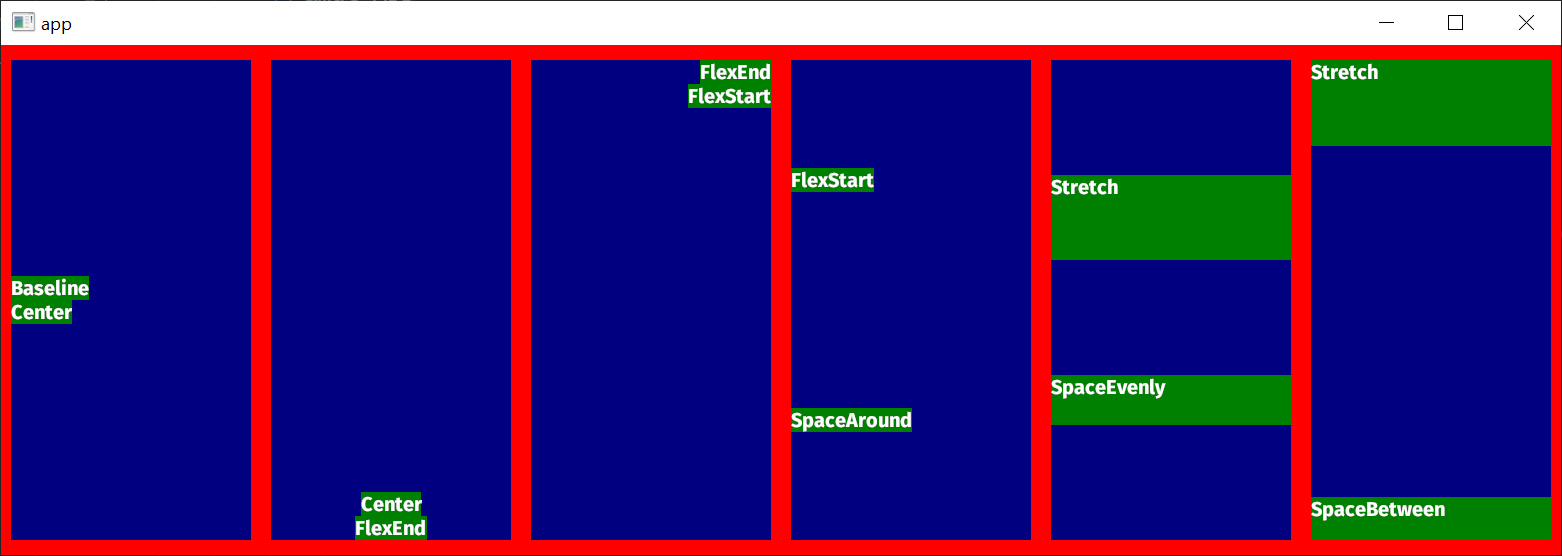
with this PR (accurately matching the behavior of Flexbox):
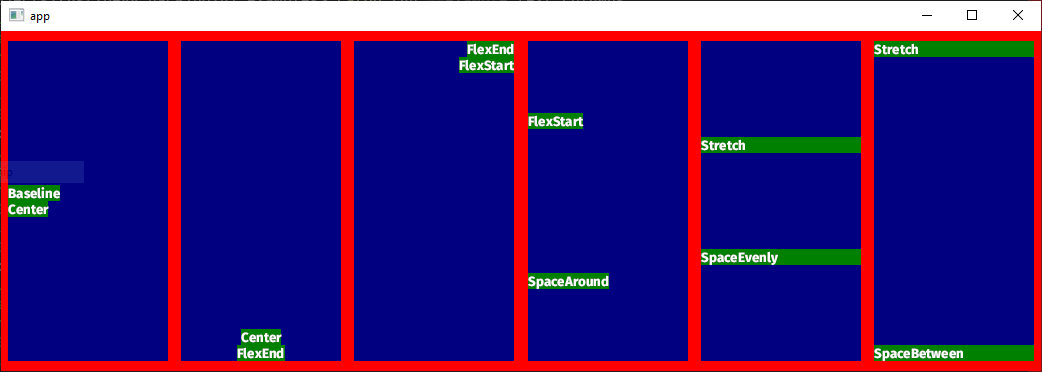
## Solution
Only perform the aspect ratio calculations if the uinode contains an image.
## Changelog
* Added a field `preserve_aspect_ratio` to `CalculatedSize`
* The `MeasureFunc` only preserves the aspect ratio when `preserve_aspect_ratio` is true.
* `update_image_calculated_size_system` sets `preserve_aspect_ratio` to true for nodes with images.
# Objective
Delete `ImageMode`. It doesn't do anything except mislead people into thinking it controls the aspect ratio of images somehow.
Fixes#3933 and #6637
## Solution
Delete `ImageMode`
## Changelog
Removes the `ImageMode` enum.
Removes the `image_mode` field from `ImageBundle`
Removes the `With<ImageMode>` query filter from `image_node_system`
Renames `image_node_system` to` update_image_calculated_size_system`
# Objective
Fixes  #3225, Allow for flippable UI Images

## Solution
Add flip_x and flip_y fields to UiImage, and swap the UV coordinates accordingly in ui_prepare_nodes.

## Changelog
* Changes UiImage to a struct with texture, flip_x, and flip_y fields.
* Adds flip_x and flip_y fields to ExtractedUiNode.
* Changes extract_uinodes to extract the flip_x and flip_y values from UiImage.
* Changes prepare_uinodes to swap the UV coordinates as required.
* Changes UiImage derefs to texture field accesses.
# Objective

Bevy's internal plugins have lots of execution-order ambiguities, which makes the ambiguity detection tool very noisy for our users.

## Solution

Silence every last ambiguity that can currently be resolved.
Each time an ambiguity is silenced, it is accompanied by a comment describing why it is correct. This description should be based on the public API of the respective systems. Thus, I have added documentation to some systems describing how they use some resources.

# Future work

Some ambiguities remain, due to issues out of scope for this PR.

* The ambiguity checker does not respect `Without<>` filters, leading to false positives.
* Ambiguities between `bevy_ui` and `bevy_animation` cannot be resolved, since neither crate knows that the other exists. We will need a general solution to this problem.
> In draft until #4761 is merged. See the relevant commits [here](a85fe94a18).

---

# Objective

Update enums across Bevy to use the new enum reflection and get rid of `#[reflect_value(...)]` usages.

## Solution

Find and replace all[^1] instances of `#[reflect_value(...)]` on enum types.

---

## Changelog

- Updated all[^1] reflected enums to implement `Enum` (i.e. they are no longer `ReflectRef::Value`)

## Migration Guide
Bevy-defined enums have been updated to implement `Enum` and are not considered value types (`ReflectRef::Value`) anymore. This means that their serialized representations will need to be updated. For example, given the Bevy enum:

```rust
pub enum ScalingMode {
  None,
  WindowSize,
  Auto { min_width: f32, min_height: f32 },
  FixedVertical(f32),
  FixedHorizontal(f32),
}
```

You will need to update the serialized versions accordingly.

```js
// OLD FORMAT
{
  "type": "bevy_render:📷:projection::ScalingMode",
  "value": FixedHorizontal(720),
},

// NEW FORMAT
{
  "type": "bevy_render:📷:projection::ScalingMode",
  "enum": {
    "variant": "FixedHorizontal",
    "tuple": [
      {
        "type": "f32",
        "value": 720,
      },
    ],
  },
},
```

This may also have other smaller implications (such as `Debug` representation), but serialization is probably the most prominent.

[^1]: All enums except `HandleId` as neither `Uuid` nor `AssetPathId` implement the reflection traits
# Objective

- Migrate changes from #3503.

## Solution

- Change `Size<T>` and `UiRect<T>` to `Size` and `UiRect` using `Val`.
- Implement `Sub`, `SubAssign`, `Mul`, `MulAssign`, `Div` and `DivAssign` for `Val`.
- Update tests for `Size`.

---

## Changelog

### Changed

- The generic `T` of `Size` and `UiRect` got removed and instead they both now always use `Val`.

## Migration Guide

- The generic `T` of `Size` and `UiRect` got removed and instead they both now always use `Val`. If you used a `Size<f32>` consider replacing it with a `Vec2` which is way more powerful.


Co-authored-by: KDecay <KDecayMusic@protonmail.com>
Remove unnecessary calls to `iter()`/`iter_mut()`.
Mainly updates the use of queries in our code, docs, and examples.

```rust
// From
for _ in list.iter() {
for _ in list.iter_mut() {

// To
for _ in &list {
for _ in &mut list {
```

We already enable the pedantic lint [clippy::explicit_iter_loop](https://rust-lang.github.io/rust-clippy/stable/) inside of Bevy. However, this only warns for a few known types from the standard library.

## Note for reviewers
As you can see the additions and deletions are exactly equal.
Maybe give it a quick skim to check I didn't sneak in a crypto miner, but you don't have to torture yourself by reading every line.
I already experienced enough pain making this PR :)


Co-authored-by: devil-ira <justthecooldude@gmail.com>
# Objective
Fixes#5153
## Solution
Search for all enums and manually check if they have default impls that can use this new derive.
By my reckoning:
| enum | num |
|-|-|
| total | 159 |
| has default impl | 29 |
| default is unit variant | 23 |
builds on top of #4780

# Objective

`Reflect` and `Serialize` are currently very tied together because `Reflect` has a `fn serialize(&self) -> Option<Serializable<'_>>` method. Because of that, we can either implement `Reflect` for types like `Option<T>` with `T: Serialize` and have `fn serialize` be implemented, or without the bound but having `fn serialize` return `None`.

By separating `ReflectSerialize` into a separate type (like how it already is for `ReflectDeserialize`, `ReflectDefault`), we could separately `.register::<Option<T>>()` and `.register_data::<Option<T>, ReflectSerialize>()` only if the type `T: Serialize`.

This PR does not change the registration but allows it to be changed in a future PR.

## Solution

- add the type
```rust
struct ReflectSerialize { .. }
impl<T: Reflect + Serialize> FromType<T> for ReflectSerialize { .. }
```

- remove `#[reflect(Serialize)]` special casing.

- when serializing reflect value types, look for `ReflectSerialize` in the `TypeRegistry` instead of calling `value.serialize()`
# Objective

- Sometimes, people might load an asset as one type, then use it with an `Asset`s for a different type.
- See e.g. #4784.
- This is especially likely with the Gltf types, since users may not have a clear conceptual model of what types the assets will be.
- We had an instance of this ourselves, in the `scene_viewer` example

## Solution

- Make `Assets::get` require a type safe handle.

---

## Changelog

### Changed

- `Assets::<T>::get` and `Assets::<T>::get_mut` now require that the passed handles are `Handle<T>`, improving the type safety of handles.

### Added
- `HandleUntyped::typed_weak`, a helper function for creating a weak typed version of an exisitng `HandleUntyped`.

## Migration Guide

`Assets::<T>::get` and `Assets::<T>::get_mut` now require that the passed handles are `Handle<T>`, improving the type safety of handles. If you were previously passing in:
   - a `HandleId`, use `&Handle::weak(id)` instead, to create a weak handle. You may have been able to store a type safe `Handle` instead.
   - a `HandleUntyped`, use `&handle_untyped.typed_weak()` to create a weak handle of the specified type. This is most likely to be the useful when using [load_folder](https://docs.rs/bevy_asset/latest/bevy_asset/struct.AssetServer.html#method.load_folder)
   - a `Handle<U>` of  of a different type, consider whether this is the correct handle type to store. If it is (i.e. the same handle id is used for multiple different Asset types) use `Handle::weak(handle.id)` to cast to a different type.
# Objective

- Related #4276.
- Part of the splitting process of #3503.

## Solution

- Move `Size` to `bevy_ui`.

## Reasons

- `Size` is only needed in `bevy_ui` (because it needs to use `Val` instead of `f32`), but it's also used as a worse `Vec2`  replacement in other areas.
- `Vec2` is more powerful than `Size` so it should be used whenever possible.
- Discussion in #3503.

## Changelog

### Changed

- The `Size` type got moved from `bevy_math` to `bevy_ui`.

## Migration Guide

- The `Size` type got moved from `bevy::math` to `bevy::ui`. To migrate you just have to import `bevy::ui::Size` instead of `bevy::math::Math` or use the `bevy::prelude` instead.

Co-authored-by: KDecay <KDecayMusic@protonmail.com>
# Objective

Updated the docs for bevy_ui as requested by #3492

## Solution

I have documented the parts I understand. anchors.rs is not in use and should be removed, thus I haven't documented that, and some of the more renderer-heavy code is beyond me and needs input from either cart or someone familiar with bevy rendering

Co-authored-by: Troels Jessen <kairyuka@gmail.com>
This makes the [New Bevy Renderer](#2535) the default (and only) renderer. The new renderer isn't _quite_ ready for the final release yet, but I want as many people as possible to start testing it so we can identify bugs and address feedback prior to release.

The examples are all ported over and operational with a few exceptions:

* I removed a good portion of the examples in the `shader` folder. We still have some work to do in order to make these examples possible / ergonomic / worthwhile: #3120 and "high level shader material plugins" are the big ones. This is a temporary measure.
* Temporarily removed the multiple_windows example: doing this properly in the new renderer will require the upcoming "render targets" changes. Same goes for the render_to_texture example.
* Removed z_sort_debug: entity visibility sort info is no longer available in app logic. we could do this on the "render app" side, but i dont consider it a priority.
This implements the most minimal variant of #1843 - a derive for marker trait. This is a prerequisite to more complicated features like statically defined storage type or opt-out component reflection.

In order to make component struct's purpose explicit and avoid misuse, it must be annotated with `#[derive(Component)]` (manual impl is discouraged for compatibility). Right now this is just a marker trait, but in the future it might be expanded. Making this change early allows us to make further changes later without breaking backward compatibility for derive macro users.

This already prevents a lot of issues, like using bundles in `insert` calls. Primitive types are no longer valid components as well. This can be easily worked around by adding newtype wrappers and deriving `Component` for them.

One funny example of prevented bad code (from our own tests) is when an newtype struct or enum variant is used. Previously, it was possible to write `insert(Newtype)` instead of `insert(Newtype(value))`. That code compiled, because function pointers (in this case newtype struct constructor) implement `Send + Sync + 'static`, so we allowed them to be used as components. This is no longer the case and such invalid code will trigger a compile error.


Co-authored-by: = <=>
Co-authored-by: TheRawMeatball <therawmeatball@gmail.com>
Co-authored-by: Carter Anderson <mcanders1@gmail.com>