ec5c0a5089
61 Commits
| Author | SHA1 | Message | Date | |
|---|---|---|---|---|
 Talin
Talin
|
65bddbd3e4
|
Bevy Feathers: an opinionated widget toolkit for building Bevy tooling (#19730)
# Objective This PR introduces Bevy Feathers, an opinionated widget toolkit and theming system intended for use by the Bevy Editor, World Inspector, and other tools. The `bevy_feathers` crate is incomplete and hidden behind an experimental feature flag. The API is going to change significantly before release. --------- Co-authored-by: Alice Cecile <alice.i.cecile@gmail.com> |
||
|
Erick Z
|
b6e4d171b5
|
Adding PartialEq to some UI and Text types (#19552)
# Objective - During the development of [`bevy_flair`](https://github.com/eckz/bevy_flair) I found [some types lacking `PartialEq`](https://github.com/search?q=repo%3Aeckz%2Fbevy_flair%20%20%22Try%20to%20upstream%20it%20to%20bevy%22&type=code) which made the unit testing a little bit inconvinient. ## Solution - Adding `PartialEq` for the following types: - `LineHeight ` - `TextShadow` - `NodeImageMode` ## Testing - Letting github actions do the testing, this is not an invasive change and `cargo run --bin ci` doesn't seem to work in `main` at the moment. |
||
|
ickshonpe
|
02fa833be1
|
Rename JustifyText to Justify (#19522)
# Objective Rename `JustifyText`: * The name `JustifyText` is just ugly. * It's inconsistent since no other `bevy_text` types have a `Text-` suffix, only prefix. * It's inconsistent with the other text layout enum `Linebreak` which doesn't have a prefix or suffix. Fixes #19521. ## Solution Rename `JustifyText` to `Justify`. Without other context, it's natural to assume the name `Justify` refers to text justification. --------- Co-authored-by: Alice Cecile <alice.i.cecile@gmail.com> |
||
|
Alice Cecile
|
e1230fdc54
|
Remove re-exports of cosmic_text types (#19516)
# Objective As discussed in #19285, we do a poor job at keeping the namespace tidy and free of duplicates / user-conflicting names in places. `cosmic_text` re-exports were the worst offender. ## Solution Remove the re-exports completely. While the type aliases were quite thoughtful, they weren't used in any of our code / API. |
||
|
ickshonpe
|
5e2ecf4178
|
Text background colors (#18892)
# Objective Add background colors for text. Fixes #18889 ## Solution New component `TextBackgroundColor`, add it to any UI `Text` or `TextSpan` entity to add a background color to its text. New field on `TextLayoutInfo` `section_rects` holds the list of bounding rects for each text section. The bounding rects are generated in `TextPipeline::queue_text` during text layout, `extract_text_background_colors` extracts the colored background rects for rendering. Didn't include `Text2d` support because of z-order issues. The section rects can also be used to implement interactions targeting individual text sections. ## Testing Includes a basic example that can be used for testing: ``` cargo run --example text_background_colors ``` --- ## Showcase  Using a proportional font with kerning the results aren't so tidy (since the bounds of adjacent glyphs can overlap) but it still works fine:  --------- Co-authored-by: Olle Lukowski <lukowskiolle@gmail.com> Co-authored-by: Gilles Henaux <ghx_github_priv@fastmail.com> |
||
|
Carter Anderson
|
d8fa57bd7b
|
Switch ChildOf back to tuple struct (#18672)
# Objective In #17905 we swapped to a named field on `ChildOf` to help resolve variable naming ambiguity of child vs parent (ex: `child_of.parent` clearly reads as "I am accessing the parent of the child_of relationship", whereas `child_of.0` is less clear). Unfortunately this has the side effect of making initialization less ideal. `ChildOf { parent }` reads just as well as `ChildOf(parent)`, but `ChildOf { parent: root }` doesn't read nearly as well as `ChildOf(root)`. ## Solution Move back to `ChildOf(pub Entity)` but add a `child_of.parent()` function and use it for all accesses. The downside here is that users are no longer "forced" to access the parent field with `parent` nomenclature, but I think this strikes the right balance. Take a look at the diff. I think the results provide strong evidence for this change. Initialization has the benefit of reading much better _and_ of taking up significantly less space, as many lines go from 3 to 1, and we're cutting out a bunch of syntax in some cases. Sadly I do think this should land in 0.16 as the cost of doing this _after_ the relationships migration is high. |
||
|
Gino Valente
|
9b32e09551
|
bevy_reflect: Add clone registrations project-wide (#18307)
# Objective Now that #13432 has been merged, it's important we update our reflected types to properly opt into this feature. If we do not, then this could cause issues for users downstream who want to make use of reflection-based cloning. ## Solution This PR is broken into 4 commits: 1. Add `#[reflect(Clone)]` on all types marked `#[reflect(opaque)]` that are also `Clone`. This is mandatory as these types would otherwise cause the cloning operation to fail for any type that contains it at any depth. 2. Update the reflection example to suggest adding `#[reflect(Clone)]` on opaque types. 3. Add `#[reflect(clone)]` attributes on all fields marked `#[reflect(ignore)]` that are also `Clone`. This prevents the ignored field from causing the cloning operation to fail. Note that some of the types that contain these fields are also `Clone`, and thus can be marked `#[reflect(Clone)]`. This makes the `#[reflect(clone)]` attribute redundant. However, I think it's safer to keep it marked in the case that the `Clone` impl/derive is ever removed. I'm open to removing them, though, if people disagree. 4. Finally, I added `#[reflect(Clone)]` on all types that are also `Clone`. While not strictly necessary, it enables us to reduce the generated output since we can just call `Clone::clone` directly instead of calling `PartialReflect::reflect_clone` on each variant/field. It also means we benefit from any optimizations or customizations made in the `Clone` impl, including directly dereferencing `Copy` values and increasing reference counters. Along with that change I also took the liberty of adding any missing registrations that I saw could be applied to the type as well, such as `Default`, `PartialEq`, and `Hash`. There were hundreds of these to edit, though, so it's possible I missed quite a few. That last commit is **_massive_**. There were nearly 700 types to update. So it's recommended to review the first three before moving onto that last one. Additionally, I can break the last commit off into its own PR or into smaller PRs, but I figured this would be the easiest way of doing it (and in a timely manner since I unfortunately don't have as much time as I used to for code contributions). ## Testing You can test locally with a `cargo check`: ``` cargo check --workspace --all-features ``` |
||
|
Carter Anderson
|
b73811d40e
|
Remove ChildOf::get and Deref impl (#18080)
# Objective There are currently three ways to access the parent stored on a ChildOf relationship: 1. `child_of.parent` (field accessor) 2. `child_of.get()` (get function) 3. `**child_of` (Deref impl) I will assert that we should only have one (the field accessor), and that the existence of the other implementations causes confusion and legibility issues. The deref approach is heinous, and `child_of.get()` is significantly less clear than `child_of.parent`. ## Solution Remove `impl Deref for ChildOf` and `ChildOf::get`. The one "downside" I'm seeing is that: ```rust entity.get::<ChildOf>().map(ChildOf::get) ``` Becomes this: ```rust entity.get::<ChildOf>().map(|c| c.parent) ``` I strongly believe that this is worth the increased clarity and consistency. I'm also not really a huge fan of the "pass function pointer to map" syntax. I think most people don't think this way about maps. They think in terms of a function that takes the item in the Option and returns the result of some action on it. ## Migration Guide ```rust // Before **child_of // After child_of.parent // Before child_of.get() // After child_of.parent // Before entity.get::<ChildOf>().map(ChildOf::get) // After entity.get::<ChildOf>().map(|c| c.parent) ``` |
||
|
Tim Overbeek
|
ccb7069e7f
|
Change ChildOf to Childof { parent: Entity} and support deriving Relationship and RelationshipTarget with named structs (#17905)
# Objective fixes #17896 ## Solution Change ChildOf ( Entity ) to ChildOf { parent: Entity } by doing this we also allow users to use named structs for relationship derives, When you have more than 1 field in a struct with named fields the macro will look for a field with the attribute #[relationship] and all of the other fields should implement the Default trait. Unnamed fields are still supported. When u have a unnamed struct with more than one field the macro will fail. Do we want to support something like this ? ```rust #[derive(Component)] #[relationship_target(relationship = ChildOf)] pub struct Children (#[relationship] Entity, u8); ``` I could add this, it but doesn't seem nice. ## Testing crates/bevy_ecs - cargo test ## Showcase ```rust use bevy_ecs::component::Component; use bevy_ecs::entity::Entity; #[derive(Component)] #[relationship(relationship_target = Children)] pub struct ChildOf { #[relationship] pub parent: Entity, internal: u8, }; #[derive(Component)] #[relationship_target(relationship = ChildOf)] pub struct Children { children: Vec<Entity> }; ``` --------- Co-authored-by: Tim Overbeek <oorbecktim@Tims-MacBook-Pro.local> Co-authored-by: Tim Overbeek <oorbecktim@c-001-001-042.client.nl.eduvpn.org> Co-authored-by: Tim Overbeek <oorbecktim@c-001-001-059.client.nl.eduvpn.org> Co-authored-by: Tim Overbeek <oorbecktim@c-001-001-054.client.nl.eduvpn.org> Co-authored-by: Tim Overbeek <oorbecktim@c-001-001-027.client.nl.eduvpn.org> |
||
|
fschlee
|
db0356517e
|
CosmicBuffer is a public type but not not used or accessible in any public API (#17748)
# Objective Currently [CosmicBuffer](https://docs.rs/bevy/latest/bevy/text/struct.CosmicBuffer.html) is a public type with a public field that is not used or accessible in any public API. Since it is prominently shown in the docs it is the obvious place to start when trying to access `cosmic_string` features such as for mapping between screen coordinates and positions in the displayed text. The only place `CosmicBuffer` is currently used is as a field of `ComputedTextBlock`, where a comment explains why the field is private: /// Buffer for managing text layout and creating [`TextLayoutInfo`]. /// /// This is private because buffer contents are always refreshed from ECS state when writing glyphs to /// `TextLayoutInfo`. If you want to control the buffer contents manually or use the `cosmic-text` /// editor, then you need to not use `TextLayout` and instead manually implement the conversion to /// `TextLayoutInfo`. #[reflect(ignore)] pub(crate) buffer: CosmicBuffer, Unfortunately this comment does not appear in the docs, so a user looking for a way to access `CosmicBuffer` will not find it unless they check the source code. Also there does not seem to be any alternative way to map between screen coordinates and positions in the displayed text, which would be highly useful for things like text edit widgets or tool tips. The reasons given for making the field private only apply for mutable access, so non-mutable access would presumably be fine. ## Solution I added a getter to `ComputedTextBlock`, and added the explanation for why there is no mutable access in the comment: /// Accesses the underling buffer which can be used for `cosmic-text` APIs such as accessing layout information /// or calculating a cursor position. /// /// Mutable access not offered because changes would be overwritten during the automated layout calculation. /// If you want to control the buffer contents manually or use the `cosmic-text` /// editor, then you need to not use `TextLayout` and instead manually implement the conversion to /// `TextLayoutInfo`. pub fn get_buffer(&self) -> &CosmicBuffer { &self.buffer } ## Testing I tested that the getter could be used to map from screen coordinates to string positions by creating a rudimentary text edit widget and trying it out. ## Alternatives An alternative to making `CosmicBuffer` accessible would be to make the type private so that no one wastes time looking for a way of accessing it, and adding additional methods to `ComputedTextBlock` that make use of the buffer as implementation detail and offer access to currently inaccessible functionality. --------- Co-authored-by: Rob Parrett <robparrett@gmail.com> |
||
|
Rob Parrett
|
adcc80c43d
|
Improve TextSpan docs (#17415)
# Objective Our [`TextSpan`](https://docs.rs/bevy/latest/bevy/prelude/struct.TextSpan.html) docs include a code example that does not actually "work." The code silently does not render anything, and the `Text*Writer` helpers fail. This seems to be by design, because we can't use `Text` or `Text2d` from `bevy_ui` or `bevy_sprite` within docs in `bevy_text`. (Correct me if I am wrong) I have seen multiple users confused by these docs. Also fixes #16794 ## Solution Remove the code example from `TextSpan`, and instead encourage users to seek docs on `Text` or `Text2d`. Add examples with nested `TextSpan`s in those areas. |
||
|
Jean Mertz
|
6bda03cc08
|
chore: impl PartialEq for bevy_ui::Text and bevy_text::TextColor (#17606)
Adding these allows using `DetectChangesMut::set_if_neq` to only update the values when needed. Currently you need to get the inner values first (`String` and `Color`), to do any equality checks. --------- Signed-off-by: Jean Mertz <git@jeanmertz.com> |
||
|
Carter Anderson
|
ba5e71f53d
|
Parent -> ChildOf (#17427)
Fixes #17412 ## Objective `Parent` uses the "has a X" naming convention. There is increasing sentiment that we should use the "is a X" naming convention for relationships (following #17398). This leaves `Children` as-is because there is prevailing sentiment that `Children` is clearer than `ParentOf` in many cases (especially when treating it like a collection). This renames `Parent` to `ChildOf`. This is just the implementation PR. To discuss the path forward, do so in #17412. ## Migration Guide - The `Parent` component has been renamed to `ChildOf`. |
||
|
Carter Anderson
|
21f1e3045c
|
Relationships (non-fragmenting, one-to-many) (#17398)
This adds support for one-to-many non-fragmenting relationships (with planned paths for fragmenting and non-fragmenting many-to-many relationships). "Non-fragmenting" means that entities with the same relationship type, but different relationship targets, are not forced into separate tables (which would cause "table fragmentation"). Functionally, this fills a similar niche as the current Parent/Children system. The biggest differences are: 1. Relationships have simpler internals and significantly improved performance and UX. Commands and specialized APIs are no longer necessary to keep everything in sync. Just spawn entities with the relationship components you want and everything "just works". 2. Relationships are generalized. Bevy can provide additional built in relationships, and users can define their own. **REQUEST TO REVIEWERS**: _please don't leave top level comments and instead comment on specific lines of code. That way we can take advantage of threaded discussions. Also dont leave comments simply pointing out CI failures as I can read those just fine._ ## Built on top of what we have Relationships are implemented on top of the Bevy ECS features we already have: components, immutability, and hooks. This makes them immediately compatible with all of our existing (and future) APIs for querying, spawning, removing, scenes, reflection, etc. The fewer specialized APIs we need to build, maintain, and teach, the better. ## Why focus on one-to-many non-fragmenting first? 1. This allows us to improve Parent/Children relationships immediately, in a way that is reasonably uncontroversial. Switching our hierarchy to fragmenting relationships would have significant performance implications. ~~Flecs is heavily considering a switch to non-fragmenting relations after careful considerations of the performance tradeoffs.~~ _(Correction from @SanderMertens: Flecs is implementing non-fragmenting storage specialized for asset hierarchies, where asset hierarchies are many instances of small trees that have a well defined structure)_ 2. Adding generalized one-to-many relationships is currently a priority for the [Next Generation Scene / UI effort](https://github.com/bevyengine/bevy/discussions/14437). Specifically, we're interested in building reactions and observers on top. ## The changes This PR does the following: 1. Adds a generic one-to-many Relationship system 3. Ports the existing Parent/Children system to Relationships, which now lives in `bevy_ecs::hierarchy`. The old `bevy_hierarchy` crate has been removed. 4. Adds on_despawn component hooks 5. Relationships can opt-in to "despawn descendants" behavior, meaning that the entire relationship hierarchy is despawned when `entity.despawn()` is called. The built in Parent/Children hierarchies enable this behavior, and `entity.despawn_recursive()` has been removed. 6. `world.spawn` now applies commands after spawning. This ensures that relationship bookkeeping happens immediately and removes the need to manually flush. This is in line with the equivalent behaviors recently added to the other APIs (ex: insert). 7. Removes the ValidParentCheckPlugin (system-driven / poll based) in favor of a `validate_parent_has_component` hook. ## Using Relationships The `Relationship` trait looks like this: ```rust pub trait Relationship: Component + Sized { type RelationshipSources: RelationshipSources<Relationship = Self>; fn get(&self) -> Entity; fn from(entity: Entity) -> Self; } ``` A relationship is a component that: 1. Is a simple wrapper over a "target" Entity. 2. Has a corresponding `RelationshipSources` component, which is a simple wrapper over a collection of entities. Every "target entity" targeted by a "source entity" with a `Relationship` has a `RelationshipSources` component, which contains every "source entity" that targets it. For example, the `Parent` component (as it currently exists in Bevy) is the `Relationship` component and the entity containing the Parent is the "source entity". The entity _inside_ the `Parent(Entity)` component is the "target entity". And that target entity has a `Children` component (which implements `RelationshipSources`). In practice, the Parent/Children relationship looks like this: ```rust #[derive(Relationship)] #[relationship(relationship_sources = Children)] pub struct Parent(pub Entity); #[derive(RelationshipSources)] #[relationship_sources(relationship = Parent)] pub struct Children(Vec<Entity>); ``` The Relationship and RelationshipSources derives automatically implement Component with the relevant configuration (namely, the hooks necessary to keep everything in sync). The most direct way to add relationships is to spawn entities with relationship components: ```rust let a = world.spawn_empty().id(); let b = world.spawn(Parent(a)).id(); assert_eq!(world.entity(a).get::<Children>().unwrap(), &[b]); ``` There are also convenience APIs for spawning more than one entity with the same relationship: ```rust world.spawn_empty().with_related::<Children>(|s| { s.spawn_empty(); s.spawn_empty(); }) ``` The existing `with_children` API is now a simpler wrapper over `with_related`. This makes this change largely non-breaking for existing spawn patterns. ```rust world.spawn_empty().with_children(|s| { s.spawn_empty(); s.spawn_empty(); }) ``` There are also other relationship APIs, such as `add_related` and `despawn_related`. ## Automatic recursive despawn via the new on_despawn hook `RelationshipSources` can opt-in to "despawn descendants" behavior, which will despawn all related entities in the relationship hierarchy: ```rust #[derive(RelationshipSources)] #[relationship_sources(relationship = Parent, despawn_descendants)] pub struct Children(Vec<Entity>); ``` This means that `entity.despawn_recursive()` is no longer required. Instead, just use `entity.despawn()` and the relevant related entities will also be despawned. To despawn an entity _without_ despawning its parent/child descendants, you should remove the `Children` component first, which will also remove the related `Parent` components: ```rust entity .remove::<Children>() .despawn() ``` This builds on the on_despawn hook introduced in this PR, which is fired when an entity is despawned (before other hooks). ## Relationships are the source of truth `Relationship` is the _single_ source of truth component. `RelationshipSources` is merely a reflection of what all the `Relationship` components say. By embracing this, we are able to significantly improve the performance of the system as a whole. We can rely on component lifecycles to protect us against duplicates, rather than needing to scan at runtime to ensure entities don't already exist (which results in quadratic runtime). A single source of truth gives us constant-time inserts. This does mean that we cannot directly spawn populated `Children` components (or directly add or remove entities from those components). I personally think this is a worthwhile tradeoff, both because it makes the performance much better _and_ because it means theres exactly one way to do things (which is a philosophy we try to employ for Bevy APIs). As an aside: treating both sides of the relationship as "equivalent source of truth relations" does enable building simple and flexible many-to-many relationships. But this introduces an _inherent_ need to scan (or hash) to protect against duplicates. [`evergreen_relations`](https://github.com/EvergreenNest/evergreen_relations) has a very nice implementation of the "symmetrical many-to-many" approach. Unfortunately I think the performance issues inherent to that approach make it a poor choice for Bevy's default relationship system. ## Followup Work * Discuss renaming `Parent` to `ChildOf`. I refrained from doing that in this PR to keep the diff reasonable, but I'm personally biased toward this change (and using that naming pattern generally for relationships). * [Improved spawning ergonomics](https://github.com/bevyengine/bevy/discussions/16920) * Consider adding relationship observers/triggers for "relationship targets" whenever a source is added or removed. This would replace the current "hierarchy events" system, which is unused upstream but may have existing users downstream. I think triggers are the better fit for this than a buffered event queue, and would prefer not to add that back. * Fragmenting relations: My current idea hinges on the introduction of "value components" (aka: components whose type _and_ value determines their ComponentId, via something like Hashing / PartialEq). By labeling a Relationship component such as `ChildOf(Entity)` as a "value component", `ChildOf(e1)` and `ChildOf(e2)` would be considered "different components". This makes the transition between fragmenting and non-fragmenting a single flag, and everything else continues to work as expected. * Many-to-many support * Non-fragmenting: We can expand Relationship to be a list of entities instead of a single entity. I have largely already written the code for this. * Fragmenting: With the "value component" impl mentioned above, we get many-to-many support "for free", as it would allow inserting multiple copies of a Relationship component with different target entities. Fixes #3742 (If this PR is merged, I think we should open more targeted followup issues for the work above, with a fresh tracking issue free of the large amount of less-directed historical context) Fixes #17301 Fixes #12235 Fixes #15299 Fixes #15308 ## Migration Guide * Replace `ChildBuilder` with `ChildSpawnerCommands`. * Replace calls to `.set_parent(parent_id)` with `.insert(Parent(parent_id))`. * Replace calls to `.replace_children()` with `.remove::<Children>()` followed by `.add_children()`. Note that you'll need to manually despawn any children that are not carried over. * Replace calls to `.despawn_recursive()` with `.despawn()`. * Replace calls to `.despawn_descendants()` with `.despawn_related::<Children>()`. * If you have any calls to `.despawn()` which depend on the children being preserved, you'll need to remove the `Children` component first. --------- Co-authored-by: Alice Cecile <alice.i.cecile@gmail.com> |
||
|
Rob Parrett
|
f896ad8457
|
Add builder method for TextFont::line_height (#17203)
# Objective Followup from #16614 `TextFont` has builder methods for its other fields. Add `with_line_height` for consistency. ## Solution Add it |
||
|
Cyborus04
|
4ba09f3dd9
|
add line height to TextFont (#16614)
# Objective - Allow users to customize the line height of text. - Implements #16085 ## Solution - Add a `line_height` field to `TextFont` to feed into `cosmic_text`'s `Metrics`. ## Testing - Tested on my own game, and worked exactly as I wanted. - My game is only 2D, so I only tested `Text2d`. `Text` still needs tested, but I imagine it'll work fine. - An example is available [here](https://code.cartoon-aa.xyz/Cyborus/custom-line-height-example) --- ## Showcase <details> <summary>Click to view showcase</summary> With font: ```rust TextFont { font: /* unimportant */, font_size: 16.0, line_height: None, ..default() } ```  With font: ```rust TextFont { font: /* unimportant */, font_size: 16.0, line_height: Some(16.0), ..default() } ```  </details> ## Migration Guide `TextFont` now has a `line_height` field. Any instantiation of `TextFont` that doesn't have `..default()` will need to add this field. |
||
|
Zachary Harrold
|
a371ee3019
|
Remove tracing re-export from bevy_utils (#17161)
# Objective - Contributes to #11478 ## Solution - Made `bevy_utils::tracing` `doc(hidden)` - Re-exported `tracing` from `bevy_log` for end-users - Added `tracing` directly to crates that need it. ## Testing - CI --- ## Migration Guide If you were importing `tracing` via `bevy::utils::tracing`, instead use `bevy::log::tracing`. Note that many items within `tracing` are also directly re-exported from `bevy::log` as well, so you may only need `bevy::log` for the most common items (e.g., `warn!`, `trace!`, etc.). This also applies to the `log_once!` family of macros. ## Notes - While this doesn't reduce the line-count in `bevy_utils`, it further decouples the internal crates from `bevy_utils`, making its eventual removal more feasible in the future. - I have just imported `tracing` as we do for all dependencies. However, a workspace dependency may be more appropriate for version management. |
||
|
Benjamin Brienen
|
64efd08e13
|
Prefer Display over Debug (#16112)
# Objective Fixes #16104 ## Solution I removed all instances of `:?` and put them back one by one where it caused an error. I removed some bevy_utils helper functions that were only used in 2 places and don't add value. See: #11478 ## Testing CI should catch the mistakes ## Migration Guide `bevy::utils::{dbg,info,warn,error}` were removed. Use `bevy::utils::tracing::{debug,info,warn,error}` instead. --------- Co-authored-by: SpecificProtagonist <vincentjunge@posteo.net> |
||
|
Marco Buono
|
ff57e8082c
|
Drive-by Docs Fixes: bevy_picking, bevy_text (#16946)
Noticed these were either incomplete or inconsistent, so I fixed/augmented them. |
||
|
Martín Maita
|
4dd805a003
|
Adds some helpful methods to TextFont (#16370)
# Objective - Add methods to facilitate `TextFont` component creation and insertion. ## Solution - Added `from_font` and `from_font_size` which return a new `TextFont` with said attributes provided as parameters. - Added `with_font` and `with_font_size` which return an existing `TextFont` modifying said attributes with the values provided as parameters. ## Testing - CI Checks. - Tested methods locally by changing values and running the `text_debug` example. |
||
|
s-puig
|
5cbc2a9018
|
Reflect TextLayout and ComputedTextBlock (#16296)
# Objective - Fix panic when saving/loading scenes with text nodes due to missing Reflect implementations. |
||
|
ickshonpe
|
6f7d0e5725
|
split up TextStyle (#15857)
# Objective

Currently text is recomputed unnecessarily on any changes to its color,
which is extremely expensive.

## Solution
Split up `TextStyle` into two separate components `TextFont` and
`TextColor`.

## Testing

I added this system to `many_buttons`:
```rust
fn set_text_colors_changed(mut colors: Query<&mut TextColor>) {
    for mut text_color in colors.iter_mut() {
        text_color.set_changed();
    }
}
```

reports ~4fps on main, ~50fps with this PR.

## Migration Guide
`TextStyle` has been renamed to `TextFont` and its `color` field has
been moved to a separate component named `TextColor` which newtypes
`Color`.
|
||
|
UkoeHB
|
a6be9b4ccd
|
Rename TextBlock to TextLayout (#15797)
# Objective - Improve clarity when spawning a text block. See [this discussion](https://github.com/bevyengine/bevy/pull/15591/#discussion_r1787083571). ## Solution - Rename `TextBlock` to `TextLayout`. |
||
|
UkoeHB
|
c2c19e5ae4
|
Text rework (#15591)
**Ready for review. Examples migration progress: 100%.** # Objective - Implement https://github.com/bevyengine/bevy/discussions/15014 ## Solution This implements [cart's proposal](https://github.com/bevyengine/bevy/discussions/15014#discussioncomment-10574459) faithfully except for one change. I separated `TextSpan` from `TextSpan2d` because `TextSpan` needs to require the `GhostNode` component, which is a `bevy_ui` component only usable by UI. Extra changes: - Added `EntityCommands::commands_mut` that returns a mutable reference. This is a blocker for extension methods that return something other than `self`. Note that `sickle_ui`'s `UiBuilder::commands` returns a mutable reference for this reason. ## Testing - [x] Text examples all work. --- ## Showcase TODO: showcase-worthy ## Migration Guide TODO: very breaking ### Accessing text spans by index Text sections are now text sections on different entities in a hierarchy, Use the new `TextReader` and `TextWriter` system parameters to access spans by index. Before: ```rust fn refresh_text(mut query: Query<&mut Text, With<TimeText>>, time: Res<Time>) { let text = query.single_mut(); text.sections[1].value = format_time(time.elapsed()); } ``` After: ```rust fn refresh_text( query: Query<Entity, With<TimeText>>, mut writer: UiTextWriter, time: Res<Time> ) { let entity = query.single(); *writer.text(entity, 1) = format_time(time.elapsed()); } ``` ### Iterating text spans Text spans are now entities in a hierarchy, so the new `UiTextReader` and `UiTextWriter` system parameters provide ways to iterate that hierarchy. The `UiTextReader::iter` method will give you a normal iterator over spans, and `UiTextWriter::for_each` lets you visit each of the spans. --------- Co-authored-by: ickshonpe <david.curthoys@googlemail.com> Co-authored-by: Carter Anderson <mcanders1@gmail.com> |
||
|
UkoeHB
|
ead84e0e3d
|
Rename BreakLineOn to LineBreak (#15583)
# Objective - Improve code quality in preparation for https://github.com/bevyengine/bevy/discussions/15014 ## Solution - Rename BreakLineOn to LineBreak. ## Migration Guide `BreakLineOn` was renamed to `LineBreak`, and paramters named `linebreak_behavior` were renamed to `linebreak`. |
||
|
Clar Fon
|
efda7f3f9c
|
Simpler lint fixes: makes ci lints work but disables a lint for now (#15376)
Takes the first two commits from #15375 and adds suggestions from this comment: https://github.com/bevyengine/bevy/pull/15375#issuecomment-2366968300 See #15375 for more reasoning/motivation. ## Rebasing (rerunning) ```rust git switch simpler-lint-fixes git reset --hard main cargo fmt --all -- --unstable-features --config normalize_comments=true,imports_granularity=Crate cargo fmt --all git add --update git commit --message "rustfmt" cargo clippy --workspace --all-targets --all-features --fix cargo fmt --all -- --unstable-features --config normalize_comments=true,imports_granularity=Crate cargo fmt --all git add --update git commit --message "clippy" git cherry-pick e6c0b94f6795222310fb812fa5c4512661fc7887 ``` |
||
|
Marco Buono
|
8e3db957c5
|
Add the ability to control font smoothing (#15368)
# Objective - Fixes #10720 - Adds the ability to control font smoothing of rendered text ## Solution - Introduce the `FontSmoothing` enum, with two possible variants (`FontSmoothing::None` and `FontSmoothing::AntiAliased`): - This is based on `-webkit-font-smoothing`, in line with our practice of adopting CSS-like properties/names for UI; - I could have gone instead for the [`font-smooth` property](https://developer.mozilla.org/en-US/docs/Web/CSS/font-smooth) that's also supported by browsers, but didn't since it's also non-standard, has an uglier name, and doesn't allow controlling the type of antialias applied. - Having an enum instead of e.g. a boolean, leaves the path open for adding `FontSmoothing::SubpixelAntiAliased` in the future, without a breaking change; - Add all the necessary plumbing to get the `FontSmoothing` information to where we rasterize the glyphs and store them in the atlas; - Change the font atlas key to also take into account the smoothing setting, not only font and font size; - Since COSMIC Text [doesn't support controlling font smoothing](https://github.com/pop-os/cosmic-text/issues/279), we roll out our own threshold-based “implementation”: - This has the downside of **looking ugly for “regular” vector fonts** ⚠️, since it doesn't properly take the hinting information into account like a proper implementation on the rasterizer side would. - However, **for fonts that have been specifically authored to be pixel fonts, (a common use case in games!) this is not as big of a problem**, since all lines are vertical/horizontal, and close to the final pixel boundaries (as long as the font is used at a multiple of the size originally intended by the author) - Once COSMIC exposes this functionality, we can switch to using it directly, and get better results; - Use a nearest neighbor sampler for atlases with font smoothing disabled, so that you can scale the text via transform and still get the pixelated look; - Add a convenience method to `Text` for setting the font smoothing; - Add a demonstration of using the `FontSmoothing` property to the `text2d` example. ## Testing - Did you test these changes? If so, how? - Yes. Via the `text2d`example, and also in my game. - Are there any parts that need more testing? - I'd like help from someone for testing this on devices/OSs with fractional scaling (Android/Windows) - How can other people (reviewers) test your changes? Is there anything specific they need to know? - Both via the `text2d` example and also by using it directly on your projects. - If relevant, what platforms did you test these changes on, and are there any important ones you can't test? - macOS --- ## Showcase ```rust commands.spawn(Text2dBundle { text: Text::from_section("Hello, World!", default()) .with_font_smoothing(FontSmoothing::None), ..default() }); ```  <img width="740" alt="image" src="https://github.com/user-attachments/assets/b881b02c-4e43-410b-902f-6985c25140fc"> ## Migration Guide - `Text` now contains a `font_smoothing: FontSmoothing` property, make sure to include it or add `..default()` when using the struct directly; - `FontSizeKey` has been renamed to `FontAtlasKey`, and now also contains the `FontSmoothing` setting; - The following methods now take an extra `font_smoothing: FontSmoothing` argument: - `FontAtlas::new()` - `FontAtlasSet::add_glyph_to_atlas()` - `FontAtlasSet::get_glyph_atlas_info()` - `FontAtlasSet::get_outlined_glyph_texture()` |
||
|
Blazepaws
|
1c2e1fc15a
|
Reflect derived traits on all components and resources: bevy_text (#15229)
Solves https://github.com/bevyengine/bevy/issues/15187 for bevy_text |
||
|
Sludge
|
1edec4d890
|
Remove #[cfg] from the From impls of TextSection (#14439)
# Objective - Not including bevy's default font shouldn't result in code not compiling anymore. - Games may want to load their own default font into the default `Handle<Font>` and not include bevy's default font, but still use these convenience impls (https://github.com/bevyengine/bevy/issues/12192 currently makes this a bit inconvenient, but it does work). ## Solution - Include these impls unconditionally. - Slightly expand the comment on the `font` field to indicate that a custom font can be used to override the default font. - (drive-by: add `#[reflect(Default)]` on `TextSection`, since it was missing a way to construct it via reflection) |
||
|
TotalKrill
|
5986d5d309
|
Cosmic text (#10193)
# Replace ab_glyph with the more capable cosmic-text Fixes #7616. Cosmic-text is a more mature text-rendering library that handles scripts and ligatures better than ab_glyph, it can also handle system fonts which can be implemented in bevy in the future Rebase of https://github.com/bevyengine/bevy/pull/8808 ## Changelog Replaces text renderer ab_glyph with cosmic-text The definition of the font size has changed with the migration to cosmic text. The behavior is now consistent with other platforms (e.g. the web), where the font size in pixels measures the height of the font (the distance between the top of the highest ascender and the bottom of the lowest descender). Font sizes in your app need to be rescaled to approximately 1.2x smaller; for example, if you were using a font size of 60.0, you should now use a font size of 50.0. ## Migration guide - `Text2dBounds` has been replaced with `TextBounds`, and it now accepts `Option`s to the bounds, instead of using `f32::INFINITY` to inidicate lack of bounds - Textsizes should be changed, dividing the current size with 1.2 will result in the same size as before. - `TextSettings` struct is removed - Feature `subpixel_alignment` has been removed since cosmic-text already does this automatically - TextBundles and things rendering texts requires the `CosmicBuffer` Component on them as well ## Suggested followups: - TextPipeline: reconstruct byte indices for keeping track of eventual cursors in text input - TextPipeline: (future work) split text entities into section entities - TextPipeline: (future work) text editing - Support line height as an option. Unitless `1.2` is the default used in browsers (1.2x font size). - Support System Fonts and font families - Example showing of animated text styles. Eg. throbbing hyperlinks --------- Co-authored-by: tigregalis <anak.harimau@gmail.com> Co-authored-by: Nico Burns <nico@nicoburns.com> Co-authored-by: sam edelsten <samedelsten1@gmail.com> Co-authored-by: Dimchikkk <velo.app1@gmail.com> Co-authored-by: Alice Cecile <alice.i.cecile@gmail.com> Co-authored-by: Rob Parrett <robparrett@gmail.com> |
||
|
Jan Hohenheim
|
6273227e09
|
Fix lints introduced in Rust beta 1.80 (#13899)
Resolves #13895 Mostly just involves being more explicit about which parts of the docs belong to a list and which begin a new paragraph. - found a few docs that were malformed because of exactly this, so I fixed that by introducing a paragraph - added indentation to nearly all multiline lists - fixed a few minor typos - added `#[allow(dead_code)]` to types that are needed to test annotations but are never constructed ([here](https://github.com/bevyengine/bevy/pull/13899/files#diff-b02b63604e569c8577c491e7a2030d456886d8f6716eeccd46b11df8aac75dafR1514) and [here](https://github.com/bevyengine/bevy/pull/13899/files#diff-b02b63604e569c8577c491e7a2030d456886d8f6716eeccd46b11df8aac75dafR1523)) - verified that `cargo +beta run -p ci -- lints` passes - verified that `cargo +beta run -p ci -- test` passes |
||
|
Martín Maita
|
f237cf2441
|
Updates default Text font size to 24px (#13603)
# Objective - The default font size is too small to be useful in examples or for debug text. - Fixes #13587 ## Solution - Updated the default font size value in `TextStyle` from 12px to 24px. - Resorted to Text defaults in examples to use the default font size in most of them. ## Testing - WIP --- ## Migration Guide - The default font size has been increased to 24px from 12px. Make sure you set the font to the appropriate values in places you were using `Default` text style. |
||
|
BD103
|
7b8d502083
|
Fix beta lints (#12980)
# Objective - Fixes #12976 ## Solution This one is a doozy. - Run `cargo +beta clippy --workspace --all-targets --all-features` and fix all issues - This includes: - Moving inner attributes to be outer attributes, when the item in question has both inner and outer attributes - Use `ptr::from_ref` in more scenarios - Extend the valid idents list used by `clippy:doc_markdown` with more names - Use `Clone::clone_from` when possible - Remove redundant `ron` import - Add backticks to **so many** identifiers and items - I'm sorry whoever has to review this --- ## Changelog - Added links to more identifiers in documentation. |
||
|
Andrew
|
fc4716f56c
|
feat: derive some common traits on some UI types (#12532)
# Objective - working with UI components in Bevy, I found myself wanting some of these common traits, like `PartialEq` for comparing simple types ## Solution - I added only (hopefully) uncontroversial `derive`s for some common UI types Note that many types, unfortunately, can't have `PartialEq` `derive`d for them, because they contain `f32`s and / or `Vec`s. |
||
|
Alice Cecile
|
599e5e4e76
|
Migrate from LegacyColor to bevy_color::Color (#12163)
# Objective - As part of the migration process we need to a) see the end effect of the migration on user ergonomics b) check for serious perf regressions c) actually migrate the code - To accomplish this, I'm going to attempt to migrate all of the remaining user-facing usages of `LegacyColor` in one PR, being careful to keep a clean commit history. - Fixes #12056. ## Solution I've chosen to use the polymorphic `Color` type as our standard user-facing API. - [x] Migrate `bevy_gizmos`. - [x] Take `impl Into<Color>` in all `bevy_gizmos` APIs - [x] Migrate sprites - [x] Migrate UI - [x] Migrate `ColorMaterial` - [x] Migrate `MaterialMesh2D` - [x] Migrate fog - [x] Migrate lights - [x] Migrate StandardMaterial - [x] Migrate wireframes - [x] Migrate clear color - [x] Migrate text - [x] Migrate gltf loader - [x] Register color types for reflection - [x] Remove `LegacyColor` - [x] Make sure CI passes Incidental improvements to ease migration: - added `Color::srgba_u8`, `Color::srgba_from_array` and friends - added `set_alpha`, `is_fully_transparent` and `is_fully_opaque` to the `Alpha` trait - add and immediately deprecate (lol) `Color::rgb` and friends in favor of more explicit and consistent `Color::srgb` - standardized on white and black for most example text colors - added vector field traits to `LinearRgba`: ~~`Add`, `Sub`, `AddAssign`, `SubAssign`,~~ `Mul<f32>` and `Div<f32>`. Multiplications and divisions do not scale alpha. `Add` and `Sub` have been cut from this PR. - added `LinearRgba` and `Srgba` `RED/GREEN/BLUE` - added `LinearRgba_to_f32_array` and `LinearRgba::to_u32` ## Migration Guide Bevy's color types have changed! Wherever you used a `bevy::render::Color`, a `bevy::color::Color` is used instead. These are quite similar! Both are enums storing a color in a specific color space (or to be more precise, using a specific color model). However, each of the different color models now has its own type. TODO... - `Color::rgba`, `Color::rgb`, `Color::rbga_u8`, `Color::rgb_u8`, `Color::rgb_from_array` are now `Color::srgba`, `Color::srgb`, `Color::srgba_u8`, `Color::srgb_u8` and `Color::srgb_from_array`. - `Color::set_a` and `Color::a` is now `Color::set_alpha` and `Color::alpha`. These are part of the `Alpha` trait in `bevy_color`. - `Color::is_fully_transparent` is now part of the `Alpha` trait in `bevy_color` - `Color::r`, `Color::set_r`, `Color::with_r` and the equivalents for `g`, `b` `h`, `s` and `l` have been removed due to causing silent relatively expensive conversions. Convert your `Color` into the desired color space, perform your operations there, and then convert it back into a polymorphic `Color` enum. - `Color::hex` is now `Srgba::hex`. Call `.into` or construct a `Color::Srgba` variant manually to convert it. - `WireframeMaterial`, `ExtractedUiNode`, `ExtractedDirectionalLight`, `ExtractedPointLight`, `ExtractedSpotLight` and `ExtractedSprite` now store a `LinearRgba`, rather than a polymorphic `Color` - `Color::rgb_linear` and `Color::rgba_linear` are now `Color::linear_rgb` and `Color::linear_rgba` - The various CSS color constants are no longer stored directly on `Color`. Instead, they're defined in the `Srgba` color space, and accessed via `bevy::color::palettes::css`. Call `.into()` on them to convert them into a `Color` for quick debugging use, and consider using the much prettier `tailwind` palette for prototyping. - The `LIME_GREEN` color has been renamed to `LIMEGREEN` to comply with the standard naming. - Vector field arithmetic operations on `Color` (add, subtract, multiply and divide by a f32) have been removed. Instead, convert your colors into `LinearRgba` space, and perform your operations explicitly there. This is particularly relevant when working with emissive or HDR colors, whose color channel values are routinely outside of the ordinary 0 to 1 range. - `Color::as_linear_rgba_f32` has been removed. Call `LinearRgba::to_f32_array` instead, converting if needed. - `Color::as_linear_rgba_u32` has been removed. Call `LinearRgba::to_u32` instead, converting if needed. - Several other color conversion methods to transform LCH or HSL colors into float arrays or `Vec` types have been removed. Please reimplement these externally or open a PR to re-add them if you found them particularly useful. - Various methods on `Color` such as `rgb` or `hsl` to convert the color into a specific color space have been removed. Convert into `LinearRgba`, then to the color space of your choice. - Various implicitly-converting color value methods on `Color` such as `r`, `g`, `b` or `h` have been removed. Please convert it into the color space of your choice, then check these properties. - `Color` no longer implements `AsBindGroup`. Store a `LinearRgba` internally instead to avoid conversion costs. --------- Co-authored-by: Alice Cecile <alice.i.cecil@gmail.com> Co-authored-by: Afonso Lage <lage.afonso@gmail.com> Co-authored-by: Rob Parrett <robparrett@gmail.com> Co-authored-by: Zachary Harrold <zac@harrold.com.au> |
||
|
Alice Cecile
|
de004da8d5
|
Rename bevy_render::Color to LegacyColor (#12069)
# Objective The migration process for `bevy_color` (#12013) will be fairly involved: there will be hundreds of affected files, and a large number of APIs. ## Solution To allow us to proceed granularly, we're going to keep both `bevy_color::Color` (new) and `bevy_render::Color` (old) around until the migration is complete. However, simply doing this directly is confusing! They're both called `Color`, making it very hard to tell when a portion of the code has been ported. As discussed in #12056, by renaming the old `Color` type, we can make it easier to gradually migrate over, one API at a time. ## Migration Guide THIS MIGRATION GUIDE INTENTIONALLY LEFT BLANK. This change should not be shipped to end users: delete this section in the final migration guide! --------- Co-authored-by: Alice Cecile <alice.i.cecil@gmail.com> |
||
|
ickshonpe
|
166686e0f2
|
Rename TextAlignment to JustifyText. (#10854)
# Objective The name `TextAlignment` is really deceptive and almost every new user gets confused about the differences between aligning text with `TextAlignment`, aligning text with `Style` and aligning text with anchor (when using `Text2d`). ## Solution * Rename `TextAlignment` to `JustifyText`. The associated helper methods are also renamed. * Improve the doc comments for text explaining explicitly how the `JustifyText` component affects the arrangement of text. * Add some extra cases to the `text_debug` example that demonstate the differences between alignment using `JustifyText` and alignment using `Style`. <img width="757" alt="text_debug_2" src="https://github.com/bevyengine/bevy/assets/27962798/9d53e647-93f9-4bc7-8a20-0d9f783304d2"> --- ## Changelog * `TextAlignment` has been renamed to `JustifyText` * `TextBundle::with_text_alignment` has been renamed to `TextBundle::with_text_justify` * `Text::with_alignment` has been renamed to `Text::with_justify` * The `text_alignment` field of `TextMeasureInfo` has been renamed to `justification` ## Migration Guide * `TextAlignment` has been renamed to `JustifyText` * `TextBundle::with_text_alignment` has been renamed to `TextBundle::with_text_justify` * `Text::with_alignment` has been renamed to `Text::with_justify` * The `text_alignment` field of `TextMeasureInfo` has been renamed to `justification` |
||
|
Stepan Koltsov
|
a4d98f3377
|
[bevy_text] Document what happens when font is not specified (#10252) | ||
|
ickshonpe
|
625d386940
|
impl From<String> and From<&str> for TextSection (#8856)
# Objective

Implement `From<String>` and `From<&str>` for `TextSection`

Example from something I was working on earlier:
```rust
parent.spawn(TextBundle::from_sections([
    TextSection::new("press ".to_string(), TextStyle::default()),
    TextSection::new("space".to_string(), TextStyle { color: Color::YELLOW, ..default() }),
    TextSection::new(" to advance frames".to_string(), TextStyle::default()),
]));
```

After an `impl From<&str> for TextSection` :

```rust
parent.spawn(TextBundle::from_sections([
    "press ".into(),
    TextSection::new("space".to_string(), TextStyle { color: Color::YELLOW, ..default() }),
    " to advance frames".into(),
]));
```

* Potentially unhelpful without a default font, so behind the
`default_font` feature.

 Co-authored-by: [hate](https://github.com/hate)

---------

Co-authored-by: hate <15314665+hate@users.noreply.github.com>
|
||
|
Carter Anderson
|
5eb292dc10
|
Bevy Asset V2 (#8624)
# Bevy Asset V2 Proposal ## Why Does Bevy Need A New Asset System? Asset pipelines are a central part of the gamedev process. Bevy's current asset system is missing a number of features that make it non-viable for many classes of gamedev. After plenty of discussions and [a long community feedback period](https://github.com/bevyengine/bevy/discussions/3972), we've identified a number missing features: * **Asset Preprocessing**: it should be possible to "preprocess" / "compile" / "crunch" assets at "development time" rather than when the game starts up. This enables offloading expensive work from deployed apps, faster asset loading, less runtime memory usage, etc. * **Per-Asset Loader Settings**: Individual assets cannot define their own loaders that override the defaults. Additionally, they cannot provide per-asset settings to their loaders. This is a huge limitation, as many asset types don't provide all information necessary for Bevy _inside_ the asset. For example, a raw PNG image says nothing about how it should be sampled (ex: linear vs nearest). * **Asset `.meta` files**: assets should have configuration files stored adjacent to the asset in question, which allows the user to configure asset-type-specific settings. These settings should be accessible during the pre-processing phase. Modifying a `.meta` file should trigger a re-processing / re-load of the asset. It should be possible to configure asset loaders from the meta file. * **Processed Asset Hot Reloading**: Changes to processed assets (or their dependencies) should result in re-processing them and re-loading the results in live Bevy Apps. * **Asset Dependency Tracking**: The current bevy_asset has no good way to wait for asset dependencies to load. It punts this as an exercise for consumers of the loader apis, which is unreasonable and error prone. There should be easy, ergonomic ways to wait for assets to load and block some logic on an asset's entire dependency tree loading. * **Runtime Asset Loading**: it should be (optionally) possible to load arbitrary assets dynamically at runtime. This necessitates being able to deploy and run the asset server alongside Bevy Apps on _all platforms_. For example, we should be able to invoke the shader compiler at runtime, stream scenes from sources like the internet, etc. To keep deployed binaries (and startup times) small, the runtime asset server configuration should be configurable with different settings compared to the "pre processor asset server". * **Multiple Backends**: It should be possible to load assets from arbitrary sources (filesystems, the internet, remote asset serves, etc). * **Asset Packing**: It should be possible to deploy assets in compressed "packs", which makes it easier and more efficient to distribute assets with Bevy Apps. * **Asset Handoff**: It should be possible to hold a "live" asset handle, which correlates to runtime data, without actually holding the asset in memory. Ex: it must be possible to hold a reference to a GPU mesh generated from a "mesh asset" without keeping the mesh data in CPU memory * **Per-Platform Processed Assets**: Different platforms and app distributions have different capabilities and requirements. Some platforms need lower asset resolutions or different asset formats to operate within the hardware constraints of the platform. It should be possible to define per-platform asset processing profiles. And it should be possible to deploy only the assets required for a given platform. These features have architectural implications that are significant enough to require a full rewrite. The current Bevy Asset implementation got us this far, but it can take us no farther. This PR defines a brand new asset system that implements most of these features, while laying the foundations for the remaining features to be built. ## Bevy Asset V2 Here is a quick overview of the features introduced in this PR. * **Asset Preprocessing**: Preprocess assets at development time into more efficient (and configurable) representations * **Dependency Aware**: Dependencies required to process an asset are tracked. If an asset's processed dependency changes, it will be reprocessed * **Hot Reprocessing/Reloading**: detect changes to asset source files, reprocess them if they have changed, and then hot-reload them in Bevy Apps. * **Only Process Changes**: Assets are only re-processed when their source file (or meta file) has changed. This uses hashing and timestamps to avoid processing assets that haven't changed. * **Transactional and Reliable**: Uses write-ahead logging (a technique commonly used by databases) to recover from crashes / forced-exits. Whenever possible it avoids full-reprocessing / only uncompleted transactions will be reprocessed. When the processor is running in parallel with a Bevy App, processor asset writes block Bevy App asset reads. Reading metadata + asset bytes is guaranteed to be transactional / correctly paired. * **Portable / Run anywhere / Database-free**: The processor does not rely on an in-memory database (although it uses some database techniques for reliability). This is important because pretty much all in-memory databases have unsupported platforms or build complications. * **Configure Processor Defaults Per File Type**: You can say "use this processor for all files of this type". * **Custom Processors**: The `Processor` trait is flexible and unopinionated. It can be implemented by downstream plugins. * **LoadAndSave Processors**: Most asset processing scenarios can be expressed as "run AssetLoader A, save the results using AssetSaver X, and then load the result using AssetLoader B". For example, load this png image using `PngImageLoader`, which produces an `Image` asset and then save it using `CompressedImageSaver` (which also produces an `Image` asset, but in a compressed format), which takes an `Image` asset as input. This means if you have an `AssetLoader` for an asset, you are already half way there! It also means that you can share AssetSavers across multiple loaders. Because `CompressedImageSaver` accepts Bevy's generic Image asset as input, it means you can also use it with some future `JpegImageLoader`. * **Loader and Saver Settings**: Asset Loaders and Savers can now define their own settings types, which are passed in as input when an asset is loaded / saved. Each asset can define its own settings. * **Asset `.meta` files**: configure asset loaders, their settings, enable/disable processing, and configure processor settings * **Runtime Asset Dependency Tracking** Runtime asset dependencies (ex: if an asset contains a `Handle<Image>`) are tracked by the asset server. An event is emitted when an asset and all of its dependencies have been loaded * **Unprocessed Asset Loading**: Assets do not require preprocessing. They can be loaded directly. A processed asset is just a "normal" asset with some extra metadata. Asset Loaders don't need to know or care about whether or not an asset was processed. * **Async Asset IO**: Asset readers/writers use async non-blocking interfaces. Note that because Rust doesn't yet support async traits, there is a bit of manual Boxing / Future boilerplate. This will hopefully be removed in the near future when Rust gets async traits. * **Pluggable Asset Readers and Writers**: Arbitrary asset source readers/writers are supported, both by the processor and the asset server. * **Better Asset Handles** * **Single Arc Tree**: Asset Handles now use a single arc tree that represents the lifetime of the asset. This makes their implementation simpler, more efficient, and allows us to cheaply attach metadata to handles. Ex: the AssetPath of a handle is now directly accessible on the handle itself! * **Const Typed Handles**: typed handles can be constructed in a const context. No more weird "const untyped converted to typed at runtime" patterns! * **Handles and Ids are Smaller / Faster To Hash / Compare**: Typed `Handle<T>` is now much smaller in memory and `AssetId<T>` is even smaller. * **Weak Handle Usage Reduction**: In general Handles are now considered to be "strong". Bevy features that previously used "weak `Handle<T>`" have been ported to `AssetId<T>`, which makes it statically clear that the features do not hold strong handles (while retaining strong type information). Currently Handle::Weak still exists, but it is very possible that we can remove that entirely. * **Efficient / Dense Asset Ids**: Assets now have efficient dense runtime asset ids, which means we can avoid expensive hash lookups. Assets are stored in Vecs instead of HashMaps. There are now typed and untyped ids, which means we no longer need to store dynamic type information in the ID for typed handles. "AssetPathId" (which was a nightmare from a performance and correctness standpoint) has been entirely removed in favor of dense ids (which are retrieved for a path on load) * **Direct Asset Loading, with Dependency Tracking**: Assets that are defined at runtime can still have their dependencies tracked by the Asset Server (ex: if you create a material at runtime, you can still wait for its textures to load). This is accomplished via the (currently optional) "asset dependency visitor" trait. This system can also be used to define a set of assets to load, then wait for those assets to load. * **Async folder loading**: Folder loading also uses this system and immediately returns a handle to the LoadedFolder asset, which means folder loading no longer blocks on directory traversals. * **Improved Loader Interface**: Loaders now have a specific "top level asset type", which makes returning the top-level asset simpler and statically typed. * **Basic Image Settings and Processing**: Image assets can now be processed into the gpu-friendly Basic Universal format. The ImageLoader now has a setting to define what format the image should be loaded as. Note that this is just a minimal MVP ... plenty of additional work to do here. To demo this, enable the `basis-universal` feature and turn on asset processing. * **Simpler Audio Play / AudioSink API**: Asset handle providers are cloneable, which means the Audio resource can mint its own handles. This means you can now do `let sink_handle = audio.play(music)` instead of `let sink_handle = audio_sinks.get_handle(audio.play(music))`. Note that this might still be replaced by https://github.com/bevyengine/bevy/pull/8424. **Removed Handle Casting From Engine Features**: Ex: FontAtlases no longer use casting between handle types ## Using The New Asset System ### Normal Unprocessed Asset Loading By default the `AssetPlugin` does not use processing. It behaves pretty much the same way as the old system. If you are defining a custom asset, first derive `Asset`: ```rust #[derive(Asset)] struct Thing { value: String, } ``` Initialize the asset: ```rust app.init_asset:<Thing>() ``` Implement a new `AssetLoader` for it: ```rust #[derive(Default)] struct ThingLoader; #[derive(Serialize, Deserialize, Default)] pub struct ThingSettings { some_setting: bool, } impl AssetLoader for ThingLoader { type Asset = Thing; type Settings = ThingSettings; fn load<'a>( &'a self, reader: &'a mut Reader, settings: &'a ThingSettings, load_context: &'a mut LoadContext, ) -> BoxedFuture<'a, Result<Thing, anyhow::Error>> { Box::pin(async move { let mut bytes = Vec::new(); reader.read_to_end(&mut bytes).await?; // convert bytes to value somehow Ok(Thing { value }) }) } fn extensions(&self) -> &[&str] { &["thing"] } } ``` Note that this interface will get much cleaner once Rust gets support for async traits. `Reader` is an async futures_io::AsyncRead. You can stream bytes as they come in or read them all into a `Vec<u8>`, depending on the context. You can use `let handle = load_context.load(path)` to kick off a dependency load, retrieve a handle, and register the dependency for the asset. Then just register the loader in your Bevy app: ```rust app.init_asset_loader::<ThingLoader>() ``` Now just add your `Thing` asset files into the `assets` folder and load them like this: ```rust fn system(asset_server: Res<AssetServer>) { let handle = Handle<Thing> = asset_server.load("cool.thing"); } ``` You can check load states directly via the asset server: ```rust if asset_server.load_state(&handle) == LoadState::Loaded { } ``` You can also listen for events: ```rust fn system(mut events: EventReader<AssetEvent<Thing>>, handle: Res<SomeThingHandle>) { for event in events.iter() { if event.is_loaded_with_dependencies(&handle) { } } } ``` Note the new `AssetEvent::LoadedWithDependencies`, which only fires when the asset is loaded _and_ all dependencies (and their dependencies) have loaded. Unlike the old asset system, for a given asset path all `Handle<T>` values point to the same underlying Arc. This means Handles can cheaply hold more asset information, such as the AssetPath: ```rust // prints the AssetPath of the handle info!("{:?}", handle.path()) ``` ### Processed Assets Asset processing can be enabled via the `AssetPlugin`. When developing Bevy Apps with processed assets, do this: ```rust app.add_plugins(DefaultPlugins.set(AssetPlugin::processed_dev())) ``` This runs the `AssetProcessor` in the background with hot-reloading. It reads assets from the `assets` folder, processes them, and writes them to the `.imported_assets` folder. Asset loads in the Bevy App will wait for a processed version of the asset to become available. If an asset in the `assets` folder changes, it will be reprocessed and hot-reloaded in the Bevy App. When deploying processed Bevy apps, do this: ```rust app.add_plugins(DefaultPlugins.set(AssetPlugin::processed())) ``` This does not run the `AssetProcessor` in the background. It behaves like `AssetPlugin::unprocessed()`, but reads assets from `.imported_assets`. When the `AssetProcessor` is running, it will populate sibling `.meta` files for assets in the `assets` folder. Meta files for assets that do not have a processor configured look like this: ```rust ( meta_format_version: "1.0", asset: Load( loader: "bevy_render::texture::image_loader::ImageLoader", settings: ( format: FromExtension, ), ), ) ``` This is metadata for an image asset. For example, if you have `assets/my_sprite.png`, this could be the metadata stored at `assets/my_sprite.png.meta`. Meta files are totally optional. If no metadata exists, the default settings will be used. In short, this file says "load this asset with the ImageLoader and use the file extension to determine the image type". This type of meta file is supported in all AssetPlugin modes. If in `Unprocessed` mode, the asset (with the meta settings) will be loaded directly. If in `ProcessedDev` mode, the asset file will be copied directly to the `.imported_assets` folder. The meta will also be copied directly to the `.imported_assets` folder, but with one addition: ```rust ( meta_format_version: "1.0", processed_info: Some(( hash: 12415480888597742505, full_hash: 14344495437905856884, process_dependencies: [], )), asset: Load( loader: "bevy_render::texture::image_loader::ImageLoader", settings: ( format: FromExtension, ), ), ) ``` `processed_info` contains `hash` (a direct hash of the asset and meta bytes), `full_hash` (a hash of `hash` and the hashes of all `process_dependencies`), and `process_dependencies` (the `path` and `full_hash` of every process_dependency). A "process dependency" is an asset dependency that is _directly_ used when processing the asset. Images do not have process dependencies, so this is empty. When the processor is enabled, you can use the `Process` metadata config: ```rust ( meta_format_version: "1.0", asset: Process( processor: "bevy_asset::processor::process::LoadAndSave<bevy_render::texture::image_loader::ImageLoader, bevy_render::texture::compressed_image_saver::CompressedImageSaver>", settings: ( loader_settings: ( format: FromExtension, ), saver_settings: ( generate_mipmaps: true, ), ), ), ) ``` This configures the asset to use the `LoadAndSave` processor, which runs an AssetLoader and feeds the result into an AssetSaver (which saves the given Asset and defines a loader to load it with). (for terseness LoadAndSave will likely get a shorter/friendlier type name when [Stable Type Paths](#7184) lands). `LoadAndSave` is likely to be the most common processor type, but arbitrary processors are supported. `CompressedImageSaver` saves an `Image` in the Basis Universal format and configures the ImageLoader to load it as basis universal. The `AssetProcessor` will read this meta, run it through the LoadAndSave processor, and write the basis-universal version of the image to `.imported_assets`. The final metadata will look like this: ```rust ( meta_format_version: "1.0", processed_info: Some(( hash: 905599590923828066, full_hash: 9948823010183819117, process_dependencies: [], )), asset: Load( loader: "bevy_render::texture::image_loader::ImageLoader", settings: ( format: Format(Basis), ), ), ) ``` To try basis-universal processing out in Bevy examples, (for example `sprite.rs`), change `add_plugins(DefaultPlugins)` to `add_plugins(DefaultPlugins.set(AssetPlugin::processed_dev()))` and run with the `basis-universal` feature enabled: `cargo run --features=basis-universal --example sprite`. To create a custom processor, there are two main paths: 1. Use the `LoadAndSave` processor with an existing `AssetLoader`. Implement the `AssetSaver` trait, register the processor using `asset_processor.register_processor::<LoadAndSave<ImageLoader, CompressedImageSaver>>(image_saver.into())`. 2. Implement the `Process` trait directly and register it using: `asset_processor.register_processor(thing_processor)`. You can configure default processors for file extensions like this: ```rust asset_processor.set_default_processor::<ThingProcessor>("thing") ``` There is one more metadata type to be aware of: ```rust ( meta_format_version: "1.0", asset: Ignore, ) ``` This will ignore the asset during processing / prevent it from being written to `.imported_assets`. The AssetProcessor stores a transaction log at `.imported_assets/log` and uses it to gracefully recover from unexpected stops. This means you can force-quit the processor (and Bevy Apps running the processor in parallel) at arbitrary times! `.imported_assets` is "local state". It should _not_ be checked into source control. It should also be considered "read only". In practice, you _can_ modify processed assets and processed metadata if you really need to test something. But those modifications will not be represented in the hashes of the assets, so the processed state will be "out of sync" with the source assets. The processor _will not_ fix this for you. Either revert the change after you have tested it, or delete the processed files so they can be re-populated. ## Open Questions There are a number of open questions to be discussed. We should decide if they need to be addressed in this PR and if so, how we will address them: ### Implied Dependencies vs Dependency Enumeration There are currently two ways to populate asset dependencies: * **Implied via AssetLoaders**: if an AssetLoader loads an asset (and retrieves a handle), a dependency is added to the list. * **Explicit via the optional Asset::visit_dependencies**: if `server.load_asset(my_asset)` is called, it will call `my_asset.visit_dependencies`, which will grab dependencies that have been manually defined for the asset via the Asset trait impl (which can be derived). This means that defining explicit dependencies is optional for "loaded assets". And the list of dependencies is always accurate because loaders can only produce Handles if they register dependencies. If an asset was loaded with an AssetLoader, it only uses the implied dependencies. If an asset was created at runtime and added with `asset_server.load_asset(MyAsset)`, it will use `Asset::visit_dependencies`. However this can create a behavior mismatch between loaded assets and equivalent "created at runtime" assets if `Assets::visit_dependencies` doesn't exactly match the dependencies produced by the AssetLoader. This behavior mismatch can be resolved by completely removing "implied loader dependencies" and requiring `Asset::visit_dependencies` to supply dependency data. But this creates two problems: * It makes defining loaded assets harder and more error prone: Devs must remember to manually annotate asset dependencies with `#[dependency]` when deriving `Asset`. For more complicated assets (such as scenes), the derive likely wouldn't be sufficient and a manual `visit_dependencies` impl would be required. * Removes the ability to immediately kick off dependency loads: When AssetLoaders retrieve a Handle, they also immediately kick off an asset load for the handle, which means it can start loading in parallel _before_ the asset finishes loading. For large assets, this could be significant. (although this could be mitigated for processed assets if we store dependencies in the processed meta file and load them ahead of time) ### Eager ProcessorDev Asset Loading I made a controversial call in the interest of fast startup times ("time to first pixel") for the "processor dev mode configuration". When initializing the AssetProcessor, current processed versions of unchanged assets are yielded immediately, even if their dependencies haven't been checked yet for reprocessing. This means that non-current-state-of-filesystem-but-previously-valid assets might be returned to the App first, then hot-reloaded if/when their dependencies change and the asset is reprocessed. Is this behavior desirable? There is largely one alternative: do not yield an asset from the processor to the app until all of its dependencies have been checked for changes. In some common cases (load dependency has not changed since last run) this will increase startup time. The main question is "by how much" and is that slower startup time worth it in the interest of only yielding assets that are true to the current state of the filesystem. Should this be configurable? I'm starting to think we should only yield an asset after its (historical) dependencies have been checked for changes + processed as necessary, but I'm curious what you all think. ### Paths Are Currently The Only Canonical ID / Do We Want Asset UUIDs? In this implementation AssetPaths are the only canonical asset identifier (just like the previous Bevy Asset system and Godot). Moving assets will result in re-scans (and currently reprocessing, although reprocessing can easily be avoided with some changes). Asset renames/moves will break code and assets that rely on specific paths, unless those paths are fixed up. Do we want / need "stable asset uuids"? Introducing them is very possible: 1. Generate a UUID and include it in .meta files 2. Support UUID in AssetPath 3. Generate "asset indices" which are loaded on startup and map UUIDs to paths. 4 (maybe). Consider only supporting UUIDs for processed assets so we can generate quick-to-load indices instead of scanning meta files. The main "pro" is that assets referencing UUIDs don't need to be migrated when a path changes. The main "con" is that UUIDs cannot be "lazily resolved" like paths. They need a full view of all assets to answer the question "does this UUID exist". Which means UUIDs require the AssetProcessor to fully finish startup scans before saying an asset doesnt exist. And they essentially require asset pre-processing to use in apps, because scanning all asset metadata files at runtime to resolve a UUID is not viable for medium-to-large apps. It really requires a pre-generated UUID index, which must be loaded before querying for assets. I personally think this should be investigated in a separate PR. Paths aren't going anywhere ... _everyone_ uses filesystems (and filesystem-like apis) to manage their asset source files. I consider them permanent canonical asset information. Additionally, they behave well for both processed and unprocessed asset modes. Given that Bevy is supporting both, this feels like the right canonical ID to start with. UUIDS (and maybe even other indexed-identifier types) can be added later as necessary. ### Folder / File Naming Conventions All asset processing config currently lives in the `.imported_assets` folder. The processor transaction log is in `.imported_assets/log`. Processed assets are added to `.imported_assets/Default`, which will make migrating to processed asset profiles (ex: a `.imported_assets/Mobile` profile) a non-breaking change. It also allows us to create top-level files like `.imported_assets/log` without it being interpreted as an asset. Meta files currently have a `.meta` suffix. Do we like these names and conventions? ### Should the `AssetPlugin::processed_dev` configuration enable `watch_for_changes` automatically? Currently it does (which I think makes sense), but it does make it the only configuration that enables watch_for_changes by default. ### Discuss on_loaded High Level Interface: This PR includes a very rough "proof of concept" `on_loaded` system adapter that uses the `LoadedWithDependencies` event in combination with `asset_server.load_asset` dependency tracking to support this pattern ```rust fn main() { App::new() .init_asset::<MyAssets>() .add_systems(Update, on_loaded(create_array_texture)) .run(); } #[derive(Asset, Clone)] struct MyAssets { #[dependency] picture_of_my_cat: Handle<Image>, #[dependency] picture_of_my_other_cat: Handle<Image>, } impl FromWorld for ArrayTexture { fn from_world(world: &mut World) -> Self { picture_of_my_cat: server.load("meow.png"), picture_of_my_other_cat: server.load("meeeeeeeow.png"), } } fn spawn_cat(In(my_assets): In<MyAssets>, mut commands: Commands) { commands.spawn(SpriteBundle { texture: my_assets.picture_of_my_cat.clone(), ..default() }); commands.spawn(SpriteBundle { texture: my_assets.picture_of_my_other_cat.clone(), ..default() }); } ``` The implementation is _very_ rough. And it is currently unsafe because `bevy_ecs` doesn't expose some internals to do this safely from inside `bevy_asset`. There are plenty of unanswered questions like: * "do we add a Loadable" derive? (effectively automate the FromWorld implementation above) * Should `MyAssets` even be an Asset? (largely implemented this way because it elegantly builds on `server.load_asset(MyAsset { .. })` dependency tracking). We should think hard about what our ideal API looks like (and if this is a pattern we want to support). Not necessarily something we need to solve in this PR. The current `on_loaded` impl should probably be removed from this PR before merging. ## Clarifying Questions ### What about Assets as Entities? This Bevy Asset V2 proposal implementation initially stored Assets as ECS Entities. Instead of `AssetId<T>` + the `Assets<T>` resource it used `Entity` as the asset id and Asset values were just ECS components. There are plenty of compelling reasons to do this: 1. Easier to inline assets in Bevy Scenes (as they are "just" normal entities + components) 2. More flexible queries: use the power of the ECS to filter assets (ex: `Query<Mesh, With<Tree>>`). 3. Extensible. Users can add arbitrary component data to assets. 4. Things like "component visualization tools" work out of the box to visualize asset data. However Assets as Entities has a ton of caveats right now: * We need to be able to allocate entity ids without a direct World reference (aka rework id allocator in Entities ... i worked around this in my prototypes by just pre allocating big chunks of entities) * We want asset change events in addition to ECS change tracking ... how do we populate them when mutations can come from anywhere? Do we use Changed queries? This would require iterating over the change data for all assets every frame. Is this acceptable or should we implement a new "event based" component change detection option? * Reconciling manually created assets with asset-system managed assets has some nuance (ex: are they "loaded" / do they also have that component metadata?) * "how do we handle "static" / default entity handles" (ties in to the Entity Indices discussion: https://github.com/bevyengine/bevy/discussions/8319). This is necessary for things like "built in" assets and default handles in things like SpriteBundle. * Storing asset information as a component makes it easy to "invalidate" asset state by removing the component (or forcing modifications). Ideally we have ways to lock this down (some combination of Rust type privacy and ECS validation) In practice, how we store and identify assets is a reasonably superficial change (porting off of Assets as Entities and implementing dedicated storage + ids took less than a day). So once we sort out the remaining challenges the flip should be straightforward. Additionally, I do still have "Assets as Entities" in my commit history, so we can reuse that work. I personally think "assets as entities" is a good endgame, but it also doesn't provide _significant_ value at the moment and it certainly isn't ready yet with the current state of things. ### Why not Distill? [Distill](https://github.com/amethyst/distill) is a high quality fully featured asset system built in Rust. It is very natural to ask "why not just use Distill?". It is also worth calling out that for awhile, [we planned on adopting Distill / I signed off on it](https://github.com/bevyengine/bevy/issues/708). However I think Bevy has a number of constraints that make Distill adoption suboptimal: * **Architectural Simplicity:** * Distill's processor requires an in-memory database (lmdb) and RPC networked API (using Cap'n Proto). Each of these introduces API complexity that increases maintenance burden and "code grokability". Ignoring tests, documentation, and examples, Distill has 24,237 lines of Rust code (including generated code for RPC + database interactions). If you ignore generated code, it has 11,499 lines. * Bevy builds the AssetProcessor and AssetServer using pluggable AssetReader/AssetWriter Rust traits with simple io interfaces. They do not necessitate databases or RPC interfaces (although Readers/Writers could use them if that is desired). Bevy Asset V2 (at the time of writing this PR) is 5,384 lines of Rust code (ignoring tests, documentation, and examples). Grain of salt: Distill does have more features currently (ex: Asset Packing, GUIDS, remote-out-of-process asset processor). I do plan to implement these features in Bevy Asset V2 and I personally highly doubt they will meaningfully close the 6115 lines-of-code gap. * This complexity gap (which while illustrated by lines of code, is much bigger than just that) is noteworthy to me. Bevy should be hackable and there are pillars of Distill that are very hard to understand and extend. This is a matter of opinion (and Bevy Asset V2 also has complicated areas), but I think Bevy Asset V2 is much more approachable for the average developer. * Necessary disclaimer: counting lines of code is an extremely rough complexity metric. Read the code and form your own opinions. * **Optional Asset Processing:** Not all Bevy Apps (or Bevy App developers) need / want asset preprocessing. Processing increases the complexity of the development environment by introducing things like meta files, imported asset storage, running processors in the background, waiting for processing to finish, etc. Distill _requires_ preprocessing to work. With Bevy Asset V2 processing is fully opt-in. The AssetServer isn't directly aware of asset processors at all. AssetLoaders only care about converting bytes to runtime Assets ... they don't know or care if the bytes were pre-processed or not. Processing is "elegantly" (forgive my self-congratulatory phrasing) layered on top and builds on the existing Asset system primitives. * **Direct Filesystem Access to Processed Asset State:** Distill stores processed assets in a database. This makes debugging / inspecting the processed outputs harder (either requires special tooling to query the database or they need to be "deployed" to be inspected). Bevy Asset V2, on the other hand, stores processed assets in the filesystem (by default ... this is configurable). This makes interacting with the processed state more natural. Note that both Godot and Unity's new asset system store processed assets in the filesystem. * **Portability**: Because Distill's processor uses lmdb and RPC networking, it cannot be run on certain platforms (ex: lmdb is a non-rust dependency that cannot run on the web, some platforms don't support running network servers). Bevy should be able to process assets everywhere (ex: run the Bevy Editor on the web, compile + process shaders on mobile, etc). Distill does partially mitigate this problem by supporting "streaming" assets via the RPC protocol, but this is not a full solve from my perspective. And Bevy Asset V2 can (in theory) also stream assets (without requiring RPC, although this isn't implemented yet) Note that I _do_ still think Distill would be a solid asset system for Bevy. But I think the approach in this PR is a better solve for Bevy's specific "asset system requirements". ### Doesn't async-fs just shim requests to "sync" `std::fs`? What is the point? "True async file io" has limited / spotty platform support. async-fs (and the rust async ecosystem generally ... ex Tokio) currently use async wrappers over std::fs that offload blocking requests to separate threads. This may feel unsatisfying, but it _does_ still provide value because it prevents our task pools from blocking on file system operations (which would prevent progress when there are many tasks to do, but all threads in a pool are currently blocking on file system ops). Additionally, using async APIs for our AssetReaders and AssetWriters also provides value because we can later add support for "true async file io" for platforms that support it. _And_ we can implement other "true async io" asset backends (such as networked asset io). ## Draft TODO - [x] Fill in missing filesystem event APIs: file removed event (which is expressed as dangling RenameFrom events in some cases), file/folder renamed event - [x] Assets without loaders are not moved to the processed folder. This breaks things like referenced `.bin` files for GLTFs. This should be configurable per-non-asset-type. - [x] Initial implementation of Reflect and FromReflect for Handle. The "deserialization" parity bar is low here as this only worked with static UUIDs in the old impl ... this is a non-trivial problem. Either we add a Handle::AssetPath variant that gets "upgraded" to a strong handle on scene load or we use a separate AssetRef type for Bevy scenes (which is converted to a runtime Handle on load). This deserves its own discussion in a different pr. - [x] Populate read_asset_bytes hash when run by the processor (a bit of a special case .. when run by the processor the processed meta will contain the hash so we don't need to compute it on the spot, but we don't want/need to read the meta when run by the main AssetServer) - [x] Delay hot reloading: currently filesystem events are handled immediately, which creates timing issues in some cases. For example hot reloading images can sometimes break because the image isn't finished writing. We should add a delay, likely similar to the [implementation in this PR](https://github.com/bevyengine/bevy/pull/8503). - [x] Port old platform-specific AssetIo implementations to the new AssetReader interface (currently missing Android and web) - [x] Resolve on_loaded unsafety (either by removing the API entirely or removing the unsafe) - [x] Runtime loader setting overrides - [x] Remove remaining unwraps that should be error-handled. There are number of TODOs here - [x] Pretty AssetPath Display impl - [x] Document more APIs - [x] Resolve spurious "reloading because it has changed" events (to repro run load_gltf with `processed_dev()`) - [x] load_dependency hot reloading currently only works for processed assets. If processing is disabled, load_dependency changes are not hot reloaded. - [x] Replace AssetInfo dependency load/fail counters with `loading_dependencies: HashSet<UntypedAssetId>` to prevent reloads from (potentially) breaking counters. Storing this will also enable "dependency reloaded" events (see [Next Steps](#next-steps)) - [x] Re-add filesystem watcher cargo feature gate (currently it is not optional) - [ ] Migration Guide - [ ] Changelog ## Followup TODO - [ ] Replace "eager unchanged processed asset loading" behavior with "don't returned unchanged processed asset until dependencies have been checked". - [ ] Add true `Ignore` AssetAction that does not copy the asset to the imported_assets folder. - [ ] Finish "live asset unloading" (ex: free up CPU asset memory after uploading an image to the GPU), rethink RenderAssets, and port renderer features. The `Assets` collection uses `Option<T>` for asset storage to support its removal. (1) the Option might not actually be necessary ... might be able to just remove from the collection entirely (2) need to finalize removal apis - [ ] Try replacing the "channel based" asset id recycling with something a bit more efficient (ex: we might be able to use raw atomic ints with some cleverness) - [ ] Consider adding UUIDs to processed assets (scoped just to helping identify moved assets ... not exposed to load queries ... see [Next Steps](#next-steps)) - [ ] Store "last modified" source asset and meta timestamps in processed meta files to enable skipping expensive hashing when the file wasn't changed - [ ] Fix "slow loop" handle drop fix - [ ] Migrate to TypeName - [x] Handle "loader preregistration". See #9429 ## Next Steps * **Configurable per-type defaults for AssetMeta**: It should be possible to add configuration like "all png image meta should default to using nearest sampling" (currently this hard-coded per-loader/processor Settings::default() impls). Also see the "Folder Meta" bullet point. * **Avoid Reprocessing on Asset Renames / Moves**: See the "canonical asset ids" discussion in [Open Questions](#open-questions) and the relevant bullet point in [Draft TODO](#draft-todo). Even without canonical ids, folder renames could avoid reprocessing in some cases. * **Multiple Asset Sources**: Expand AssetPath to support "asset source names" and support multiple AssetReaders in the asset server (ex: `webserver://some_path/image.png` backed by an Http webserver AssetReader). The "default" asset reader would use normal `some_path/image.png` paths. Ideally this works in combination with multiple AssetWatchers for hot-reloading * **Stable Type Names**: this pr removes the TypeUuid requirement from assets in favor of `std::any::type_name`. This makes defining assets easier (no need to generate a new uuid / use weird proc macro syntax). It also makes reading meta files easier (because things have "friendly names"). We also use type names for components in scene files. If they are good enough for components, they are good enough for assets. And consistency across Bevy pillars is desirable. However, `std::any::type_name` is not guaranteed to be stable (although in practice it is). We've developed a [stable type path](https://github.com/bevyengine/bevy/pull/7184) to resolve this, which should be adopted when it is ready. * **Command Line Interface**: It should be possible to run the asset processor in a separate process from the command line. This will also require building a network-server-backed AssetReader to communicate between the app and the processor. We've been planning to build a "bevy cli" for awhile. This seems like a good excuse to build it. * **Asset Packing**: This is largely an additive feature, so it made sense to me to punt this until we've laid the foundations in this PR. * **Per-Platform Processed Assets**: It should be possible to generate assets for multiple platforms by supporting multiple "processor profiles" per asset (ex: compress with format X on PC and Y on iOS). I think there should probably be arbitrary "profiles" (which can be separate from actual platforms), which are then assigned to a given platform when generating the final asset distribution for that platform. Ex: maybe devs want a "Mobile" profile that is shared between iOS and Android. Or a "LowEnd" profile shared between web and mobile. * **Versioning and Migrations**: Assets, Loaders, Savers, and Processors need to have versions to determine if their schema is valid. If an asset / loader version is incompatible with the current version expected at runtime, the processor should be able to migrate them. I think we should try using Bevy Reflect for this, as it would allow us to load the old version as a dynamic Reflect type without actually having the old Rust type. It would also allow us to define "patches" to migrate between versions (Bevy Reflect devs are currently working on patching). The `.meta` file already has its own format version. Migrating that to new versions should also be possible. * **Real Copy-on-write AssetPaths**: Rust's actual Cow (clone-on-write type) currently used by AssetPath can still result in String clones that aren't actually necessary (cloning an Owned Cow clones the contents). Bevy's asset system requires cloning AssetPaths in a number of places, which result in actual clones of the internal Strings. This is not efficient. AssetPath internals should be reworked to exhibit truer cow-like-behavior that reduces String clones to the absolute minimum. * **Consider processor-less processing**: In theory the AssetServer could run processors "inline" even if the background AssetProcessor is disabled. If we decide this is actually desirable, we could add this. But I don't think its a priority in the short or medium term. * **Pre-emptive dependency loading**: We could encode dependencies in processed meta files, which could then be used by the Asset Server to kick of dependency loads as early as possible (prior to starting the actual asset load). Is this desirable? How much time would this save in practice? * **Optimize Processor With UntypedAssetIds**: The processor exclusively uses AssetPath to identify assets currently. It might be possible to swap these out for UntypedAssetIds in some places, which are smaller / cheaper to hash and compare. * **One to Many Asset Processing**: An asset source file that produces many assets currently must be processed into a single "processed" asset source. If labeled assets can be written separately they can each have their own configured savers _and_ they could be loaded more granularly. Definitely worth exploring! * **Automatically Track "Runtime-only" Asset Dependencies**: Right now, tracking "created at runtime" asset dependencies requires adding them via `asset_server.load_asset(StandardMaterial::default())`. I think with some cleverness we could also do this for `materials.add(StandardMaterial::default())`, making tracking work "everywhere". There are challenges here relating to change detection / ensuring the server is made aware of dependency changes. This could be expensive in some cases. * **"Dependency Changed" events**: Some assets have runtime artifacts that need to be re-generated when one of their dependencies change (ex: regenerate a material's bind group when a Texture needs to change). We are generating the dependency graph so we can definitely produce these events. Buuuuut generating these events will have a cost / they could be high frequency for some assets, so we might want this to be opt-in for specific cases. * **Investigate Storing More Information In Handles**: Handles can now store arbitrary information, which makes it cheaper and easier to access. How much should we move into them? Canonical asset load states (via atomics)? (`handle.is_loaded()` would be very cool). Should we store the entire asset and remove the `Assets<T>` collection? (`Arc<RwLock<Option<Image>>>`?) * **Support processing and loading files without extensions**: This is a pretty arbitrary restriction and could be supported with very minimal changes. * **Folder Meta**: It would be nice if we could define per folder processor configuration defaults (likely in a `.meta` or `.folder_meta` file). Things like "default to linear filtering for all Images in this folder". * **Replace async_broadcast with event-listener?** This might be approximately drop-in for some uses and it feels more light weight * **Support Running the AssetProcessor on the Web**: Most of the hard work is done here, but there are some easy straggling TODOs (make the transaction log an interface instead of a direct file writer so we can write a web storage backend, implement an AssetReader/AssetWriter that reads/writes to something like LocalStorage). * **Consider identifying and preventing circular dependencies**: This is especially important for "processor dependencies", as processing will silently never finish in these cases. * **Built-in/Inlined Asset Hot Reloading**: This PR regresses "built-in/inlined" asset hot reloading (previously provided by the DebugAssetServer). I'm intentionally punting this because I think it can be cleanly implemented with "multiple asset sources" by registering a "debug asset source" (ex: `debug://bevy_pbr/src/render/pbr.wgsl` asset paths) in combination with an AssetWatcher for that asset source and support for "manually loading pats with asset bytes instead of AssetReaders". The old DebugAssetServer was quite nasty and I'd love to avoid that hackery going forward. * **Investigate ways to remove double-parsing meta files**: Parsing meta files currently involves parsing once with "minimal" versions of the meta file to extract the type name of the loader/processor config, then parsing again to parse the "full" meta. This is suboptimal. We should be able to define custom deserializers that (1) assume the loader/processor type name comes first (2) dynamically looks up the loader/processor registrations to deserialize settings in-line (similar to components in the bevy scene format). Another alternative: deserialize as dynamic Reflect objects and then convert. * **More runtime loading configuration**: Support using the Handle type as a hint to select an asset loader (instead of relying on AssetPath extensions) * **More high level Processor trait implementations**: For example, it might be worth adding support for arbitrary chains of "asset transforms" that modify an in-memory asset representation between loading and saving. (ex: load a Mesh, run a `subdivide_mesh` transform, followed by a `flip_normals` transform, then save the mesh to an efficient compressed format). * **Bevy Scene Handle Deserialization**: (see the relevant [Draft TODO item](#draft-todo) for context) * **Explore High Level Load Interfaces**: See [this discussion](#discuss-on_loaded-high-level-interface) for one prototype. * **Asset Streaming**: It would be great if we could stream Assets (ex: stream a long video file piece by piece) * **ID Exchanging**: In this PR Asset Handles/AssetIds are bigger than they need to be because they have a Uuid enum variant. If we implement an "id exchanging" system that trades Uuids for "efficient runtime ids", we can cut down on the size of AssetIds, making them more efficient. This has some open design questions, such as how to spawn entities with "default" handle values (as these wouldn't have access to the exchange api in the current system). * **Asset Path Fixup Tooling**: Assets that inline asset paths inside them will break when an asset moves. The asset system provides the functionality to detect when paths break. We should build a framework that enables formats to define "path migrations". This is especially important for scene files. For editor-generated files, we should also consider using UUIDs (see other bullet point) to avoid the need to migrate in these cases. --------- Co-authored-by: BeastLe9enD <beastle9end@outlook.de> Co-authored-by: Mike <mike.hsu@gmail.com> Co-authored-by: Nicola Papale <nicopap@users.noreply.github.com> |
||
|
Nicola Papale
|
afcb1fee90
|
Cleanup some bevy_text pipeline.rs (#9111)
## Objective

- `bevy_text/src/pipeline.rs` had some crufty code.

## Solution

Remove the cruft.

- `&mut self` argument was unused by
`TextPipeline::create_text_measure`, so we replace it with a constructor
`TextMeasureInfo::from_text`.
- We also pass a `&Text` to `from_text` since there is no reason to
split the struct before passing it as argument.
- from_text also checks beforehand that every Font exist in the
Assets<Font>. This allows rust to skip the drop code on the Vecs we
create in the method, since there is no early exit.
- We also remove the scaled_fonts field on `TextMeasureInfo`. This
avoids an additional allocation. We can re-use the font on `fonts`
instead in `compute_size`. Building a `ScaledFont` seems fairly cheap,
when looking at the ab_glyph internals.
- We also implement ToSectionText on TextMeasureSection, this let us
skip creating a whole new Vec each time we call compute_size.
- This let us remove compute_size_from_section_text, since its only
purpose was to not have to allocate the Vec we just made redundant.
- Make some immutabe `Vec<T>` into `Box<[T]>` and `String` into
`Box<str>`
- `{min,max}_width_content_size` fields of `TextMeasureInfo` have name
`width` in them, yet the contain information on both width and height.
- `TextMeasureInfo::linebreak_behaviour`  -> `linebreak_behavior`

## Migration Guide

- The `ResMut<TextPipeline>` argument to `measure_text_system` doesn't
exist anymore. If you were calling this system manually, you should
remove the argument.
- The `{min,max}_width_content_size` fields of `TextMeasureInfo` are
renamed to `min` and `max` respectively
- Other changes to `TextMeasureInfo` may also break your code if you
were manually building it. Please consider using the new
`TextMeasureInfo::from_text` to build one instead.
- `TextPipeline::create_text_measure` has been removed in favor of
`TextMeasureInfo::from_text`
|
||
|
Rob Parrett
|
90f77beca2
|
Improve font size related docs (#9320)
# Objective Fixes #7273 Closes #7578 This PR also drive-by fixes a broken doc link. |
||
|
Gino Valente
|
aeeb20ec4c
|
bevy_reflect: FromReflect Ergonomics Implementation (#6056)
# Objective **This implementation is based on https://github.com/bevyengine/rfcs/pull/59.** --- Resolves #4597 Full details and motivation can be found in the RFC, but here's a brief summary. `FromReflect` is a very powerful and important trait within the reflection API. It allows Dynamic types (e.g., `DynamicList`, etc.) to be formed into Real ones (e.g., `Vec<i32>`, etc.). This mainly comes into play concerning deserialization, where the reflection deserializers both return a `Box<dyn Reflect>` that almost always contain one of these Dynamic representations of a Real type. To convert this to our Real type, we need to use `FromReflect`. It also sneaks up in other ways. For example, it's a required bound for `T` in `Vec<T>` so that `Vec<T>` as a whole can be made `FromReflect`. It's also required by all fields of an enum as it's used as part of the `Reflect::apply` implementation. So in other words, much like `GetTypeRegistration` and `Typed`, it is very much a core reflection trait. The problem is that it is not currently treated like a core trait and is not automatically derived alongside `Reflect`. This makes using it a bit cumbersome and easy to forget. ## Solution Automatically derive `FromReflect` when deriving `Reflect`. Users can then choose to opt-out if needed using the `#[reflect(from_reflect = false)]` attribute. ```rust #[derive(Reflect)] struct Foo; #[derive(Reflect)] #[reflect(from_reflect = false)] struct Bar; fn test<T: FromReflect>(value: T) {} test(Foo); // <-- OK test(Bar); // <-- Panic! Bar does not implement trait `FromReflect` ``` #### `ReflectFromReflect` This PR also automatically adds the `ReflectFromReflect` (introduced in #6245) registration to the derived `GetTypeRegistration` impl— if the type hasn't opted out of `FromReflect` of course. <details> <summary><h4>Improved Deserialization</h4></summary> > **Warning** > This section includes changes that have since been descoped from this PR. They will likely be implemented again in a followup PR. I am mainly leaving these details in for archival purposes, as well as for reference when implementing this logic again. And since we can do all the above, we might as well improve deserialization. We can now choose to deserialize into a Dynamic type or automatically convert it using `FromReflect` under the hood. `[Un]TypedReflectDeserializer::new` will now perform the conversion and return the `Box`'d Real type. `[Un]TypedReflectDeserializer::new_dynamic` will work like what we have now and simply return the `Box`'d Dynamic type. ```rust // Returns the Real type let reflect_deserializer = UntypedReflectDeserializer::new(®istry); let mut deserializer = ron:🇩🇪:Deserializer::from_str(input)?; let output: SomeStruct = reflect_deserializer.deserialize(&mut deserializer)?.take()?; // Returns the Dynamic type let reflect_deserializer = UntypedReflectDeserializer::new_dynamic(®istry); let mut deserializer = ron:🇩🇪:Deserializer::from_str(input)?; let output: DynamicStruct = reflect_deserializer.deserialize(&mut deserializer)?.take()?; ``` </details> --- ## Changelog * `FromReflect` is now automatically derived within the `Reflect` derive macro * This includes auto-registering `ReflectFromReflect` in the derived `GetTypeRegistration` impl * ~~Renamed `TypedReflectDeserializer::new` and `UntypedReflectDeserializer::new` to `TypedReflectDeserializer::new_dynamic` and `UntypedReflectDeserializer::new_dynamic`, respectively~~ **Descoped** * ~~Changed `TypedReflectDeserializer::new` and `UntypedReflectDeserializer::new` to automatically convert the deserialized output using `FromReflect`~~ **Descoped** ## Migration Guide * `FromReflect` is now automatically derived within the `Reflect` derive macro. Items with both derives will need to remove the `FromReflect` one. ```rust // OLD #[derive(Reflect, FromReflect)] struct Foo; // NEW #[derive(Reflect)] struct Foo; ``` If using a manual implementation of `FromReflect` and the `Reflect` derive, users will need to opt-out of the automatic implementation. ```rust // OLD #[derive(Reflect)] struct Foo; impl FromReflect for Foo {/* ... */} // NEW #[derive(Reflect)] #[reflect(from_reflect = false)] struct Foo; impl FromReflect for Foo {/* ... */} ``` <details> <summary><h4>Removed Migrations</h4></summary> > **Warning** > This section includes changes that have since been descoped from this PR. They will likely be implemented again in a followup PR. I am mainly leaving these details in for archival purposes, as well as for reference when implementing this logic again. * The reflect deserializers now perform a `FromReflect` conversion internally. The expected output of `TypedReflectDeserializer::new` and `UntypedReflectDeserializer::new` is no longer a Dynamic (e.g., `DynamicList`), but its Real counterpart (e.g., `Vec<i32>`). ```rust let reflect_deserializer = UntypedReflectDeserializer::new_dynamic(®istry); let mut deserializer = ron:🇩🇪:Deserializer::from_str(input)?; // OLD let output: DynamicStruct = reflect_deserializer.deserialize(&mut deserializer)?.take()?; // NEW let output: SomeStruct = reflect_deserializer.deserialize(&mut deserializer)?.take()?; ``` Alternatively, if this behavior isn't desired, use the `TypedReflectDeserializer::new_dynamic` and `UntypedReflectDeserializer::new_dynamic` methods instead: ```rust // OLD let reflect_deserializer = UntypedReflectDeserializer::new(®istry); // NEW let reflect_deserializer = UntypedReflectDeserializer::new_dynamic(®istry); ``` </details> --------- Co-authored-by: Carter Anderson <mcanders1@gmail.com> |
||
|
ickshonpe
|
aeea4b0344
|
NoWrap Text feature (#8947)
# Objective In Bevy 10.1 and before, the only way to enable text wrapping was to set a local `Val::Px` width constraint on the text node itself. `Val::Percent` constraints and constraints on the text node's ancestors did nothing. #7779 fixed those problems. But perversely displaying unwrapped text is really difficult now, and requires users to nest each `TextBundle` in a `NodeBundle` and apply `min_width` and `max_width` constraints. Some constructions may even need more than one layer of nesting. I've seen several people already who have really struggled with this when porting their projects to main in advance of 0.11. ## Solution Add a `NoWrap` variant to the `BreakLineOn` enum. If `NoWrap` is set, ignore any constraints on the width for the text and call `TextPipeline::queue_text` with a width bound of `f32::INFINITY`. --- ## Changelog * Added a `NoWrap` variant to the `BreakLineOn` enum. * If `NoWrap` is set, any constraints on the width for the text are ignored and `TextPipeline::queue_text` is called with a width bound of `f32::INFINITY`. * Changed the `size` field of `FixedMeasure` to `pub`. This shouldn't have been private, it was always intended to have `pub` visibility. * Added a `with_no_wrap` method to `TextBundle`. ## Migration Guide `bevy_text::text::BreakLineOn` has a new variant `NoWrap` that disables text wrapping for the `Text`. Text wrapping can also be disabled using the `with_no_wrap` method of `TextBundle`. |
||
|
François
|
149c86b2ae
|
also import the default handle when feature disabled (#8456)
# Objective - Fix compilation issue when default font is not enabled ## Solution - Fix import |
||
|
François
|
e0e5f3acd4
|
add a default font (#8445)
# Objective - Have a default font ## Solution - Add a font based on FiraMono containing only ASCII characters and use it as the default font - It is behind a feature `default_font` enabled by default - I also updated examples to use it, but not UI examples to still show how to use a custom font --- ## Changelog * If you display text without using the default handle provided by `TextStyle`, the text will be displayed |
||
|
Mikkel Rasmussen
|
e9312254d8
|
Non-breaking change* from UK spellings to US (#8291)
Fixes issue mentioned in PR #8285. _Note: By mistake, this is currently dependent on #8285_ # Objective Ensure consistency in the spelling of the documentation. Exceptions: `crates/bevy_mikktspace/src/generated.rs` - Has not been changed from licence to license as it is part of a licensing agreement. Maybe for further consistency, https://github.com/bevyengine/bevy-website should also be given a look. ## Solution ### Changed the spelling of the current words (UK/CN/AU -> US) : cancelled -> canceled (Breaking API changes in #8285) behaviour -> behavior (Breaking API changes in #8285) neighbour -> neighbor grey -> gray recognise -> recognize centre -> center metres -> meters colour -> color ### ~~Update [`engine_style_guide.md`]~~ Moved to #8324 --- ## Changelog Changed UK spellings in documentation to US ## Migration Guide Non-breaking changes* \* If merged after #8285 |
||
|
Mikkel Rasmussen
|
1575481429
|
Changed spelling linebreak_behaviour to linebreak_behavior (#8285)
# Objective
In the
[`Text`](
|
||
|
Molot2032
|
cef56a0d47 |
Allow users of Text/TextBundle to choose from glyph_brush_layout's BuiltInLineBreaker options. (#7283)
# Objective Currently, Text always uses the default linebreaking behaviour in glyph_brush_layout `BuiltInLineBreaker::Unicode` which breaks lines at word boundaries. However, glyph_brush_layout also supports breaking lines at any character by setting the linebreaker to `BuiltInLineBreaker::AnyChar`. Having text wrap character-by-character instead of at word boundaries is desirable in some cases - consider that consoles/terminals usually wrap this way. As a side note, the default Unicode linebreaker does not seem to handle emergency cases, where there is no word boundary on a line to break at. In that case, the text runs out of bounds. Issue #1867 shows an example of this. ## Solution Basically just copies how TextAlignment is exposed, but for a new enum TextLineBreakBehaviour. This PR exposes glyph_brush_layout's two simple linebreaking options (Unicode, AnyChar) to users of Text via the enum TextLineBreakBehaviour (which just translates those 2 aforementioned options), plus a method 'with_linebreak_behaviour' on Text and TextBundle. ## Changelog Added `Text::with_linebreak_behaviour` Added `TextBundle::with_linebreak_behaviour` `TextPipeline::queue_text` and `GlyphBrush::compute_glyphs` now need a TextLineBreakBehaviour argument, in order to pass through the new field. Modified the `text2d` example to show both linebreaking behaviours. ## Example Here's what the modified example looks like 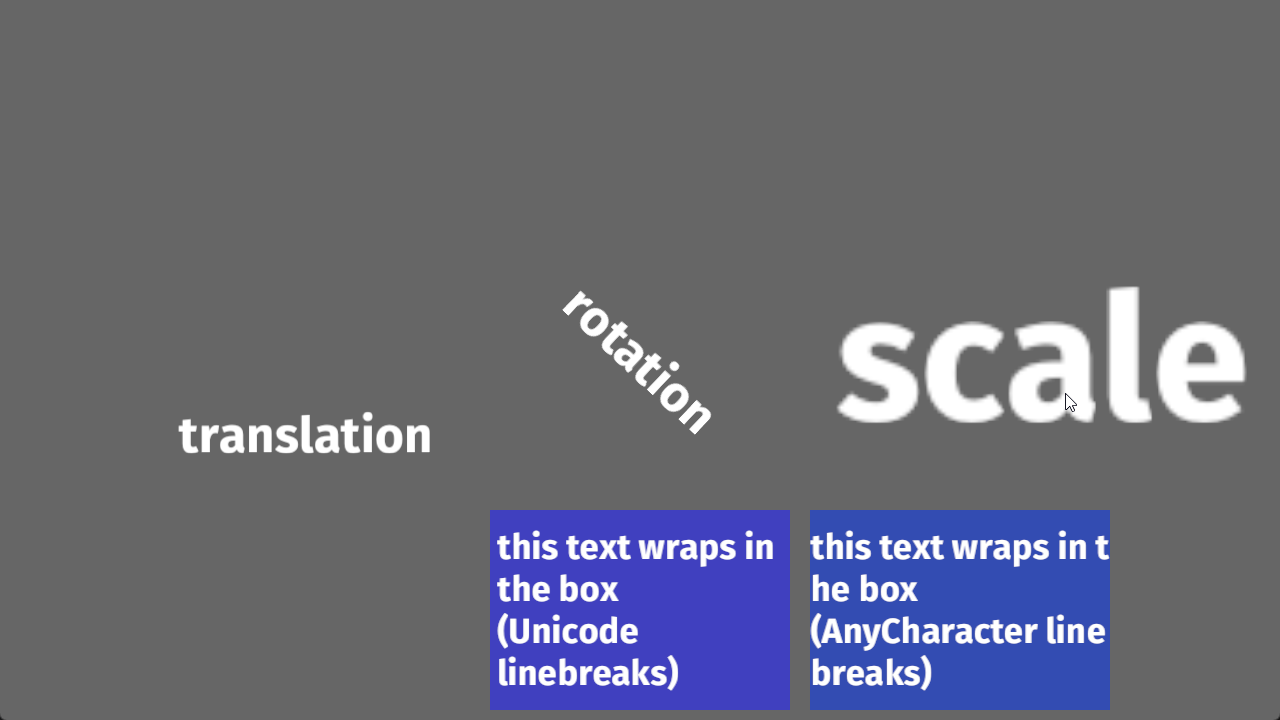 |
||
|
ickshonpe
|
9eefd7c022 |
Remove VerticalAlign from TextAlignment (#6807)
# Objective Remove the `VerticalAlign` enum. Text's alignment field should only affect the text's internal text alignment, not its position. The only way to control a `TextBundle`'s position and bounds should be through the manipulation of the constraints in the `Style` components of the nodes in the Bevy UI's layout tree. `Text2dBundle` should have a separate `Anchor` component that sets its position relative to its transform. Related issues: #676, #1490, #5502, #5513, #5834, #6717, #6724, #6741, #6748 ## Changelog * Changed `TextAlignment` into an enum with `Left`, `Center`, and `Right` variants. * Removed the `HorizontalAlign` and `VerticalAlign` types. * Added an `Anchor` component to `Text2dBundle` * Added `Component` derive to `Anchor` * Use `f32::INFINITY` instead of `f32::MAX` to represent unbounded text in Text2dBounds ## Migration Guide The `alignment` field of `Text` now only affects the text's internal alignment. ### Change `TextAlignment` to TextAlignment` which is now an enum. Replace: * `TextAlignment::TOP_LEFT`, `TextAlignment::CENTER_LEFT`, `TextAlignment::BOTTOM_LEFT` with `TextAlignment::Left` * `TextAlignment::TOP_CENTER`, `TextAlignment::CENTER_LEFT`, `TextAlignment::BOTTOM_CENTER` with `TextAlignment::Center` * `TextAlignment::TOP_RIGHT`, `TextAlignment::CENTER_RIGHT`, `TextAlignment::BOTTOM_RIGHT` with `TextAlignment::Right` ### Changes for `Text2dBundle` `Text2dBundle` has a new field 'text_anchor' that takes an `Anchor` component that controls its position relative to its transform. |
