3945a6de3b
273 Commits
| Author | SHA1 | Message | Date | |
|---|---|---|---|---|
 vero
vero
|
4a23dc4216
|
Split out bevy_mesh from bevy_render (#15666)
# Objective - bevy_render is gargantuan ## Solution - Split out bevy_mesh ## Testing - Ran some examples, everything looks fine ## Migration Guide `bevy_render::mesh::morph::inherit_weights` is now `bevy_render::mesh::inherit_weights` if you were using `Mesh::compute_aabb`, you will need to `use bevy_render::mesh::MeshAabb;` now --------- Co-authored-by: Joona Aalto <jondolf.dev@gmail.com> |
||
|
vero
|
8b0388c74a
|
Split off bevy_image from bevy_render (#15650)
# Objective - bevy_render is gargantuan ## Solution - Split off bevy_image ## Testing - Ran some examples |
||
|
Kristoffer Søholm
|
73af2b7d29
|
Cleanup unneeded lifetimes in bevy_asset (#15546)
# Objective Fixes #15541 A bunch of lifetimes were added during the Assets V2 rework, but after moving to async traits in #12550 they can be elided. That PR mentions that this might be the case, but apparently it wasn't followed up on at the time. ~~I ended up grepping for `<'a` and finding a similar case in `bevy_reflect` which I also fixed.~~ (edit: that one was needed apparently) Note that elided lifetimes are unstable in `impl Trait`. If that gets stabilized then we can elide even more. ## Solution Remove the extra lifetimes. ## Testing Everything still compiles. If I have messed something up there is a small risk that some user code stops compiling, but all the examples still work at least. --- ## Migration Guide The traits `AssetLoader`, `AssetSaver` and `Process` traits from `bevy_asset` now use elided lifetimes. If you implement these then remove the named lifetime. |
||
|
Erik Živković
|
72aaa41603
|
Remove render_resource_wrapper (#15441)
# Objective

* Remove all uses of render_resource_wrapper.
* Make it easier to share a `wgpu::Device` between Bevy and application
code.

## Solution

Removed the `render_resource_wrapper` macro.

To improve the `RenderCreation:: Manual ` API, `ErasedRenderDevice` was
replaced by `Arc`. Unfortunately I had to introduce one more usage of
`WgpuWrapper` which seems like an unwanted constraint on the caller.

## Testing

- Did you test these changes? If so, how?
    - Ran `cargo test`.
    - Ran a few examples.
    - Used `RenderCreation::Manual` in my own project
    - Exercised `RenderCreation::Automatic` through examples

- Are there any parts that need more testing?
    - No

- How can other people (reviewers) test your changes? Is there anything
specific they need to know?
    - Run examples
    - Use `RenderCreation::Manual` in their own project
|
||
|
Zachary Harrold
|
d70595b667
|
Add core and alloc over std Lints (#15281)
# Objective - Fixes #6370 - Closes #6581 ## Solution - Added the following lints to the workspace: - `std_instead_of_core` - `std_instead_of_alloc` - `alloc_instead_of_core` - Used `cargo +nightly fmt` with [item level use formatting](https://rust-lang.github.io/rustfmt/?version=v1.6.0&search=#Item%5C%3A) to split all `use` statements into single items. - Used `cargo clippy --workspace --all-targets --all-features --fix --allow-dirty` to _attempt_ to resolve the new linting issues, and intervened where the lint was unable to resolve the issue automatically (usually due to needing an `extern crate alloc;` statement in a crate root). - Manually removed certain uses of `std` where negative feature gating prevented `--all-features` from finding the offending uses. - Used `cargo +nightly fmt` with [crate level use formatting](https://rust-lang.github.io/rustfmt/?version=v1.6.0&search=#Crate%5C%3A) to re-merge all `use` statements matching Bevy's previous styling. - Manually fixed cases where the `fmt` tool could not re-merge `use` statements due to conditional compilation attributes. ## Testing - Ran CI locally ## Migration Guide The MSRV is now 1.81. Please update to this version or higher. ## Notes - This is a _massive_ change to try and push through, which is why I've outlined the semi-automatic steps I used to create this PR, in case this fails and someone else tries again in the future. - Making this change has no impact on user code, but does mean Bevy contributors will be warned to use `core` and `alloc` instead of `std` where possible. - This lint is a critical first step towards investigating `no_std` options for Bevy. --------- Co-authored-by: François Mockers <francois.mockers@vleue.com> |
||
|
Clar Fon
|
efda7f3f9c
|
Simpler lint fixes: makes ci lints work but disables a lint for now (#15376)
Takes the first two commits from #15375 and adds suggestions from this comment: https://github.com/bevyengine/bevy/pull/15375#issuecomment-2366968300 See #15375 for more reasoning/motivation. ## Rebasing (rerunning) ```rust git switch simpler-lint-fixes git reset --hard main cargo fmt --all -- --unstable-features --config normalize_comments=true,imports_granularity=Crate cargo fmt --all git add --update git commit --message "rustfmt" cargo clippy --workspace --all-targets --all-features --fix cargo fmt --all -- --unstable-features --config normalize_comments=true,imports_granularity=Crate cargo fmt --all git add --update git commit --message "clippy" git cherry-pick e6c0b94f6795222310fb812fa5c4512661fc7887 ``` |
||
|
Benjamin Brienen
|
1b8c1c1242
|
simplify std::mem references (#15315)
# Objective - Fixes #15314 ## Solution - Remove unnecessary usings and simplify references to those functions. ## Testing CI |
||
|
charlotte
|
a4640046fc
|
Adds ShaderStorageBuffer asset (#14663)
Adds a new `Handle<Storage>` asset type that can be used as a render asset, particularly for use with `AsBindGroup`. Closes: #13658 # Objective Allow users to create storage buffers in the main world without having to access the `RenderDevice`. While this resource is technically available, it's bad form to use in the main world and requires mixing rendering details with main world code. Additionally, this makes storage buffers easier to use with `AsBindGroup`, particularly in the following scenarios: - Sharing the same buffers between a compute stage and material shader. We already have examples of this for storage textures (see game of life example) and these changes allow a similar pattern to be used with storage buffers. - Preventing repeated gpu upload (see the previous easier to use `Vec` `AsBindGroup` option). - Allow initializing custom materials using `Default`. Previously, the lack of a `Default` implement for the raw `wgpu::Buffer` type made implementing a `AsBindGroup + Default` bound difficult in the presence of buffers. ## Solution Adds a new `Handle<Storage>` asset type that is prepared into a `GpuStorageBuffer` render asset. This asset can either be initialized with a `Vec<u8>` of properly aligned data or with a size hint. Users can modify the underlying `wgpu::BufferDescriptor` to provide additional usage flags. ## Migration Guide The `AsBindGroup` `storage` attribute has been modified to reference the new `Handle<Storage>` asset instead. Usages of Vec` should be converted into assets instead. --------- Co-authored-by: IceSentry <IceSentry@users.noreply.github.com> |
||
|
Zachary Harrold
|
bc13161416
|
Migrated NonZero* to NonZero<*> (#14978)
# Objective - Fixes #14974 ## Solution - Replace all* instances of `NonZero*` with `NonZero<*>` ## Testing - CI passed locally. --- ## Notes Within the `bevy_reflect` implementations for `std` types, `impl_reflect_value!()` will continue to use the type aliases instead, as it inappropriately parses the concrete type parameter as a generic argument. If the `ZeroablePrimitive` trait was stable, or the macro could be modified to accept a finite list of types, then we could fully migrate. |
||
|
akimakinai
|
4648f7bf72
|
Make TrackedRenderPass::set_vertex_buffer aware of slice size (#14916)
# Objective - Fixes #14841 ## Solution - Compute BufferSlice size manually and use it for comparison in `TrackedRenderPass` ## Testing - Gizmo example does not crash with #14721 (without system ordering), and `slice` computes correct size there --- ## Migration Guide - `TrackedRenderPass::set_vertex_buffer` function has been modified to update vertex buffers when the same buffer with the same offset is provided, but its size has changed. Some existing code may rely on the previous behavior, which did not update the vertex buffer in this scenario. --------- Co-authored-by: Zachary Harrold <zac@harrold.com.au> |
||
|
JMS55
|
6cc96f4c1f
|
Meshlet software raster + start of cleanup (#14623)
# Objective - Faster meshlet rasterization path for small triangles - Avoid having to allocate and write out a triangle buffer - Refactor gpu_scene.rs ## Solution - Replace the 32bit visbuffer texture with a 64bit visbuffer buffer, where the left 32 bits encode depth, and the right 32 bits encode the existing cluster + triangle IDs. Can't use 64bit textures, wgpu/naga doesn't support atomic ops on textures yet. - Instead of writing out a buffer of packed cluster + triangle IDs (per triangle) to raster, the culling pass now writes out a buffer of just cluster IDs (per cluster, so less memory allocated, cheaper to write out). - Clusters for software raster are allocated from the left side - Clusters for hardware raster are allocated in the same buffer, from the right side - The buffer size is fixed at MeshletPlugin build time, and should be set to a reasonable value for your scene (no warning on overflow, and no good way to determine what value you need outside of renderdoc - I plan to fix this in a future PR adding a meshlet stats overlay) - Currently I don't have a heuristic for software vs hardware raster selection for each cluster. The existing code is just a placeholder. I need to profile on a release scene and come up with a heuristic, probably in a future PR. - The culling shader is getting pretty hard to follow at this point, but I don't want to spend time improving it as the entire shader/pass is getting rewritten/replaced in the near future. - Software raster is a compute workgroup per-cluster. Each workgroup loads and transforms the <=64 vertices of the cluster, and then rasterizes the <=64 triangles of the cluster. - Two variants are implemented: Scanline for clusters with any larger triangles (still smaller than hardware is good at), and brute-force for very very tiny triangles - Once the shader determines that a pixel should be filled in, it does an atomicMax() on the visbuffer to store the results, copying how Nanite works - On devices with a low max workgroups per dispatch limit, an extra compute pass is inserted before software raster to convert from a 1d to 2d dispatch (I don't think 3d would ever be necessary). - I haven't implemented the top-left rule or subpixel precision yet, I'm leaving that for a future PR since I get usable results without it for now - Resources used: https://kristoffer-dyrkorn.github.io/triangle-rasterizer and chapters 6-8 of https://fgiesen.wordpress.com/2013/02/17/optimizing-sw-occlusion-culling-index - Hardware raster now spawns 64*3 vertex invocations per meshlet, instead of the actual meshlet vertex count. Extra invocations just early-exit. - While this is slower than the existing system, hardware draws should be rare now that software raster is usable, and it saves a ton of memory using the unified cluster ID buffer. This would be fixed if wgpu had support for mesh shaders. - Instead of writing to a color+depth attachment, the hardware raster pass also does the same atomic visbuffer writes that software raster uses. - We have to bind a dummy render target anyways, as wgpu doesn't currently support render passes without any attachments - Material IDs are no longer written out during the main rasterization passes. - If we had async compute queues, we could overlap the software and hardware raster passes. - New material and depth resolve passes run at the end of the visbuffer node, and write out view depth and material ID depth textures ### Misc changes - Fixed cluster culling importing, but never actually using the previous view uniforms when doing occlusion culling - Fixed incorrectly adding the LOD error twice when building the meshlet mesh - Splitup gpu_scene module into meshlet_mesh_manager, instance_manager, and resource_manager - resource_manager is still too complex and inefficient (extract and prepare are way too expensive). I plan on improving this in a future PR, but for now ResourceManager is mostly a 1:1 port of the leftover MeshletGpuScene bits. - Material draw passes have been renamed to the more accurate material shade pass, as well as some other misc renaming (in the future, these will be compute shaders even, and not actual draw calls) --- ## Migration Guide - TBD (ask me at the end of the release for meshlet changes as a whole) --------- Co-authored-by: vero <email@atlasdostal.com> |
||
|
Sludge
|
7bb76ab74b
|
Add VertexBufferLayout::offset_locations (#9805)
# Objective

When using instancing, 2 `VertexBufferLayout`s are needed, one for
per-vertex and one for per-instance data. Shader locations of all
attributes must not overlap, so one of the layouts needs to start its
locations at an offset. However,
`VertexBufferLayout::from_vertex_formats` will always start locations at
0, requiring manual adjustment, which is currently pretty verbose.

## Solution

Add `VertexBufferLayout::offset_locations`, which adds an offset to all
attribute locations.

Code using this method looks like this:

```rust
VertexState {
    shader: BACKBUFFER_SHADER_HANDLE.typed(),
    shader_defs: Vec::new(),
    entry_point: "vertex".into(),
    buffers: vec![
        VertexBufferLayout::from_vertex_formats(
            VertexStepMode::Vertex,
            [VertexFormat::Float32x2],
        ),
        VertexBufferLayout::from_vertex_formats(
            VertexStepMode::Instance,
            [VertexFormat::Float32x2, VertexFormat::Float32x3],
        )
        .offset_locations(1),
    ],
}
```

Alternative solutions include:

- Pass the starting location to `from_vertex_formats` – this is a bit
simpler than my solution here, but most calls don't need an offset, so
they'd always pass 0 there.
- Do nothing and make the user hand-write this.

---

## Changelog

- Add `VertexBufferLayout::offset_locations` to simplify buffer layout
construction when using instancing.

---------

Co-authored-by: Nicola Papale <nicopap@users.noreply.github.com>
Co-authored-by: Alice Cecile <alice.i.cecile@gmail.com>
|
||
|
charlotte
|
1caa64d948
|
Refactor AsBindGroup to use a associated SystemParam. (#14909)
# Objective Adding more features to `AsBindGroup` proc macro means making the trait arguments uglier. Downstream implementors of the trait without the proc macro might want to do different things than our default arguments. ## Solution Make `AsBindGroup` take an associated `Param` type. ## Migration Guide `AsBindGroup` now allows the user to specify a `SystemParam` to be used for creating bind groups. |
||
|
EdJoPaTo
|
938d810766
|
Apply unused_qualifications lint (#14828)
# Objective Fixes #14782 ## Solution Enable the lint and fix all upcoming hints (`--fix`). Also tried to figure out the false-positive (see review comment). Maybe split this PR up into multiple parts where only the last one enables the lint, so some can already be merged resulting in less many files touched / less potential for merge conflicts? Currently, there are some cases where it might be easier to read the code with the qualifier, so perhaps remove the import of it and adapt its cases? In the current stage it's just a plain adoption of the suggestions in order to have a base to discuss. ## Testing `cargo clippy` and `cargo run -p ci` are happy. |
||
|
robtfm
|
6e2f96f222
|
check sampler type in as_bind_group derives (#12637)
# Objective

currently if we use an image with the wrong sampler type in a material,
wgpu panics with an invalid texture format. turn this into a warning and
fail more gracefully.

## Solution

the expected sampler type is specified in the AsBindGroup derive, so we
can just check the image sampler is what it should be.

i am not totally sure about the mapping of image sampler type to
#[sampler(type)], i assumed:

```
    "filtering" => [ TextureSampleType::Float { filterable: true } ],
    "non_filtering" => [
        TextureSampleType::Float { filterable: false },
        TextureSampleType::Sint,
        TextureSampleType::Uint,
    ],
    "comparison" => [ TextureSampleType::Depth ],
```
|
||
|
callym
|
7b81ae7e40
|
Update WGPU to version 22 (#14401)
Upgrading to WGPU 22. Needs `naga_oil` to upgrade first, I've got a fork that compiles but fails tests, so until that's fixed and the crate is officially updated/released this will be blocked. --------- Co-authored-by: Elabajaba <Elabajaba@users.noreply.github.com> |
||
|
Jan Hohenheim
|
6f7c554daa
|
Fix common capitalization errors in documentation (#14562)
WASM -> Wasm MacOS -> macOS Nothing important, just something that annoyed me for a while :) |
||
|
Daniel Miller
|
692840274f
|
Added AstcBlock and AstcChannel to the forwarded wgpu types. (#14410)
Currently `TextureFormat::Astc` can't be programmatically constructed without importing wgpu in addition to bevy. # Objective Allow programmatic construction of `TextureFormat::Astc` with no additional imports required. ## Solution Exported the two component enums `AstcBlock` and `AstcChannel` used in `TextureFormat::Astc` construction. ## Testing I did not test this, the change seemed pretty safe. :) |
||
|
Giacomo Stevanato
|
d7080369a7
|
Fix intra-doc links and make CI test them (#14076)
# Objective - Bevy currently has lot of invalid intra-doc links, let's fix them! - Also make CI test them, to avoid future regressions. - Helps with #1983 (but doesn't fix it, as there could still be explicit links to docs.rs that are broken) ## Solution - Make `cargo r -p ci -- doc-check` check fail on warnings (could also be changed to just some specific lints) - Manually fix all the warnings (note that in some cases it was unclear to me what the fix should have been, I'll try to highlight them in a self-review) |
||
|
Joseph
|
5876352206
|
Optimize common usages of AssetReader (#14082)
# Objective

The `AssetReader` trait allows customizing the behavior of fetching
bytes for an `AssetPath`, and expects implementors to return `dyn
AsyncRead + AsyncSeek`. This gives implementors of `AssetLoader` great
flexibility to tightly integrate their asset loading behavior with the
asynchronous task system.

However, almost all implementors of `AssetLoader` don't use the async
functionality at all, and just call `AsyncReadExt::read_to_end(&mut
Vec<u8>)`. This is incredibly inefficient, as this method repeatedly
calls `poll_read` on the trait object, filling the vector 32 bytes at a
time. At my work we have assets that are hundreds of megabytes which
makes this a meaningful overhead.

## Solution

Turn the `Reader` type alias into an actual trait, with a provided
method `read_to_end`. This provided method should be more efficient than
the existing extension method, as the compiler will know the underlying
type of `Reader` when generating this function, which removes the
repeated dynamic dispatches and allows the compiler to make further
optimizations after inlining. Individual implementors are able to
override the provided implementation -- for simple asset readers that
just copy bytes from one buffer to another, this allows removing a large
amount of overhead from the provided implementation.

Now that `Reader` is an actual trait, I also improved the ergonomics for
implementing `AssetReader`. Currently, implementors are expected to box
their reader and return it as a trait object, which adds unnecessary
boilerplate to implementations. This PR changes that trait method to
return a pseudo trait alias, which allows implementors to return `impl
Reader` instead of `Box<dyn Reader>`. Now, the boilerplate for boxing
occurs in `ErasedAssetReader`.

## Testing

I made identical changes to my company's fork of bevy. Our app, which
makes heavy use of `read_to_end` for asset loading, still worked
properly after this. I am not aware if we have a more systematic way of
testing asset loading for correctness.

---

## Migration Guide

The trait method `bevy_asset::io::AssetReader::read` (and `read_meta`)
now return an opaque type instead of a boxed trait object. Implementors
of these methods should change the type signatures appropriately

```rust
impl AssetReader for MyReader {
    // Before
    async fn read<'a>(&'a self, path: &'a Path) -> Result<Box<Reader<'a>>, AssetReaderError> {
        let reader = // construct a reader
        Box::new(reader) as Box<Reader<'a>>
    }

    // After
    async fn read<'a>(&'a self, path: &'a Path) -> Result<impl Reader + 'a, AssetReaderError> {
        // create a reader
    }
}
```

`bevy::asset::io::Reader` is now a trait, rather than a type alias for a
trait object. Implementors of `AssetLoader::load` will need to adjust
the method signature accordingly

```rust
impl AssetLoader for MyLoader {
    async fn load<'a>(
        &'a self,
        // Before:
        reader: &'a mut bevy::asset::io::Reader,
        // After:
        reader: &'a mut dyn bevy::asset::io::Reader,
        _: &'a Self::Settings,
        load_context: &'a mut LoadContext<'_>,
    ) -> Result<Self::Asset, Self::Error> {
}
```

Additionally, implementors of `AssetReader` that return a type
implementing `futures_io::AsyncRead` and `AsyncSeek` might need to
explicitly implement `bevy::asset::io::Reader` for that type.

```rust
impl bevy::asset::io::Reader for MyAsyncReadAndSeek {}
```
|
||
|
Lura
|
856b39d821
|
Apply Clippy lints regarding lazy evaluation and closures (#14015)
# Objective - Lazily evaluate [default](https://rust-lang.github.io/rust-clippy/master/index.html#/unwrap_or_default)~~/[or](https://rust-lang.github.io/rust-clippy/master/index.html#/or_fun_call)~~ values where it makes sense - ~~`unwrap_or(foo())` -> `unwrap_or_else(|| foo())`~~ - `unwrap_or(Default::default())` -> `unwrap_or_default()` - etc. - Avoid creating [redundant closures](https://rust-lang.github.io/rust-clippy/master/index.html#/redundant_closure), even for [method calls](https://rust-lang.github.io/rust-clippy/master/index.html#/redundant_closure_for_method_calls) - `map(|something| something.into())` -> `map(Into:into)` ## Solution - Apply Clippy lints: - ~~[or_fun_call](https://rust-lang.github.io/rust-clippy/master/index.html#/or_fun_call)~~ - [unwrap_or_default](https://rust-lang.github.io/rust-clippy/master/index.html#/unwrap_or_default) - [redundant_closure_for_method_calls](https://rust-lang.github.io/rust-clippy/master/index.html#/redundant_closure_for_method_calls) ([redundant closures](https://rust-lang.github.io/rust-clippy/master/index.html#/redundant_closure) is already enabled) ## Testing - Tested on Windows 11 (`stable-x86_64-pc-windows-gnu`, 1.79.0) - Bevy compiles without errors or warnings and examples seem to work as intended - `cargo clippy` ✅ - `cargo run -p ci -- compile` ✅ --------- Co-authored-by: Alice Cecile <alice.i.cecile@gmail.com> |
||
|
Jan Hohenheim
|
6273227e09
|
Fix lints introduced in Rust beta 1.80 (#13899)
Resolves #13895 Mostly just involves being more explicit about which parts of the docs belong to a list and which begin a new paragraph. - found a few docs that were malformed because of exactly this, so I fixed that by introducing a paragraph - added indentation to nearly all multiline lists - fixed a few minor typos - added `#[allow(dead_code)]` to types that are needed to test annotations but are never constructed ([here](https://github.com/bevyengine/bevy/pull/13899/files#diff-b02b63604e569c8577c491e7a2030d456886d8f6716eeccd46b11df8aac75dafR1514) and [here](https://github.com/bevyengine/bevy/pull/13899/files#diff-b02b63604e569c8577c491e7a2030d456886d8f6716eeccd46b11df8aac75dafR1523)) - verified that `cargo +beta run -p ci -- lints` passes - verified that `cargo +beta run -p ci -- test` passes |
||
|
Elabajaba
|
2825ac8a8e
|
Wgpu 0.20 (#13186)
Currently blocked on https://github.com/gfx-rs/wgpu/issues/5774 # Objective Update to wgpu 0.20 ## Solution Update to wgpu 0.20 and naga_oil 0.14. ## Testing Tested a few different examples on linux (vulkan, webgl2, webgpu) and windows (dx12 + vulkan) and they worked. --- ## Changelog - Updated to wgpu 0.20. Note that we don't currently support wgpu's new pipeline overridable constants, as they don't work on web currently and need some more changes to naga_oil (and are somewhat redundant with naga_oil's shader defs). See wgpu's changelog for more https://github.com/gfx-rs/wgpu/blob/trunk/CHANGELOG.md#v0200-2024-04-28 ## Migration Guide TODO --------- Co-authored-by: Alice Cecile <alice.i.cecile@gmail.com> Co-authored-by: François Mockers <mockersf@gmail.com> |
||
|
Isaïe
|
2356276afd
|
Clarify error message due to missing shader file (#13766)
# Objective The error printed-out due to a missing shader file was confusing; This PR changes the error message. Fixes #13644 ## Solution I replaced the confusing wording (`... shader is not loaded yet`) with a clear explanation (`... shader could not be loaded`) ## Testing > Did you test these changes? If so, how? removing `assets/shaders/game_of_life.wgsl` & running its associated example now produces the following error: ``` thread '<unnamed>' panicked at examples/shader/compute_shader_game_of_life.rs:233:25: Initializing assets/shaders/game_of_life.wgsl: Pipeline could not be compiled because the following shader could not be loaded: AssetId<bevy_render::render_resource::shader::Shader>{ index: 0, generation: 0} note: run with `RUST_BACKTRACE=1` environment variable to display a backtrace Encountered a panic in system `bevy_render::renderer::render_system`! ``` I don't think there are any tests expecting the previous error message, so this change should not break anything. > Are there any parts that need more testing? If there was an intent behind the original message, this might need more attention. > How can other people (reviewers) test your changes? Is there anything specific they need to know? One should be able to preview the changes by running any example after deleting/renaming their associated shader(s). > If relevant, what platforms did you test these changes on, and are there any important ones you can't test? N/A |
||
|
IceSentry
|
d0e1b43402
|
Add binding() helper function to BufferVec (#13667)
# Objective - Other render resources have a convenient `.binding()` helper function to get the binding to the resource ## Solution - Add the same thing to `BufferVec`, `RawBufferVec`, and `UninitBufferVec` |
||
|
andristarr
|
bb76a2c69c
|
multi_threaded feature rename (#12997)
# Objective Fixes #12966 ## Solution Renaming multi_threaded feature to match snake case ## Migration Guide Bevy feature multi-threaded should be refered to multi_threaded from now on. |
||
|
IceSentry
|
a22ecede49
|
Only create changed buffer if it already exists (#13242)
# Objective - `DynamicUniformBuffer` tries to create a buffer as soon as the changed flag is set to true. This doesn't work correctly when the buffer wasn't already created. This currently creates a crash because it's trying to create a buffer of size 0 if the flag is set but there's no buffer yet. ## Solution - Don't create a changed buffer until there's data that needs to be written to a buffer. ## Testing - run `cargo run --example scene_viewer` and see that it doesn't crash anymore Fixes #13235 |
||
|
Bram Buurlage
|
d390420093
|
Implement Auto Exposure plugin (#12792)
# Objective - Add auto exposure/eye adaptation to the bevy render pipeline. - Support features that users might expect from other engines: - Metering masks - Compensation curves - Smooth exposure transitions This PR is based on an implementation I already built for a personal project before https://github.com/bevyengine/bevy/pull/8809 was submitted, so I wasn't able to adopt that PR in the proper way. I've still drawn inspiration from it, so @fintelia should be credited as well. ## Solution An auto exposure compute shader builds a 64 bin histogram of the scene's luminance, and then adjusts the exposure based on that histogram. Using a histogram allows the system to ignore outliers like shadows and specular highlights, and it allows to give more weight to certain areas based on a mask. --- ## Changelog - Added: AutoExposure plugin that allows to adjust a camera's exposure based on it's scene's luminance. --------- Co-authored-by: Alice Cecile <alice.i.cecile@gmail.com> |
||
|
Kristoffer Søholm
|
2089a28717
|
Add BufferVec, an higher-performance alternative to StorageBuffer, and make GpuArrayBuffer use it. (#13199)
This is an adoption of #12670 plus some documentation fixes. See that PR for more details. --- ## Changelog * Renamed `BufferVec` to `RawBufferVec` and added a new `BufferVec` type. ## Migration Guide `BufferVec` has been renamed to `RawBufferVec` and a new similar type has taken the `BufferVec` name. --------- Co-authored-by: Patrick Walton <pcwalton@mimiga.net> Co-authored-by: Alice Cecile <alice.i.cecile@gmail.com> Co-authored-by: IceSentry <IceSentry@users.noreply.github.com> |
||
|
mgi388
|
78bf48b874
|
Use BindGroupLayoutEntryBuilder in texture_binding_array example (#13169)
# Objective - I've been using the `texture_binding_array` example as a base to use multiple textures in meshes in my program - I only realised once I was deep in render code that these helpers existed to create layouts - I wish I knew the existed earlier because the alternative (filling in every struct field) is so much more verbose ## Solution - Use `BindGroupLayoutEntries::with_indices` to teach users that the helper exists - Also fix typo which should be `texture_2d`. ## Alternatives considered - Just leave it as is to teach users about every single struct field - However, leaving as is leaves users writing roughly 29 lines versus roughly 2 lines for 2 entries and I'd prefer the 2 line approach ## Testing Ran the example locally and compared before and after. Before: <img width="1280" alt="image" src="https://github.com/bevyengine/bevy/assets/135186256/f5897210-2560-4110-b92b-85497be9023c"> After: <img width="1279" alt="image" src="https://github.com/bevyengine/bevy/assets/135186256/8d13a939-b1ce-4a49-a9da-0b1779c8cb6a"> Co-authored-by: mgi388 <> |
||
|
Martín Maita
|
32cd0c5dc1
|
Update glam version requirement from 0.25 to 0.27 (#12757)
# Objective

- Update glam version requirement to latest version.

## Solution

- Updated `glam` version requirement from 0.25 to 0.27.
- Updated `encase` and `encase_derive_impl` version requirement from 0.7
to 0.8.
- Updated `hexasphere` version requirement from 10.0 to 12.0.
- Breaking changes from glam changelog:
- [0.26.0] Minimum Supported Rust Version bumped to 1.68.2 for impl
From<bool> for {f32,f64} support.
- [0.27.0] Changed implementation of vector fract method to match the
Rust implementation instead of the GLSL implementation, that is self -
self.trunc() instead of self - self.floor().

---

## Migration Guide

- When using `glam` exports, keep in mind that `vector` `fract()` method
now matches Rust implementation (that is `self - self.trunc()` instead
of `self - self.floor()`). If you want to use the GLSL implementation
you should now use `fract_gl()`.

---------

Co-authored-by: Alice Cecile <alice.i.cecile@gmail.com>
|
||
|
Patrick Walton
|
16531fb3e3
|
Implement GPU frustum culling. (#12889)
This commit implements opt-in GPU frustum culling, built on top of the infrastructure in https://github.com/bevyengine/bevy/pull/12773. To enable it on a camera, add the `GpuCulling` component to it. To additionally disable CPU frustum culling, add the `NoCpuCulling` component. Note that adding `GpuCulling` without `NoCpuCulling` *currently* does nothing useful. The reason why `GpuCulling` doesn't automatically imply `NoCpuCulling` is that I intend to follow this patch up with GPU two-phase occlusion culling, and CPU frustum culling plus GPU occlusion culling seems like a very commonly-desired mode. Adding the `GpuCulling` component to a view puts that view into *indirect mode*. This mode makes all drawcalls indirect, relying on the mesh preprocessing shader to allocate instances dynamically. In indirect mode, the `PreprocessWorkItem` `output_index` points not to a `MeshUniform` instance slot but instead to a set of `wgpu` `IndirectParameters`, from which it allocates an instance slot dynamically if frustum culling succeeds. Batch building has been updated to allocate and track indirect parameter slots, and the AABBs are now supplied to the GPU as `MeshCullingData`. A small amount of code relating to the frustum culling has been borrowed from meshlets and moved into `maths.wgsl`. Note that standard Bevy frustum culling uses AABBs, while meshlets use bounding spheres; this means that not as much code can be shared as one might think. This patch doesn't provide any way to perform GPU culling on shadow maps, to avoid making this patch bigger than it already is. That can be a followup. ## Changelog ### Added * Frustum culling can now optionally be done on the GPU. To enable it, add the `GpuCulling` component to a camera. * To disable CPU frustum culling, add `NoCpuCulling` to a camera. Note that `GpuCulling` doesn't automatically imply `NoCpuCulling`. |
||
|
Aevyrie
|
ade70b3925
|
Per-Object Motion Blur (#9924)
https://github.com/bevyengine/bevy/assets/2632925/e046205e-3317-47c3-9959-fc94c529f7e0 # Objective - Adds per-object motion blur to the core 3d pipeline. This is a common effect used in games and other simulations. - Partially resolves #4710 ## Solution - This is a post-process effect that uses the depth and motion vector buffers to estimate per-object motion blur. The implementation is combined from knowledge from multiple papers and articles. The approach itself, and the shader are quite simple. Most of the effort was in wiring up the bevy rendering plumbing, and properly specializing for HDR and MSAA. - To work with MSAA, the MULTISAMPLED_SHADING wgpu capability is required. I've extracted this code from #9000. This is because the prepass buffers are multisampled, and require accessing with `textureLoad` as opposed to the widely compatible `textureSample`. - Added an example to demonstrate the effect of motion blur parameters. ## Future Improvements - While this approach does have limitations, it's one of the most commonly used, and is much better than camera motion blur, which does not consider object velocity. For example, this implementation allows a dolly to track an object, and that object will remain unblurred while the background is blurred. The biggest issue with this implementation is that blur is constrained to the boundaries of objects which results in hard edges. There are solutions to this by either dilating the object or the motion vector buffer, or by taking a different approach such as https://casual-effects.com/research/McGuire2012Blur/index.html - I'm using a noise PRNG function to jitter samples. This could be replaced with a blue noise texture lookup or similar, however after playing with the parameters, it gives quite nice results with 4 samples, and is significantly better than the artifacts generated when not jittering. --- ## Changelog - Added: per-object motion blur. This can be enabled and configured by adding the `MotionBlurBundle` to a camera entity. --------- Co-authored-by: Torstein Grindvik <52322338+torsteingrindvik@users.noreply.github.com> |
||
|
Patrick Walton
|
11817f4ba4
|
Generate MeshUniforms on the GPU via compute shader where available. (#12773)
Currently, `MeshUniform`s are rather large: 160 bytes. They're also somewhat expensive to compute, because they involve taking the inverse of a 3x4 matrix. Finally, if a mesh is present in multiple views, that mesh will have a separate `MeshUniform` for each and every view, which is wasteful. This commit fixes these issues by introducing the concept of a *mesh input uniform* and adding a *mesh uniform building* compute shader pass. The `MeshInputUniform` is simply the minimum amount of data needed for the GPU to compute the full `MeshUniform`. Most of this data is just the transform and is therefore only 64 bytes. `MeshInputUniform`s are computed during the *extraction* phase, much like skins are today, in order to avoid needlessly copying transforms around on CPU. (In fact, the render app has been changed to only store the translation of each mesh; it no longer cares about any other part of the transform, which is stored only on the GPU and the main world.) Before rendering, the `build_mesh_uniforms` pass runs to expand the `MeshInputUniform`s to the full `MeshUniform`. The mesh uniform building pass does the following, all on GPU: 1. Copy the appropriate fields of the `MeshInputUniform` to the `MeshUniform` slot. If a single mesh is present in multiple views, this effectively duplicates it into each view. 2. Compute the inverse transpose of the model transform, used for transforming normals. 3. If applicable, copy the mesh's transform from the previous frame for TAA. To support this, we double-buffer the `MeshInputUniform`s over two frames and swap the buffers each frame. The `MeshInputUniform`s for the current frame contain the index of that mesh's `MeshInputUniform` for the previous frame. This commit produces wins in virtually every CPU part of the pipeline: `extract_meshes`, `queue_material_meshes`, `batch_and_prepare_render_phase`, and especially `write_batched_instance_buffer` are all faster. Shrinking the amount of CPU data that has to be shuffled around speeds up the entire rendering process. | Benchmark | This branch | `main` | Speedup | |------------------------|-------------|---------|---------| | `many_cubes -nfc` | 17.259 | 24.529 | 42.12% | | `many_cubes -nfc -vpi` | 302.116 | 312.123 | 3.31% | | `many_foxes` | 3.227 | 3.515 | 8.92% | Because mesh uniform building requires compute shader, and WebGL 2 has no compute shader, the existing CPU mesh uniform building code has been left as-is. Many types now have both CPU mesh uniform building and GPU mesh uniform building modes. Developers can opt into the old CPU mesh uniform building by setting the `use_gpu_uniform_builder` option on `PbrPlugin` to `false`. Below are graphs of the CPU portions of `many-cubes --no-frustum-culling`. Yellow is this branch, red is `main`. `extract_meshes`:  It's notable that we get a small win even though we're now writing to a GPU buffer. `queue_material_meshes`:  There's a bit of a regression here; not sure what's causing it. In any case it's very outweighed by the other gains. `batch_and_prepare_render_phase`:  There's a huge win here, enough to make batching basically drop off the profile. `write_batched_instance_buffer`:  There's a massive improvement here, as expected. Note that a lot of it simply comes from the fact that `MeshInputUniform` is `Pod`. (This isn't a maintainability problem in my view because `MeshInputUniform` is so simple: just 16 tightly-packed words.) ## Changelog ### Added * Per-mesh instance data is now generated on GPU with a compute shader instead of CPU, resulting in rendering performance improvements on platforms where compute shaders are supported. ## Migration guide * Custom render phases now need multiple systems beyond just `batch_and_prepare_render_phase`. Code that was previously creating custom render phases should now add a `BinnedRenderPhasePlugin` or `SortedRenderPhasePlugin` as appropriate instead of directly adding `batch_and_prepare_render_phase`. |
||
|
Robert Swain
|
ab7cbfa8fc
|
Consolidate Render(Ui)Materials(2d) into RenderAssets (#12827)
# Objective - Replace `RenderMaterials` / `RenderMaterials2d` / `RenderUiMaterials` with `RenderAssets` to enable implementing changes to one thing, `RenderAssets`, that applies to all use cases rather than duplicating changes everywhere for multiple things that should be one thing. - Adopts #8149 ## Solution - Make RenderAsset generic over the destination type rather than the source type as in #8149 - Use `RenderAssets<PreparedMaterial<M>>` etc for render materials --- ## Changelog - Changed: - The `RenderAsset` trait is now implemented on the destination type. Its `SourceAsset` associated type refers to the type of the source asset. - `RenderMaterials`, `RenderMaterials2d`, and `RenderUiMaterials` have been replaced by `RenderAssets<PreparedMaterial<M>>` and similar. ## Migration Guide - `RenderAsset` is now implemented for the destination type rather that the source asset type. The source asset type is now the `RenderAsset` trait's `SourceAsset` associated type. |
||
|
Remi Godin
|
c233d6e0d0
|
Added method to get waiting pipelines IDs from pipeline cache. (#12874)
# Objective - Add a way to easily get currently waiting pipelines IDs. ## Solution - Added a method to get waiting pipelines `CachedPipelineId`. --------- Co-authored-by: James Liu <contact@jamessliu.com> |
||
|
James Liu
|
a4ed1b88b8
|
Relax BufferVec's type constraints (#12866)
# Objective Since BufferVec was first introduced, `bytemuck` has added additional traits with fewer restrictions than `Pod`. Within BufferVec, we only rely on the constraints of `bytemuck::cast_slice` to a `u8` slice, which now only requires `T: NoUninit` which is a strict superset of `Pod` types. ## Solution Change out the `Pod` generic type constraint with `NoUninit`. Also taking the opportunity to substitute `cast_slice` with `must_cast_slice`, which avoids a runtime panic in place of a compile time failure if `T` cannot be used. --- ## Changelog Changed: `BufferVec` now supports working with types containing `NoUninit` but not `Pod` members. Changed: `BufferVec` will now fail to compile if used with a type that cannot be safely read from. Most notably, this includes ZSTs, which would previously always panic at runtime. |
||
|
Patrick Walton
|
37522fd0ae
|
Micro-optimize queue_material_meshes, primarily to remove bit manipulation. (#12791)
This commit makes the following optimizations: ## `MeshPipelineKey`/`BaseMeshPipelineKey` split `MeshPipelineKey` has been split into `BaseMeshPipelineKey`, which lives in `bevy_render` and `MeshPipelineKey`, which lives in `bevy_pbr`. Conceptually, `BaseMeshPipelineKey` is a superclass of `MeshPipelineKey`. For `BaseMeshPipelineKey`, the bits start at the highest (most significant) bit and grow downward toward the lowest bit; for `MeshPipelineKey`, the bits start at the lowest bit and grow upward toward the highest bit. This prevents them from colliding. The goal of this is to avoid having to reassemble bits of the pipeline key for every mesh every frame. Instead, we can just use a bitwise or operation to combine the pieces that make up a `MeshPipelineKey`. ## `specialize_slow` Previously, all of `specialize()` was marked as `#[inline]`. This bloated `queue_material_meshes` unnecessarily, as a large chunk of it ended up being a slow path that was rarely hit. This commit refactors the function to move the slow path to `specialize_slow()`. Together, these two changes shave about 5% off `queue_material_meshes`:  ## Migration Guide - The `primitive_topology` field on `GpuMesh` is now an accessor method: `GpuMesh::primitive_topology()`. - For performance reasons, `MeshPipelineKey` has been split into `BaseMeshPipelineKey`, which lives in `bevy_render`, and `MeshPipelineKey`, which lives in `bevy_pbr`. These two should be combined with bitwise-or to produce the final `MeshPipelineKey`. |
||
|
Patrick Walton
|
4dadebd9c4
|
Improve performance by binning together opaque items instead of sorting them. (#12453)
Today, we sort all entities added to all phases, even the phases that don't strictly need sorting, such as the opaque and shadow phases. This results in a performance loss because our `PhaseItem`s are rather large in memory, so sorting is slow. Additionally, determining the boundaries of batches is an O(n) process. This commit makes Bevy instead applicable place phase items into *bins* keyed by *bin keys*, which have the invariant that everything in the same bin is potentially batchable. This makes determining batch boundaries O(1), because everything in the same bin can be batched. Instead of sorting each entity, we now sort only the bin keys. This drops the sorting time to near-zero on workloads with few bins like `many_cubes --no-frustum-culling`. Memory usage is improved too, with batch boundaries and dynamic indices now implicit instead of explicit. The improved memory usage results in a significant win even on unbatchable workloads like `many_cubes --no-frustum-culling --vary-material-data-per-instance`, presumably due to cache effects. Not all phases can be binned; some, such as transparent and transmissive phases, must still be sorted. To handle this, this commit splits `PhaseItem` into `BinnedPhaseItem` and `SortedPhaseItem`. Most of the logic that today deals with `PhaseItem`s has been moved to `SortedPhaseItem`. `BinnedPhaseItem` has the new logic. Frame time results (in ms/frame) are as follows: | Benchmark | `binning` | `main` | Speedup | | ------------------------ | --------- | ------- | ------- | | `many_cubes -nfc -vpi` | 232.179 | 312.123 | 34.43% | | `many_cubes -nfc` | 25.874 | 30.117 | 16.40% | | `many_foxes` | 3.276 | 3.515 | 7.30% | (`-nfc` is short for `--no-frustum-culling`; `-vpi` is short for `--vary-per-instance`.) --- ## Changelog ### Changed * Render phases have been split into binned and sorted phases. Binned phases, such as the common opaque phase, achieve improved CPU performance by avoiding the sorting step. ## Migration Guide - `PhaseItem` has been split into `BinnedPhaseItem` and `SortedPhaseItem`. If your code has custom `PhaseItem`s, you will need to migrate them to one of these two types. `SortedPhaseItem` requires the fewest code changes, but you may want to pick `BinnedPhaseItem` if your phase doesn't require sorting, as that enables higher performance. ## Tracy graphs `many-cubes --no-frustum-culling`, `main` branch: <img width="1064" alt="Screenshot 2024-03-12 180037" src="https://github.com/bevyengine/bevy/assets/157897/e1180ce8-8e89-46d2-85e3-f59f72109a55"> `many-cubes --no-frustum-culling`, this branch: <img width="1064" alt="Screenshot 2024-03-12 180011" src="https://github.com/bevyengine/bevy/assets/157897/0899f036-6075-44c5-a972-44d95895f46c"> You can see that `batch_and_prepare_binned_render_phase` is a much smaller fraction of the time. Zooming in on that function, with yellow being this branch and red being `main`, we see: <img width="1064" alt="Screenshot 2024-03-12 175832" src="https://github.com/bevyengine/bevy/assets/157897/0dfc8d3f-49f4-496e-8825-a66e64d356d0"> The binning happens in `queue_material_meshes`. Again with yellow being this branch and red being `main`: <img width="1064" alt="Screenshot 2024-03-12 175755" src="https://github.com/bevyengine/bevy/assets/157897/b9b20dc1-11c8-400c-a6cc-1c2e09c1bb96"> We can see that there is a small regression in `queue_material_meshes` performance, but it's not nearly enough to outweigh the large gains in `batch_and_prepare_binned_render_phase`. --------- Co-authored-by: James Liu <contact@jamessliu.com> |
||
|
James Liu
|
e62a01f403
|
Make PersistentGpuBufferable a safe trait (#12744)
# Objective Fixes #12727. All parts that `PersistentGpuBuffer` interact with should be 100% safe both on the CPU and the GPU: `Queue::write_buffer_with` zeroes out the slice being written to and when uploading to the GPU, and all slice writes are bounds checked on the CPU side. ## Solution Make `PersistentGpuBufferable` a safe trait. Enforce it's correct implementation via assertions. Re-enable `forbid(unsafe_code)` on `bevy_pbr`. |
||
|
Ian Kettlewell
|
b35974010b
|
Get Bevy building for WebAssembly with multithreading (#12205)
# Objective This gets Bevy building on Wasm when the `atomics` flag is enabled. This does not yet multithread Bevy itself, but it allows Bevy users to use a crate like `wasm_thread` to spawn their own threads and manually parallelize work. This is a first step towards resolving #4078 . Also fixes #9304. This provides a foothold so that Bevy contributors can begin to think about multithreaded Wasm's constraints and Bevy can work towards changes to get the engine itself multithreaded. Some flags need to be set on the Rust compiler when compiling for Wasm multithreading. Here's what my build script looks like, with the correct flags set, to test out Bevy examples on web: ```bash set -e RUSTFLAGS='-C target-feature=+atomics,+bulk-memory,+mutable-globals' \ cargo build --example breakout --target wasm32-unknown-unknown -Z build-std=std,panic_abort --release wasm-bindgen --out-name wasm_example \ --out-dir examples/wasm/target \ --target web target/wasm32-unknown-unknown/release/examples/breakout.wasm devserver --header Cross-Origin-Opener-Policy='same-origin' --header Cross-Origin-Embedder-Policy='require-corp' --path examples/wasm ``` A few notes: 1. `cpal` crashes immediately when the `atomics` flag is set. That is patched in https://github.com/RustAudio/cpal/pull/837, but not yet in the latest crates.io release. That can be temporarily worked around by patching Cpal like so: ```toml [patch.crates-io] cpal = { git = "https://github.com/RustAudio/cpal" } ``` 2. When testing out `wasm_thread` you need to enable the `es_modules` feature. ## Solution The largest obstacle to compiling Bevy with `atomics` on web is that `wgpu` types are _not_ Send and Sync. Longer term Bevy will need an approach to handle that, but in the near term Bevy is already configured to be single-threaded on web. Therefor it is enough to wrap `wgpu` types in a `send_wrapper::SendWrapper` that _is_ Send / Sync, but panics if accessed off the `wgpu` thread. --- ## Changelog - `wgpu` types that are not `Send` are wrapped in `send_wrapper::SendWrapper` on Wasm + 'atomics' - CommandBuffers are not generated in parallel on Wasm + 'atomics' ## Questions - Bevy should probably add CI checks to make sure this doesn't regress. Should that go in this PR or a separate PR? **Edit:** Added checks to build Wasm with atomics --------- Co-authored-by: François <mockersf@gmail.com> Co-authored-by: Alice Cecile <alice.i.cecile@gmail.com> Co-authored-by: daxpedda <daxpedda@gmail.com> Co-authored-by: François <francois.mockers@vleue.com> |
||
|
Arthur Brussee
|
ac49dce4ca
|
Use async-fn in traits rather than BoxedFuture (#12550)
# Objective

Simplify implementing some asset traits without Box::pin(async move{})
shenanigans.
Fixes (in part) https://github.com/bevyengine/bevy/issues/11308

## Solution
Use async-fn in traits when possible in all traits. Traits with return
position impl trait are not object safe however, and as AssetReader and
AssetWriter are both used with dynamic dispatch, you need a Boxed
version of these futures anyway.

In the future, Rust is [adding
](https://blog.rust-lang.org/2023/12/21/async-fn-rpit-in-traits.html)proc
macros to generate these traits automatically, and at some point in the
future dyn traits should 'just work'. Until then.... this seemed liked
the right approach given more ErasedXXX already exist, but, no clue if
there's plans here! Especially since these are public now, it's a bit of
an unfortunate API, and means this is a breaking change.

In theory this saves some performance when these traits are used with
static dispatch, but, seems like most code paths go through dynamic
dispatch, which boxes anyway.

I also suspect a bunch of the lifetime annotations on these function
could be simplified now as the BoxedFuture was often the only thing
returned which needed a lifetime annotation, but I'm not touching that
for now as traits + lifetimes can be so tricky.

This is a revival of
[pull/11362](https://github.com/bevyengine/bevy/pull/11362) after a
spectacular merge f*ckup, with updates to the latest Bevy. Just to recap
some discussion:
- Overall this seems like a win for code quality, especially when
implementing these traits, but a loss for having to deal with ErasedXXX
variants.
- `ConditionalSend` was the preferred name for the trait that might be
Send, to deal with wasm platforms.
- When reviewing be sure to disable whitespace difference, as that's 95%
of the PR.


## Changelog
- AssetReader, AssetWriter, AssetLoader, AssetSaver and Process now use
async-fn in traits rather than boxed futures.

## Migration Guide
- Custom implementations of AssetReader, AssetWriter, AssetLoader,
AssetSaver and Process should switch to async fn rather than returning a
bevy_utils::BoxedFuture.
- Simultaniously, to use dynamic dispatch on these traits you should
instead use dyn ErasedXXX.
|
||
|
James Liu
|
512b7463a3
|
Disentangle bevy_utils/bevy_core's reexported dependencies (#12313)
# Objective Make bevy_utils less of a compilation bottleneck. Tackle #11478. ## Solution * Move all of the directly reexported dependencies and move them to where they're actually used. * Remove the UUID utilities that have gone unused since `TypePath` took over for `TypeUuid`. * There was also a extraneous bytemuck dependency on `bevy_core` that has not been used for a long time (since `encase` became the primary way to prepare GPU buffers). * Remove the `all_tuples` macro reexport from bevy_ecs since it's accessible from `bevy_utils`. --- ## Changelog Removed: Many of the reexports from bevy_utils (petgraph, uuid, nonmax, smallvec, and thiserror). Removed: bevy_core's reexports of bytemuck. ## Migration Guide bevy_utils' reexports of petgraph, uuid, nonmax, smallvec, and thiserror have been removed. bevy_core' reexports of bytemuck's types has been removed. Add them as dependencies in your own crate instead. |
||
|
James Liu
|
5619bd09d1
|
Replace bevy_log's tracing reexport with bevy_utils' (#12254)
# Objective Fixes #11298. Make the use of bevy_log vs bevy_utils::tracing more consistent. ## Solution Replace all uses of bevy_log's logging macros with the reexport from bevy_utils. Remove bevy_log as a dependency where it's no longer needed anymore. Ideally we should just be using tracing directly, but given that all of these crates are already using bevy_utils, this likely isn't that great of a loss right now. |
||
|
James Liu
|
eb52a489ad
|
Batching: replace GpuArrayBufferIndex::index with a u32 (#12250)
# Objective While mucking around with batch_and_prepare systems, it became apparent that `GpuArrayBufferIndex::index` doesn't need to be a NonMaxU32. ## Solution Replace it with a normal u32. This likely has some potential perf benefit by avoiding panics and the NOT operations, but I haven't been able to find any substantial gains, so this is primarily for code quality. --- ## Changelog Changed: `GpuArrayBufferIndex::index` is now a u32. ## Migration Guide `GpuArrayBuferIndex::index` is now a u32 instead of a `NonMaxU32`. Remove any calls to `NonMaxU32::get` on the member. |
||
|
Patrick Walton
|
f9cc91d5a1
|
Intern mesh vertex buffer layouts so that we don't have to compare them over and over. (#12216)
Although we cached hashes of `MeshVertexBufferLayout`, we were paying the cost of `PartialEq` on `InnerMeshVertexBufferLayout` for every entity, every frame. This patch changes that logic to place `MeshVertexBufferLayout`s in `Arc`s so that they can be compared and hashed by pointer. This results in a 28% speedup in the `queue_material_meshes` phase of `many_cubes`, with frustum culling disabled. Additionally, this patch contains two minor changes: 1. This commit flattens the specialized mesh pipeline cache to one level of hash tables instead of two. This saves a hash lookup. 2. The example `many_cubes` has been given a `--no-frustum-culling` flag, to aid in benchmarking. See the Tracy profile: <img width="1064" alt="Screenshot 2024-02-29 144406" src="https://github.com/bevyengine/bevy/assets/157897/18632f1d-1fdd-4ac7-90ed-2d10306b2a1e"> ## Migration guide * Duplicate `MeshVertexBufferLayout`s are now combined into a single object, `MeshVertexBufferLayoutRef`, which contains an atomically-reference-counted pointer to the layout. Code that was using `MeshVertexBufferLayout` may need to be updated to use `MeshVertexBufferLayoutRef` instead. |
||
|
Alice Cecile
|
599e5e4e76
|
Migrate from LegacyColor to bevy_color::Color (#12163)
# Objective - As part of the migration process we need to a) see the end effect of the migration on user ergonomics b) check for serious perf regressions c) actually migrate the code - To accomplish this, I'm going to attempt to migrate all of the remaining user-facing usages of `LegacyColor` in one PR, being careful to keep a clean commit history. - Fixes #12056. ## Solution I've chosen to use the polymorphic `Color` type as our standard user-facing API. - [x] Migrate `bevy_gizmos`. - [x] Take `impl Into<Color>` in all `bevy_gizmos` APIs - [x] Migrate sprites - [x] Migrate UI - [x] Migrate `ColorMaterial` - [x] Migrate `MaterialMesh2D` - [x] Migrate fog - [x] Migrate lights - [x] Migrate StandardMaterial - [x] Migrate wireframes - [x] Migrate clear color - [x] Migrate text - [x] Migrate gltf loader - [x] Register color types for reflection - [x] Remove `LegacyColor` - [x] Make sure CI passes Incidental improvements to ease migration: - added `Color::srgba_u8`, `Color::srgba_from_array` and friends - added `set_alpha`, `is_fully_transparent` and `is_fully_opaque` to the `Alpha` trait - add and immediately deprecate (lol) `Color::rgb` and friends in favor of more explicit and consistent `Color::srgb` - standardized on white and black for most example text colors - added vector field traits to `LinearRgba`: ~~`Add`, `Sub`, `AddAssign`, `SubAssign`,~~ `Mul<f32>` and `Div<f32>`. Multiplications and divisions do not scale alpha. `Add` and `Sub` have been cut from this PR. - added `LinearRgba` and `Srgba` `RED/GREEN/BLUE` - added `LinearRgba_to_f32_array` and `LinearRgba::to_u32` ## Migration Guide Bevy's color types have changed! Wherever you used a `bevy::render::Color`, a `bevy::color::Color` is used instead. These are quite similar! Both are enums storing a color in a specific color space (or to be more precise, using a specific color model). However, each of the different color models now has its own type. TODO... - `Color::rgba`, `Color::rgb`, `Color::rbga_u8`, `Color::rgb_u8`, `Color::rgb_from_array` are now `Color::srgba`, `Color::srgb`, `Color::srgba_u8`, `Color::srgb_u8` and `Color::srgb_from_array`. - `Color::set_a` and `Color::a` is now `Color::set_alpha` and `Color::alpha`. These are part of the `Alpha` trait in `bevy_color`. - `Color::is_fully_transparent` is now part of the `Alpha` trait in `bevy_color` - `Color::r`, `Color::set_r`, `Color::with_r` and the equivalents for `g`, `b` `h`, `s` and `l` have been removed due to causing silent relatively expensive conversions. Convert your `Color` into the desired color space, perform your operations there, and then convert it back into a polymorphic `Color` enum. - `Color::hex` is now `Srgba::hex`. Call `.into` or construct a `Color::Srgba` variant manually to convert it. - `WireframeMaterial`, `ExtractedUiNode`, `ExtractedDirectionalLight`, `ExtractedPointLight`, `ExtractedSpotLight` and `ExtractedSprite` now store a `LinearRgba`, rather than a polymorphic `Color` - `Color::rgb_linear` and `Color::rgba_linear` are now `Color::linear_rgb` and `Color::linear_rgba` - The various CSS color constants are no longer stored directly on `Color`. Instead, they're defined in the `Srgba` color space, and accessed via `bevy::color::palettes::css`. Call `.into()` on them to convert them into a `Color` for quick debugging use, and consider using the much prettier `tailwind` palette for prototyping. - The `LIME_GREEN` color has been renamed to `LIMEGREEN` to comply with the standard naming. - Vector field arithmetic operations on `Color` (add, subtract, multiply and divide by a f32) have been removed. Instead, convert your colors into `LinearRgba` space, and perform your operations explicitly there. This is particularly relevant when working with emissive or HDR colors, whose color channel values are routinely outside of the ordinary 0 to 1 range. - `Color::as_linear_rgba_f32` has been removed. Call `LinearRgba::to_f32_array` instead, converting if needed. - `Color::as_linear_rgba_u32` has been removed. Call `LinearRgba::to_u32` instead, converting if needed. - Several other color conversion methods to transform LCH or HSL colors into float arrays or `Vec` types have been removed. Please reimplement these externally or open a PR to re-add them if you found them particularly useful. - Various methods on `Color` such as `rgb` or `hsl` to convert the color into a specific color space have been removed. Convert into `LinearRgba`, then to the color space of your choice. - Various implicitly-converting color value methods on `Color` such as `r`, `g`, `b` or `h` have been removed. Please convert it into the color space of your choice, then check these properties. - `Color` no longer implements `AsBindGroup`. Store a `LinearRgba` internally instead to avoid conversion costs. --------- Co-authored-by: Alice Cecile <alice.i.cecil@gmail.com> Co-authored-by: Afonso Lage <lage.afonso@gmail.com> Co-authored-by: Rob Parrett <robparrett@gmail.com> Co-authored-by: Zachary Harrold <zac@harrold.com.au> |
||
|
Tristan Guichaoua
|
1cded6ac60
|
Use immutable key for HashMap and HashSet (#12086)
# Objective Memory usage optimisation ## Solution `HashMap` and `HashSet`'s keys are immutable. So using mutable types like `String`, `Vec<T>`, or `PathBuf` as a key is a waste of memory: they have an extra `usize` for their capacity and may have spare capacity. This PR replaces these types by their immutable equivalents `Box<str>`, `Box<[T]>`, and `Box<Path>`. For more context, I recommend watching the [Use Arc Instead of Vec](https://www.youtube.com/watch?v=A4cKi7PTJSs) video. --------- Co-authored-by: James Liu <contact@jamessliu.com> |
||
|
eri
|
5f8f3b532c
|
Check cfg during CI and fix feature typos (#12103)
# Objective - Add the new `-Zcheck-cfg` checks to catch more warnings - Fixes #12091 ## Solution - Create a new `cfg-check` to the CI that runs `cargo check -Zcheck-cfg --workspace` using cargo nightly (and fails if there are warnings) - Fix all warnings generated by the new check --- ## Changelog - Remove all redundant imports - Fix cfg wasm32 targets - Add 3 dead code exceptions (should StandardColor be unused?) - Convert ios_simulator to a feature (I'm not sure if this is the right way to do it, but the check complained before) ## Migration Guide No breaking changes --------- Co-authored-by: Alice Cecile <alice.i.cecile@gmail.com> |
||
|
Alice Cecile
|
de004da8d5
|
Rename bevy_render::Color to LegacyColor (#12069)
# Objective The migration process for `bevy_color` (#12013) will be fairly involved: there will be hundreds of affected files, and a large number of APIs. ## Solution To allow us to proceed granularly, we're going to keep both `bevy_color::Color` (new) and `bevy_render::Color` (old) around until the migration is complete. However, simply doing this directly is confusing! They're both called `Color`, making it very hard to tell when a portion of the code has been ported. As discussed in #12056, by renaming the old `Color` type, we can make it easier to gradually migrate over, one API at a time. ## Migration Guide THIS MIGRATION GUIDE INTENTIONALLY LEFT BLANK. This change should not be shipped to end users: delete this section in the final migration guide! --------- Co-authored-by: Alice Cecile <alice.i.cecil@gmail.com> |
||
|
François
|
c641882cfe
|
set pipeline to queued when shader is not yet available (#12051)
# Objective - Fixes #11977 - user defined shaders don't work in wasm - After investigation, it won't work if the shader is not yet available when compiling the pipeline on all platforms, for example if you load many assets ## Solution - Set the pipeline state to queued when it errs waiting for the shader so that it's retried |
||
|
Sam Pettersson
|
caa7ec68d4
|
FIX: iOS Simulator not rendering due to missing CUBE_ARRAY_TEXTURES (#12052)
This PR closes #11978 # Objective Fix rendering on iOS Simulators. iOS Simulator doesn't support the capability CUBE_ARRAY_TEXTURES, since 0.13 this started to make iOS Simulator not render anything with the following message being outputted: ``` 2024-02-19T14:59:34.896266Z ERROR bevy_render::render_resource::pipeline_cache: failed to create shader module: Validation Error Caused by: In Device::create_shader_module Shader validation error: Type [40] '' is invalid Capability Capabilities(CUBE_ARRAY_TEXTURES) is required ``` ## Solution - Split up NO_ARRAY_TEXTURES_SUPPORT into both NO_ARRAY_TEXTURES_SUPPORT and NO_CUBE_ARRAY_TEXTURES_SUPPORT and correctly apply NO_ARRAY_TEXTURES_SUPPORT for iOS Simulator using the cfg flag introduced in #10178. --- ## Changelog ### Fixed - Rendering on iOS Simulator due to missing CUBE_ARRAY_TEXTURES support. --------- Co-authored-by: Sam Pettersson <sam.pettersson@geoguessr.com> |
||
|
James Liu
|
6d547d7ce6
|
Allow Mesh-related queue phase systems to parallelize (#11804)
# Objective Partially addresses #3548. `queue_shadows` and `queue_material_meshes` cannot parallelize because of the `ResMut<RenderMeshInstances>` parameter for `queue_material_meshes`. ## Solution Change the `material_bind_group` field to use atomics instead of needing full mutable access. Change the `ResMut` to a `Res`, which should allow both sets of systems to parallelize without issue. ## Performance Tested against `many_foxes`, this has a significant improvement over the entire render schedule. (Yellow is this PR, red is main)  The use of atomics does seem to have a negative effect on `queue_material_meshes` (roughly a 8.29% increase in time spent in the system).  `queue_shadows` seems to be ever so slightly slower (1.6% more time spent) in the system.  `batch_and_prepare_render_phase` seems to be a mix, but overall seems to be slightly *faster* by about 5%.  |
||
|
Rob Parrett
|
ebaa347afe
|
Add configuration for async pipeline creation on RenderPlugin (#11847)
# Objective Fixes #11846 ## Solution Add a `synchronous_pipeline_compilation ` field to `RenderPlugin`, defaulting to `false`. Most of the diff is whitespace. ## Changelog Added `synchronous_pipeline_compilation ` to `RenderPlugin` for disabling async pipeline creation. ## Migration Guide TODO: consider combining this with the guide for #11846 `RenderPlugin` has a new `synchronous_pipeline_compilation ` property. The default value is `false`. Set this to `true` if you want to retain the previous synchronous behavior. --------- Co-authored-by: JMS55 <47158642+JMS55@users.noreply.github.com> Co-authored-by: François <mockersf@gmail.com> |
||
|
JMS55
|
9f7e61b819
|
Async pipeline compilation (#10812)
# Objective - Pipeline compilation is slow and blocks the frame - Closes https://github.com/bevyengine/bevy/issues/8224 ## Solution - Compile pipelines in a Task on the AsyncComputeTaskPool --- ## Changelog - Render/compute pipeline compilation is now done asynchronously over multiple frames when the multi-threaded feature is enabled and on non-wasm and non-macOS platforms - Added `CachedPipelineState::Creating` - Added `PipelineCache::block_on_render_pipeline()` - Added `bevy_utils::futures::check_ready` - Added `bevy_render/multi-threaded` cargo feature ## Migration Guide - Match on the new `Creating` variant for exhaustive matches of `CachedPipelineState` |
||
|
Elabajaba
|
35ac1b152e
|
Update to wgpu 0.19 and raw-window-handle 0.6 (#11280)
# Objective Keep core dependencies up to date. ## Solution Update the dependencies. wgpu 0.19 only supports raw-window-handle (rwh) 0.6, so bumping that was included in this. The rwh 0.6 version bump is just the simplest way of doing it. There might be a way we can take advantage of wgpu's new safe surface creation api, but I'm not familiar enough with bevy's window management to untangle it and my attempt ended up being a mess of lifetimes and rustc complaining about missing trait impls (that were implemented). Thanks to @MiniaczQ for the (much simpler) rwh 0.6 version bump code. Unblocks https://github.com/bevyengine/bevy/pull/9172 and https://github.com/bevyengine/bevy/pull/10812 ~~This might be blocked on cpal and oboe updating their ndk versions to 0.8, as they both currently target ndk 0.7 which uses rwh 0.5.2~~ Tested on android, and everything seems to work correctly (audio properly stops when minimized, and plays when re-focusing the app). --- ## Changelog - `wgpu` has been updated to 0.19! The long awaited arcanization has been merged (for more info, see https://gfx-rs.github.io/2023/11/24/arcanization.html), and Vulkan should now be working again on Intel GPUs. - Targeting WebGPU now requires that you add the new `webgpu` feature (setting the `RUSTFLAGS` environment variable to `--cfg=web_sys_unstable_apis` is still required). This feature currently overrides the `webgl2` feature if you have both enabled (the `webgl2` feature is enabled by default), so it is not recommended to add it as a default feature to libraries without putting it behind a flag that allows library users to opt out of it! In the future we plan on supporting wasm binaries that can target both webgl2 and webgpu now that wgpu added support for doing so (see https://github.com/bevyengine/bevy/issues/11505). - `raw-window-handle` has been updated to version 0.6. ## Migration Guide - `bevy_render::instance_index::get_instance_index()` has been removed as the webgl2 workaround is no longer required as it was fixed upstream in wgpu. The `BASE_INSTANCE_WORKAROUND` shaderdef has also been removed. - WebGPU now requires the new `webgpu` feature to be enabled. The `webgpu` feature currently overrides the `webgl2` feature so you no longer need to disable all default features and re-add them all when targeting `webgpu`, but binaries built with both the `webgpu` and `webgl2` features will only target the webgpu backend, and will only work on browsers that support WebGPU. - Places where you conditionally compiled things for webgl2 need to be updated because of this change, eg: - `#[cfg(any(not(feature = "webgl"), not(target_arch = "wasm32")))]` becomes `#[cfg(any(not(feature = "webgl") ,not(target_arch = "wasm32"), feature = "webgpu"))]` - `#[cfg(all(feature = "webgl", target_arch = "wasm32"))]` becomes `#[cfg(all(feature = "webgl", target_arch = "wasm32", not(feature = "webgpu")))]` - `if cfg!(all(feature = "webgl", target_arch = "wasm32"))` becomes `if cfg!(all(feature = "webgl", target_arch = "wasm32", not(feature = "webgpu")))` - `create_texture_with_data` now also takes a `TextureDataOrder`. You can probably just set this to `TextureDataOrder::default()` - `TextureFormat`'s `block_size` has been renamed to `block_copy_size` - See the `wgpu` changelog for anything I might've missed: https://github.com/gfx-rs/wgpu/blob/trunk/CHANGELOG.md --------- Co-authored-by: François <mockersf@gmail.com> |
||
|
JMS55
|
a796d53a05
|
Meshlet prep (#11442)
# Objective - Prep for https://github.com/bevyengine/bevy/pull/10164 - Make deferred_lighting_pass_id a ColorAttachment - Correctly extract shadow view frusta so that the view uniforms get populated - Make some needed things public - Misc formatting |
||
|
HugoPeters1024
|
8afb3ceb89
|
add storage_texture option to as_bind_group macro (#9943)
# Objective - Add the ability to describe storage texture bindings when deriving `AsBindGroup`. - This is especially valuable for the compute story of bevy which deserves some extra love imo. ## Solution - This add the ability to annotate struct fields with a `#[storage_texture(0)]` annotation. - Instead of adding specific option parsing for all the image formats and access modes, I simply accept a token stream and defer checking to see if the option is valid to the compiler. This still results in useful and friendly errors and is free to maintain and always compatible with wgpu changes. --- ## Changelog - The `#[storage_texture(..)]` annotation is now accepted for fields of `Handle<Image>` in structs that derive `AsBindGroup`. - The game_of_life compute shader example has been updated to use `AsBindGroup` together with `[storage_texture(..)]` to obtain the `BindGroupLayout`. ## Migration Guide |
||
|
Patrick Walton
|
83d6600267
|
Implement minimal reflection probes (fixed macOS, iOS, and Android). (#11366)
This pull request re-submits #10057, which was backed out for breaking macOS, iOS, and Android. I've tested this version on macOS and Android and on the iOS simulator. # Objective This pull request implements *reflection probes*, which generalize environment maps to allow for multiple environment maps in the same scene, each of which has an axis-aligned bounding box. This is a standard feature of physically-based renderers and was inspired by [the corresponding feature in Blender's Eevee renderer]. ## Solution This is a minimal implementation of reflection probes that allows artists to define cuboid bounding regions associated with environment maps. For every view, on every frame, a system builds up a list of the nearest 4 reflection probes that are within the view's frustum and supplies that list to the shader. The PBR fragment shader searches through the list, finds the first containing reflection probe, and uses it for indirect lighting, falling back to the view's environment map if none is found. Both forward and deferred renderers are fully supported. A reflection probe is an entity with a pair of components, *LightProbe* and *EnvironmentMapLight* (as well as the standard *SpatialBundle*, to position it in the world). The *LightProbe* component (along with the *Transform*) defines the bounding region, while the *EnvironmentMapLight* component specifies the associated diffuse and specular cubemaps. A frequent question is "why two components instead of just one?" The advantages of this setup are: 1. It's readily extensible to other types of light probes, in particular *irradiance volumes* (also known as ambient cubes or voxel global illumination), which use the same approach of bounding cuboids. With a single component that applies to both reflection probes and irradiance volumes, we can share the logic that implements falloff and blending between multiple light probes between both of those features. 2. It reduces duplication between the existing *EnvironmentMapLight* and these new reflection probes. Systems can treat environment maps attached to cameras the same way they treat environment maps applied to reflection probes if they wish. Internally, we gather up all environment maps in the scene and place them in a cubemap array. At present, this means that all environment maps must have the same size, mipmap count, and texture format. A warning is emitted if this restriction is violated. We could potentially relax this in the future as part of the automatic mipmap generation work, which could easily do texture format conversion as part of its preprocessing. An easy way to generate reflection probe cubemaps is to bake them in Blender and use the `export-blender-gi` tool that's part of the [`bevy-baked-gi`] project. This tool takes a `.blend` file containing baked cubemaps as input and exports cubemap images, pre-filtered with an embedded fork of the [glTF IBL Sampler], alongside a corresponding `.scn.ron` file that the scene spawner can use to recreate the reflection probes. Note that this is intentionally a minimal implementation, to aid reviewability. Known issues are: * Reflection probes are basically unsupported on WebGL 2, because WebGL 2 has no cubemap arrays. (Strictly speaking, you can have precisely one reflection probe in the scene if you have no other cubemaps anywhere, but this isn't very useful.) * Reflection probes have no falloff, so reflections will abruptly change when objects move from one bounding region to another. * As mentioned before, all cubemaps in the world of a given type (diffuse or specular) must have the same size, format, and mipmap count. Future work includes: * Blending between multiple reflection probes. * A falloff/fade-out region so that reflected objects disappear gradually instead of vanishing all at once. * Irradiance volumes for voxel-based global illumination. This should reuse much of the reflection probe logic, as they're both GI techniques based on cuboid bounding regions. * Support for WebGL 2, by breaking batches when reflection probes are used. These issues notwithstanding, I think it's best to land this with roughly the current set of functionality, because this patch is useful as is and adding everything above would make the pull request significantly larger and harder to review. --- ## Changelog ### Added * A new *LightProbe* component is available that specifies a bounding region that an *EnvironmentMapLight* applies to. The combination of a *LightProbe* and an *EnvironmentMapLight* offers *reflection probe* functionality similar to that available in other engines. [the corresponding feature in Blender's Eevee renderer]: https://docs.blender.org/manual/en/latest/render/eevee/light_probes/reflection_cubemaps.html [`bevy-baked-gi`]: https://github.com/pcwalton/bevy-baked-gi [glTF IBL Sampler]: https://github.com/KhronosGroup/glTF-IBL-Sampler |
||
|
Giacomo Stevanato
|
39cca41f3f
|
Make DynamicUniformBuffer::push accept an &T instead of T (#11373)
# Objective - `DynamicUniformBuffer::push` takes an owned `T` but only uses a shared reference to it - This in turn requires users of `DynamicUniformBuffer::push` to potentially unecessarily clone data ## Solution - Have `DynamicUniformBuffer::push` take a shared reference to `T` --- ## Changelog - `DynamicUniformBuffer::push` now takes a `&T` instead of `T` ## Migration Guide - Users of `DynamicUniformBuffer::push` now need to pass references to `DynamicUniformBuffer::push` (e.g. existing `uniforms.push(value)` will now become `uniforms.push(&value)`) |
||
|
vero
|
54a54d4c10
|
Remove Vec from GpuArrayBuffer (#11368)
# Objective - Remove Vec as described in https://github.com/bevyengine/bevy/pull/11290#issuecomment-1890315650 ## Solution - Rely on StorageBuffer's backing Vec instead --- ## Changelog - GpuArrayBuffer no longer has a redundant backing Vec |
||
|
François
|
3d996639a0
|
Revert "Implement minimal reflection probes. (#10057)" (#11307)
# Objective - Fix working on macOS, iOS, Android on main - Fixes #11281 - Fixes #11282 - Fixes #11283 - Fixes #11299 ## Solution - Revert #10057 |
||
|
Patrick Walton
|
54a943d232
|
Implement minimal reflection probes. (#10057)
# Objective This pull request implements *reflection probes*, which generalize environment maps to allow for multiple environment maps in the same scene, each of which has an axis-aligned bounding box. This is a standard feature of physically-based renderers and was inspired by [the corresponding feature in Blender's Eevee renderer]. ## Solution This is a minimal implementation of reflection probes that allows artists to define cuboid bounding regions associated with environment maps. For every view, on every frame, a system builds up a list of the nearest 4 reflection probes that are within the view's frustum and supplies that list to the shader. The PBR fragment shader searches through the list, finds the first containing reflection probe, and uses it for indirect lighting, falling back to the view's environment map if none is found. Both forward and deferred renderers are fully supported. A reflection probe is an entity with a pair of components, *LightProbe* and *EnvironmentMapLight* (as well as the standard *SpatialBundle*, to position it in the world). The *LightProbe* component (along with the *Transform*) defines the bounding region, while the *EnvironmentMapLight* component specifies the associated diffuse and specular cubemaps. A frequent question is "why two components instead of just one?" The advantages of this setup are: 1. It's readily extensible to other types of light probes, in particular *irradiance volumes* (also known as ambient cubes or voxel global illumination), which use the same approach of bounding cuboids. With a single component that applies to both reflection probes and irradiance volumes, we can share the logic that implements falloff and blending between multiple light probes between both of those features. 2. It reduces duplication between the existing *EnvironmentMapLight* and these new reflection probes. Systems can treat environment maps attached to cameras the same way they treat environment maps applied to reflection probes if they wish. Internally, we gather up all environment maps in the scene and place them in a cubemap array. At present, this means that all environment maps must have the same size, mipmap count, and texture format. A warning is emitted if this restriction is violated. We could potentially relax this in the future as part of the automatic mipmap generation work, which could easily do texture format conversion as part of its preprocessing. An easy way to generate reflection probe cubemaps is to bake them in Blender and use the `export-blender-gi` tool that's part of the [`bevy-baked-gi`] project. This tool takes a `.blend` file containing baked cubemaps as input and exports cubemap images, pre-filtered with an embedded fork of the [glTF IBL Sampler], alongside a corresponding `.scn.ron` file that the scene spawner can use to recreate the reflection probes. Note that this is intentionally a minimal implementation, to aid reviewability. Known issues are: * Reflection probes are basically unsupported on WebGL 2, because WebGL 2 has no cubemap arrays. (Strictly speaking, you can have precisely one reflection probe in the scene if you have no other cubemaps anywhere, but this isn't very useful.) * Reflection probes have no falloff, so reflections will abruptly change when objects move from one bounding region to another. * As mentioned before, all cubemaps in the world of a given type (diffuse or specular) must have the same size, format, and mipmap count. Future work includes: * Blending between multiple reflection probes. * A falloff/fade-out region so that reflected objects disappear gradually instead of vanishing all at once. * Irradiance volumes for voxel-based global illumination. This should reuse much of the reflection probe logic, as they're both GI techniques based on cuboid bounding regions. * Support for WebGL 2, by breaking batches when reflection probes are used. These issues notwithstanding, I think it's best to land this with roughly the current set of functionality, because this patch is useful as is and adding everything above would make the pull request significantly larger and harder to review. --- ## Changelog ### Added * A new *LightProbe* component is available that specifies a bounding region that an *EnvironmentMapLight* applies to. The combination of a *LightProbe* and an *EnvironmentMapLight* offers *reflection probe* functionality similar to that available in other engines. [the corresponding feature in Blender's Eevee renderer]: https://docs.blender.org/manual/en/latest/render/eevee/light_probes/reflection_cubemaps.html [`bevy-baked-gi`]: https://github.com/pcwalton/bevy-baked-gi [glTF IBL Sampler]: https://github.com/KhronosGroup/glTF-IBL-Sampler |
||
|
JMS55
|
44424391fe
|
Unload render assets from RAM (#10520)
# Objective - No point in keeping Meshes/Images in RAM once they're going to be sent to the GPU, and kept in VRAM. This saves a _significant_ amount of memory (several GBs) on scenes like bistro. - References - https://github.com/bevyengine/bevy/pull/1782 - https://github.com/bevyengine/bevy/pull/8624 ## Solution - Augment RenderAsset with the capability to unload the underlying asset after extracting to the render world. - Mesh/Image now have a cpu_persistent_access field. If this field is RenderAssetPersistencePolicy::Unload, the asset will be unloaded from Assets<T>. - A new AssetEvent is sent upon dropping the last strong handle for the asset, which signals to the RenderAsset to remove the GPU version of the asset. --- ## Changelog - Added `AssetEvent::NoLongerUsed` and `AssetEvent::is_no_longer_used()`. This event is sent when the last strong handle of an asset is dropped. - Rewrote the API for `RenderAsset` to allow for unloading the asset data from the CPU. - Added `RenderAssetPersistencePolicy`. - Added `Mesh::cpu_persistent_access` for memory savings when the asset is not needed except for on the GPU. - Added `Image::cpu_persistent_access` for memory savings when the asset is not needed except for on the GPU. - Added `ImageLoaderSettings::cpu_persistent_access`. - Added `ExrTextureLoaderSettings`. - Added `HdrTextureLoaderSettings`. ## Migration Guide - Asset loaders (GLTF, etc) now load meshes and textures without `cpu_persistent_access`. These assets will be removed from `Assets<Mesh>` and `Assets<Image>` once `RenderAssets<Mesh>` and `RenderAssets<Image>` contain the GPU versions of these assets, in order to reduce memory usage. If you require access to the asset data from the CPU in future frames after the GLTF asset has been loaded, modify all dependent `Mesh` and `Image` assets and set `cpu_persistent_access` to `RenderAssetPersistencePolicy::Keep`. - `Mesh` now requires a new `cpu_persistent_access` field. Set it to `RenderAssetPersistencePolicy::Keep` to mimic the previous behavior. - `Image` now requires a new `cpu_persistent_access` field. Set it to `RenderAssetPersistencePolicy::Keep` to mimic the previous behavior. - `MorphTargetImage::new()` now requires a new `cpu_persistent_access` parameter. Set it to `RenderAssetPersistencePolicy::Keep` to mimic the previous behavior. - `DynamicTextureAtlasBuilder::add_texture()` now requires that the `TextureAtlas` you pass has an `Image` with `cpu_persistent_access: RenderAssetPersistencePolicy::Keep`. Ensure you construct the image properly for the texture atlas. - The `RenderAsset` trait has significantly changed, and requires adapting your existing implementations. - The trait now requires `Clone`. - The `ExtractedAsset` associated type has been removed (the type itself is now extracted). - The signature of `prepare_asset()` is slightly different - A new `persistence_policy()` method is now required (return RenderAssetPersistencePolicy::Unload to match the previous behavior). - Match on the new `NoLongerUsed` variant for exhaustive matches of `AssetEvent`. |
||
|
Doonv
|
189ceaf0d3
|
Replace or document ignored doctests (#11040)
# Objective There are a lot of doctests that are `ignore`d for no documented reason. And that should be fixed. ## Solution I searched the bevy repo with the regex ` ```[a-z,]*ignore ` in order to find all `ignore`d doctests. For each one of the `ignore`d doctests, I did the following steps: 1. Attempt to remove the `ignored` attribute while still passing the test. I did this by adding hidden dummy structs and imports. 2. If step 1 doesn't work, attempt to replace the `ignored` attribute with the `no_run` attribute while still passing the test. 3. If step 2 doesn't work, keep the `ignored` attribute but add documentation for why the `ignored` attribute was added. --------- Co-authored-by: François <mockersf@gmail.com> |
||
|
JMS55
|
3d3a065820
|
Misc cleanup (#11134)
Re-exports a few types/functions I need that have no reason to be private, and some minor code quality changes. |
||
|
Elabajaba
|
70a592f31a
|
Update to wgpu 0.18 (#10266)
# Objective Keep up to date with wgpu. ## Solution Update the wgpu version. Currently blocked on naga_oil updating to naga 0.14 and releasing a new version. 3d scenes (or maybe any scene with lighting?) currently don't render anything due to ``` error: naga_oil bug, please file a report: composer failed to build a valid header: Type [2] '' is invalid = Capability Capabilities(CUBE_ARRAY_TEXTURES) is required ``` I'm not sure what should be passed in for `wgpu::InstanceFlags`, or if we want to make the gles3minorversion configurable (might be useful for debugging?) Currently blocked on https://github.com/bevyengine/naga_oil/pull/63, and https://github.com/gfx-rs/wgpu/issues/4569 to be fixed upstream in wgpu first. ## Known issues Amd+windows+vulkan has issues with texture_binding_arrays (see the image [here](https://github.com/bevyengine/bevy/pull/10266#issuecomment-1819946278)), but that'll be fixed in the next wgpu/naga version, and you can just use dx12 as a workaround for now (Amd+linux mesa+vulkan texture_binding_arrays are fixed though). --- ## Changelog Updated wgpu to 0.18, naga to 0.14.2, and naga_oil to 0.11. - Windows desktop GL should now be less painful as it no longer requires Angle. - You can now toggle shader validation and debug information for debug and release builds using `WgpuSettings.instance_flags` and [InstanceFlags](https://docs.rs/wgpu/0.18.0/wgpu/struct.InstanceFlags.html) ## Migration Guide - `RenderPassDescriptor` `color_attachments` (as well as `RenderPassColorAttachment`, and `RenderPassDepthStencilAttachment`) now use `StoreOp::Store` or `StoreOp::Discard` instead of a `boolean` to declare whether or not they should be stored. - `RenderPassDescriptor` now have `timestamp_writes` and `occlusion_query_set` fields. These can safely be set to `None`. - `ComputePassDescriptor` now have a `timestamp_writes` field. This can be set to `None` for now. - See the [wgpu changelog](https://github.com/gfx-rs/wgpu/blob/trunk/CHANGELOG.md#v0180-2023-10-25) for additional details |
||
|
tygyh
|
fd308571c4
|
Remove unnecessary path prefixes (#10749)
# Objective - Shorten paths by removing unnecessary prefixes ## Solution - Remove the prefixes from many paths which do not need them. Finding the paths was done automatically using built-in refactoring tools in Jetbrains RustRover. |
||
|
JMS55
|
4bf20e7d27
|
Swap material and mesh bind groups (#10485)
# Objective - Materials should be a more frequent rebind then meshes (due to being able to use a single vertex buffer, such as in #10164) and therefore should be in a higher bind group. --- ## Changelog - For 2d and 3d mesh/material setups (but not UI materials, or other rendering setups such as gizmos, sprites, or text), mesh data is now in bind group 1, and material data is now in bind group 2, which is swapped from how they were before. ## Migration Guide - Custom 2d and 3d mesh/material shaders should now use bind group 2 `@group(2) @binding(x)` for their bound resources, instead of bind group 1. - Many internal pieces of rendering code have changed so that mesh data is now in bind group 1, and material data is now in bind group 2. Semi-custom rendering setups (that don't use the Material or Material2d APIs) should adapt to these changes. |
||
|
IceSentry
|
6d0c11a28f
|
Bind group layout entries (#10224)
# Objective
- Follow up to #9694
## Solution
- Same api as #9694 but adapted for `BindGroupLayoutEntry`
- Use the same `ShaderStages` visibilty for all entries by default
- Add `BindingType` helper function that mirror the wgsl equivalent and
that make writing layouts much simpler.
Before:
```rust
let layout = render_device.create_bind_group_layout(&BindGroupLayoutDescriptor {
label: Some("post_process_bind_group_layout"),
entries: &[
BindGroupLayoutEntry {
binding: 0,
visibility: ShaderStages::FRAGMENT,
ty: BindingType::Texture {
sample_type: TextureSampleType::Float { filterable: true },
view_dimension: TextureViewDimension::D2,
multisampled: false,
},
count: None,
},
BindGroupLayoutEntry {
binding: 1,
visibility: ShaderStages::FRAGMENT,
ty: BindingType::Sampler(SamplerBindingType::Filtering),
count: None,
},
BindGroupLayoutEntry {
binding: 2,
visibility: ShaderStages::FRAGMENT,
ty: BindingType::Buffer {
ty: bevy::render::render_resource::BufferBindingType::Uniform,
has_dynamic_offset: false,
min_binding_size: Some(PostProcessSettings::min_size()),
},
count: None,
},
],
});
```
After:
```rust
let layout = render_device.create_bind_group_layout(
"post_process_bind_group_layout"),
&BindGroupLayoutEntries::sequential(
ShaderStages::FRAGMENT,
(
texture_2d_f32(),
sampler(SamplerBindingType::Filtering),
uniform_buffer(false, Some(PostProcessSettings::min_size())),
),
),
);
```
Here's a more extreme example in bevy_solari:
|
||
|
TheBigCheese
|
e67cfdf82b
|
Enable clippy::undocumented_unsafe_blocks warning across the workspace (#10646)
# Objective Enables warning on `clippy::undocumented_unsafe_blocks` across the workspace rather than only in `bevy_ecs`, `bevy_transform` and `bevy_utils`. This adds a little awkwardness in a few areas of code that have trivial safety or explain safety for multiple unsafe blocks with one comment however automatically prevents these comments from being missed. ## Solution This adds `undocumented_unsafe_blocks = "warn"` to the workspace `Cargo.toml` and fixes / adds a few missed safety comments. I also added `#[allow(clippy::undocumented_unsafe_blocks)]` where the safety is explained somewhere above. There are a couple of safety comments I added I'm not 100% sure about in `bevy_animation` and `bevy_render/src/view` and I'm not sure about the use of `#[allow(clippy::undocumented_unsafe_blocks)]` compared to adding comments like `// SAFETY: See above`. |
||
|
Torstein Grindvik
|
1f168a154b
|
Re-export wgpu BufferAsyncError (#10611)
# Objective The `map_async` method involves a type `BufferAsyncError`: https://docs.rs/bevy/latest/bevy/render/render_resource/struct.BufferSlice.html#method.map_async This type is not re-exported in Bevy, so if a user wants to store a struct involving this type they have to add wgpu manually to their manifest. ## Solution - Re-export wgpu::BufferAsyncError --- ## Changelog ### Added - Re-export wgpu::BufferAsyncError Signed-off-by: Torstein Grindvik <torstein.grindvik@muybridge.com> Co-authored-by: Torstein Grindvik <torstein.grindvik@muybridge.com> |
||
|
Carter Anderson
|
0eeb8f95fb
|
Fix shader import hot reloading on windows (#10502)
# Objective

Hot reloading shader imports on windows is currently broken due to
inconsistent `/` and `\` usage ('/` is used in the user facing APIs and
`\` is produced by notify-rs (and likely other OS apis).

Fixes #10500

## Solution

Standardize import paths when loading a `Shader`. The correct long term
fix is to standardize AssetPath on `/`-only, but this is the right scope
of fix for a patch release.

---------

Co-authored-by: François <mockersf@gmail.com>
|
||
|
Sludge
|
f91f69e88f
|
Reexport wgpu::Maintain (#10461)
# Objective Calling `RenderDevice::poll` requires an instance of `wgpu::Maintain`, but the type was not reexported by bevy. Working around it requires adding a dependency on `wgpu`, since bevy does not reexport the `wgpu` crate as a whole anywhere. ## Solution Reexport `wgpu::Maintain` in `render_resource`, where the other wgpu types are reexported. |
||
|
Pascal Hertleif
|
0c2c52a0cd
|
Derive Error for more error types (#10240)
# Objective Align all error-like types to implement `Error`. Fixes #10176 ## Solution - Derive `Error` on more types - Refactor instances of manual implementations that could be derived This adds thiserror as a dependency to bevy_transform, which might increase compilation time -- but I don't know of any situation where you might only use that but not any other crate that pulls in bevy_utils. The `contributors` example has a `LoadContributorsError` type, but as it's an example I have not updated it. Doing that would mean either having a `use bevy_internal::utils::thiserror::Error;` in an example file, or adding `thiserror` as a dev-dependency to the main `bevy` crate. --- ## Changelog - All `…Error` types now implement the `Error` trait |
||
|
Bruce Mitchener
|
c5087fef3c
|
Use clippy::doc_markdown more. (#10286)
# Objective - Remove special cases where `clippy::doc_markdown` lint is disabled. ## Solution - Add default values back into `clippy.toml` by adding `".."` to the list of `doc-valid-idents`. - Add `"VSync"` and `"WebGL2"` to the list of `doc-valid-idents`. - Remove all instances where `clippy::doc_markdown` is allowed. - Fix `max_mip` formatting so that there isn't a warning. |
||
|
François
|
c3627248f5
|
Fix alignment on ios simulator (#10178)
# Objective - Fix #10165 - On iOS simulator on apple silicon Macs, shader validation is going through the host, but device limits are reported for the device. They sometimes differ, and cause the validation to crash on something that should work ``` -[MTLDebugRenderCommandEncoder validateCommonDrawErrors:]:5775: failed assertion `Draw Errors Validation Fragment Function(fragment_): the offset into the buffer _naga_oil_mod_MJSXM6K7OBRHEOR2NVSXG2C7OZUWK527MJUW4ZDJNZTXG_memberfog that is bound at buffer index 6 must be a multiple of 256 but was set to 448. ``` ## Solution - Add a custom flag when building for the simulator and override the buffer alignment |
||
|
robtfm
|
6f2a5cb862
|
Bind group entries (#9694)
# Objective Simplify bind group creation code. alternative to (and based on) #9476 ## Solution - Add a `BindGroupEntries` struct that can transparently be used where `&[BindGroupEntry<'b>]` is required in BindGroupDescriptors. Allows constructing the descriptor's entries as: ```rust render_device.create_bind_group( "my_bind_group", &my_layout, &BindGroupEntries::with_indexes(( (2, &my_sampler), (3, my_uniform), )), ); ``` instead of ```rust render_device.create_bind_group( "my_bind_group", &my_layout, &[ BindGroupEntry { binding: 2, resource: BindingResource::Sampler(&my_sampler), }, BindGroupEntry { binding: 3, resource: my_uniform, }, ], ); ``` or ```rust render_device.create_bind_group( "my_bind_group", &my_layout, &BindGroupEntries::sequential((&my_sampler, my_uniform)), ); ``` instead of ```rust render_device.create_bind_group( "my_bind_group", &my_layout, &[ BindGroupEntry { binding: 0, resource: BindingResource::Sampler(&my_sampler), }, BindGroupEntry { binding: 1, resource: my_uniform, }, ], ); ``` the structs has no user facing macros, is tuple-type-based so stack allocated, and has no noticeable impact on compile time. - Also adds a `DynamicBindGroupEntries` struct with a similar api that uses a `Vec` under the hood and allows extending the entries. - Modifies `RenderDevice::create_bind_group` to take separate arguments `label`, `layout` and `entries` instead of a `BindGroupDescriptor` struct. The struct can't be stored due to the internal references, and with only 3 members arguably does not add enough context to justify itself. - Modify the codebase to use the new api and the `BindGroupEntries` / `DynamicBindGroupEntries` structs where appropriate (whenever the entries slice contains more than 1 member). ## Migration Guide - Calls to `RenderDevice::create_bind_group({BindGroupDescriptor { label, layout, entries })` must be amended to `RenderDevice::create_bind_group(label, layout, entries)`. - If `label`s have been specified as `"bind_group_name".into()`, they need to change to just `"bind_group_name"`. `Some("bind_group_name")` and `None` will still work, but `Some("bind_group_name")` can optionally be simplified to just `"bind_group_name"`. --------- Co-authored-by: IceSentry <IceSentry@users.noreply.github.com> |
||
|
robtfm
|
c99351f7c2
|
allow extensions to StandardMaterial (#7820)
# Objective allow extending `Material`s (including the built in `StandardMaterial`) with custom vertex/fragment shaders and additional data, to easily get pbr lighting with custom modifications, or otherwise extend a base material. # Solution - added `ExtendedMaterial<B: Material, E: MaterialExtension>` which contains a base material and a user-defined extension. - added example `extended_material` showing how to use it - modified AsBindGroup to have "unprepared" functions that return raw resources / layout entries so that the extended material can combine them note: doesn't currently work with array resources, as i can't figure out how to make the OwnedBindingResource::get_binding() work, as wgpu requires a `&'a[&'a TextureView]` and i have a `Vec<TextureView>`. # Migration Guide manual implementations of `AsBindGroup` will need to be adjusted, the changes are pretty straightforward and can be seen in the diff for e.g. the `texture_binding_array` example. --------- Co-authored-by: Robert Swain <robert.swain@gmail.com> |
||
|
Zachary Harrold
|
dd46fd3aee
|
Removed anyhow (#10003)
# Objective - Fixes #8140 ## Solution - Added Explicit Error Typing for `AssetLoader` and `AssetSaver`, which were the last instances of `anyhow` in use across Bevy. --- ## Changelog - Added an associated type `Error` to `AssetLoader` and `AssetSaver` for use with the `load` and `save` methods respectively. - Changed `ErasedAssetLoader` and `ErasedAssetSaver` `load` and `save` methods to use `Box<dyn Error + Send + Sync + 'static>` to allow for arbitrary `Error` types from the non-erased trait variants. Note the strict requirements match the pre-existing requirements around `anyhow::Error`. ## Migration Guide - `anyhow` is no longer exported by `bevy_asset`; Add it to your own project (if required). - `AssetLoader` and `AssetSaver` have an associated type `Error`; Define an appropriate error type (e.g., using `thiserror`), or use a pre-made error type (e.g., `anyhow::Error`). Note that using `anyhow::Error` is a drop-in replacement. - `AssetLoaderError` has been removed; Define a new error type, or use an alternative (e.g., `anyhow::Error`) - All the first-party `AssetLoader`'s and `AssetSaver`'s now return relevant (and narrow) error types instead of a single ambiguous type; Match over the specific error type, or encapsulate (`Box<dyn>`, `thiserror`, `anyhow`, etc.) ## Notes A simpler PR to resolve this issue would simply define a Bevy `Error` type defined as `Box<dyn std::error::Error + Send + Sync + 'static>`, but I think this type of error handling should be discouraged when possible. Since only 2 traits required the use of `anyhow`, it isn't a substantive body of work to solidify these error types, and remove `anyhow` entirely. End users are still encouraged to use `anyhow` if that is their preferred error handling style. Arguably, adding the `Error` associated type gives more freedom to end-users to decide whether they want more or less explicit error handling (`anyhow` vs `thiserror`). As an aside, I didn't perform any testing on Android or WASM. CI passed locally, but there may be mistakes for those platforms I missed. |
||
|
robtfm
|
30cb95d96e
|
fix custom shader imports (#10030)
# Objective assets v2 broke custom shader imports. fix them ## Solution store handles of any file dependencies in the `Shader` to avoid them being immediately dropped. also added a use into the `shader_material` example so that it'll be harder to break support in future. |
||
|
Mike
|
687e379800
|
Updates for rust 1.73 (#10035)
# Objective - Updates for rust 1.73 ## Solution - new doc check for `redundant_explicit_links` - updated to text for compile fail tests --- ## Changelog - updates for rust 1.73 |
||
|
Zachary Harrold
|
450328d15e
|
Replaced parking_lot with std::sync (#9545)
# Objective - Fixes #4610 ## Solution - Replaced all instances of `parking_lot` locks with equivalents from `std::sync`. Acquiring locks within `std::sync` can fail, so `.expect("Lock Poisoned")` statements were added where required. ## Comments In [this comment](https://github.com/bevyengine/bevy/issues/4610#issuecomment-1592407881), the lack of deadlock detection was mentioned as a potential reason to not make this change. From what I can gather, Bevy doesn't appear to be using this functionality within the engine. Unless it was expected that a Bevy consumer was expected to enable and use this functionality, it appears to be a feature lost without consequence. Unfortunately, `cpal` and `wgpu` both still rely on `parking_lot`, leaving it in the dependency graph even after this change. From my basic experimentation, this change doesn't appear to have any performance impacts, positive or negative. I tested this using `bevymark` with 50,000 entities and observed 20ms of frame-time before and after the change. More extensive testing with larger/real projects should probably be done. |
||
|
James Liu
|
12032cd296
|
Directly copy data into uniform buffers (#9865)
# Objective This is a minimally disruptive version of #8340. I attempted to update it, but failed due to the scope of the changes added in #8204. Fixes #8307. Partially addresses #4642. As seen in https://github.com/bevyengine/bevy/issues/8284, we're actually copying data twice in Prepare stage systems. Once into a CPU-side intermediate scratch buffer, and once again into a mapped buffer. This is inefficient and effectively doubles the time spent and memory allocated to run these systems. ## Solution Skip the scratch buffer entirely and use `wgpu::Queue::write_buffer_with` to directly write data into mapped buffers. Separately, this also directly uses `wgpu::Limits::min_uniform_buffer_offset_alignment` to set up the alignment when writing to the buffers. Partially addressing the issue raised in #4642. Storage buffers and the abstractions built on top of `DynamicUniformBuffer` will need to come in followup PRs. This may not have a noticeable performance difference in this PR, as the only first-party systems affected by this are view related, and likely are not going to be particularly heavy. --- ## Changelog Added: `DynamicUniformBuffer::get_writer`. Added: `DynamicUniformBufferWriter`. |
||
|
Robert Swain
|
5c884c5a15
|
Automatic batching/instancing of draw commands (#9685)
# Objective - Implement the foundations of automatic batching/instancing of draw commands as the next step from #89 - NOTE: More performance improvements will come when more data is managed and bound in ways that do not require rebinding such as mesh, material, and texture data. ## Solution - The core idea for batching of draw commands is to check whether any of the information that has to be passed when encoding a draw command changes between two things that are being drawn according to the sorted render phase order. These should be things like the pipeline, bind groups and their dynamic offsets, index/vertex buffers, and so on. - The following assumptions have been made: - Only entities with prepared assets (pipelines, materials, meshes) are queued to phases - View bindings are constant across a phase for a given draw function as phases are per-view - `batch_and_prepare_render_phase` is the only system that performs this batching and has sole responsibility for preparing the per-object data. As such the mesh binding and dynamic offsets are assumed to only vary as a result of the `batch_and_prepare_render_phase` system, e.g. due to having to split data across separate uniform bindings within the same buffer due to the maximum uniform buffer binding size. - Implement `GpuArrayBuffer` for `Mesh2dUniform` to store Mesh2dUniform in arrays in GPU buffers rather than each one being at a dynamic offset in a uniform buffer. This is the same optimisation that was made for 3D not long ago. - Change batch size for a range in `PhaseItem`, adding API for getting or mutating the range. This is more flexible than a size as the length of the range can be used in place of the size, but the start and end can be otherwise whatever is needed. - Add an optional mesh bind group dynamic offset to `PhaseItem`. This avoids having to do a massive table move just to insert `GpuArrayBufferIndex` components. ## Benchmarks All tests have been run on an M1 Max on AC power. `bevymark` and `many_cubes` were modified to use 1920x1080 with a scale factor of 1. I run a script that runs a separate Tracy capture process, and then runs the bevy example with `--features bevy_ci_testing,trace_tracy` and `CI_TESTING_CONFIG=../benchmark.ron` with the contents of `../benchmark.ron`: ```rust ( exit_after: Some(1500) ) ``` ...in order to run each test for 1500 frames. The recent changes to `many_cubes` and `bevymark` added reproducible random number generation so that with the same settings, the same rng will occur. They also added benchmark modes that use a fixed delta time for animations. Combined this means that the same frames should be rendered both on main and on the branch. The graphs compare main (yellow) to this PR (red). ### 3D Mesh `many_cubes --benchmark` <img width="1411" alt="Screenshot 2023-09-03 at 23 42 10" src="https://github.com/bevyengine/bevy/assets/302146/2088716a-c918-486c-8129-090b26fd2bc4"> The mesh and material are the same for all instances. This is basically the best case for the initial batching implementation as it results in 1 draw for the ~11.7k visible meshes. It gives a ~30% reduction in median frame time. The 1000th frame is identical using the flip tool:  ``` Mean: 0.000000 Weighted median: 0.000000 1st weighted quartile: 0.000000 3rd weighted quartile: 0.000000 Min: 0.000000 Max: 0.000000 Evaluation time: 0.4615 seconds ``` ### 3D Mesh `many_cubes --benchmark --material-texture-count 10` <img width="1404" alt="Screenshot 2023-09-03 at 23 45 18" src="https://github.com/bevyengine/bevy/assets/302146/5ee9c447-5bd2-45c6-9706-ac5ff8916daf"> This run uses 10 different materials by varying their textures. The materials are randomly selected, and there is no sorting by material bind group for opaque 3D so any batching is 'random'. The PR produces a ~5% reduction in median frame time. If we were to sort the opaque phase by the material bind group, then this should be a lot faster. This produces about 10.5k draws for the 11.7k visible entities. This makes sense as randomly selecting from 10 materials gives a chance that two adjacent entities randomly select the same material and can be batched. The 1000th frame is identical in flip:  ``` Mean: 0.000000 Weighted median: 0.000000 1st weighted quartile: 0.000000 3rd weighted quartile: 0.000000 Min: 0.000000 Max: 0.000000 Evaluation time: 0.4537 seconds ``` ### 3D Mesh `many_cubes --benchmark --vary-per-instance` <img width="1394" alt="Screenshot 2023-09-03 at 23 48 44" src="https://github.com/bevyengine/bevy/assets/302146/f02a816b-a444-4c18-a96a-63b5436f3b7f"> This run varies the material data per instance by randomly-generating its colour. This is the worst case for batching and that it performs about the same as `main` is a good thing as it demonstrates that the batching has minimal overhead when dealing with ~11k visible mesh entities. The 1000th frame is identical according to flip:  ``` Mean: 0.000000 Weighted median: 0.000000 1st weighted quartile: 0.000000 3rd weighted quartile: 0.000000 Min: 0.000000 Max: 0.000000 Evaluation time: 0.4568 seconds ``` ### 2D Mesh `bevymark --benchmark --waves 160 --per-wave 1000 --mode mesh2d` <img width="1412" alt="Screenshot 2023-09-03 at 23 59 56" src="https://github.com/bevyengine/bevy/assets/302146/cb02ae07-237b-4646-ae9f-fda4dafcbad4"> This spawns 160 waves of 1000 quad meshes that are shaded with ColorMaterial. Each wave has a different material so 160 waves currently should result in 160 batches. This results in a 50% reduction in median frame time. Capturing a screenshot of the 1000th frame main vs PR gives:  ``` Mean: 0.001222 Weighted median: 0.750432 1st weighted quartile: 0.453494 3rd weighted quartile: 0.969758 Min: 0.000000 Max: 0.990296 Evaluation time: 0.4255 seconds ``` So they seem to produce the same results. I also double-checked the number of draws. `main` does 160000 draws, and the PR does 160, as expected. ### 2D Mesh `bevymark --benchmark --waves 160 --per-wave 1000 --mode mesh2d --material-texture-count 10` <img width="1392" alt="Screenshot 2023-09-04 at 00 09 22" src="https://github.com/bevyengine/bevy/assets/302146/4358da2e-ce32-4134-82df-3ab74c40849c"> This generates 10 textures and generates materials for each of those and then selects one material per wave. The median frame time is reduced by 50%. Similar to the plain run above, this produces 160 draws on the PR and 160000 on `main` and the 1000th frame is identical (ignoring the fps counter text overlay).  ``` Mean: 0.002877 Weighted median: 0.964980 1st weighted quartile: 0.668871 3rd weighted quartile: 0.982749 Min: 0.000000 Max: 0.992377 Evaluation time: 0.4301 seconds ``` ### 2D Mesh `bevymark --benchmark --waves 160 --per-wave 1000 --mode mesh2d --vary-per-instance` <img width="1396" alt="Screenshot 2023-09-04 at 00 13 53" src="https://github.com/bevyengine/bevy/assets/302146/b2198b18-3439-47ad-919a-cdabe190facb"> This creates unique materials per instance by randomly-generating the material's colour. This is the worst case for 2D batching. Somehow, this PR manages a 7% reduction in median frame time. Both main and this PR issue 160000 draws. The 1000th frame is the same:  ``` Mean: 0.001214 Weighted median: 0.937499 1st weighted quartile: 0.635467 3rd weighted quartile: 0.979085 Min: 0.000000 Max: 0.988971 Evaluation time: 0.4462 seconds ``` ### 2D Sprite `bevymark --benchmark --waves 160 --per-wave 1000 --mode sprite` <img width="1396" alt="Screenshot 2023-09-04 at 12 21 12" src="https://github.com/bevyengine/bevy/assets/302146/8b31e915-d6be-4cac-abf5-c6a4da9c3d43"> This just spawns 160 waves of 1000 sprites. There should be and is no notable difference between main and the PR. ### 2D Sprite `bevymark --benchmark --waves 160 --per-wave 1000 --mode sprite --material-texture-count 10` <img width="1389" alt="Screenshot 2023-09-04 at 12 36 08" src="https://github.com/bevyengine/bevy/assets/302146/45fe8d6d-c901-4062-a349-3693dd044413"> This spawns the sprites selecting a texture at random per instance from the 10 generated textures. This has no significant change vs main and shouldn't. ### 2D Sprite `bevymark --benchmark --waves 160 --per-wave 1000 --mode sprite --vary-per-instance` <img width="1401" alt="Screenshot 2023-09-04 at 12 29 52" src="https://github.com/bevyengine/bevy/assets/302146/762c5c60-352e-471f-8dbe-bbf10e24ebd6"> This sets the sprite colour as being unique per instance. This can still all be drawn using one batch. There should be no difference but the PR produces median frame times that are 4% higher. Investigation showed no clear sources of cost, rather a mix of give and take that should not happen. It seems like noise in the results. ### Summary | Benchmark | % change in median frame time | | ------------- | ------------- | | many_cubes | 🟩 -30% | | many_cubes 10 materials | 🟩 -5% | | many_cubes unique materials | 🟩 ~0% | | bevymark mesh2d | 🟩 -50% | | bevymark mesh2d 10 materials | 🟩 -50% | | bevymark mesh2d unique materials | 🟩 -7% | | bevymark sprite | 🟥 2% | | bevymark sprite 10 materials | 🟥 0.6% | | bevymark sprite unique materials | 🟥 4.1% | --- ## Changelog - Added: 2D and 3D mesh entities that share the same mesh and material (same textures, same data) are now batched into the same draw command for better performance. --------- Co-authored-by: robtfm <50659922+robtfm@users.noreply.github.com> Co-authored-by: Nicola Papale <nico@nicopap.ch> |
||
|
Nicola Papale
|
7163aabf29
|
Use a single line for of large binding lists (#9849)
# Objective - When adding/removing bindings in large binding lists, git would generate very difficult-to-read diffs ## Solution - Move the `@group(X) @binding(Y)` into the same line as the binding type declaration |
||
|
Joseph
|
d5d355ae1f
|
Fix the clippy::explicit_iter_loop lint (#9834)
# Objective

Replace instances of

```rust
for x in collection.iter{_mut}() {
```

with

```rust
for x in &{mut} collection {
```

This also changes CI to no longer suppress this lint. Note that since
this lint only shows up when using clippy in pedantic mode, it was
probably unnecessary to suppress this lint in the first place.
|
||
|
Carter Anderson
|
5eb292dc10
|
Bevy Asset V2 (#8624)
# Bevy Asset V2 Proposal ## Why Does Bevy Need A New Asset System? Asset pipelines are a central part of the gamedev process. Bevy's current asset system is missing a number of features that make it non-viable for many classes of gamedev. After plenty of discussions and [a long community feedback period](https://github.com/bevyengine/bevy/discussions/3972), we've identified a number missing features: * **Asset Preprocessing**: it should be possible to "preprocess" / "compile" / "crunch" assets at "development time" rather than when the game starts up. This enables offloading expensive work from deployed apps, faster asset loading, less runtime memory usage, etc. * **Per-Asset Loader Settings**: Individual assets cannot define their own loaders that override the defaults. Additionally, they cannot provide per-asset settings to their loaders. This is a huge limitation, as many asset types don't provide all information necessary for Bevy _inside_ the asset. For example, a raw PNG image says nothing about how it should be sampled (ex: linear vs nearest). * **Asset `.meta` files**: assets should have configuration files stored adjacent to the asset in question, which allows the user to configure asset-type-specific settings. These settings should be accessible during the pre-processing phase. Modifying a `.meta` file should trigger a re-processing / re-load of the asset. It should be possible to configure asset loaders from the meta file. * **Processed Asset Hot Reloading**: Changes to processed assets (or their dependencies) should result in re-processing them and re-loading the results in live Bevy Apps. * **Asset Dependency Tracking**: The current bevy_asset has no good way to wait for asset dependencies to load. It punts this as an exercise for consumers of the loader apis, which is unreasonable and error prone. There should be easy, ergonomic ways to wait for assets to load and block some logic on an asset's entire dependency tree loading. * **Runtime Asset Loading**: it should be (optionally) possible to load arbitrary assets dynamically at runtime. This necessitates being able to deploy and run the asset server alongside Bevy Apps on _all platforms_. For example, we should be able to invoke the shader compiler at runtime, stream scenes from sources like the internet, etc. To keep deployed binaries (and startup times) small, the runtime asset server configuration should be configurable with different settings compared to the "pre processor asset server". * **Multiple Backends**: It should be possible to load assets from arbitrary sources (filesystems, the internet, remote asset serves, etc). * **Asset Packing**: It should be possible to deploy assets in compressed "packs", which makes it easier and more efficient to distribute assets with Bevy Apps. * **Asset Handoff**: It should be possible to hold a "live" asset handle, which correlates to runtime data, without actually holding the asset in memory. Ex: it must be possible to hold a reference to a GPU mesh generated from a "mesh asset" without keeping the mesh data in CPU memory * **Per-Platform Processed Assets**: Different platforms and app distributions have different capabilities and requirements. Some platforms need lower asset resolutions or different asset formats to operate within the hardware constraints of the platform. It should be possible to define per-platform asset processing profiles. And it should be possible to deploy only the assets required for a given platform. These features have architectural implications that are significant enough to require a full rewrite. The current Bevy Asset implementation got us this far, but it can take us no farther. This PR defines a brand new asset system that implements most of these features, while laying the foundations for the remaining features to be built. ## Bevy Asset V2 Here is a quick overview of the features introduced in this PR. * **Asset Preprocessing**: Preprocess assets at development time into more efficient (and configurable) representations * **Dependency Aware**: Dependencies required to process an asset are tracked. If an asset's processed dependency changes, it will be reprocessed * **Hot Reprocessing/Reloading**: detect changes to asset source files, reprocess them if they have changed, and then hot-reload them in Bevy Apps. * **Only Process Changes**: Assets are only re-processed when their source file (or meta file) has changed. This uses hashing and timestamps to avoid processing assets that haven't changed. * **Transactional and Reliable**: Uses write-ahead logging (a technique commonly used by databases) to recover from crashes / forced-exits. Whenever possible it avoids full-reprocessing / only uncompleted transactions will be reprocessed. When the processor is running in parallel with a Bevy App, processor asset writes block Bevy App asset reads. Reading metadata + asset bytes is guaranteed to be transactional / correctly paired. * **Portable / Run anywhere / Database-free**: The processor does not rely on an in-memory database (although it uses some database techniques for reliability). This is important because pretty much all in-memory databases have unsupported platforms or build complications. * **Configure Processor Defaults Per File Type**: You can say "use this processor for all files of this type". * **Custom Processors**: The `Processor` trait is flexible and unopinionated. It can be implemented by downstream plugins. * **LoadAndSave Processors**: Most asset processing scenarios can be expressed as "run AssetLoader A, save the results using AssetSaver X, and then load the result using AssetLoader B". For example, load this png image using `PngImageLoader`, which produces an `Image` asset and then save it using `CompressedImageSaver` (which also produces an `Image` asset, but in a compressed format), which takes an `Image` asset as input. This means if you have an `AssetLoader` for an asset, you are already half way there! It also means that you can share AssetSavers across multiple loaders. Because `CompressedImageSaver` accepts Bevy's generic Image asset as input, it means you can also use it with some future `JpegImageLoader`. * **Loader and Saver Settings**: Asset Loaders and Savers can now define their own settings types, which are passed in as input when an asset is loaded / saved. Each asset can define its own settings. * **Asset `.meta` files**: configure asset loaders, their settings, enable/disable processing, and configure processor settings * **Runtime Asset Dependency Tracking** Runtime asset dependencies (ex: if an asset contains a `Handle<Image>`) are tracked by the asset server. An event is emitted when an asset and all of its dependencies have been loaded * **Unprocessed Asset Loading**: Assets do not require preprocessing. They can be loaded directly. A processed asset is just a "normal" asset with some extra metadata. Asset Loaders don't need to know or care about whether or not an asset was processed. * **Async Asset IO**: Asset readers/writers use async non-blocking interfaces. Note that because Rust doesn't yet support async traits, there is a bit of manual Boxing / Future boilerplate. This will hopefully be removed in the near future when Rust gets async traits. * **Pluggable Asset Readers and Writers**: Arbitrary asset source readers/writers are supported, both by the processor and the asset server. * **Better Asset Handles** * **Single Arc Tree**: Asset Handles now use a single arc tree that represents the lifetime of the asset. This makes their implementation simpler, more efficient, and allows us to cheaply attach metadata to handles. Ex: the AssetPath of a handle is now directly accessible on the handle itself! * **Const Typed Handles**: typed handles can be constructed in a const context. No more weird "const untyped converted to typed at runtime" patterns! * **Handles and Ids are Smaller / Faster To Hash / Compare**: Typed `Handle<T>` is now much smaller in memory and `AssetId<T>` is even smaller. * **Weak Handle Usage Reduction**: In general Handles are now considered to be "strong". Bevy features that previously used "weak `Handle<T>`" have been ported to `AssetId<T>`, which makes it statically clear that the features do not hold strong handles (while retaining strong type information). Currently Handle::Weak still exists, but it is very possible that we can remove that entirely. * **Efficient / Dense Asset Ids**: Assets now have efficient dense runtime asset ids, which means we can avoid expensive hash lookups. Assets are stored in Vecs instead of HashMaps. There are now typed and untyped ids, which means we no longer need to store dynamic type information in the ID for typed handles. "AssetPathId" (which was a nightmare from a performance and correctness standpoint) has been entirely removed in favor of dense ids (which are retrieved for a path on load) * **Direct Asset Loading, with Dependency Tracking**: Assets that are defined at runtime can still have their dependencies tracked by the Asset Server (ex: if you create a material at runtime, you can still wait for its textures to load). This is accomplished via the (currently optional) "asset dependency visitor" trait. This system can also be used to define a set of assets to load, then wait for those assets to load. * **Async folder loading**: Folder loading also uses this system and immediately returns a handle to the LoadedFolder asset, which means folder loading no longer blocks on directory traversals. * **Improved Loader Interface**: Loaders now have a specific "top level asset type", which makes returning the top-level asset simpler and statically typed. * **Basic Image Settings and Processing**: Image assets can now be processed into the gpu-friendly Basic Universal format. The ImageLoader now has a setting to define what format the image should be loaded as. Note that this is just a minimal MVP ... plenty of additional work to do here. To demo this, enable the `basis-universal` feature and turn on asset processing. * **Simpler Audio Play / AudioSink API**: Asset handle providers are cloneable, which means the Audio resource can mint its own handles. This means you can now do `let sink_handle = audio.play(music)` instead of `let sink_handle = audio_sinks.get_handle(audio.play(music))`. Note that this might still be replaced by https://github.com/bevyengine/bevy/pull/8424. **Removed Handle Casting From Engine Features**: Ex: FontAtlases no longer use casting between handle types ## Using The New Asset System ### Normal Unprocessed Asset Loading By default the `AssetPlugin` does not use processing. It behaves pretty much the same way as the old system. If you are defining a custom asset, first derive `Asset`: ```rust #[derive(Asset)] struct Thing { value: String, } ``` Initialize the asset: ```rust app.init_asset:<Thing>() ``` Implement a new `AssetLoader` for it: ```rust #[derive(Default)] struct ThingLoader; #[derive(Serialize, Deserialize, Default)] pub struct ThingSettings { some_setting: bool, } impl AssetLoader for ThingLoader { type Asset = Thing; type Settings = ThingSettings; fn load<'a>( &'a self, reader: &'a mut Reader, settings: &'a ThingSettings, load_context: &'a mut LoadContext, ) -> BoxedFuture<'a, Result<Thing, anyhow::Error>> { Box::pin(async move { let mut bytes = Vec::new(); reader.read_to_end(&mut bytes).await?; // convert bytes to value somehow Ok(Thing { value }) }) } fn extensions(&self) -> &[&str] { &["thing"] } } ``` Note that this interface will get much cleaner once Rust gets support for async traits. `Reader` is an async futures_io::AsyncRead. You can stream bytes as they come in or read them all into a `Vec<u8>`, depending on the context. You can use `let handle = load_context.load(path)` to kick off a dependency load, retrieve a handle, and register the dependency for the asset. Then just register the loader in your Bevy app: ```rust app.init_asset_loader::<ThingLoader>() ``` Now just add your `Thing` asset files into the `assets` folder and load them like this: ```rust fn system(asset_server: Res<AssetServer>) { let handle = Handle<Thing> = asset_server.load("cool.thing"); } ``` You can check load states directly via the asset server: ```rust if asset_server.load_state(&handle) == LoadState::Loaded { } ``` You can also listen for events: ```rust fn system(mut events: EventReader<AssetEvent<Thing>>, handle: Res<SomeThingHandle>) { for event in events.iter() { if event.is_loaded_with_dependencies(&handle) { } } } ``` Note the new `AssetEvent::LoadedWithDependencies`, which only fires when the asset is loaded _and_ all dependencies (and their dependencies) have loaded. Unlike the old asset system, for a given asset path all `Handle<T>` values point to the same underlying Arc. This means Handles can cheaply hold more asset information, such as the AssetPath: ```rust // prints the AssetPath of the handle info!("{:?}", handle.path()) ``` ### Processed Assets Asset processing can be enabled via the `AssetPlugin`. When developing Bevy Apps with processed assets, do this: ```rust app.add_plugins(DefaultPlugins.set(AssetPlugin::processed_dev())) ``` This runs the `AssetProcessor` in the background with hot-reloading. It reads assets from the `assets` folder, processes them, and writes them to the `.imported_assets` folder. Asset loads in the Bevy App will wait for a processed version of the asset to become available. If an asset in the `assets` folder changes, it will be reprocessed and hot-reloaded in the Bevy App. When deploying processed Bevy apps, do this: ```rust app.add_plugins(DefaultPlugins.set(AssetPlugin::processed())) ``` This does not run the `AssetProcessor` in the background. It behaves like `AssetPlugin::unprocessed()`, but reads assets from `.imported_assets`. When the `AssetProcessor` is running, it will populate sibling `.meta` files for assets in the `assets` folder. Meta files for assets that do not have a processor configured look like this: ```rust ( meta_format_version: "1.0", asset: Load( loader: "bevy_render::texture::image_loader::ImageLoader", settings: ( format: FromExtension, ), ), ) ``` This is metadata for an image asset. For example, if you have `assets/my_sprite.png`, this could be the metadata stored at `assets/my_sprite.png.meta`. Meta files are totally optional. If no metadata exists, the default settings will be used. In short, this file says "load this asset with the ImageLoader and use the file extension to determine the image type". This type of meta file is supported in all AssetPlugin modes. If in `Unprocessed` mode, the asset (with the meta settings) will be loaded directly. If in `ProcessedDev` mode, the asset file will be copied directly to the `.imported_assets` folder. The meta will also be copied directly to the `.imported_assets` folder, but with one addition: ```rust ( meta_format_version: "1.0", processed_info: Some(( hash: 12415480888597742505, full_hash: 14344495437905856884, process_dependencies: [], )), asset: Load( loader: "bevy_render::texture::image_loader::ImageLoader", settings: ( format: FromExtension, ), ), ) ``` `processed_info` contains `hash` (a direct hash of the asset and meta bytes), `full_hash` (a hash of `hash` and the hashes of all `process_dependencies`), and `process_dependencies` (the `path` and `full_hash` of every process_dependency). A "process dependency" is an asset dependency that is _directly_ used when processing the asset. Images do not have process dependencies, so this is empty. When the processor is enabled, you can use the `Process` metadata config: ```rust ( meta_format_version: "1.0", asset: Process( processor: "bevy_asset::processor::process::LoadAndSave<bevy_render::texture::image_loader::ImageLoader, bevy_render::texture::compressed_image_saver::CompressedImageSaver>", settings: ( loader_settings: ( format: FromExtension, ), saver_settings: ( generate_mipmaps: true, ), ), ), ) ``` This configures the asset to use the `LoadAndSave` processor, which runs an AssetLoader and feeds the result into an AssetSaver (which saves the given Asset and defines a loader to load it with). (for terseness LoadAndSave will likely get a shorter/friendlier type name when [Stable Type Paths](#7184) lands). `LoadAndSave` is likely to be the most common processor type, but arbitrary processors are supported. `CompressedImageSaver` saves an `Image` in the Basis Universal format and configures the ImageLoader to load it as basis universal. The `AssetProcessor` will read this meta, run it through the LoadAndSave processor, and write the basis-universal version of the image to `.imported_assets`. The final metadata will look like this: ```rust ( meta_format_version: "1.0", processed_info: Some(( hash: 905599590923828066, full_hash: 9948823010183819117, process_dependencies: [], )), asset: Load( loader: "bevy_render::texture::image_loader::ImageLoader", settings: ( format: Format(Basis), ), ), ) ``` To try basis-universal processing out in Bevy examples, (for example `sprite.rs`), change `add_plugins(DefaultPlugins)` to `add_plugins(DefaultPlugins.set(AssetPlugin::processed_dev()))` and run with the `basis-universal` feature enabled: `cargo run --features=basis-universal --example sprite`. To create a custom processor, there are two main paths: 1. Use the `LoadAndSave` processor with an existing `AssetLoader`. Implement the `AssetSaver` trait, register the processor using `asset_processor.register_processor::<LoadAndSave<ImageLoader, CompressedImageSaver>>(image_saver.into())`. 2. Implement the `Process` trait directly and register it using: `asset_processor.register_processor(thing_processor)`. You can configure default processors for file extensions like this: ```rust asset_processor.set_default_processor::<ThingProcessor>("thing") ``` There is one more metadata type to be aware of: ```rust ( meta_format_version: "1.0", asset: Ignore, ) ``` This will ignore the asset during processing / prevent it from being written to `.imported_assets`. The AssetProcessor stores a transaction log at `.imported_assets/log` and uses it to gracefully recover from unexpected stops. This means you can force-quit the processor (and Bevy Apps running the processor in parallel) at arbitrary times! `.imported_assets` is "local state". It should _not_ be checked into source control. It should also be considered "read only". In practice, you _can_ modify processed assets and processed metadata if you really need to test something. But those modifications will not be represented in the hashes of the assets, so the processed state will be "out of sync" with the source assets. The processor _will not_ fix this for you. Either revert the change after you have tested it, or delete the processed files so they can be re-populated. ## Open Questions There are a number of open questions to be discussed. We should decide if they need to be addressed in this PR and if so, how we will address them: ### Implied Dependencies vs Dependency Enumeration There are currently two ways to populate asset dependencies: * **Implied via AssetLoaders**: if an AssetLoader loads an asset (and retrieves a handle), a dependency is added to the list. * **Explicit via the optional Asset::visit_dependencies**: if `server.load_asset(my_asset)` is called, it will call `my_asset.visit_dependencies`, which will grab dependencies that have been manually defined for the asset via the Asset trait impl (which can be derived). This means that defining explicit dependencies is optional for "loaded assets". And the list of dependencies is always accurate because loaders can only produce Handles if they register dependencies. If an asset was loaded with an AssetLoader, it only uses the implied dependencies. If an asset was created at runtime and added with `asset_server.load_asset(MyAsset)`, it will use `Asset::visit_dependencies`. However this can create a behavior mismatch between loaded assets and equivalent "created at runtime" assets if `Assets::visit_dependencies` doesn't exactly match the dependencies produced by the AssetLoader. This behavior mismatch can be resolved by completely removing "implied loader dependencies" and requiring `Asset::visit_dependencies` to supply dependency data. But this creates two problems: * It makes defining loaded assets harder and more error prone: Devs must remember to manually annotate asset dependencies with `#[dependency]` when deriving `Asset`. For more complicated assets (such as scenes), the derive likely wouldn't be sufficient and a manual `visit_dependencies` impl would be required. * Removes the ability to immediately kick off dependency loads: When AssetLoaders retrieve a Handle, they also immediately kick off an asset load for the handle, which means it can start loading in parallel _before_ the asset finishes loading. For large assets, this could be significant. (although this could be mitigated for processed assets if we store dependencies in the processed meta file and load them ahead of time) ### Eager ProcessorDev Asset Loading I made a controversial call in the interest of fast startup times ("time to first pixel") for the "processor dev mode configuration". When initializing the AssetProcessor, current processed versions of unchanged assets are yielded immediately, even if their dependencies haven't been checked yet for reprocessing. This means that non-current-state-of-filesystem-but-previously-valid assets might be returned to the App first, then hot-reloaded if/when their dependencies change and the asset is reprocessed. Is this behavior desirable? There is largely one alternative: do not yield an asset from the processor to the app until all of its dependencies have been checked for changes. In some common cases (load dependency has not changed since last run) this will increase startup time. The main question is "by how much" and is that slower startup time worth it in the interest of only yielding assets that are true to the current state of the filesystem. Should this be configurable? I'm starting to think we should only yield an asset after its (historical) dependencies have been checked for changes + processed as necessary, but I'm curious what you all think. ### Paths Are Currently The Only Canonical ID / Do We Want Asset UUIDs? In this implementation AssetPaths are the only canonical asset identifier (just like the previous Bevy Asset system and Godot). Moving assets will result in re-scans (and currently reprocessing, although reprocessing can easily be avoided with some changes). Asset renames/moves will break code and assets that rely on specific paths, unless those paths are fixed up. Do we want / need "stable asset uuids"? Introducing them is very possible: 1. Generate a UUID and include it in .meta files 2. Support UUID in AssetPath 3. Generate "asset indices" which are loaded on startup and map UUIDs to paths. 4 (maybe). Consider only supporting UUIDs for processed assets so we can generate quick-to-load indices instead of scanning meta files. The main "pro" is that assets referencing UUIDs don't need to be migrated when a path changes. The main "con" is that UUIDs cannot be "lazily resolved" like paths. They need a full view of all assets to answer the question "does this UUID exist". Which means UUIDs require the AssetProcessor to fully finish startup scans before saying an asset doesnt exist. And they essentially require asset pre-processing to use in apps, because scanning all asset metadata files at runtime to resolve a UUID is not viable for medium-to-large apps. It really requires a pre-generated UUID index, which must be loaded before querying for assets. I personally think this should be investigated in a separate PR. Paths aren't going anywhere ... _everyone_ uses filesystems (and filesystem-like apis) to manage their asset source files. I consider them permanent canonical asset information. Additionally, they behave well for both processed and unprocessed asset modes. Given that Bevy is supporting both, this feels like the right canonical ID to start with. UUIDS (and maybe even other indexed-identifier types) can be added later as necessary. ### Folder / File Naming Conventions All asset processing config currently lives in the `.imported_assets` folder. The processor transaction log is in `.imported_assets/log`. Processed assets are added to `.imported_assets/Default`, which will make migrating to processed asset profiles (ex: a `.imported_assets/Mobile` profile) a non-breaking change. It also allows us to create top-level files like `.imported_assets/log` without it being interpreted as an asset. Meta files currently have a `.meta` suffix. Do we like these names and conventions? ### Should the `AssetPlugin::processed_dev` configuration enable `watch_for_changes` automatically? Currently it does (which I think makes sense), but it does make it the only configuration that enables watch_for_changes by default. ### Discuss on_loaded High Level Interface: This PR includes a very rough "proof of concept" `on_loaded` system adapter that uses the `LoadedWithDependencies` event in combination with `asset_server.load_asset` dependency tracking to support this pattern ```rust fn main() { App::new() .init_asset::<MyAssets>() .add_systems(Update, on_loaded(create_array_texture)) .run(); } #[derive(Asset, Clone)] struct MyAssets { #[dependency] picture_of_my_cat: Handle<Image>, #[dependency] picture_of_my_other_cat: Handle<Image>, } impl FromWorld for ArrayTexture { fn from_world(world: &mut World) -> Self { picture_of_my_cat: server.load("meow.png"), picture_of_my_other_cat: server.load("meeeeeeeow.png"), } } fn spawn_cat(In(my_assets): In<MyAssets>, mut commands: Commands) { commands.spawn(SpriteBundle { texture: my_assets.picture_of_my_cat.clone(), ..default() }); commands.spawn(SpriteBundle { texture: my_assets.picture_of_my_other_cat.clone(), ..default() }); } ``` The implementation is _very_ rough. And it is currently unsafe because `bevy_ecs` doesn't expose some internals to do this safely from inside `bevy_asset`. There are plenty of unanswered questions like: * "do we add a Loadable" derive? (effectively automate the FromWorld implementation above) * Should `MyAssets` even be an Asset? (largely implemented this way because it elegantly builds on `server.load_asset(MyAsset { .. })` dependency tracking). We should think hard about what our ideal API looks like (and if this is a pattern we want to support). Not necessarily something we need to solve in this PR. The current `on_loaded` impl should probably be removed from this PR before merging. ## Clarifying Questions ### What about Assets as Entities? This Bevy Asset V2 proposal implementation initially stored Assets as ECS Entities. Instead of `AssetId<T>` + the `Assets<T>` resource it used `Entity` as the asset id and Asset values were just ECS components. There are plenty of compelling reasons to do this: 1. Easier to inline assets in Bevy Scenes (as they are "just" normal entities + components) 2. More flexible queries: use the power of the ECS to filter assets (ex: `Query<Mesh, With<Tree>>`). 3. Extensible. Users can add arbitrary component data to assets. 4. Things like "component visualization tools" work out of the box to visualize asset data. However Assets as Entities has a ton of caveats right now: * We need to be able to allocate entity ids without a direct World reference (aka rework id allocator in Entities ... i worked around this in my prototypes by just pre allocating big chunks of entities) * We want asset change events in addition to ECS change tracking ... how do we populate them when mutations can come from anywhere? Do we use Changed queries? This would require iterating over the change data for all assets every frame. Is this acceptable or should we implement a new "event based" component change detection option? * Reconciling manually created assets with asset-system managed assets has some nuance (ex: are they "loaded" / do they also have that component metadata?) * "how do we handle "static" / default entity handles" (ties in to the Entity Indices discussion: https://github.com/bevyengine/bevy/discussions/8319). This is necessary for things like "built in" assets and default handles in things like SpriteBundle. * Storing asset information as a component makes it easy to "invalidate" asset state by removing the component (or forcing modifications). Ideally we have ways to lock this down (some combination of Rust type privacy and ECS validation) In practice, how we store and identify assets is a reasonably superficial change (porting off of Assets as Entities and implementing dedicated storage + ids took less than a day). So once we sort out the remaining challenges the flip should be straightforward. Additionally, I do still have "Assets as Entities" in my commit history, so we can reuse that work. I personally think "assets as entities" is a good endgame, but it also doesn't provide _significant_ value at the moment and it certainly isn't ready yet with the current state of things. ### Why not Distill? [Distill](https://github.com/amethyst/distill) is a high quality fully featured asset system built in Rust. It is very natural to ask "why not just use Distill?". It is also worth calling out that for awhile, [we planned on adopting Distill / I signed off on it](https://github.com/bevyengine/bevy/issues/708). However I think Bevy has a number of constraints that make Distill adoption suboptimal: * **Architectural Simplicity:** * Distill's processor requires an in-memory database (lmdb) and RPC networked API (using Cap'n Proto). Each of these introduces API complexity that increases maintenance burden and "code grokability". Ignoring tests, documentation, and examples, Distill has 24,237 lines of Rust code (including generated code for RPC + database interactions). If you ignore generated code, it has 11,499 lines. * Bevy builds the AssetProcessor and AssetServer using pluggable AssetReader/AssetWriter Rust traits with simple io interfaces. They do not necessitate databases or RPC interfaces (although Readers/Writers could use them if that is desired). Bevy Asset V2 (at the time of writing this PR) is 5,384 lines of Rust code (ignoring tests, documentation, and examples). Grain of salt: Distill does have more features currently (ex: Asset Packing, GUIDS, remote-out-of-process asset processor). I do plan to implement these features in Bevy Asset V2 and I personally highly doubt they will meaningfully close the 6115 lines-of-code gap. * This complexity gap (which while illustrated by lines of code, is much bigger than just that) is noteworthy to me. Bevy should be hackable and there are pillars of Distill that are very hard to understand and extend. This is a matter of opinion (and Bevy Asset V2 also has complicated areas), but I think Bevy Asset V2 is much more approachable for the average developer. * Necessary disclaimer: counting lines of code is an extremely rough complexity metric. Read the code and form your own opinions. * **Optional Asset Processing:** Not all Bevy Apps (or Bevy App developers) need / want asset preprocessing. Processing increases the complexity of the development environment by introducing things like meta files, imported asset storage, running processors in the background, waiting for processing to finish, etc. Distill _requires_ preprocessing to work. With Bevy Asset V2 processing is fully opt-in. The AssetServer isn't directly aware of asset processors at all. AssetLoaders only care about converting bytes to runtime Assets ... they don't know or care if the bytes were pre-processed or not. Processing is "elegantly" (forgive my self-congratulatory phrasing) layered on top and builds on the existing Asset system primitives. * **Direct Filesystem Access to Processed Asset State:** Distill stores processed assets in a database. This makes debugging / inspecting the processed outputs harder (either requires special tooling to query the database or they need to be "deployed" to be inspected). Bevy Asset V2, on the other hand, stores processed assets in the filesystem (by default ... this is configurable). This makes interacting with the processed state more natural. Note that both Godot and Unity's new asset system store processed assets in the filesystem. * **Portability**: Because Distill's processor uses lmdb and RPC networking, it cannot be run on certain platforms (ex: lmdb is a non-rust dependency that cannot run on the web, some platforms don't support running network servers). Bevy should be able to process assets everywhere (ex: run the Bevy Editor on the web, compile + process shaders on mobile, etc). Distill does partially mitigate this problem by supporting "streaming" assets via the RPC protocol, but this is not a full solve from my perspective. And Bevy Asset V2 can (in theory) also stream assets (without requiring RPC, although this isn't implemented yet) Note that I _do_ still think Distill would be a solid asset system for Bevy. But I think the approach in this PR is a better solve for Bevy's specific "asset system requirements". ### Doesn't async-fs just shim requests to "sync" `std::fs`? What is the point? "True async file io" has limited / spotty platform support. async-fs (and the rust async ecosystem generally ... ex Tokio) currently use async wrappers over std::fs that offload blocking requests to separate threads. This may feel unsatisfying, but it _does_ still provide value because it prevents our task pools from blocking on file system operations (which would prevent progress when there are many tasks to do, but all threads in a pool are currently blocking on file system ops). Additionally, using async APIs for our AssetReaders and AssetWriters also provides value because we can later add support for "true async file io" for platforms that support it. _And_ we can implement other "true async io" asset backends (such as networked asset io). ## Draft TODO - [x] Fill in missing filesystem event APIs: file removed event (which is expressed as dangling RenameFrom events in some cases), file/folder renamed event - [x] Assets without loaders are not moved to the processed folder. This breaks things like referenced `.bin` files for GLTFs. This should be configurable per-non-asset-type. - [x] Initial implementation of Reflect and FromReflect for Handle. The "deserialization" parity bar is low here as this only worked with static UUIDs in the old impl ... this is a non-trivial problem. Either we add a Handle::AssetPath variant that gets "upgraded" to a strong handle on scene load or we use a separate AssetRef type for Bevy scenes (which is converted to a runtime Handle on load). This deserves its own discussion in a different pr. - [x] Populate read_asset_bytes hash when run by the processor (a bit of a special case .. when run by the processor the processed meta will contain the hash so we don't need to compute it on the spot, but we don't want/need to read the meta when run by the main AssetServer) - [x] Delay hot reloading: currently filesystem events are handled immediately, which creates timing issues in some cases. For example hot reloading images can sometimes break because the image isn't finished writing. We should add a delay, likely similar to the [implementation in this PR](https://github.com/bevyengine/bevy/pull/8503). - [x] Port old platform-specific AssetIo implementations to the new AssetReader interface (currently missing Android and web) - [x] Resolve on_loaded unsafety (either by removing the API entirely or removing the unsafe) - [x] Runtime loader setting overrides - [x] Remove remaining unwraps that should be error-handled. There are number of TODOs here - [x] Pretty AssetPath Display impl - [x] Document more APIs - [x] Resolve spurious "reloading because it has changed" events (to repro run load_gltf with `processed_dev()`) - [x] load_dependency hot reloading currently only works for processed assets. If processing is disabled, load_dependency changes are not hot reloaded. - [x] Replace AssetInfo dependency load/fail counters with `loading_dependencies: HashSet<UntypedAssetId>` to prevent reloads from (potentially) breaking counters. Storing this will also enable "dependency reloaded" events (see [Next Steps](#next-steps)) - [x] Re-add filesystem watcher cargo feature gate (currently it is not optional) - [ ] Migration Guide - [ ] Changelog ## Followup TODO - [ ] Replace "eager unchanged processed asset loading" behavior with "don't returned unchanged processed asset until dependencies have been checked". - [ ] Add true `Ignore` AssetAction that does not copy the asset to the imported_assets folder. - [ ] Finish "live asset unloading" (ex: free up CPU asset memory after uploading an image to the GPU), rethink RenderAssets, and port renderer features. The `Assets` collection uses `Option<T>` for asset storage to support its removal. (1) the Option might not actually be necessary ... might be able to just remove from the collection entirely (2) need to finalize removal apis - [ ] Try replacing the "channel based" asset id recycling with something a bit more efficient (ex: we might be able to use raw atomic ints with some cleverness) - [ ] Consider adding UUIDs to processed assets (scoped just to helping identify moved assets ... not exposed to load queries ... see [Next Steps](#next-steps)) - [ ] Store "last modified" source asset and meta timestamps in processed meta files to enable skipping expensive hashing when the file wasn't changed - [ ] Fix "slow loop" handle drop fix - [ ] Migrate to TypeName - [x] Handle "loader preregistration". See #9429 ## Next Steps * **Configurable per-type defaults for AssetMeta**: It should be possible to add configuration like "all png image meta should default to using nearest sampling" (currently this hard-coded per-loader/processor Settings::default() impls). Also see the "Folder Meta" bullet point. * **Avoid Reprocessing on Asset Renames / Moves**: See the "canonical asset ids" discussion in [Open Questions](#open-questions) and the relevant bullet point in [Draft TODO](#draft-todo). Even without canonical ids, folder renames could avoid reprocessing in some cases. * **Multiple Asset Sources**: Expand AssetPath to support "asset source names" and support multiple AssetReaders in the asset server (ex: `webserver://some_path/image.png` backed by an Http webserver AssetReader). The "default" asset reader would use normal `some_path/image.png` paths. Ideally this works in combination with multiple AssetWatchers for hot-reloading * **Stable Type Names**: this pr removes the TypeUuid requirement from assets in favor of `std::any::type_name`. This makes defining assets easier (no need to generate a new uuid / use weird proc macro syntax). It also makes reading meta files easier (because things have "friendly names"). We also use type names for components in scene files. If they are good enough for components, they are good enough for assets. And consistency across Bevy pillars is desirable. However, `std::any::type_name` is not guaranteed to be stable (although in practice it is). We've developed a [stable type path](https://github.com/bevyengine/bevy/pull/7184) to resolve this, which should be adopted when it is ready. * **Command Line Interface**: It should be possible to run the asset processor in a separate process from the command line. This will also require building a network-server-backed AssetReader to communicate between the app and the processor. We've been planning to build a "bevy cli" for awhile. This seems like a good excuse to build it. * **Asset Packing**: This is largely an additive feature, so it made sense to me to punt this until we've laid the foundations in this PR. * **Per-Platform Processed Assets**: It should be possible to generate assets for multiple platforms by supporting multiple "processor profiles" per asset (ex: compress with format X on PC and Y on iOS). I think there should probably be arbitrary "profiles" (which can be separate from actual platforms), which are then assigned to a given platform when generating the final asset distribution for that platform. Ex: maybe devs want a "Mobile" profile that is shared between iOS and Android. Or a "LowEnd" profile shared between web and mobile. * **Versioning and Migrations**: Assets, Loaders, Savers, and Processors need to have versions to determine if their schema is valid. If an asset / loader version is incompatible with the current version expected at runtime, the processor should be able to migrate them. I think we should try using Bevy Reflect for this, as it would allow us to load the old version as a dynamic Reflect type without actually having the old Rust type. It would also allow us to define "patches" to migrate between versions (Bevy Reflect devs are currently working on patching). The `.meta` file already has its own format version. Migrating that to new versions should also be possible. * **Real Copy-on-write AssetPaths**: Rust's actual Cow (clone-on-write type) currently used by AssetPath can still result in String clones that aren't actually necessary (cloning an Owned Cow clones the contents). Bevy's asset system requires cloning AssetPaths in a number of places, which result in actual clones of the internal Strings. This is not efficient. AssetPath internals should be reworked to exhibit truer cow-like-behavior that reduces String clones to the absolute minimum. * **Consider processor-less processing**: In theory the AssetServer could run processors "inline" even if the background AssetProcessor is disabled. If we decide this is actually desirable, we could add this. But I don't think its a priority in the short or medium term. * **Pre-emptive dependency loading**: We could encode dependencies in processed meta files, which could then be used by the Asset Server to kick of dependency loads as early as possible (prior to starting the actual asset load). Is this desirable? How much time would this save in practice? * **Optimize Processor With UntypedAssetIds**: The processor exclusively uses AssetPath to identify assets currently. It might be possible to swap these out for UntypedAssetIds in some places, which are smaller / cheaper to hash and compare. * **One to Many Asset Processing**: An asset source file that produces many assets currently must be processed into a single "processed" asset source. If labeled assets can be written separately they can each have their own configured savers _and_ they could be loaded more granularly. Definitely worth exploring! * **Automatically Track "Runtime-only" Asset Dependencies**: Right now, tracking "created at runtime" asset dependencies requires adding them via `asset_server.load_asset(StandardMaterial::default())`. I think with some cleverness we could also do this for `materials.add(StandardMaterial::default())`, making tracking work "everywhere". There are challenges here relating to change detection / ensuring the server is made aware of dependency changes. This could be expensive in some cases. * **"Dependency Changed" events**: Some assets have runtime artifacts that need to be re-generated when one of their dependencies change (ex: regenerate a material's bind group when a Texture needs to change). We are generating the dependency graph so we can definitely produce these events. Buuuuut generating these events will have a cost / they could be high frequency for some assets, so we might want this to be opt-in for specific cases. * **Investigate Storing More Information In Handles**: Handles can now store arbitrary information, which makes it cheaper and easier to access. How much should we move into them? Canonical asset load states (via atomics)? (`handle.is_loaded()` would be very cool). Should we store the entire asset and remove the `Assets<T>` collection? (`Arc<RwLock<Option<Image>>>`?) * **Support processing and loading files without extensions**: This is a pretty arbitrary restriction and could be supported with very minimal changes. * **Folder Meta**: It would be nice if we could define per folder processor configuration defaults (likely in a `.meta` or `.folder_meta` file). Things like "default to linear filtering for all Images in this folder". * **Replace async_broadcast with event-listener?** This might be approximately drop-in for some uses and it feels more light weight * **Support Running the AssetProcessor on the Web**: Most of the hard work is done here, but there are some easy straggling TODOs (make the transaction log an interface instead of a direct file writer so we can write a web storage backend, implement an AssetReader/AssetWriter that reads/writes to something like LocalStorage). * **Consider identifying and preventing circular dependencies**: This is especially important for "processor dependencies", as processing will silently never finish in these cases. * **Built-in/Inlined Asset Hot Reloading**: This PR regresses "built-in/inlined" asset hot reloading (previously provided by the DebugAssetServer). I'm intentionally punting this because I think it can be cleanly implemented with "multiple asset sources" by registering a "debug asset source" (ex: `debug://bevy_pbr/src/render/pbr.wgsl` asset paths) in combination with an AssetWatcher for that asset source and support for "manually loading pats with asset bytes instead of AssetReaders". The old DebugAssetServer was quite nasty and I'd love to avoid that hackery going forward. * **Investigate ways to remove double-parsing meta files**: Parsing meta files currently involves parsing once with "minimal" versions of the meta file to extract the type name of the loader/processor config, then parsing again to parse the "full" meta. This is suboptimal. We should be able to define custom deserializers that (1) assume the loader/processor type name comes first (2) dynamically looks up the loader/processor registrations to deserialize settings in-line (similar to components in the bevy scene format). Another alternative: deserialize as dynamic Reflect objects and then convert. * **More runtime loading configuration**: Support using the Handle type as a hint to select an asset loader (instead of relying on AssetPath extensions) * **More high level Processor trait implementations**: For example, it might be worth adding support for arbitrary chains of "asset transforms" that modify an in-memory asset representation between loading and saving. (ex: load a Mesh, run a `subdivide_mesh` transform, followed by a `flip_normals` transform, then save the mesh to an efficient compressed format). * **Bevy Scene Handle Deserialization**: (see the relevant [Draft TODO item](#draft-todo) for context) * **Explore High Level Load Interfaces**: See [this discussion](#discuss-on_loaded-high-level-interface) for one prototype. * **Asset Streaming**: It would be great if we could stream Assets (ex: stream a long video file piece by piece) * **ID Exchanging**: In this PR Asset Handles/AssetIds are bigger than they need to be because they have a Uuid enum variant. If we implement an "id exchanging" system that trades Uuids for "efficient runtime ids", we can cut down on the size of AssetIds, making them more efficient. This has some open design questions, such as how to spawn entities with "default" handle values (as these wouldn't have access to the exchange api in the current system). * **Asset Path Fixup Tooling**: Assets that inline asset paths inside them will break when an asset moves. The asset system provides the functionality to detect when paths break. We should build a framework that enables formats to define "path migrations". This is especially important for scene files. For editor-generated files, we should also consider using UUIDs (see other bullet point) to avoid the need to migrate in these cases. --------- Co-authored-by: BeastLe9enD <beastle9end@outlook.de> Co-authored-by: Mike <mike.hsu@gmail.com> Co-authored-by: Nicola Papale <nicopap@users.noreply.github.com> |
||
|
Robert Swain
|
4fdea02087
|
Use instancing for sprites (#9597)
# Objective - Supercedes #8872 - Improve sprite rendering performance after the regression in #9236 ## Solution - Use an instance-rate vertex buffer to store per-instance data. - Store color, UV offset and scale, and a transform per instance. - Convert Sprite rect, custom_size, anchor, and flip_x/_y to an affine 3x4 matrix and store the transpose of that in the per-instance data. This is similar to how MeshUniform uses transpose affine matrices. - Use a special index buffer that has batches of 6 indices referencing 4 vertices. The lower 2 bits indicate the x and y of a quad such that the corners are: ``` 10 11 00 01 ``` UVs are implicit but get modified by UV offset and scale The remaining upper bits contain the instance index. ## Benchmarks I will compare versus `main` before #9236 because the results should be as good as or faster than that. Running `bevymark -- 10000 16` on an M1 Max with `main` at `e8b38925` in yellow, this PR in red: 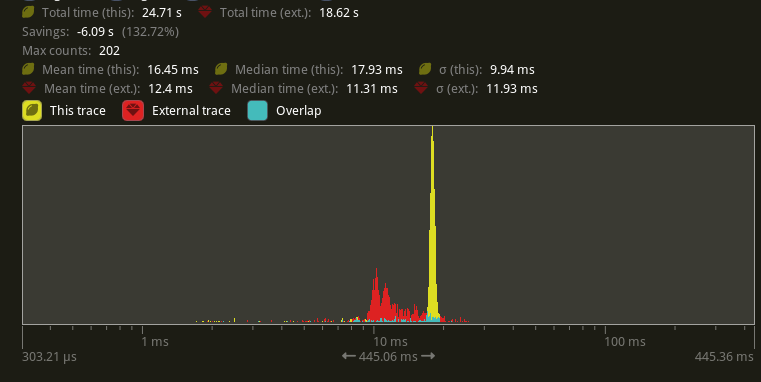 Looking at the median frame times, that's a 37% reduction from before. --- ## Changelog - Changed: Improved sprite rendering performance by leveraging an instance-rate vertex buffer. --------- Co-authored-by: Giacomo Stevanato <giaco.stevanato@gmail.com> |
||
|
lelo
|
42e6dc8987
|
Refactor EventReader::iter to read (#9631)
# Objective - The current `EventReader::iter` has been determined to cause confusion among new Bevy users. It was suggested by @JoJoJet to rename the method to better clarify its usage. - Solves #9624 ## Solution - Rename `EventReader::iter` to `EventReader::read`. - Rename `EventReader::iter_with_id` to `EventReader::read_with_id`. - Rename `ManualEventReader::iter` to `ManualEventReader::read`. - Rename `ManualEventReader::iter_with_id` to `ManualEventReader::read_with_id`. --- ## Changelog - `EventReader::iter` has been renamed to `EventReader::read`. - `EventReader::iter_with_id` has been renamed to `EventReader::read_with_id`. - `ManualEventReader::iter` has been renamed to `ManualEventReader::read`. - `ManualEventReader::iter_with_id` has been renamed to `ManualEventReader::read_with_id`. - Deprecated `EventReader::iter` - Deprecated `EventReader::iter_with_id` - Deprecated `ManualEventReader::iter` - Deprecated `ManualEventReader::iter_with_id` ## Migration Guide - Existing usages of `EventReader::iter` and `EventReader::iter_with_id` will have to be changed to `EventReader::read` and `EventReader::read_with_id` respectively. - Existing usages of `ManualEventReader::iter` and `ManualEventReader::iter_with_id` will have to be changed to `ManualEventReader::read` and `ManualEventReader::read_with_id` respectively. |
||
|
robtfm
|
db47ea2f27
|
include toplevel shader-associated defs (#9343)
# Objective shader defs associated with a shader via `load_internal_asset!` or `Shader::from_xxx_with_defs` were being accidentally ignored for top-level shaders. ## Solution include the defs for top level shaders. |
||
|
JMS55
|
ad011d0455
|
Add GpuArrayBuffer and BatchedUniformBuffer (#8204)
# Objective - Add a type for uploading a Rust `Vec<T>` to a GPU `array<T>`. - Makes progress towards https://github.com/bevyengine/bevy/issues/89. ## Solution - Port @superdump's `BatchedUniformBuffer` to bevy main, as a fallback for WebGL2, which doesn't support storage buffers. - Rather than getting an `array<T>` in a shader, you get an `array<T, N>`, and have to rebind every N elements via dynamic offsets. - Add `GpuArrayBuffer` to abstract over `StorageBuffer<Vec<T>>`/`BatchedUniformBuffer`. ## Future Work Add a shader macro kinda thing to abstract over the following automatically: https://github.com/bevyengine/bevy/pull/8204#pullrequestreview-1396911727 --- ## Changelog * Added `GpuArrayBuffer`, `GpuComponentArrayBufferPlugin`, `GpuArrayBufferable`, and `GpuArrayBufferIndex` types. * Added `DynamicUniformBuffer::new_with_alignment()`. --------- Co-authored-by: Robert Swain <robert.swain@gmail.com> Co-authored-by: François <mockersf@gmail.com> Co-authored-by: Teodor Tanasoaia <28601907+teoxoy@users.noreply.github.com> Co-authored-by: IceSentry <IceSentry@users.noreply.github.com> Co-authored-by: Vincent <9408210+konsolas@users.noreply.github.com> Co-authored-by: robtfm <50659922+robtfm@users.noreply.github.com> |
||
|
robtfm
|
9ad546ecec
|
fix module name for AssetPath shaders (#9186)
# Objective AssetPath shader imports check if the shader is added using the path without quotes. this causes them to be re-added even if already present, which can cause previous dependents to get unloaded leading to a "missing import" error. ## Solution fix the module name of AssetPath shaders used for checking if it's already added to correctly use the quoted name. |
||
|
robtfm
|
10f5c92068
|
improve shader import model (#5703)
# Objective operate on naga IR directly to improve handling of shader modules. - give codespan reporting into imported modules - allow glsl to be used from wgsl and vice-versa the ultimate objective is to make it possible to - provide user hooks for core shader functions (to modify light behaviour within the standard pbr pipeline, for example) - make automatic binding slot allocation possible but ... since this is already big, adds some value and (i think) is at feature parity with the existing code, i wanted to push this now. ## Solution i made a crate called naga_oil (https://github.com/robtfm/naga_oil - unpublished for now, could be part of bevy) which manages modules by - building each module independantly to naga IR - creating "header" files for each supported language, which are used to build dependent modules/shaders - make final shaders by combining the shader IR with the IR for imported modules then integrated this into bevy, replacing some of the existing shader processing stuff. also reworked examples to reflect this. ## Migration Guide shaders that don't use `#import` directives should work without changes. the most notable user-facing difference is that imported functions/variables/etc need to be qualified at point of use, and there's no "leakage" of visible stuff into your shader scope from the imports of your imports, so if you used things imported by your imports, you now need to import them directly and qualify them. the current strategy of including/'spreading' `mesh_vertex_output` directly into a struct doesn't work any more, so these need to be modified as per the examples (e.g. color_material.wgsl, or many others). mesh data is assumed to be in bindgroup 2 by default, if mesh data is bound into bindgroup 1 instead then the shader def `MESH_BINDGROUP_1` needs to be added to the pipeline shader_defs. |
||
|
loganbenjamin
|
ee1368a032
|
Fix AsBindGroup derive, texture attribute, visibility flag parsing (#8868)
# Objective - Fix the AsBindGroup texture attribute visibility flag parsing - This appears to have been caused by a syn crate update which then the visibility code got updated - Also I noticed that by default the vertex and fragment flags were on, so visibility(compute) would actually make the texture visible to vertex, fragment and compute shaders, I fixed this too ## Solution - Update flag parsing to use MetaList.parse_nested_meta function, which loads the flags into a Vec then loop through those flags - Change initial visibility flags to use VisibilityFlags::default() rather than VisibilityFlags::vertex_fragment() |
||
|
radiish
|
1efc762924
|
reflect: stable type path v2 (#7184)
# Objective
- Introduce a stable alternative to
[`std::any::type_name`](https://doc.rust-lang.org/std/any/fn.type_name.html).
- Rewrite of #5805 with heavy inspiration in design.
- On the path to #5830.
- Part of solving #3327.
## Solution
- Add a `TypePath` trait for static stable type path/name information.
- Add a `TypePath` derive macro.
- Add a `impl_type_path` macro for implementing internal and foreign
types in `bevy_reflect`.
---
## Changelog
- Added `TypePath` trait.
- Added `DynamicTypePath` trait and `get_type_path` method to `Reflect`.
- Added a `TypePath` derive macro.
- Added a `bevy_reflect::impl_type_path` for implementing `TypePath` on
internal and foreign types in `bevy_reflect`.
- Changed `bevy_reflect::utility::(Non)GenericTypeInfoCell` to
`(Non)GenericTypedCell<T>` which allows us to be generic over both
`TypeInfo` and `TypePath`.
- `TypePath` is now a supertrait of `Asset`, `Material` and
`Material2d`.
- `impl_reflect_struct` needs a `#[type_path = "..."]` attribute to be
specified.
- `impl_reflect_value` needs to either specify path starting with a
double colon (`::core::option::Option`) or an `in my_crate::foo`
declaration.
- Added `bevy_reflect_derive::ReflectTypePath`.
- Most uses of `Ident` in `bevy_reflect_derive` changed to use
`ReflectTypePath`.
## Migration Guide
- Implementors of `Asset`, `Material` and `Material2d` now also need to
derive `TypePath`.
- Manual implementors of `Reflect` will need to implement the new
`get_type_path` method.
## Open Questions
- [x] ~This PR currently does not migrate any usages of
`std::any::type_name` to use `bevy_reflect::TypePath` to ease the review
process. Should it?~ Migration will be left to a follow-up PR.
- [ ] This PR adds a lot of `#[derive(TypePath)]` and `T: TypePath` to
satisfy new bounds, mostly when deriving `TypeUuid`. Should we make
`TypePath` a supertrait of `TypeUuid`? [Should we remove `TypeUuid` in
favour of
`TypePath`?](
|
||
|
ira
|
5f936b42b1
|
Resolve clippy issues for rust 1.70.0 (#8738)
- Supress false positive `redundant_clone` lints. - Supress inactionable `result_large_err` lint. Most of the size(50 out of 68 bytes) is coming from `naga::WithSpan<naga::valid::ValidationError>` |
||
|
Connor McMillin
|
f786ad4906
|
Added Vec append to BufferVec - Issue #3531 (#8575)
# Objective - Fixes #3531 ## Solution - Added an append wrapper to BufferVec based on the function signature for vec.append() --- First PR to Bevy. I didn't see any tests for other BufferVec methods (could have missed them) and currently this method is not used anywhere in the project. Let me know if there are tests to add or if I should find somewhere to use append so it is not dead code. The issue mentions implementing `truncate` and `extend` which were already implemented and merged [here](https://github.com/bevyengine/bevy/pull/6833/files#diff-c8fb332382379e383f1811e30c31991b1e0feb38ca436c357971755368012ced) |
||
|
François
|
71842c5ac9
|
Webgpu support (#8336)
# Objective - Support WebGPU - alternative to #5027 that doesn't need any async / await - fixes #8315 - Surprise fix #7318 ## Solution ### For async renderer initialisation - Update the plugin lifecycle: - app builds the plugin - calls `plugin.build` - registers the plugin - app starts the event loop - event loop waits for `ready` of all registered plugins in the same order - returns `true` by default - then call all `finish` then all `cleanup` in the same order as registered - then execute the schedule In the case of the renderer, to avoid anything async: - building the renderer plugin creates a detached task that will send back the initialised renderer through a mutex in a resource - `ready` will wait for the renderer to be present in the resource - `finish` will take that renderer and place it in the expected resources by other plugins - other plugins (that expect the renderer to be available) `finish` are called and they are able to set up their pipelines - `cleanup` is called, only custom one is still for pipeline rendering ### For WebGPU support - update the `build-wasm-example` script to support passing `--api webgpu` that will build the example with WebGPU support - feature for webgl2 was always enabled when building for wasm. it's now in the default feature list and enabled on all platforms, so check for this feature must also check that the target_arch is `wasm32` --- ## Migration Guide - `Plugin::setup` has been renamed `Plugin::cleanup` - `Plugin::finish` has been added, and plugins adding pipelines should do it in this function instead of `Plugin::build` ```rust // Before impl Plugin for MyPlugin { fn build(&self, app: &mut App) { app.insert_resource::<MyResource> .add_systems(Update, my_system); let render_app = match app.get_sub_app_mut(RenderApp) { Ok(render_app) => render_app, Err(_) => return, }; render_app .init_resource::<RenderResourceNeedingDevice>() .init_resource::<OtherRenderResource>(); } } // After impl Plugin for MyPlugin { fn build(&self, app: &mut App) { app.insert_resource::<MyResource> .add_systems(Update, my_system); let render_app = match app.get_sub_app_mut(RenderApp) { Ok(render_app) => render_app, Err(_) => return, }; render_app .init_resource::<OtherRenderResource>(); } fn finish(&self, app: &mut App) { let render_app = match app.get_sub_app_mut(RenderApp) { Ok(render_app) => render_app, Err(_) => return, }; render_app .init_resource::<RenderResourceNeedingDevice>(); } } ``` |
||
|
Airing
|
4d54ce14aa
|
Updated to wgpu 0.16.0, wgpu-hal 0.16.0 and naga 0.12.0 (#8446)
# Objective - Updated to wgpu 0.16.0 and wgpu-hal 0.16.0 --- ## Changelog 1. Upgrade wgpu to 0.16.0 and wgpu-hal to 0.16.0 2. Fix the error in native when using a filterable `TextureSampleType::Float` on a multisample `BindingType::Texture`. ([https://github.com/gfx-rs/wgpu/pull/3686](https://github.com/gfx-rs/wgpu/pull/3686)) --------- Co-authored-by: François <mockersf@gmail.com> |