# Objective

Upgrade to `wgpu` version `25.0`.

Depends on https://github.com/bevyengine/naga_oil/pull/121

## Solution

### Problem

The biggest issue we face upgrading is the following requirement:
> To facilitate this change, there was an additional validation rule put
in place: if there is a binding array in a bind group, you may not use
dynamic offset buffers or uniform buffers in that bind group. This
requirement comes from vulkan rules on UpdateAfterBind descriptors.

This is a major difficulty for us, as there are a number of binding
arrays that are used in the view bind group. Note, this requirement does
not affect merely uniform buffors that use dynamic offset but the use of
*any* uniform in a bind group that also has a binding array.

### Attempted fixes

The easiest fix would be to change uniforms to be storage buffers
whenever binding arrays are in use:
```wgsl
#ifdef BINDING_ARRAYS_ARE_USED
@group(0) @binding(0) var<uniform> view: View;
@group(0) @binding(1) var<uniform> lights: types::Lights;
#else
@group(0) @binding(0) var<storage> view: array<View>;
@group(0) @binding(1) var<storage> lights: array<types::Lights>;
#endif
```

This requires passing the view index to the shader so that we know where
to index into the buffer:

```wgsl
struct PushConstants {
    view_index: u32,
}

var<push_constant> push_constants: PushConstants;
```

Using push constants is no problem because binding arrays are only
usable on native anyway.

However, this greatly complicates the ability to access `view` in
shaders. For example:
```wgsl
#ifdef BINDING_ARRAYS_ARE_USED
mesh_view_bindings::view.view_from_world[0].z
#else
mesh_view_bindings::view[mesh_view_bindings::view_index].view_from_world[0].z
#endif
```

Using this approach would work but would have the effect of polluting
our shaders with ifdef spam basically *everywhere*.

Why not use a function? Unfortunately, the following is not valid wgsl
as it returns a binding directly from a function in the uniform path.

```wgsl
fn get_view() -> View {
#if BINDING_ARRAYS_ARE_USED
    let view_index = push_constants.view_index;
    let view = views[view_index];
#endif
    return view;
}
```

This also poses problems for things like lights where we want to return
a ptr to the light data. Returning ptrs from wgsl functions isn't
allowed even if both bindings were buffers.

The next attempt was to simply use indexed buffers everywhere, in both
the binding array and non binding array path. This would be viable if
push constants were available everywhere to pass the view index, but
unfortunately they are not available on webgpu. This means either
passing the view index in a storage buffer (not ideal for such a small
amount of state) or using push constants sometimes and uniform buffers
only on webgpu. However, this kind of conditional layout infects
absolutely everything.

Even if we were to accept just using storage buffer for the view index,
there's also the additional problem that some dynamic offsets aren't
actually per-view but per-use of a setting on a camera, which would
require passing that uniform data on *every* camera regardless of
whether that rendering feature is being used, which is also gross.

As such, although it's gross, the simplest solution just to bump binding
arrays into `@group(1)` and all other bindings up one bind group. This
should still bring us under the device limit of 4 for most users.

### Next steps / looking towards the future

I'd like to avoid needing split our view bind group into multiple parts.
In the future, if `wgpu` were to add `@builtin(draw_index)`, we could
build a list of draw state in gpu processing and avoid the need for any
kind of state change at all (see
https://github.com/gfx-rs/wgpu/issues/6823). This would also provide
significantly more flexibility to handle things like offsets into other
arrays that may not be per-view.

### Testing

Tested a number of examples, there are probably more that are still
broken.

---------

Co-authored-by: François Mockers <mockersf@gmail.com>
Co-authored-by: Elabajaba <Elabajaba@users.noreply.github.com>
# Bevy Solari
<img
src="https://github.com/user-attachments/assets/94061fc8-01cf-4208-b72a-8eecad610d76"
width="100" />
## Preface
- See release notes.
- Please talk to me in #rendering-dev on discord or open a github
discussion if you have questions about the long term plan, and keep
discussion in this PR limited to the contents of the PR :)
## Connections
- Works towards #639, #16408.
- Spawned https://github.com/bevyengine/bevy/issues/18993.
- Need to fix RT stuff in naga_oil first
https://github.com/bevyengine/naga_oil/pull/116.
## This PR
After nearly two years, I've revived the raytraced lighting effort I
first started in https://github.com/bevyengine/bevy/pull/10000.
Unlike that PR, which has realtime techniques, I've limited this PR to:
* `RaytracingScenePlugin` - BLAS and TLAS building, geometry and texture
binding, sampling functions.
* `PathtracingPlugin` - A non-realtime path tracer intended to serve as
a testbed and reference.
## What's implemented?

* BLAS building on mesh load
* Emissive lights
* Directional lights with soft shadows
* Diffuse (lambert, not Bevy's diffuse BRDF) and emissive materials
* A reference path tracer with:
* Antialiasing
* Direct light sampling (next event estimation) with 0/1 MIS weights
* Importance-sampled BRDF bounces
* Russian roulette
## What's _not_ implemented?
* Anything realtime, including a real-time denoiser
* Integration with Bevy's rasterized gbuffer
* Specular materials
* Non-opaque geometry
* Any sort of CPU or GPU optimizations
* BLAS compaction, proper bindless, and further RT APIs are things that
we need wgpu to add
* PointLights, SpotLights, or skyboxes / environment lighting
* Support for materials other than StandardMaterial (and only a subset
of properties are supported)
* Skinned/morphed or otherwise animating/deformed meshes
* Mipmaps
* Adaptive self-intersection ray bias
* A good way for developers to detect whether the user's GPU supports RT
or not, and fallback to baked lighting.
* Documentation and actual finalized APIs (literally everything is
subject to change)
## End-user Usage
* Have a GPU that supports RT with inline ray queries
* Add `SolariPlugin` to your app
* Ensure any `Mesh` asset you want to use for raytracing has
`enable_raytracing: true` (defaults to true), and that it uses the
standard uncompressed position/normal/uv_0/tangent vertex attribute set,
triangle list topology, and 32-bit indices.
* If you don't want to build a BLAS and use the mesh for RT, set
enable_raytracing to false.
* Add the `RaytracingMesh3d` component to your entity (separate from
`Mesh3d` or `MeshletMesh3d`).
## Testing
- Did you test these changes? If so, how?
- Ran the solari example.
- Are there any parts that need more testing?
- Other test scenes probably. Normal mapping would be good to test.
- How can other people (reviewers) test your changes? Is there anything
specific they need to know?
- See the solari.rs example for how to setup raytracing.
- If relevant, what platforms did you test these changes on, and are
there any important ones you can't test?
- Windows 11, NVIDIA RTX 3080.
---------
Co-authored-by: atlv <email@atlasdostal.com>
Co-authored-by: IceSentry <IceSentry@users.noreply.github.com>
Co-authored-by: Carter Anderson <mcanders1@gmail.com>
# Objective

- A step towards splitting out bevy_camera from bevy_render

## Solution

- Move a shim type into bevy_utils to avoid a dependency cycle
- Manually expand Deref/DerefMut to avoid having a bevy_derive
dependency so early in the dep tree

## Testing

- It compiles
# Objective

The goal of `bevy_platform_support` is to provide a set of platform
agnostic APIs, alongside platform-specific functionality. This is a high
traffic crate (providing things like HashMap and Instant). Especially in
light of https://github.com/bevyengine/bevy/discussions/18799, it
deserves a friendlier / shorter name.

Given that it hasn't had a full release yet, getting this change in
before Bevy 0.16 makes sense.

## Solution

- Rename `bevy_platform_support` to `bevy_platform`.
* `submit_graph_commands` was incorrectly timing the command buffer
generation tasks as well, and not only the queue submission. Moved the
span to fix that.
* Added a new `command_buffer_generation_tasks` span as a parent for all
the individual command buffer generation tasks that don't run as part of
the Core3d span.

# Objective

Fixes https://github.com/bevyengine/bevy/issues/18366 which seems to
have a similar underlying cause than the already closed (but not fixed)
https://github.com/bevyengine/bevy/issues/16185.

## Solution

For Windows with the AMD vulkan driver, there was already a hack to
force serial command encoding, which prevented these issues. The Linux
version of the AMD vulkan driver seems to have similar issues than its
Windows counterpart, so I extended the hack to also cover AMD on Linux.

I also removed the mention of `wgpu` since it was already outdated, and
doesn't seem to be relevant to the core issue (the AMD driver being
buggy).

## Testing

- Did you test these changes? If so, how?
- I ran the `3d_scene` example, which on `main` produced the flickering
shadows on Linux with the amdvlk driver, while it no longer does with
the workaround applied.
- Are there any parts that need more testing?
  - Not sure.
- How can other people (reviewers) test your changes? Is there anything
specific they need to know?
  - Requires a Linux system with an AMD card and the AMDVLK driver.
- If relevant, what platforms did you test these changes on, and are
there any important ones you can't test?
  - My change should only affect Linux, where I did test it.
# Objective
- Fixes#17960
## Solution
- Followed the [edition upgrade
guide](https://doc.rust-lang.org/edition-guide/editions/transitioning-an-existing-project-to-a-new-edition.html)
## Testing
- CI
---
## Summary of Changes
### Documentation Indentation
When using lists in documentation, proper indentation is now linted for.
This means subsequent lines within the same list item must start at the
same indentation level as the item.
```rust
/* Valid */
/// - Item 1
/// Run-on sentence.
/// - Item 2
struct Foo;
/* Invalid */
/// - Item 1
/// Run-on sentence.
/// - Item 2
struct Foo;
```
### Implicit `!` to `()` Conversion
`!` (the never return type, returned by `panic!`, etc.) no longer
implicitly converts to `()`. This is particularly painful for systems
with `todo!` or `panic!` statements, as they will no longer be functions
returning `()` (or `Result<()>`), making them invalid systems for
functions like `add_systems`. The ideal fix would be to accept functions
returning `!` (or rather, _not_ returning), but this is blocked on the
[stabilisation of the `!` type
itself](https://doc.rust-lang.org/std/primitive.never.html), which is
not done.
The "simple" fix would be to add an explicit `-> ()` to system
signatures (e.g., `|| { todo!() }` becomes `|| -> () { todo!() }`).
However, this is _also_ banned, as there is an existing lint which (IMO,
incorrectly) marks this as an unnecessary annotation.
So, the "fix" (read: workaround) is to put these kinds of `|| -> ! { ...
}` closuers into variables and give the variable an explicit type (e.g.,
`fn()`).
```rust
// Valid
let system: fn() = || todo!("Not implemented yet!");
app.add_systems(..., system);
// Invalid
app.add_systems(..., || todo!("Not implemented yet!"));
```
### Temporary Variable Lifetimes
The order in which temporary variables are dropped has changed. The
simple fix here is _usually_ to just assign temporaries to a named
variable before use.
### `gen` is a keyword
We can no longer use the name `gen` as it is reserved for a future
generator syntax. This involved replacing uses of the name `gen` with
`r#gen` (the raw-identifier syntax).
### Formatting has changed
Use statements have had the order of imports changed, causing a
substantial +/-3,000 diff when applied. For now, I have opted-out of
this change by amending `rustfmt.toml`
```toml
style_edition = "2021"
```
This preserves the original formatting for now, reducing the size of
this PR. It would be a simple followup to update this to 2024 and run
`cargo fmt`.
### New `use<>` Opt-Out Syntax
Lifetimes are now implicitly included in RPIT types. There was a handful
of instances where it needed to be added to satisfy the borrow checker,
but there may be more cases where it _should_ be added to avoid
breakages in user code.
### `MyUnitStruct { .. }` is an invalid pattern
Previously, you could match against unit structs (and unit enum
variants) with a `{ .. }` destructuring. This is no longer valid.
### Pretty much every use of `ref` and `mut` are gone
Pattern binding has changed to the point where these terms are largely
unused now. They still serve a purpose, but it is far more niche now.
### `iter::repeat(...).take(...)` is bad
New lint recommends using the more explicit `iter::repeat_n(..., ...)`
instead.
## Migration Guide
The lifetimes of functions using return-position impl-trait (RPIT) are
likely _more_ conservative than they had been previously. If you
encounter lifetime issues with such a function, please create an issue
to investigate the addition of `+ use<...>`.
## Notes
- Check the individual commits for a clearer breakdown for what
_actually_ changed.
---------
Co-authored-by: François Mockers <francois.mockers@vleue.com>
Didn't remove WgpuWrapper. Not sure if it's needed or not still.

## Testing

- Did you test these changes? If so, how? Example runner
- Are there any parts that need more testing? Web (portable atomics
thingy?), DXC.

## Migration Guide
- Bevy has upgraded to [wgpu
v24](https://github.com/gfx-rs/wgpu/blob/trunk/CHANGELOG.md#v2400-2025-01-15).
- When using the DirectX 12 rendering backend, the new priority system
for choosing a shader compiler is as follows:
- If the `WGPU_DX12_COMPILER` environment variable is set at runtime, it
is used
- Else if the new `statically-linked-dxc` feature is enabled, a custom
version of DXC will be statically linked into your app at compile time.
- Else Bevy will look in the app's working directory for
`dxcompiler.dll` and `dxil.dll` at runtime.
- Else if they are missing, Bevy will fall back to FXC (not recommended)

---------

Co-authored-by: Alice Cecile <alice.i.cecile@gmail.com>
Co-authored-by: IceSentry <c.giguere42@gmail.com>
Co-authored-by: François Mockers <francois.mockers@vleue.com>
# Objective

- Contributes to #16877

## Solution

- Initial creation of `bevy_platform_support` crate.
- Moved `bevy_utils::Instant` into new `bevy_platform_support` crate.
- Moved `portable-atomic`, `portable-atomic-util`, and
`critical-section` into new `bevy_platform_support` crate.

## Testing

- CI

---

## Showcase

Instead of needing code like this to import an `Arc`:

```rust
#[cfg(feature = "portable-atomic")]
use portable_atomic_util::Arc;

#[cfg(not(feature = "portable-atomic"))]
use alloc::sync::Arc;
```

We can now use:

```rust
use bevy_platform_support::sync::Arc;
```

This applies to many other types, but the goal is overall the same:
allowing crates to use `std`-like types without the boilerplate of
conditional compilation and platform-dependencies.

## Migration Guide

- Replace imports of `bevy_utils::Instant` with
`bevy_platform_support::time::Instant`
- Replace imports of `bevy::utils::Instant` with
`bevy::platform_support::time::Instant`

## Notes

- `bevy_platform_support` hasn't been reserved on `crates.io`
- ~~`bevy_platform_support` is not re-exported from `bevy` at this time.
It may be worthwhile exporting this crate, but I am unsure of a
reasonable name to export it under (`platform_support` may be a bit
wordy for user-facing).~~
- I've included an implementation of `Instant` which is suitable for
`no_std` platforms that are not Wasm for the sake of eliminating feature
gates around its use. It may be a controversial inclusion, so I'm happy
to remove it if required.
- There are many other items (`spin`, `bevy_utils::Sync(Unsafe)Cell`,
etc.) which should be added to this crate. I have kept the initial scope
small to demonstrate utility without making this too unwieldy.

---------

Co-authored-by: TimJentzsch <TimJentzsch@users.noreply.github.com>
Co-authored-by: Chris Russell <8494645+chescock@users.noreply.github.com>
Co-authored-by: François Mockers <francois.mockers@vleue.com>
# Objective

- Contributes to #11478

## Solution

- Made `bevy_utils::tracing` `doc(hidden)`
- Re-exported `tracing` from `bevy_log` for end-users
- Added `tracing` directly to crates that need it.

## Testing

- CI

---

## Migration Guide

If you were importing `tracing` via `bevy::utils::tracing`, instead use
`bevy::log::tracing`. Note that many items within `tracing` are also
directly re-exported from `bevy::log` as well, so you may only need
`bevy::log` for the most common items (e.g., `warn!`, `trace!`, etc.).
This also applies to the `log_once!` family of macros.

## Notes

- While this doesn't reduce the line-count in `bevy_utils`, it further
decouples the internal crates from `bevy_utils`, making its eventual
removal more feasible in the future.
- I have just imported `tracing` as we do for all dependencies. However,
a workspace dependency may be more appropriate for version management.
# Objective

* Remove all uses of render_resource_wrapper.
* Make it easier to share a `wgpu::Device` between Bevy and application
code.

## Solution

Removed the `render_resource_wrapper` macro.

To improve the `RenderCreation:: Manual ` API, `ErasedRenderDevice` was
replaced by `Arc`. Unfortunately I had to introduce one more usage of
`WgpuWrapper` which seems like an unwanted constraint on the caller.

## Testing

- Did you test these changes? If so, how?
    - Ran `cargo test`.
    - Ran a few examples.
    - Used `RenderCreation::Manual` in my own project
    - Exercised `RenderCreation::Automatic` through examples

- Are there any parts that need more testing?
    - No

- How can other people (reviewers) test your changes? Is there anything
specific they need to know?
    - Run examples
    - Use `RenderCreation::Manual` in their own project
# Objective

Adds a new `Readback` component to request for readback of a
`Handle<Image>` or `Handle<ShaderStorageBuffer>` to the CPU in a future
frame.

## Solution

We track the `Readback` component and allocate a target buffer to write
the gpu resource into and map it back asynchronously, which then fires a
trigger on the entity in the main world. This proccess is asynchronous,
and generally takes a few frames.

## Showcase

```rust
let mut buffer = ShaderStorageBuffer::from(vec![0u32; 16]);
buffer.buffer_description.usage |= BufferUsages::COPY_SRC;
let buffer = buffers.add(buffer);

commands
    .spawn(Readback::buffer(buffer.clone()))
    .observe(|trigger: Trigger<ReadbackComplete>| {
        info!("Buffer data from previous frame {:?}", trigger.event());
    });
```

---------

Co-authored-by: Kristoffer Søholm <k.soeholm@gmail.com>
Co-authored-by: IceSentry <IceSentry@users.noreply.github.com>
# Objective
- Fixes#6370
- Closes#6581
## Solution
- Added the following lints to the workspace:
- `std_instead_of_core`
- `std_instead_of_alloc`
- `alloc_instead_of_core`
- Used `cargo +nightly fmt` with [item level use
formatting](https://rust-lang.github.io/rustfmt/?version=v1.6.0&search=#Item%5C%3A)
to split all `use` statements into single items.
- Used `cargo clippy --workspace --all-targets --all-features --fix
--allow-dirty` to _attempt_ to resolve the new linting issues, and
intervened where the lint was unable to resolve the issue automatically
(usually due to needing an `extern crate alloc;` statement in a crate
root).
- Manually removed certain uses of `std` where negative feature gating
prevented `--all-features` from finding the offending uses.
- Used `cargo +nightly fmt` with [crate level use
formatting](https://rust-lang.github.io/rustfmt/?version=v1.6.0&search=#Crate%5C%3A)
to re-merge all `use` statements matching Bevy's previous styling.
- Manually fixed cases where the `fmt` tool could not re-merge `use`
statements due to conditional compilation attributes.
## Testing
- Ran CI locally
## Migration Guide
The MSRV is now 1.81. Please update to this version or higher.
## Notes
- This is a _massive_ change to try and push through, which is why I've
outlined the semi-automatic steps I used to create this PR, in case this
fails and someone else tries again in the future.
- Making this change has no impact on user code, but does mean Bevy
contributors will be warned to use `core` and `alloc` instead of `std`
where possible.
- This lint is a critical first step towards investigating `no_std`
options for Bevy.
---------
Co-authored-by: François Mockers <francois.mockers@vleue.com>
# Objective
- Remove the `wgpu_trace` feature while still making it easy/possible to
record wgpu traces for debugging.
- Close#14725.
- Get a taste of the bevy codebase. :P
## Solution
This PR performs the above objective by removing the `wgpu_trace`
feature from all `Cargo.toml` files.
However, wgpu traces are still useful for debugging - but to record
them, you need to pass in a directory path to store the traces in. To
avoid forcing users into manually creating the renderer,
`bevy_render::settings::WgpuSettings` now has a `trace_path` field, so
that all of Bevy's automatic initialization can happen while still
allowing for tracing.
## Testing
- Did you test these changes? If so, how?
- I have tested these changes, but only via running `cargo run -p ci`. I
am hoping the Github Actions workflows will catch anything I missed.
- Are there any parts that need more testing?
- I do not believe so.
- How can other people (reviewers) test your changes? Is there anything
specific they need to know?
- If you want to test these changes, I have updated the debugging guide
(`docs/debugging.md`) section on WGPU Tracing.
- If relevant, what platforms did you test these changes on, and are
there any important ones you can't test?
- I ran the above command on a Windows 10 64-bit (x64) machine, using
the `stable-x86_64-pc-windows-msvc` toolchain. I do not have anything
set up for other platforms or targets (though I can't imagine this needs
testing on other platforms).
---
## Migration Guide
1. The `bevy/wgpu_trace`, `bevy_render/wgpu_trace`, and
`bevy_internal/wgpu_trace` features no longer exist. Remove them from
your `Cargo.toml`, CI, tooling, and what-not.
2. Follow the instructions in the updated `docs/debugging.md` file in
the repository, under the WGPU Tracing section.
Because of the changes made, you can now generate traces to any path,
rather than the hardcoded `%WorkspaceRoot%/wgpu_trace` (where
`%WorkspaceRoot%` is... the root of your crate's workspace) folder.
(If WGPU hasn't restored tracing functionality...) Do note that WGPU has
not yet restored tracing functionality. However, once it does, the above
should be sufficient to generate new traces.
---------
Co-authored-by: TrialDragon <31419708+TrialDragon@users.noreply.github.com>
# Objective
Fixes#14782
## Solution
Enable the lint and fix all upcoming hints (`--fix`). Also tried to
figure out the false-positive (see review comment). Maybe split this PR
up into multiple parts where only the last one enables the lint, so some
can already be merged resulting in less many files touched / less
potential for merge conflicts?
Currently, there are some cases where it might be easier to read the
code with the qualifier, so perhaps remove the import of it and adapt
its cases? In the current stage it's just a plain adoption of the
suggestions in order to have a base to discuss.
## Testing
`cargo clippy` and `cargo run -p ci` are happy.
Upgrading to WGPU 22.

Needs `naga_oil` to upgrade first, I've got a fork that compiles but
fails tests, so until that's fixed and the crate is officially
updated/released this will be blocked.

---------

Co-authored-by: Elabajaba <Elabajaba@users.noreply.github.com>
# Objective

Numerous people have been confused that Bevy runs slowly, when the
reason is that the `llvmpipe` software rendered is being used.

## Solution

Printing a warning could reduce the confusion.
Currently blocked on https://github.com/gfx-rs/wgpu/issues/5774

# Objective

Update to wgpu 0.20

## Solution

Update to wgpu 0.20 and naga_oil 0.14.

## Testing

Tested a few different examples on linux (vulkan, webgl2, webgpu) and
windows (dx12 + vulkan) and they worked.

---

## Changelog

- Updated to wgpu 0.20. Note that we don't currently support wgpu's new
pipeline overridable constants, as they don't work on web currently and
need some more changes to naga_oil (and are somewhat redundant with
naga_oil's shader defs). See wgpu's changelog for more
https://github.com/gfx-rs/wgpu/blob/trunk/CHANGELOG.md#v0200-2024-04-28

## Migration Guide

TODO

---------

Co-authored-by: Alice Cecile <alice.i.cecile@gmail.com>
Co-authored-by: François Mockers <mockersf@gmail.com>
# Objective

I'm reading some of the rendering code for the first time; and using
this opportunity to flesh out some docs for the parts that I did not
understand.
rather than a questionable design choice is not a breaking change.

---------

Co-authored-by: BD103 <59022059+BD103@users.noreply.github.com>
# Objective

See https://github.com/gfx-rs/wgpu/issues/5488 for context and
rationale.

## Solution

- Disables `wgpu::Features::RAY_QUERY` and
`wgpu::Features::RAY_TRACING_ACCELERATION_STRUCTURE` by default. They
must be explicitly opted into now.

---

## Changelog

- Disables `wgpu::Features::RAY_QUERY` and
`wgpu::Features::RAY_TRACING_ACCELERATION_STRUCTURE` by default. They
must be explicitly opted into now.

## Migration Guide

- If you need `wgpu::Features::RAY_QUERY` or
`wgpu::Features::RAY_TRACING_ACCELERATION_STRUCTURE`, enable them
explicitly using `WgpuSettings::features`
# Objective
This gets Bevy building on Wasm when the `atomics` flag is enabled. This
does not yet multithread Bevy itself, but it allows Bevy users to use a
crate like `wasm_thread` to spawn their own threads and manually
parallelize work. This is a first step towards resolving #4078 . Also
fixes#9304.
This provides a foothold so that Bevy contributors can begin to think
about multithreaded Wasm's constraints and Bevy can work towards changes
to get the engine itself multithreaded.
Some flags need to be set on the Rust compiler when compiling for Wasm
multithreading. Here's what my build script looks like, with the correct
flags set, to test out Bevy examples on web:
```bash
set -e
RUSTFLAGS='-C target-feature=+atomics,+bulk-memory,+mutable-globals' \
cargo build --example breakout --target wasm32-unknown-unknown -Z build-std=std,panic_abort --release
wasm-bindgen --out-name wasm_example \
--out-dir examples/wasm/target \
--target web target/wasm32-unknown-unknown/release/examples/breakout.wasm
devserver --header Cross-Origin-Opener-Policy='same-origin' --header Cross-Origin-Embedder-Policy='require-corp' --path examples/wasm
```
A few notes:
1. `cpal` crashes immediately when the `atomics` flag is set. That is
patched in https://github.com/RustAudio/cpal/pull/837, but not yet in
the latest crates.io release.
That can be temporarily worked around by patching Cpal like so:
```toml
[patch.crates-io]
cpal = { git = "https://github.com/RustAudio/cpal" }
```
2. When testing out `wasm_thread` you need to enable the `es_modules`
feature.
## Solution
The largest obstacle to compiling Bevy with `atomics` on web is that
`wgpu` types are _not_ Send and Sync. Longer term Bevy will need an
approach to handle that, but in the near term Bevy is already configured
to be single-threaded on web.
Therefor it is enough to wrap `wgpu` types in a
`send_wrapper::SendWrapper` that _is_ Send / Sync, but panics if
accessed off the `wgpu` thread.
---
## Changelog
- `wgpu` types that are not `Send` are wrapped in
`send_wrapper::SendWrapper` on Wasm + 'atomics'
- CommandBuffers are not generated in parallel on Wasm + 'atomics'
## Questions
- Bevy should probably add CI checks to make sure this doesn't regress.
Should that go in this PR or a separate PR? **Edit:** Added checks to
build Wasm with atomics
---------
Co-authored-by: François <mockersf@gmail.com>
Co-authored-by: Alice Cecile <alice.i.cecile@gmail.com>
Co-authored-by: daxpedda <daxpedda@gmail.com>
Co-authored-by: François <francois.mockers@vleue.com>
# Objective

It's useful to have access to render pipeline statistics, since they
provide more information than FPS alone. For example, the number of
drawn triangles can be used to debug culling and LODs. The number of
fragment shader invocations can provide a more stable alternative metric
than GPU elapsed time.

See also: Render node GPU timing overlay #8067, which doesn't provide
pipeline statistics, but adds a nice overlay.

## Solution

Add `RenderDiagnosticsPlugin`, which enables collecting pipeline
statistics and CPU & GPU timings.

---

## Changelog

- Add `RenderDiagnosticsPlugin`
- Add `RenderContext::diagnostic_recorder` method

---------

Co-authored-by: Alice Cecile <alice.i.cecile@gmail.com>
# Objective
- Encoding many GPU commands (such as in a renderpass with many draws,
such as the main opaque pass) onto a `wgpu::CommandEncoder` is very
expensive, and takes a long time.
- To improve performance, we want to perform the command encoding for
these heavy passes in parallel.
## Solution
- `RenderContext` can now queue up "command buffer generation tasks"
which are closures that will generate a command buffer when called.
- When finalizing the render context to produce the final list of
command buffers, these tasks are run in parallel on the
`ComputeTaskPool` to produce their corresponding command buffers.
- The general idea is that the node graph will run in serial, but in a
node, instead of doing rendering work, you can add tasks to do render
work in parallel with other node's tasks that get ran at the end of the
graph execution.
## Nodes Parallelized
- `MainOpaquePass3dNode`
- `PrepassNode`
- `DeferredGBufferPrepassNode`
- `ShadowPassNode` (One task per view)
## Future Work
- For large number of draws calls, might be worth further subdividing
passes into 2+ tasks.
- Extend this to UI, 2d, transparent, and transmissive nodes?
- Needs testing - small command buffers are inefficient - it may be
worth reverting to the serial command encoder usage for render phases
with few items.
- All "serial" (traditional) rendering work must finish before parallel
rendering tasks (the new stuff) can start to run.
- There is still only one submission to the graphics queue at the end of
the graph execution. There is still no ability to submit work earlier.
## Performance Improvement
Thanks to @Elabajaba for testing on Bistro.

TLDR: Without shadow mapping, this PR has no impact. _With_ shadow
mapping, this PR gives **~40 more fps** than main.
---
## Changelog
- `MainOpaquePass3dNode`, `PrepassNode`, `DeferredGBufferPrepassNode`,
and each shadow map within `ShadowPassNode` are now encoded in parallel,
giving _greatly_ increased CPU performance, mainly when shadow mapping
is enabled.
- Does not work on WASM or AMD+Windows+Vulkan.
- Added `RenderContext::add_command_buffer_generation_task()`.
- `RenderContext::new()` now takes adapter info
- Some render graph and Node related types and methods now have
additional lifetime constraints.
## Migration Guide
`RenderContext::new()` now takes adapter info
- Some render graph and Node related types and methods now have
additional lifetime constraints.
---------
Co-authored-by: Elabajaba <Elabajaba@users.noreply.github.com>
Co-authored-by: François <mockersf@gmail.com>
# Objective
While profiling around to validate the results of #9172, I noticed that
`present_frames` can take a significant amount of time. Digging into the
cause, it seems like we're creating a new `QueryState` from scratch
every frame. This involves scanning the entire World's metadata instead
of just updating its view of the world.
## Solution
Use a `SystemState` argument to cache the `QueryState` to avoid this
construction cost.
## Performance
Against `many_foxes`, this seems to cut the time spent in
`present_frames` by nearly almost 2x. Yellow is this PR, red is main.

# Objective

Keep core dependencies up to date.

## Solution

Update the dependencies.

wgpu 0.19 only supports raw-window-handle (rwh) 0.6, so bumping that was
included in this.

The rwh 0.6 version bump is just the simplest way of doing it. There
might be a way we can take advantage of wgpu's new safe surface creation
api, but I'm not familiar enough with bevy's window management to
untangle it and my attempt ended up being a mess of lifetimes and rustc
complaining about missing trait impls (that were implemented). Thanks to
@MiniaczQ for the (much simpler) rwh 0.6 version bump code.

Unblocks https://github.com/bevyengine/bevy/pull/9172 and
https://github.com/bevyengine/bevy/pull/10812

~~This might be blocked on cpal and oboe updating their ndk versions to
0.8, as they both currently target ndk 0.7 which uses rwh 0.5.2~~ Tested
on android, and everything seems to work correctly (audio properly stops
when minimized, and plays when re-focusing the app).

---

## Changelog

- `wgpu` has been updated to 0.19! The long awaited arcanization has
been merged (for more info, see
https://gfx-rs.github.io/2023/11/24/arcanization.html), and Vulkan
should now be working again on Intel GPUs.
- Targeting WebGPU now requires that you add the new `webgpu` feature
(setting the `RUSTFLAGS` environment variable to
`--cfg=web_sys_unstable_apis` is still required). This feature currently
overrides the `webgl2` feature if you have both enabled (the `webgl2`
feature is enabled by default), so it is not recommended to add it as a
default feature to libraries without putting it behind a flag that
allows library users to opt out of it! In the future we plan on
supporting wasm binaries that can target both webgl2 and webgpu now that
wgpu added support for doing so (see
https://github.com/bevyengine/bevy/issues/11505).
- `raw-window-handle` has been updated to version 0.6.

## Migration Guide

- `bevy_render::instance_index::get_instance_index()` has been removed
as the webgl2 workaround is no longer required as it was fixed upstream
in wgpu. The `BASE_INSTANCE_WORKAROUND` shaderdef has also been removed.
- WebGPU now requires the new `webgpu` feature to be enabled. The
`webgpu` feature currently overrides the `webgl2` feature so you no
longer need to disable all default features and re-add them all when
targeting `webgpu`, but binaries built with both the `webgpu` and
`webgl2` features will only target the webgpu backend, and will only
work on browsers that support WebGPU.
- Places where you conditionally compiled things for webgl2 need to be
updated because of this change, eg:
- `#[cfg(any(not(feature = "webgl"), not(target_arch = "wasm32")))]`
becomes `#[cfg(any(not(feature = "webgl") ,not(target_arch = "wasm32"),
feature = "webgpu"))]`
- `#[cfg(all(feature = "webgl", target_arch = "wasm32"))]` becomes
`#[cfg(all(feature = "webgl", target_arch = "wasm32", not(feature =
"webgpu")))]`
- `if cfg!(all(feature = "webgl", target_arch = "wasm32"))` becomes `if
cfg!(all(feature = "webgl", target_arch = "wasm32", not(feature =
"webgpu")))`
- `create_texture_with_data` now also takes a `TextureDataOrder`. You
can probably just set this to `TextureDataOrder::default()`
- `TextureFormat`'s `block_size` has been renamed to `block_copy_size`
- See the `wgpu` changelog for anything I might've missed:
https://github.com/gfx-rs/wgpu/blob/trunk/CHANGELOG.md

---------

Co-authored-by: François <mockersf@gmail.com>
# Objective
- Since #10702, the way bevy updates the window leads to major slowdowns
as seen in
- #11122
- #11220
- Slow is bad, furthermore, _very_ slow is _very_ bad. We should fix
this issue.
## Solution
- Move the app update code into the `Event::WindowEvent { event:
WindowEvent::RedrawRequested }` branch of the event loop.
- Run `window.request_redraw()` When `runner_state.redraw_requested`
- Instead of swapping `ControlFlow` between `Poll` and `Wait`, we always
keep it at `Wait`, and use `window.request_redraw()` to schedule an
immediate call to the event loop.
- `runner_state.redraw_requested` is set to `true` when
`UpdateMode::Continuous` and when a `RequestRedraw` event is received.
- Extract the redraw code into a separate function, because otherwise
I'd go crazy with the indentation level.
- Fix#11122.
## Testing
I tested the WASM builds as follow:
```sh
cargo run -p build-wasm-example -- --api webgl2 bevymark
python -m http.server --directory examples/wasm/ 8080
# Open browser at http://localhost:8080
```
On main, even spawning a couple sprites is super choppy. Even if it says
"300 FPS". While on this branch, it is smooth as butter.
I also found that it fixes all choppiness on window resize (tested on
Linux/X11). This was another issue from #10702 IIRC.
So here is what I tested:
- On `wasm`: `many_foxes` and `bevymark`, with `argh::from_env()`
commented out, otherwise we get a cryptic error.
- Both with `PresentMode::AutoVsync` and `PresentMode::AutoNoVsync`
- On main, it is consistently choppy.
- With this PR, the visible frame rate is consistent with the diagnostic
numbers
- On native (linux/x11) I ran similar tests, making sure that
`AutoVsync` limits to monitor framerate, and `AutoNoVsync` doesn't.
## Future work
Code could be improved, I wanted a quick solution easy to review, but we
really need to make the code more accessible.
- #9768
- ~~**`WinitSettings::desktop_app()` is completely borked.**~~ actually
broken on main as well
### Review guide
Consider enable the non-whitespace diff to see the _real_ change set.
# Objective

Keep up to date with wgpu.

## Solution

Update the wgpu version.

Currently blocked on naga_oil updating to naga 0.14 and releasing a new
version.

3d scenes (or maybe any scene with lighting?) currently don't render
anything due to
```
error: naga_oil bug, please file a report: composer failed to build a valid header: Type [2] '' is invalid
 = Capability Capabilities(CUBE_ARRAY_TEXTURES) is required
 ```

I'm not sure what should be passed in for `wgpu::InstanceFlags`, or if we want to make the gles3minorversion configurable (might be useful for debugging?)

Currently blocked on https://github.com/bevyengine/naga_oil/pull/63, and https://github.com/gfx-rs/wgpu/issues/4569 to be fixed upstream in wgpu first.

## Known issues

Amd+windows+vulkan has issues with texture_binding_arrays (see the image [here](https://github.com/bevyengine/bevy/pull/10266#issuecomment-1819946278)), but that'll be fixed in the next wgpu/naga version, and you can just use dx12 as a workaround for now (Amd+linux mesa+vulkan texture_binding_arrays are fixed though).

---

## Changelog

Updated wgpu to 0.18, naga to 0.14.2, and naga_oil to 0.11.
- Windows desktop GL should now be less painful as it no longer requires Angle.
- You can now toggle shader validation and debug information for debug and release builds using `WgpuSettings.instance_flags` and [InstanceFlags](https://docs.rs/wgpu/0.18.0/wgpu/struct.InstanceFlags.html)

## Migration Guide

- `RenderPassDescriptor` `color_attachments`  (as well as `RenderPassColorAttachment`, and `RenderPassDepthStencilAttachment`) now use `StoreOp::Store` or `StoreOp::Discard` instead of a `boolean` to declare whether or not they should be stored.
- `RenderPassDescriptor` now have `timestamp_writes` and `occlusion_query_set` fields. These can safely be set to `None`.
- `ComputePassDescriptor` now have a `timestamp_writes` field. This can be set to `None` for now.
- See the [wgpu changelog](https://github.com/gfx-rs/wgpu/blob/trunk/CHANGELOG.md#v0180-2023-10-25) for additional details
# Objective

- Shorten paths by removing unnecessary prefixes

## Solution

- Remove the prefixes from many paths which do not need them. Finding
the paths was done automatically using built-in refactoring tools in
Jetbrains RustRover.
# Objective

- sometimes when bevy shuts down on certain machines the render thread
tries to send the time after the main world has been dropped.
- fixes an error mentioned in a reply in
https://github.com/bevyengine/bevy/issues/9543

---

## Changelog

- ignore disconnected errors from the time channel.
This is a duplicate of #9632, it was created since I forgot to make a
new branch when I first made this PR, so I was having trouble resolving
merge conflicts, meaning I had to rebuild my PR.

# Objective

- Allow other plugins to create the renderer resources. An example of
where this would be required is my [OpenXR
plugin](https://github.com/awtterpip/bevy_openxr)

## Solution

- Changed the bevy RenderPlugin to optionally take precreated render
resources instead of a configuration.

## Migration Guide

The `RenderPlugin` now takes a `RenderCreation` enum instead of
`WgpuSettings`. `RenderSettings::default()` returns
`RenderSettings::Automatic(WgpuSettings::default())`. `RenderSettings`
also implements `From<WgpuSettings>`.

```rust
// before
RenderPlugin {
    wgpu_settings: WgpuSettings {
    ...
    },
}

// now
RenderPlugin {
    render_creation: RenderCreation::Automatic(WgpuSettings {
    ...
    }),
}
// or
RenderPlugin {
    render_creation: WgpuSettings {
    ...
    }.into(),
}
```

---------

Co-authored-by: Malek <pocmalek@gmail.com>
Co-authored-by: Robert Swain <robert.swain@gmail.com>
Links in the api docs are nice. I noticed that there were several places
where structs / functions and other things were referenced in the docs,
but weren't linked. I added the links where possible / logical.

---------

Co-authored-by: Alice Cecile <alice.i.cecile@gmail.com>
Co-authored-by: François <mockersf@gmail.com>
Fixes https://github.com/bevyengine/bevy/issues/1207

# Objective

Right now, it's impossible to capture a screenshot of the entire window
without forking bevy. This is because
- The swapchain texture never has the COPY_SRC usage
- It can't be accessed without taking ownership of it
- Taking ownership of it breaks *a lot* of stuff

## Solution

- Introduce a dedicated api for taking a screenshot of a given bevy
window, and guarantee this screenshot will always match up with what
gets put on the screen.

---

## Changelog

- Added the `ScreenshotManager` resource with two functions,
`take_screenshot` and `save_screenshot_to_disk`
# Objective

Update Bevy to wgpu 0.15.

## Changelog

- Update to wgpu 0.15, wgpu-hal 0.15.1, and naga 0.11
- Users can now use the [DirectX Shader Compiler](https://github.com/microsoft/DirectXShaderCompiler) (DXC) on Windows with DX12 for faster shader compilation and ShaderModel 6.0+ support (requires `dxcompiler.dll` and `dxil.dll`, which are included in DXC downloads from [here](https://github.com/microsoft/DirectXShaderCompiler/releases/latest))

## Migration Guide

### WGSL Top-Level `let` is now `const`

All top level constants are now declared with `const`, catching up with the wgsl spec.

`let` is no longer allowed at the global scope, only within functions.

```diff
-let SOME_CONSTANT = 12.0;
+const SOME_CONSTANT = 12.0;
```

#### `TextureDescriptor` and `SurfaceConfiguration` now requires a `view_formats` field

The new `view_formats` field in the `TextureDescriptor` is used to specify a list of formats the texture can be re-interpreted to in a texture view. Currently only changing srgb-ness is allowed (ex. `Rgba8Unorm` <=> `Rgba8UnormSrgb`). You should set `view_formats` to `&[]` (empty) unless you have a specific reason not to.

#### The DirectX Shader Compiler (DXC) is now supported on DX12

DXC is now the default shader compiler when using the DX12 backend. DXC is Microsoft's replacement for their legacy FXC compiler, and is faster, less buggy, and allows for modern shader features to be used (ShaderModel 6.0+). DXC requires `dxcompiler.dll` and `dxil.dll` to be available, otherwise it will log a warning and fall back to FXC.

You can get `dxcompiler.dll` and `dxil.dll` by downloading the latest release from [Microsoft's DirectXShaderCompiler github repo](https://github.com/microsoft/DirectXShaderCompiler/releases/latest) and copying them into your project's root directory. These must be included when you distribute your Bevy game/app/etc if you plan on supporting the DX12 backend and are using DXC.

`WgpuSettings` now has a `dx12_shader_compiler` field which can be used to choose between either FXC or DXC (if you pass None for the paths for DXC, it will check for the .dlls in the working directory).
# Objective
`RenderContext`, the core abstraction for running the render graph, currently only supports recording one `CommandBuffer` across the entire render graph. This means the entire buffer must be recorded sequentially, usually via the render graph itself. This prevents parallelization and forces users to only encode their commands in the render graph.

## Solution
Allow `RenderContext` to store a `Vec<CommandBuffer>` that it progressively appends to. By default, the context will not have a command encoder, but will create one as soon as either `begin_tracked_render_pass` or the `command_encoder` accesor is first called. `RenderContext::add_command_buffer` allows users to interrupt the current command encoder, flush it to the vec, append a user-provided `CommandBuffer` and reset the command encoder to start a new buffer. Users or the render graph will call `RenderContext::finish` to retrieve the series of buffers for submitting to the queue.

This allows users to encode their own `CommandBuffer`s outside of the render graph, potentially in different threads, and store them in components or resources.

Ideally, in the future, the core pipeline passes can run in `RenderStage::Render` systems and end up saving the completed command buffers to either `Commands` or a field in `RenderPhase`.

## Alternatives
The alternative is to use to use wgpu's `RenderBundle`s, which can achieve similar results; however it's not universally available (no OpenGL, WebGL, and DX11).

---

## Changelog
Added: `RenderContext::new`
Added: `RenderContext::add_command_buffer`
Added: `RenderContext::finish`
Changed: `RenderContext::render_device` is now private. Use the accessor `RenderContext::render_device()` instead.
Changed: `RenderContext::command_encoder` is now private. Use the accessor `RenderContext::command_encoder()` instead.
Changed: `RenderContext` now supports adding external `CommandBuffer`s for inclusion into the render graphs. These buffers can be encoded outside of the render graph (i.e. in a system).

## Migration Guide
`RenderContext`'s fields are now private. Use the accessors on `RenderContext` instead, and construct it with `RenderContext::new`.
# Objective
Speed up the render phase for rendering.
## Solution
- Follow up #6988 and make the internals of atomic IDs `NonZeroU32`. This niches the `Option`s of the IDs in draw state, which reduces the size and branching behavior when evaluating for equality.
- Require `&RenderDevice` to get the device's `Limits` when initializing a `TrackedRenderPass` to preallocate the bind groups and vertex buffer state in `DrawState`, this removes the branch on needing to resize those `Vec`s.
## Performance
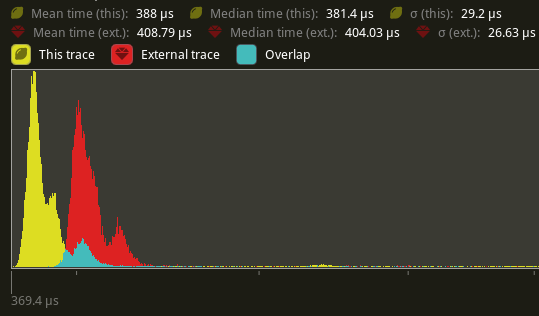
This produces a similar speed up akin to that of #6885. This shows an approximate 6% speed up in `main_opaque_pass_3d` on `many_foxes` (408.79 us -> 388us). This should be orthogonal to the gains seen there.
---
## Changelog
Added: `RenderContext::begin_tracked_render_pass`.
Changed: `TrackedRenderPass` now requires a `&RenderDevice` on construction.
Removed: `bevy_render::render_phase::DrawState`. It was not usable in any form outside of `bevy_render`.
## Migration Guide
TODO
# Objective

`TEXTURE_ADAPTER_SPECIFIC_FORMAT_FEATURES`  was already included in `adapter.features()` on non-wasm target, and since it is the default value for `WgpuSettings.features`, the subsequent code will also combine into this feature:
b6066c30b6/crates/bevy_render/src/renderer/mod.rs (L155-L156)
# Objective

- fix new clippy lints before they get stable and break CI

## Solution

- run `clippy --fix` to auto-fix machine-applicable lints
- silence `clippy::should_implement_trait` for `fn HandleId::default<T: Asset>`

## Changes
- always prefer `format!("{inline}")` over `format!("{}", not_inline)`
- prefer `Box::default` (or `Box::<T>::default` if necessary) over `Box::new(T::default())`
# Objective
Currently, Bevy only supports rendering to the current "surface texture format". This means that "render to texture" scenarios must use the exact format the primary window's surface uses, or Bevy will crash. This is even harder than it used to be now that we detect preferred surface formats at runtime instead of using hard coded BevyDefault values.
## Solution
1. Look up and store each window surface's texture format alongside other extracted window information
2. Specialize the upscaling pass on the current `RenderTarget`'s texture format, now that we can cheaply correlate render targets to their current texture format
3. Remove the old `SurfaceTextureFormat` and `AvailableTextureFormats`: these are now redundant with the information stored on each extracted window, and probably should not have been globals in the first place (as in theory each surface could have a different format).
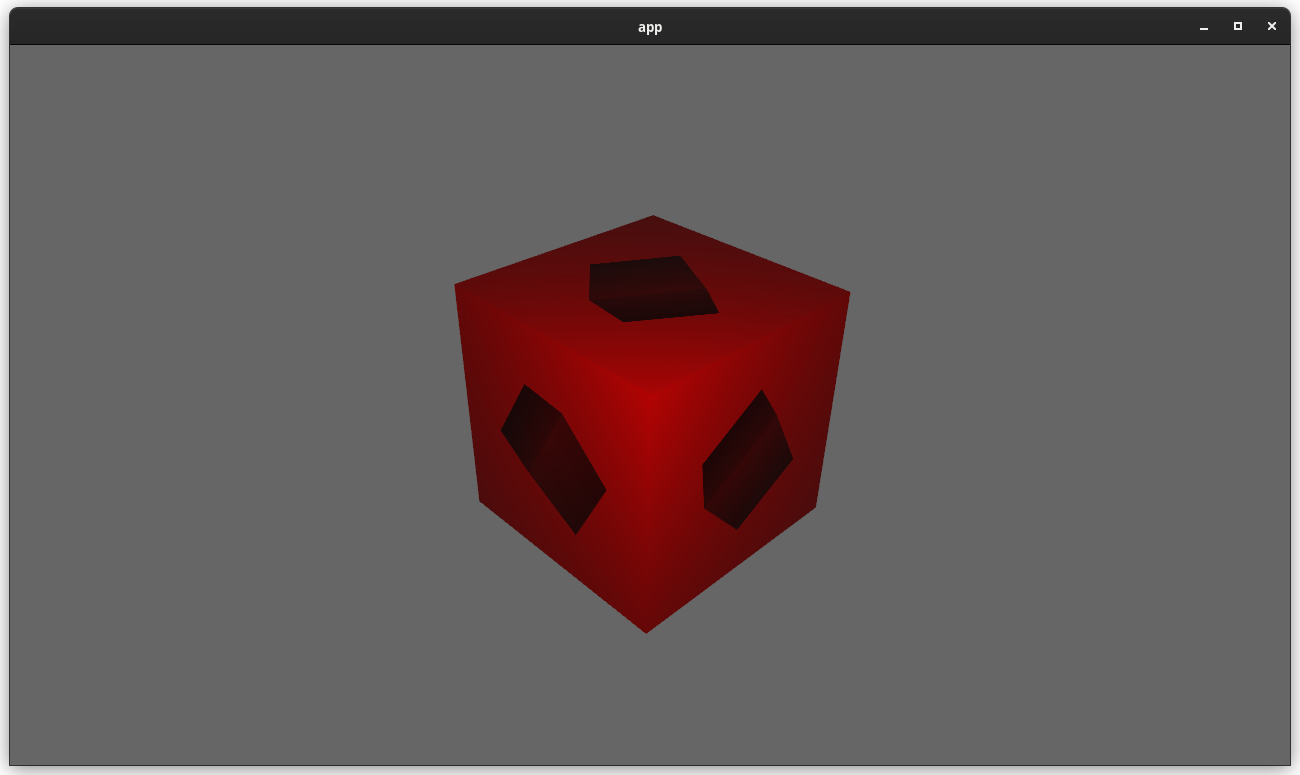
This means you can now use any texture format you want when rendering to a texture! For example, changing the `render_to_texture` example to use `R16Float` now doesn't crash / properly only stores the red component:
Attempt to make features like bloom https://github.com/bevyengine/bevy/pull/2876 easier to implement.
**This PR:**
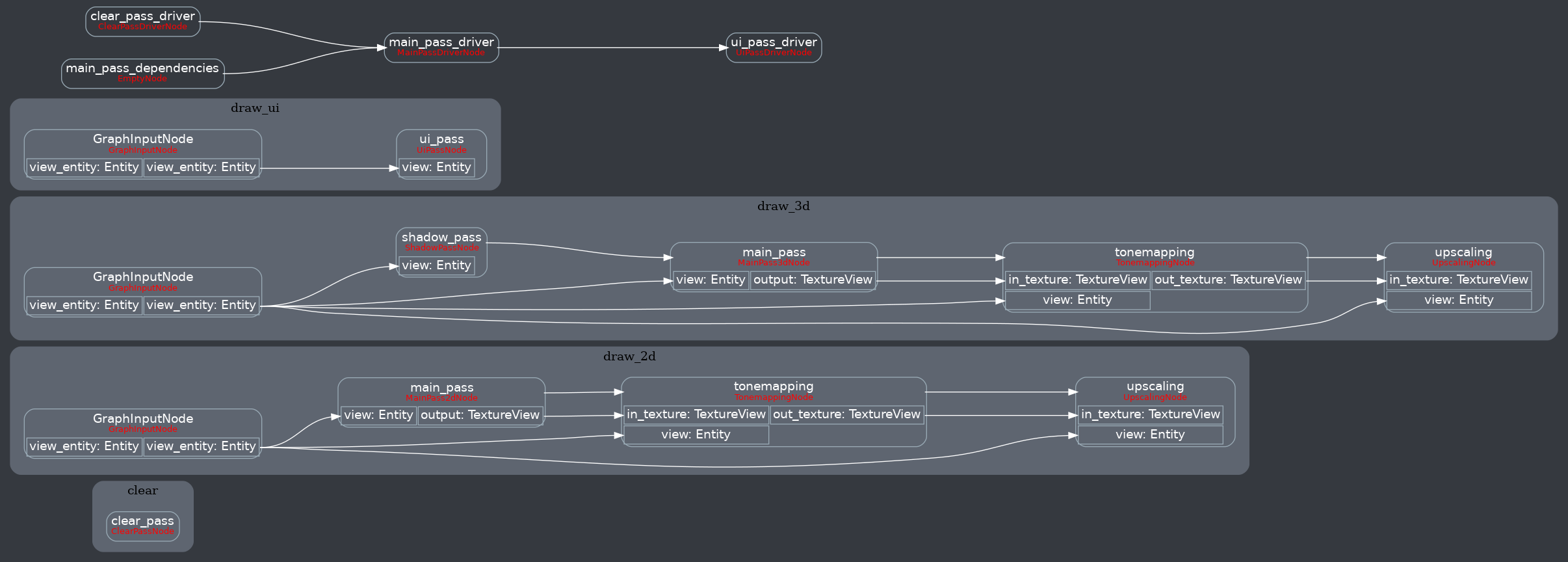
- Moves the tonemapping from `pbr.wgsl` into a separate pass
- also add a separate upscaling pass after the tonemapping which writes to the swap chain (enables resolution-independant rendering and post-processing after tonemapping)
- adds a `hdr` bool to the camera which controls whether the pbr and sprite shaders render into a `Rgba16Float` texture
**Open questions:**
- ~should the 2d graph work the same as the 3d one?~ it is the same now
- ~The current solution is a bit inflexible because while you can add a post processing pass that writes to e.g. the `hdr_texture`, you can't write to a separate `user_postprocess_texture` while reading the `hdr_texture` and tell the tone mapping pass to read from the `user_postprocess_texture` instead. If the tonemapping and upscaling render graph nodes were to take in a `TextureView` instead of the view entity this would almost work, but the bind groups for their respective input textures are already created in the `Queue` render stage in the hardcoded order.~ solved by creating bind groups in render node
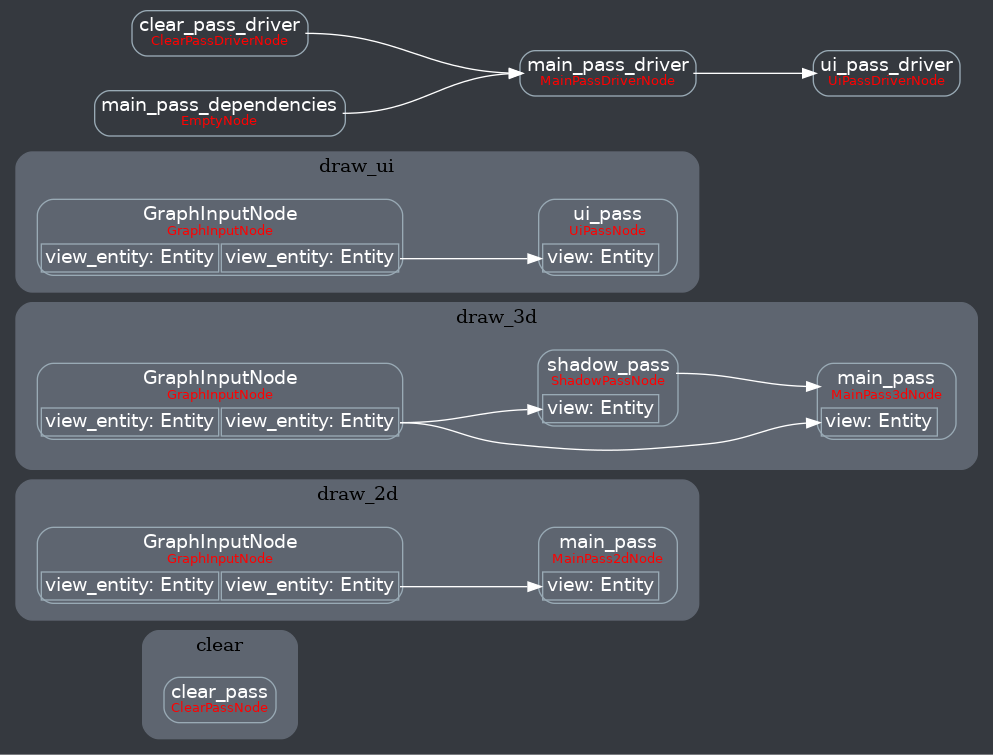
**New render graph:**
<details>
<summary>Before</summary>
</details>
Co-authored-by: Carter Anderson <mcanders1@gmail.com>
As suggested in #6104, it would be nice to link directly to `linux_dependencies.md` file in the panic message when running on Linux. And when not compiling for Linux, we fall back to the old message.
Signed-off-by: Lena Milizé <me@lvmn.org>
# Objective
Resolves#6104.
## Solution
Add link to `linux_dependencies.md` when compiling for Linux, and fall back to the old one when not.
# Objective
There is no Srgb support on some GPU and display protocols with `winit` (for example, Nvidia's GPUs with Wayland). Thus `TextureFormat::bevy_default()` which returns `Rgba8UnormSrgb` or `Bgra8UnormSrgb` will cause panics on such platforms. This patch will resolve this problem. Fix https://github.com/bevyengine/bevy/issues/3897.

## Solution

Make `initialize_renderer` expose `wgpu::Adapter` and `first_available_texture_format`, use the `first_available_texture_format` by default.

## Changelog

* Fixed https://github.com/bevyengine/bevy/issues/3897.