# Objective

- Provide an expressive way to register dynamic behavior in response to
ECS changes that is consistent with existing bevy types and traits as to
provide a smooth user experience.
- Provide a mechanism for immediate changes in response to events during
command application in order to facilitate improved query caching on the
path to relations.

## Solution

- A new fundamental ECS construct, the `Observer`; inspired by flec's
observers but adapted to better fit bevy's access patterns and rust's
type system.

---

## Examples
There are 3 main ways to register observers. The first is a "component
observer" that looks like this:
```rust
world.observe(|trigger: Trigger<OnAdd, Transform>, query: Query<&Transform>| {
    let transform = query.get(trigger.entity()).unwrap();
});
```
The above code will spawn a new entity representing the observer that
will run it's callback whenever the `Transform` component is added to an
entity. This is a system-like function that supports dependency
injection for all the standard bevy types: `Query`, `Res`, `Commands`
etc. It also has a `Trigger` parameter that provides information about
the trigger such as the target entity, and the event being triggered.
Importantly these systems run during command application which is key
for their future use to keep ECS internals up to date. There are similar
events for `OnInsert` and `OnRemove`, and this will be expanded with
things such as `ArchetypeCreated`, `TableEmpty` etc. in follow up PRs.

Another way to register an observer is an "entity observer" that looks
like this:
```rust
world.entity_mut(entity).observe(|trigger: Trigger<Resize>| {
    // ...
});
```
Entity observers run whenever an event of their type is triggered
targeting that specific entity. This type of observer will de-spawn
itself if the entity (or entities) it is observing is ever de-spawned so
as to not leave dangling observers.

Entity observers can also be spawned from deferred contexts such as
other observers, systems, or hooks using commands:
```rust
commands.entity(entity).observe(|trigger: Trigger<Resize>| {
    // ...
});
```

Observers are not limited to in built event types, they can be used with
any type that implements `Event` (which has been extended to implement
Component). This means events can also carry data:

```rust
#[derive(Event)]
struct Resize { x: u32, y: u32 }

commands.entity(entity).observe(|trigger: Trigger<Resize>, query: Query<&mut Size>| {
    let event = trigger.event();
    // ...
});

// Will trigger the observer when commands are applied.
commands.trigger_targets(Resize { x: 10, y: 10 }, entity);
```

You can also trigger events that target more than one entity at a time:

```rust
commands.trigger_targets(Resize { x: 10, y: 10 }, [e1, e2]);
```

Additionally, Observers don't _need_ entity targets:

```rust
app.observe(|trigger: Trigger<Quit>| {
})

commands.trigger(Quit);
```

In these cases, `trigger.entity()` will be a placeholder.

Observers are actually just normal entities with an `ObserverState` and
`Observer` component! The `observe()` functions above are just shorthand
for:

```rust
world.spawn(Observer::new(|trigger: Trigger<Resize>| {});
```

This will spawn the `Observer` system and use an `on_add` hook to add
the `ObserverState` component.

Dynamic components and trigger types are also fully supported allowing
for runtime defined trigger types.

## Possible Follow-ups
1. Deprecate `RemovedComponents`, observers should fulfill all use cases
while being more flexible and performant.
2. Queries as entities: Swap queries to entities and begin using
observers listening to archetype creation triggers to keep their caches
in sync, this allows unification of `ObserverState` and `QueryState` as
well as unlocking several API improvements for `Query` and the
management of `QueryState`.
3. Trigger bubbling: For some UI use cases in particular users are
likely to want some form of bubbling for entity observers, this is
trivial to implement naively but ideally this includes an acceleration
structure to cache hierarchy traversals.
4. All kinds of other in-built trigger types.
5. Optimization; in order to not bloat the complexity of the PR I have
kept the implementation straightforward, there are several areas where
performance can be improved. The focus for this PR is to get the
behavior implemented and not incur a performance cost for users who
don't use observers.

I am leaving each of these to follow up PR's in order to keep each of
them reviewable as this already includes significant changes.

---------

Co-authored-by: Alice Cecile <alice.i.cecile@gmail.com>
Co-authored-by: MiniaczQ <xnetroidpl@gmail.com>
Co-authored-by: Carter Anderson <mcanders1@gmail.com>
…izer (#13442)"

This reverts commit 5cfb063d4a.

- This PR broke bevy-trait-query, which needs to be able to write a
resource in init_state. See #13798 for more details.
- Note this doesn't fix everything as transmutes for bevy-trait-query
will still be broken,. But the current usage in that crate is UB, so we
need to find another solution.
Fixes#13758.
# Objective
Calling `update` on the main app already calls `clear_trackers`. Calling
it again in `SubApps::update` caused RemovedCompenet Events to be
cleared earlier than they should be.
## Solution
- Don't call clear_trackers an extra time.
## Testing
I manually tested the fix with this unit test:
```
#[cfg(test)]
mod test {
use crate::core::{FrameCount, FrameCountPlugin};
use crate::prelude::*;
#[test]
fn test_next_frame_removal() {
#[derive(Component)]
struct Foo;
#[derive(Resource)]
struct RemovedCount(usize);
let mut app = App::new();
app.add_plugins(FrameCountPlugin);
app.add_systems(Startup, |mut commands: Commands| {
for _ in 0..100 {
commands.spawn(Foo);
}
commands.insert_resource(RemovedCount(0));
});
app.add_systems(First, |counter: Res<FrameCount>| {
println!("Frame {}:", counter.0)
});
fn detector_system(
mut removals: RemovedComponents<Foo>,
foos: Query<Entity, With<Foo>>,
mut removed_c: ResMut<RemovedCount>,
) {
for e in removals.read() {
println!(" Detected removed Foo component for {e:?}");
removed_c.0 += 1;
}
let c = foos.iter().count();
println!(" Total Foos: {}", c);
assert_eq!(c + removed_c.0, 100);
}
fn deleter_system(foos: Query<Entity, With<Foo>>, mut commands: Commands) {
foos.iter().next().map(|e| {
commands.entity(e).remove::<Foo>();
});
}
app.add_systems(Update, (detector_system, deleter_system).chain());
app.update();
app.update();
app.update();
app.update();
}
}
```
# Objective

Add slice based variants of existing `get_many_entities` functions on
`World`. This allows for a collection of entries to be looked up mutably
or immutably instead of requiring a compile time constant number.

## Solution

We just take slices and return Vectors.

the following functions have been added:
- `get_many_entities_dynamic`
- `get_many_entities_dynamic_mut`
- `get_many_entities_from_set_mut`

## Testing

- Doc tests, which pass when run through Miri
# Objective

Adds capability to clear all components on an entity without de-spawning
said entity.

## Testing

The function calls `remove_by_id` on every component in the entity
archetype - wasn't sure if it's worth going out of our way to create a
test for this considering `remove_by_id` is already unit tested.

---

## Changelog

Added `clear` function to `EntityWorldMut` which removes all components
on an entity.

## Migration Guide

N/A

---------

Co-authored-by: Alice Cecile <alice.i.cecile@gmail.com>
# Objective
In #13343, `WorldQuery::get_state` was constrained from `&World` as the
argument to `&Components`, but `WorldQuery::init_state` hasn't yet been
changed from `&mut World` to match.
Fixes#13358
## Solution
Create a wrapper around `&mut Components` and `&mut Storages` that can
be obtained from `&mut World` with a `component_initializer` method.
This new `ComponentInitializer` re-exposes the API on `&mut Components`
minus the `&mut Storages` parameter where it was present. For the
`&Components` API, it simply derefs to its `components` field.
## Changelog
### Added
The `World::component_initializer` method.
The `ComponentInitializer` struct that re-exposes `Components` API.
### Changed
`WorldQuery::init_state` now takes `&mut ComponentInitializer` instead
of `&mut World`.
## Migration Guide
Instead of passing `&mut World` to `WorldQuery::init_state` directly,
pass in a mutable reference to the struct returned from
`World::component_initializer`.
Currently, either an `EntityRef` or `EntityMut` is required in order to
reflect a component on an entity. This can, however, be generalized to
`FilteredEntityRef` and `FilteredEntityMut`, which are versions of
`EntityRef` and `EntityMut` that restrict the components that can be
accessed. This is useful because dynamic queries yield
`FilteredEntityRef` and `FilteredEntityMut` rows when iterated over.

This commit changes `ReflectComponent::contains()`,
`ReflectComponent::reflect()`, and `ReflectComponent::reflect_mut()` to
take an `Into<FilteredEntityRef>` (in the case of `contains()` and
`reflect()`) and `Into<FilteredEntityMut>` (in the case of
`reflect_mut()`). Fortunately, `EntityRef` and `EntityMut` already
implement the corresponding trait, so nothing else has to be done to the
public API. Note that in order to implement
`ReflectComponent::reflect_mut()` properly, an additional method
`FilteredEntityMut::into_mut()` was required, to match the one on
`EntityMut`.

I ran into this when attempting to implement `QUERY` in the Bevy Remote
Protocol when trying to iterate over rows of dynamic queries and fetch
the associated components without unsafe code. There were other
potential ways to work around this problem, but they required either
reimplementing the query logic myself instead of using regular Bevy
queries or storing entity IDs and then issuing another query to fetch
the associated `EntityRef`. Both of these seemed worse than just
improving the `reflect()` function.

## Migration Guide

* `ReflectComponent::contains`, `ReflectComponent::reflect`, and
`ReflectComponent::reflect_mut` now take `FilteredEntityRef` (in the
case of `contains()` and `reflect()`) and `FilteredEntityMut` (in the
case of `reflect_mut()`) parameters. `FilteredEntityRef` and
`FilteredEntityMut` have very similar APIs to `EntityRef` and
`EntityMut` respectively, but optionally restrict the components that
can be accessed.
# Objective

- `FilteredEntity{Ref,Mut}` various `get` methods never checked that the
given component was present on the entity, only the access allowed
reading/writing them, which is always the case when it is constructed
from a `EntityRef`/`EntityMut`/`EntityWorldMut` (and I guess can also
happen with queries containing `Option<T>` that get transmuted).
- In those cases the various `get` methods were calling
`debug_checked_unwrap` on `None`s, which is UB when debug assertions are
not enabled;
- The goal is thus to fix this soundness issue.

## Solution

- Don't call `debug_checked_unwrap` on those `None` and instead
`flatten` them.

## Testing

- This PR includes regression tests for each combination of
`FilteredEntityRef`/`FilteredEntityMut` and component
present/not-present. The two tests for the not-present cases fail on
`main` but success with this PR changes.
# Objective

- Prevent the case where a hook/observer is triggered but the source
entity/component no longer exists

## Solution

- Re-order command application such that all hooks/observers that are
notified will run before any have a chance to invalidate the result.

## Testing
Updated relevant tests in `bevy_ecs`, all other tests pass.

---------

Co-authored-by: Carter Anderson <mcanders1@gmail.com>
Co-authored-by: Mike Hsu <mike.hsu@gmail.com>
Co-authored-by: Alice Cecile <alice.i.cecile@gmail.com>
# Objective

- Implement `From<&'w mut EntityMut>` for `EntityMut<'w>`;
- Make it possible to pass `&mut EntityMut` where `impl Into<EntityMut>`
is required;
- Helps with #12895.

## Solution

- Implement `From<&'w mut EntityMut>` for `EntityMut<'w>`

---

## Changelog

- `EntityMut<'w>` now implements `From<&'w mut EntityMut>`
# Objective
- Add `remove_by_id` method to `EntityWorldMut` and `EntityCommands`
- This is a duplicate of the awesome work by @mateuseap, last updated
04/09/23 - #9663
- I'm opening a second one to ensure the feature makes it into `0.14`
- Fixes#9261
## Solution
Almost identical to #9663 with three exceptions
- Uses a closure instead of struct for commands, consistent with other
similar commands
- Does not refactor `EntityCommands::insert`, so no migration guide
- `EntityWorldMut::remove_by_id` is now safe containing unsafe blocks, I
think thats what @SkiFire13 was indicating should happen [in this
comment](https://github.com/bevyengine/bevy/pull/9663#discussion_r1314307525)
## Changelog
- Added `EntityWorldMut::remove_by_id` method and its tests.
- Added `EntityCommands::remove_by_id` method and its tests.
---------
Co-authored-by: James Liu <contact@jamessliu.com>
# Objective
- Closes#12019
- Related to #4955
- Useful for dev_tools and networking
## Solution
- Create `World::iter_resources()` and `World::iter_resources_mut()`
---------
Co-authored-by: Alice Cecile <alice.i.cecile@gmail.com>
Co-authored-by: James Liu <contact@jamessliu.com>
Co-authored-by: Pablo Reinhardt <126117294+pablo-lua@users.noreply.github.com>
# Objective
Make it easy to get the ids of all the components in a bundle (and
initialise any components not yet initialised). This is fairly similar
to the `Bundle::get_component_ids()` method added in the observers PR
however that will return none for any non-initialised components. This
is exactly the API space covered by `Bundle::component_ids()` however
that isn't possible to call outside of `bevy_ecs` as it requires `&mut
Components` and `&mut Storages`.

## Solution
Added `World.init_bundle<B: Bundle>()` which similarly to
`init_component` and `init_resource`, initialises all components in the
bundle and returns a vector of their component ids.

---

## Changelog
Added the method `init_bundle` to `World` as a counterpart to
`init_component` and `init_resource`.

---------

Co-authored-by: James Liu <contact@jamessliu.com>
# Objective

- Tiny PR to clarify that `self.world.bundles.init_info::<T>` must have
been called so that the BundleInfo is present in the World

---------

Co-authored-by: James Liu <contact@jamessliu.com>
# Objective


I was reading some of the Archetype and Bundle code and was getting
confused a little bit in some places (is the `archetype_id` in
`AddBundle` the source or the target archetype id?).
Small PR that adds some docstrings to make it easier for first-time
readers.
# Objective
Fix Pr CI failing over dead code in tests and main branch CI failing
over a missing semicolon. Fixes#12620.
## Solution
Add dead_code annotations and a semicolon.
# Objective
Fixes#12549. WorldCell's support of everything a World can do is
incomplete, and represents an alternative, potentially confusing, and
less performant way of pulling multiple fetches from a `World`. The
typical approach is to use `SystemState` for a runtime cached and safe
way, or `UnsafeWorldCell` if the use of `unsafe` is tolerable.
## Solution
Remove it!
---
## Changelog
Removed: `WorldCell`
Removed: `World::cell`
## Migration Guide
`WorldCell` has been removed. If you were using it to fetch multiple
distinct values from a `&mut World`, use `SystemState` by calling
`SystemState::get` instead. Alternatively, if `SystemState` cannot be
used, `UnsafeWorldCell` can instead be used in unsafe contexts.
# Objective
Provide component access to `&'w T`, `Ref<'w, T>`, `Mut<'w, T>`,
`Ptr<'w>` and `MutUntyped<'w>` from `EntityMut<'w>`/`EntityWorldMut<'w>`
with the world `'w` lifetime instead of `'_`.
Fixes#12417
## Solution
Add `into_` prefixed methods for `EntityMut<'w>`/`EntityWorldMut<'w>`
that consume `self` and returns component access with the world `'w`
lifetime unlike the `get_` prefixed methods that takes `&'a self` and
returns component access with `'a` lifetime.
Methods implemented:
- EntityMut::into_borrow
- EntityMut::into_ref
- EntityMut::into_mut
- EntityMut::into_borrow_by_id
- EntityMut::into_mut_by_id
- EntityWorldMut::into_borrow
- EntityWorldMut::into_ref
- EntityWorldMut::into_mut
- EntityWorldMut::into_borrow_by_id
- EntityWorldMut::into_mut_by_id
# Objective
`initialize_resource<T>` and it's non-send equivalent is only used in
two locations each. Fix#6285.
## Solution
Remove them, replace their calls with their internals. Cut down on a bit
of generic codegen.
This does mean that `initialize_resource_internal` is now `pub(crate)`,
but that's likely OK given that only one variant will remain once
NonSend resources are removed from the World.
# Objective
When doing a final pass for #3362, it appeared that `ComponentStorage`
as a trait, the two types implementing it, and the associated type on
`Component` aren't really necessary anymore. This likely was due to an
earlier constraint on the use of consts in traits, but that definitely
doesn't seem to be a problem in Rust 1.76.

## Solution
Remove them.

---

## Changelog
Changed: `Component::Storage` has been replaced with
`Component::STORAGE_TYPE` as a const.
Removed: `bevy::ecs::component::ComponentStorage` trait
Removed: `bevy::ecs::component::TableStorage` struct
Removed: `bevy::ecs::component::SparseSetStorage` struct

## Migration Guide
If you were manually implementing `Component` instead of using the
derive macro, replace the associated `Storage` associated type with the
`STORAGE_TYPE` const:

```rust
// in Bevy 0.13
impl Component for MyComponent {
    type Storage = TableStorage;
}
// in Bevy 0.14
impl Component for MyComponent {
    const STORAGE_TYPE: StorageType = StorageType::Table;
}
```

Component is no longer object safe. If you were relying on `&dyn
Component`, `Box<dyn Component>`, etc. please [file an issue
](https://github.com/bevyengine/bevy/issues) to get [this
change](https://github.com/bevyengine/bevy/pull/12311) reverted.

---------

Co-authored-by: Alice Cecile <alice.i.cecile@gmail.com>
# Objective

Fixes https://github.com/bevyengine/bevy/issues/11628

## Migration Guide

`Command` and `CommandQueue` have migrated from `bevy_ecs::system` to
`bevy_ecs::world`, so `use bevy_ecs::world::{Command, CommandQueue};`
when necessary.
# Objective

- Provide a reliable and performant mechanism to allows users to keep
components synchronized with external sources: closing/opening sockets,
updating indexes, debugging etc.
- Implement a generic mechanism to provide mutable access to the world
without allowing structural changes; this will not only be used here but
is a foundational piece for observers, which are key for a performant
implementation of relations.

## Solution

- Implement a new type `DeferredWorld` (naming is not important,
`StaticWorld` is also suitable) that wraps a world pointer and prevents
user code from making any structural changes to the ECS; spawning
entities, creating components, initializing resources etc.
- Add component lifecycle hooks `on_add`, `on_insert` and `on_remove`
that can be assigned callbacks in user code.

---

## Changelog
- Add new `DeferredWorld` type.
- Add new world methods: `register_component::<T>` and
`register_component_with_descriptor`. These differ from `init_component`
in that they provide mutable access to the created `ComponentInfo` but
will panic if the component is already in any archetypes. These
restrictions serve two purposes:
1. Prevent users from defining hooks for components that may already
have associated hooks provided in another plugin. (a use case better
served by observers)
2. Ensure that when an `Archetype` is created it gets the appropriate
flags to early-out when triggering hooks.
- Add methods to `ComponentInfo`: `on_add`, `on_insert` and `on_remove`
to be used to register hooks of the form `fn(DeferredWorld, Entity,
ComponentId)`
- Modify `BundleInserter`, `BundleSpawner` and `EntityWorldMut` to
trigger component hooks when appropriate.
- Add bit flags to `Archetype` indicating whether or not any contained
components have each type of hook, this can be expanded for other flags
as needed.
- Add `component_hooks` example to illustrate usage. Try it out! It's
fun to mash keys.

## Safety
The changes to component insertion, removal and deletion involve a large
amount of unsafe code and it's fair for that to raise some concern. I
have attempted to document it as clearly as possible and have confirmed
that all the hooks examples are accepted by `cargo miri` as not causing
any undefined behavior. The largest issue is in ensuring there are no
outstanding references when passing a `DeferredWorld` to the hooks which
requires some use of raw pointers (as was already happening to some
degree in those places) and I have taken some time to ensure that is the
case but feel free to let me know if I've missed anything.

## Performance
These changes come with a small but measurable performance cost of
between 1-5% on `add_remove` benchmarks and between 1-3% on `insert`
benchmarks. One consideration to be made is the existence of the current
`RemovedComponents` which is on average more costly than the addition of
`on_remove` hooks due to the early-out, however hooks doesn't completely
remove the need for `RemovedComponents` as there is a chance you want to
respond to the removal of a component that already has an `on_remove`
hook defined in another plugin, so I have not removed it here. I do
intend to deprecate it with the introduction of observers in a follow up
PR.

## Discussion Questions
- Currently `DeferredWorld` implements `Deref` to `&World` which makes
sense conceptually, however it does cause some issues with rust-analyzer
providing autocomplete for `&mut World` references which is annoying.
There are alternative implementations that may address this but involve
more code churn so I have attempted them here. The other alternative is
to not implement `Deref` at all but that leads to a large amount of API
duplication.
- `DeferredWorld`, `StaticWorld`, something else?
- In adding support for hooks to `EntityWorldMut` I encountered some
unfortunate difficulties with my desired API. If commands are flushed
after each call i.e. `world.spawn() // flush commands .insert(A) //
flush commands` the entity may be despawned while `EntityWorldMut` still
exists which is invalid. An alternative was then to add
`self.world.flush_commands()` to the drop implementation for
`EntityWorldMut` but that runs into other problems for implementing
functions like `into_unsafe_entity_cell`. For now I have implemented a
`.flush()` which will flush the commands and consume `EntityWorldMut` or
users can manually run `world.flush_commands()` after using
`EntityWorldMut`.
- In order to allowing querying on a deferred world we need
implementations of `WorldQuery` to not break our guarantees of no
structural changes through their `UnsafeWorldCell`. All our
implementations do this, but there isn't currently any safety
documentation specifying what is or isn't allowed for an implementation,
just for the caller, (they also shouldn't be aliasing components they
didn't specify access for etc.) is that something we should start doing?
(see 10752)

Please check out the example `component_hooks` or the tests in
`bundle.rs` for usage examples. I will continue to expand this
description as I go.

See #10839 for a more ergonomic API built on top of this one that isn't
subject to the same restrictions and supports `SystemParam` dependency
injection.
# Objective

- Part of #11590
- Fix `unsafe_op_in_unsafe_fn` for trivial cases in bevy_ecs

## Solution

Fix `unsafe_op_in_unsafe_fn` in bevy_ecs for trivial cases, i.e., add an
`unsafe` block when the safety comment already exists or add a comment
like "The invariants are uphold by the caller".

---------

Co-authored-by: James Liu <contact@jamessliu.com>
# Objective

- There are multiple instances of `let Some(x) = ... else { None };`
throughout the project.
- Because `Option<T>` implements
[`Try`](https://doc.rust-lang.org/stable/std/ops/trait.Try.html), it can
use the question mark `?` operator.

## Solution

- Use question mark operator instead of `let Some(x) = ... else { None
}`.

---

There was another PR that did a similar thing a few weeks ago, but I
couldn't find it.
# Objective

Bevy's change detection functionality is invaluable for writing robust
apps, but it only works in the context of systems and exclusive systems.
Oftentimes it is necessary to detect changes made in earlier code
without having to place the code in separate systems, but it is not
currently possible to do so since there is no way to set the value of
`World::last_change_tick`.

`World::clear_trackers` allows you to update the change tick, but this
has unintended side effects, since it irreversibly affects the behavior
of change and removal detection for the entire app.

## Solution

Add a method `World::last_change_tick_scope`. This allows you to set
`last_change_tick` to a specific value for a region of code. To ensure
that misuse doesn't break unrelated functions, we restore the world's
original change tick at the end of the provided scope.

### Example

A function that uses this to run an update loop repeatedly, allowing
each iteration of the loop to react to changes made in the previous loop
iteration.

```rust
fn update_loop(
    world: &mut World,
    mut update_fn: impl FnMut(&mut World) -> std::ops::ControlFlow<()>,
) {
    let mut last_change_tick = world.last_change_tick();

    // Repeatedly run the update function until it requests a break.
    loop {
        // Update once.
        let control_flow = world.last_change_tick_scope(last_change_tick, |world| {
            update_fn(world)
        });

        // End the loop when the closure returns `ControlFlow::Break`.
        if control_flow.is_break() {
            break;
        }

        // Increment the change tick so the next update can detect changes from this update.
        last_change_tick = world.change_tick();
        world.increment_change_tick();
    }
}
```

---

## Changelog

+ Added `World::last_change_tick_scope`, which allows you to specify the
reference for change detection within a certain scope.
# Objective

It's sometimes desirable to get a `Res<T>` rather than `&T` from
`World::get_resource`.
Alternative to #9940, partly adresses #9926

## Solution

added additional methods to `World` and `UnsafeWorldCell` to retrieve a
resource wrapped in a `Res`.
- `UnsafeWorldCell::get_resource_ref`
- `World::get_resource_ref`
- `World::resource_ref`

I can change it so `World::resource_mut` returns `ResMut` instead of
`Mut` as well if that's desired, but that could also be added later in a
seperate pr.

---------

Co-authored-by: Alice Cecile <alice.i.cecile@gmail.com>
Co-authored-by: Mike <mike.hsu@gmail.com>
Co-authored-by: MinerSebas <66798382+MinerSebas@users.noreply.github.com>
# Objective
- `World::get_resource`'s comment on it's `unsafe` usage meant to say
"mutably" but instead said "immutably."
- Fixes#11430.
## Solution
- Replace "immutably" with "mutably."
# Objective
- Add methods to get Change Ticks for a given resource by type or
ComponentId
- Fixes#11390
The `is_resource_id_changed` requested in the Issue already exists, this
adds their request for `get_resource_change_ticks`
## Solution
- Added two methods to get change ticks by Type or ComponentId
# Objective
Expand the existing `Query` API to support more dynamic use cases i.e.
scripting.

## Prior Art
 - #6390
 - #8308
- #10037

## Solution
- Create a `QueryBuilder` with runtime methods to define the set of
component accesses for a built query.
- Create new `WorldQueryData` implementations `FilteredEntityMut` and
`FilteredEntityRef` as variants of `EntityMut` and `EntityRef` that
provide run time checked access to the components included in a given
query.
- Add new methods to `Query` to create "query lens" with a subset of the
access of the initial query.

### Query Builder
The `QueryBuilder` API allows you to define a query at runtime. At it's
most basic use it will simply create a query with the corresponding type
signature:
```rust
let query = QueryBuilder::<Entity, With<A>>::new(&mut world).build();
// is equivalent to
let query = QueryState::<Entity, With<A>>::new(&mut world);
```
Before calling `.build()` you also have the opportunity to add
additional accesses and filters. Here is a simple example where we add
additional filter terms:
```rust
let entity_a = world.spawn((A(0), B(0))).id();
let entity_b = world.spawn((A(0), C(0))).id();

let mut query_a = QueryBuilder::<Entity>::new(&mut world)
    .with::<A>()
    .without::<C>()
    .build();

assert_eq!(entity_a, query_a.single(&world));
```
This alone is useful in that allows you to decide which archetypes your
query will match at runtime. However it is also very limited, consider a
case like the following:
```rust
let query_a = QueryBuilder::<&A>::new(&mut world)
// Add an additional access
    .data::<&B>()
    .build();
```
This will grant the query an additional read access to component B
however we have no way of accessing the data while iterating as the type
signature still only includes &A. For an even more concrete example of
this consider dynamic components:
```rust
let query_a = QueryBuilder::<Entity>::new(&mut world)
// Adding a filter is easy since it doesn't need be read later
    .with_id(component_id_a)
// How do I access the data of this component?
    .ref_id(component_id_b)
    .build();
```
With this in mind the `QueryBuilder` API seems somewhat incomplete by
itself, we need some way method of accessing the components dynamically.
So here's one:
### Query Transmutation
If the problem is not having the component in the type signature why not
just add it? This PR also adds transmute methods to `QueryBuilder` and
`QueryState`. Here's a simple example:
```rust
world.spawn(A(0));
world.spawn((A(1), B(0)));
let mut query = QueryBuilder::<()>::new(&mut world)
    .with::<B>()
    .transmute::<&A>()
    .build();

query.iter(&world).for_each(|a| assert_eq!(a.0, 1));
```
The `QueryState` and `QueryBuilder` transmute methods look quite similar
but are different in one respect. Transmuting a builder will always
succeed as it will just add the additional accesses needed for the new
terms if they weren't already included. Transmuting a `QueryState` will
panic in the case that the new type signature would give it access it
didn't already have, for example:
```rust
let query = QueryState::<&A, Option<&B>>::new(&mut world);
/// This is fine, the access for Option<&A> is less restrictive than &A
query.transmute::<Option<&A>>(&world);
/// Oh no, this would allow access to &B on entities that might not have it, so it panics
query.transmute::<&B>(&world);
/// This is right out
query.transmute::<&C>(&world);
```
This is quite an appealing API to also have available on `Query` however
it does pose one additional wrinkle: In order to to change the iterator
we need to create a new `QueryState` to back it. `Query` doesn't own
it's own state though, it just borrows it, so we need a place to borrow
it from. This is why `QueryLens` exists, it is a place to store the new
state so it can be borrowed when you call `.query()` leaving you with an
API like this:
```rust
fn function_that_takes_a_query(query: &Query<&A>) {
    // ...
}

fn system(query: Query<(&A, &B)>) {
    let lens = query.transmute_lens::<&A>();
    let q = lens.query();
    function_that_takes_a_query(&q);
}
```
Now you may be thinking: Hey, wait a second, you introduced the problem
with dynamic components and then described a solution that only works
for static components! Ok, you got me, I guess we need a bit more:
### Filtered Entity References
Currently the only way you can access dynamic components on entities
through a query is with either `EntityMut` or `EntityRef`, however these
can access all components and so conflict with all other accesses. This
PR introduces `FilteredEntityMut` and `FilteredEntityRef` as
alternatives that have additional runtime checking to prevent accessing
components that you shouldn't. This way you can build a query with a
`QueryBuilder` and actually access the components you asked for:
```rust
let mut query = QueryBuilder::<FilteredEntityRef>::new(&mut world)
    .ref_id(component_id_a)
    .with(component_id_b)
    .build();

let entity_ref = query.single(&world);

// Returns Some(Ptr) as we have that component and are allowed to read it
let a = entity_ref.get_by_id(component_id_a);
// Will return None even though the entity does have the component, as we are not allowed to read it
let b = entity_ref.get_by_id(component_id_b);
```
For the most part these new structs have the exact same methods as their
non-filtered equivalents.

Putting all of this together we can do some truly dynamic ECS queries,
check out the `dynamic` example to see it in action:
```
Commands:
    comp, c   Create new components
    spawn, s  Spawn entities
    query, q  Query for entities
Enter a command with no parameters for usage.

> c A, B, C, Data 4
Component A created with id: 0
Component B created with id: 1
Component C created with id: 2
Component Data created with id: 3

> s A, B, Data 1
Entity spawned with id: 0v0

> s A, C, Data 0
Entity spawned with id: 1v0

> q &Data
0v0: Data: [1, 0, 0, 0]
1v0: Data: [0, 0, 0, 0]

> q B, &mut Data
0v0: Data: [2, 1, 1, 1]

> q B || C, &Data
0v0: Data: [2, 1, 1, 1]
1v0: Data: [0, 0, 0, 0]
```
## Changelog
 - Add new `transmute_lens` methods to `Query`.
- Add new types `QueryBuilder`, `FilteredEntityMut`, `FilteredEntityRef`
and `QueryLens`
- `update_archetype_component_access` has been removed, archetype
component accesses are now determined by the accesses set in
`update_component_access`
- Added method `set_access` to `WorldQuery`, this is called before
`update_component_access` for queries that have a restricted set of
accesses, such as those built by `QueryBuilder` or `QueryLens`. This is
primarily used by the `FilteredEntity*` variants and has an empty trait
implementation.
- Added method `get_state` to `WorldQuery` as a fallible version of
`init_state` when you don't have `&mut World` access.

## Future Work
Improve performance of `FilteredEntityMut` and `FilteredEntityRef`,
currently they have to determine the accesses a query has in a given
archetype during iteration which is far from ideal, especially since we
already did the work when matching the archetype in the first place. To
avoid making more internal API changes I have left it out of this PR.

---------

Co-authored-by: Mike Hsu <mike.hsu@gmail.com>
# Objective

There are a lot of doctests that are `ignore`d for no documented reason.
And that should be fixed.

## Solution

I searched the bevy repo with the regex ` ```[a-z,]*ignore ` in order to
find all `ignore`d doctests. For each one of the `ignore`d doctests, I
did the following steps:
1. Attempt to remove the `ignored` attribute while still passing the
test. I did this by adding hidden dummy structs and imports.
2. If step 1 doesn't work, attempt to replace the `ignored` attribute
with the `no_run` attribute while still passing the test.
3. If step 2 doesn't work, keep the `ignored` attribute but add
documentation for why the `ignored` attribute was added.

---------

Co-authored-by: François <mockersf@gmail.com>
# Objective
Fixes#11050
Rename ArchetypeEntity::entity to ArchetypeEntity::id to be consistent
with `EntityWorldMut`, `EntityMut` and `EntityRef`.
## Migration Guide
The method `ArchetypeEntity::entity` has been renamed to
`ArchetypeEntity::id`
# Objective

Mostly for consistency.

## Solution

```rust
impl ExclusiveSystemParam for WorldId
```

- Also add a test for `SystemParam for WorldId`

## Changelog
Added: Worldd now implements ExclusiveSystemParam.
# Objective

- Allow checking if a resource has changed by its ComponentId

---

## Changelog
- Added `World::is_resource_changed_by_id()` and
`World::is_resource_added_by_id()`.
# Objective

Since #10776 split `WorldQuery` to `WorldQueryData` and
`WorldQueryFilter`, it should be clear that the query is actually
composed of two parts. It is not factually correct to call "query" only
the data part. Therefore I suggest to rename the `Q` parameter to `D` in
`Query` and related items.

As far as I know, there shouldn't be breaking changes from renaming
generic type parameters.

## Solution

I used a combination of rust-analyzer go to reference and `Ctrl-F`ing
various patterns to catch as many cases as possible. Hopefully I got
them all. Feel free to check if you're concerned of me having missed
some.

## Notes

This and #10779 have many lines in common, so merging one will cause a
lot of merge conflicts to the other.

---------

Co-authored-by: Alice Cecile <alice.i.cecile@gmail.com>
# Objective

- The example in the docs is unsound.

Demo:

```rust
#[derive(Resource)]
struct MyRes(u32);

fn main() {
    let mut w = World::new();
    w.insert_resource(MyRes(0));

    let (mut res, comp) = split_world_access(&mut w);
    let mut r1 = res.get_resource_mut::<MyRes>().unwrap();
    let mut r2 = res.get_resource_mut::<MyRes>().unwrap();

    *r1 = MyRes(1);
    *r2 = MyRes(2);
}
```

The API in the example allows aliasing mutable references to the same
resource. Miri also complains when running this.

## Solution

- Change the example API to make the returned `Mut` borrow from the
`OnlyResourceAccessWorld` instead of borrowing from the world via `'w`.
This prevents obtaining more than one `Mut` at the same time from it.
# Objective

The `Despawn` command breaks the hierarchy whenever you use it if the
despawned entity has a parent or any children. This is a serious footgun
because the `Despawn` command has the shortest name, the behavior is
unexpected and not likely to be what you want, and the crash that it
causes can be very difficult to track down.

## Solution

Until this can be fixed by relations, add a note mentioning the footgun
in the documentation.
## Solution

`Commands.remove` and `.retain` (because I copied `remove`s doc)
referenced `EntityWorldMut.remove` and `retain` for more detail but the
`Commands` docs are much more detailed (which makes sense because it is
the most common api), so I have instead inverted this so that
`EntityWorldMut` docs link to `Commands`.

I also made `EntityWorldMut.despawn` reference `World.despawn` for more
details, like `Commands.despawn` does.
# Objective
Adds `EntityCommands.retain` and `EntityWorldMut.retain` to remove all
components except the given bundle from the entity.
Fixes#10865.
## Solution
I added a private unsafe function in `EntityWorldMut` called
`remove_bundle_info` which performs the shared behaviour of `remove` and
`retain`, namely taking a `BundleInfo` of components to remove, and
removing them from the given entity. Then `retain` simply gets all the
components on the entity and filters them by whether they are in the
bundle it was passed, before passing this `BundleInfo` into
`remove_bundle_info`.
`EntityCommands.retain` just creates a new type `Retain` which runs
`EntityWorldMut.retain` when run.
---
## Changelog
Added `EntityCommands.retain` and `EntityWorldMut.retain`, which remove
all components except the given bundle from the entity, they can also be
used to remove all components by passing `()` as the bundle.
# Objective

- Shorten paths by removing unnecessary prefixes

## Solution

- Remove the prefixes from many paths which do not need them. Finding
the paths was done automatically using built-in refactoring tools in
Jetbrains RustRover.
# Objective

Related to #10612.

Enable the
[`clippy::manual_let_else`](https://rust-lang.github.io/rust-clippy/master/#manual_let_else)
lint as a warning. The `let else` form seems more idiomatic to me than a
`match`/`if else` that either match a pattern or diverge, and from the
clippy doc, the lint doesn't seem to have any possible false positive.

## Solution

Add the lint as warning in `Cargo.toml`, refactor places where the lint
triggers.
# Objective
- Fixes#7680
- This is an updated for https://github.com/bevyengine/bevy/pull/8899
which had the same objective but fell a long way behind the latest
changes
## Solution
The traits `WorldQueryData : WorldQuery` and `WorldQueryFilter :
WorldQuery` have been added and some of the types and functions from
`WorldQuery` has been moved into them.
`ReadOnlyWorldQuery` has been replaced with `ReadOnlyWorldQueryData`.
`WorldQueryFilter` is safe (as long as `WorldQuery` is implemented
safely).
`WorldQueryData` is unsafe - safely implementing it requires that
`Self::ReadOnly` is a readonly version of `Self` (this used to be a
safety requirement of `WorldQuery`)
The type parameters `Q` and `F` of `Query` must now implement
`WorldQueryData` and `WorldQueryFilter` respectively.
This makes it impossible to accidentally use a filter in the data
position or vice versa which was something that could lead to bugs.
~~Compile failure tests have been added to check this.~~
It was previously sometimes useful to use `Option<With<T>>` in the data
position. Use `Has<T>` instead in these cases.
The `WorldQuery` derive macro has been split into separate derive macros
for `WorldQueryData` and `WorldQueryFilter`.
Previously it was possible to derive both `WorldQuery` for a struct that
had a mixture of data and filter items. This would not work correctly in
some cases but could be a useful pattern in others. *This is no longer
possible.*
---
## Notes
- The changes outside of `bevy_ecs` are all changing type parameters to
the new types, updating the macro use, or replacing `Option<With<T>>`
with `Has<T>`.
- All `WorldQueryData` types always returned `true` for `IS_ARCHETYPAL`
so I moved it to `WorldQueryFilter` and
replaced all calls to it with `true`. That should be the only logic
change outside of the macro generation code.
- `Changed<T>` and `Added<T>` were being generated by a macro that I
have expanded. Happy to revert that if desired.
- The two derive macros share some functions for implementing
`WorldQuery` but the tidiest way I could find to implement them was to
give them a ton of arguments and ask clippy to ignore that.
## Changelog
### Changed
- Split `WorldQuery` into `WorldQueryData` and `WorldQueryFilter` which
now have separate derive macros. It is not possible to derive both for
the same type.
- `Query` now requires that the first type argument implements
`WorldQueryData` and the second implements `WorldQueryFilter`
## Migration Guide
- Update derives
```rust
// old
#[derive(WorldQuery)]
#[world_query(mutable, derive(Debug))]
struct CustomQuery {
entity: Entity,
a: &'static mut ComponentA
}
#[derive(WorldQuery)]
struct QueryFilter {
_c: With<ComponentC>
}
// new
#[derive(WorldQueryData)]
#[world_query_data(mutable, derive(Debug))]
struct CustomQuery {
entity: Entity,
a: &'static mut ComponentA,
}
#[derive(WorldQueryFilter)]
struct QueryFilter {
_c: With<ComponentC>
}
```
- Replace `Option<With<T>>` with `Has<T>`
```rust
/// old
fn my_system(query: Query<(Entity, Option<With<ComponentA>>)>)
{
for (entity, has_a_option) in query.iter(){
let has_a:bool = has_a_option.is_some();
//todo!()
}
}
/// new
fn my_system(query: Query<(Entity, Has<ComponentA>)>)
{
for (entity, has_a) in query.iter(){
//todo!()
}
}
```
- Fix queries which had filters in the data position or vice versa.
```rust
// old
fn my_system(query: Query<(Entity, With<ComponentA>)>)
{
for (entity, _) in query.iter(){
//todo!()
}
}
// new
fn my_system(query: Query<Entity, With<ComponentA>>)
{
for entity in query.iter(){
//todo!()
}
}
// old
fn my_system(query: Query<AnyOf<(&ComponentA, With<ComponentB>)>>)
{
for (entity, _) in query.iter(){
//todo!()
}
}
// new
fn my_system(query: Query<Option<&ComponentA>, Or<(With<ComponentA>, With<ComponentB>)>>)
{
for entity in query.iter(){
//todo!()
}
}
```
---------
Co-authored-by: Alice Cecile <alice.i.cecile@gmail.com>
# Objective
Adds `.entry` to `EntityWorldMut` with `Entry`, `OccupiedEntry` and
`VacantEntry` for easier in-situ modification, based on `HashMap.entry`.
Fixes#10635
## Solution
This adds the `entry` method to `EntityWorldMut` which returns an
`Entry`. This is an enum of `OccupiedEntry` and `VacantEntry` and has
the methods `and_modify`, `insert_entry`, `or_insert`, `or_insert_with`
and `or_default`. The only difference between `OccupiedEntry` and
`VacantEntry` is the type, they are both a mutable reference to the
`EntityWorldMut` and a marker for the component type, `HashMap` also
stores things to make it quicker to access the data in `OccupiedEntry`
but I wasn't sure if we had anything it would be logical to store to
make accessing/modifying the component faster? As such, the differences
are that `OccupiedEntry` assumes the entity has the component (because
nothing else can have an `EntityWorldMut` so it can't be changed outside
the entry api) and has different methods.
All the methods are based very closely off `hashbrown::HashMap` (because
its easier to read the source of) with a couple of quirks like
`OccupiedEntry.insert` doesn't return the old value because we don't
appear to have an api for mem::replacing components.
---
## Changelog
- Added a new function `EntityWorldMut.entry` which returns an `Entry`,
allowing easier in-situ modification of a component.
---------
Co-authored-by: Alice Cecile <alice.i.cecile@gmail.com>
Co-authored-by: Pascal Hertleif <killercup@gmail.com>
# Objective
- Fixes#10532
## Solution
I've updated the various `Event` send methods to return the sent
`EventId`(s). Since these methods previously returned nothing, and this
information is cheap to copy, there should be minimal negative
consequences to providing this additional information. In the case of
`send_batch`, an iterator is returned built from `Range` and `Map`,
which only consumes 16 bytes on the stack with no heap allocations for
all batch sizes. As such, the cost of this information is negligible.
These changes are reflected for `EventWriter` and `World`. For `World`,
the return types are optional to account for the possible lack of an
`Events` resource. Again, these methods previously returned no
information, so its inclusion should only be a benefit.
## Usage
Now when sending events, the IDs of those events is available for
immediate use:
```rust
// Example of a request-response system where the requester can track handled requests.
/// A system which can make and track requests
fn requester(
mut requests: EventWriter<Request>,
mut handled: EventReader<Handled>,
mut pending: Local<HashSet<EventId<Request>>>,
) {
// Check status of previous requests
for Handled(id) in handled.read() {
pending.remove(&id);
}
if !pending.is_empty() {
error!("Not all my requests were handled on the previous frame!");
pending.clear();
}
// Send a new request and remember its ID for later
let request_id = requests.send(Request::MyRequest { /* ... */ });
pending.insert(request_id);
}
/// A system which handles requests
fn responder(
mut requests: EventReader<Request>,
mut handled: EventWriter<Handled>,
) {
for (request, id) in requests.read_with_id() {
if handle(request).is_ok() {
handled.send(Handled(id));
}
}
}
```
In the above example, a `requester` system can send request events, and
keep track of which ones are currently pending by `EventId`. Then, a
`responder` system can act on that event, providing the ID as a
reference that the `requester` can use. Before this PR, it was not
trivial for a system sending events to keep track of events by ID. This
is unfortunate, since for a system reading events, it is trivial to
access the ID of a event.
---
## Changelog
- Updated `Events`:
- Added `send_batch`
- Modified `send` to return the sent `EventId`
- Modified `send_default` to return the sent `EventId`
- Updated `EventWriter`
- Modified `send_batch` to return all sent `EventId`s
- Modified `send` to return the sent `EventId`
- Modified `send_default` to return the sent `EventId`
- Updated `World`
- Modified `send_event` to return the sent `EventId` if sent, otherwise
`None`.
- Modified `send_event_default` to return the sent `EventId` if sent,
otherwise `None`.
- Modified `send_event_batch` to return all sent `EventId`s if sent,
otherwise `None`.
- Added unit test `test_send_events_ids` to ensure returned `EventId`s
match the sent `Event`s
- Updated uses of modified methods.
## Migration Guide
### `send` / `send_default` / `send_batch`
For the following methods:
- `Events::send`
- `Events::send_default`
- `Events::send_batch`
- `EventWriter::send`
- `EventWriter::send_default`
- `EventWriter::send_batch`
- `World::send_event`
- `World::send_event_default`
- `World::send_event_batch`
Ensure calls to these methods either handle the returned value, or
suppress the result with `;`.
```rust
// Now fails to compile due to mismatched return type
fn send_my_event(mut events: EventWriter<MyEvent>) {
events.send_default()
}
// Fix
fn send_my_event(mut events: EventWriter<MyEvent>) {
events.send_default();
}
```
This will most likely be noticed within `match` statements:
```rust
// Before
match is_pressed {
true => events.send(PlayerAction::Fire),
// ^--^ No longer returns ()
false => {}
}
// After
match is_pressed {
true => {
events.send(PlayerAction::Fire);
},
false => {}
}
```
---------
Co-authored-by: Alice Cecile <alice.i.cecile@gmail.com>
Co-authored-by: Nicola Papale <nicopap@users.noreply.github.com>
# Objective
First of all, this PR took heavy inspiration from #7760 and #5715. It
intends to also fix#5569, but with a slightly different approach.
This also fixes#9335 by reexporting `DynEq`.
## Solution
The advantage of this API is that we can intern a value without
allocating for zero-sized-types and for enum variants that have no
fields. This PR does this automatically in the `SystemSet` and
`ScheduleLabel` derive macros for unit structs and fieldless enum
variants. So this should cover many internal and external use cases of
`SystemSet` and `ScheduleLabel`. In these optimal use cases, no memory
will be allocated.
- The interning returns a `Interned<dyn SystemSet>`, which is just a
wrapper around a `&'static dyn SystemSet`.
- `Hash` and `Eq` are implemented in terms of the pointer value of the
reference, similar to my first approach of anonymous system sets in
#7676.
- Therefore, `Interned<T>` does not implement `Borrow<T>`, only `Deref`.
- The debug output of `Interned<T>` is the same as the interned value.
Edit:
- `AppLabel` is now also interned and the old
`derive_label`/`define_label` macros were replaced with the new
interning implementation.
- Anonymous set ids are reused for different `Schedule`s, reducing the
amount of leaked memory.
### Pros
- `InternedSystemSet` and `InternedScheduleLabel` behave very similar to
the current `BoxedSystemSet` and `BoxedScheduleLabel`, but can be copied
without an allocation.
- Many use cases don't allocate at all.
- Very fast lookups and comparisons when using `InternedSystemSet` and
`InternedScheduleLabel`.
- The `intern` module might be usable in other areas.
- `Interned{ScheduleLabel, SystemSet, AppLabel}` does implement
`{ScheduleLabel, SystemSet, AppLabel}`, increasing ergonomics.
### Cons
- Implementors of `SystemSet` and `ScheduleLabel` still need to
implement `Hash` and `Eq` (and `Clone`) for it to work.
## Changelog
### Added
- Added `intern` module to `bevy_utils`.
- Added reexports of `DynEq` to `bevy_ecs` and `bevy_app`.
### Changed
- Replaced `BoxedSystemSet` and `BoxedScheduleLabel` with
`InternedSystemSet` and `InternedScheduleLabel`.
- Replaced `impl AsRef<dyn ScheduleLabel>` with `impl ScheduleLabel`.
- Replaced `AppLabelId` with `InternedAppLabel`.
- Changed `AppLabel` to use `Debug` for error messages.
- Changed `AppLabel` to use interning.
- Changed `define_label`/`derive_label` to use interning.
- Replaced `define_boxed_label`/`derive_boxed_label` with
`define_label`/`derive_label`.
- Changed anonymous set ids to be only unique inside a schedule, not
globally.
- Made interned label types implement their label trait.
### Removed
- Removed `define_boxed_label` and `derive_boxed_label`.
## Migration guide
- Replace `BoxedScheduleLabel` and `Box<dyn ScheduleLabel>` with
`InternedScheduleLabel` or `Interned<dyn ScheduleLabel>`.
- Replace `BoxedSystemSet` and `Box<dyn SystemSet>` with
`InternedSystemSet` or `Interned<dyn SystemSet>`.
- Replace `AppLabelId` with `InternedAppLabel` or `Interned<dyn
AppLabel>`.
- Types manually implementing `ScheduleLabel`, `AppLabel` or `SystemSet`
need to implement:
- `dyn_hash` directly instead of implementing `DynHash`
- `as_dyn_eq`
- Pass labels to `World::try_schedule_scope`, `World::schedule_scope`,
`World::try_run_schedule`. `World::run_schedule`, `Schedules::remove`,
`Schedules::remove_entry`, `Schedules::contains`, `Schedules::get` and
`Schedules::get_mut` by value instead of by reference.
---------
Co-authored-by: Joseph <21144246+JoJoJet@users.noreply.github.com>
Co-authored-by: Carter Anderson <mcanders1@gmail.com>
# Objective

- Updates for rust 1.73

## Solution

- new doc check for `redundant_explicit_links`
- updated to text for compile fail tests

---

## Changelog

- updates for rust 1.73
# Objective
- Fixes#9884
- Add API for ignoring ambiguities on certain resource or components.
## Solution
- Add a `IgnoreSchedulingAmbiguitiy` resource to the world which holds
the `ComponentIds` to be ignored
- Filter out ambiguities with those component id's.
## Changelog
- add `allow_ambiguous_component` and `allow_ambiguous_resource` apis
for ignoring ambiguities
---------
Co-authored-by: Ryan Johnson <ryanj00a@gmail.com>
# Objective

We've done a lot of work to remove the pattern of a `&World` with
interior mutability (#6404, #8833). However, this pattern still persists
within `bevy_ecs` via the `unsafe_world` method.

## Solution

* Make `unsafe_world` private. Adjust any callsites to use
`UnsafeWorldCell` for interior mutability.
* Add `UnsafeWorldCell::removed_components`, since it is always safe to
access the removed components collection through `UnsafeWorldCell`.

## Future Work

Remove/hide `UnsafeWorldCell::world_metadata`, once we have provided
safe ways of accessing all world metadata.

---

## Changelog

+ Added `UnsafeWorldCell::removed_components`, which provides read-only
access to a world's collection of removed components.
# Objective

- There were a few typos in the project.
- This PR fixes these typos.

## Solution

- Fixing the typos.

Signed-off-by: SADIK KUZU <sadikkuzu@hotmail.com>
# Objective

- When reading API docs and seeing a reference to `ComponentId`, it
isn't immediately clear how to get one from your `Component`. It could
be made to be more clear.

## Solution

- Improve cross-linking of docs about `ComponentId`
# Objective

- The tick access methods mention "ticks" (as in: plural). Yet, most of
them only access a single tick.

## Solution

- Rename those methods and fix docs to reflect the singular aspect of
the return values

---

## Migration Guide

The following method names were renamed, from `foo_ticks_bar` to
`foo_tick_bar` (`ticks` is now singular, `tick`):
- `ComponentSparseSet::get_added_ticks` → `get_added_tick`
- `ComponentSparseSet::get_changed_ticks` → `get_changed_tick`
- `Column::get_added_ticks` → `get_added_tick`
- `Column::get_changed_ticks` → `get_changed_tick`
- `Column::get_added_ticks_unchecked` → `get_added_tick_unchecked`
- `Column::get_changed_ticks_unchecked` → `get_changed_tick_unchecked`
# Objective
Fix#4278Fix#5504Fix#9422
Provide safe ways to borrow an entire entity, while allowing disjoint
mutable access. `EntityRef` and `EntityMut` are not suitable for this,
since they provide access to the entire world -- they are just helper
types for working with `&World`/`&mut World`.
This has potential uses for reflection and serialization
## Solution
Remove `EntityRef::world`, which allows it to soundly be used within
queries.
`EntityMut` no longer supports structural world mutations, which allows
multiple instances of it to exist for different entities at once.
Structural world mutations are performed using the new type
`EntityWorldMut`.
```rust
fn disjoint_system(
q2: Query<&mut A>,
q1: Query<EntityMut, Without<A>>,
) { ... }
let [entity1, entity2] = world.many_entities_mut([id1, id2]);
*entity1.get_mut::<T>().unwrap() = *entity2.get().unwrap();
for entity in world.iter_entities_mut() {
...
}
```
---
## Changelog
- Removed `EntityRef::world`, to fix a soundness issue with queries.
+ Removed the ability to structurally mutate the world using
`EntityMut`, which allows it to be used in queries.
+ Added `EntityWorldMut`, which is used to perform structural mutations
that are no longer allowed using `EntityMut`.
## Migration Guide
**Note for maintainers: ensure that the guide for #9604 is updated
accordingly.**
Removed the method `EntityRef::world`, to fix a soundness issue with
queries. If you need access to `&World` while using an `EntityRef`,
consider passing the world as a separate parameter.
`EntityMut` can no longer perform 'structural' world mutations, such as
adding or removing components, or despawning the entity. Additionally,
`EntityMut::world`, `EntityMut::world_mut` , and
`EntityMut::world_scope` have been removed.
Instead, use the newly-added type `EntityWorldMut`, which is a helper
type for working with `&mut World`.
---------
Co-authored-by: Alice Cecile <alice.i.cecile@gmail.com>
# Objective
- Move schedule name into `Schedule` to allow the schedule name to be
used for errors and tracing in Schedule methods
- Fixes#9510
## Solution
- Move label onto `Schedule` and adjust api's on `World` and `Schedule`
to not pass explicit label where it makes sense to.
- add name to errors and tracing.
- `Schedule::new` now takes a label so either add the label or use
`Schedule::default` which uses a default label. `default` is mostly used
in doc examples and tests.
---
## Changelog
- move label onto `Schedule` to improve error message and logging for
schedules.
## Migration Guide
`Schedule::new` and `App::add_schedule`
```rust
// old
let schedule = Schedule::new();
app.add_schedule(MyLabel, schedule);
// new
let schedule = Schedule::new(MyLabel);
app.add_schedule(schedule);
```
if you aren't using a label and are using the schedule struct directly
you can use the default constructor.
```rust
// old
let schedule = Schedule::new();
schedule.run(world);
// new
let schedule = Schedule::default();
schedule.run(world);
```
`Schedules:insert`
```rust
// old
let schedule = Schedule::new();
schedules.insert(MyLabel, schedule);
// new
let schedule = Schedule::new(MyLabel);
schedules.insert(schedule);
```
`World::add_schedule`
```rust
// old
let schedule = Schedule::new();
world.add_schedule(MyLabel, schedule);
// new
let schedule = Schedule::new(MyLabel);
world.add_schedule(schedule);
```
# Objective

[Rust 1.72.0](https://blog.rust-lang.org/2023/08/24/Rust-1.72.0.html) is
now stable.

# Notes

- `let-else` formatting has arrived!
- I chose to allow `explicit_iter_loop` due to
https://github.com/rust-lang/rust-clippy/issues/11074.

We didn't hit any of the false positives that prevent compilation, but
fixing this did produce a lot of the "symbol soup" mentioned, e.g. `for
image in &mut *image_events {`.

  Happy to undo this if there's consensus the other way.

---------

Co-authored-by: François <mockersf@gmail.com>
# Objective

Title. This is necessary in order to update
[`bevy-trait-query`](https://crates.io/crates/bevy-trait-query) to Bevy
0.11.

---

## Changelog

Added the unsafe function `UnsafeWorldCell::storages`, which provides
unchecked access to the internal data stores of a `World`.
# Objective

`World::entity`, `World::entity_mut` and `Commands::entity` should be
marked with `track_caller` to display where (in user code) the call with
the invalid `Entity` was made. `Commands::entity` already has the
attibute, but it does nothing due to the call to `unwrap_or_else`.

## Solution

- Apply the `track_caller` attribute to the `World::entity_mut` and
`World::entity`.
- Remove the call to `unwrap_or_else` which makes the `track_caller`
attribute useless (because `unwrap_or_else` is not `track_caller`
itself). The avoid eager evaluation of the panicking branch it is never
inlined.

---------

Co-authored-by: Giacomo Stevanato <giaco.stevanato@gmail.com>
# Objective

Follow-up to #6404 and #8292.

Mutating the world through a shared reference is surprising, and it
makes the meaning of `&World` unclear: sometimes it gives read-only
access to the entire world, and sometimes it gives interior mutable
access to only part of it.

This is an up-to-date version of #6972.

## Solution

Use `UnsafeWorldCell` for all interior mutability. Now, `&World`
*always* gives you read-only access to the entire world.

---

## Changelog

TODO - do we still care about changelogs?

## Migration Guide

Mutating any world data using `&World` is now considered unsound -- the
type `UnsafeWorldCell` must be used to achieve interior mutability. The
following methods now accept `UnsafeWorldCell` instead of `&World`:

- `QueryState`: `get_unchecked`, `iter_unchecked`,
`iter_combinations_unchecked`, `for_each_unchecked`,
`get_single_unchecked`, `get_single_unchecked_manual`.
- `SystemState`: `get_unchecked_manual`

```rust
let mut world = World::new();
let mut query = world.query::<&mut T>();

// Before:
let t1 = query.get_unchecked(&world, entity_1);
let t2 = query.get_unchecked(&world, entity_2);

// After:
let world_cell = world.as_unsafe_world_cell();
let t1 = query.get_unchecked(world_cell, entity_1);
let t2 = query.get_unchecked(world_cell, entity_2);
```

The methods `QueryState::validate_world` and
`SystemState::matches_world` now take a `WorldId` instead of `&World`:

```rust
// Before:
query_state.validate_world(&world);

// After:
query_state.validate_world(world.id());
```

The methods `QueryState::update_archetypes` and
`SystemState::update_archetypes` now take `UnsafeWorldCell` instead of
`&World`:

```rust
// Before:
query_state.update_archetypes(&world);

// After:
query_state.update_archetypes(world.as_unsafe_world_cell_readonly());
```
# Objective

The method `UnsafeWorldCell::read_change_tick` was renamed in #8588, but
I forgot to update a usage of this method in a doctest.

## Solution

Update the method call.
# Objective

To mirror the `Ref` added as `WorldQuery`, and the `Mut` in
`EntityMut::get_mut`, we add `EntityRef::get_ref`, which retrieves `T`
with tick information, but *immutably*.

## Solution

- Add the method in question, also add it to`UnsafeEntityCell` since
this seems to be the best way of getting that information.

Also update/add safety comments to neighboring code.

---

## Changelog

- Add `EntityRef::get_ref` to get an `Option<Ref<T>>` from `EntityRef`

---------

Co-authored-by: James Liu <contact@jamessliu.com>
# Objective

Title.

---------

Co-authored-by: François <mockersf@gmail.com>
Co-authored-by: Alice Cecile <alice.i.cecile@gmail.com>
Co-authored-by: James Liu <contact@jamessliu.com>
# Objective
Fix#7833.
Safety comments in the multi-threaded executor don't really talk about
system world accesses, which makes it unclear if the code is actually
valid.
## Solution
Update the `System` trait to use `UnsafeWorldCell`. This type's API is
written in a way that makes it much easier to cleanly maintain safety
invariants. Use this type throughout the multi-threaded executor, with a
liberal use of safety comments.
---
## Migration Guide
The `System` trait now uses `UnsafeWorldCell` instead of `&World`. This
type provides a robust API for interior mutable world access.
- The method `run_unsafe` uses this type to manage world mutations
across multiple threads.
- The method `update_archetype_component_access` uses this type to
ensure that only world metadata can be used.
```rust
let mut system = IntoSystem::into_system(my_system);
system.initialize(&mut world);
// Before:
system.update_archetype_component_access(&world);
unsafe { system.run_unsafe(&world) }
// After:
system.update_archetype_component_access(world.as_unsafe_world_cell_readonly());
unsafe { system.run_unsafe(world.as_unsafe_world_cell()) }
```
---------
Co-authored-by: James Liu <contact@jamessliu.com>
# Objective

This method has no documentation and it's extremely unclear what it
does, or what the returned tick represents.

## Solution

Write documentation.
# Objective

The method `UnsafeWorldCell::world_mut` is a special case, since its
safety contract is more difficult to satisfy than the other methods on
`UnsafeWorldCell`. Rewrite its documentation to be specific about when
it can and cannot be used. Provide examples and emphasize that it is
unsound to call in most cases.
# Objective

The method `UnsafeWorldCell::read_change_tick` is longer than it needs
to be. `World` only has a method called this because it has two methods
for getting a change tick: one that takes `&self` and one that takes
`&mut self`. Since this distinction is not applicable to
`UnsafeWorldCell`, we should just call this method `change_tick`.

## Solution

Deprecate the current method and add a new one called `change_tick`.

---

## Changelog

- Renamed `UnsafeWorldCell::read_change_tick` to `change_tick`.

## Migration Guide

The `UnsafeWorldCell` method `read_change_tick` has been renamed to
`change_tick`.
Links in the api docs are nice. I noticed that there were several places
where structs / functions and other things were referenced in the docs,
but weren't linked. I added the links where possible / logical.

---------

Co-authored-by: Alice Cecile <alice.i.cecile@gmail.com>
Co-authored-by: François <mockersf@gmail.com>
# Objective

Methods for interacting with world schedules currently have two
variants: one that takes `impl ScheduleLabel` and one that takes `&dyn
ScheduleLabel`. Operations such as `run_schedule` or `schedule_scope`
only use the label by reference, so there is little reason to have an
owned variant of these functions.

## Solution

Decrease maintenance burden by merging the `ref` variants of these
functions with the owned variants.

---

## Changelog

- Deprecated `World::run_schedule_ref`. It is now redundant, since
`World::run_schedule` can take values by reference.

## Migration Guide

The method `World::run_schedule_ref` has been deprecated, and will be
removed in the next version of Bevy. Use `run_schedule` instead.
# Objective

If you want to execute a schedule on the world using arbitrarily complex
behavior, you currently need to use "hokey-pokey strats": remove the
schedule from the world, do your thing, and add it back to the world.
Not only is this cumbersome, it's potentially error-prone as one might
forget to re-insert the schedule.

## Solution

Add the `World::{try}schedule_scope{ref}` family of functions, which is
a convenient abstraction over hokey pokey strats. This method
essentially works the same way as `World::resource_scope`.

### Example

```rust
// Run the schedule five times.
world.schedule_scope(MySchedule, |world, schedule| {
    for _ in 0..5 {
        schedule.run(world);
    }
});
```

---

## Changelog

Added the `World::schedule_scope` family of methods, which provide a way
to get mutable access to a world and one of its schedules at the same
time.

---------

Co-authored-by: James Liu <contact@jamessliu.com>
# Objective
Upon closer inspection, there are a few functions in the ECS that are
not being inlined, even with the highest optimizations and LTO enabled:

- Almost all
[WorldQuery::init_fetch](9fd5f20e25/results/query_get.s (L57))
calls. Affects `Query::get` calls in hot loops. In particular, the
`WorldQuery` implementation for `()` is used *everywhere* as the default
filter and is effectively a no-op.
-
[Entities::get](9fd5f20e25/results/query_get.s (L39)).
Affects `Query::get`, `World::get`, and any component insertion or
removal.
-
[Entities::set](9fd5f20e25/results/entity_remove.s (L2487)).
Affects any component insertion or removal.
-
[Tick::new](9fd5f20e25/results/entity_insert.s (L1368)).
I've only seen this in component insertion and spawning.
 - ArchetypeRow::new
 - BlobVec::set_len

Almost all of these have trivial or even empty implementations or have
significant opportunity to be optimized into surrounding code when
inlined with LTO enabled.

## Solution
Inline them
# Objective

The method `World::try_run_schedule` currently panics if the `Schedules`
resource does not exist, but it should just return an `Err`. Similarly,
`World::add_schedule` panics unnecessarily if the resource does not
exist.

Also, the documentation for `World::add_schedule` is completely wrong.

## Solution

When the `Schedules` resource does not exist, we now treat it the same
as if it did exist but was empty. When calling `add_schedule`, we
initialize it if it does not exist.
# Objective

While migrating the engine to use the `Tick` type in #7905, I forgot to
update `UnsafeWorldCell::increment_change_tick`.

## Solution

Update the function.

---

## Changelog

- The function `UnsafeWorldCell::increment_change_tick` is now
strongly-typed, returning a value of type `Tick` instead of a raw `u32`.

## Migration Guide

The function `UnsafeWorldCell::increment_change_tick` is now
strongly-typed, returning a value of type `Tick` instead of a raw `u32`.
# Objective

The type `&World` is currently in an awkward place, since it has two
meanings:
1. Read-only access to the entire world.
2. Interior mutable access to the world; immutable and/or mutable access
to certain portions of world data.

This makes `&World` difficult to reason about, and surprising to see in
function signatures if one does not know about the interior mutable
property.

The type `UnsafeWorldCell` was added in #6404, which is meant to
alleviate this confusion by adding a dedicated type for interior mutable
world access. However, much of the engine still treats `&World` as an
interior mutable-ish type. One of those places is `SystemParam`.

## Solution

Modify `SystemParam::get_param` to accept `UnsafeWorldCell` instead of
`&World`. Simplify the safety invariants, since the `UnsafeWorldCell`
type encapsulates the concept of constrained world access.

---

## Changelog

`SystemParam::get_param` now accepts an `UnsafeWorldCell` instead of
`&World`. This type provides a high-level API for unsafe interior
mutable world access.

## Migration Guide

For manual implementers of `SystemParam`: the function `get_item` now
takes `UnsafeWorldCell` instead of `&World`. To access world data, use:

* `.get_entity()`, which returns an `UnsafeEntityCell` which can be used
to access component data.
* `get_resource()` and its variants, to access resource data.
This MR is a rebased and alternative proposal to
https://github.com/bevyengine/bevy/pull/5602

# Objective

- https://github.com/bevyengine/bevy/pull/4447 implemented untyped
(using component ids instead of generics and TypeId) APIs for
inserting/accessing resources and accessing components, but left
inserting components for another PR (this one)

## Solution

- add `EntityMut::insert_by_id`

- split `Bundle` into `DynamicBundle` with `get_components` and `Bundle:
DynamicBundle`. This allows the `BundleInserter` machinery to be reused
for bundles that can only be written, not read, and have no statically
available `ComponentIds`

- Compared to the original MR this approach exposes unsafe endpoints and
requires the user to manage instantiated `BundleIds`. This is quite easy
for the end user to do and does not incur the performance penalty of
checking whether component input is correctly provided for the
`BundleId`.

- This MR does ensure that constructing `BundleId` itself is safe

---

## Changelog

- add methods for inserting bundles and components to:
`world.entity_mut(entity).insert_by_id`
`EntityMut::move_entity_from_remove` had two soundness bugs:

- When removing the entity from the archetype, the swapped entity had its table row updated to the same as the removed entity's
- When removing the entity from the table, the swapped entity did not have its table row updated

`BundleInsert::insert` had two/three soundness bugs
- When moving an entity to a new archetype from an `insert`, the swapped entity had its table row set to a different entities
- When moving an entity to a new table from an `insert`, the swapped entity did not have its table row updated
See added tests for examples that trigger those bugs

`EntityMut::despawn` had two soundness bugs
- When despawning an entity, the swapped entity had its table row set to a different entities even if the table didnt change
- When despawning an entity, the swapped entity did not have its table row updated
# Objective

- A more intuitive distinction between the two. `remove_intersection` is verbose and unclear.
- `EntityMut::remove` and `Commands::remove` should match.


## Solution

- What the title says.

---

## Migration Guide

Before
```rust
fn clear_children(parent: Entity, world: &mut World) {
    if let Some(children) = world.entity_mut(parent).remove::<Children>() {
        for &child in &children.0 {
            world.entity_mut(child).remove_intersection::<Parent>();
        }
    }
}
```

After
```rust
fn clear_children(parent: Entity, world: &mut World) {
    if let Some(children) = world.entity_mut(parent).take::<Children>() {
        for &child in &children.0 {
            world.entity_mut(child).remove::<Parent>();
        }
    }
}
```
# Objective

Allow using `Local<WorldId>` in systems.

## Solution

- Describe the solution used to achieve the objective above.

---

## Changelog

+ `WorldId` now implements the `FromWorld` trait.
# Objective
Fixes#7736
## Solution
Implement the `SystemParam` trait for `WorldId`
## Changelog
- `WorldId` can now be taken as a system parameter and will return the id of the world the system is running in
…able like Table. Rename clear to clear_entities to clarify that metadata keeps, only value cleared

# Objective

- Provide some inspectability for SparseSets.

## Solution

- `Tables` has these three methods, len, is_empty and iter too. Add these methods to `SparseSets`, so user can print the shape of storage.

---

## Changelog

> This section is optional. If this was a trivial fix, or has no externally-visible impact, you can delete this section.

- Add `len`, `is_empty`, `iter` methods on SparseSets.
- Rename `clear` to `clear_entities` to clarify its purpose.
- Add `new_for_test` on `ComponentInfo` to make test code easy.
- Add test case covering new methods.

## Migration Guide

> This section is optional. If there are no breaking changes, you can delete this section.

- Simply adding new functionality is not a breaking change.
# Objective

- #6402 changed `World::fetch_table` (now `UnsafeWorldCell::fetch_table`) to access the archetype in order to get the `table_id` and `table_row` of the entity involved. However this is useless since those were already present in the `EntityLocation`
- Moreover it's useless for `UnsafeWorldCell::fetch_table` to return the `TableRow` too, since the caller must already have access to the `EntityLocation` which contains the `TableRow`.
- The result is that `UnsafeWorldCell::fetch_table` now only does 2 memory fetches instead of 4.

## Solution

- Revert the changes to the implementation of `UnsafeWorldCell::fetch_table` made in #6402
# Objective

Make the name less verbose without sacrificing clarity.

---

## Migration Guide

*Note for maintainers:* This PR has no breaking changes relative to bevy 0.9. Instead of this PR having its own migration guide, we should just edit the changelog for #6404.

The type `UnsafeWorldCellEntityRef` has been renamed to `UnsafeEntityCell`.
# Objective

- Implementing logic used by system params and `UnsafeWorldCell` on `&World` is sus since `&World` generally denotes shared read only access to world but this is a lie in the above situations. Move most/all logic that uses `&World` to mean `UnsafeWorldCell` onto `UnsafeWorldCell`
-  Add a way to take a `&mut World` out of `UnsafeWorldCell` and use this in `WorldCell`'s `Drop` impl instead of a `UnsafeCell` field

---

## Changelog

- changed some `UnsafeWorldCell` methods to take `self` instead of `&self`/`&mut self` since there is literally no point to them doing that
- `UnsafeWorldCell::world` is now used to get immutable access to the whole world instead of just the metadata which can now be done via `UnsafeWorldCell::world_metadata`
- `UnsafeWorldCell::world_mut` now exists and can be used to get a `&mut World` out of `UnsafeWorldCell`
- removed `UnsafeWorldCell::storages` since that is probably unsound since storages contains the actual component/resource data not just metadata

## Migration guide

N/A none of the breaking changes here make any difference for a 0.9->0.10 transition since `UnsafeWorldCell` did not exist in 0.9
Huge thanks to @maniwani, @devil-ira, @hymm, @cart, @superdump and @jakobhellermann for the help with this PR.

# Objective

- Followup #6587.
- Minimal integration for the Stageless Scheduling RFC: https://github.com/bevyengine/rfcs/pull/45

## Solution

- [x]  Remove old scheduling module
- [x] Migrate new methods to no longer use extension methods
- [x] Fix compiler errors
- [x] Fix benchmarks
- [x] Fix examples
- [x] Fix docs
- [x] Fix tests

## Changelog

### Added

- a large number of methods on `App` to work with schedules ergonomically
- the `CoreSchedule` enum
- `App::add_extract_system` via the `RenderingAppExtension` trait extension method
- the private `prepare_view_uniforms` system now has a public system set for scheduling purposes, called `ViewSet::PrepareUniforms`

### Removed

- stages, and all code that mentions stages
- states have been dramatically simplified, and no longer use a stack
- `RunCriteriaLabel`
- `AsSystemLabel` trait
- `on_hierarchy_reports_enabled` run criteria (now just uses an ad hoc resource checking run condition)
- systems in `RenderSet/Stage::Extract` no longer warn when they do not read data from the main world
- `RunCriteriaLabel`
- `transform_propagate_system_set`: this was a nonstandard pattern that didn't actually provide enough control. The systems are already `pub`: the docs have been updated to ensure that the third-party usage is clear.

### Changed

- `System::default_labels` is now `System::default_system_sets`.
- `App::add_default_labels` is now `App::add_default_sets`
- `CoreStage` and `StartupStage` enums are now `CoreSet` and `StartupSet`
- `App::add_system_set` was renamed to `App::add_systems`
- The `StartupSchedule` label is now defined as part of the `CoreSchedules` enum
-  `.label(SystemLabel)` is now referred to as `.in_set(SystemSet)`
- `SystemLabel` trait was replaced by `SystemSet`
- `SystemTypeIdLabel<T>` was replaced by `SystemSetType<T>`
- The `ReportHierarchyIssue` resource now has a public constructor (`new`), and implements `PartialEq`
- Fixed time steps now use a schedule (`CoreSchedule::FixedTimeStep`) rather than a run criteria.
- Adding rendering extraction systems now panics rather than silently failing if no subapp with the `RenderApp` label is found.
- the `calculate_bounds` system, with the `CalculateBounds` label, is now in `CoreSet::Update`, rather than in `CoreSet::PostUpdate` before commands are applied.
- `SceneSpawnerSystem` now runs under `CoreSet::Update`, rather than `CoreStage::PreUpdate.at_end()`.
- `bevy_pbr::add_clusters` is no longer an exclusive system
- the top level `bevy_ecs::schedule` module was replaced with `bevy_ecs::scheduling`
- `tick_global_task_pools_on_main_thread` is no longer run as an exclusive system. Instead, it has been replaced by `tick_global_task_pools`, which uses a `NonSend` resource to force running on the main thread.

## Migration Guide

- Calls to `.label(MyLabel)` should be replaced with `.in_set(MySet)`
- Stages have been removed. Replace these with system sets, and then add command flushes using the `apply_system_buffers` exclusive system where needed.
- The `CoreStage`, `StartupStage, `RenderStage` and `AssetStage`  enums have been replaced with `CoreSet`, `StartupSet, `RenderSet` and `AssetSet`. The same scheduling guarantees have been preserved.
  - Systems are no longer added to `CoreSet::Update` by default. Add systems manually if this behavior is needed, although you should consider adding your game logic systems to `CoreSchedule::FixedTimestep` instead for more reliable framerate-independent behavior.
  - Similarly, startup systems are no longer part of `StartupSet::Startup` by default. In most cases, this won't matter to you.
  - For example, `add_system_to_stage(CoreStage::PostUpdate, my_system)` should be replaced with
  - `add_system(my_system.in_set(CoreSet::PostUpdate)`
- When testing systems or otherwise running them in a headless fashion, simply construct and run a schedule using `Schedule::new()` and `World::run_schedule` rather than constructing stages
- Run criteria have been renamed to run conditions. These can now be combined with each other and with states.
- Looping run criteria and state stacks have been removed. Use an exclusive system that runs a schedule if you need this level of control over system control flow.
- For app-level control flow over which schedules get run when (such as for rollback networking), create your own schedule and insert it under the `CoreSchedule::Outer` label.
- Fixed timesteps are now evaluated in a schedule, rather than controlled via run criteria. The `run_fixed_timestep` system runs this schedule between `CoreSet::First` and `CoreSet::PreUpdate` by default.
- Command flush points introduced by `AssetStage` have been removed. If you were relying on these, add them back manually.
- Adding extract systems is now typically done directly on the main app. Make sure the `RenderingAppExtension` trait is in scope, then call `app.add_extract_system(my_system)`.
- the `calculate_bounds` system, with the `CalculateBounds` label, is now in `CoreSet::Update`, rather than in `CoreSet::PostUpdate` before commands are applied. You may need to order your movement systems to occur before this system in order to avoid system order ambiguities in culling behavior.
- the `RenderLabel` `AppLabel` was renamed to `RenderApp` for clarity
- `App::add_state` now takes 0 arguments: the starting state is set based on the `Default` impl.
- Instead of creating `SystemSet` containers for systems that run in stages, simply use `.on_enter::<State::Variant>()` or its `on_exit` or `on_update` siblings.
- `SystemLabel` derives should be replaced with `SystemSet`. You will also need to add the `Debug`, `PartialEq`, `Eq`, and `Hash` traits to satisfy the new trait bounds.
- `with_run_criteria` has been renamed to `run_if`. Run criteria have been renamed to run conditions for clarity, and should now simply return a bool.
- States have been dramatically simplified: there is no longer a "state stack". To queue a transition to the next state, call `NextState::set`

## TODO

- [x] remove dead methods on App and World
- [x] add `App::add_system_to_schedule` and `App::add_systems_to_schedule`
- [x] avoid adding the default system set at inappropriate times
- [x] remove any accidental cycles in the default plugins schedule
- [x] migrate benchmarks
- [x] expose explicit labels for the built-in command flush points
- [x] migrate engine code
- [x] remove all mentions of stages from the docs
- [x] verify docs for States
- [x] fix uses of exclusive systems that use .end / .at_start / .before_commands
- [x] migrate RenderStage and AssetStage
- [x] migrate examples
- [x] ensure that transform propagation is exported in a sufficiently public way (the systems are already pub)
- [x] ensure that on_enter schedules are run at least once before the main app
- [x] re-enable opt-in to execution order ambiguities
- [x] revert change to `update_bounds` to ensure it runs in `PostUpdate`
- [x] test all examples
  - [x] unbreak directional lights
  - [x] unbreak shadows (see 3d_scene, 3d_shape, lighting, transparaency_3d examples)
  - [x] game menu example shows loading screen and menu simultaneously
  - [x] display settings menu is a blank screen
  - [x] `without_winit` example panics
- [x] ensure all tests pass
  - [x] SubApp doc test fails
  - [x] runs_spawn_local tasks fails
  - [x] [Fix panic_when_hierachy_cycle test hanging](https://github.com/alice-i-cecile/bevy/pull/120)

## Points of Difficulty and Controversy

**Reviewers, please give feedback on these and look closely**

1.  Default sets, from the RFC, have been removed. These added a tremendous amount of implicit complexity and result in hard to debug scheduling errors. They're going to be tackled in the form of "base sets" by @cart in a followup.
2. The outer schedule controls which schedule is run when `App::update` is called.
3. I implemented `Label for `Box<dyn Label>` for our label types. This enables us to store schedule labels in concrete form, and then later run them. I ran into the same set of problems when working with one-shot systems. We've previously investigated this pattern in depth, and it does not appear to lead to extra indirection with nested boxes.
4. `SubApp::update` simply runs the default schedule once. This sucks, but this whole API is incomplete and this was the minimal changeset.
5. `time_system` and `tick_global_task_pools_on_main_thread` no longer use exclusive systems to attempt to force scheduling order
6. Implemetnation strategy for fixed timesteps
7. `AssetStage` was migrated to `AssetSet` without reintroducing command flush points. These did not appear to be used, and it's nice to remove these bottlenecks.
8. Migration of `bevy_render/lib.rs` and pipelined rendering. The logic here is unusually tricky, as we have complex scheduling requirements.

## Future Work (ideally before 0.10)

- Rename schedule_v3 module to schedule or scheduling
- Add a derive macro to states, and likely a `EnumIter` trait of some form
- Figure out what exactly to do with the "systems added should basically work by default" problem
- Improve ergonomics for working with fixed timesteps and states
- Polish FixedTime API to match Time
- Rebase and merge #7415
- Resolve all internal ambiguities (blocked on better tools, especially #7442)
- Add "base sets" to replace the removed default sets.
# Objective

- Make the internals of `RemovedComponents` clearer


## Solution

- Add a wrapper around `Entity`, used in `RemovedComponents` as `Events<RemovedComponentsEntity>`

---

## Changelog

- `RemovedComponents` now internally uses an `Events<RemovedComponentsEntity>` instead of an `Events<Entity>`
The `DoubleEndedIterator` impls produce incorrect results on subsequent calls to `iter()` if the iterator is only partially consumed.

The following code shows what happens
```rust

fn next_back_is_bad() {
    let mut events = Events::<TestEvent>::default();
    events.send(TestEvent { i: 0 });
    events.send(TestEvent { i: 1 });
    events.send(TestEvent { i: 2 });
    let mut reader = events.get_reader();
    let mut iter = reader.iter(&events);
    assert_eq!(iter.next_back(), Some(&TestEvent { i: 2 }));
    assert_eq!(iter.next(), Some(&TestEvent { i: 0 }));

    let mut iter = reader.iter(&events);
    // `i: 2` event is returned twice! The `i: 1` event is missed.
    assert_eq!(iter.next(), Some(&TestEvent { i: 2 }));
    assert_eq!(iter.next(), None);
}
```

I don't think this can be fixed without adding some very convoluted bookkeeping.

## Migration Guide
`ManualEventIterator` and `ManualEventIteratorWithId` are no longer `DoubleEndedIterator`s.


Co-authored-by: devil-ira <justthecooldude@gmail.com>
# Objective
Removal events are unwieldy and require some knowledge of when to put systems that need to catch events for them, it is very easy to end up missing one and end up with memory leak-ish issues where you don't clean up after yourself.

## Solution
Consolidate removals with the benefits of `Events<...>` (such as double buffering and per system ticks for reading the events) and reduce the special casing of it, ideally I was hoping to move the removals to a `Resource` in the world, but that seems a bit more rough to implement/maintain because of double mutable borrowing issues.

This doesn't go the full length of change detection esque removal detection a la https://github.com/bevyengine/rfcs/pull/44.
Just tries to make the current workflow a bit more user friendly so detecting removals isn't such a scheduling nightmare.

---

## Changelog
- RemovedComponents<T> is now backed by an `Events<Entity>` for the benefits of double buffering.

## Migration Guide
- Add a `mut` for `removed: RemovedComponents<T>` since we are now modifying an event reader internally.
- Iterating over removed components now requires `&mut removed_components` or `removed_components.iter()` instead of `&removed_components`.
# Objective

Found while working on #7385.

The struct `EntityMut` has the safety invariant that it's cached `EntityLocation` must always accurately specify where the entity is stored. Thus, any time its location might be invalidated (such as by calling `EntityMut::world_mut` and moving archetypes), the cached location *must* be updated by calling `EntityMut::update_location`.

The method `world_scope` encapsulates this pattern in safe API by requiring world mutations to be done in a closure, after which `update_location` will automatically be called. However, this method has a soundness hole: if a panic occurs within the closure, then `update_location` will never get called. If the panic is caught in an outer scope, then the `EntityMut` will be left with an outdated location, which is undefined behavior.

An example of this can be seen in the unit test `entity_mut_world_scope_panic`, which has been added to this PR as a regression test. Without the other changes in this PR, that test will invoke undefined behavior in safe code.

## Solution

Call `EntityMut::update_location()` from within a `Drop` impl, which ensures that it will get executed even if `EntityMut::world_scope` unwinds.
# Objective

The function `EntityMut::world_scope` is a safe abstraction that allows you to temporarily get mutable access to the underlying `World` of an `EntityMut`. This function is purely stateful, meaning it is not easily possible to return a value from it.

## Solution

Allow returning a computed value from the closure. This is similar to how `World::resource_scope` works.

---

## Changelog

- The function `EntityMut::world_scope` now allows returning a value from the immediately-computed closure.
alternative to #5922, implements #5956
builds on top of https://github.com/bevyengine/bevy/pull/6402

# Objective

https://github.com/bevyengine/bevy/issues/5956 goes into more detail, but the TLDR is:
- bevy systems ensure disjoint accesses to resources and components, and for that to work there are methods `World::get_resource_unchecked_mut(&self)`, ..., `EntityRef::get_mut_unchecked(&self)` etc.
- we don't have these unchecked methods for `by_id` variants, so third-party crate authors cannot build their own safe disjoint-access abstractions with these
- having `_unchecked_mut` methods is not great, because in their presence safe code can accidentally violate subtle invariants. Having to go through `world.as_unsafe_world_cell().unsafe_method()` forces you to stop and think about what you want to write in your `// SAFETY` comment.

The alternative is to keep exposing `_unchecked_mut` variants for every operation that we want third-party crates to build upon, but we'd prefer to avoid using these methods alltogether: https://github.com/bevyengine/bevy/pull/5922#issuecomment-1241954543

Also, this is something that **cannot be implemented outside of bevy**, so having either this PR or #5922 as an escape hatch with lots of discouraging comments would be great.

## Solution

- add `UnsafeWorldCell` with `unsafe fn get_resource(&self)`, `unsafe fn get_resource_mut(&self)`
- add `fn World::as_unsafe_world_cell(&mut self) -> UnsafeWorldCell<'_>` (and `as_unsafe_world_cell_readonly(&self)`)
- add `UnsafeWorldCellEntityRef` with `unsafe fn get`, `unsafe fn get_mut` and the other utilities on `EntityRef` (no methods for spawning, despawning, insertion)
- use the `UnsafeWorldCell` abstraction in `ReflectComponent`, `ReflectResource` and `ReflectAsset`, so these APIs are easier to reason about
- remove `World::get_resource_mut_unchecked`, `EntityRef::get_mut_unchecked` and use `unsafe { world.as_unsafe_world_cell().get_mut() }` and `unsafe { world.as_unsafe_world_cell().get_entity(entity)?.get_mut() }` instead

This PR does **not** make use of `UnsafeWorldCell` for anywhere else in `bevy_ecs` such as `SystemParam` or `Query`. That is a much larger change, and I am convinced that having `UnsafeWorldCell` is already useful for third-party crates.

Implemented API:

```rust
struct World { .. }
impl World {
  fn as_unsafe_world_cell(&self) -> UnsafeWorldCell<'_>;
}

struct UnsafeWorldCell<'w>(&'w World);
impl<'w> UnsafeWorldCell {
  unsafe fn world(&self) -> &World;

  fn get_entity(&self) -> UnsafeWorldCellEntityRef<'w>; // returns 'w which is `'self` of the `World::as_unsafe_world_cell(&'w self)`

  unsafe fn get_resource<T>(&self) -> Option<&'w T>;
  unsafe fn get_resource_by_id(&self, ComponentId) -> Option<&'w T>;
  unsafe fn get_resource_mut<T>(&self) -> Option<Mut<'w, T>>;
  unsafe fn get_resource_mut_by_id(&self) -> Option<MutUntyped<'w>>;
  unsafe fn get_non_send_resource<T>(&self) -> Option<&'w T>;
  unsafe fn get_non_send_resource_mut<T>(&self) -> Option<Mut<'w, T>>>;

  // not included: remove, remove_resource, despawn, anything that might change archetypes
}

struct UnsafeWorldCellEntityRef<'w> { .. }
impl UnsafeWorldCellEntityRef<'w> {
  unsafe fn get<T>(&self, Entity) -> Option<&'w T>;
  unsafe fn get_by_id(&self, Entity, ComponentId) -> Option<Ptr<'w>>;
  unsafe fn get_mut<T>(&self, Entity) -> Option<Mut<'w, T>>;
  unsafe fn get_mut_by_id(&self, Entity, ComponentId) -> Option<MutUntyped<'w>>;
  unsafe fn get_change_ticks<T>(&self, Entity) -> Option<Mut<'w, T>>;
  // fn id, archetype, contains, contains_id, containts_type_id
}
```

<details>
<summary>UnsafeWorldCell docs</summary>

Variant of the [`World`] where resource and component accesses takes a `&World`, and the responsibility to avoid
aliasing violations are given to the caller instead of being checked at compile-time by rust's unique XOR shared rule.

### Rationale
In rust, having a `&mut World` means that there are absolutely no other references to the safe world alive at the same time,
without exceptions. Not even unsafe code can change this.

But there are situations where careful shared mutable access through a type is possible and safe. For this, rust provides the [`UnsafeCell`](std::cell::UnsafeCell)
escape hatch, which allows you to get a `*mut T` from a `&UnsafeCell<T>` and around which safe abstractions can be built.

Access to resources and components can be done uniquely using [`World::resource_mut`] and [`World::entity_mut`], and shared using [`World::resource`] and [`World::entity`].
These methods use lifetimes to check at compile time that no aliasing rules are being broken.

This alone is not enough to implement bevy systems where multiple systems can access *disjoint* parts of the world concurrently. For this, bevy stores all values of
resources and components (and [`ComponentTicks`](crate::component::ComponentTicks)) in [`UnsafeCell`](std::cell::UnsafeCell)s, and carefully validates disjoint access patterns using
APIs like [`System::component_access`](crate::system::System::component_access).

A system then can be executed using [`System::run_unsafe`](crate::system::System::run_unsafe) with a `&World` and use methods with interior mutability to access resource values.
access resource values.

### Example Usage

[`UnsafeWorldCell`] can be used as a building block for writing APIs that safely allow disjoint access into the world.
In the following example, the world is split into a resource access half and a component access half, where each one can
safely hand out mutable references.

```rust
use bevy_ecs::world::World;
use bevy_ecs::change_detection::Mut;
use bevy_ecs::system::Resource;
use bevy_ecs::world::unsafe_world_cell_world::UnsafeWorldCell;

// INVARIANT: existance of this struct means that users of it are the only ones being able to access resources in the world
struct OnlyResourceAccessWorld<'w>(UnsafeWorldCell<'w>);
// INVARIANT: existance of this struct means that users of it are the only ones being able to access components in the world
struct OnlyComponentAccessWorld<'w>(UnsafeWorldCell<'w>);

impl<'w> OnlyResourceAccessWorld<'w> {
    fn get_resource_mut<T: Resource>(&mut self) -> Option<Mut<'w, T>> {
        // SAFETY: resource access is allowed through this UnsafeWorldCell
        unsafe { self.0.get_resource_mut::<T>() }
    }
}
// impl<'w> OnlyComponentAccessWorld<'w> {
//     ...
// }

// the two interior mutable worlds borrow from the `&mut World`, so it cannot be accessed while they are live
fn split_world_access(world: &mut World) -> (OnlyResourceAccessWorld<'_>, OnlyComponentAccessWorld<'_>) {
    let resource_access = OnlyResourceAccessWorld(unsafe { world.as_unsafe_world_cell() });
    let component_access = OnlyComponentAccessWorld(unsafe { world.as_unsafe_world_cell() });
    (resource_access, component_access)
}
```


</details>
# Objective

- `Components::resource_id` doesn't exist. Like `Components::component_id` but for resources.

## Solution

- Created `Components::resource_id` and added some docs.

---

## Changelog

- Added `Components::resource_id`.
- Changed `World::init_resource` to return the generated `ComponentId`.
- Changed `World::init_non_send_resource` to return the generated `ComponentId`.
# Objective

Repeated calls to `init_non_send_resource` currently overwrite the old value because the wrong storage is being checked.

## Solution

Use the correct storage. Add some tests.

## Notes

Without the fix, the new test fails with
```
thread 'world::tests::init_non_send_resource_does_not_overwrite' panicked at 'assertion failed: `(left == right)`
  left: `1`,
 right: `0`', crates/bevy_ecs/src/world/mod.rs:2267:9
note: run with `RUST_BACKTRACE=1` environment variable to display a backtrace
test world::tests::init_non_send_resource_does_not_overwrite ... FAILED
```

This was introduced by #7174 and it seems like a fairly straightforward oopsie.
# Objective
- Fixes#3158
## Solution
- clear columns
My implementation of `clear_resources` do not remove the components itself but it clears the columns that keeps the resource data. I'm not sure if the issue meant to clear all resources, even the components and component ids (which I'm not sure if it's possible)
Co-authored-by: 2ne1ugly <47616772+2ne1ugly@users.noreply.github.com>
# Objective

Complete the first part of the migration detailed in bevyengine/rfcs#45.

## Solution

Add all the new stuff.

### TODO

- [x] Impl tuple methods.
- [x] Impl chaining.
- [x] Port ambiguity detection.
- [x] Write docs.
- [x] ~~Write more tests.~~(will do later)
- [ ] Write changelog and examples here?
- [x] ~~Replace `petgraph`.~~ (will do later)


Co-authored-by: james7132 <contact@jamessliu.com>
Co-authored-by: Michael Hsu <mike.hsu@gmail.com>
Co-authored-by: Mike Hsu <mike.hsu@gmail.com>
# Objective
- We rely on the construction of `EntityRef` to be valid elsewhere in unsafe code. This construction is not checked (for performance reasons), and thus this private method must be unsafe.
- Fixes#7218.
## Solution
- Make the method unsafe.
- Add safety docs.
- Improve safety docs slightly for the sibling `EntityMut::new`.
- Add debug asserts to start to verify these assumptions in debug mode.
## Context for reviewers
I attempted to verify the `EntityLocation` more thoroughly, but this turned out to be more work than expected. I've spun that off into #7221 as a result.
# Objective

There are some utility functions for actually working with `Storages` inside `entity_ref.rs` that are used both for `EntityRef/EntityMut` and `World`, with a `// TODO: move to Storages`.
This PR moves them to private methods on `World`, because that's the safest API boundary. On `Storages` you would need to ensure that you pass `Components` from the same world.

## Solution

- move get_component[_with_type], get_ticks[_with_type], get_component_and_ticks[_with_type] to `World` (still pub(crate))
- replace `pub use entity_ref::*;` with `pub use entity_ref::{EntityRef, EntityMut}` and qualified `entity_ref::get_mut[_by_id]` in `world.rs`
- add safety comments to a bunch of methods
# Objective

* `World::init_resource` and `World::get_resource_or_insert_with` are implemented naively, and as such they perform duplicate `TypeId -> ComponentId` lookups.
* `World::get_resource_or_insert_with` contains an additional duplicate `ComponentId -> ResourceData` lookup.
    * This function also contains an unnecessary panic branch, which we rely on the optimizer to be able to remove.

## Solution

Implement the functions using engine-internal code, instead of combining high-level functions. This allows computed variables to persist across different branches, instead of being recomputed.
# Objective
- Fixes#7066
## Solution
- Split the ChangeDetection trait into ChangeDetection and ChangeDetectionMut
- Added Ref as equivalent to &T with change detection
---
## Changelog
- Support for Ref which allow inspecting change detection flags in an immutable way
## Migration Guide
- While bevy prelude includes both ChangeDetection and ChangeDetectionMut any code explicitly referencing ChangeDetection might need to be updated to ChangeDetectionMut or both. Specifically any reading logic requires ChangeDetection while writes requires ChangeDetectionMut.
use bevy_ecs::change_detection::DetectChanges -> use bevy_ecs::change_detection::{DetectChanges, DetectChangesMut}
- Previously Res had methods to access change detection `is_changed` and `is_added` those methods have been moved to the `DetectChanges` trait. If you are including bevy prelude you will have access to these types otherwise you will need to `use bevy_ecs::change_detection::DetectChanges` to continue using them.
# Objective
Fixes#3310. Fixes#6282. Fixes#6278. Fixes#3666.
## Solution
Split out `!Send` resources into `NonSendResources`. Add a `origin_thread_id` to all `!Send` Resources, check it on dropping `NonSendResourceData`, if there's a mismatch, panic. Moved all of the checks that `MainThreadValidator` would do into `NonSendResources` instead.
All `!Send` resources now individually track which thread they were inserted from. This is validated against for every access, mutation, and drop that could be done against the value.
A regression test using an altered version of the example from #3310 has been added.
This is a stopgap solution for the current status quo. A full solution may involve fully removing `!Send` resources/components from `World`, which will likely require a much more thorough design on how to handle the existing in-engine and ecosystem use cases.
This PR also introduces another breaking change:
```rust
use bevy_ecs::prelude::*;
#[derive(Resource)]
struct Resource(u32);
fn main() {
let mut world = World::new();
world.insert_resource(Resource(1));
world.insert_non_send_resource(Resource(2));
let res = world.get_resource_mut::<Resource>().unwrap();
assert_eq!(res.0, 2);
}
```
This code will run correctly on 0.9.1 but not with this PR, since NonSend resources and normal resources have become actual distinct concepts storage wise.
## Changelog
Changed: Fix soundness bug with `World: Send`. Dropping a `World` that contains a `!Send` resource on the wrong thread will now panic.
## Migration Guide
Normal resources and `NonSend` resources no longer share the same backing storage. If `R: Resource`, then `NonSend<R>` and `Res<R>` will return different instances from each other. If you are using both `Res<T>` and `NonSend<T>` (or their mutable variants), to fetch the same resources, it's strongly advised to use `Res<T>`.
# Objective
`Query::get` and other random access methods require looking up `EntityLocation` for every provided entity, then always looking up the `Archetype` to get the table ID and table row. This requires 4 total random fetches from memory: the `Entities` lookup, the `Archetype` lookup, the table row lookup, and the final fetch from table/sparse sets. If `EntityLocation` contains the table ID and table row, only the `Entities` lookup and the final storage fetch are required.

## Solution
Add `TableId` and table row to `EntityLocation`. Ensure it's updated whenever entities are moved around. To ensure `EntityMeta` does not grow bigger, both `TableId` and `ArchetypeId` have been shrunk to u32, and the archetype index and table row are stored as u32s instead of as usizes. This should shrink `EntityMeta` by 4 bytes, from 24 to 20 bytes, as there is no padding anymore due to the change in alignment.

This idea was partially concocted by @BoxyUwU.

## Performance
This should restore the `Query::get` "gains" lost to #6625 that were introduced in #4800 without being unsound, and also incorporates some of the memory usage reductions seen in #3678.

This also removes the same lookups during add/remove/spawn commands, so there may be a bit of a speedup in commands and `Entity{Ref,Mut}`.

---

## Changelog
Added: `EntityLocation::table_id`
Added: `EntityLocation::table_row`.
Changed: `World`s can now only hold a maximum of 2<sup>32</sup>- 1 archetypes.
Changed: `World`s can now only hold a maximum of 2<sup>32</sup> - 1 tables.

## Migration Guide

A `World` can only hold a maximum of 2<sup>32</sup> - 1 archetypes and tables now. If your use case requires more than this, please file an issue explaining your use case.
# Objective
Prevent future unsoundness that was seen in #6623.

## Solution
Newtype both indexes in `Archetype` and `Table` as `ArchetypeRow` and `TableRow`. This avoids weird numerical manipulation on the indices, and can be stored and treated opaquely. Also enforces the source and destination of where these indices at a type level.

---

## Changelog
Changed: `Archetype` indices and `Table` rows have been newtyped as `ArchetypeRow` and `TableRow`.
# Objective
`EntityRef::get` and friends all type erase calls to fetch the target components by using passing in the `TypeId` instead of using generics. This is forcing a lookup to `Components` to fetch the storage type. This adds an extra memory lookup and forces a runtime branch instead of allowing the compiler to optimize out the unused branch.

## Solution
Leverage `Component::Storage::STORAGE_TYPE` as a constant instead of fetching the metadata from `Components`.

## Performance
This has a near 2x speedup for all calls to `World::get`. Microbenchmark results from my local machine. `Query::get_component`, which uses `EntityRef::get` internally also show a slight speed up. This has closed the gap between `World::get` and `Query::get` for the same use case.

```
group                                                             entity-ref-generics                     main
-----                                                             -------------------                     ----
query_get_component/50000_entities_sparse                         1.00   890.6±40.42µs        ? ?/sec     1.10   980.6±28.22µs        ? ?/sec
query_get_component/50000_entities_table                          1.00   968.5±73.73µs        ? ?/sec     1.08  1048.8±31.76µs        ? ?/sec
query_get_component_simple/system                                 1.00    703.2±4.37µs        ? ?/sec     1.00    702.1±6.13µs        ? ?/sec
query_get_component_simple/unchecked                              1.02    855.8±8.98µs        ? ?/sec     1.00    843.1±8.19µs        ? ?/sec
world_get/50000_entities_sparse                                   1.00    202.3±3.15µs        ? ?/sec     1.85   374.0±20.96µs        ? ?/sec
world_get/50000_entities_table                                    1.00    193.0±1.78µs        ? ?/sec     2.02   389.2±26.55µs        ? ?/sec
world_query_get/50000_entities_sparse                             1.01    162.4±2.23µs        ? ?/sec     1.00    161.3±0.95µs        ? ?/sec
world_query_get/50000_entities_table                              1.00    199.9±0.63µs        ? ?/sec     1.00    200.2±0.74µs        ? ?/sec
```

This should also, by proxy, speed up the `ReflectComponent` APIs as most of those use `World::get` variants internally.
# Objective

The methods `World::change_tick` and `World::read_change_tick` lack documentation and have confusingly similar behavior.

## Solution

Add documentation and clarify the distinction between the two functions.
# Objective
- Fixes#6812.
## Solution
- Replaced `World::read_change_ticks` with `World::change_ticks` within `bevy_ecs` crate in places where `World` references were mutable.
---
# Objective
Partially addresses #5504. Allow users to get an `Iterator<Item = EntityRef<'a>>` over all entities in the `World`.

## Solution
Change `World::iter_entities` to return an iterator of `EntityRef` instead of `Entity`.

Not sure how to tackle making an `Iterator<Item = EntityMut<'_>>` without being horribly unsound. Might need to wait for `LendingIterator` to stabilize so we can ensure only one of them is valid at a given time.

---

## Changelog
Changed: `World::iter_entities` now returns an iterator of `EntityRef` instead of `Entity`.
# Objective
The soundness of the ECS `World` partially relies on the correctness of the state of `Entities` stored within it. We're currently allowing users to (unsafely) mutate it, as well as readily construct it without using a `World`. While this is not strictly unsound so long as users (including `bevy_render`) safely use the APIs, it's a fairly easy path to unsoundness without much of a guard rail.

Addresses #3362 for `bevy_ecs::entity`. Incorporates the changes from #3985.

## Solution
Remove `Entities`'s  `Default` implementation and force access to the type to only be through a properly constructed `World`.

Additional cleanup for other parts of `bevy_ecs::entity`:

 - `Entity::index` and `Entity::generation` are no longer `pub(crate)`, opting to force the rest of bevy_ecs to use the public interface to access these values.
 - `EntityMeta` is no longer `pub` and also not `pub(crate)` to attempt to cut down on updating `generation` without going through an `Entities` API. It's currently inaccessible except via the `pub(crate)` Vec on `Entities`, there was no way for an outside user to use it.
 - Added `Entities::set`, an unsafe `pub(crate)` API for setting the location of an Entity (parallel to `Entities::get`) that replaces the internal case where we need to set the location of an entity when it's been spawned, moved, or despawned.
 - `Entities::alloc_at_without_replacement` is only used in `World::get_or_spawn` within the first party crates, and I cannot find a public use of this API in any ecosystem crate that I've checked (via GitHub search).
 - Attempted to document the few remaining undocumented public APIs in the module.

---

## Changelog
Removed: `Entities`'s `Default` implementation.
Removed: `EntityMeta`
Removed: `Entities::alloc_at_without_replacement` and `AllocAtWithoutReplacement`.

Co-authored-by: james7132 <contact@jamessliu.com>
Co-authored-by: James Liu <contact@jamessliu.com>
# Objective
Document `bevy_ecs::archetype` and and declutter the public documentation for the module by making types non-`pub`.

Addresses #3362 for `bevy_ecs::archetype`.

## Solution
 - Add module level documentation.
 - Add type and API level documentation for all public facing types.
 - Make `ArchetypeId`, `ArchetypeGeneration`, and `ArchetypeComponentId` truly opaque IDs that are not publicly constructable.
 - Make `AddBundle` non-pub, make `Edges::get_add_bundle` return a `Option<ArchetypeId>` and fork the existing function into `Edges::get_add_bundle_internal`.
 - Remove `pub(crate)` on fields that have a corresponding pub accessor function.
 - Removed the `Archetypes: Default` impl, opting for a `pub(crate) fn new` alternative instead.

---

## Changelog
Added: `ArchetypeGeneration` now implements `Ord` and `PartialOrd`.
Removed: `Archetypes`'s `Default` implementation.
Removed: `Archetype::new` and `Archetype::is_empty`.
Removed: `ArchetypeId::new` and `ArchetypeId::value`.
Removed: `ArchetypeGeneration::value`
Removed: `ArchetypeIdentity`.
Removed: `ArchetypeComponentId::new` and `ArchetypeComponentId::value`.
Removed: `AddBundle`. `Edges::get_add_bundle` now returns `Option<ArchetypeId>`
# Objective

Consider the test
```rust
let cell = world.cell();
let _value_a = cell.resource_mut::<A>();
let _value_b = cell.resource_mut::<A>();
```

Currently, this will roughly execute

```rust
// first call
let value = unsafe {
    self.world
    .get_non_send_unchecked_mut_with_id(component_id)?
};
return Some(WorldBorrowMut::new(value, archetype_component_id, self.access)))

// second call
let value = unsafe {
    self.world
    .get_non_send_unchecked_mut_with_id(component_id)?
};
return Some(WorldBorrowMut::new(value, archetype_component_id, self.access)))
```
where `WorldBorrowMut::new` will panic if the resource is already borrowed.

This means, that `_value_a` will be created, the access checked (OK), then `value_b` will be created, and the access checked (`panic`).
For a moment, both `_value_a` and `_value_b` existed as `&mut T` to the same location, which is insta-UB as far as I understand it.

## Solution
Flip the order so that `WorldBorrowMut::new` first checks the access, _then_ fetches creates the value. To do that, we pass a `impl FnOnce() -> Mut<T>` instead of the `Mut<T>` directly:

```rust
let get_value = || unsafe {
    self.world
    .get_non_send_unchecked_mut_with_id(component_id)?
};
return Some(WorldBorrowMut::new(get_value, archetype_component_id, self.access)))
```
# Objective
Fixes#4884. `ComponentTicks` stores both added and changed ticks contiguously in the same 8 bytes. This is convenient when passing around both together, but causes half the bytes fetched from memory for the purposes of change detection to effectively go unused. This is inefficient when most queries (no filter, mutating *something*) only write out to the changed ticks.
## Solution
Split the storage for change detection ticks into two separate `Vec`s inside `Column`. Fetch only what is needed during iteration.
This also potentially also removes one blocker from autovectorization of dense queries.
EDIT: This is confirmed to enable autovectorization of dense queries in `for_each` and `par_for_each` where possible. Unfortunately `iter` has other blockers that prevent it.
### TODO
- [x] Microbenchmark
- [x] Check if this allows query iteration to autovectorize simple loops.
- [x] Clean up all of the spurious tuples now littered throughout the API
### Open Questions
- ~~Is `Mut::is_added` absolutely necessary? Can we not just use `Added` or `ChangeTrackers`?~~ It's optimized out if unused.
- ~~Does the fetch of the added ticks get optimized out if not used?~~ Yes it is.
---
## Changelog
Added: `Tick`, a wrapper around a single change detection tick.
Added: `Column::get_added_ticks`
Added: `Column::get_column_ticks`
Added: `SparseSet::get_added_ticks`
Added: `SparseSet::get_column_ticks`
Changed: `Column` now stores added and changed ticks separately internally.
Changed: Most APIs returning `&UnsafeCell<ComponentTicks>` now returns `TickCells` instead, which contains two separate `&UnsafeCell<Tick>` for either component ticks.
Changed: `Query::for_each(_mut)`, `Query::par_for_each(_mut)` will now leverage autovectorization to speed up query iteration where possible.
## Migration Guide
TODO
# Objective
Archetype is a deceptively large type in memory. It stores metadata about which components are in which storage in multiple locations, which is only used when creating new Archetypes while moving entities.

## Solution
Remove the redundant `Box<[ComponentId]>`s and iterate over the sparse set of component metadata instead. Reduces Archetype's size by 4 usizes (32 bytes on 64-bit systems), as well as the additional allocations for holding these slices.

It'd seem like there's a downside that the origin archetype has it's component metadata iterated over twice when creating a new archetype, but this change also removes the extra `Vec<ArchetypeComponentId>` allocations when creating a new archetype which may amortize out to a net gain here. This change likely negatively impacts creating new archetypes with a large number of components, but that's a cost mitigated by the fact that these archetypal relationships are cached in Edges and is incurred only once for each edge created.

## Additional Context
There are several other in-flight PRs that shrink Archetype:

 - #4800 merges the entities and rows Vecs together (shaves off 24 bytes per archetype)
 - #4809 removes unique_components and moves it to it's own dedicated storage (shaves off 72 bytes per archetype)

---

## Changelog
Changed: `Archetype::table_components` and `Archetype::sparse_set_components` return iterators instead of slices. `Archetype::new` requires iterators instead of parallel slices/vecs.

## Migration Guide
Do I still need to do this? I really hope people were not relying on the public facing APIs changed here.
# Objective

Copy `send_event` and friends from `World` to `WorldCell`.

Clean up `bevy_winit` using `WorldCell::send_event`.

## Changelog

Added `send_event`, `send_event_default`, and `send_event_batch` to `WorldCell`.

Co-authored-by: devil-ira <justthecooldude@gmail.com>
* Move the despawn debug log from `World::despawn` to `EntityMut::despawn`.
 * Move the despawn non-existent warning log from `Commands::despawn` to `World::despawn`.

This should make logging consistent regardless of which of the three `despawn` methods is used.

Co-authored-by: devil-ira <justthecooldude@gmail.com>
`EntityMut::remove_children` does not call `self.update_location()` which is unsound.
Verified by adding the following assertion, which fails when running the tests.
```rust
let before = self.location();
self.update_location();
assert_eq!(before, self.location());
```

I also removed incorrect messages like "parent entity is not modified" and the unhelpful "Inserting a bundle in the children entities may change the parent entity's location if they were of the same archetype" which might lead people to think that's the *only* thing that can change the entity's location.

# Changelog
Added `EntityMut::world_scope`.

Co-authored-by: devil-ira <justthecooldude@gmail.com>
# Objective
Alternative to #6424Fixes#6226
Fixes spawning empty bundles
## Solution
Add `BundleComponentStatus` trait and implement it for `AddBundle` and a new `SpawnBundleStatus` type (which always returns an Added status). `write_components` is now generic on `BundleComponentStatus` instead of taking `AddBundle` directly. This means BundleSpawner can now avoid needing AddBundle from the Empty archetype, which means BundleSpawner no longer needs a reference to the original archetype.
In theory this cuts down on the work done in `write_components` when spawning, but I'm seeing no change in the spawn benchmarks.
# Objective
Fixes#6059, changing all incorrect occurrences of ``id`` in the ``entity`` module to ``index``:
* struct level documentation,
* ``id`` struct field,
* ``id`` method and its documentation.
## Solution
Renaming and verifying using CI.
Co-authored-by: Edvin Kjell <43633999+Edwox@users.noreply.github.com>
# Objective

- fix new clippy lints before they get stable and break CI

## Solution

- run `clippy --fix` to auto-fix machine-applicable lints
- silence `clippy::should_implement_trait` for `fn HandleId::default<T: Asset>`

## Changes
- always prefer `format!("{inline}")` over `format!("{}", not_inline)`
- prefer `Box::default` (or `Box::<T>::default` if necessary) over `Box::new(T::default())`
# Objective
Clean up code surrounding fetch by pulling out the common parts into the iteration code.

## Solution
Merge `Fetch::table_fetch` and `Fetch::archetype_fetch` into a single API: `Fetch::fetch(&mut self, entity: &Entity, table_row: &usize)`. This provides everything any fetch requires to internally decide which storage to read from and get the underlying data. All of these functions are marked as `#[inline(always)]` and the arguments are passed as references to attempt to optimize out the argument that isn't being used.

External to `Fetch`, Query iteration has been changed to keep track of the table row and entity outside of fetch, which moves a lot of the expensive bookkeeping `Fetch` structs had previously done internally into the outer loop.

~~TODO: Benchmark, docs~~ Done.

---

## Changelog
Changed: `Fetch::table_fetch` and `Fetch::archetype_fetch` have been merged into a single `Fetch::fetch` function.

## Migration Guide
TODO

Co-authored-by: Brian Merchant <bhmerchang@gmail.com>
Co-authored-by: Saverio Miroddi <saverio.pub2@gmail.com>
# Objective

- Proactive changing of code to comply with warnings generated by beta of rustlang version of cargo clippy.

## Solution

- Code changed as recommended by `rustup update`, `rustup default beta`, `cargo run -p ci -- clippy`.
- Tested using `beta` and `stable`.  No clippy warnings in either after changes made.

---

## Changelog

- Warnings fixed were: `clippy::explicit-auto-deref` (present in 11 files), `clippy::needless-borrow` (present in 2 files), and `clippy::only-used-in-recursion` (only 1 file).
# Objective
At least partially addresses #6282.

Resources are currently stored as a dedicated Resource archetype (ID 1). This allows for easy code reusability, but unnecessarily adds 72 bytes (on 64-bit systems) to the struct that is only used for that one archetype. It also requires several fields to be `pub(crate)` which isn't ideal.

This should also remove one sparse-set lookup from fetching, inserting, and removing resources from a `World`.

## Solution

- Add `Resources` parallel to `Tables` and `SparseSets` and extract the functionality used by `Archetype` in it.
- Remove `unique_components` from `Archetype`
- Remove the `pub(crate)` on `Archetype::components`.
- Remove `ArchetypeId::RESOURCE`
- Remove `Archetypes::resource` and `Archetypes::resource_mut`

---

## Changelog
Added: `Resources` type to store resources.
Added: `Storages::resource`
Removed: `ArchetypeId::RESOURCE`
Removed: `Archetypes::resource` and `Archetypes::resources`
Removed: `Archetype::unique_components` and `Archetypes::unique_components_mut`

## Migration Guide
Resources have been moved to `Resources` under `Storages` in `World`. All code dependent on `Archetype::unique_components(_mut)` should access it via `world.storages().resources()` instead.

All APIs accessing the raw data of individual resources (mutable *and* read-only) have been removed as these APIs allowed for unsound unsafe code. All usages of these APIs should be changed to use `World::{get, insert, remove}_resource`.
# Objective

- Add a way to iterate over all entities from &World

## Solution

- Added a function `iter_entities` on World which returns an iterator of `Entity` derived from the entities in the `World`'s `archetypes`

---

## Changelog

- Added a function `iter_entities` on World, allowing iterating over all entities in contexts where you only have read-only access to the World.
# Objective
Relaxes the trait bound for `World::resource_scope` to allow non-send resources. Fixes#6037.
## Solution
No big changes in code had to be made. Added a check so that the non-send resources won't be accessed from a different thread.
---
## Changelog
- `World::resource_scope` accepts non-send resources now
- `World::resource_scope` verifies non-send access if the resource is non-send
- Two new tests are added, one for valid use of `World::resource_scope` with a non-send resource, and one for invalid use (calling it from a different thread, resulting in panic)
Co-authored-by: Dawid Piotrowski <41804418+Pietrek14@users.noreply.github.com>
# Objective
Now that we can consolidate Bundles and Components under a single insert (thanks to #2975 and #6039), almost 100% of world spawns now look like `world.spawn().insert((Some, Tuple, Here))`. Spawning an entity without any components is an extremely uncommon pattern, so it makes sense to give spawn the "first class" ergonomic api. This consolidated api should be made consistent across all spawn apis (such as World and Commands).
## Solution
All `spawn` apis (`World::spawn`, `Commands:;spawn`, `ChildBuilder::spawn`, and `WorldChildBuilder::spawn`) now accept a bundle as input:
```rust
// before:
commands
.spawn()
.insert((A, B, C));
world
.spawn()
.insert((A, B, C);
// after
commands.spawn((A, B, C));
world.spawn((A, B, C));
```
All existing instances of `spawn_bundle` have been deprecated in favor of the new `spawn` api. A new `spawn_empty` has been added, replacing the old `spawn` api.
By allowing `world.spawn(some_bundle)` to replace `world.spawn().insert(some_bundle)`, this opened the door to removing the initial entity allocation in the "empty" archetype / table done in `spawn()` (and subsequent move to the actual archetype in `.insert(some_bundle)`).
This improves spawn performance by over 10%:
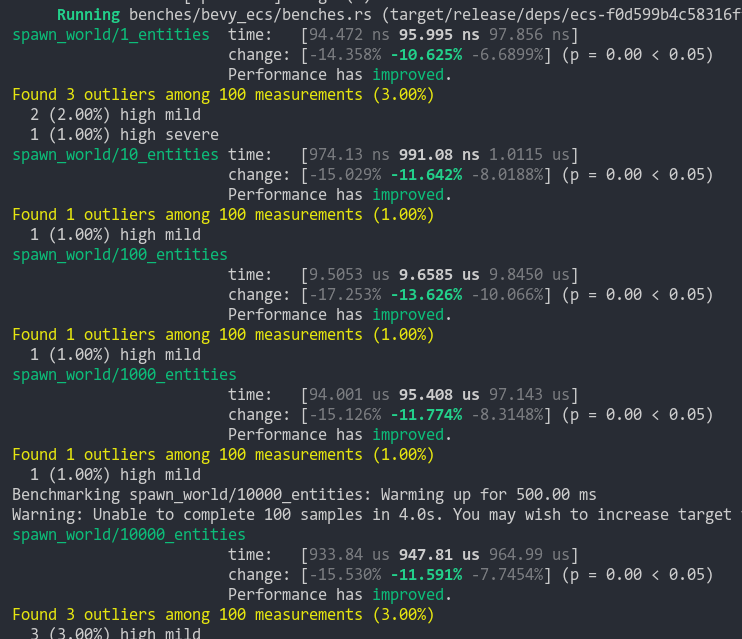
To take this measurement, I added a new `world_spawn` benchmark.
Unfortunately, optimizing `Commands::spawn` is slightly less trivial, as Commands expose the Entity id of spawned entities prior to actually spawning. Doing the optimization would (naively) require assurances that the `spawn(some_bundle)` command is applied before all other commands involving the entity (which would not necessarily be true, if memory serves). Optimizing `Commands::spawn` this way does feel possible, but it will require careful thought (and maybe some additional checks), which deserves its own PR. For now, it has the same performance characteristics of the current `Commands::spawn_bundle` on main.
**Note that 99% of this PR is simple renames and refactors. The only code that needs careful scrutiny is the new `World::spawn()` impl, which is relatively straightforward, but it has some new unsafe code (which re-uses battle tested BundlerSpawner code path).**
---
## Changelog
- All `spawn` apis (`World::spawn`, `Commands:;spawn`, `ChildBuilder::spawn`, and `WorldChildBuilder::spawn`) now accept a bundle as input
- All instances of `spawn_bundle` have been deprecated in favor of the new `spawn` api
- World and Commands now have `spawn_empty()`, which is equivalent to the old `spawn()` behavior.
## Migration Guide
```rust
// Old (0.8):
commands
.spawn()
.insert_bundle((A, B, C));
// New (0.9)
commands.spawn((A, B, C));
// Old (0.8):
commands.spawn_bundle((A, B, C));
// New (0.9)
commands.spawn((A, B, C));
// Old (0.8):
let entity = commands.spawn().id();
// New (0.9)
let entity = commands.spawn_empty().id();
// Old (0.8)
let entity = world.spawn().id();
// New (0.9)
let entity = world.spawn_empty();
```
# Objective

Take advantage of the "impl Bundle for Component" changes in #2975 / add the follow up changes discussed there.

## Solution

- Change `insert` and `remove` to accept a Bundle instead of a Component (for both Commands and World)
- Deprecate `insert_bundle`, `remove_bundle`, and `remove_bundle_intersection`
- Add `remove_intersection`

---

## Changelog

- Change `insert` and `remove` now accept a Bundle instead of a Component (for both Commands and World)
- `insert_bundle` and `remove_bundle` are deprecated


## Migration Guide

Replace `insert_bundle` with `insert`:
```rust
// Old (0.8)
commands.spawn().insert_bundle(SomeBundle::default());
// New (0.9)
commands.spawn().insert(SomeBundle::default());
```

Replace `remove_bundle` with `remove`:
```rust
// Old (0.8)
commands.entity(some_entity).remove_bundle::<SomeBundle>();
// New (0.9)
commands.entity(some_entity).remove::<SomeBundle>();
```

Replace `remove_bundle_intersection` with `remove_intersection`:
```rust
// Old (0.8)
world.entity_mut(some_entity).remove_bundle_intersection::<SomeBundle>();
// New (0.9)
world.entity_mut(some_entity).remove_intersection::<SomeBundle>();
```

Consider consolidating as many operations as possible to improve ergonomics and cut down on archetype moves:
```rust
// Old (0.8)
commands.spawn()
  .insert_bundle(SomeBundle::default())
  .insert(SomeComponent);

// New (0.9) - Option 1
commands.spawn().insert((
  SomeBundle::default(),
  SomeComponent,
))

// New (0.9) - Option 2
commands.spawn_bundle((
  SomeBundle::default(),
  SomeComponent,
))
```

## Next Steps

Consider changing `spawn` to accept a bundle and deprecate `spawn_bundle`.
@BoxyUwU this is your fault.
Also cart didn't arrive in time to tell us not to do this.
# Objective
- Fix#2974
## Solution
- The first commit just does the actual change
- Follow up commits do steps to prove that this method works to unify as required, but this does not remove `insert_bundle`.
## Changelog
### Changed
Nested bundles now collapse automatically, and every `Component` now implements `Bundle`.
This means that you can combine bundles and components arbitrarily, for example:
```rust
// before:
.insert(A).insert_bundle(MyBBundle{..})
// after:
.insert_bundle((A, MyBBundle {..}))
```
Note that there will be a follow up PR that removes the current `insert` impl and renames `insert_bundle` to `insert`.
### Removed
The `bundle` attribute in `derive(Bundle)`.
## Migration guide
In `derive(Bundle)`, the `bundle` attribute has been removed. Nested bundles are not collapsed automatically. You should remove `#[bundle]` attributes.
Co-authored-by: Carter Anderson <mcanders1@gmail.com>
# Objective

Fixes Issue #6005.

## Solution

Replaced WorldQuery with ReadOnlyWorldQuery on F generic in Query filters and QueryState to restrict its trait bound.

## Migration Guide

Query filter (`F`) generics are now bound by `ReadOnlyWorldQuery`, rather than `WorldQuery`. If for some reason you were requesting `Query<&A, &mut B>`, please use `Query<&A, With<B>>` instead.
# Objective

EntityMut::world takes &mut self instead of &self I don't see any reason for this.
EntityRef is overly restrictive with fn world and could return &'w World

---

## Changelog

- EntityRef now implements Copy and Clone
- EntityRef::world is now fn(&self) -> &'w World instead of fn(&mut self) -> &World
- EntityMut::world is now fn(&self) -> &World instead of fn(&mut self) -> &World
# Objective

remove `insert_resource_with_id` because `insert_resource_by_id` exists and does almost exactly the same thing

blocked on #5587 because otherwise we will leak a resource when it's inserted

## Solution

remove the function and also add a safety invariant of to `insert_resource_by_id` that the id be valid for the world.

I didn't see any discussion in #4447 about this safety invariant being left off in favor of a panic so I'm curious if there was one or if it just seemed nicer to have less safety invariants for callers to uphold 😅

---

## Changelog

- safety invariant added to `insert_resource_by_id` requiring the id to be valid for world

## Migration Guide

- audit any calls to `insert_resource_by_id` making sure that the id is valid for the world

Co-authored-by: Carter Anderson <mcanders1@gmail.com>
# Objective
- Fixes#5365
- The `assert!()` when the resource from `World::resource_scope` is inserted into the world is not descriptive.
## Solution
- Add more context to the assert inside of `World::resource_scope` when the `FnOnce` param inserts the resource.
# Objective

While trying out the lint `unsafe_op_in_unsafe_fn` I noticed that `insert_resource_by_id` didn't drop the old value if it already existed, and reimplemented `Column::replace` manually for no apparent reason.

## Solution

- use `Column::replace` and add a test expecting the correct drop count

---

## Changelog

- `World::insert_resource_by_id` will now correctly drop the old resource value, if one already existed
# Objective

Provide a safe API to access an `EntityMut`'s `World`.

## Solution

* Add `EntityMut::into_world_mut` for safe access to the entity's world.

---

## Changelog

* Add `EntityMut::into_world_mut` for safe access to the entity's world.
*This PR description is an edited copy of #5007, written by @alice-i-cecile.*
# Objective
Follow-up to https://github.com/bevyengine/bevy/pull/2254. The `Resource` trait currently has a blanket implementation for all types that meet its bounds.

While ergonomic, this results in several drawbacks:

* it is possible to make confusing, silent mistakes such as inserting a function pointer (Foo) rather than a value (Foo::Bar) as a resource
* it is challenging to discover if a type is intended to be used as a resource
* we cannot later add customization options (see the [RFC](https://github.com/bevyengine/rfcs/blob/main/rfcs/27-derive-component.md) for the equivalent choice for Component).
* dependencies can use the same Rust type as a resource in invisibly conflicting ways
* raw Rust types used as resources cannot preserve privacy appropriately, as anyone able to access that type can read and write to internal values
* we cannot capture a definitive list of possible resources to display to users in an editor
## Notes to reviewers
 * Review this commit-by-commit; there's effectively no back-tracking and there's a lot of churn in some of these commits.
   *ira: My commits are not as well organized :')*
 * I've relaxed the bound on Local to Send + Sync + 'static: I don't think these concerns apply there, so this can keep things simple. Storing e.g. a u32 in a Local is fine, because there's a variable name attached explaining what it does.
 * I think this is a bad place for the Resource trait to live, but I've left it in place to make reviewing easier. IMO that's best tackled with https://github.com/bevyengine/bevy/issues/4981.

## Changelog
`Resource` is no longer automatically implemented for all matching types. Instead, use the new `#[derive(Resource)]` macro.

## Migration Guide
Add `#[derive(Resource)]` to all types you are using as a resource.

If you are using a third party type as a resource, wrap it in a tuple struct to bypass orphan rules. Consider deriving `Deref` and `DerefMut` to improve ergonomics.

`ClearColor` no longer implements `Component`. Using `ClearColor` as a component in 0.8 did nothing.
Use the `ClearColorConfig` in the `Camera3d` and `Camera2d` components instead.


Co-authored-by: Alice <alice.i.cecile@gmail.com>
Co-authored-by: Alice Cecile <alice.i.cecile@gmail.com>
Co-authored-by: devil-ira <justthecooldude@gmail.com>
Co-authored-by: Carter Anderson <mcanders1@gmail.com>
after #5355, three methods were added on world:
* `send_event`
* `send_event_batch`
* `send_default_event`

rename `send_default_event` to `send_event_default` for better discoverability
# Objective

- With access to `World`, it's not obvious how to send an event.
- This is especially useful if you are writing a `Command` that needs to send an `Event`.
- `Events` are a first-class construct in bevy, even though they are just `Resources` under the hood. Their methods should be discoverable.

## Solution

- Provide a simple helpers to send events through `Res<Events<T>>`.
---

## Changelog

> `send_event`, `send_default_event`, and `send_event_batch` methods added to `World`.
# Objective
`SAFETY` comments are meant to be placed before `unsafe` blocks and should contain the reasoning of why in this case the usage of unsafe is okay. This is useful when reading the code because it makes it clear which assumptions are required for safety, and makes it easier to spot possible unsoundness holes. It also forces the code writer to think of something to write and maybe look at the safety contracts of any called unsafe methods again to double-check their correct usage.
There's a clippy lint called `undocumented_unsafe_blocks` which warns when using a block without such a comment.
## Solution
- since clippy expects `SAFETY` instead of `SAFE`, rename those
- add `SAFETY` comments in more places
- for the last remaining 3 places, add an `#[allow()]` and `// TODO` since I wasn't comfortable enough with the code to justify their safety
- add ` #![warn(clippy::undocumented_unsafe_blocks)]` to `bevy_ecs`
### Note for reviewers
The first commit only renames `SAFETY` to `SAFE` so it doesn't need a thorough review.
cb042a416e..55cef2d6fa is the diff for all other changes.
### Safety comments where I'm not too familiar with the code
774012ece5/crates/bevy_ecs/src/entity/mod.rs (L540-L546)774012ece5/crates/bevy_ecs/src/world/entity_ref.rs (L249-L252)
### Locations left undocumented with a `TODO` comment
5dde944a30/crates/bevy_ecs/src/schedule/executor_parallel.rs (L196-L199)5dde944a30/crates/bevy_ecs/src/world/entity_ref.rs (L287-L289)5dde944a30/crates/bevy_ecs/src/world/entity_ref.rs (L413-L415)
Co-authored-by: Jakob Hellermann <hellermann@sipgate.de>
The first leak:
```rust
    #[test]
    fn blob_vec_drop_empty_capacity() {
        let item_layout = Layout:🆕:<Foo>();
        let drop = drop_ptr::<Foo>;
        let _ = unsafe { BlobVec::new(item_layout, Some(drop), 0) };
    }
```
this is because we allocate the swap scratch in blobvec regardless of what the capacity is, but we only deallocate if capacity is > 0

The second leak:
```rust
    #[test]
    fn panic_while_overwriting_component() {
        let helper = DropTestHelper::new();

        let res = panic::catch_unwind(|| {
            let mut world = World::new();
            world
                .spawn()
                .insert(helper.make_component(true, 0))
                .insert(helper.make_component(false, 1));

            println!("Done inserting! Dropping world...");
        });

        let drop_log = helper.finish(res);

        assert_eq!(
            &*drop_log,
            [
                DropLogItem::Create(0),
                DropLogItem::Create(1),
                DropLogItem::Drop(0),
            ]
        );
    }
```
this is caused by us not running the drop impl on the to-be-inserted component if the drop impl of the overwritten component panics

---

managed to figure out where the leaks were by using this 10/10 command
```
cargo --quiet test --lib -- --list | sed 's/: test$//' | MIRIFLAGS="-Zmiri-disable-isolation" xargs -n1 cargo miri test --lib -- --exact
```
which runs every test one by one rather than all at once which let miri actually tell me which test had the leak 🙃
# Objective
- Provide a way to see the components of an entity.
- Fixes#1467
## Solution
- Add `World::inspect_entity`. It accepts an `Entity` and returns a vector of `&ComponentInfo` that the entity has.
- Add `EntityCommands::log_components`. It logs the component names of the entity. (info level)
---
## Changelog
### Added
- Ability to inspect components of an entity through `World::inspect_entity` or `EntityCommands::log_components`
There are some outdated error messages for when a resource is not found. It references `add_resource` and `add_non_send_resource` which were renamed to `insert_resource` and `insert_non_send_resource`.
# Objective
- Simplify the process of obtaining a `ComponentId` instance corresponding to a `Component`.
- Resolves#5060.
## Solution
- Add a `component_id::<T: Component>(&self)` function to both `World` and `Components` to retrieve the `ComponentId` associated with `T` from a immutable reference.
---
## Changelog
- Added `World::component_id::<C>()` and `Components::component_id::<C>()` to retrieve a `Component`'s corresponding `ComponentId` if it exists.
# Objective
Closes#1557. Partially addresses #3362.
Cleanup the public facing API for storage types. Most of these APIs are difficult to use safely when directly interfacing with these types, and is also currently impossible to interact with in normal ECS use as there is no `World::storages_mut`. The majority of these types should be easy enough to read, and perhaps mutate the contents, but never structurally altered without the same checks in the rest of bevy_ecs code. This both cleans up the public facing types and helps use unused code detection to remove a few of the APIs we're not using internally.
## Solution
- Mark all APIs that take `&mut T` under `bevy_ecs::storage` as `pub(crate)` or `pub(super)`
- Cleanup after it all.
Entire type visibility changes:
- `BlobVec` is `pub(super)`, only storage code should be directly interacting with it.
- `SparseArray` is now `pub(crate)` for the entire type. It's an implementation detail for `Table` and `(Component)SparseSet`.
- `TableMoveResult` is now `pub(crate)
---
## Changelog
TODO
## Migration Guide
Dear God, I hope not.
# Objective
Most of our `Iterator` impls satisfy the requirements of `std::iter::FusedIterator`, which has internal specialization that optimizes `Interator::fuse`. The std lib iterator combinators do have a few that rely on `fuse`, so this could optimize those use cases. I don't think we're using any of them in the engine itself, but beyond a light increase in compile time, it doesn't hurt to implement the trait.

## Solution
Implement the trait for all eligible iterators in first party crates. Also add a missing `ExactSizeIterator` on an iterator that could use it.
# Objective

Even if bevy itself does not provide any builtin scripting or modding APIs, it should have the foundations for building them yourself.
For that it should be enough to have APIs that are not tied to the actual rust types with generics, but rather accept `ComponentId`s and `bevy_ptr` ptrs.

## Solution

Add the following APIs to bevy
```rust
fn EntityRef::get_by_id(ComponentId) -> Option<Ptr<'w>>;
fn EntityMut::get_by_id(ComponentId) -> Option<Ptr<'_>>;
fn EntityMut::get_mut_by_id(ComponentId) -> Option<MutUntyped<'_>>;

fn World::get_resource_by_id(ComponentId) -> Option<Ptr<'_>>;
fn World::get_resource_mut_by_id(ComponentId) -> Option<MutUntyped<'_>>;

// Safety: `value` must point to a valid value of the component
unsafe fn World::insert_resource_by_id(ComponentId, value: OwningPtr);

fn ComponentDescriptor::new_with_layout(..) -> Self;
fn World::init_component_with_descriptor(ComponentDescriptor) -> ComponentId;
```

~~This PR would definitely benefit from #3001 (lifetime'd pointers) to make sure that the lifetimes of the pointers are valid and the my-move pointer in `insert_resource_by_id` could be an `OwningPtr`, but that can be adapter later if/when #3001 is merged.~~

### Not in this PR
- inserting components on entities (this is very tied to types with bundles and the `BundleInserter`)
- an untyped version of a query (needs good API design, has a large implementation complexity, can be done in a third-party crate)

Co-authored-by: Jakob Hellermann <hellermann@sipgate.de>
# Objective

The pointer types introduced in #3001 are useful not just in `bevy_ecs`, but also in crates like `bevy_reflect` (#4475) or even outside of bevy.

## Solution

Extract `Ptr<'a>`, `PtrMut<'a>`, `OwnedPtr<'a>`, `ThinSlicePtr<'a, T>` and `UnsafeCellDeref` from `bevy_ecs::ptr` into `bevy_ptr`.

**Note:** `bevy_ecs` still reexports the `bevy_ptr` as `bevy_ecs::ptr` so that crates like `bevy_transform` can use the `Bundle` derive without needing to depend on `bevy_ptr` themselves.
# Objective

`bevy_ecs` has large amounts of unsafe code which is hard to get right and makes it difficult to audit for soundness.

## Solution

Introduce lifetimed, type-erased pointers: `Ptr<'a>` `PtrMut<'a>` `OwningPtr<'a>'` and `ThinSlicePtr<'a, T>` which are newtypes around a raw pointer with a lifetime and conceptually representing strong invariants about the pointee and validity of the pointer.

The process of converting bevy_ecs to use these has already caught multiple cases of unsound behavior.

## Changelog

TL;DR for release notes: `bevy_ecs` now uses lifetimed, type-erased pointers internally, significantly improving safety and legibility without sacrificing performance. This should have approximately no end user impact, unless you were meddling with the (unfortunately public) internals of `bevy_ecs`.

- `Fetch`, `FilterFetch` and `ReadOnlyFetch` trait no longer have a `'state` lifetime
    - this was unneeded
- `ReadOnly/Fetch` associated types on `WorldQuery` are now on a new `WorldQueryGats<'world>` trait
    - was required to work around lack of Generic Associated Types (we wish to express `type Fetch<'a>: Fetch<'a>`)
- `derive(WorldQuery)` no longer requires `'w` lifetime on struct
    - this was unneeded, and improves the end user experience
- `EntityMut::get_unchecked_mut` returns `&'_ mut T` not `&'w mut T`
    - allows easier use of unsafe API with less footguns, and can be worked around via lifetime transmutery as a user
- `Bundle::from_components` now takes a `ctx` parameter to pass to the `FnMut` closure
    - required because closure return types can't borrow from captures
- `Fetch::init` takes `&'world World`, `Fetch::set_archetype` takes `&'world Archetype` and `&'world Tables`, `Fetch::set_table` takes `&'world Table`
    - allows types implementing `Fetch` to store borrows into world
- `WorldQuery` trait now has a `shrink` fn to shorten the lifetime in `Fetch::<'a>::Item`
    - this works around lack of subtyping of assoc types, rust doesnt allow you to turn `<T as Fetch<'static>>::Item'` into `<T as Fetch<'a>>::Item'`
    - `QueryCombinationsIter` requires this
- Most types implementing `Fetch` now have a lifetime `'w`
    - allows the fetches to store borrows of world data instead of using raw pointers

## Migration guide

- `EntityMut::get_unchecked_mut` returns a more restricted lifetime, there is no general way to migrate this as it depends on your code
- `Bundle::from_components` implementations must pass the `ctx` arg to `func`
- `Bundle::from_components` callers have to use a fn arg instead of closure captures for borrowing from world
- Remove lifetime args on `derive(WorldQuery)` structs as it is nonsensical
- `<Q as WorldQuery>::ReadOnly/Fetch` should be changed to either `RO/QueryFetch<'world>` or `<Q as WorldQueryGats<'world>>::ReadOnly/Fetch`
- `<F as Fetch<'w, 's>>` should be changed to `<F as Fetch<'w>>`
- Change the fn sigs of `Fetch::init/set_archetype/set_table` to match respective trait fn sigs
- Implement the required `fn shrink` on any `WorldQuery` implementations
- Move assoc types `Fetch` and `ReadOnlyFetch` on `WorldQuery` impls to `WorldQueryGats` impls
- Pass an appropriate `'world` lifetime to whatever fetch struct you are for some reason using

### Type inference regression

in some cases rustc may give spurrious errors when attempting to infer the `F` parameter on a query/querystate this can be fixed by manually specifying the type, i.e. `QueryState:🆕:<_, ()>(world)`. The error is rather confusing:

```rust=
error[E0271]: type mismatch resolving `<() as Fetch<'_>>::Item == bool`
    --> crates/bevy_pbr/src/render/light.rs:1413:30
     |
1413 |             main_view_query: QueryState::new(world),
     |                              ^^^^^^^^^^^^^^^ expected `bool`, found `()`
     |
     = note: required because of the requirements on the impl of `for<'x> FilterFetch<'x>` for `<() as WorldQueryGats<'x>>::Fetch`
note: required by a bound in `bevy_ecs::query::QueryState::<Q, F>::new`
    --> crates/bevy_ecs/src/query/state.rs:49:32
     |
49   |     for<'x> QueryFetch<'x, F>: FilterFetch<'x>,
     |                                ^^^^^^^^^^^^^^^ required by this bound in `bevy_ecs::query::QueryState::<Q, F>::new`
```

---

Made with help from @BoxyUwU and @alice-i-cecile

Co-authored-by: Boxy <supbscripter@gmail.com>
# Objective

- `EntityRef` and `EntityMut` are surpisingly important public types when working directly with the `World`.
- They're undocumented.

## Solution

- Just add docs!
The only way to soundly use this API is already encapsulated within `EntityMut::get`, so this api is removed.

# Migration guide

Replace calls to `EntityMut::get_unchecked` with calls to `EntityMut::get`.
# Objective

- Provide more information when despawning an entity

## Solution

- Add a debug log when despawning an entity
- Add spans to the recursive ways of despawning an entity

```sh
RUST_LOG=debug cargo run --example panic --features trace
# RUST_LOG=debug needed to show debug logs from bevy_ecs
# --features trace needed to have the extra spans
...

DEBUG bevy_app:frame:stage{name=Update}:system_commands{name="panic::despawn_parent"}:command{name="DespawnRecursive" entity=0v0}: bevy_ecs::world: Despawning entity 1v0
DEBUG bevy_app:frame:stage{name=Update}:system_commands{name="panic::despawn_parent"}:command{name="DespawnRecursive" entity=0v0}: bevy_ecs::world: Despawning entity 0v0
```
Fixes#3408#3001 also solves this but I dont see it getting merged any time soon so...
# Objective
make bevy ecs a lil bit less unsound
## Solution
make `EntityMut::get_component_mut` return borrows from self instead of `'w`
# Objective
make bevy ecs a lil bit less unsound

## Solution
make unsound API unsafe so that there is an unsafe block to blame:

```rust
use bevy_ecs::prelude::*;

#[derive(Debug, Component)]
struct Foo(u8);

fn main() {
    let mut world = World::new();
    let e1 = world.spawn().id();
    let e2 = world.spawn().insert(Foo(2)).id();
    world.entities_mut().meta[0] = world.entities_mut().meta[1].clone();
    let foo = world.entity(e1).get::<Foo>().unwrap();
    // whoo i love having components i dont have
    dbg!(foo);
}
```

This is not _strictly_ speaking UB, however:
- `Query::get_multiple` cannot work if this is allowed
- bevy_ecs is a pile of unsafe code whose soundness generally depends on the world being in a "correct" state with "no funny business" so it seems best to disallow this
- it is trivial to get bevy to panic inside of functions with safety invariants that have been violated (the entity location is not valid)
- it seems to violate what the safety invariant on `Entities::flush` is trying to ensure
# Objective
make bevy ecs a lil bit less unsound
## Solution
yeet unsound API `World::components_mut`:
```rust
use bevy_ecs::prelude::*;

#[derive(Component)]
struct Foo(u8);

#[derive(Debug, Component)]
struct Bar([u8; 100]);

fn main() {
    let mut world = World::new();
    let e = world.spawn().insert(Foo(0)).id();
    *world.components_mut() = Default::default();
    let bar = world.entity_mut(e).remove::<Bar>().unwrap();
    // oopsies reading memory copied from outside allocation
    dbg!(bar);
}
```
# Objective

- In the large majority of cases, users were calling `.unwrap()` immediately after `.get_resource`.
- Attempting to add more helpful error messages here resulted in endless manual boilerplate (see #3899 and the linked PRs).

## Solution

- Add an infallible variant named `.resource` and so on.
- Use these infallible variants over `.get_resource().unwrap()` across the code base.

## Notes

I did not provide equivalent methods on `WorldCell`, in favor of removing it entirely in #3939.

## Migration Guide

Infallible variants of `.get_resource` have been added that implicitly panic, rather than needing to be unwrapped.

Replace `world.get_resource::<Foo>().unwrap()` with `world.resource::<Foo>()`.

## Impact

- `.unwrap` search results before: 1084
- `.unwrap` search results after: 942
- internal `unwrap_or_else` calls added: 4
- trivial unwrap calls removed from tests and code: 146
- uses of the new `try_get_resource` API: 11
- percentage of the time the unwrapping API was used internally: 93%
# Objective
- `SystemStates` rock for dealing with exclusive world access, but are hard to figure out how to use.
- Fixes#3341.
## Solution
- Clearly document how to use `SystemState`, and why they're useful as an end-user.
What is says on the tin.

This has got more to do with making `clippy` slightly more *quiet* than it does with changing anything that might greatly impact readability or performance.

that said, deriving `Default` for a couple of structs is a nice easy win
# Objective
- Fixes#3078
- Fixes#1397
## Solution
- Implement Commands::init_resource.
- Also implement for World, for consistency and to simplify internal structure.
- While we're here, clean up some of the docs for Command and World resource modification.
# Objective

Calling forget would invalidate the data pointer before it is used.

## Solution

Use `ManuallyDrop` to prevent the value from being dropped without moving it.
# Objective
Fixes#3566
## Solution
- [x] Fix broken links in private docs.
- [x] Add the `--document-private-items` flag to the CI.
## Note
The following was said by @killercup in #3566:
> I don't have time to confirm this but I assume that linking to private items throws an error/warning when just running cargo doc, and --document-private-item might actually hide that warning. So to test this, you'd have to run it twice.
I tested this and this is thankfully not the case. If you are linking to a private item you will get a warning no matter if you run `cargo doc` or `cargo doc --document-private-items`.
### Example
I added `struct Test;` to `bevy_core/src/name.rs` and linked to it inside of a doc comment using ``[`Test`]``. After that I ran `cargo doc -p bevy_core --document-private-items` using `RUSTDOCFLAGS="-D warnings"` and got the following output (note the last sentence):
```rust
error: public documentation for `Name` links to private item `Test`
--> crates/bevy_core/src/name.rs:11:82
|
11 | /// Component used to identify an entity. Stores a hash for faster comparisons [`Test`]
| ^^^^ this item is private
|
= note: `-D rustdoc::private-intra-doc-links` implied by `-D warnings`
= note: this link resolves only because you passed `--document-private-items`, but will break without
```
# Objective

- Calling .id() has no purpose unless you use the Entity returned
- This is an easy source of confusion for beginners.
- This is easily missed during refactors.

## Solution

- Mark the appropriate methods as #[must_use]
#3457 adds the `doc_markdown` clippy lint, which checks doc comments to make sure code identifiers are escaped with backticks. This causes a lot of lint errors, so this is one of a number of PR's that will fix those lint errors one crate at a time.

This PR fixes lints in the `bevy_ecs` crate.
# Objective
I thought I'd have a go a trying to fix#2597.
Hopefully fixes#2597.
## Solution
I reused the memory pointed to by the value parameter, that is already required by `insert` to not be dropped, to contain the extracted value while dropping it.
Add the entity ID and generation to the expect() message of two
world accessors, to make it easier to debug use-after-free issues.
Coupled with e.g. bevy-inspector-egui which also displays the entity ID,
this makes it much easier to identify what entity is being misused.

# Objective

Make it easier to identity an entity being accessed after being deleted.

## Solution

Augment the error message of some `expect()` call with the entity ID and
generation. Combined with some external tool like `bevy-inspector-egui`, which
also displays the entity ID, this increases the chances to be able to identify
the entity, and therefore find the error that led to a use-after-despawn.
This implements the most minimal variant of #1843 - a derive for marker trait. This is a prerequisite to more complicated features like statically defined storage type or opt-out component reflection.

In order to make component struct's purpose explicit and avoid misuse, it must be annotated with `#[derive(Component)]` (manual impl is discouraged for compatibility). Right now this is just a marker trait, but in the future it might be expanded. Making this change early allows us to make further changes later without breaking backward compatibility for derive macro users.

This already prevents a lot of issues, like using bundles in `insert` calls. Primitive types are no longer valid components as well. This can be easily worked around by adding newtype wrappers and deriving `Component` for them.

One funny example of prevented bad code (from our own tests) is when an newtype struct or enum variant is used. Previously, it was possible to write `insert(Newtype)` instead of `insert(Newtype(value))`. That code compiled, because function pointers (in this case newtype struct constructor) implement `Send + Sync + 'static`, so we allowed them to be used as components. This is no longer the case and such invalid code will trigger a compile error.


Co-authored-by: = <=>
Co-authored-by: TheRawMeatball <therawmeatball@gmail.com>
Co-authored-by: Carter Anderson <mcanders1@gmail.com>
# Objective

Fixes these issues:
- `WorldId`s currently aren't necessarily unique
    - I want to guarantee that they're unique to safeguard my librarified version of https://github.com/bevyengine/bevy/discussions/2805
    - There probably hasn't been a collision yet, but they could technically collide
- `SystemId` isn't used for anything
  - It's no longer used now that `Locals` are stored within the `System`.
- `bevy_ecs` depends on rand

## Solution

- Instead of randomly generating `WorldId`s, just use an incrementing atomic counter, panicing on overflow.
- Remove `SystemId`
    - We do need to allow Locals for exclusive systems at some point, but exclusive systems couldn't access their own `SystemId` anyway.
- Now that these don't depend on rand, move it to a dev-dependency

## Todo

Determine if `WorldId` should be `u32` based instead
Changed out unwraps to use if let syntax instead. Returning false when None.
Also modified an existing test to encompass these methods
This PR fixes#2828
## Objective
The upcoming Bevy Book makes many references to the API documentation of bevy.
Most references belong to the first two chapters of the Bevy Book:
- bevyengine/bevy-website#176
- bevyengine/bevy-website#182
This PR attempts to improve the documentation of `bevy_ecs` and `bevy_app` in order to help readers of the Book who want to delve deeper into technical details.
## Solution
- Add crate and level module documentation
- Document the most important items (basically those included in the preludes), with the following style, where applicable:
- **Summary.** Short description of the item.
- **Second paragraph.** Detailed description of the item, without going too much in the implementation.
- **Code example(s).**
- **Safety or panic notes.**
## Collaboration
Any kind of collaboration is welcome, especially corrections, wording, new ideas and guidelines on where the focus should be put in.
---
### Related issues
- Fixes#2246
This upstreams the code changes used by the new renderer to enable cross-app Entity reuse:

* Spawning at specific entities
* get_or_spawn: spawns an entity if it doesn't already exist and returns an EntityMut
* insert_or_spawn_batch: the batched equivalent to `world.get_or_spawn(entity).insert_bundle(bundle)`
* Clearing entities and storages
* Allocating Entities with "invalid" archetypes. These entities cannot be queried / are treated as "non existent". They serve as "reserved" entities that won't show up when calling `spawn()`. They must be "specifically spawned at" using apis like `get_or_spawn(entity)`.

In combination, these changes enable the "render world" to clear entities / storages each frame and reserve all "app world entities". These can then be spawned during the "render extract step".

This refactors "spawn" and "insert" code in a way that I think is a massive improvement to legibility and re-usability. It also yields marginal performance wins by reducing some duplicate lookups (less than a percentage point improvement on insertion benchmarks). There is also some potential for future unsafe reduction (by making BatchSpawner and BatchInserter generic). But for now I want to cut down generic usage to a minimum to encourage smaller binaries and faster compiles.

This is currently a draft because it needs more tests (although this code has already had some real-world testing on my custom-shaders branch).

I also fixed the benchmarks (which currently don't compile!) / added new ones to illustrate batching wins.

After these changes, Bevy ECS is basically ready to accommodate the new renderer. I think the biggest missing piece at this point is "sub apps".
This logic was in both `remove_bundle` and ` remove_bundle_intersection` but only differed by whether we call `.._forget_missing_..` or `.._drop_missing_..`
Continuing the work on reducing the safety footguns in the code, I've removed one extra `UnsafeCell` in favour of safe `Cell` usage inisde `ComponentTicks`. That change led to discovery of misbehaving component insert logic, where data wasn't properly dropped when overwritten. Apart from that being fixed, some method names were changed to better convey the "initialize new allocation" and "replace existing allocation" semantic.

Depends on #2221, I will rebase this PR after the dependency is merged. For now, review just the last commit.

Co-authored-by: Carter Anderson <mcanders1@gmail.com>
`ResMut`, `Mut` and `ReflectMut` all share very similar code for change detection.
This PR is a first pass at refactoring these implementation and removing a lot of the duplicated code.

Note, this introduces a new trait `ChangeDetectable`.

Please feel free to comment away and let me know what you think!
I've noticed that we are overusing interior mutability of the Table data, where in many cases we already own a unique reference to it. That prompted a slight refactor aiming to reduce number of safety constraints that must be manually upheld. Now the majority of those are just about avoiding bound checking, which is relatively easy to prove right.

Another aspect is reducing the complexity of Table struct. Notably, we don't ever use archetypes stored there, so this whole thing goes away. Capacity and grow amount were mostly superficial, as we are already using Vecs inside anyway, so I've got rid of those too. Now the overall table capacity is being driven by the internal entity Vec capacity. This has a side effect of automatically implementing exponential growth pattern for BitVecs reallocations inside Table, which to my measurements slightly improves performance in tests that are heavy on inserts. YMMV, but I hope that those tests were at least remotely correct.
This new api stems from this [discord conversation](https://discord.com/channels/691052431525675048/742569353878437978/844057268172357663).

This exposes a public facing `set_changed` method on `ResMut` and `Mut`.

As a side note: `ResMut` and `Mut` have a lot of duplicated code, I have a PR I may put up later that refactors these commonalities into a trait.

Co-authored-by: Carter Anderson <mcanders1@gmail.com>
- simplified code around archetype generations a little bit, as the special case value is not actually needed
- removed unnecessary UnsafeCell around pointer value that is never updated through shared references
- fixed and added a test for correct drop behaviour when removing sparse components through remove_bundle command
This can save users from having to type `&*X` all the time at the cost of some complexity in the type signature. For instance, this allows me to accommodate @jakobhellermann's suggestion in #1799 without requiring users to type `&*windows` 99% of the time.
This shrinks breakout from 316k to 310k when using `--feature dynamic`.
I haven't run the ecs benchmark to test performance as my laptop is too noisy for reliable benchmarking.
We discussed with @alice-i-cecile privately on iterators and agreed that making a custom ordered iterator over query makes no sense since materialization is required anyway and it's better to reuse existing components or code. Therefore, just adding an example to the documentation as requested.
Fixes#1470.
Co-authored-by: Carter Anderson <mcanders1@gmail.com>
I think [collection, thing_removed_from_collection] is a more natural order than [thing_removed_from_collection, collection]. Just a small tweak that I think we should include in 0.5.
Removing the checks on this line https://github.com/bevyengine/bevy/blob/main/crates/bevy_sprite/src/frustum_culling.rs#L64 and running the "many_sprites" example revealed two corner case bugs in bevy_ecs. The first, a simple and honest missed line introduced in #1471. The other, an insidious monster that has been there since the ECS v2 rewrite, just waiting for the time to strike:
1. #1471 accidentally removed the "insert" line for sparse set components with the "mutated" bundle state. Re-adding it fixes the problem. I did a slight refactor here to make the implementation simpler and remove a branch.
2. The other issue is nastier. ECS v2 added an "archetype graph". When determining what components were added/mutated during an archetype change, we read the FromBundle edge (which encodes this state) on the "new" archetype. The problem is that unlike "add edges" which are guaranteed to be unique for a given ("graph node", "bundle id") pair, FromBundle edges are not necessarily unique:
```rust
// OLD_ARCHETYPE -> NEW_ARCHETYPE
// [] -> [usize]
e.insert(2usize);
// [usize] -> [usize, i32]
e.insert(1i32);
// [usize, i32] -> [usize, i32]
e.insert(1i32);
// [usize, i32] -> [usize]
e.remove::<i32>();
// [usize] -> [usize, i32]
e.insert(1i32);
```
Note that the second `e.insert(1i32)` command has a different "archetype graph edge" than the first, but they both lead to the same "new archetype".
The fix here is simple: just remove FromBundle edges because they are broken and store the information in the "add edges", which are guaranteed to be unique.
FromBundle edges were added to cut down on the number of archetype accesses / make the archetype access patterns nicer. But benching this change resulted in no significant perf changes and the addition of get_2_mut() for archetypes resolves the access pattern issue.
# Problem Definition
The current change tracking (via flags for both components and resources) fails to detect changes made by systems that are scheduled to run earlier in the frame than they are.
This issue is discussed at length in [#68](https://github.com/bevyengine/bevy/issues/68) and [#54](https://github.com/bevyengine/bevy/issues/54).
This is very much a draft PR, and contributions are welcome and needed.
# Criteria
1. Each change is detected at least once, no matter the ordering.
2. Each change is detected at most once, no matter the ordering.
3. Changes should be detected the same frame that they are made.
4. Competitive ergonomics. Ideally does not require opting-in.
5. Low CPU overhead of computation.
6. Memory efficient. This must not increase over time, except where the number of entities / resources does.
7. Changes should not be lost for systems that don't run.
8. A frame needs to act as a pure function. Given the same set of entities / components it needs to produce the same end state without side-effects.
**Exact** change-tracking proposals satisfy criteria 1 and 2.
**Conservative** change-tracking proposals satisfy criteria 1 but not 2.
**Flaky** change tracking proposals satisfy criteria 2 but not 1.
# Code Base Navigation
There are three types of flags:
- `Added`: A piece of data was added to an entity / `Resources`.
- `Mutated`: A piece of data was able to be modified, because its `DerefMut` was accessed
- `Changed`: The bitwise OR of `Added` and `Changed`
The special behavior of `ChangedRes`, with respect to the scheduler is being removed in [#1313](https://github.com/bevyengine/bevy/pull/1313) and does not need to be reproduced.
`ChangedRes` and friends can be found in "bevy_ecs/core/resources/resource_query.rs".
The `Flags` trait for Components can be found in "bevy_ecs/core/query.rs".
`ComponentFlags` are stored in "bevy_ecs/core/archetypes.rs", defined on line 446.
# Proposals
**Proposal 5 was selected for implementation.**
## Proposal 0: No Change Detection
The baseline, where computations are performed on everything regardless of whether it changed.
**Type:** Conservative
**Pros:**
- already implemented
- will never miss events
- no overhead
**Cons:**
- tons of repeated work
- doesn't allow users to avoid repeating work (or monitoring for other changes)
## Proposal 1: Earlier-This-Tick Change Detection
The current approach as of Bevy 0.4. Flags are set, and then flushed at the end of each frame.
**Type:** Flaky
**Pros:**
- already implemented
- simple to understand
- low memory overhead (2 bits per component)
- low time overhead (clear every flag once per frame)
**Cons:**
- misses systems based on ordering
- systems that don't run every frame miss changes
- duplicates detection when looping
- can lead to unresolvable circular dependencies
## Proposal 2: Two-Tick Change Detection
Flags persist for two frames, using a double-buffer system identical to that used in events.
A change is observed if it is found in either the current frame's list of changes or the previous frame's.
**Type:** Conservative
**Pros:**
- easy to understand
- easy to implement
- low memory overhead (4 bits per component)
- low time overhead (bit mask and shift every flag once per frame)
**Cons:**
- can result in a great deal of duplicated work
- systems that don't run every frame miss changes
- duplicates detection when looping
## Proposal 3: Last-Tick Change Detection
Flags persist for two frames, using a double-buffer system identical to that used in events.
A change is observed if it is found in the previous frame's list of changes.
**Type:** Exact
**Pros:**
- exact
- easy to understand
- easy to implement
- low memory overhead (4 bits per component)
- low time overhead (bit mask and shift every flag once per frame)
**Cons:**
- change detection is always delayed, possibly causing painful chained delays
- systems that don't run every frame miss changes
- duplicates detection when looping
## Proposal 4: Flag-Doubling Change Detection
Combine Proposal 2 and Proposal 3. Differentiate between `JustChanged` (current behavior) and `Changed` (Proposal 3).
Pack this data into the flags according to [this implementation proposal](https://github.com/bevyengine/bevy/issues/68#issuecomment-769174804).
**Type:** Flaky + Exact
**Pros:**
- allows users to acc
- easy to implement
- low memory overhead (4 bits per component)
- low time overhead (bit mask and shift every flag once per frame)
**Cons:**
- users must specify the type of change detection required
- still quite fragile to system ordering effects when using the flaky `JustChanged` form
- cannot get immediate + exact results
- systems that don't run every frame miss changes
- duplicates detection when looping
## [SELECTED] Proposal 5: Generation-Counter Change Detection
A global counter is increased after each system is run. Each component saves the time of last mutation, and each system saves the time of last execution. Mutation is detected when the component's counter is greater than the system's counter. Discussed [here](https://github.com/bevyengine/bevy/issues/68#issuecomment-769174804). How to handle addition detection is unsolved; the current proposal is to use the highest bit of the counter as in proposal 1.
**Type:** Exact (for mutations), flaky (for additions)
**Pros:**
- low time overhead (set component counter on access, set system counter after execution)
- robust to systems that don't run every frame
- robust to systems that loop
**Cons:**
- moderately complex implementation
- must be modified as systems are inserted dynamically
- medium memory overhead (4 bytes per component + system)
- unsolved addition detection
## Proposal 6: System-Data Change Detection
For each system, track which system's changes it has seen. This approach is only worth fully designing and implementing if Proposal 5 fails in some way.
**Type:** Exact
**Pros:**
- exact
- conceptually simple
**Cons:**
- requires storing data on each system
- implementation is complex
- must be modified as systems are inserted dynamically
## Proposal 7: Total-Order Change Detection
Discussed [here](https://github.com/bevyengine/bevy/issues/68#issuecomment-754326523). This proposal is somewhat complicated by the new scheduler, but I believe it should still be conceptually feasible. This approach is only worth fully designing and implementing if Proposal 5 fails in some way.
**Type:** Exact
**Pros:**
- exact
- efficient data storage relative to other exact proposals
**Cons:**
- requires access to the scheduler
- complex implementation and difficulty grokking
- must be modified as systems are inserted dynamically
# Tests
- We will need to verify properties 1, 2, 3, 7 and 8. Priority: 1 > 2 = 3 > 8 > 7
- Ideally we can use identical user-facing syntax for all proposals, allowing us to re-use the same syntax for each.
- When writing tests, we need to carefully specify order using explicit dependencies.
- These tests will need to be duplicated for both components and resources.
- We need to be sure to handle cases where ambiguous system orders exist.
`changing_system` is always the system that makes the changes, and `detecting_system` always detects the changes.
The component / resource changed will be simple boolean wrapper structs.
## Basic Added / Mutated / Changed
2 x 3 design:
- Resources vs. Components
- Added vs. Changed vs. Mutated
- `changing_system` runs before `detecting_system`
- verify at the end of tick 2
## At Least Once
2 x 3 design:
- Resources vs. Components
- Added vs. Changed vs. Mutated
- `changing_system` runs after `detecting_system`
- verify at the end of tick 2
## At Most Once
2 x 3 design:
- Resources vs. Components
- Added vs. Changed vs. Mutated
- `changing_system` runs once before `detecting_system`
- increment a counter based on the number of changes detected
- verify at the end of tick 2
## Fast Detection
2 x 3 design:
- Resources vs. Components
- Added vs. Changed vs. Mutated
- `changing_system` runs before `detecting_system`
- verify at the end of tick 1
## Ambiguous System Ordering Robustness
2 x 3 x 2 design:
- Resources vs. Components
- Added vs. Changed vs. Mutated
- `changing_system` runs [before/after] `detecting_system` in tick 1
- `changing_system` runs [after/before] `detecting_system` in tick 2
## System Pausing
2 x 3 design:
- Resources vs. Components
- Added vs. Changed vs. Mutated
- `changing_system` runs in tick 1, then is disabled by run criteria
- `detecting_system` is disabled by run criteria until it is run once during tick 3
- verify at the end of tick 3
## Addition Causes Mutation
2 design:
- Resources vs. Components
- `adding_system_1` adds a component / resource
- `adding system_2` adds the same component / resource
- verify the `Mutated` flag at the end of the tick
- verify the `Added` flag at the end of the tick
First check tests for: https://github.com/bevyengine/bevy/issues/333
Second check tests for: https://github.com/bevyengine/bevy/issues/1443
## Changes Made By Commands
- `adding_system` runs in Update in tick 1, and sends a command to add a component
- `detecting_system` runs in Update in tick 1 and 2, after `adding_system`
- We can't detect the changes in tick 1, since they haven't been processed yet
- If we were to track these changes as being emitted by `adding_system`, we can't detect the changes in tick 2 either, since `detecting_system` has already run once after `adding_system` :(
# Benchmarks
See: [general advice](https://github.com/bevyengine/bevy/blob/master/docs/profiling.md), [Criterion crate](https://github.com/bheisler/criterion.rs)
There are several critical parameters to vary:
1. entity count (1 to 10^9)
2. fraction of entities that are changed (0% to 100%)
3. cost to perform work on changed entities, i.e. workload (1 ns to 1s)
1 and 2 should be varied between benchmark runs. 3 can be added on computationally.
We want to measure:
- memory cost
- run time
We should collect these measurements across several frames (100?) to reduce bootup effects and accurately measure the mean, variance and drift.
Entity-component change detection is much more important to benchmark than resource change detection, due to the orders of magnitude higher number of pieces of data.
No change detection at all should be included in benchmarks as a second control for cases where missing changes is unacceptable.
## Graphs
1. y: performance, x: log_10(entity count), color: proposal, facet: performance metric. Set cost to perform work to 0.
2. y: run time, x: cost to perform work, color: proposal, facet: fraction changed. Set number of entities to 10^6
3. y: memory, x: frames, color: proposal
# Conclusions
1. Is the theoretical categorization of the proposals correct according to our tests?
2. How does the performance of the proposals compare without any load?
3. How does the performance of the proposals compare with realistic loads?
4. At what workload does more exact change tracking become worth the (presumably) higher overhead?
5. When does adding change-detection to save on work become worthwhile?
6. Is there enough divergence in performance between the best solutions in each class to ship more than one change-tracking solution?
# Implementation Plan
1. Write a test suite.
2. Verify that tests fail for existing approach.
3. Write a benchmark suite.
4. Get performance numbers for existing approach.
5. Implement, test and benchmark various solutions using a Git branch per proposal.
6. Create a draft PR with all solutions and present results to team.
7. Select a solution and replace existing change detection.
Co-authored-by: Brice DAVIER <bricedavier@gmail.com>
Co-authored-by: Carter Anderson <mcanders1@gmail.com>
Fixes all warnings from `cargo doc --all`.
Those related to code blocks were introduced in #1612, but re-formatting using the experimental features in `rustfmt.toml` doesn't seem to reintroduce them.
Removes `get_unchecked` and `get_unchecked_mut` from `Tables` and `Archetypes` collections in favor of safe Index implementations. This fixes a safety error in `Archetypes::get_id_or_insert()` (which previously relied on TableId being valid to be safe ... the alternative was to make that method unsafe too). It also cuts down on a lot of unsafe and makes the code easier to look at. I'm not sure what changed since the last benchmark, but these numbers are more favorable than my last tests of similar changes. I didn't include the Components collection as those severely killed perf last time I tried. But this does inspire me to try again (just in a separate pr)!
Note that the `simple_insert/bevy_unbatched` benchmark fluctuates a lot on both branches (this was also true for prior versions of bevy). It seems like the allocator has more variance for many small allocations. And `sparse_frag_iter/bevy` operates on such a small scale that 10% fluctuations are common.
Some benches do take a small hit here, but I personally think its worth it.
This also fixes a safety error in Query::for_each_mut, which needed to mutably borrow Query (aaahh!).
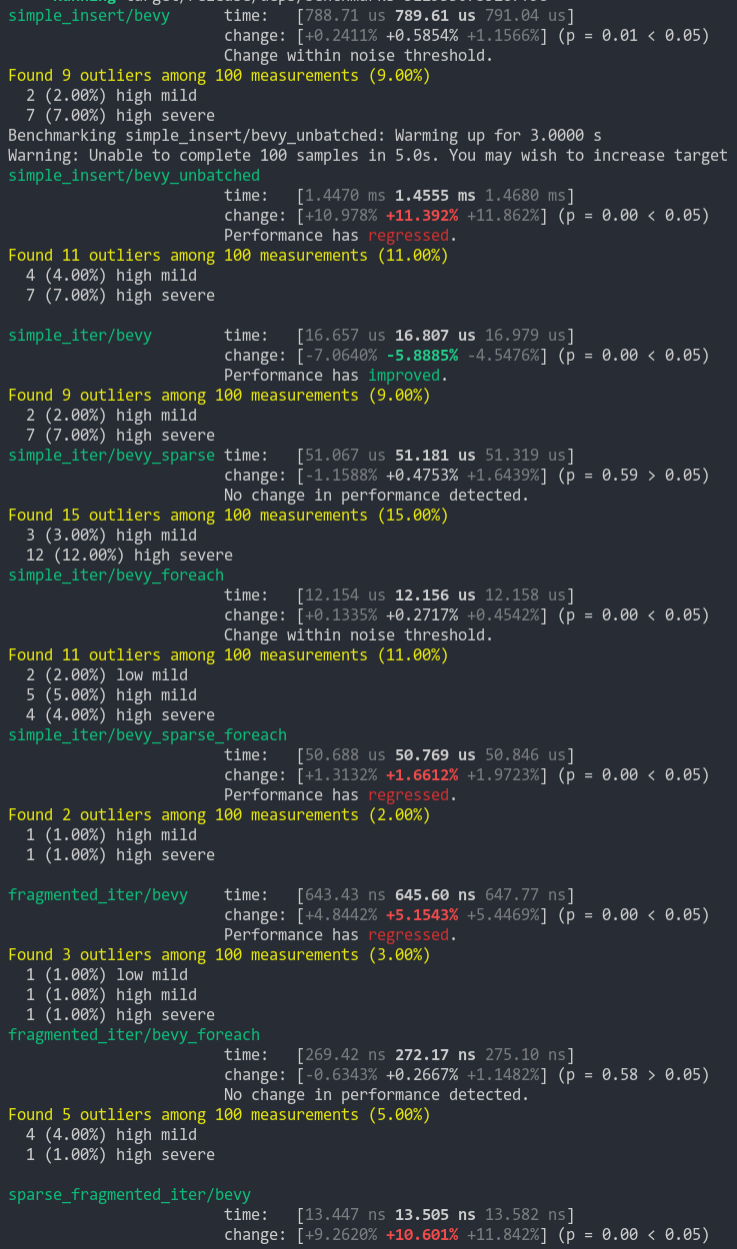
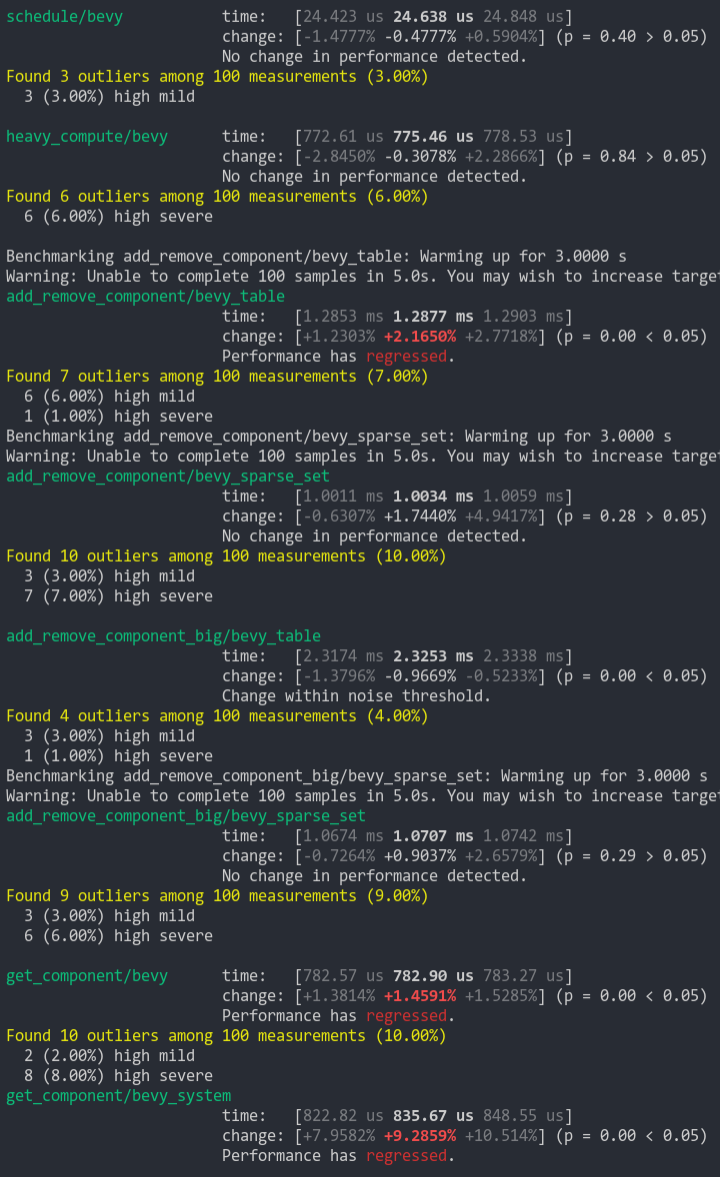
# Bevy ECS V2
This is a rewrite of Bevy ECS (basically everything but the new executor/schedule, which are already awesome). The overall goal was to improve the performance and versatility of Bevy ECS. Here is a quick bulleted list of changes before we dive into the details:
* Complete World rewrite
* Multiple component storage types:
* Tables: fast cache friendly iteration, slower add/removes (previously called Archetypes)
* Sparse Sets: fast add/remove, slower iteration
* Stateful Queries (caches query results for faster iteration. fragmented iteration is _fast_ now)
* Stateful System Params (caches expensive operations. inspired by @DJMcNab's work in #1364)
* Configurable System Params (users can set configuration when they construct their systems. once again inspired by @DJMcNab's work)
* Archetypes are now "just metadata", component storage is separate
* Archetype Graph (for faster archetype changes)
* Component Metadata
* Configure component storage type
* Retrieve information about component size/type/name/layout/send-ness/etc
* Components are uniquely identified by a densely packed ComponentId
* TypeIds are now totally optional (which should make implementing scripting easier)
* Super fast "for_each" query iterators
* Merged Resources into World. Resources are now just a special type of component
* EntityRef/EntityMut builder apis (more efficient and more ergonomic)
* Fast bitset-backed `Access<T>` replaces old hashmap-based approach everywhere
* Query conflicts are determined by component access instead of archetype component access (to avoid random failures at runtime)
* With/Without are still taken into account for conflicts, so this should still be comfy to use
* Much simpler `IntoSystem` impl
* Significantly reduced the amount of hashing throughout the ecs in favor of Sparse Sets (indexed by densely packed ArchetypeId, ComponentId, BundleId, and TableId)
* Safety Improvements
* Entity reservation uses a normal world reference instead of unsafe transmute
* QuerySets no longer transmute lifetimes
* Made traits "unsafe" where relevant
* More thorough safety docs
* WorldCell
* Exposes safe mutable access to multiple resources at a time in a World
* Replaced "catch all" `System::update_archetypes(world: &World)` with `System::new_archetype(archetype: &Archetype)`
* Simpler Bundle implementation
* Replaced slow "remove_bundle_one_by_one" used as fallback for Commands::remove_bundle with fast "remove_bundle_intersection"
* Removed `Mut<T>` query impl. it is better to only support one way: `&mut T`
* Removed with() from `Flags<T>` in favor of `Option<Flags<T>>`, which allows querying for flags to be "filtered" by default
* Components now have is_send property (currently only resources support non-send)
* More granular module organization
* New `RemovedComponents<T>` SystemParam that replaces `query.removed::<T>()`
* `world.resource_scope()` for mutable access to resources and world at the same time
* WorldQuery and QueryFilter traits unified. FilterFetch trait added to enable "short circuit" filtering. Auto impled for cases that don't need it
* Significantly slimmed down SystemState in favor of individual SystemParam state
* System Commands changed from `commands: &mut Commands` back to `mut commands: Commands` (to allow Commands to have a World reference)
Fixes#1320
## `World` Rewrite
This is a from-scratch rewrite of `World` that fills the niche that `hecs` used to. Yes, this means Bevy ECS is no longer a "fork" of hecs. We're going out our own!
(the only shared code between the projects is the entity id allocator, which is already basically ideal)
A huge shout out to @SanderMertens (author of [flecs](https://github.com/SanderMertens/flecs)) for sharing some great ideas with me (specifically hybrid ecs storage and archetype graphs). He also helped advise on a number of implementation details.
## Component Storage (The Problem)
Two ECS storage paradigms have gained a lot of traction over the years:
* **Archetypal ECS**:
* Stores components in "tables" with static schemas. Each "column" stores components of a given type. Each "row" is an entity.
* Each "archetype" has its own table. Adding/removing an entity's component changes the archetype.
* Enables super-fast Query iteration due to its cache-friendly data layout
* Comes at the cost of more expensive add/remove operations for an Entity's components, because all components need to be copied to the new archetype's "table"
* **Sparse Set ECS**:
* Stores components of the same type in densely packed arrays, which are sparsely indexed by densely packed unsigned integers (Entity ids)
* Query iteration is slower than Archetypal ECS because each entity's component could be at any position in the sparse set. This "random access" pattern isn't cache friendly. Additionally, there is an extra layer of indirection because you must first map the entity id to an index in the component array.
* Adding/removing components is a cheap, constant time operation
Bevy ECS V1, hecs, legion, flec, and Unity DOTS are all "archetypal ecs-es". I personally think "archetypal" storage is a good default for game engines. An entity's archetype doesn't need to change frequently in general, and it creates "fast by default" query iteration (which is a much more common operation). It is also "self optimizing". Users don't need to think about optimizing component layouts for iteration performance. It "just works" without any extra boilerplate.
Shipyard and EnTT are "sparse set ecs-es". They employ "packing" as a way to work around the "suboptimal by default" iteration performance for specific sets of components. This helps, but I didn't think this was a good choice for a general purpose engine like Bevy because:
1. "packs" conflict with each other. If bevy decides to internally pack the Transform and GlobalTransform components, users are then blocked if they want to pack some custom component with Transform.
2. users need to take manual action to optimize
Developers selecting an ECS framework are stuck with a hard choice. Select an "archetypal" framework with "fast iteration everywhere" but without the ability to cheaply add/remove components, or select a "sparse set" framework to cheaply add/remove components but with slower iteration performance.
## Hybrid Component Storage (The Solution)
In Bevy ECS V2, we get to have our cake and eat it too. It now has _both_ of the component storage types above (and more can be added later if needed):
* **Tables** (aka "archetypal" storage)
* The default storage. If you don't configure anything, this is what you get
* Fast iteration by default
* Slower add/remove operations
* **Sparse Sets**
* Opt-in
* Slower iteration
* Faster add/remove operations
These storage types complement each other perfectly. By default Query iteration is fast. If developers know that they want to add/remove a component at high frequencies, they can set the storage to "sparse set":
```rust
world.register_component(
ComponentDescriptor:🆕:<MyComponent>(StorageType::SparseSet)
).unwrap();
```
## Archetypes
Archetypes are now "just metadata" ... they no longer store components directly. They do store:
* The `ComponentId`s of each of the Archetype's components (and that component's storage type)
* Archetypes are uniquely defined by their component layouts
* For example: entities with "table" components `[A, B, C]` _and_ "sparse set" components `[D, E]` will always be in the same archetype.
* The `TableId` associated with the archetype
* For now each archetype has exactly one table (which can have no components),
* There is a 1->Many relationship from Tables->Archetypes. A given table could have any number of archetype components stored in it:
* Ex: an entity with "table storage" components `[A, B, C]` and "sparse set" components `[D, E]` will share the same `[A, B, C]` table as an entity with `[A, B, C]` table component and `[F]` sparse set components.
* This 1->Many relationship is how we preserve fast "cache friendly" iteration performance when possible (more on this later)
* A list of entities that are in the archetype and the row id of the table they are in
* ArchetypeComponentIds
* unique densely packed identifiers for (ArchetypeId, ComponentId) pairs
* used by the schedule executor for cheap system access control
* "Archetype Graph Edges" (see the next section)
## The "Archetype Graph"
Archetype changes in Bevy (and a number of other archetypal ecs-es) have historically been expensive to compute. First, you need to allocate a new vector of the entity's current component ids, add or remove components based on the operation performed, sort it (to ensure it is order-independent), then hash it to find the archetype (if it exists). And thats all before we get to the _already_ expensive full copy of all components to the new table storage.
The solution is to build a "graph" of archetypes to cache these results. @SanderMertens first exposed me to the idea (and he got it from @gjroelofs, who came up with it). They propose adding directed edges between archetypes for add/remove component operations. If `ComponentId`s are densely packed, you can use sparse sets to cheaply jump between archetypes.
Bevy takes this one step further by using add/remove `Bundle` edges instead of `Component` edges. Bevy encourages the use of `Bundles` to group add/remove operations. This is largely for "clearer game logic" reasons, but it also helps cut down on the number of archetype changes required. `Bundles` now also have densely-packed `BundleId`s. This allows us to use a _single_ edge for each bundle operation (rather than needing to traverse N edges ... one for each component). Single component operations are also bundles, so this is strictly an improvement over a "component only" graph.
As a result, an operation that used to be _heavy_ (both for allocations and compute) is now two dirt-cheap array lookups and zero allocations.
## Stateful Queries
World queries are now stateful. This allows us to:
1. Cache archetype (and table) matches
* This resolves another issue with (naive) archetypal ECS: query performance getting worse as the number of archetypes goes up (and fragmentation occurs).
2. Cache Fetch and Filter state
* The expensive parts of fetch/filter operations (such as hashing the TypeId to find the ComponentId) now only happen once when the Query is first constructed
3. Incrementally build up state
* When new archetypes are added, we only process the new archetypes (no need to rebuild state for old archetypes)
As a result, the direct `World` query api now looks like this:
```rust
let mut query = world.query::<(&A, &mut B)>();
for (a, mut b) in query.iter_mut(&mut world) {
}
```
Requiring `World` to generate stateful queries (rather than letting the `QueryState` type be constructed separately) allows us to ensure that _all_ queries are properly initialized (and the relevant world state, such as ComponentIds). This enables QueryState to remove branches from its operations that check for initialization status (and also enables query.iter() to take an immutable world reference because it doesn't need to initialize anything in world).
However in systems, this is a non-breaking change. State management is done internally by the relevant SystemParam.
## Stateful SystemParams
Like Queries, `SystemParams` now also cache state. For example, `Query` system params store the "stateful query" state mentioned above. Commands store their internal `CommandQueue`. This means you can now safely use as many separate `Commands` parameters in your system as you want. `Local<T>` system params store their `T` value in their state (instead of in Resources).
SystemParam state also enabled a significant slim-down of SystemState. It is much nicer to look at now.
Per-SystemParam state naturally insulates us from an "aliased mut" class of errors we have hit in the past (ex: using multiple `Commands` system params).
(credit goes to @DJMcNab for the initial idea and draft pr here #1364)
## Configurable SystemParams
@DJMcNab also had the great idea to make SystemParams configurable. This allows users to provide some initial configuration / values for system parameters (when possible). Most SystemParams have no config (the config type is `()`), but the `Local<T>` param now supports user-provided parameters:
```rust
fn foo(value: Local<usize>) {
}
app.add_system(foo.system().config(|c| c.0 = Some(10)));
```
## Uber Fast "for_each" Query Iterators
Developers now have the choice to use a fast "for_each" iterator, which yields ~1.5-3x iteration speed improvements for "fragmented iteration", and minor ~1.2x iteration speed improvements for unfragmented iteration.
```rust
fn system(query: Query<(&A, &mut B)>) {
// you now have the option to do this for a speed boost
query.for_each_mut(|(a, mut b)| {
});
// however normal iterators are still available
for (a, mut b) in query.iter_mut() {
}
}
```
I think in most cases we should continue to encourage "normal" iterators as they are more flexible and more "rust idiomatic". But when that extra "oomf" is needed, it makes sense to use `for_each`.
We should also consider using `for_each` for internal bevy systems to give our users a nice speed boost (but that should be a separate pr).
## Component Metadata
`World` now has a `Components` collection, which is accessible via `world.components()`. This stores mappings from `ComponentId` to `ComponentInfo`, as well as `TypeId` to `ComponentId` mappings (where relevant). `ComponentInfo` stores information about the component, such as ComponentId, TypeId, memory layout, send-ness (currently limited to resources), and storage type.
## Significantly Cheaper `Access<T>`
We used to use `TypeAccess<TypeId>` to manage read/write component/archetype-component access. This was expensive because TypeIds must be hashed and compared individually. The parallel executor got around this by "condensing" type ids into bitset-backed access types. This worked, but it had to be re-generated from the `TypeAccess<TypeId>`sources every time archetypes changed.
This pr removes TypeAccess in favor of faster bitset access everywhere. We can do this thanks to the move to densely packed `ComponentId`s and `ArchetypeComponentId`s.
## Merged Resources into World
Resources had a lot of redundant functionality with Components. They stored typed data, they had access control, they had unique ids, they were queryable via SystemParams, etc. In fact the _only_ major difference between them was that they were unique (and didn't correlate to an entity).
Separate resources also had the downside of requiring a separate set of access controls, which meant the parallel executor needed to compare more bitsets per system and manage more state.
I initially got the "separate resources" idea from `legion`. I think that design was motivated by the fact that it made the direct world query/resource lifetime interactions more manageable. It certainly made our lives easier when using Resources alongside hecs/bevy_ecs. However we already have a construct for safely and ergonomically managing in-world lifetimes: systems (which use `Access<T>` internally).
This pr merges Resources into World:
```rust
world.insert_resource(1);
world.insert_resource(2.0);
let a = world.get_resource::<i32>().unwrap();
let mut b = world.get_resource_mut::<f64>().unwrap();
*b = 3.0;
```
Resources are now just a special kind of component. They have their own ComponentIds (and their own resource TypeId->ComponentId scope, so they don't conflict wit components of the same type). They are stored in a special "resource archetype", which stores components inside the archetype using a new `unique_components` sparse set (note that this sparse set could later be used to implement Tags). This allows us to keep the code size small by reusing existing datastructures (namely Column, Archetype, ComponentFlags, and ComponentInfo). This allows us the executor to use a single `Access<ArchetypeComponentId>` per system. It should also make scripting language integration easier.
_But_ this merge did create problems for people directly interacting with `World`. What if you need mutable access to multiple resources at the same time? `world.get_resource_mut()` borrows World mutably!
## WorldCell
WorldCell applies the `Access<ArchetypeComponentId>` concept to direct world access:
```rust
let world_cell = world.cell();
let a = world_cell.get_resource_mut::<i32>().unwrap();
let b = world_cell.get_resource_mut::<f64>().unwrap();
```
This adds cheap runtime checks (a sparse set lookup of `ArchetypeComponentId` and a counter) to ensure that world accesses do not conflict with each other. Each operation returns a `WorldBorrow<'w, T>` or `WorldBorrowMut<'w, T>` wrapper type, which will release the relevant ArchetypeComponentId resources when dropped.
World caches the access sparse set (and only one cell can exist at a time), so `world.cell()` is a cheap operation.
WorldCell does _not_ use atomic operations. It is non-send, does a mutable borrow of world to prevent other accesses, and uses a simple `Rc<RefCell<ArchetypeComponentAccess>>` wrapper in each WorldBorrow pointer.
The api is currently limited to resource access, but it can and should be extended to queries / entity component access.
## Resource Scopes
WorldCell does not yet support component queries, and even when it does there are sometimes legitimate reasons to want a mutable world ref _and_ a mutable resource ref (ex: bevy_render and bevy_scene both need this). In these cases we could always drop down to the unsafe `world.get_resource_unchecked_mut()`, but that is not ideal!
Instead developers can use a "resource scope"
```rust
world.resource_scope(|world: &mut World, a: &mut A| {
})
```
This temporarily removes the `A` resource from `World`, provides mutable pointers to both, and re-adds A to World when finished. Thanks to the move to ComponentIds/sparse sets, this is a cheap operation.
If multiple resources are required, scopes can be nested. We could also consider adding a "resource tuple" to the api if this pattern becomes common and the boilerplate gets nasty.
## Query Conflicts Use ComponentId Instead of ArchetypeComponentId
For safety reasons, systems cannot contain queries that conflict with each other without wrapping them in a QuerySet. On bevy `main`, we use ArchetypeComponentIds to determine conflicts. This is nice because it can take into account filters:
```rust
// these queries will never conflict due to their filters
fn filter_system(a: Query<&mut A, With<B>>, b: Query<&mut B, Without<B>>) {
}
```
But it also has a significant downside:
```rust
// these queries will not conflict _until_ an entity with A, B, and C is spawned
fn maybe_conflicts_system(a: Query<(&mut A, &C)>, b: Query<(&mut A, &B)>) {
}
```
The system above will panic at runtime if an entity with A, B, and C is spawned. This makes it hard to trust that your game logic will run without crashing.
In this pr, I switched to using `ComponentId` instead. This _is_ more constraining. `maybe_conflicts_system` will now always fail, but it will do it consistently at startup. Naively, it would also _disallow_ `filter_system`, which would be a significant downgrade in usability. Bevy has a number of internal systems that rely on disjoint queries and I expect it to be a common pattern in userspace.
To resolve this, I added a new `FilteredAccess<T>` type, which wraps `Access<T>` and adds with/without filters. If two `FilteredAccess` have with/without values that prove they are disjoint, they will no longer conflict.
## EntityRef / EntityMut
World entity operations on `main` require that the user passes in an `entity` id to each operation:
```rust
let entity = world.spawn((A, )); // create a new entity with A
world.get::<A>(entity);
world.insert(entity, (B, C));
world.insert_one(entity, D);
```
This means that each operation needs to look up the entity location / verify its validity. The initial spawn operation also requires a Bundle as input. This can be awkward when no components are required (or one component is required).
These operations have been replaced by `EntityRef` and `EntityMut`, which are "builder-style" wrappers around world that provide read and read/write operations on a single, pre-validated entity:
```rust
// spawn now takes no inputs and returns an EntityMut
let entity = world.spawn()
.insert(A) // insert a single component into the entity
.insert_bundle((B, C)) // insert a bundle of components into the entity
.id() // id returns the Entity id
// Returns EntityMut (or panics if the entity does not exist)
world.entity_mut(entity)
.insert(D)
.insert_bundle(SomeBundle::default());
{
// returns EntityRef (or panics if the entity does not exist)
let d = world.entity(entity)
.get::<D>() // gets the D component
.unwrap();
// world.get still exists for ergonomics
let d = world.get::<D>(entity).unwrap();
}
// These variants return Options if you want to check existence instead of panicing
world.get_entity_mut(entity)
.unwrap()
.insert(E);
if let Some(entity_ref) = world.get_entity(entity) {
let d = entity_ref.get::<D>().unwrap();
}
```
This _does not_ affect the current Commands api or terminology. I think that should be a separate conversation as that is a much larger breaking change.
## Safety Improvements
* Entity reservation in Commands uses a normal world borrow instead of an unsafe transmute
* QuerySets no longer transmutes lifetimes
* Made traits "unsafe" when implementing a trait incorrectly could cause unsafety
* More thorough safety docs
## RemovedComponents SystemParam
The old approach to querying removed components: `query.removed:<T>()` was confusing because it had no connection to the query itself. I replaced it with the following, which is both clearer and allows us to cache the ComponentId mapping in the SystemParamState:
```rust
fn system(removed: RemovedComponents<T>) {
for entity in removed.iter() {
}
}
```
## Simpler Bundle implementation
Bundles are no longer responsible for sorting (or deduping) TypeInfo. They are just a simple ordered list of component types / data. This makes the implementation smaller and opens the door to an easy "nested bundle" implementation in the future (which i might even add in this pr). Duplicate detection is now done once per bundle type by World the first time a bundle is used.
## Unified WorldQuery and QueryFilter types
(don't worry they are still separate type _parameters_ in Queries .. this is a non-breaking change)
WorldQuery and QueryFilter were already basically identical apis. With the addition of `FetchState` and more storage-specific fetch methods, the overlap was even clearer (and the redundancy more painful).
QueryFilters are now just `F: WorldQuery where F::Fetch: FilterFetch`. FilterFetch requires `Fetch<Item = bool>` and adds new "short circuit" variants of fetch methods. This enables a filter tuple like `(With<A>, Without<B>, Changed<C>)` to stop evaluating the filter after the first mismatch is encountered. FilterFetch is automatically implemented for `Fetch` implementations that return bool.
This forces fetch implementations that return things like `(bool, bool, bool)` (such as the filter above) to manually implement FilterFetch and decide whether or not to short-circuit.
## More Granular Modules
World no longer globs all of the internal modules together. It now exports `core`, `system`, and `schedule` separately. I'm also considering exporting `core` submodules directly as that is still pretty "glob-ey" and unorganized (feedback welcome here).
## Remaining Draft Work (to be done in this pr)
* ~~panic on conflicting WorldQuery fetches (&A, &mut A)~~
* ~~bevy `main` and hecs both currently allow this, but we should protect against it if possible~~
* ~~batch_iter / par_iter (currently stubbed out)~~
* ~~ChangedRes~~
* ~~I skipped this while we sort out #1313. This pr should be adapted to account for whatever we land on there~~.
* ~~The `Archetypes` and `Tables` collections use hashes of sorted lists of component ids to uniquely identify each archetype/table. This hash is then used as the key in a HashMap to look up the relevant ArchetypeId or TableId. (which doesn't handle hash collisions properly)~~
* ~~It is currently unsafe to generate a Query from "World A", then use it on "World B" (despite the api claiming it is safe). We should probably close this gap. This could be done by adding a randomly generated WorldId to each world, then storing that id in each Query. They could then be compared to each other on each `query.do_thing(&world)` operation. This _does_ add an extra branch to each query operation, so I'm open to other suggestions if people have them.~~
* ~~Nested Bundles (if i find time)~~
## Potential Future Work
* Expand WorldCell to support queries.
* Consider not allocating in the empty archetype on `world.spawn()`
* ex: return something like EntityMutUninit, which turns into EntityMut after an `insert` or `insert_bundle` op
* this actually regressed performance last time i tried it, but in theory it should be faster
* Optimize SparseSet::insert (see `PERF` comment on insert)
* Replace SparseArray `Option<T>` with T::MAX to cut down on branching
* would enable cheaper get_unchecked() operations
* upstream fixedbitset optimizations
* fixedbitset could be allocation free for small block counts (store blocks in a SmallVec)
* fixedbitset could have a const constructor
* Consider implementing Tags (archetype-specific by-value data that affects archetype identity)
* ex: ArchetypeA could have `[A, B, C]` table components and `[D(1)]` "tag" component. ArchetypeB could have `[A, B, C]` table components and a `[D(2)]` tag component. The archetypes are different, despite both having D tags because the value inside D is different.
* this could potentially build on top of the `archetype.unique_components` added in this pr for resource storage.
* Consider reverting `all_tuples` proc macro in favor of the old `macro_rules` implementation
* all_tuples is more flexible and produces cleaner documentation (the macro_rules version produces weird type parameter orders due to parser constraints)
* but unfortunately all_tuples also appears to make Rust Analyzer sad/slow when working inside of `bevy_ecs` (does not affect user code)
* Consider "resource queries" and/or "mixed resource and entity component queries" as an alternative to WorldCell
* this is basically just "systems" so maybe it's not worth it
* Add more world ops
* `world.clear()`
* `world.reserve<T: Bundle>(count: usize)`
* Try using the old archetype allocation strategy (allocate new memory on resize and copy everything over). I expect this to improve batch insertion performance at the cost of unbatched performance. But thats just a guess. I'm not an allocation perf pro :)
* Adapt Commands apis for consistency with new World apis
## Benchmarks
key:
* `bevy_old`: bevy `main` branch
* `bevy`: this branch
* `_foreach`: uses an optimized for_each iterator
* ` _sparse`: uses sparse set storage (if unspecified assume table storage)
* `_system`: runs inside a system (if unspecified assume test happens via direct world ops)
### Simple Insert (from ecs_bench_suite)
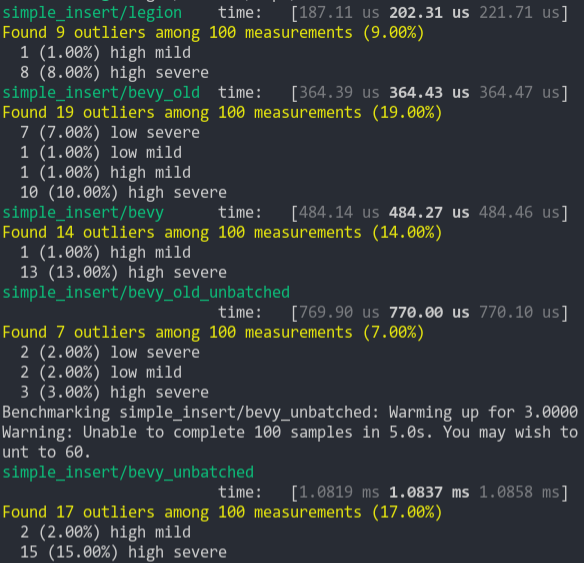
### Simpler Iter (from ecs_bench_suite)
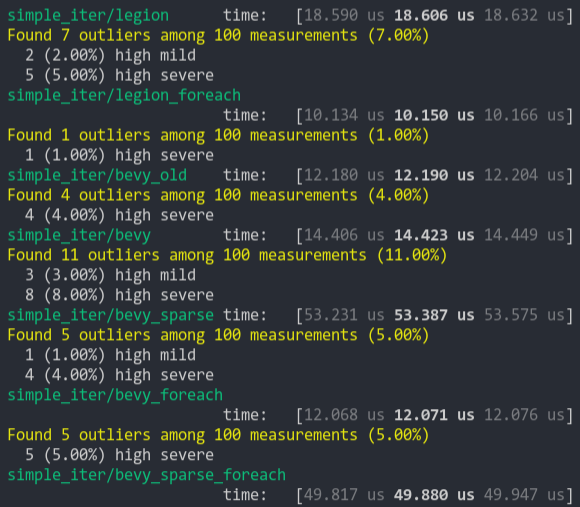
### Fragment Iter (from ecs_bench_suite)
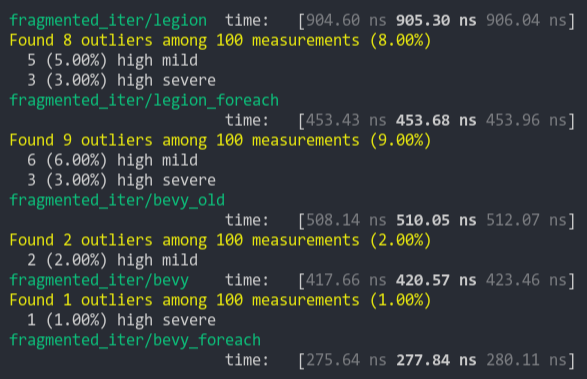
### Sparse Fragmented Iter
Iterate a query that matches 5 entities from a single matching archetype, but there are 100 unmatching archetypes
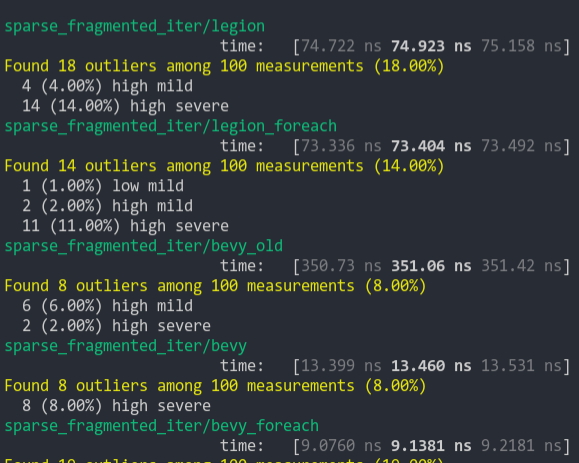
### Schedule (from ecs_bench_suite)
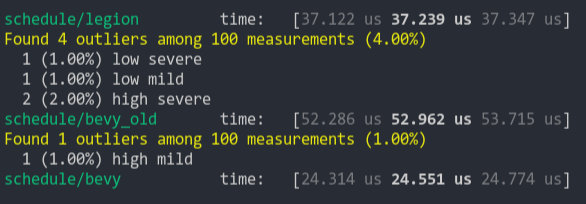
### Add Remove Component (from ecs_bench_suite)
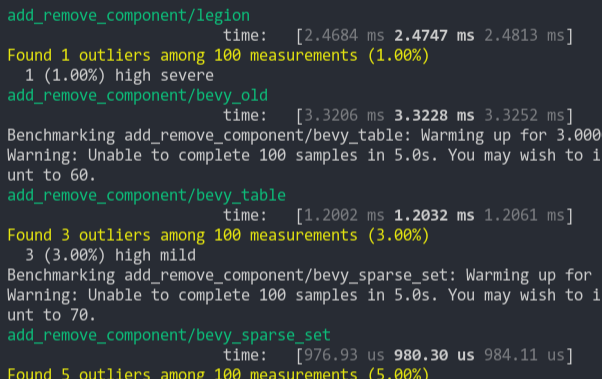
### Add Remove Component Big
Same as the test above, but each entity has 5 "large" matrix components and 1 "large" matrix component is added and removed
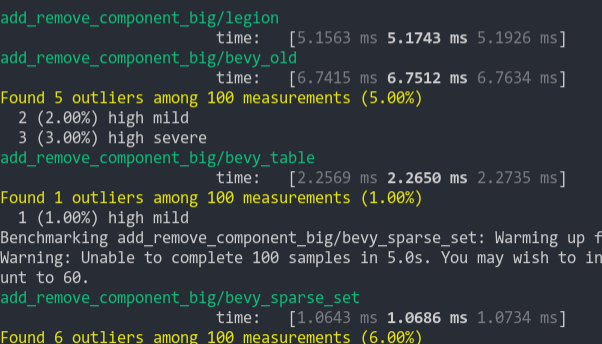
### Get Component
Looks up a single component value a large number of times